

Scheme 1.
Synthesis pathway of Ligand


The design and synthesis of oligomeric or polymeric complexes by using neutral coordination complexes held together by additional donor molecules or secondary bonding interactions are acquiring increasing importance in the field of crystal engineering[1-5]. The development of coordination polymer chemistry has given rise to many remarkable inorganic architectures through the self-assembly of suitable polydentate ligands with metal ions or unsaturated metal complexes[6-8]. The design of the ligand is crucial for this purpose, since the dimensionality and topology of the final assemblies are predominantly controlled by the coordination preferences of the metal center and the location of donor sites in the ligand[9-13]. Recently, there have been a relatively large number of nickel(Ⅱ), zinc(Ⅱ) and cadmium(Ⅱ) complexes formed with bridging bipyridine ligands[14-17]. The formation, e.g. monomeric, dimeric and polymeric, and topology when polymers are formed of these adducts are varied, e.g. straight chain, zig-zag, step-ladder, etc. Up to date, there has been neither concerted nor systematic study directed towards ascertaining the principles of polymer topology in these adducts[18-20]. It has been demonstrated that steric effects are not as dominant in controlling polymer formation in these systems, but the ligand substitution patterns as well as steric effects can be exploited to good effect, in certain circumstances, to control the topology of the resultant polymers. DBPMF is a good bridge-ligand which can bridge two metals to form coordination polymers like 4, 4΄-bibydrine. To the best of our knowledge, using DBPMF as ligand to synthesize polymers is rarely reported. Here, a new polymeric structure of a nickel(Ⅱ) xanthogenate adduct was determined through X-ray crystal structure analysis, [Ni(S2COiBu)2(DBPMF)·(CHCl3)] in zig-zag topology. Herein we wish to report the synthesis, crystal structure, fluorescence and thermal stability of this polymer.
All manipulations were carried out in air. All solvents, nickel sulfate and sodium hydroxide were purchased from National Chemical Reagents Company (Shanghai, China) and used as supplied.
Elemental analyses for carbon, hydrogen and nitrogen were performed by a Perkin-Elmer 240C elemental instrument. The melting points were determined on a Yanaco MP-500 melting point apparatus. Thermal analysis was recorded on a Shimadzu TGA-50 thermogravimetric analyzer. 1H NMR spectra (DMSO-d6) were recorded on Avance Mercury plus-400 instrument with TMS as an internal standard. Infrared spectra were recorded on a Nicolet 170SX spectrometer. Fluorescence spectra were recorded on an F96 Fluorescence Spectrophotometer.
The ligand synthetic path is shown in Scheme 1. 2, 7-Dibromo fluorene (0.01 mol, 3.24 g), 4-chlorine methyl pyridine hydrochloride (0.025 mol, 4.1 g) and KI (0.2 g) were mixed in DMSO (30 mL) under stirring at room temperature. After a while, the solution in the round-bottomed flask turns yellow. Then KOH powder (0.08 mol, 4.5 g) was added to the resulting mixture. The solution turned red first and became brown gradually. After the reaction was finished in 5 hours and the solution was poured into water, blue solid precipitate was found. The solid was filtrated and washed with 30 mL of ethanol in the suction filter, then dried, obtaining the product DBPMF (4.6 g) in 90.9% yield. m. p.: 221.8~223.6 ℃. Anal. Calcd. found (%): C, 60.06 (59.31); H, 3.36 (3.58); N, 5.43 (5.53). 1H NMR (400Hz, DMSO): δ1 8.224~8.058 (m, 4H), 7.492~7.402 (m, 6H), 6.490~6.475 (m, 4H), 3.600(s, 4H); IR ν 3329 (vs), 3106 (vs), 1573 (vs), 1466 (vs), 1371 (vs), 1327 (s), 1283 (vs), 1264 (s), 1195 (vs), 1028 (s), 963 (w), 762 (w), 693.17 (m) cm-1.
Carbon disulfide (0.004 mol, 105 ml) and sodium hydroxide (0.004 mol, 0.16 g, 50% aqueous solution) were added to a stirred solution of isobutanol (0.004 mol, 0.37 ml). After stirring for 2~3 hours, the volatile was evaporated without heating. The pure Na(iBuOCS2) was obtained by recrystallization from ethanol. Then, the heated aqueous solution of Na(iBuOCS2) was added into an EtOH (30 ml) solution of Ni(ClO4)2 (0.002 mol, 0.73 g) with stirring. A deep green precipitate was deposited. Upon collection by filtration, the deposit was washed with water and dried over P4O10, obtaining the solid [Ni(S2COiBu)2].
The [Ni(S2COiBu)2] (0.00056 mol, 0.2 g) with a 1:1 stoichiometric amount of 2, 7-dibromo-9, 9-(4-pyridylmethyl) (0.00056 mol, 0.28 g) fluorene ligand were added in CHCl3 solution (30 mL), and then the mixture solution was refluxed for 2 hours. After that, the solvent was removed in vacuo and the residue recrystallized by slow evaporation from chloroform/acetonitrile (3/1) solution of the compound to yield the crystals suitable for single-crystal X-ray analysis.
The diffraction data were collected on a Enraf-Nonius CAD-4 diffractometer with graphite-monchromated Mo-Kα radiation (λ = 0.71073 Å and T = 293 K). The technique used was ω-scan with limits 1.60º to 25.00º. Empirical absorption correction was carried out by using the SADABS program. The structure of the title compound was solved by direct methods and refined by least-squares on F2 by using the SHELXTL software package[21]. All non-hydrogen atoms were anisotropically refined. The hydrogen atom positions were fixed geometrically at the calculated distances and allowed to ride on the parent carbon atoms. Crystal structure of the title complex crystallizes in monoclinic system, space group P21/c with a = 12.947(3), b = 17.419(3), c = 20.761(7) Å, V = 4232.3(19) Å3, Mr = 982.80, Z = 4, Dc = 1.542 Mg/m3, μ = 2.767 mm-1, F(000) = 1984, GOOF = 1.045, R = 0.0621, wR = 0.1596 (w = 1/[σ2(Fo2) + (0.1000P)2 + 0.0000P], where P = (Fo2 + 2Fc2)/3). Atomic scattering factors and anomalous dispersion corrections were taken from International Tables for X-ray Crystallography.
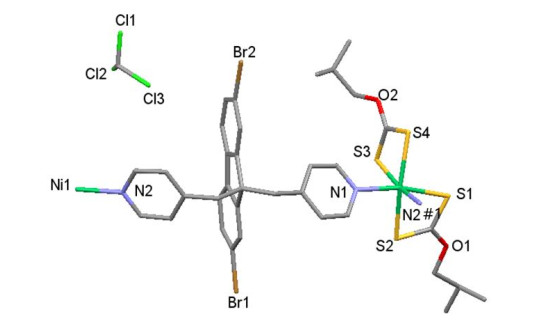
X-ray crystal structural analysis indicates that the repeat unit of the title compound contains Ni(S2COiBu)2, DBPMF molecule, and a lattice CHCl3 (Fig. 1). The central nickel(Ⅱ) atom connected with four S atoms on two isobutyl xanthate ligands and two N atoms on the DBPMF ligand adopts a slightly distorted six-coordinated octahedral geometry. The xanthogenate ligand coordinates to the nickel center, forming essentially equivalent Ni–S bond distances averaged by 2.454 Å; Two Ni–N (pyridine) bond lengths are 2.115(6) and 2.139(7), respectively, which are longer than those in other reported Ni(Ⅱ) complexes. The N(1)–Ni–N(2) bond angle of 86.82° is similar to the reported value[22]. All of the bond lengths and bond angles in DBPMF fall in normal ranges[23]. Selected bond lengths and bond angles are shown in Table 1.

 DownLoad:
CSV
DownLoad:
CSV
| Bond | Dist. | Bond | Dist. | Bond | Dist. | ||
| Ni(1)–N(2)#1 | 2.115(6) | Ni(1)–S(3) | 2.458(2) | O(1)–C(5) | 1.336(10) | ||
| Ni(1)–N(1) | 2.139(7) | Ni(1)–S(2) | 2.458(2) | N(1)–C(15) | 1.332(10) | ||
| Ni(1)–S(4) | 2.449(2) | S(1)–C(5) | 1.674(9) | ||||
| Ni(1)–S(1) | 2.450(3) | Br(1)–C(33) | 1.884(9) | ||||
| Angle | (°) | Angle | (°) | Angle | (°) | ||
| N(2)#1–Ni(1)–N(1) | 86.8(2) | S(4)–Ni(1)–S(1) | 95.26(8) | N(1)–Ni(1)–S(2) | 96.56(17) | ||
| N(2)#1–Ni(1)–S(4) | 96.78(17) | N(2)#1–Ni(1)–S(3) | 168.92(18) | S(4)–Ni(1)–S(2) | 161.86(9) | ||
| N(1)–Ni(1)–S(4) | 95.69(17) | N(1)–Ni(1)–S(3) | 90.85(17) | S(1)–Ni(1)–S(2) | 72.72(8) | ||
| N(2)#1–Ni(1)–S(1) | 92.20(19) | S(4)–Ni(1)–S(3) | 72.65(7) | S(3)–Ni(1)–S(2) | 93.82(8) | ||
| N(1)–Ni(1)–S(1) | 169.04(17) | N(2)#1–Ni(1)–S(2) | 97.21(18) | ||||
| Symmetry transformations used to generate the equivalent atoms: #1: –x, y–1/2, –z–1/2 | |||||||
There are many types of intramolecular and intermolecular hydrogen bonds, potential weak C–H⋅⋅⋅Br and C–H⋅⋅⋅S intermolecular interactions (Table 2), which stabilize the molecular structure.
DownLoad:
CSV
| D–H···A | d(D–H) | d(H···A) | d(D···A) | ∠DHA | Symmetry codes |
| C(8)–H(8)···S(2) | 0.98 | 2.84 | 3.694(1) | 146 | –x, –y, –1 – z |
| C(10)–H(10A)···S(3) | 0.96 | 2.82 | 3.603(1) | 139 | –x, –y, –1 –z |
| C(10)–H(10C)···Br(1) | 0.96 | 3.00 | 3.816(1) | 144 | –1 + x, y, z |
| C(16)–H(16A)···S(1) | 0.97 | 2.88 | 3.8275(1) | 165 | –x, –y, –1/2 + z |
| C(32)–H(32)···S(1) | 0.93 | 2.94 | 3.849(8) | 165 | x, –1/2 –y, –1/2 + z |
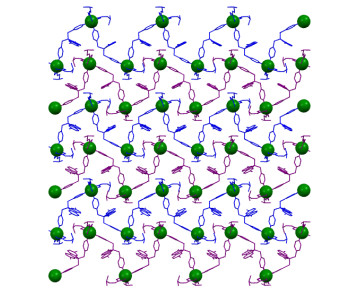
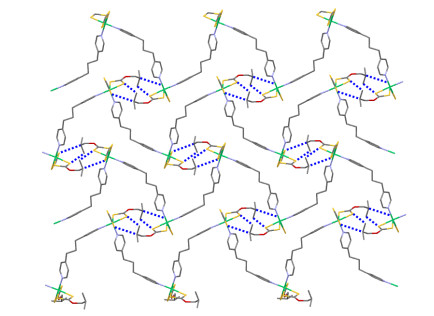
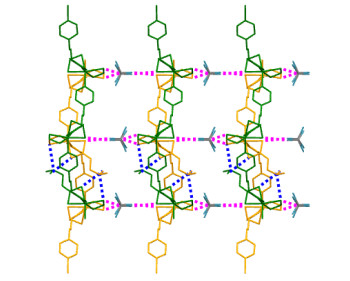
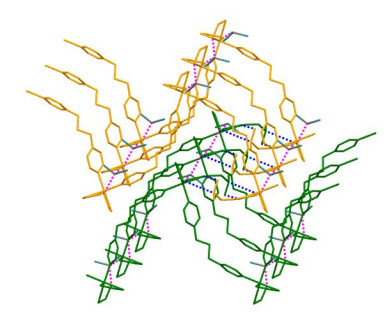
The most notable structure feature of the title compound is that the ligand molecule (DBPMF) is a bipyridine ligand with V-type structure. The [Ni(S2COiBu)2] unit was connected with the dipyridyl ligand (DBPMF) to form an infinite one-dimensional structure of zig-zag chain (Fig. 2). The hydrogen bonds of C(8)–H⋅⋅⋅S(2) and C(10)–H⋅⋅⋅S(3) link the two zig-zag chains to form 2-dimensional networks (Fig. 3) which are accumulated through the hydrogen bonding of CHCl3 in an overlapping way along the b-axis (Fig. 4), thus expending this complex into a three-dimensional structure (Fig. 5).
Based on the aforementioned experimental results, it can be deduced that if the Ni(Ⅱ) ion is replaced by Co(Ⅱ), Fe(Ⅱ), Fe(Ⅲ) or Cu(Ⅱ) ion, similar coordination polymers should be obtained. In our research group, these investigations are in progress.
Fluorescence spectra of the title compound in CHCl3 solution are shown in Fig. 6. With the excitation wavelength at λ = 350 nm, the scanning range is from 350 to 700 nm. A broad emission band with the maximum intensity at λ = 413 nm might be the π-π* transition in ligands (DBPMF). Or, after the addition of [Ni(S2COiBu)2] with DBPMF to form the polymer, the rigidity and conjugation of the system are enhanced. In addition, the polymer features the infinite structure of 1D chain, and the energy transfer continuity in the system can be realized.
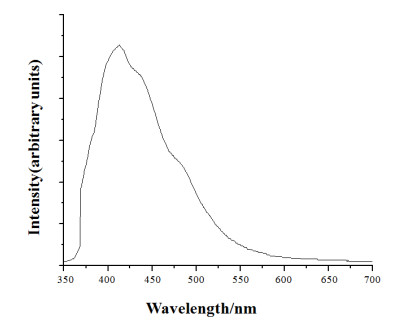
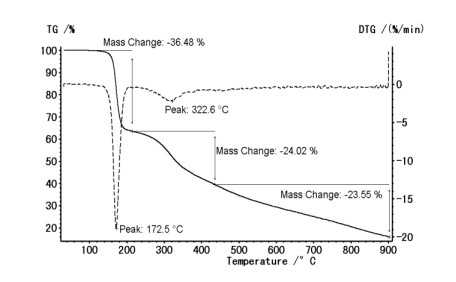
Fig. 7 gives the thermal analysis curve of the title compound. In Fig. 4, there are mainly two exothermal peaks. One is a sharp peak at 172.5 ℃ and another is 322.6 ℃. The title compound exhibits the first weight loss (36.48%) at 140~240 ℃, which is approximately corresponding to the removal of one CHCl3 molecule, two iBu molecules, two oxygen atoms and one picoline (calcd. 36.30%). The second weight loss (47.57%) occurs at 240~880 ℃, which is attributed to the departure of one carbon disulfide molecule and the rest of DBPMF molecule (calcd. 49.98%). The residue may be NiCS2 (calcd. 13.72%).
In conclusion, we have synthesized a new polymer structure by using a new bridging ligand DBPMF to react with nickel xanthate, and characterized the structure by X-ray crystallography. An infinite one-dimensional structure of zig-zag chain was formed, and the hydrogen bond and intermolecular interaction finally make the structure a three-dimensional supramolecular framework. It can be seen from the fluorescence data that combining the [Ni(S2COiBu)2] molecule with DBPMF ligand forms the polymer, and the rigidity and conjugation of the system are enhanced. The thermogravimetric data show that CHCl3 can exist stably in the molecular pores through intermolecular force. This discovery is beneficial to the research and development of porous materials in the future.
Zhao, H. K.; Yang, H. K.; Wang, X. G.; Ding, B.; Liu, Z. Y.; Zhao, X. J.; Yang, E. C. An unusual 2D polymeric Co(II) complex with 2, 6-diaminopurine: synthesis, crystal structure, and magnetic behavior. Inorg. Chem. Commun. 2019, 107, 107483. doi: 10.1016/j.inoche.2019.107483
Wu, J. Y.; Yuan, P. T.; Hsiao, C. C.; Chang, H. K.; Liu, Y. C.; Hsu, L. J.; Chiang, M. H. Structural diversity in polymeric and discrete complexes constructed by divalent transition metals and unsymmetrical quasi semirigid pyridinecarboxylate isomers. J. Solid State Chem. 2019, 277, 701‒712. doi: 10.1016/j.jssc.2019.07.033
Banasz, R.; Walesa-Chorab, M. Polymeric complexes of transition metal ions as electrochromic materials: synthesis and properties. Coord. Chem. Rev. 2019, 389, 1‒18. doi: 10.1016/j.ccr.2019.03.009
Zheng, X. Z.; Huang, J. S.; Yao, Y. M.; Xu, X. Stoichiometric reactions and catalytic dehydrogenations of amine-boranes with calcium aryloxide. Chem. Commun. 2019, 62, 9152‒9155.
Lu, S. Q.; Fang, K.; Liu, Y. Y.; Li, M. X.; Liu, S. J.; He, X. Multivariant synthesis, crystal structures and properties of four nickel coordination polymers based on flexible ligands. CrystEngComm. 2018, 34, 5045‒5055.
Eichhofer, A.; Buth, G. 1-D polymeric iron(II) thiolato complexes: synthesis, structure, and properties of ∞1[Fe(SR)2] (R = Ph, Mes), ∞1[Fe(NH3)(SPh)(µ-SPh)] and ∞1[(µ-SPh)Fe(NH3)2(µ-SPh)2Fe(µ-SPh)]. Eur. J. Inorg. Chem. 2019, 5, 639‒646.
Mahmoudi, H.; Valentini, F.; Ferlin, F.; Bivona, L. A.; Anastasiou, I.; Fusaro, L.; Aprile, C.; Marrocchi, A.; Vaccaro, L. A tailored polymeric cationic tag-anionic Pd(II) complex as a catalyst for the low-leaching Heck-Mizoroki coupling in flow and in biomass-derived GVL. Green Chem. 2019, 21, 355‒360. doi: 10.1039/C8GC03228A
Proetto, M. T.; Sanning, J.; Peterlechner, M.; Thunemann, M.; Stegemann, L.; Sadegh, S.; Devor, A.; Gianneschi, N. C.; Strassert, C. A. Phosphorescent Pt(II) complexes spatially arrayed in micellar polymeric nanoparticles providing dual readout for multimodal imaging. Chem. Commun. 2019, 55, 501‒504. doi: 10.1039/C8CC06347H
Blake, A. J.; Champness, N. R.; Hubberstey, P.; Li, W. S.; Withersby, M. A.; Schroder, M. Inorganic crystal engineering using self-assembly of tailored building-blocks. Coord. Chem. Rev. 1999, 183, 117‒138. doi: 10.1016/S0010-8545(98)00173-8
Biradha, K.; Seward, C.; Zaworotko, M. J. Helical coordination polymers with large chiral cavities. Angew. Chem. Int. Ed. 1999, 38, 492‒495. doi: 10.1002/(SICI)1521-3773(19990215)38:4<492::AID-ANIE492>3.0.CO;2-#
Zaworotko, M. J. From disymmetric molecules to chiral polymers: a new twist for supramolecular synthesis? Angew. Chem. Int. Ed. 1998, 37, 1211‒1213. doi: 10.1002/(SICI)1521-3773(19980518)37:9<1211::AID-ANIE1211>3.0.CO;2-C
Mislin, G.; Graft, E.; Hosseini, M. W.; Cian, A. D.; Kyritsakas, N.; Fischer, J. Synthesis and structural analysis of an infinite linear coordination network formed by the self-assembly of tetracyanocalix[4]arene ligands and silver cations. Chem. Commun. 1998, 22, 2545‒2546.
Kaes, C.; Hosseini, M. W.; Rickard, C. E. F.; Skelton, B. W.; White, A. H. Synthesis and structural analysis of a helical coordination polymer formed by the self-assembly of a 2, 2΄-bipyridine-based exo-ditopic macrocyclic ligand and silver cations. Angew. Chem., Int. Ed. 1998, 37, 920‒922. doi: 10.1002/(SICI)1521-3773(19980420)37:7<920::AID-ANIE920>3.0.CO;2-O
Gu, J. Z.; Cui, Y. H.; Liang, X. X.; Wu, J.; Lv, D. Y.; Kirillov, A. M. Structurally distinct metal-organic and H-bonded networks derived from 5-(6-carboxypyridin-3-yl)isophthalic acid: coordination and template effect of 4, 4΄-bipyridine. Cryst. Growth Des. 2016, 46, 4658‒4670.
Tian, X. Y.; Hu, A. Y.; Yuan, A. H.; Chen, D.; Yang, D.; Yang, F. L. Syntheses, crystal structures, and thermal expansion properties of three-dimensional cyanide-bridged compounds Zn(4, 4΄-bpy)(H2O)2M(CN)4 (4, 4΄-bpy = 4, 4΄-bipyridine; M = Ni, Pd, Pt). Z. Anorg. Und Allg. Chem. 2015, 641, 2340‒2343. doi: 10.1002/zaac.201500271
Yang, H. L.; Chen, F.; Zhang, D.; He, X.; Zhang, X. Q. Syntheses, crystal structures, thermal stabilities and fluorescence properties of silver(I) and cadmium(II) complexes based on 1, 2, 4-benzenetricarboxylic acid and 2, 2΄-bipyridine. Chin. J. Inorg. Chem. 2019, 35, 1579‒1585.
Rosales-Vazquez, L. D.; Valdes-Garcia, J.; Bazany-Rodriguez, I. J.; German-Acacio, J. M.; Martinez-Otero, D.; Vilchis-Nestor, A. R.; Morales-Luckie, R.; Sanchez-Mendieta, V.; Dorazco-Gonzalez, A. A sensitive photoluminescent chemosensor for cyanide in water based on a zinc coordination polymer bearing ditert-butyl-bipyridine. Dalton Trans. 2019, 48, 12407‒12420. doi: 10.1039/C9DT01861A
Ma, Y. J.; Han, S. D.; Pan, J.; Mu, Y.; Li, J. H.; Wang, G. M. An inorganic-organic hybrid framework from the assembly of an electron-rich diphosphonate and electron-deficient tripyridyl moiety. J. Mater. Chem. C 2018, 6, 9341‒9344. doi: 10.1039/C8TC02903B
Charles, R. M.; Taylor, N. S.; Mercado, A. A.; Frost, C. E.; Yokley, T. W.; Eckenhoff, W. T.; Schley, N. D.; DeYonker, N. J.; Brewster, T. P. Systematic evaluation of the electronic effect of aluminum-containing ligands in iridium-aluminum and rhodium-aluminum bimetallic complexes. Dalton Trans. 2020, 37, 13029‒13043.
Hawes, C. S.; Ó Máille, G. M.; Byrne, K.; Schmitt, W.; Gunnlaugsson, T. Tetraarylpyrrolo[3, 2-b]pyrroles as versatile and responsive fluorescent linkers in metal-organic frameworks. Dalton Trans. 2018, 47, 10080‒10092. doi: 10.1039/C8DT01784K
Sheldrick, G. M. SHELXTL, v5 Reference Manual, Siemens Analytical X-ray Systems, Madison: WI 1997.
Feng, X.; Ma, L. F.; Wang, L. Y.; Zhao, J. S. A unique tetranuclear nickel(II) complex containing pyridine-2-carboxaldehyde derivative bearing an intramolecular acetato: synthesis, crystal structure and magnetic property. Inorg. Chem. Commun. 2011, 14, 584‒589. doi: 10.1016/j.inoche.2011.01.030
Jian, F. F.; Qin, Y. Q.; Zhang, J.; Zhao, P. S. Synthesis, crystal structure and property studies on a tetrachlorocuprate salt of an organic cation. Bull. Korean Chem. Soc. 2008, 29, 1412‒1414. doi: 10.5012/bkcs.2008.29.7.1412

Figure 1 Molecular structure of the title compound. Symmetry code: #1 –x, y–1/2, –z–1/2

Figure 3 Two-dimension networks through hydrogen bonds of the title compound (along the a axis)
Table 1. Selected Bond Lengths (Å) and Bond Angles (°)
| Bond | Dist. | Bond | Dist. | Bond | Dist. | ||
| Ni(1)–N(2)#1 | 2.115(6) | Ni(1)–S(3) | 2.458(2) | O(1)–C(5) | 1.336(10) | ||
| Ni(1)–N(1) | 2.139(7) | Ni(1)–S(2) | 2.458(2) | N(1)–C(15) | 1.332(10) | ||
| Ni(1)–S(4) | 2.449(2) | S(1)–C(5) | 1.674(9) | ||||
| Ni(1)–S(1) | 2.450(3) | Br(1)–C(33) | 1.884(9) | ||||
| Angle | (°) | Angle | (°) | Angle | (°) | ||
| N(2)#1–Ni(1)–N(1) | 86.8(2) | S(4)–Ni(1)–S(1) | 95.26(8) | N(1)–Ni(1)–S(2) | 96.56(17) | ||
| N(2)#1–Ni(1)–S(4) | 96.78(17) | N(2)#1–Ni(1)–S(3) | 168.92(18) | S(4)–Ni(1)–S(2) | 161.86(9) | ||
| N(1)–Ni(1)–S(4) | 95.69(17) | N(1)–Ni(1)–S(3) | 90.85(17) | S(1)–Ni(1)–S(2) | 72.72(8) | ||
| N(2)#1–Ni(1)–S(1) | 92.20(19) | S(4)–Ni(1)–S(3) | 72.65(7) | S(3)–Ni(1)–S(2) | 93.82(8) | ||
| N(1)–Ni(1)–S(1) | 169.04(17) | N(2)#1–Ni(1)–S(2) | 97.21(18) | ||||
| Symmetry transformations used to generate the equivalent atoms: #1: –x, y–1/2, –z–1/2 | |||||||
 下载: 导出CSV
Table 2. Hydrogen Bonding Details of the Complex
| D–H···A | d(D–H) | d(H···A) | d(D···A) | ∠DHA | Symmetry codes |
| C(8)–H(8)···S(2) | 0.98 | 2.84 | 3.694(1) | 146 | –x, –y, –1 – z |
| C(10)–H(10A)···S(3) | 0.96 | 2.82 | 3.603(1) | 139 | –x, –y, –1 –z |
| C(10)–H(10C)···Br(1) | 0.96 | 3.00 | 3.816(1) | 144 | –1 + x, y, z |
| C(16)–H(16A)···S(1) | 0.97 | 2.88 | 3.8275(1) | 165 | –x, –y, –1/2 + z |
| C(32)–H(32)···S(1) | 0.93 | 2.94 | 3.849(8) | 165 | x, –1/2 –y, –1/2 + z |
下载: 导出CSV

 扫一扫看文章


扫一扫关注我们


 下载:
下载: