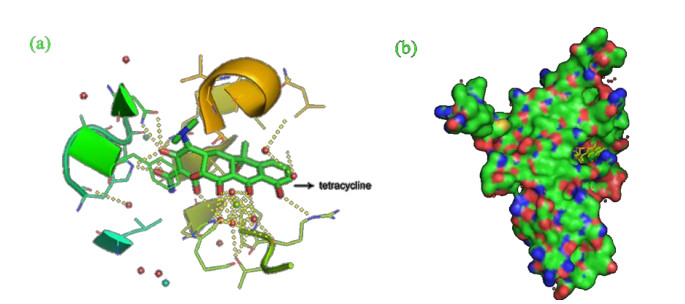
Figure 1.
Binding pattern of tetracycline and antibody.
(a) Interaction of tetracyclic and protein; (b) Overall structure of tetracyclic and protein complexes

A Sensitive Material for Specifically Treating Tetracycline in Water Environment
Min-Rui OU , Zi-Hui ZHANG , Yu-Kai WEN , Xiao-Ping XU , Huang-Hao YANG


Environmental pollution has a serious impact on human health, which has attracted more and more attention of researchers. Among many contaminants, the residual of antibiotics in the environment have many negative effects on human health and the ecological environment[1-3]. For example, it results in the increase of antibiotic concentration in the environment, which causes various hazards to various organisms on the sea and land. In addition, it leads to the emergence of antibiotic resistance[4-8]. Rebeca López-Serna et al.[9] reported that there were 72 drugs and their transformation products in the groundwater system of Barcelona, with a maximum residue of 1 μg·L-1. Li et al.[10] investigated sewage treatment plants in 23 cities in China and found that there are many antibiotics in the sewage sludge, including pyridone acids, sulfonamides and macrolide antibiotics. These residual antibiotics in the environment caused great pollution to water.
Tetracycline is one of the primarily antibiotics, but the heavy use and misuse of it lead to residual accumulation in the environment[11, 12]. Most of the tetracycline that remains in the environment eventually enters the water environment and causes adverse effects on the ecological environment. As a result, the removal of tetracycline from wastewater has become environmentally critical[13, 14].
At present, there are many materials for treating tetracycline in the water environment at home and abroad, including physical materials, chemical materials, biological materials, and mixed treatment of various materials[15-18]. Liu et al.[19] research group studied the removal efficiency of tetracycline, chloramphenicol, and sulfamethoxazole from montmorillonite, kaolinite, and recalcitrate, and investigated the effect of different clay minerals on the adsorption of antibiotics. The results showed that montmorillonite and recalcitrant had good tetracycline treatment effects, but no matter what kind of clay minerals they are, the removal effect of chloramphenicol and sulfamethoxazole was not ideal. Chang et al.[20] explored the adsorption behavior of tetracycline on palygorskite. The results showed that the maximum adsorption capacity was about 210 mmol·Kg-1 after 2 h. Khan et al.[21] studied the ozonation of tetracycline in aqueous media. This method is convenient and effective, but it is not sensitive to handle low concentrations of tetracycline. Xue Hun et al.[22] synthesized ZnSb2O4 and ZnSb2O6 as new photocatalysts to degrade tetracycline hydrochloride, which had good effect for degradation. However, these photocatalysts need UV lamps as illuminating source and take a much long time for complete degradation.
None of these materials specifically remove specific antibiotics, and they are not enough sensitive to treat low concentrations of antibiotics. The material of this work was based on the specific binding principle of antibody-antigen. The antibiotics were specifically and safely treated with immobilized antibodies, and magnetic nanocomposites were used as immobilization carriers. The aim of this study was to develop a new specific and sensitive treatment material for the removal of tetracycline in the water environment.
In this paper, the concept of antibiotic-specific treatment was proposed to remove the tetracycline in aqueous solution. Using EDC-NHS as an activator, anti-tetracycline antibody was maximally immobilized on a magnetic Fe3O4-PAMAM complex carrier. Antigens and antibodies can bind speci- fically. Based on this principle, the complexes can specifi- cally treat tetracycline. The experimental parameters in terms of reagent concentration, reaction time, pH, and temperature were optimized.
3-Aminopropyl-triethoxysilane (APTES) and N-hy- droxysucciimide (NHS) were supplied by Fujian Chemical Fiber Science and Education Instrument Co., Ltd. 1-ethyl- 3-[3-dimethylaminopropyl]carbodiimide hydrochloride (EDC) was provided by Tianjin Zhiyuan Chemical Reagent Co., Ltd. Tetracycline antibody was purchased from Beijing Boaosen Biotechnology Co., Ltd., China. The crystal structure of the tetracycline antibody has not been resolved, so the structure of the tetracycline binding protein was provided as a reference[23]. The structure of the resistance protein is shown in Fig. 1 (pdb ID: 2trt). All other chemicals were of analytical grade and used without further purification. Solutions were prepared with distilled water prepared by Fuzhou University.
(a) Interaction of tetracyclic and protein; (b) Overall structure of tetracyclic and protein complexes
Stock solutions (10 mg·L-1) of tetracycline were prepared by dissolving 0.2 g tetracycline in 20 mL distilled water. The solutions of different concentrations used in various experiments were obtained by dilution of the stock solutions.
Magnetic Fe3O4 nanoparticles were prepared by chemical coprecipitation[24]. Amine modification of the magnetic particle surface was performed using APTES as a coupling agent. Polyamide-amine dendrimer (PMAMA) was synthe- sized and purified according to the literature[25, 26]. Succinic anhydride was used to partially carboxylate the amino terminus of PAMAM. The prepared PAMAM and glutaraldehyde-treated aminated Fe3O4 were dissolved in DMSO, and the reaction was stirred at room temperature for 4 h. The complex was then separated from the excess DMSO using an external magnetic field. Anti-tetracycline antibody was put into the reaction system and reacted at room temperature. Finally, the composition was separated from the solvent by an external magnetic field to obtain Fe3O4- PAMAM-antibody.
The effect of different parameters on the antibody immobi- lization process was investigated by adjusting the con- centration of activator EDC-NHS, the pH and the fixed time. The pH of Fe3O4-PAMAM solution was adjusted by PBS buffer. The amount of antibody bound was expressed as the mass of antibody covalently coupled on a unit mass of Fe3O4-PAMAM complex carrier. The Bradford assay was used to determine the amount of antibody in the solution before and after fixation, and then the immobilized amount of the antibody was calculated. The fixed amount of antibody was calculated as follows:
|
|
(1) |
Where C0 (mg·L-1) and C1 (mg·L-1) are the antibody concentration before and after fixation, respectively.
The concentration of tetracycline was determined by liquid chromatography (UPLC, Acquity Ultra Waters, USA). The separation was achieved on the Acquity BEH C18-column (100mm × 2.1mm, 1.7 μm; Waters, USA). Detection wavelengths were set to 355 nm. Mobile phases: 0.01 mol·L-1 oxalic acid, acetonitrile, methanol (70:25:5). The flow rate was set at 0.6 mL·min-1 and injection volume of 10 μL. The column was operated at 30 ℃[27].
Absorptive removal of tetracycline by antibody complexes was carried out in batch experiments. In each experiment, equal amounts of tetracycline and antibody complexes were added in turn into 25 mL conical flasks to stir for 60 min. Every 6 min, a 10 µL sample was taken from solution and was analyzed for the residual tetracycline concentration. The effect of different parameters on the tetracycline removal process was investigated by adjusting the initial con- centration of tetracycline solution, the pH and the temperature. The tetracycline removal rate (ç) was calculated as below:
|
|
(2) |
Where C0 and Cs are the initial and equilibrium concentrations of tetracycline (mg·L-1), respectively.
EDC-NHS activator concentration can greatly affect the immobilization amount of antibody. Therefore, it was necessary to determine the optimal concentration of EDC- NHS to get the maximum immobilization amount of antibody. Fig. 2(a) shows the effect of different concentra- tions of EDC-NHS activators on antibody coupling fixation. As can be seen in the figure, the amount of immobilized antibody gradually increased with increasing the activator concentration within certain limits. The maximum immobilized amount of the antibody was obtained using activator with 1.5 mg·mL-1 EDC-NHS. This phenomenon can be due to the fact that the activation reaction of EDC/NHS reaches equilibrium. With EDC-NHS activator concentration increasing, the carboxyl group was saturated, with the fixed amount of the antibody reaching the maximum and remaining unchanged.
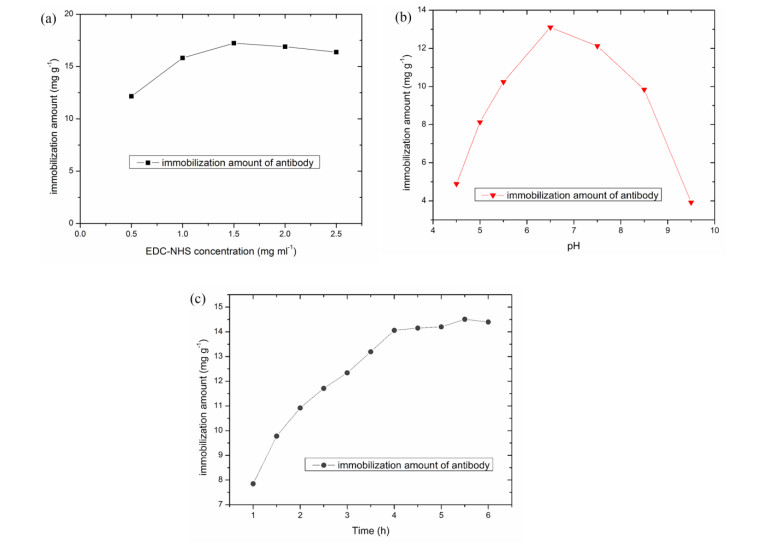
(a) EDC-NHS concentration; (b) pH; (c) fixed time
One of the important factors which could affect the immobilization of antibody is pH[28]. Fig. 2(b) demonstrates the experimental results with a wide pH range. In the pH range of 4.5~9.5, the antibody immobilized amount showed a tendency of increasing first and then decreasing with increasing pH, indicating that 6.5 was a proper pH to immobilize antibody. The reasons may be explained as follows: Firstly, the weak acid condition was beneficial to the activation of carboxyl groups by EDC-NHS, while the carboxyl oxygen in the strong acid was protonated and affected the reaction equilibrium; Secondly, the highly acidic or alkaline surroundings may affect the activity of antibody and their interaction.
The effect of fixed time on immobilization of antibody was investigated by changing the fixed time ranging from 1 to 6 h. As can be seen in Fig. 2(c), the immobilization amount of antibody increased with fixed time within certain limits. When the time reached 4 h, the immobilized amount of antibody got to a maximum of 15 mg·g-1. After 4 h of coupling, the immobilized amount of antibody no longer increased with time, but tended to be stable; and the antibody immobilization process can reach equilibrium within a short time. Therefore, the optimal time for antibody immobilization is 4 h. This trend can be due to the fact that the immobilization process of the antibody on the carrier had both physical adsorption and chemical coupling. Before the antibody reached the surface of the carrier for covalent immobilization, it is first adsorbed from the solution to the surface of the carrier by physical action, and then covalently coupled with the active group on the surface of the carrier, so it took a certain time to complete the immobilization process.
The removal effect of tetracycline (500, 400, 300, 200, 100 mg·L-1) of Fe3O4-PAMAM-antibody complexes at different initial concentrations is shown in Fig. 3(a). As can be seen from the figure, the concentration of tetracycline decreased gradually with the increase of treatment time. The removal efficiency of tetracycline increased with the decrease of its initial concentration, and the lower the concentration of tetracycline, the higher the removal efficiency, and the shorter the time to achieve equilibrium removal. When the concentration of tetracycline was 100 mg·L-1, it is almost completely removed. This phenomenon may be due to the fact that a certain amount of complex can only be covalently coupled to a certain amount of antibody, so that only a certain amount of tetracycline can be specifically linked. With the concentration of tetracycline increased, the binding sites on the tetracycline antibody were saturated, so the removal rate decreased[29].
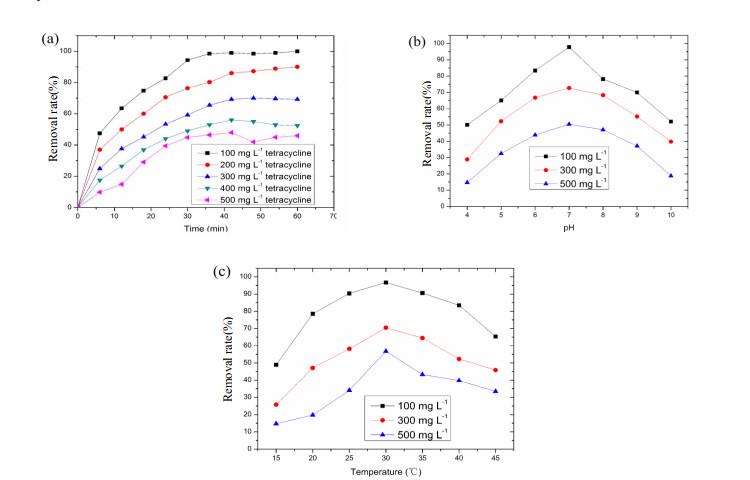
(a) initial concentration of tetracycline, (b) pH and (c) temperature
The effects of different pH (4, 5, 6, 7, 8, 9, 10) on the removal of tetracycline were studied, and tetracycline solutions with concentrations of 100, 300, and 500 mg·L-1 were used as the experimental groups. Fig. 3(b) shows the effect of pH on the removal of tetracycline. At the same pH, the removal rate of tetracycline increases as the con- centration decreases. This may be due to the fact that antibodies immobilized on the complexes in high concentration of tetracycline solution were easily saturated by tetracycline and no more tetracycline can be bound. The removal rate of tetracycline with different concentrations showed a trend of increase first and then decrease with increasing pH of the solution. The reason for this trend may be that in the proper pH range, the activity of the antibody increases with increasing pH (pH = 4~7) or decreases with increasing pH (pH = 7~10). Over-acid or over-alkaline conditions can change the conformation of the antibody[30]. In addition, Fe3O4-PAMAM-antibody complexes exhibited the best effect at pH 7 when treating three different concentrations of tetracycline. The removal rates were 100%, 73% and 52%, respectively, probably because the immobilized antibody had the highest activity and binding ability to tetracycline under near-neutral conditions.
Temperature is another major factor that affects antibody activity. As can be seen in Fig. 3(c), the removal rate of tetracycline increased first and then descended with the increase of temperature, indicating that 30 ℃ was a proper temperature to remove tetracycline. The trend can be attributed to two reasons: Firstly, at temperature in which the antibody was active, the ability of the antibody to specifically bind to tetracycline increased first and then decreased with increasing the temperature; Secondly, too high or too low temperature caused changes in the spatial structure of the antibody, so that the antibody cannot be smoothly combined with tetracycline[31, 32]. The removal rates of the three different concentrations of tetracycline solution reached a maximum around 30 ℃ maybe due to the best binding effect of the spatial structure of the antibody and the tetracycline molecule, which is most beneficial for its specific binding to tetracycline.
Table 1 shows a comparison of tetracycline sorption capacity and adsorption performances related to different adsorbents obtained by other researchers. Compared with other adsorbents, such as Powdered activated carbon (PAC)[33], Bentonite[34], Ozonation[35], Clay minerals[19], reverse osmosis and ultrafiltration (RO-UF) membrane[36] and Chlorination[35], the as-prepared antibody complexes exhibited relatively high tetracycline adsorption capacity. The advantages of our system compared to more adsorptive ones found in literature were as follows: On one hand, the antibody complexes can specifically remove low concentration of antibiotics, which is not an adsorption performance of other adsorbents. On the other hand, the prepared antibody complexes were fixed with magnetic nanocomposite material, and the antibiotics can be easily separated and removed by an external magnetic field.

 DownLoad:
CSV
DownLoad:
CSV
| Adsorbent | Adsorption capacity (%) | Specificity/ sensitivity | Reference | |
| Powdered activated carbon (PAC) | 95 | No/no | [33] | |
| Bentonite | 88.01 | No/no | [34] | |
| Clay minerals | 72 | No/no | [19] | |
| Ozonation | 95 | No/yes | [35] | |
| Reverse osmosis and ultrafiltration (RO-UF) embrane | 92 | No/yes | [36] | |
| Chlorination | 90 | No/no | [35] | |
| Magnetic Fe3O4-PAMAM-antibody complex | 100 | Yes/yes | Present | |
In this study, a novel sensitive material was found to be a very effective process explored for the removal of tetracycline, with its complete adsorption at low con- centration of tetracycline. The immobilization conditions of the antibody were optimized to ensure that the antibody was maximally immobilized on the complex carrier. That is, the concentration of the activator EDC-NHS was 1.5 mg·mL-1, the pH was 6.5, and the fixation time was 4 h. Under this condition, the maximum immobilized amount of the antibody was 17 mg·g-1. The influence of the initial concentration, pH, and temperature of tetracycline on the removal of tetracycline was also investigated. The results showed that when the tetracycline concentration was 100 mg·L-1, the removal rate was almost 100%. When the pH was 7.0 and the optimum temperature was 30 ℃, the removal rate of tetracycline was the highest.
Barhoumi, N.; Oturan, N.; Ammar, S.; Gadri, A.; Oturan, M. A.; Brillas, E. Enhanced degradation of the antibiotic tetracycline by heterogeneous electro-Fenton with pyrite catalysis. Environ. Chem. Lett. 2017, 15, 689–693. doi: 10.1007/s10311-017-0638-y
Klavarioti, M.; Mantzavinos, D.; Kassinos, D. Removal of residual pharmaceuticals from aqueous systems by advanced oxidation processes. Environ. Int. 2009, 35, 402–417. doi: 10.1016/j.envint.2008.07.009
Zhou, L. J.; Ying, G. G.; Liu, S.; Zhao, J. L.; Yang, B.; Chen, Z. F. Occurrence and fate of eleven classes of antibiotics in two typical wastewater treatment plants in South China. Sci. Total Environ. 2013, 452–453, 365–376.
Ciofu, O.; Rojo-Molinero, E.; Macià, M. D.; Oliver, A. Antibiotic treatment of biofilm infections. Apmis Acta Pathologica Microbiologica Et Immunologica Scandinavica 2017, 125, 304–319. doi: 10.1111/apm.12673
Martinez, J. L. Environmental pollution by antibiotics and by antibiotic resistance determinants. Environ. Pollut. 2009, 157, 2893–2902. doi: 10.1016/j.envpol.2009.05.051
Boonsaner, M.; Hawker, D. W. Evaluation of food chain transfer of the antibiotic oxytetracycline and human risk assessment. Chemosphere 2013, 93, 1009–1014. doi: 10.1016/j.chemosphere.2013.05.070
Näslund, J.; Hedman, J. E.; Agestrand, C. Effects of the antibiotic ciprofloxacin on the bacterial community structure and degradation of pyrene in marine sediment. Aquat. Toxicol. 2008, 90, 223–227. doi: 10.1016/j.aquatox.2008.09.002
Underwood, J. C.; Harvey, R. W.; Metge, D. W.; Repert, D. A.; Baumgartner, L. K.; Smith, R. L. Effects of the antimicrobial sulfamethoxazole on groundwater bacterial enrichment. Environ. Sci. Technol. 2011, 45, 3096–3101. doi: 10.1021/es103605e
Rebeca, L. S.; Sandra, P.; Antoni, G.; Mira, P.; Damià, B. Fully automated determination of 74 pharmaceuticals in environmental and waste waters by online solid phase extraction-liquid chromatography-electrospray-tandem mass spectrometry. Talanta. 2011, 83, 410–424.
Li, H.; Shen, Y.; Li, G.; Hong, D.; Bo, X.; Jing, D. Spatial distribution and historical records of mercury sedimentation in urban lakes under urbanization impacts. Sci. Total Environ. 2013, 445–446, 117–125.
Liu, M.; Zhang, Y.; Yang, M.; Tian, Z.; Ren, L.; Zhang, S. Abundance and distribution of tetracycline resistance genes and mobile elements in an oxytetracycline production wastewater treatment system. Environ. Sci. Technol. 2012, 46, 7551–7557. doi: 10.1021/es301145m
Daghrir, R.; Drogui, P. Tetracycline antibiotics in the environment: a review. Environ. Chem. Lett. 2013, 11, 209–227. doi: 10.1007/s10311-013-0404-8
Hoseini, M.; Safari, G. H.; Kamani, H.; Jaafari, J.; Ghanbarain, M.; Mahvi, A. H. Sonocatalytic degradation of tetracycline antibiotic in aqueous solution by sonocatalysis. Toxico. Environ. Chem. 2013, 95, 1680–1689. doi: 10.1080/02772248.2014.901328
Jeong, J.; Song, W.; Cooper, W. J.; Jung, J.; Greaves, J. Degradation of tetracycline antibiotics: mechanisms and kinetic studies for advanced oxidation/reduction processes. Chemosphere 2010, 78, 533–540. doi: 10.1016/j.chemosphere.2009.11.024
Koyuncu, I.; Arikan, O. A.; Wiesner, M. R.; Rice, C. Removal of hormones and antibiotics by nanofiltration membranes. J. Membrane Sci. 2008, 309, 94–101. doi: 10.1016/j.memsci.2007.10.010
Luu, H. T.; Lee, K. Degradation and changes in toxicity and biodegradability of tetracycline during ozone/ultraviolet-based advanced oxidation. Water Sci. Technol. 2014, 70, 1229–1235. doi: 10.2166/wst.2014.350
Shi, Y.; Wang, X.; Qi, Z.; Diao, M.; Gao, M.; Xing, S. Sorption and biodegradation of tetracycline by nitrifying granules and the toxicity of tetracycline on granules. J. Hazard. Mater. 2011, 191, 103–109. doi: 10.1016/j.jhazmat.2011.04.048
Zhu, X.; Wang, Y.; Sun, R.; Zhou, D. Photocatalytic degradation of tetracycline in aqueous solution by nanosized TiO2. Chemosphere 2013, 92, 925–932. doi: 10.1016/j.chemosphere.2013.02.066
Liu, Y.; Lu, X.; Wu, F.; Deng, N. Adsorption and photooxidation of pharmaceuticals and personal care products on clay minerals. React. Kinet. Mech. Cat. 2011, 104, 61–73. doi: 10.1007/s11144-011-0349-5
Chang, P.; Li, Z.; Yu, T.; Munkhbayer, S.; Kuo, T.; Hung, Y. Sorptive removal of tetracycline from water by palygorskite. J. Hazard. Mater. 2009, 165, 148–155. doi: 10.1016/j.jhazmat.2008.09.113
Khan, M. H.; Bae, H.; Jung, J. Tetracycline degradation by ozonation in the aqueous phase: proposed degradation intermediates and pathway. J. Hazard. Mater. 2010, 181, 659–665. doi: 10.1016/j.jhazmat.2010.05.063
Xue, H.; Liao, S. X.; Chen, Y. L.; Qian, Q. R.; Liu, X. P.; Chen, Q. H. Application and mechanism of ZnSb2O4 and ZnSb2O6 in the photocatalytic degradation of tetracycline hydrochloride. Chin. J. Struct. Chem. 2019, 38, 837–847.
Hinrichs, W.; Kisker, C.; Duvel, M.; Muller, A.; Tovar, K.; Hillen, W. Structure of the tet repressor-tetracycline complex and regulation of antibiotic resistance. Science 1994, 264, 418–420. doi: 10.1126/science.8153629
Liang, Y.; Zhang, Y.; Guo, Z.; Xie, J.; Bai, T.; Zou, J. Ultrafast preparation of monodisperse Fe3O4 nanoparticles by microwave-assisted thermal decomposition. Chem Eur. J. 2016, 22, 11807–11815. doi: 10.1002/chem.201601434
Ghosh, S.; Banthia, A. K. Synthesis of photoresponsive polyamidoamine (PAMAM) dendritic architecture. Tetrahedron Lett. 2001, 42, 501–503. doi: 10.1016/S0040-4039(00)01996-1
Tomalia, D. A.; Baker, H.; Dewald, J.; Hall, M.; Kallos, G.; Martin, S. A new class of polymers: starburst-dendritic macromolecules. Polym. J. 1985, 34, 117–132.
Chen, Y.; Zhang, H.; Luo, Y.; Song, J. Occurrence and dissipation of veterinary antibiotics in two typical swine wastewater treatment systems in east China. Environ. Monit. Assess. 2012, 184, 2205–2217. doi: 10.1007/s10661-011-2110-y
Zhang, T.; Ma, N.; Ali, A.; Wei, Q.; Wu, D.; Ren, X. Electrochemical ultrasensitive detection of cardiac troponin I using covalent organic frameworks for signal amplification. Biosens. Bioelectron. 2018, 119, 176–181. doi: 10.1016/j.bios.2018.08.020
Cao, J.; Yang, Z.; Xiong, W.; Zhou, Y.; Peng, Y.; Li, X.; Zhou, C.; Zhang, Y. One-step synthesis of Co-doped UiO-66 nanoparticle with enhanced removal efficiency of tetracycline: simultaneous adsorption and photocatalysis. Chem. Eng. J. 2017, 353, 126–137.
Dear, B. J.; Hung, J.; Truskett, T. M.; Johnston, K. P. Contrasting the influence of cationic amino acids on the viscosity and stability of a highly concentrated monoclonal antibody. Pharm. Res. 2017, 34, 1–15. doi: 10.1007/s11095-016-2039-5
Levison, S. A.; Jancsi, A. N.; Dandliker, W. B. Temperature effects on the kinetics of the primary antigen-antibody combination. Biochem. Bioph. Res. Co. 1968, 33, 942–948. doi: 10.1016/0006-291X(68)90403-8
De, D. G.; Cruz-Gil, P.; Mateo-Martí, E.; Fernández-Calvo, P.; Rivas, L. A.; Parro, V. Assessing antibody microarrays for space missions: effect of long-term storage, gamma radiation, and temperature shifts on printed and fluorescently labeled antibodies. Astrobiology 2011, 11, 759–773. doi: 10.1089/ast.2011.0647
Kim, S. H.; Shon, H. K.; Ngo, H. H. Adsorption characteristics of antibiotics trimethoprim on powdered and granular activated carbon. J. Ind. Eng. Chem. 2010, 16, 344–349. doi: 10.1016/j.jiec.2009.09.061
Putra, E. K.; Pranowo, R.; Sunarso, J.; Indraswati, N.; Ismadji, S. Performance of activated carbon and bentonite for adsorption of amoxicillin from wastewater: mechanisms, isotherms and kinetics. Water Res. 2009, 43, 2419–2430. doi: 10.1016/j.watres.2009.02.039
Adams, C.; Wang, Y.; Loftin, K.; Meyer, M. Removal of antibiotics from surface and distilled water in conventional water treatment processes. J. Environ. Eng. ASCE. 2002, 128, 253–260. doi: 10.1061/(ASCE)0733-9372(2002)128:3(253)
Li, S.; Li, X.; Wang, D. Membrane (RO-UF) filtration for antibiotic wastewater treatment and recovery of antibiotics. Sep. Purif. Technol. 2004, 34, 109–114. doi: 10.1016/S1383-5866(03)00184-9

Figure 1 Binding pattern of tetracycline and antibody.
(a) Interaction of tetracyclic and protein; (b) Overall structure of tetracyclic and protein complexes

Figure 2 Effect of various conditions on immobilization amount of antibody
(a) EDC-NHS concentration; (b) pH; (c) fixed time

Figure 3 Effect of tetracycline removal with the antibody complexes for different parameters.
(a) initial concentration of tetracycline, (b) pH and (c) temperature
Table 1. Comparison of Adsorption Capacities for Tetracycline of Various Adsorbents
| Adsorbent | Adsorption capacity (%) | Specificity/ sensitivity | Reference | |
| Powdered activated carbon (PAC) | 95 | No/no | [33] | |
| Bentonite | 88.01 | No/no | [34] | |
| Clay minerals | 72 | No/no | [19] | |
| Ozonation | 95 | No/yes | [35] | |
| Reverse osmosis and ultrafiltration (RO-UF) embrane | 92 | No/yes | [36] | |
| Chlorination | 90 | No/no | [35] | |
| Magnetic Fe3O4-PAMAM-antibody complex | 100 | Yes/yes | Present | |
 下载: 导出CSV

 扫一扫看文章


扫一扫关注我们
 下载:
下载: