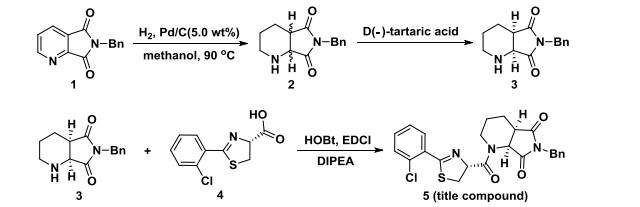
Scheme 1.
Synthetic route of the title compound

Synthesis, Crystal Structure and Insecticidal Activities of (4aR, 7aS)-6-Benzyl-1-((R)-2-(2-chlorophenyl)-4, 5-dihydrothiazole- 4-carbonyl)hexahydro-5H-pyrrolo[3, 4-b]pyridine-5, 7(6H)-dione
Jing-Bo LIU , Na QIN , Yuan-Hong WANG , Yu-Xin LI , Zheng-Ming LI


In the past decades, natural products (NPs) play an important role in the agrochemical design and development process owing to their various bioactivities, potential target sites, unique structures, and environment-friendly characteri- stics[1-4]. Although diverse natural products are obtained by extraction and separation, their bioactivities are generally too low to develop as agrochemicals. It is one of the most effective and promising ways to discover natural privileged active structures and improve their bioactivities by structural optimization on the basis of pharmacological skeletons from natural products[5-7].
(R)-2-(2-Hydroxyphenyl)-4, 5-dihydrothiazole-4-carboxylic acid is a class of natural privileged active structure, and can bind to a variety of receptors, which makes them attractive scaffolds for drug discovery. Pyochelin and (−)-(R)-dihy- droaeruginoic acid are two representative derivatives of 2-aryl-4, 5-dihydrothiazole-4-carboxylic acid, which exhibit unique microbial siderophore and antiproliferative activity, respectively[8, 9]. In the past years, studies have found that 2-aryl-4, 5-dihydrothiazole-4-carboxylic acid derivatives have a variety of medicinal properties such as anticancer[10], antiproliferative[11], anti-HIV[12], antibiotic[13], and metallo-β- lactamase inhibiting activity[14]. Recently, our research group found that 2-aryl-4, 5-dihydrothiazole-4-carboxylic acid derivatives containing amide or ester group displayed potential antifungal and insecticidal activities in the field of agriculture[15-18]. Additionally, introducing heterocycle structures into bioactive molecules for the development of agrochemicals has attracted much attention[19-23].
Inspired by the above descriptions, to discover potent agrochemical candidates, herein the title compound (4aR, 7aS)- 6-benzyl-1-((R)-2-(2-chlorophenyl)-4, 5-dihydro-thiazole-4- carbonyl)hexahydro-5H-pyrrolo[3, 4-b]pyridine-5, 7(6H)- dione was designed and synthesized, and its chemical structure was confirmed by 1H NMR, 13C NMR and X-ray diffraction. The insecticidal activity of the title compound was evaluated accordingly. Furthermore, the preliminary insecticidal mechanism of the title compound was inves- tigated by calcium imaging technique.
Melting points were confirmed on an X-4 binocular microscope melting point apparatus and uncorrected. 1H NMR and 13C NMR were recorded on 400 MHz using a Bruker AV 400 spectrometer using CDCl3 as solvent with tetramethylsilane (TMS) as the internal standard. Elemental Analysis (EA) was detected by using a Vario EL elemental analyzer. The crystal structure was recorded by a Rigaku Saturn 724 CCD diffractometer. Column chromatography purification was carried out using silica gel (200~300 mesh). 6-Benzyl-5H-pyrrolo[3, 4-b]pyridine-5, 7(6H)-dione (1) and (R)-2-(2-chlorophenyl)-4, 5-dihydrothiazole-4-car- boxylic acid (4) were synthesized according to our previous work[8]. Reagents were all analytically pure. All solvents and liquid reagents were dried by standard methods in advance and distilled before use.
1 (2.384 g, 10.0 mmol) and Pd/C (0.184 g, 5.0 wt%) were added in a 50 mL reaction kettle, followed by the addition of 20 mL anhydrous methanol. Then the reaction was heated to 90 ℃ under 4.0 MPa hydrogen atmosphere, which was detected by TLC. After completion, the resulting mixture was filtered and the filtrate was collected and evaporated to obtain 6-benzyltetrahydro-1H-pyrrolo[3, 4-b]-pyridine-5, 7(6H)-dione (2). Then 2 (1.221 g, 5.0 mmol) was added in 10 mL ethanol (90%), and D(−)-tartaric acid (0.755 g, 5 mmol) was added to the above solution in batches. The reaction was stirred at 50 ℃ for 30 min, then cooled to 20 ℃ slowly, and a large amount of white solid appeared. This solid was filtered, washed with anhydrous ethanol, and dried. The obtained solid was dissolved in 10 mL water, basified to pH 11 with 1 mol/L sodium hydroxide, and extracted with ethyl acetate. The organic layer was collected and evaporated to afford (4aR, 7aS)-6-benzyltetrahydro-1H- pyrrolo[3, 4-b]pyridine-5, 7(6H)-dione (3): white solid, yield 43.9%, m.p. 74~75 ℃. 1H NMR (400 MHz, CDCl3) δ 7.38~7.34 (m, 2H, Ph-H), 7.33~7.29 (m, 2H, Ph-H), 7.28~7.25 (m, 1H, Ph-H), 4.65 (s, 2H, PhCH2), 3.84 (d, J = 7.1 Hz, 1H, NHCHCO), 2.86 (q, J = 7.1 Hz, 1H, CH2CHCO), 2.79 (dt, J = 10.7, 5.3 Hz, 1H, 1/2NHCH2CH2), 2.67 (dt, J = 11.7, 5.9 Hz, 1H, 1/2NHCH2CH2), 1.97 (m, 2H, NH and 1/2CH2CHCO), 1.66 (dt, J = 13.7, 6.9 Hz, 1H, 1/2CH2CHCO), 1.56~1.39 (m, 2H, CH2CH2CH2).
(R)-2-(2-Chlorophenyl)-4, 5-dihydrothiazole-4-carboxylic acid (0.241 g, 1.0 mmol) was dissolved in 5 mL anhydrous dichloromethane, followed by successively adding 1-hy- droxy-1H-benzotriazole (HOBt, 0.143 g, 1.0 mmol) and N-(3-dimethylaminopropyl)-N΄-ethylcarbodiimidehydrochlo-ride (EDCI, 0.230 g, 1.05 mmol). The mixture was stirred for 30 min, and 1.1 mmol N, N-diisopropylethylenediamine was added to the above mixture. After 10 min, (4aR, 7aS)- 6-benzylhexahydro-5H-pyrrolo[3, 4-b]pyridine-5, 7(6H)-dione (0.244 g, 1.0 mmol) dissolved in 5 mL dichloromethane was added to the reaction mixture. Then the reaction was stirred at room temperature and detected by TLC. After completion, 10 mL dichloromethane was added to the mixture which was then washed with water, 1 mol/L hydrochloric acid, and saturated sodium bicarbonate solution successively. The organic layer was collected and purified by chromatography on silica gel to afford the title compound: white solid, yield 75.5%, m.p. 110~111 ℃, 1H NMR (400 MHz, DCCl3), δ: 7.65 (dd, J = 7.6, 1.6 Hz, 1H, Ph-H), 7.43 (d, J = 7.9, 1.0 Hz, 1H, Ph-H), 7.41~7.36 (m, 2H, Ph-H), 7.36~7.27 (m, 5H, Ph-H), 5.82 (d, J = 8.5 Hz, 1H, CH2NCH), 5.50 (t, J = 9.1 Hz, 1H, SCH2CH), 4.69 (s, 2H, PhCH2), 4.64~4.55 (m, 1H, NCHCH), 4.24 (dd, J = 11.1, 9.1 Hz, 1H, 1/2SCH2), 3.52 (dd, J = 11.1, 9.2 Hz, 1H, 1/2SCH2), 3.16~3.01 (m, 2H, CH2NCH), 2.11 (ddd, J = 10.8, 8.7, 5.4 Hz, 1H, 1/2CHCHCH2), 1.70 (ddd, J = 16.0, 11.0, 7.3 Hz, 1H, 1/2CHCHCH2), 1.58~1.45 (m, 2H, CH2CH2CH2). 13C NMR (101 MHz, CDCl3) δ 176.95, 174.63, 169.21, 167.83, 135.49, 132.65, 132.06, 131.40, 131.14, 130.78, 128.85, 128.78, 128.15, 126.74, 77.48, 51.66, 42.92, 42.57, 38.98, 34.64, 24.24, 21.02. EA calculated for C24H22ClN3O3S: C, 61.60; H, 4.74; N, 8.98. Found: C, 61.65; H, 4.75; N, 8.90.
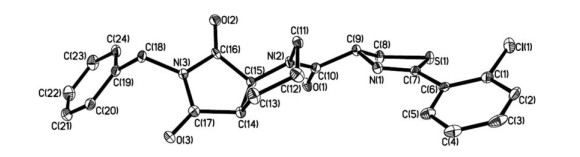
The single crystal of the title compound suitable for X-ray diffraction study was cultivated from dichloromethane and n-hexane (volume ratio 3:10) by self-volatilization, and the white block crystal with dimensions of 0.20mm × 0.18mm × 0.12mm was mounted on a Rigaku Saturn 724 CCD diffractometer MoKα radiation (λ = 0.71073 Å), and the absolute chiral configuration of the title compound was confirmed C9 (R), C14 (R) and C15 (S). Intensity data were collected at 113(2) K by using a multi-scan mode in the range of 1.72≤θ≤25.02° (index ranges: –34≤h≤22, –9≤k≤9, –24≤l≤27). A total of 12974 reflections were collected with 3720 unique ones (Rint = 0.0650), of which 2812 were observed with I > 2σ(I). The crystal structure was solved by direct methods with SHELXS-97 program[24] and refined by full-matrix least-squares on F2 with SHELXL-97[25]. All non-hydrogen atoms were located with successive difference Fourier syntheses and refined by using anisotropic thermal parameters. All hydrogen atoms were located in the calculated positions and refined according to theoretical models. The final full-matrix least-squares refinement converged at R = 0.0629 and wR = 0.1708 (w = 1/[σ2(Fo2) + (0.0883P)2 + 0.7616P], where P = (Fo2 + 2Fc2)/3) with (Δ/σ)max = 0.000 and S = 1.056.
Insecticidal assays of the title compound against Mythimna separata, Plutella xylostella, and Culex pipiens pallens were conducted in the greenhouse according to the reported method[26-28] with chlorantraniliprole used as the positive control. The bioassay was replicated at 25 ± 1 ℃ according to statistical requirements. Assessments were made on a dead/alive basis, and mortality rates were corrected by applying Abbott's formula[29]. Evaluation was based on a percentage scale of 0~100, in which 0 equals no activity and 100 equals total kill. The standard deviations of the tested biological values were ±5%.
The preliminary insecticidal mechanism of the title compound was explored by calcium imaging technique according to our previous method[30].
The synthetic route of the title compound is shown in Scheme 1. Intermediates 6-benzyl-5H-pyrrolo[3, 4-b]pyri- dine-5, 7(6H)-dione 1 and (R)-2-(2-chlorophenyl)-4, 5-dihy- drothiazole-4-carboxylic acid 4 were prepared by referring to our previous work[8]. Compound 1 was reduced by hydrogen to prepare compound 2 optical isomers, and then the optical isomers were separated by using D(−)-tartaric acid. During separation, temperature had a great impact on the resolution of optical isomers. Thus we applied the programmed temperature control method to optimize the resolution conditions. Finally, the title compound was synthesized by a convenient one-step condensation reaction with N-(3-dimethylaminopropyl)-N΄-ethylcarbodiimide hydrochloride (EDCI) and 1-hydroxy-1H-benzotriazole (HOBT) as condensation agents. The structure of the pure title compound was confirmed by 1H NMR, 13C NMR and elemental analysis (EA). As shown in Fig. 1S (in Supporting information), the doublet signal at 5.82 ppm is the proton on carbon atom C(g), and the triplet signal at 5.50 ppm belongs to the proton on carbon atom C(b). Due to the effect of the chiral carbon atom C(b), the two protons on carbon atom C(a) appear at around 4.24 and 3.52 ppm with double of doublet signals. Similarly, the two protons on carbon atom C(e) are found at around 2.11 and 1.70 ppm with triple doublet signals. The signals at around 4.69, 4.60, 3.08 and 1.51 ppm belong to the protons on carbon atoms C(h), C(f), C(c) and C(d), respectively.
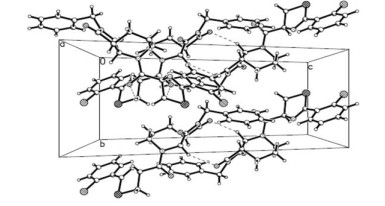
The molecular structure of the title compound is shown in Fig. 1 and the crystal packing in Fig. 2. The selected bond lengths, bond angles and torsion angles are listed in Table 1.
 DownLoad:
CSV
DownLoad:
CSV
| Bond | Dist. | Bond | Dist. | Bond | Dist. | ||
| N(2)–C(10) | 1.354(5) | N(3)–C(16) | 1.388(4) | N(3)–C(17) | 1.382(5) | ||
| N(1)–C(7) | 1.282(4) | C(9)–C(10) | 1.530(5) | S(1)–C(8) | 1.809(4) | ||
| Angle | (°) | Angle | (°) | Angle | (°) | ||
| C(10)–N(2)–C(11) | 125.8(3)° | C(10)–N(2)–C(15) | 119.0(3)° | C(15)–N(2)–C(11) | 114.3(3)° | ||
| C(17)–N(3)–C(16) | 112.4(3)° | C(17)–N(3)–C(18) | 122.8(3)° | C(15)–N(3)–C(18) | 124.2(3)° | ||
| Torsion angle | (°) | Torsion angle | (°) | Torsion angle | (°) | ||
| S(1)–C(8)–C(9)–N(1) | –29.5(3)° | C(12)–C(13)–C(14)–C(15) | –60.6(4) | C(15)–N(2)–C(11)–C(12) | –42.3(5)° | ||
| N(2)–C(11)–C(12)–C(13) | 52.9(5)° | C(18)–N(3)–C(16)–O(2) | –0.7(5)° | C(11)–C(12)–C(13)–C(14) | 60.1(4)° | ||
| C(14)–C(15)–C(16)–N(3) | –23.9(4)° | C(18)–N(3)–C(17)–O(3) | 13.6(5)° |
Generally, the average bond lengths and bond angles of phenyl ring system are in normal ranges[31]. The bond lengths of N(2)–C(10) (1.354(5) Å), N(3)–C(16) (1.388(4) Å) and N(3)–C(17) (1.382(5) Å) are much shorter than the normal bond length of N–C (1.47 Å), but close to the normal bond length of N=C (1.33 Å), which is owing to the p-π conjugate effect[32]. The bond angles of C(10)–N(2)–C(11), C(10)–N(2)–C(15) and C(15)–N(2)–C(11) are 125.8(3)°, 119.0(3)° and 114.3(3)°, respectively, with their sum to be 359.1° (approximately 360°), implying that N(2) atom is the sp2 hybridization state. The sum of C(17)–N(3)–C(16) (112.4(3)°), C(17)–N(3)–C(18) (122.8(3)°) and C(15)–N(3)– C(18) (124.2(3)°) bond angles is 359.4° (approximately 360°), indicating that N(3) atom is also the sp2 hybridization state. The torsion angle of S(1)–C(8)–C(9)–N(1) is –29.5(3)°, which means that the dihydrothiazole ring is nonplanar, and the torsion angles of C(12)–C(13)–C(14)–C(15), C(15)– N(2)–C(11)–C(12), C(11)–C(12)–C(13)–C(14) and N(2)– C(11)–C(12)–C(13) are –60.6(4), –42.3(5)°, 60.1(4)°, and 52.9(5)°, respectively, suggesting that the piperidine ring is also not in the same plane and exhibits a chair conformation. The pyrrole ring is also nonplanar as the torsion angle of C(14)–C(15)–C(16)–N(3) is –23.9(4)°. The torsion angles of C(18)–N(3)–C(16)–O(2) and C(18)–N(3)–C(17)–O(3) are –0.7(5)° and 13.6(5)°, respectively, which implied that the two carbonyl groups are opposite. The intermolecular interactions are shown in Fig. 2, and two non-classical intermolecular hydrogen bonds (C(8)–H(8B)⋅⋅⋅O(1) and C(15)–H(15)⋅⋅⋅O(3)) exist in the structure. The intermole- cular interactions strengthen the integration of the 3D network, and play an important role in stabilizing the crystal structure.
DownLoad:
CSV
| Compound | D–H⋅⋅⋅A | d(D–H) | d(H⋅⋅⋅A) | d(D⋅⋅⋅A) | ∠DHA |
| 5 | C(8)–H(8B)⋅⋅⋅O(1)#1 | 0.95 | 2.45 | 3.232(4) | 154 |
| C(15)–H(15)⋅⋅⋅O(3)#2 | 0.98 | 2.35 | 3.328(5) | 147 | |
| Symmetry transformations used to generate the equivalent atoms: #1 –x, –y, –z+1, #2 –x, –y+1, –z+1 | |||||
Insecticidal activities of the title compound against Mythimna separata, Plutella xylostella and Culex pipiens pallens are listed in Table 3. The preliminary bioassay results indicated that the title compound exhibited good and promising insecticidal activities. The title compound displayed 100% larvicidal activity against Mythimna separata and Plutella xylostella at 100 mg/L, equivalent to that of chlorantraniliprole (100%). Moreover, even at 10 mg/L, the title compound exhibited 73% larvicidal activity against Plutella xylostella, which was a little weaker than that of chlorantraniliprole (100%). More impressively, for Culex pipiens pallens, the insecticidal activity of the title compound (100%) was the same with chlorantraniliprole (100%) even at 2 mg/L. Furthermore, the title compound exhibited more than 90% insecticidal efficacy, which was comparable to that of chlorantraniliprole (100%).
DownLoad:
CSV
| Compound | Larvicidal activity (%) | ||||||||||
| Mythimna separata (mg/L) | Plutella xylostella (mg/L) | Culex pipiens pallens (mg/L) | |||||||||
| 200 | 100 | 50 | 200 | 100 | 50 | 10 | 10 | 5 | 2 | 1 | |
| Title compound (5) | 100 | 100 | 57 | 100 | 100 | 95 | 73 | 100 | 100 | 100 | 92 |
| Chlorantraniliprole | 100 | 100 | 100 | 100 | 100 | 100 | 100 | 100 | 100 | 100 | 100 |
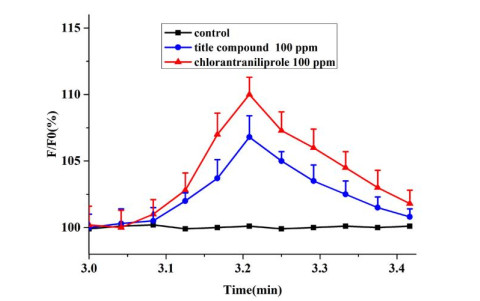
To explore the preliminary insecticidal mechanism of the title compound, we investigated the influence on calcium signaling in the central neurons isolated from the third instar of Mythimna separata by calcium imaging technique. The isolated central neurons were loaded with fluo-3 AM. As shown in Fig. 3, when the isolated central neurons were treated with the title compound (100 mg/L) and chlorantrani- liprole (100 mg/L) in the absence of extracellular calcium, respectively, the cytosolic calcium concentrations were increased differently, compared to the initial values. The result was similar to our previous research[22, 30]. Owing to the absence of extracellular calcium in bathing solution, the result implied that the title compound, similar to chlorantraniliprole, can activate intracellular calcium channels to release the stockpiled [Ca2+]i from endoplasmic reticulum (ER) to cytoplasm of Mythimna separata. Therefore, the insecticidal mechanism of the title compound was related to calcium homeostasis modulation in insects.
Cantrell, C. L.; Dayan, F. E.; Duke, S. O. Natural products as sources for new pesticides. J. Nat. Prod. 2012, 75, 1231–1242. doi: 10.1021/np300024u
Xu, H. Natural products as leads for new drugs and pesticides discovery. Mini. Rev. Org. Chem. 2012, 9, 125. doi: 10.2174/157019312800604751
Bolzani, V. D.; Davies-Coleman, M.; Newman, D. J.; Singh, S. B.; Gordon, M.; Cragg, D.; Phil, D. Sc. (H. C. ): a man for all natural products. J. Nat. Prod. 2012, 75, 309–310. doi: 10.1021/np201003c
Copping, L. G.; Duke, S. O. Natural products that have been used commercially as crop protection agents. Pest Manag. Sci. 2007, 63, 524–554. doi: 10.1002/ps.1378
Bauer, A.; Bronstrupt, M. Industrial natural product chemistry for drug discovery and development. Nat. Prod. Rep. 2014, 31, 35–60. doi: 10.1039/C3NP70058E
Rodrigues, T.; Reker, D.; Schneider, P.; Schneider, G. Counting on natural products for drug design. Nat. Chem. 2016, 8, 531–541. doi: 10.1038/nchem.2479
Newman, D. J.; Cragg, G. M. Natural products as sources of new drugs from 1981 to 2014. J. Nat. Prod. 2016, 79, 629–661. doi: 10.1021/acs.jnatprod.5b01055
Rinehart, K. L.; Staley, A. L.; Wilson, S. R.; Ankenbauer, R. G.; Cox, C. D. Stereochemical assignment of the pyochelins. J. Org. Chem. 1995, 60, 2786–2791. doi: 10.1021/jo00114a029
Elliot, G. T.; Kelly, K. F.; Bonna, R. L.; Wardlaw, T. R.; Burns, E. R. In vitro antiproliferative activity of 2΄-(2-hydroxyphenyl)-2΄-thiazoline- 4΄-carboxylic acid and its methyl ester of L1210 and P388 murine neoplasms. Cancer Chemother. Pharmacol. 1988, 21, 233–236.
Gududuru, V.; Hurh, E.; Dalton, J. T.; Miller, D. D. SAR studies of 2-arylthiazolidine-4-carboxylic acid amides: a novel class of cytotoxic agents for prostate cancer. J. Med. Chem. 2005, 48, 2584–2588. doi: 10.1021/jm049208b
Pattenden, G.; Thom, S. M. Naturally occurring linear fused thiazoline-thiazole containing metabolites: total synthesis of (–)-didehydromirabazole A, a cytotoxic alkaloid from blue-green algae. J. Chem. Soc. Perk. Trans. 1993, 14, 1629–1636.
Bergeron, R. J.; Wollenweber, M.; Weigand, J. An investigation of desferrithiocin metabolism. J. Med. Chem. 1994, 37, 2889–2895. doi: 10.1021/jm00044a009
Zamri, A.; Schalk, I. J.; Pattus, F.; Abdallah, M. A. Bacterial siderophores: synthesis and biological activities of novel pyochelin analogues. Bioorg. Med. Chem. Lett. 2003, 13, 1147–1150. doi: 10.1016/S0960-894X(03)00010-6
Chen, P.; Horton, L. B.; Mikulski, R. L.; Deng, L.; Sundriyal, S.; Palzkill, T.; Song, Y. 2-Substituted 4, 5-dihydrothiazole-4-carboxylic acids are novel inhibitors of metallo-β-lactamases. Bioorg. Med. Chem. Lett. 2012, 22, 6229–6232. doi: 10.1016/j.bmcl.2012.08.012
Liu, J. B.; Li, Y. X.; Chen, Y. W.; Hua, X. W.; Wan, Y. Y.; Wei, W.; Song, H. B.; Yu, S. J.; Zhang, X.; Li, Z. M. Design, synthesis, antifungal activities and SARs of (R)-2-aryl-4, 5-dihydrothiazole-4-carboxylic acid derivatives. Chin. J. Chem. 2015, 33, 1269–1275. doi: 10.1002/cjoc.201500619
Liu, J. B.; Li, F. Y.; Wang, Y. H.; Zhang, H. X.; Dong, J. Y.; Sun, P. W.; Li, Y. X.; Li, Z. M. Synthesis, biological activities and 3D-QSAR studies of (R)-2-phenyl-4, 5-dihydrothiazole-4-carboxamide derivatives containing a sulfur ether moiety. Chin. Chem. Lett. 2019, 30, 668–671. doi: 10.1016/j.cclet.2018.11.001
Li, F. Y.; Liu, J. B.; Gong, J. N.; Li, G. (R)-2-Phenyl-4, 5-dihydrothiazole-4-carboxamide derivatives containing a diacylhydrazine group: synthesis, biological evaluation, and SARs. Molecules 2019, 24, 4440. doi: 10.3390/molecules24244440
Liu, J. B.; Li, F. Y.; Wang, Y. H.; Zhang, H. X.; Li, Y. X.; Li, Z. M. Synthesis, biological activities, and 3D-QSAR studies of (R)-2-phenyl-4, 5-dihydrothiazole- 4-carboxamide derivatives containing a sulfonohydrazide moiety. Med. Chem. Res. 2020, 29, 495–503. doi: 10.1007/s00044-020-02499-3
Min, L. J.; Wang, Q.; Tan, C. X.; Weng, J. Q.; Liu, X. H. Synthesis, crystal structure and fungicidal activity of 2-chloro-N-(o-tolylcarbamoyl) nicotinamide. Chin. J. Struct. Chem. 2020, 39, 452–458.
Jin, T.; Zhai, Z. W.; Han, L.; Weng, J. Q.; Tan, C. X.; Liu, X. H. Synthesis, crystal structure, docking and antifungal activity of a new pyrazole acylurea compound. Chin. J. Struct. Chem. 2018, 37, 1259–1264.
Cheng, L.; Zhang, R. R.; Wu, H. K.; Xu, T. M.; Liu, X. H. The synthesis of 6-(tertbutyl)-8-fluoro-2, 3-dimethylquinoline carbonate derivatives and their antifungal activity against pyricularia oryzae. Front. Chem. Sci. Eng. 2019, 13, 369–376. doi: 10.1007/s11705-018-1734-7
Liu, J. B.; Li, F. Y.; Dong, J. Y.; Li, Y. X.; Zhang, X. L.; Wang, Y. H.; Xiong, L. X.; Li, Z. M. Anthranilic diamides derivatives as potential ryanodine receptor modulators: synthesis, biological evaluation and structure activity relationship. Bioorgan. Med. Chem. 2018, 26, 3541–3550. doi: 10.1016/j.bmc.2018.05.028
Li, F. Y.; Wang, Y. H.; Liu, J. B.; Li, Y. X.; Li, Z. M. Synthesis, insecticidal evaluation and mode of action of novel anthranilic diamide derivatives containing sulfur moiety as potential ryanodine receptor activators. Bioorgan. Med. Chem. 2019, 27, 769–776. doi: 10.1016/j.bmc.2019.01.009
Sheldrick, G. M. SHELXS-97, Program for Solution of Crystal Structures. University of Göttingen, Germany 1997.
Sheldrick, G. M. SHELXL-97, Program for Crystal Structure Refinement. University of Göttingen, Germany 1997.
Wu, Y. D.; Shen, J. L.; Chen, J.; Lin, X. W.; Li, A. M. Evaluation of two resistance monitoring methods in Helicoverpa armigera: topical application method and leaf dipping method. Plant Prot. 1996, 22, 3–6.
Ma, H.; Wang, K. Y.; Xia, X. M.; Zhang, Y.; Guo, Q. L. The toxicity testing of five insecticides to different instar larvae of Spodoptera exigua. Mod. Agrochem. 2006, 5, 44–46.
Wang, B. L.; Ma, Y.; Xiong, L. X.; Li, Z. M. Synthesis and insecticidal activity of novel N-pyridylpyrazole carbonyl thioureas. Chin. J. Chem. 2012, 30, 815–821. doi: 10.1002/cjoc.201100386
Abbott, W. S. A method of computing the effectiveness of an insecticide. J. Econ. Entomol. 1925, 18, 265–267.
Liu, J. B.; Li, F. Y.; Li, Y. X.; Zhang, X. L.; Hua, X. W.; Xiong, L. X.; Li, Z. M. Synthesis, insecticidal evaluation and 3D-QSAR study of novel anthranilic diamide derivatives as potential ryanodine receptor modulators. Pest Manag. Sci. 2019, 75, 1034–1044. doi: 10.1002/ps.5213
Liu, X. H.; Xu, X. Y.; Tan, C. X.; Weng, J. Q.; Xin, J. H.; Chen, J. Synthesis, crystal structure, herbicidal activities and 3D-QSAR study of some novel 1, 2, 4-triazolo[4, 3-a]pyridine derivatives. Pest Manag. Sci. 2015, 71, 292–301. doi: 10.1002/ps.3804
Li, F. Y.; Zhu, Y. J.; Fan, Z. J.; Xu, J. H.; Guo, X. F.; Zong, G. N.; Song, H. B. Synthesis, crystal structure and biological activity of 2-(1-(3-bromo-1-(3-chloropyridin-2-yl)-1H-pyrazole-5-carbonyl)piperidin-4-yl)-N-isopropyl-1, 3-thiazole-4-carboxamide. Chin. J. Struct. Chem. 2015, 34, 659–666.

Figure 3 Change of [Ca2+]i versus recording time when the neurons of Mythimna separata third-instar larvae were treated with the title compound (100 ppm) and chlorantraniliprole (100 ppm). The central neurons were dyed by loading with fluo-3 AM
Table 1. Selected Bond Lengths (Å), Bond Angles (°), and Torsion Angles (°) for the Title Compound
| Bond | Dist. | Bond | Dist. | Bond | Dist. | ||
| N(2)–C(10) | 1.354(5) | N(3)–C(16) | 1.388(4) | N(3)–C(17) | 1.382(5) | ||
| N(1)–C(7) | 1.282(4) | C(9)–C(10) | 1.530(5) | S(1)–C(8) | 1.809(4) | ||
| Angle | (°) | Angle | (°) | Angle | (°) | ||
| C(10)–N(2)–C(11) | 125.8(3)° | C(10)–N(2)–C(15) | 119.0(3)° | C(15)–N(2)–C(11) | 114.3(3)° | ||
| C(17)–N(3)–C(16) | 112.4(3)° | C(17)–N(3)–C(18) | 122.8(3)° | C(15)–N(3)–C(18) | 124.2(3)° | ||
| Torsion angle | (°) | Torsion angle | (°) | Torsion angle | (°) | ||
| S(1)–C(8)–C(9)–N(1) | –29.5(3)° | C(12)–C(13)–C(14)–C(15) | –60.6(4) | C(15)–N(2)–C(11)–C(12) | –42.3(5)° | ||
| N(2)–C(11)–C(12)–C(13) | 52.9(5)° | C(18)–N(3)–C(16)–O(2) | –0.7(5)° | C(11)–C(12)–C(13)–C(14) | 60.1(4)° | ||
| C(14)–C(15)–C(16)–N(3) | –23.9(4)° | C(18)–N(3)–C(17)–O(3) | 13.6(5)° |
 下载: 导出CSV
Table 2. Hydrogen Bond Lengths (Å) and Bond Angles (°)
| Compound | D–H⋅⋅⋅A | d(D–H) | d(H⋅⋅⋅A) | d(D⋅⋅⋅A) | ∠DHA |
| 5 | C(8)–H(8B)⋅⋅⋅O(1)#1 | 0.95 | 2.45 | 3.232(4) | 154 |
| C(15)–H(15)⋅⋅⋅O(3)#2 | 0.98 | 2.35 | 3.328(5) | 147 | |
| Symmetry transformations used to generate the equivalent atoms: #1 –x, –y, –z+1, #2 –x, –y+1, –z+1 | |||||
下载: 导出CSV
Table 3. Insecticidal Activity of the Title Compound
| Compound | Larvicidal activity (%) | ||||||||||
| Mythimna separata (mg/L) | Plutella xylostella (mg/L) | Culex pipiens pallens (mg/L) | |||||||||
| 200 | 100 | 50 | 200 | 100 | 50 | 10 | 10 | 5 | 2 | 1 | |
| Title compound (5) | 100 | 100 | 57 | 100 | 100 | 95 | 73 | 100 | 100 | 100 | 92 |
| Chlorantraniliprole | 100 | 100 | 100 | 100 | 100 | 100 | 100 | 100 | 100 | 100 | 100 |
下载: 导出CSV

 扫一扫看文章


扫一扫关注我们


 下载:
下载: