School of Materials Science and Engineering and Tianjin Key Laboratory of Molecular Optoelectronic Science, Tianjin University, Tianjin 300072, China
b.
Collaborative Innovation Center of Chemical Science and Engineering(Tianjin), Tianjin University, Tianjin 300072, China
c.
State Key Laboratory of Polymer Physics and Chemistry, Changchun Institute of Applied Chemistry, Chinese Academy of Sciences, Changchun 130022, China
Corresponding author:
LI Miaomiao, lecturer; Tel:022-85356661; E-mail:miaomiao.li@tju.edu.cn; Research interests:organic photoelectric materials and devices
Received Date:
23 February 2019 Accepted Date:
22 March 2019 Revised Date:
18 March 2019 Available Online:
10 September 2019
Fund Project:
Supported by the National Natural Science Foundation of China(No.51703158)
Abstract:
A series of non-fullerene acceptors with dithieno[3, 2-b:2', 3'-d]pyrrole(DTP) π bridge to link indacenodithiophene(IDT) core and 3-(dicyanomethylidene)indan-1-one(IC) or difluorinated IC(2F-IC) terminals, i.e. IDTDTP-C2C2-H and IDTDTP-C2C2-F with 1-ethylpropyl on DTP, IDTDTP-C6C6-H and IDTDTP-C6C6-F with 1-hexylheptyl on DTP, and IDTDTP-C12-H and IDTDTP-C12-F with n-dodecyl on DTP, was designed and synthesized. These molecules achieved low optical band gaps(1.37~1.44 eV). Compared with the IC-terminated molecules(IDTDTP-C2C2-H, IDTDTP-C6C6-H and IDTDTP-C12-H), IDTDTP-C2C2-F, IDTDTP-C6C6-F and IDTDTP-C12-F with 2F-IC as terminals show red-shifted absorption spectra and down-shifted the highest occupied molecular orbitals(HOMO) and the lowest unoccupied molecular orbitals(LUMO) energy levels owing to the electron-withdrawing ability of F substituents. Organic solar cells(OSCs) based on these acceptors were fabricated with the wide-bandgap polymer poly[2, 6-(4, 8-bis(5-(2-ethylhexyl))thiophen-2-yl)-benzo[1, 2-b:4, 5-b']dithiophene-alt-5, 5-(1', 3'-di-2-thienyl)-5', 7'-bis(2-ethylhexyl)-benzo[1', 2'-c:4', 5'-c']dithiophene-4, 8-dione](PBDB-T) as the donor. Owing to the higher and more balanced hole and electron mobilities, and a proper phase-separated morphology in the blend film, IDTDTP-C6C6-F with 1-hexylheptyl on DTP unit achieved a maximum power conversion efficiency(PCE) of 6.94% with an open-circuit voltage(Voc) of 0.86 V, a short circuit current density(Jsc) of 13.56 mA/cm2 and a fill factor(FF) of 59.5%.
Bruker AV 400M型核磁共振波谱仪(NMR, 德国布鲁克公司);LDI-1700型激光飞行质谱仪(MS, 美国Linear Scientific公司),飞行质谱的测试以二氯甲烷为溶剂(质量浓度约为0.1 g/L)制样,以反-2-[3-(4-叔丁基苯基)-2-甲基-2-亚丙烯基]丙二腈(DCTB)作为基质,在真空条件、反射正离子模式下测试所得;FlashEA1112型元素分析仪(美国Thermo Electron SPA公司);Shimadzu UV3600 Plus型光谱仪(日本Shimadzu公司);CHI600型电化学工作站(上海辰华公司),铂丝为对电极,饱和甘汞电极(SCE)为参比电极,铂碳电极为工作电极;Bruker MutiMode 8型原子力显微镜(AFM,德国布鲁克公司);电池器件在手套箱中使用Keithley-2400型数字源表(美国吉时利源表公司)在AM 1.5G光强照射下测试;TA-Q100型热分析仪(美国TA公司)。
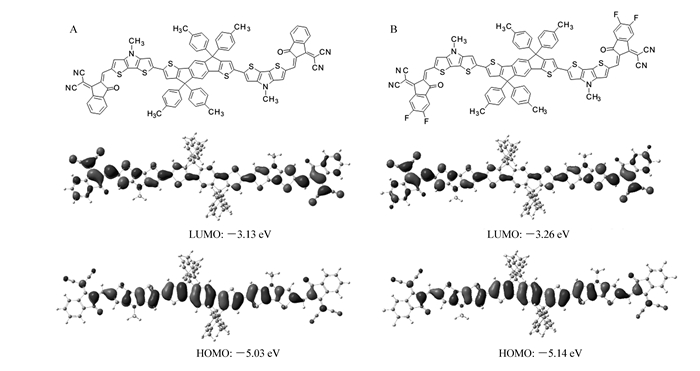
图 2.
以IC(A)或2F-IC(B)为末端单元的分子的前线轨道能级分布计算结果(B3LYP/6-31G(d), density functional theory (DFT)),烷基取代基简化为甲基
Figure 2.
DFT-calculated frontier molecular orbitals of the molecules with IC(A) and 2F-IC(B) as terminals at the B3LYP/6-31G level. All alkyl substituents were replaced with methyl groups for simplifying the calculations
a.The ‘s’ and ‘f’ refer to ‘solution’ and ‘film’, respectively; b.the optical band gap(Egopt) was calculated from the film absorption onset; c.The highest occupied molecular orbital(HOMO) and the lowest unoccupied molecular orbital(LUMO) energies were calculated according to HOMO=-(4.80+Eonsetox) eV and LUMO=-(4.80+Eonsetre) eV, in which Eonsetox and Eonsetre represent oxidation and reduction onset potentials, respectively, versus the half potential of SCE.
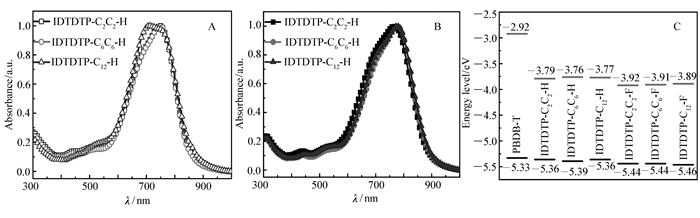
图 3
图 3.
以IC(A)和2F-IC(B)为末端单元的分子薄膜吸收光谱及分子前线轨道能级示意图(C)
Figure 3.
Thin film absorption spectra of the molecules with IC(A) and 2F-IC(B) terminals, and the schematic energy level diagram of the materials(C)
a.Statistical and optimal results are listed outside of parentheses and in parentheses, respectively, and average values are obtained from ten devices; b.with 0.5% DIO as solvent additive and thermal annealing at 120 ℃ for 10 min; c.with 0.5% DIO as solvent additive and thermal annealing at 100 ℃ for 10 min; d.with thermal annealing at 120 ℃ for 10 min; e.with thermal annealing at 100 ℃ for 10 min.
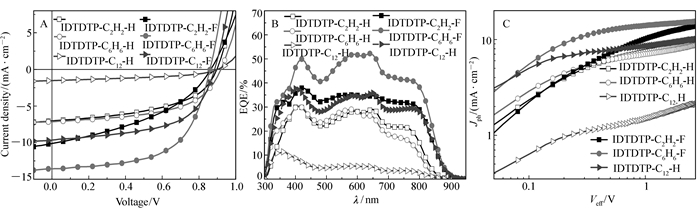
Figure 4.
Current density-voltage(J-V) characteristics(A), the external quantum efficiency(EQE) curves(B), and photocurrent density versus effective voltage(Jph-Veff) characteristics (C) of the devices under the optimized conditions
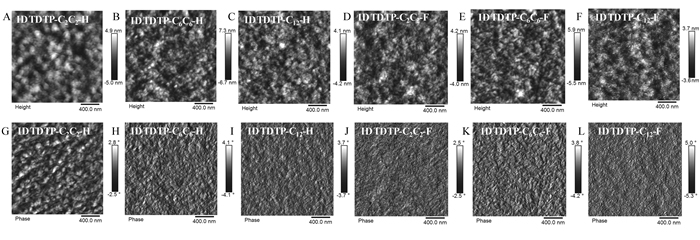
Figure 5.
AFM height(A~F) and phase(G~L) images of PBDB-T:IDTDTP-C2C2-H blend film(A and G), PBDB-T:IDTDTP-C6C6-H blend film(B and H), PBDB-T:IDTDTP-C12-H blend film(C and I), PBDB-T:IDTDTP-C2C2-F blend film(D and J), PBDB-T:IDTDTP-C6C6-F blend film(E and K), PBDB-T:IDTDTP-C12-F blend film(F and L)
Cheng Y J, Yang S H, Hsu C S. Synthesis of Conjugated Polymers for Organic Solar Cell Applications[J]. Chem Rev,
2009, 109(11):
5868-5923.
doi: 10.1021/cr900182s
[2]
Li Y F. Molecular Design of Photovoltaic Materials for Polymer Solar Cells:Toward Suitable Electronic Energy Levels and Broad Absorption[J]. Acc Chem Res,
2012, 45(5):
723-733.
doi: 10.1021/ar2002446
[3]
Li G, Zhu R, Yang Y. Polymer Solar Cells[J]. Nat Photonics,
2012, 6:
153-161.
doi: 10.1038/nphoton.2012.11
[4]
Kim T, Kim J H, Kang T E. Flexible, Highly Efficient All-Polymer Solar Cells[J]. Nat Commun,
2015, 6:
8547-8553.
doi: 10.1038/ncomms9547
[5]
Sun C, Pan F, Bin H. A Low Cost and High Performance Polymer Donor Material for Polymer Solar Cells[J]. Nat Commun,
2018, 9:
743-752.
doi: 10.1038/s41467-018-03207-x
[6]
Guo X, Zhou N, Lou S J. Polymer Solar Cells with Enhanced Fill Factors[J]. Nat Photonics,
2013, 7:
825-833.
doi: 10.1038/nphoton.2013.207
[7]
Wang M, Hu X, Liu P. Donor-Acceptor Conjugated Polymer Based on Naphtho[1, 2-c:5, 6-c]bis[1, 2, 5] thiadiazole for High-Performance Polymer Solar Cells[J]. J Am Chem Soc,
2011, 133(25):
9638-9641.
doi: 10.1021/ja201131h
[8]
Wu W, Zhang G, Xu X. Wide Bandgap Molecular Acceptors with a Truxene Core for Efficient Nonfullerene Polymer Solar Cells:Linkage Position on Molecular Configuration and Photovoltaic Properties[J]. Adv Funct Mater,
2018, 28(18):
1707493.
doi: 10.1002/adfm.201707493
[9]
Liu J, Chen S, Qian D. Fast Charge Separation in a Non-fullerene Organic Solar Cell with a Small Driving Force[J]. Nat Energy,
2016, 1:
16089.
doi: 10.1038/nenergy.2016.89
[10]
Li S, Ye L, Zhao W. Energy-Level Modulation of Small-Molecule Electron Acceptors to Achieve over 12% Efficiency in Polymer Solar Cells[J]. Adv Mater,
2016, 28(42):
9423-9429.
doi: 10.1002/adma.201602776
[11]
Qiu N, Zhang H, Wan X. A New Nonfullerene Electron Acceptor with a Ladder Type Backbone for High-Performance Organic Solar Cells[J]. Adv Mater,
2017, 29(6):
1604964.
doi: 10.1002/adma.201604964
[12]
Yang Y, Zhang Z G, Bin H. Side-Chain Isomerization on an N-Type Organic Semiconductor ITIC Acceptor Makes 11.77% High Efficiency Polymer Solar Cells[J]. J Am Chem Soc,
2016, 138(45):
15011-15018.
doi: 10.1021/jacs.6b09110
[13]
Cheng P, Li G, Zhan X. Next-Generation Organic Photovoltaics Based on Non-fullerene Acceptors[J]. Nat Photonics,
2018, 12:
131-142.
doi: 10.1038/s41566-018-0104-9
[14]
Lin Y, Wang J, Zhang Z G. An Electron Acceptor Challenging Fullerenes for Efficient Polymer Solar Cells[J]. Adv Mater,
2015, 27(7):
1170-1174.
doi: 10.1002/adma.201404317
[15]
Lin Y, Zhang Z G, Bai H. High-Performance Fullerene-Free Polymer Solar Cells with 6.31% Efficiency[J]. Energy Environ Sci,
2015, 8:
610-616.
doi: 10.1039/C4EE03424D
[16]
Lin Y, Zhao F, He Q. High-Performance Electron Acceptor with Thienyl Side Chains for Organic Photovoltaics[J]. J Am Chem Soc,
2016, 138(14):
4955-4961.
doi: 10.1021/jacs.6b02004
[17]
Zhao F, Dai S, Wu Y. Single-Junction Binary-Blend Nonfullerene Polymer Solar Cells with 12.1% Efficiency[J]. Adv Mater,
2017, 29(18):
1700144.
doi: 10.1002/adma.201700144
[18]
Liu F, Zhou Z, Zhang C. A Thieno[3, 4-b]thiophene-Based Non-fullerene Electron Acceptor for High-Performance Bulk-Heterojunction Organic Solar Cells[J]. J Am Chem Soc,
2016, 138(48):
15523-15526.
doi: 10.1021/jacs.6b08523
[19]
Li R, Liu G, Xie R. Introducing Cyclic Alkyl Chains into Small-molecule Acceptors for Efficient Polymer Solar Cells[J]. J Mater Chem C,
2018, 6:
7046-7053.
doi: 10.1039/C8TC01780H
[20]
Liu Y, Zhang Z, Feng S. Exploiting Noncovalently Conformational Locking as a Design Strategy for High Performance Fused-Ring Electron Acceptor Used in Polymer Solar Cells[J]. J Am Chem Soc,
2017, 139(9):
3356-3359.
doi: 10.1021/jacs.7b00566
[21]
Zhao W, Li S, Yao H. Molecular Optimization Enables over 13% Efficiency in Organic Solar Cells[J]. J Am Chem Soc,
2017, 139(21):
7148-7151.
doi: 10.1021/jacs.7b02677
[22]
Li R, Liu G, Xiao M. Non-Fullerene Acceptors Based on Fused-ring Oligomers for Efficient Polymer Solar Cells via Complementary Light-Absorption[J]. J Mater Chem A,
2017, 5:
23926-23936.
doi: 10.1039/C7TA06631G
[23]
Sun J, Ma X, Zhang Z. Dithieno[3, 2-b:2', 3'-d]pyrrol Fused Nonfullerene Acceptors Enabling over 13% Efficiency for Organic Solar Cells[J]. Adv Mater,
2018, 30(16):
1707150.
doi: 10.1002/adma.201707150
[24]
Xu X, Yu T, Bi Z. Realizing over 13% Efficiency in Green-Solvent-Processed Nonfullerene Organic Solar Cells Enabled by 1, 3, 4-Thiadiazole-Based Wide-Bandgap Copolymers[J]. Adv Mater,
2018, 30(3):
1703973.
doi: 10.1002/adma.201703973
[25]
Zhao W, Zhang S, Zhang Y. Environmentally Friendly Solvent-Processed Organic Solar Cells that are Highly Efficient and Adaptable for the Blade-Coating Method[J]. Adv Mater,
2018, 30(4):
1704837.
doi: 10.1002/adma.201704837
[26]
Li S, Ye L, Zhao W. A Wide Band Gap Polymer with a Deep Highest Occupied Molecular Orbital Level Enables 14.2% Efficiency in Polymer Solar Cells[J]. J Am Chem Soc,
2018, 140(23):
7159-7167.
doi: 10.1021/jacs.8b02695
[27]
Xiao Z, Jia X, Ding L. Ternary Organic Solar Cells Offer 14% Power Conversion Efficiency[J]. Sci Bull,
2017, 62:
1562-1564.
doi: 10.1016/j.scib.2017.11.003
[28]
Li W, Hendriks K H, Wienk M M. Diketopyrrolopyrrole Polymers for Organic Solar Cells[J]. Acc Chem Res,
2016, 49(1):
78-85.
doi: 10.1021/acs.accounts.5b00334
[29]
You J, Dou L, Yoshimura K. A Polymer Tandem Solar Cell with 10.6% Power Conversion Efficiency[J]. Nat Commun,
2013, 4:
1446-1455.
doi: 10.1038/ncomms2411
[30]
Li W, Furlan A, Hendriks K H. Efficient Tandem and Triple-Junction Polymer Solar Cells[J]. J Am Chem Soc,
2013, 135(15):
5529-5532.
doi: 10.1021/ja401434x
[31]
Chang C Y, Zuo L, Yip H L. A Versatile Fluoro-Containing Low-Bandgap Polymer for Efficient Semitransparent and Tandem Polymer Solar Cells[J]. Adv Funct Mater,
2013, 23(40):
5084-5090.
doi: 10.1002/adfm201301557
[32]
Zhou E, Wei Q, Yamakawa S. Diketopyrrolopyrrole-Based Semiconducting Polymer for Photovoltaic Device with Photocurrent Response Wavelengths up to 1.1μm[J]. Macromolecules,
2010, 43(2):
821-826.
doi: 10.1021/ma902398q
[33]
Bai H, Wang Y, Cheng P. An Electron Acceptor Based on Indacenodithiophene and 1, 1-Dicyanomethylene-3-Indanone for Fullerene-Free Organic Solar Cells[J]. J Mater Chem A,
2015, 3(5):
1910-1914.
doi: 10.1039/C4TA06004K
[34]
Yao H, Chen Y, Qin Y. Design and Synthesis of a Low Bandgap Small Molecule Acceptor for Efficient Polymer Solar Cells[J]. Adv Mater,
2016, 28(37):
8283-8287.
doi: 10.1002/adma.201602642
[35]
Cui Y, Yang C, Yao H. Efficient Semitransparent Organic Solar Cells with Tunable Color Enabled by an Ultralow-Bandgap Nonfullerene Acceptor[J]. Adv Mater,
2017, 29(43):
1703080.
doi: 10.1002/adma.201703080
[36]
Yao H, Cui Y, Yu R. Design, Synthesis, and Photovoltaic Characterization of a Small Molecular Acceptor with an Ultra-Narrow Band Gap[J]. Angew Chem Int Ed,
2017, 56(11):
3045-3049.
doi: 10.1002/anie.201610944
[37]
Yan C, Wu Y, Wang J. Enhancing Performance of Non-Fullerene Organic Solar Cells via Side Chain Engineering of Fused-Ring Electron Acceptors[J]. Dyes Pigm,
2017, 139:
627-634.
doi: 10.1016/j.dyepig.2016.12.065
[38]
Liang Z, Li M, Zhang X. Near-Infrared Absorbing Non-Fullerene Acceptors with Selenophene as π Bridges for Efficient Organic Solar Cells[J]. J Mater Chem A,
2018, 6:
8059-8067.
doi: 10.1039/C8TA00783G
[39]
Liu F, Zhou Z, Zhang C. Efficient Semitransparent Solar Cells with High NIR Responsiveness Enabled by a Small-Bandgap Electron Acceptor[J]. Adv Mater,
2017, 29(21):
1606574.
doi: 10.1002/adma.201606574
[40]
Duan C, Franeker J J, Wienk M M. High Open Circuit Voltage Polymer Solar Cells Enabled by Employing Thiazoles in Semiconducting Polymers[J]. Polym Chem,
2016, 7:
5730-5738.
doi: 10.1039/C6PY01083K
[41]
Duan C, Gao K, Colberts F J M. Thiophene Rings Improve the Device Performance of Conjugated Polymers in Polymer Solar Cells with Thick Active Layers[J]. Adv Energy Mater,
2017, 7(19):
1700519.
doi: 10.1002/aenm.201700519
[42]
Hou J, Inganas O, Friend R H. Organic Solar Cells Based on Non-fullerene Acceptors[J]. Nat Mater,
2018, 17(2):
119-128.
doi: 10.1038/nmat5063
[43]
Huang C, Liao X, Gao K. Highly Efficient Organic Solar Cells Based on S, N-Heteroacene Non-fullerene Acceptors[J]. Chem Mater,
2018, 30(15):
5429-5434.
doi: 10.1021/acs.chemmater.8b02276
[44]
Yue W, Zhao Y, Shao S. Novel NIR-Absorbing Conjugated Polymers for Efficient Polymer Solar Cells:Effect of Alkyl Chain Length on Device Performance[J]. J Mater Chem,
2009, 19:
2199-2206.
doi: 10.1039/b818885h
[45]
Zhou E, Nakamura M, Nishizawa T. Synthesis and Photovoltaic Properties of a Novel Low Band Gap Polymer Based on N-Substituted Dithieno[3, 2-b:2', 3'-d]pyrrole[J]. Macromolecules,
2008, 41(22):
8302-8305.
doi: 10.1021/ma802052w
[46]
Duan C, Willems R E M, Franeker J J. Effect of Side Chain Length on the Charge Transport, Morphology, and Photovoltaic Performance of Conjugated Polymers in Bulk Heterojunction Solar Cells[J]. J Mater Chem A,
2016, 4:
1855-1866.
doi: 10.1039/C5TA09483F
[47]
Bin H, Gao L, Zhang Z G. 11.4% Efficiency Non-Fullerene Polymer Solar Cells with Trialkylsilyl Substituted 2D-Conjugated Polymer as Donor[J]. Nat Commun,
2016, 7:
13651-13661.
doi: 10.1038/ncomms13651
[48]
Wang J, Wang S, Duan C. Conjugated Polymers Based on Difluorobenzoxadiazole Toward Practical Application of Polymer Solar Cells[J]. Adv Energy Mater,
2017, 7(22):
1702033.
doi: 10.1002/aenm.201702033
[49]
Jia X, Chen Z, Duan C. Polythiophene Derivatives Compatible with Both Fullerene and Non-fullerene Acceptors for Polymer Solar Cells[J]. J Mater Chem C,
2019, 7:
314-323.
doi: 10.1039/C8TC04746D
[50]
Yang Y, Zhang Z G, Bin H. Side-Chain Isomerization on an n-type Organic Semiconductor ITIC Acceptor Makes 11.77% High Efficiency Polymer Solar Cells[J]. J Am Chem Soc,
2016, 138(45):
15011-15018.
doi: 10.1021/jacs.6b09110
[51]
Liu X, Zhang C, Duan C. Morphology Optimization via Side Chain Engineering Enables All-Polymer Solar Cells with Excellent Fill Factor and Stability[J]. J Am Chem Soc,
2018, 140(28):
8934-8943.
doi: 10.1021/jacs.8b05038
[52]
Liu X, Xie B, Duan C. A High Dielectric Constant Non-Fullerene Acceptor for Efficient Bulk-Heterojunction Organic Solar Cells[J]. J Mater Chem A,
2018, 6:
395-403.
doi: 10.1039/C7TA10136H
[53]
Chen S, Lee K C, Zhang Z G. An Indacenodithiophene-Quinoxaline Polymer Prepared by Direct Arylation Polymerization for Organic Photovoltaics[J]. Macromolecules,
2016, 49(2):
527-536.
doi: 10.1021/acs.macromol.5b02324
[54]
Perera I R, Gupta A, Xiang W. Introducing Manganese Complexes as Redox Mediators for Dye-Sensitized Solar Cells[J]. Phys Chem Chem Phys,
2014, 16:
12021-12028.
doi: 10.1039/c3cp54894e
[55]
Zhang Z G, Qi B, Jin Z. Perylene Diimides:A Thickness-Insensitive Cathode Interlayer for High Performance Polymer Solar Cells[J]. Energy Environ Sci,
2014, 7:
1966-1973.
doi: 10.1039/c4ee00022f
[56]
Wu Y, Yang H, Zou Y. A New Dialkylthio-Substituted Naphtho[2, 3-c]thiophene-4, 9-dione Based Polymer Donorfor High-Performance Polymer Solar Cells[J]. Energy Environ Sci,
2019, 12(2):
675-683.
doi: 10.1039/C8EE03608J
[57]
Guo B, Li W, Guo X. High Efficiency Nonfullerene Polymer Solar Cells with Thick Active Layer and Large Area[J]. Adv Mater,
2017, 29(36):
1702291.
doi: 10.1002/adma.201702291
[58]
Fan Q, Wang Y, Zhang M. High-Performance As-Cast Nonfullerene Polymer Solar Cells with Thicker Active Layer and Large Area Exceeding 11% Power Conversion Efficiency[J]. Adv Mater,
2018, 30(6):
1704546.
doi: 10.1002/adma.201704546
图 2
以IC(A)或2F-IC(B)为末端单元的分子的前线轨道能级分布计算结果(B3LYP/6-31G(d), density functional theory (DFT)),烷基取代基简化为甲基
Figure 2
DFT-calculated frontier molecular orbitals of the molecules with IC(A) and 2F-IC(B) as terminals at the B3LYP/6-31G level. All alkyl substituents were replaced with methyl groups for simplifying the calculations
Figure 4
Current density-voltage(J-V) characteristics(A), the external quantum efficiency(EQE) curves(B), and photocurrent density versus effective voltage(Jph-Veff) characteristics (C) of the devices under the optimized conditions
Figure 5
AFM height(A~F) and phase(G~L) images of PBDB-T:IDTDTP-C2C2-H blend film(A and G), PBDB-T:IDTDTP-C6C6-H blend film(B and H), PBDB-T:IDTDTP-C12-H blend film(C and I), PBDB-T:IDTDTP-C2C2-F blend film(D and J), PBDB-T:IDTDTP-C6C6-F blend film(E and K), PBDB-T:IDTDTP-C12-F blend film(F and L)
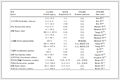
Table 1.
Photophysical and electrochemical properties of the molecules
Acceptor
Td /℃
λmaxs/nma
λmaxf/nma
Egopt/eVb
Eonsetox(V)/HOMO(eV)c
Eonsetre(V)/LUMO(eV)c
IDTDTP-C2C2-H
345
732
750
1.44
0.56/-5.36
-1.01/-3.79
IDTDTP-C6C6-H
366
733
749
1.44
0.59/-5.39
-1.04/-3.76
IDTDTP-C12-H
392
733
710
1.42
0.56/-5.36
-1.03/-3.77
IDTDTP-C2C2-F
401
750
763
1.38
0.64/-5.44
-0.88/-3.92
IDTDTP-C6C6-F
362
750
776
1.38
0.64/-5.44
-0.89/-3.91
IDTDTP-C12-F
371
750
778
1.37
0.66/-5.46
-0.91/-3.89
a.The ‘s’ and ‘f’ refer to ‘solution’ and ‘film’, respectively; b.the optical band gap(Egopt) was calculated from the film absorption onset; c.The highest occupied molecular orbital(HOMO) and the lowest unoccupied molecular orbital(LUMO) energies were calculated according to HOMO=-(4.80+Eonsetox) eV and LUMO=-(4.80+Eonsetre) eV, in which Eonsetox and Eonsetre represent oxidation and reduction onset potentials, respectively, versus the half potential of SCE.
Table 2.
The photovoltaic parameters of the OSCs based on IDTDTP-C2C2-H(F), IDTDTP-C6C6-H(F) and IDTDTP-C12-H(F)a
Acceptor
Treatment
Voc /V
Jsc/(mA·cm-2)
FF/%
PCE/%
IDTDTP-C2C2-H
As-cast
0.89±0.01(0.89)
6.25±0.31(6.59)
34.0±0.6(34.8)
1.89±0.12(2.04)
DIO/TAb
0.89±0.01(0.90)
6.93±0.09(7.03)
49.3±0.3(49.7)
3.03±0.09(3.13)
IDTDTP-C6C6-H
As-cast
0.92±0.01(0.93)
6.60±0.13(6.76)
37.8±0.9 (39.0)
2.28±0.11(2.44)
DIO/TAc
0.92±0.01(0.92)
6.97±0.14(7.14)
53.7±0.4(54.2)
3.44±0.08(3.56)
IDTDTP-C12-H
As-cast
0.90±0.01(0.90)
1.22±0.15(1.40)
42.0±0.5(42.9)
0.47±0.05(0.54)
TAd
0.90±0.01(0.90)
1.33±0.14(1.52)
42.6±1.0(43.7)
0.51±0.09(0.61)
IDTDTP-C2C2-F
As-cast
0.87±0.01(0.87)
9.02±0.25(9.32)
34.4±0.8(35.5)
2.70±0.14(2.89)
TAe
0.87±0.01(0.87)
10.02±0.13(10.19)
40.1±0.5(40.7)
3.50±0.10(3.62)
IDTDTP-C6C6-F
As-cast
0.86±0.01(0.87)
11.69±0.20(11.92)
51.0±1.1(52.2)
5.21±0.19(5.41)
TAd
0.86±0.01(0.86)
13.37±0.13(13.56)
59.4±0.1(59.5)
6.83±0.08(6.94)
IDTDTP-C12-F
As-cast
0.89±0.01(0.90)
8.98±0.19(9.23)
53.4±0.4(54.1)
4.31±0.15(4.51)
DIO/TAc
0.88±0.01(0.89)
9.36±0.16(9.57)
56.0±0.6(56.8)
4.64±0.17(4.84)
a.Statistical and optimal results are listed outside of parentheses and in parentheses, respectively, and average values are obtained from ten devices; b.with 0.5% DIO as solvent additive and thermal annealing at 120 ℃ for 10 min; c.with 0.5% DIO as solvent additive and thermal annealing at 100 ℃ for 10 min; d.with thermal annealing at 120 ℃ for 10 min; e.with thermal annealing at 100 ℃ for 10 min.


 下载:
下载:

 下载:
下载:


 下载:
下载:

