石墨烯基电极材料在柔性全固态超级电容器中的研究进展

李宁 陈涛

引用本文: 李宁, 陈涛. 石墨烯基电极材料在柔性全固态超级电容器中的研究进展[J]. 应用化学, 2018, 35(3): 259-271. doi: 10.11944/j.issn.1000-0518.2018.03.170381 shu
Citation:  LI Ning, CHEN Tao. Recent Progress on Graphene-Based Flexible All-Solid-State Supercapacitors[J]. Chinese Journal of Applied Chemistry, 2018, 35(3): 259-271. doi: 10.11944/j.issn.1000-0518.2018.03.170381 shu

石墨烯基电极材料在柔性全固态超级电容器中的研究进展

    通讯作者: 陈涛, 特聘研究员; Tel/Fax:021-65985033;E-mail:tchen@tongji.edu.cn; 研究方向:纳米能源材料与柔性器件
  • 基金项目:

    国家自然科学基金(51503152,51702237),上海市启明星计划(17QA1404300);上海市东方学者和上海市青年拔尖人才计划资助

摘要: 随着电子产品向着智能化、微型化和便携化的方向发展,亟需发展与之匹配的高效柔性储能器件。超级电容器由于功率密度高、循环寿命长、安全无污染、易于实现其柔性化等特点,近年来引起人们的广泛关注。石墨烯材料具有极高的比表面积、优异的电化学性能和良好的机械稳定性,被广泛作为柔性全固态超级电容器的电极材料。本文简要介绍了石墨烯电极材料的制备方法,并总结了其在柔性全固态超级电容器中的最新研究进展,探讨了其发展前景和面临的挑战。

English

  • 目前,柔性、可穿戴智能电子设备,如谷歌眼镜、苹果手表、小米手环等,引起人们的极大关注和兴趣[1-3]。柔性、可穿戴设备可以集成生物传感、智能识别、柔性显示、无线通信等前沿技术,应用于运动检测、健康管理、休闲娱乐、移动支付等诸多领域,实现与日常生活的完美对接[4-6]。而这些柔性、可穿戴电子产品需要与之相匹配的柔性储能器件如超级电容器、锂离子电池等进行连续供电以保证其正常运行[7-8]。超级电容器具有功率密度高、循环寿命长、成本低、充电快等特点,作为高效储能器件具有极大的应用潜力[9-10]。传统的基于液体电解质的超级电容器需进行封装以防止电解质泄露,通常具有较大体积且不可弯曲,难以满足当今柔性电子产品的应用需求[11]。而基于凝胶电解质的全固态超级电容器能够方便地制备到柔性基底上,具有较轻的质量、良好的柔性,近年来发展迅速[12-14]。石墨烯材料具有极大的比表面积、优异的电学和力学性能,被广泛用作超级电容器的电极材料[15-16]。电荷或离子能够在石墨烯片层间快速传输或扩散,实现具有较高性能的柔性全固态超级电容器。通常情况下,石墨烯可以被制作成一维纤维、二维薄膜和三维泡沫,作为电极材料构筑具有多种结构的柔性全固态超级电容器;并能通过多种合成技术将不同结构的双电层电容石墨烯材料与其它赝电容材料复合,获得高性能的柔性全固态超级电容器[17-18]

    石墨烯是由sp2杂化碳原子形成的具有蜂窝点阵六边形结构的二维层状碳纳米材料,具有导电性高、比表面积大、结构稳定和强度高等优异性能,成为电化学储能领域的研究热点[19-21]。为满足不同结构的柔性全固态超级电容器的需求,石墨烯可以被组装成一维石墨烯纤维、二维石墨烯薄膜和三维石墨烯泡沫。下面分别简要介绍其制备方法。

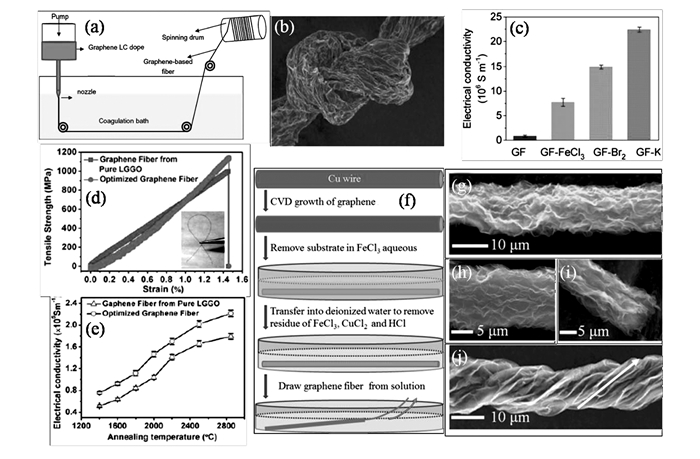
    一维石墨烯纤维不仅具有优异的导电性能,还具有较传统金属丝和涂有导电层的聚合物纤维更为优异的柔性和稳定性,在纤维状、可穿戴能量器件中具有重要的应用价值和潜力[22-23]。石墨烯纤维可通过湿法凝固纺丝法和化学气相沉积直接合成法制备[24-25]。其中,前者借助于氧化石墨烯在溶液中的液晶取向行为来制备宏观石墨烯纤维。Gao课题组[26]用注射器将氧化石墨烯(GO)分散液注入到NaOH/甲醇的凝固浴中,在凝固浴的作用下获得直径均匀的氧化石墨烯纤维;通过后续的化学还原步骤,得到石墨烯纤维[26](图 1a)。纤维的直径可通过调控注射器喷头的尺寸和注入速率来控制。由于致密堆叠的石墨烯片间较强的相互作用,湿法纺丝制备的还原氧化石墨烯(rGO)纤维具有优异的机械性能(拉伸强度为140 MPa)和导电性能(电导率为2.5×10⁴ S/m);并且具有优异的柔性[26](图 1b),能被编织成任意形状而不会发生结构破坏。此外,通过杂原子掺杂和高温热处理,能够进一步提高石墨烯纤维的电导率和机械强度(图 1c),并可实现连续化制备[27]。通过对GO片层尺寸的设计,利用大尺寸(平均粒径为23 μm)GO构成高度取向的纤维骨架,用质量分数为30%的小尺寸(平均粒径为0.8 μm)GO填充空隙,然后进行高温(2850 ℃)退火处理,获得高强度(1080 MPa)和高电导率(2.21×10⁵ S/m)的石墨烯纤维(图 1d1e)[28]

    图 1

    图 1  (a) 湿法纺丝制备GO纤维示意图[26];(b)打结的rGO纤维的SEM照片[26];(c)未掺杂和掺杂石墨烯纤维的电导率对比[27];(d)石墨烯纤维的应力-应变曲线[28];(e)石墨烯纤维的电导率随退火温度的变化曲线[28];(f)CVD法制备石墨烯纤维的流程图[30];(g~j)石墨烯纤维的SEM照片[30]
    Figure 1.  (a)The schematic of wet-spinning process from GO liquid crystals to fibers in a continuous manner[26]. (b)SEM image of a knotted rGO fiber[26]. (c)Electrical conductivities of the pure graphene fibers and doped graphene fibers[27]. (d)Stress-strain curves of graphene fibers[28]. (e)Electrical conductivity of graphene fibers upon thermal annealing temperature[28]. (f)Schematic illumination of the route to fabricate graphene fiber from CVD-grown hollow multilayer graphene tube[30]. (g~j)SEM images of the graphene fibers from CVD-grown graphene tubes[30]

    另外一种制备石墨烯纤维的方法是基于化学气相沉积法(CVD)生长的石墨烯片层,在溶剂表面张力的作用下,直接从溶液中拉出并收缩成石墨烯纤维。该法[29]首先采用CVD法在铜箔上合成多层石墨烯,刻蚀掉铜基底后,直接从溶剂中拉出,在溶剂表面张力的作用下收缩形成具有多孔结构的石墨烯纤维。然而,石墨烯片层边缘处含有较多的结构缺陷,从溶液中拉出时不足以克服溶液较强的表面张力,极易被撕裂,很难获得较长的石墨烯纤维。Chen等[30]采用CVD法在铜丝上合成多层石墨烯,刻蚀掉铜基底后得到悬浮在溶液中的连续中空石墨烯管。该连续的中空石墨烯管仅端部具有缺陷,使其能够从具有较大表面张力的水中直接拉出具有多孔结构的石墨烯纤维(如图 1f~1j所示)。基于CVD生长的石墨烯纤维的直径可通过控制铜丝的直径和石墨烯的层数来调控,其长度可通过控制铜丝的长度进行调节。另外,这种方法合成的石墨烯纤维即使弯曲循环1000次,仍保持稳定的机械性能和电化学性能,显示出优异的柔性。

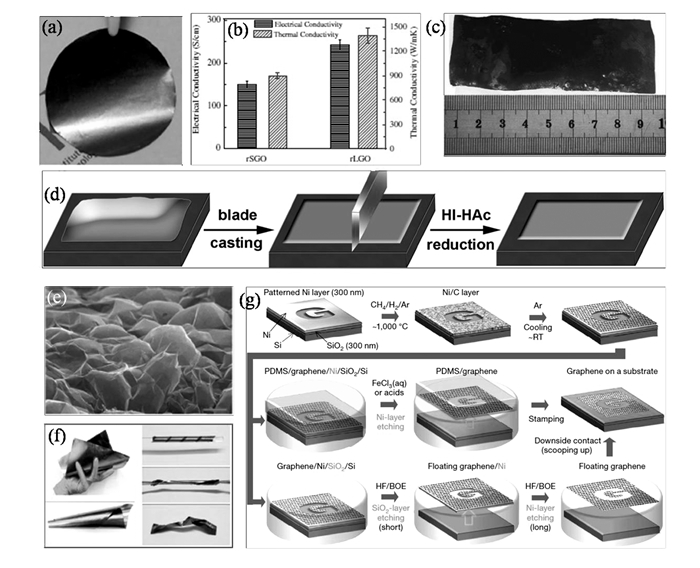
    制备宏观二维石墨烯薄膜的常用方法有3种,即真空抽滤、湿法合成和化学气相沉积[31-33]。真空抽滤法主要是利用压力差来排除溶剂形成薄膜,将GO分散液通过离心分离出大片层和小片层,然后抽滤成膜,再用氢碘酸还原得到石墨烯薄膜(图 2a2b)[34]。研究表明,基于大片GO的还原石墨烯薄膜具有更高的电导率,因为GO片层越大,薄膜中石墨烯片层之间的接触点越少,所产生的接触电阻越小。制备过程简单,易于操作,但耗时较长,且薄膜大小受限于滤纸大小。湿法合成则是先制备GO水凝胶,然后还原干燥得到石墨烯薄膜。基于GO水凝胶,采用传统的刮涂技术得到GO凝胶膜,然后用氢碘酸或者乙酸进行化学还原得到多孔石墨烯薄膜(图 2c2d)[35-36]。通过类似方法,在铜箔基底上将具有大尺寸的GO凝胶刮涂成膜并干燥,最后通过高温热还原得到具有超高柔性的多孔石墨烯薄膜(图 2e2f)[37]。该方法可制备任意尺寸大小的二维石墨烯薄膜,薄膜的厚度可通过控制制膜过程中GO凝胶的用量进行调控,操作方便,易于控制。除上述基于GO的溶液法,大面积石墨烯薄膜还可以通过CVD法直接合成。比如,首先利用电子束蒸发技术在硅片表面沉积一层300 nm厚的Ni膜,然后以甲烷作为碳源,在1000 ℃进行CVD合成石墨烯,最后刻蚀掉基体,得到石墨烯薄膜(图 2g)[38]。另外,铜箔可以直接作为生长石墨烯的基底,通过CVD直接在任意尺寸大小铜箔上生长多层石墨烯,刻蚀掉基底后得到的多层石墨烯能方便地转移至其它任意基底[39-41]。通过调控CVD合成过程中的碳源和载气的流量等参数,能够合成从单层到多层的高质量石墨烯薄膜,且能够实现大规模制备。

    图 2

    图 2  (a) 真空抽滤法制备的石墨烯薄膜的光学照片[34];(b)分别用大尺寸和小尺寸石墨烯片制备的石墨烯膜的电导率和热导率对比图[34];(c)石墨烯薄膜的光学照片[35];(d)湿法刮涂制备石墨烯薄膜的流程图[35];(e)石墨烯薄膜的SEM照片[37];(f)石墨烯薄膜的柔性[37];(g)CVD法制备多层石墨烯的流程图[38]
    Figure 2.  (a)Digital photograph of the rGO film through filtration method[34]. (b)Electrical and thermal conductivities of small-rGO and large-rGO thin films[34]. (c)Digital photograph of a rGO film[35]. (d)Schematic illustration of the porous rGO film by wet chemical synthesis[35]. (e)SEM image of the rGO film[37]. (f)Flexibility of the rGO film[37]. (g)The schematic CVD process for graphene films[38]

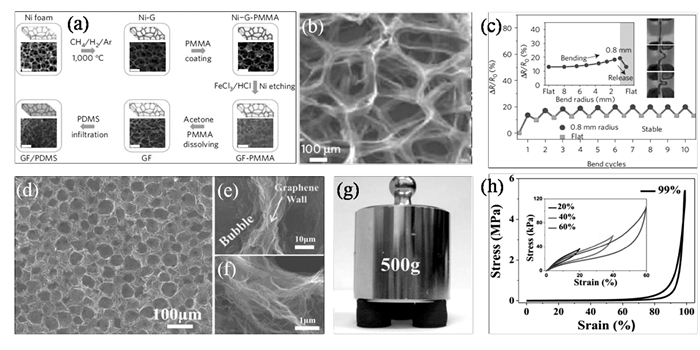
    三维石墨烯泡沫能够极大地降低石墨烯片层间的过度堆叠,增加比表面积的利用率。其制备方法主要有CVD法在海绵状的模板上直接合成,或者使用水热、冷冻干燥、3D打印、浸涂等溶液法先合成GO泡沫再还原成石墨烯泡沫[42-46]图 3a为通过CVD法在泡沫镍基底上合成多孔状石墨烯泡沫[47],其相互连接的三维网络结构(图 3b)为电荷提供快速的传输通道,从而获得较高导电性能。石墨烯泡沫能够被转移至其它柔性基底上,从而表现出良好的柔性甚至可拉伸性(图 3c)。基于溶液法,通过多次浸涂的方法可以在泡沫状材料上负载GO,干燥后直接在酒精火焰上燃烧,快速去除模板得到氮掺杂石墨烯泡沫[48]。在不加入有机溶剂的条件下,以气泡作为模板同样可以制备石墨烯泡沫(图 3d~3f)[49],这种石墨烯泡沫可承受5.4 MPa的压缩应力(图 3g),且即使在1000次压缩回复的循环过程中,仍能保持99%的应变,显示出优异的机械稳定性(图 3h)。CVD合成的石墨烯泡沫由于共价键连接的网络结构而具有优异的机械性能,但高温合成过程和模板的去除使得整个制备过程较为复杂和耗时。基于氧化石墨烯的还原法制备石墨烯泡沫则需要加入粘结剂(如碳纳米管、乙二胺等)才能获得较高的机械性能(如可压缩性)。

    图 3

    图 3  (a) CVD法合成石墨烯泡沫流程图[47];(b)石墨烯泡沫的SEM照片[47];(c)石墨烯/PDMS复合物弯曲状态下的电学性能变化[47];(d~f)超柔性石墨烯泡沫的SEM照片[49];(g)石墨烯泡沫压缩状态下的光学照片[49];(h)石墨烯泡沫不同压缩应变下的应力-应变曲线[49]
    Figure 3.  (a)The schematic of CVD process for the graphene foam[47]. (b)SEM image of a graphene foam[47]. (c)Electrical-resistance change of GF/PDMS composite when bending and then straightening for different cycles[47]. (d~f)SEM images of the ultraelastic graphene foam at different magnifications[49]. (g)The digital image showing the stress tolerance of the graphene foams[49]. (h)Stress-strain curves at different compressive strains of a graphene foam[49]

    不同于传统的基于液态电解质的超级电容器,柔性全固态超级电容器采用凝胶电解质(常用的有聚乙烯醇在硫酸或磷酸溶液中形成的水凝胶),不需要外加隔膜以防止短路,并且解决了液态电解液易泄露和封装的难题。基于石墨烯的电极材料,不仅具有大的比表面积、良好的柔性、优异的电学性能和机械性能,并且能够集电极材料和电荷集流体于一体,使基于石墨烯电极材料的柔性全固态超级电容器的结构更为简单,并易于制备,成为近年来人们关注的热点课题[50-54]。基于不同结构的石墨烯电极材料,可以发展出纤维状、平面状及in-plane微型柔性全固态超级电容器。

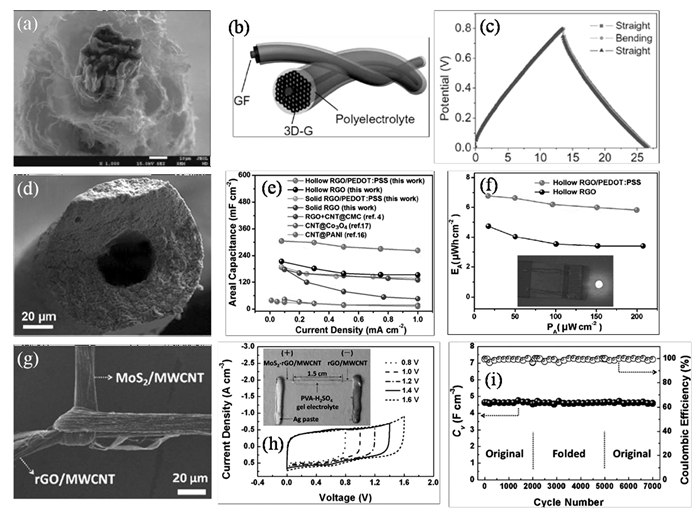
    顾名思义,纤维状柔性全固态超级电容器即具有纤维状结构的超级电容器,能够通过单电极同轴结构、双电极平行结构或缠绕结构方便制得[55-60]。由于其独特的结构,纤维状全固态超级电容器不仅具有良好的柔性,还可以利用传统的纺织技术将其编织、集成到其它织物中,在柔性、可穿戴电子产品领域具有极大的应用价值和潜力。目前,构筑纤维状全固态超级电容器多基于双电极相互缠绕结构,两纤维电极之间用凝胶电解质隔开。由于其大的比表面积、优异的电学和力学性能,石墨烯纤维被广泛用于纤维状柔性全固态超级电容器的构筑[61],其多孔结构和高电导率能够促进电荷或离子的快速传输,获得较高的能量储存效率。Meng等[62]制备了内核为石墨烯纤维、外壳为石墨烯网络的全石墨烯纤维(图 4a)。这种多层次杂化结构的石墨烯纤维不仅保留了内核纤维的高导电性和柔性,外层的石墨烯网络进一步提高了比表面积。基于该石墨烯纤维,所构建的双电极缠绕结构的纤维状全固态超级电容器(图 4b4c)的比容量为1.2~1.7 mF/cm2,在弯曲状态下,器件的电化学性质基本保持不变,表现出良好的柔性。Kou等[63]采用湿法纺丝技术制备核壳结构的聚合物电解质包裹的石墨烯与碳纳米管的复合纤维,基于该复合纤维的双电极缠绕结构的纤维状全固态超级电容器具有超高的面积比容量(177 mF/cm2)和能量密度(3.84 μWh/cm2),并且在进行2000次充放电循环的过程中,其容量无明显的衰减,具有较高的循环稳定性。然而,和其它纳米碳材料一样,超级电容器中石墨烯电极材料仅仅通过静电作用所产生的双电层电容相对较低。因此,通常需要引入其它赝电容材料,利用赝电容材料在充放电过程中发生的氧化还原反应来提高柔性全固态超级电容器的能量储存性能[64-65]。基于中空结构的石墨烯/PEDOT:PSS[聚(3,4-乙烯二氧噻吩)-聚(苯乙烯磺酸)]复合纤维电极(图 4d),所得到的纤维状超级电容器的面积比容量高达304.5 mF/cm2(图 4e),能量密度为6.8 μWh/cm2(图 4f),且在500次弯曲循环过程中,容量几乎保持不变,显示出优异的柔性[66]。为进一步提高器件的开路电压和能量密度,可将纤维状超级电容器制备成非对称结构,比如,以rGO/CNT复合纤维和MoS2-rGO/CNT复合纤维分别作为正极、负极(图 4g)[67],所构建的纤维状非对称超级电容器的电压窗口可以拓宽至1.6 V(图 4h),且具有优异的电化学稳定性和良好的柔性(图 4i)。

    图 4

    图 4  (a) 核壳结构的全石墨烯纤维的截面SEM照片[62];(b)双电极缠绕结构纤维状超级电容器的结构示意图[62];(c)纤维状超级电容器弯曲前后的GCD曲线[62];(d)中空结构石墨烯复合纤维的截面SEM照片[66];(e)纤维状超级电容器在不同电流密度下的比容量变化曲线[66];(f)纤维状超级电容器的能量密度与功率密度的变化曲线[66];(g)打结的rGO/CNT和MoS2 /CNT复合纤维的SEM照片[67];(h)纤维状非对称超级电容器在不同电压窗口的CV曲线[67];(i)纤维状非对称超级电容器的弯曲循环稳定性和库伦效率[67]
    Figure 4.  (a)Cross-sectional SEM image of all-graphene core-sheath microfiber[62]. (b)Schematic illustration of a fiber-shaped supercapacitor fabricated by twisted twographene fibers with polyelectrolyte in between[62]. (c)GCD curves of all-graphene fiber supercapacitor in straight and bending states, respectively[62]. (d)Cross-sectional SEM image of a hollow graphene composite fiber[66]. (e)Dependance of areal specific capacitances on current densities of charge-discharge[66]. (f)Ragone plots the fiber supercapacitors based on bare hollow graphene and its composite fibers[66]. (g)SEM image of tightly knotted MoS2/MWCNT and rGO/MWCNT fibers[67]. (h)CV curves of the fiber-based asymmetric supercapacitor at different potential windows[67]. (i)Cycling and bending stability of volumetric capacitance and Coulombic efficiency[67]

    纤维状全固态超级电容器的性能不仅取决于电极材料,还受纤维电极的直径和长度的影响。研究表明,随着纤维电极直径的增加,在其比表面积和导电性能没有下降的情况下,所制备的纤维状超级电容器的性能随之增加[58]。另一方面,随着纤维电极和器件长度的增加,纤维电极的电阻和器件的内阻相应增大,导致纤维状全固态超级电容器的能量储存性能(比容量)明显降低[68],这是纤维状超级电容器目前所面临的重要挑战,尤其是面向实际应用时大规模生产需要重点解决的问题。因此,纤维状全固态超级电容器性能的进一步发展需要综合考虑电极材料、尺寸、连续化制备等因素的影响,进行系统优化。

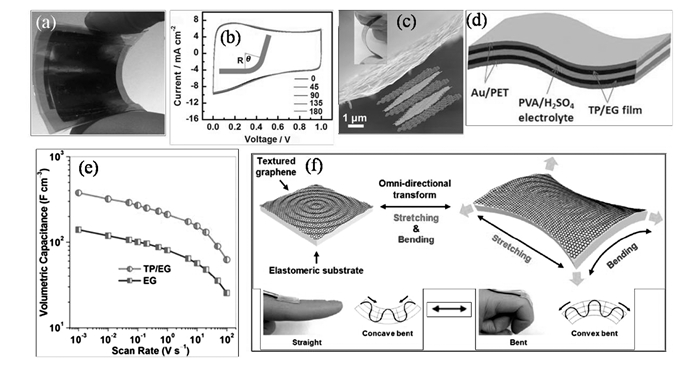
    传统的平面状超级电容器通常需要金属作为电荷集流体,不仅增加了器件的质量和成本,还会限制超级电容器的柔性及其在柔性可穿戴电子设备中的应用[69-73]。石墨烯薄膜优异的电学和力学性能使其可以同时作为平面状全固态超级电容器的电荷集流体和活性电极材料,能够实现高度柔性的器件[74-77]。基于具有超高机械强度的石墨烯薄膜电极,所构建的柔性超级电容器的面积比容量达到71.0 mF/cm2(图 5a),并且具有较高的倍率性能和循环性能,被弯曲至任意角度性能几乎没有降低,显示出优异的柔性(图 5b)[35]。Wu等[78]将电化学剥离的石墨烯(EG)与2D噻吩(TP)纳米片复合(图 5c)制备出具有高倍率性能的柔性全固态超级电容器(图 5d)。研究结果表明,所构建的超级电容器具有明显的氧化还原峰,显示出极高的赝电容,产生的体积比容量、能量密度和功率密度分别可达到375 F/cm3(图 5e)、13 mWh/cm3和776 W/cm3。通过对石墨烯电极材料的设计,并结合透明可拉伸基底,可实现光学透明且可拉伸的全固态超级电容器[79],甚至实现在任意方向的可拉伸性(图 5f)[80]。这类新型可拉伸超级电容器能够在一定破坏力作用下保持性能的稳定,在可穿戴能源器件领域具有广阔应用前景。

    图 5

    图 5  (a) 平面状柔性超级电容器的光学照片[35];(b)平面状超级电容器在不同弯曲状态下的CV曲线[35];(c)TP/EG薄膜的SEM照片[78];(d)平面状柔性全固态超级电容器的示意图[78];(e)基于EG和TP/EG的超级电容器在不同扫速下的体积比容量变化曲线[78];(f)柔性石墨烯电极的全方位拉伸和弯曲的示意图[80]
    Figure 5.  (a)Digital photograph of a planar flexible supercapacitor[35]. (b)CV curves of the film supercapacitor at the different bending states[35]. (c)SEM image of the freestanding TP/EG heterostructure film[78]. (d)The schematic of planar flexible all-solid-state supercapacitor[78]. (e)Volumetric capacitances of the EG and TP/EG all-solid-state supercapacitors at various scan rates[78]. (f)Schematic illustration of the transformation of the graphene film under omni-directional stretching and bending[80]

    受限于电荷或离子在电极材料中的传输速率和距离,膜电极材料的厚度对全固态超级电容器的能量储存效率具有明显的影响。由于液体电解质的离子(或电荷)传导性较好,基于液体电解质的超级电容器的容量基本上随着膜电极材料的厚度相应提高;而固体电解质的离子(或电荷)传导性能相对较低,基于固体电解质的超级电容器的性能随石墨烯膜电极厚度在一定范围内的增加而增加;随着厚度的进一步增加,受限于离子的扩散速率和传输距离,超级电容器的性能则增加有限[81]。因此,石墨烯基材料应用于全固态超级电容器时,需要对膜电极材料的厚度进行优化。另外,石墨烯片层的堆叠通常不利于离子或电荷的传输,导致所制备电容器的性能较低,可通过以下两种手段进行优化:1)构建具有多孔自支撑结构的三维石墨烯气凝胶电极[81],提高石墨烯基电极的有效电化学利用面积;2)通过对石墨烯进行化学改性(比如还原氧化石墨烯的芳基重氮盐化)克服石墨烯片层间相互堆叠的问题,从而进一步提升超级电容器的电化学储能性能[82-84]

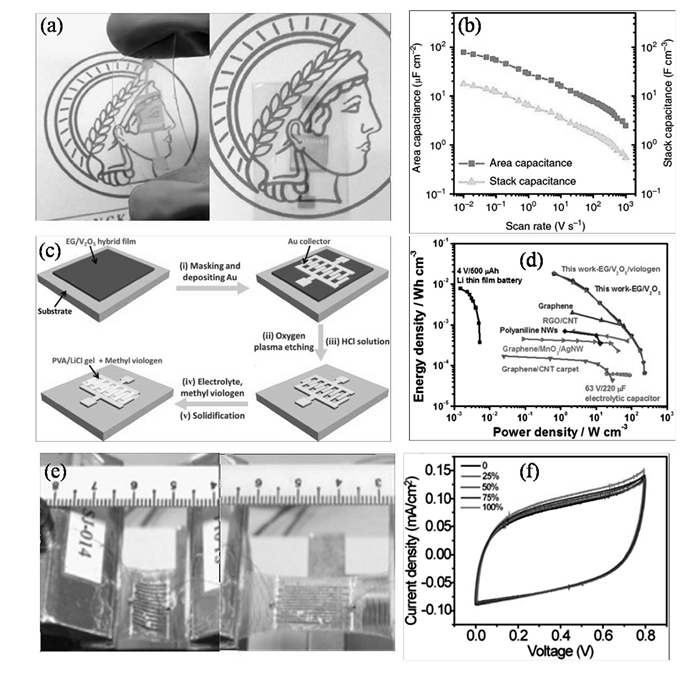
    石墨烯片层之间的严重堆叠,一方面降低了石墨烯电极材料表面积的利用率;另一方面,不利于电荷或离子在层间的扩散和传输,使得基于石墨烯电极材料的平面状超级电容器并未达到预期。基于石墨烯电极材料,如果将其设计成面内型(in-plane)结构,电荷或离子直接沿石墨烯片层进行扩散和传输,而不需要跨越层间进行传输,能极大地提高电容器的性能。另外,面内型全固态超级电容器还能够利用现有的维纳加工技术,实现器件的微型化和集成化[85-92],在微型、便携电子器件领域具有重要的应用价值[93-94]。面内型微型超级电容器可通过图案化的设计策略进行制备[95],具体步骤如下:1)在氧等离子体处理的铜箔上旋涂一层GO分散液,之后用甲烷等离子体进行还原处理得到厚度为6~100 nm石墨烯薄膜;2)将还原后的石墨烯薄膜转移至PET基底上并进行图案化设计;3)在图案化的石墨烯电极上滴涂凝胶电解质得到面内型柔性微型全固态超级电容器(图 6a)。其中,石墨烯电极的宽度和电极之间的距离可通过设计具有不同尺寸的掩膜板进行精确调控。该微型超级电容器的面积比容量为80.7 μF/cm2(体积比容量为17.9 F/cm3)(图 6b),且具有较高的能量密度(2.5 mWh/cm3)和功率密度(495 W/cm3)。基于石墨烯电极材料,引入赝电容材料聚苯胺后,所获得的柔性面内型微型超级电容器不仅具有高的体积比容量(75 F/cm3)和功率密度(600 W/cm3),且其能量密度可达到6.67 mWh/cm3,与目前商业化的薄膜状锂电池相当[96]。另外,结合其它功能电极材料,可实现面内型微型超级电容器的功能化、智能化。比如,基于V2O5纳米带/石墨烯复合电极材料所发展的微型超级电容器(图 6c)的体积比容量、能量密度和功率密度分别为130.7 F/cm3、20 mWh/cm3和235 W/cm3(图 6d)。有趣的是,由于在充放电过程中金属钒价态的转变,使该微型超级电容器表现出可逆的电致变色性能[97]。另外,基于可拉伸基底,通过对石墨烯电极材料的结构设计,可实现柔性、可拉伸微型超级电容器的构筑。采用波浪形石墨烯纳米带所制备的微型超级电容器(图 6e)在被拉伸至100%应变时仍能保持稳定的电化学性能(图 6f)[98]。由于其独特的结构,微型全固态超级电容器在微型化电子器件中具有极大的应用价值和潜力,尤其是用于体表甚至植入型人体健康检测的电子器件领域。

    图 6

    图 6  (a) 有(左)、无(右)金集流体的微型超级电容器照片[95];(b)基于石墨烯电极的面内型微型超级电容器在不同扫速下的面积和体积比容量变化曲线[95];(c)基于EG/V2O5的微型超级电容器制备过程[97];(d)不同材料构建的储能器件的功率密度和能量密度对比图[97];(e)微型超级电容器初始状态和100%拉伸应变下的光学照片[98];(f)微型超级电容器在不同拉伸状态下的CV曲线[98]
    Figure 6.  (a)Digital photographs of the fabricated microsupercapacitors with(left) and without(right) Au collectors[95]. (b)Area capacitances and stack capacitances of the graphene-based in-plane microsupercapacitors[95]. (c)Schematic fabrication of microsupercapacitors based on EG/V2O5[97]. (d)Ragone plots for various energy storage devices[97]. (e)Optical photographs of the microsupercapacitors under 0 and 100% strain, respectively[98]. (f)CV curves of the microsupercapacitors under different stretchable strains[98]

    作为一种制备方法简单、成本低、高性能的新型储能器件,柔性全固态超级电容器在柔性、便携和可穿戴电子产品领域具有极大的应用价值和潜力。由于其高电导率、大比表面积、优异的机械性能等特点,石墨烯作为高效电极材料被广泛应用于高性能柔性全固态超级电容器中。根据不同器件的结构特点,石墨烯可被组装成1D纤维、2D薄膜和3D泡沫以满足不同结构器件对电极材料的需求,并且取得了一系列阶段性研究成果。从材料的角度考虑,如何连续化地制备具有结构均匀、性能稳定可控的石墨烯宏观组装体需要重点关注和解决,这将直接决定石墨烯基电极材料在柔性储能领域甚至其它电子器件领域的实际应用进程。

    尽管基于石墨烯电极材料的柔性全固态超级电容器已经取得了令人瞩目的成果,但是仍然面临诸多挑战。首先,与传统的基于液态电解质体系的超级电容器相比,电荷或离子在电极及电解质中的传输或扩散速率相对困难,导致全固态超级电容器的电化学储能效率较低。因此,进一步提高柔性全固态超级电容器的性能仍然是近期需要重点关注的研究方向。一方面,可通过对石墨烯基电极材料的精确结构调控,限制石墨烯片层间的严重聚集,最大限度地提高石墨烯电极材料的有效可利用面积;另一方面,结合其它赝电容材料,并通过合理调控石墨烯及赝电容材料之间的界面结构和形貌,最大限度地发挥二者的优势,获得较高性能的全固态超级电容器。另外,目前普遍采用的聚乙烯醇凝胶电解质较为单一,难以满足具有多级纳米结构的电极材料,导致所获得的固态超级电容器的性能差异极大,因此,开发具有高离子导电性的新型凝胶电解质对于提高全固态超级电容器的性能具有重要意义。

    随着电子器件向集成化、系统化方向的发展,包括纤维状、面内型等在内的微型全固态超级电容器以及多功能集成器件应该引起足够重视。对于纤维状微型超级电容器,除需进一步提高其能量储存性能外,还需进一步研究器件中电荷或离子在曲形材料中和界面处的传输机制;另外,其性能随器件长度而降低的问题需要重点关注,可能的解决途径是在不损失纤维电极材料大比表面积的情况下,将纤维电极的导电性能通过复合或掺杂提升到金属导线的级别。无论是纤维状还是面内型全固态超级电容器,利用当前较为成熟的微纳加工技术,实现器件的连续化、规模化制备,对于该类型器件的推广应用具有重要意义。总而言之,随着材料制备和器件加工技术的不断发展,基于石墨烯电极材料的柔性全固态超级电容器将在柔性电子器件领域发挥重要作用。

    1. [1]

      Rogers J A, Someya T, Huang Y G. Materials and Mechanics for Stretchable Electronics[J]. Science, 2010, 327(5973):  1603-1607. doi: 10.1126/science.1182383

    2. [2]

      Ramuz M, Tee B C K, Tok J B H. Transparent, Optical, Pressure-sensitive Artificial Skin for Large-area Stretchable Electronics[J]. Adv Mater, 2012, 24(24):  3223-3227. doi: 10.1002/adma.v24.24

    3. [3]

      Majumder S, Mondal T, Deen M J. Wearable Sensors for Remote Health Monitoring[J]. Sensors, 2017, 17(1):  130.

    4. [4]

      Larson C, Peele B, Li S. Highly Stretchable Electroluminescent Skin for Optical Signaling and Tactile Sensing[J]. Science, 2016, 351(6277):  1071-1074. doi: 10.1126/science.aac5082

    5. [5]

      Weng W, Chen P N, He S S. Smart Electronic Textiles[J]. Angew Chem Int Ed, 2016, 55(21):  6140-6169. doi: 10.1002/anie.201507333

    6. [6]

      Gao Y, Ota H, Schaler E W. Wearable Microfluidic Diaphragm Pressure Sensor for Health and Tactile Touch Monitoring[J]. Adv Mater, 2017, 29(39):  1701985. doi: 10.1002/adma.201701985

    7. [7]

      Xie K Y, Wei B Q. Materials and Structures for Stretchable Energy Storage and Conversion Devices[J]. Adv Mater, 2014, 26(22):  3592-3617. doi: 10.1002/adma.v26.22

    8. [8]

      Hu Y H, Sun X L. Flexible Rechargeable Lithium Ion Batteries:Advances and Challenges in Materials and Process Technologies[J]. J Mater Chem A, 2014, 2(28):  10712-10738. doi: 10.1039/C4TA00716F

    9. [9]

      Chen T, Peng H S, Durstock M. High-performance Transparent and Stretchable All-solid Supercapacitors Based on Highly Aligned Carbon Nanotube Sheets[J]. Sci Rep, 2014, 4:  3612.

    10. [10]

      Lv T, Yao Y, Li N. Wearable Fiber-shaped Energy Conversion and Storage Devices Based on Aligned Carbon Nanotubes[J]. Nano Today, 2016, 11(5):  644-660. doi: 10.1016/j.nantod.2016.08.010

    11. [11]

      Chen T, Dai L M. Flexible Supercapacitors Based on Carbon Nanomaterials[J]. J Mater Chem A, 2014, 2(28):  10756-10775. doi: 10.1039/c4ta00567h

    12. [12]

      Lv T, Yao Y, Li N. Highly Stretchable Supercapacitors Based on Aligned Carbon Nanotube/Molybdenum Disulfide Composites[J]. Angew Chem Int Ed, 2016, 55(32):  9191-9195. doi: 10.1002/anie.201603356

    13. [13]

      Chen T, Hao R, Peng H S. High-Performance, Stretchable, Wire-shaped Supercapacitors[J]. Angew Chem Int Ed, 2015, 54(2):  618-622.

    14. [14]

      Wen L, Li F, Cheng H M. Carbon Nanotubes and Graphene for Flexible Electrochemical Energy Storage:From Materials to Devices[J]. Adv Mater, 2016, 28(22):  4306-4337. doi: 10.1002/adma.v28.22

    15. [15]

      Ren W C, Cheng H M. The Global Growth of Graphene[J]. Nat Nanotechnol, 2014, 9(10):  726-730. doi: 10.1038/nnano.2014.229

    16. [16]

      Bonaccorso F, Colombo L, Yu G H. Graphene, Related Two-dimensional Crystals, and Hybrid Systems for Energy Conversion and Storage[J]. Science, 2015, 347(6217):  1246501. doi: 10.1126/science.1246501

    17. [17]

      Li N, Lv T, Yao Y. Compact Graphene/MoS2 Composite Films for Highly Flexible and Stretchable All-solid-state Supercapacitors[J]. J Mater Chem A, 2017, 5(7):  3267-3273. doi: 10.1039/C6TA10165H

    18. [18]

      Xiao F, Yang S X, Zhang Z Y. Scalable Synthesis of Freestanding Sandwich-structured Graphene/Polyaniline/Graphene Nanocomposite Paper for Flexible All-solid-state Supercapacitor[J]. Sci Rep, 2015, 5:  9359. doi: 10.1038/srep09359

    19. [19]

      Dong Y F, Wu Z S, Ren W C. Graphene:A Promising 2D Material for Electrochemical Energy Storage[J]. Sci Bull, 2017, 62(10):  724-740. doi: 10.1016/j.scib.2017.04.010

    20. [20]

      Novoselov K S, Fal'ko V I, Colombo L. A Roadmap for Graphene[J]. Nature, 2012, 490(7419):  192-200. doi: 10.1038/nature11458

    21. [21]

      Xu Z, Peng L, Liu Y J. Experimental Guidance to Graphene Macroscopic Wet-spun Fibers, Continuous Papers, and Ultralightweight Aerogels[J]. Chem Mater, 2017, 29(1):  319-330. doi: 10.1021/acs.chemmater.6b02882

    22. [22]

      Xu Z, Gao C. Graphene Fiber:A New Trend in Carbon Fibers[J]. Mater Today, 2015, 18(9):  480-492. doi: 10.1016/j.mattod.2015.06.009

    23. [23]

      Yang Z B, Sun H, Chen T. Photovoltaic Wire Derived from a Graphene Composite Fiber Achieving an 8.45% Energy Conversion Efficiency[J]. Angew Chem Int Ed, 2013, 52(29):  7545-7548. doi: 10.1002/anie.201301776

    24. [24]

      Meng F C, Lu W B, Li Q W. Graphene-based Fibers:A Review[J]. Adv Mater, 2015, 27(35):  5113-5131. doi: 10.1002/adma.201501126

    25. [25]

      Xu Z, Liu Y J, Zhao X L. Ultrastiff and Strong Graphene Fibers via Full-scale Synergetic Defect Engineering[J]. Adv Mater, 2016, 28(30):  6449-6456. doi: 10.1002/adma.201506426

    26. [26]

      Xu Z, Gao C. Graphene Chiral Liquid Crystals and Macroscopic Assembled Fibres[J]. Nat Commun, 2011, 2:  571. doi: 10.1038/ncomms1583

    27. [27]

      Liu Y J, Xu Z, Zhan J M. Superb Electrically Conductive Graphene Fibers via Doping Strategy[J]. Adv Mater, 2016, 28(36):  7941-7947. doi: 10.1002/adma.201602444

    28. [28]

      Xin G Q, Yao T K, Sun H T. Highly Thermally Conductive and Mechanically Strong Graphene Fibers[J]. Science, 2015, 349(6252):  1083-1087. doi: 10.1126/science.aaa6502

    29. [29]

      Li X M, Zhao T S, Wang K L. Directly Drawing Self-assembled, Porous, and Monolithic Graphene Fiber from Chemical Vapor Deposition Grown Graphene Film and Its Electrochemical Properties[J]. Langmuir, 2011, 27(19):  12164-12171. doi: 10.1021/la202380g

    30. [30]

      Chen T, Dai L M. Macroscopic Graphene Fibers Directly Assembled from CVD-grown Fiber-shaped Hollow Graphene Tubes[J]. Angew Chem Int Ed, 2015, 54(49):  14947-14950. doi: 10.1002/anie.201507246

    31. [31]

      Eda G, Fanchini G, Chhowalla M. Large-area Ultrathin Films of Reduced Graphene Oxide as a Transparent and Flexible Electronic Material[J]. Nat Nanotechnol, 2008, 3(5):  270-274. doi: 10.1038/nnano.2008.83

    32. [32]

      Eigler S, Enzelberger-Heim M, Grimm S. Wet Chemical Synthesis of Graphene[J]. Adv Mater, 2013, 25(26):  3583-3587. doi: 10.1002/adma.201300155

    33. [33]

      Liu L H, Lyu J, Zhao T K. Large Area Preparation of Multilayered Graphene Films by Chemical Vapour Deposition with High Electrocatalytic Activity Toward Hydrogen Peroxide[J]. Mater Technol, 2015, 30(A3):  A121-A126.

    34. [34]

      Kumar P, Shahzad F, Yu S. Large-area Reduced Graphene Oxide Thin Film with Excellent Thermal Conductivity and Electromagnetic Interference Shielding Effectiveness[J]. Carbon, 2015, 94:  494-500. doi: 10.1016/j.carbon.2015.07.032

    35. [35]

      Xiong Z Y, Liao C L, Han W H. Mechanically Tough Large-area Hierarchical Porous Graphene Films for High-performance Flexible Supercapacitor Applications[J]. Adv Mater, 2015, 27(30):  4469-4475. doi: 10.1002/adma.v27.30

    36. [36]

      Zhang M, Huang L, Chen J. Ultratough, Ultrastrong, and Highly Conductive Graphene Films with Arbitrary Sizes[J]. Adv Mater, 2014, 26(45):  7588-7592. doi: 10.1002/adma.v26.45

    37. [37]

      Peng L, Xu Z, Liu Z. Ultrahigh Thermal Conductive yet Superflexible Graphene Films[J]. Adv Mater, 2017, 29(27):  1700589. doi: 10.1002/adma.v29.27

    38. [38]

      Kim K S, Zhao Y, Jang H. Large-scale Pattern Growth of Graphene Films for Stretchable Transparent Electrodes[J]. Nature, 2009, 457(7230):  706-710. doi: 10.1038/nature07719

    39. [39]

      Li X S, Cai W W, An J H. Large-area Synthesis of High-quality and Uniform Graphene Films on Copper Foils[J]. Science, 2009, 324(5932):  1312-1314. doi: 10.1126/science.1171245

    40. [40]

      Wang M, Jang S K, Jang W J. A Platform for Large-scale Graphene Electronics-CVD Growth of Single-layer Graphene on CVD-grown Hexagonal Boron Nitride[J]. Adv Mater, 2013, 25(19):  2746-2752. doi: 10.1002/adma.v25.19

    41. [41]

      Tan R K L, Reeves S P, Hashemi N. Graphene as a Flexible Electrode:Review of Fabrication Approaches[J]. J Mater Chem A, 2017, 5(34):  17777-17803. doi: 10.1039/C7TA05759H

    42. [42]

      Jiang W, Xin H, Li W. Microcellular 3D Graphene Foam via Chemical Vapor Deposition of Electroless Plated Nickel Foam Templates[J]. Mater Lett, 2016, 162:  105-109. doi: 10.1016/j.matlet.2015.09.118

    43. [43]

      Deng W, Fang Q L, Zhou X F. Hydrothermal Self-assembly of Graphene Foams with Controllable Pore Size[J]. RSC Adv, 2016, 6(25):  20843-20849. doi: 10.1039/C5RA26088D

    44. [44]

      Liu T, Huang M L, Li X F. Highly Compressible Anisotropic Graphene Aerogels Fabricated by Directional Freezing for Efficient Absorption of Organic Liquids[J]. Carbon, 2016, 100:  456-464. doi: 10.1016/j.carbon.2016.01.038

    45. [45]

      Zhang Q Q, Zhang F, Medarametla S P. 3D Printing of Graphene Aerogels[J]. Small, 2016, 12(13):  1702-1708. doi: 10.1002/smll.v12.13

    46. [46]

      Lv J L, Meng Y, Suzuki K. Fabrication of 3D Graphene Foam for a Highly Conducting Electrode[J]. Mater Lett, 2017, 196:  369-372. doi: 10.1016/j.matlet.2017.03.079

    47. [47]

      Chen Z P, Ren W C, Gao L B. Three-dimensional Flexible and Conductive Interconnected Graphene Networks Grown by Chemical Vapour Deposition[J]. Nat Mater, 2011, 10(6):  424-428. doi: 10.1038/nmat3001

    48. [48]

      Du X S, Liu H Y, Mai Y W. Ultrafast Synthesis of Multifunctional N-Doped Graphene Foam in an Ethanol Flame[J]. ACS Nano, 2016, 10(1):  453-462. doi: 10.1021/acsnano.5b05373

    49. [49]

      Lv L X, Zhang P P, Cheng H H. Solution-processed Ultraelastic and Strong Air-bubbled Graphene Foams[J]. Small, 2016, 12(24):  3229-3234. doi: 10.1002/smll.v12.24

    50. [50]

      Zhu Y W, Murali S, Stoller M D. Carbon-based Supercapacitors Produced by Activation of Graphene[J]. Science, 2011, 332(6037):  1537-1541. doi: 10.1126/science.1200770

    51. [51]

      Zhu J Y, Childress A S, Karakaya M. Defect-engineered Graphene for High-energy-and High-power-density Supercapacitor Devices[J]. Adv Mater, 2016, 28(33):  7185-7192. doi: 10.1002/adma.201602028

    52. [52]

      Wu Z S, Winter A, Chen L. Three-dimensional Nitrogen and Boron Co-doped Graphene for High-performance All-solid-state Supercapacitors[J]. Adv Mater, 2012, 24(37):  5130-5135. doi: 10.1002/adma.201201948

    53. [53]

      Choi B G, Chang S J, Kang H W. High Performance of a Solid-state Flexible Asymmetric Supercapacitor Based on Graphene Films[J]. Nanoscale, 2012, 4(16):  4983-4988. doi: 10.1039/c2nr30991b

    54. [54]

      El-Kady M F, Strong V, Dubin S. Laser Scribing of High-performance and Flexible Graphene-based Electrochemical Capacitors[J]. Science, 2012, 335(6074):  1326-1330. doi: 10.1126/science.1216744

    55. [55]

      Chen X L, Lin H J, Deng J. Electrochromic Fiber-shaped Supercapacitors[J]. Adv Mater, 2014, 26(48):  8126-8132. doi: 10.1002/adma.201403243

    56. [56]

      Yang Z B, Deng J, Chen X L. A Highly Stretchable, Fiber-shaped Supercapacitor[J]. Angew Chem Int Ed, 2013, 52(50):  13453-13457. doi: 10.1002/anie.201307619

    57. [57]

      Hu Y, Cheng H H, Zhao F. All-in-One Graphene Fiber Supercapacitor[J]. Nanoscale, 2014, 6(12):  6448-6451. doi: 10.1039/c4nr01220h

    58. [58]

      Yu D S, Goh K, Wang H. Scalable Synthesis of Hierarchically Structured Carbon Nanotube-graphene Fibres for Capacitive Energy Storage[J]. Nat Nanotechnol, 2014, 9(7):  555-562. doi: 10.1038/nnano.2014.93

    59. [59]

      Zhao X L, Zheng B N, Huang T Q. Graphene-based Single Fiber Supercapacitor with a Coaxial Structure[J]. Nanoscale, 2015, 7(21):  9399-9404. doi: 10.1039/C5NR01737H

    60. [60]

      Luo Y F, Zhang Y, Zhao Y. Aligned Carbon Nanotube/Molybdenum Disulfide Hybrids for Effective Fibrous Supercapacitors and Lithium Ion Batteries[J]. J Mater Chem A, 2015, 3(34):  17553-17557. doi: 10.1039/C5TA04457J

    61. [61]

      Sheng L Z, Wei T, Liang Y. Vertically Oriented Graphene Nanoribbon Fibers for High-volumetric Energy Density All-solid-state Asymmetric Supercapacitors[J]. Small, 2017, 13(22):  1700371. doi: 10.1002/smll.v13.22

    62. [62]

      Meng Y N, Zhao Y, Hu C G. All-graphene Core-sheath Microfibers for All-solid-state, Stretchable Fibriform Supercapacitors and Wearable Electronic Textiles[J]. Adv Mater, 2013, 25(16):  2326-2331. doi: 10.1002/adma.201300132

    63. [63]

      Kou L, Huang T Q, Zheng B N. Coaxial Wet-spun Yarn Supercapacitors for High-energy Density and Safe Wearable Electronics[J]. Nat Commun, 2014, 5:  3754.

    64. [64]

      Chen S B, Wang L, Huang M M. Reduced Graphene Oxide/Mn3O4 Nanocrystals Hybrid Fiber for Flexible All-solid-state Supercapacitor with Excellent Volumetric Energy Density[J]. Electrochim Acta, 2017, 242:  10-18. doi: 10.1016/j.electacta.2017.05.013

    65. [65]

      Ding X T, Zhao Y, Hu C G. Spinning Fabrication of Graphene/Polypyrrole Composite Fibers for All-solid-state, Flexible Fibriform Supercapacitors[J]. J Mater Chem A, 2014, 2(31):  12355-12360. doi: 10.1039/C4TA01230E

    66. [66]

      Qu G X, Cheng J L, Li X D. A Fiber Supercapacitor with High Energy Density Based on Hollow Graphene/Conducting Polymer Fiber Electrode[J]. Adv Mater, 2016, 28(19):  3646-3652. doi: 10.1002/adma.201600689

    67. [67]

      Sun G Z, Zhang X, Lin R Z. Hybrid Fibers Made of Molybdenum Disulfide, Reduced Graphene Oxide, and Multi-walled Carbon Nanotubes for Solid-State, Flexible, Asymmetric Supercapacitors[J]. Angew Chem Int Ed, 2015, 54(15):  4651-4656. doi: 10.1002/anie.201411533

    68. [68]

      Zhang D, Miao M, Niu H. Core-Spun Carbon Nanotube Yarn Supercapacitors for Wearable Electronic Textiles[J]. ACS Nano, 2014, 8(5):  4571-4579. doi: 10.1021/nn5001386

    69. [69]

      Yao B, Zhang J, Kou T Y. Paper-based Electrodes for Flexible Energy Storage Devices[J]. Adv Sci, 2017, 4(7):  1700107. doi: 10.1002/advs.v4.7

    70. [70]

      Mosa I M, Pattammattel A, Kadimisetty K. Ultrathin Graphene-protein Supercapacitors for Miniaturized Bioelectronics[J]. Adv Energy Mater, 2017, 7(17):  1700358. doi: 10.1002/aenm.201700358

    71. [71]

      Peng L L, Peng X, Liu B R. Ultrathin Two-dimensional MnO2/Graphene Hybrid Nanostructures for High-performance, Flexible Planar Supercapacitors[J]. Nano Lett, 2013, 13(5):  2151-2157. doi: 10.1021/nl400600x

    72. [72]

      Chen T, Dai L M. Carbon Nanomaterials for High-performance Supercapacitors[J]. Mater Today, 2013, 16(7/8):  272-280.

    73. [73]

      Bettini L G, Galluzzi M, Podesta A. Planar Thin Film Supercapacitor Based on Cluster-assembled Nanostructured Carbon and Ionic Liquid Electrolyte[J]. Carbon, 2013, 59:  212-220. doi: 10.1016/j.carbon.2013.03.011

    74. [74]

      Yoo J J, Balakrishnan K, Huang J S. Ultrathin Planar Graphene Supercapacitors[J]. Nano Lett, 2011, 11(4):  1423-1427. doi: 10.1021/nl200225j

    75. [75]

      Li M, Tang Z, Leng M. Flexible Solid-state Supercapacitor Based on Graphene-based Hybrid Films[J]. Adv Funct Mater, 2014, 24(47):  7495-7502. doi: 10.1002/adfm.v24.47

    76. [76]

      Li F W, Chen J T, Wang X S. Stretchable Supercapacitor with Adjustable Volumetric Capacitance Based on 3D Interdigital Electrodes[J]. Adv Funct Mater, 2015, 25(29):  4601-4606. doi: 10.1002/adfm.201500718

    77. [77]

      Jo K, Lee S, Kim S M. Stacked Bilayer Graphene and Redox-active Interlayer for Transparent and Flexible High-performance Supercapacitors[J]. Chem Mater, 2015, 27(10):  3621-3627. doi: 10.1021/cm504801r

    78. [78]

      Wu Z S, Zheng Y J, Zheng S H. Stacked-layer Heterostructure Films of 2D Thiophene Nanosheets and Graphene for High-rate All-solid-state Pseudocapacitors with Enhanced Volumetric Capacitance[J]. Adv Mater, 2017, 29(3):  1602960. doi: 10.1002/adma.v29.3

    79. [79]

      Chen T, Xue Y H, Roy A K. Transparent and Stretchable High-performance Supercapacitors Based on Wrinkled Graphene Electrodes[J]. ACS Nano, 2014, 8(1):  1039-1046. doi: 10.1021/nn405939w

    80. [80]

      Hong J Y, Kim W, Cho D. Omnidirectionally Stretchable and Transparent Graphene Electrodes[J]. ACS Nano, 2016, 10(10):  9446-9455. doi: 10.1021/acsnano.6b04493

    81. [81]

      Xu Y, Lin Z, Huang X. Flexible Solid-State Supercapacitors Based on Three-Dimensional Grahene Hydrogel Films[J]. ACS Nano, 2013, 7(5):  4042-4049. doi: 10.1021/nn4000836

    82. [82]

      Yuan K, Guo-Wang P, Hu T. Nanofibrous and Graphene-templated Conjugated Microporous Polymer Materials for Flexible Chemosensors and Supercapacitors[J]. Chem Mater, 2015, 27(21):  7403-7411. doi: 10.1021/acs.chemmater.5b03290

    83. [83]

      Yuan K, Hu T, Xu Y. Engineering the Morphology of Carbon Materials:2D Porous Carbon Nanosheets for High-performance Supercapacitors[J]. ChemElectroChem, 2016, 3(5):  822-828. doi: 10.1002/celc.201500516

    84. [84]

      Yuan K, Xu Y, Uihlein J. Straightforward Generation of Pillared, Microporous Graphene Frameworks for Use in Supercapacitors[J]. Adv Mater, 2015, 27(42):  6714-6721. doi: 10.1002/adma.201503390

    85. [85]

      Qi D, Liu Y, Liu Z. Design of Architectures and Materials in In-plane Micro-supercapacitors:Current Status and Future Challenges[J]. Adv Mater, 2017, 29(5):  1602802. doi: 10.1002/adma.201602802

    86. [86]

      Kyeremateng N A, Brousse T, Pech D. Microsupercapacitors as Miniaturized Energy-storage Components for On-chip Electronics[J]. Nat Nanotechnol, 2017, 12(1):  7-15.

    87. [87]

      Liu L L, Niu Z Q, Chen J. Design and Integration of Flexible Planar Micro-supercapacitors[J]. Nano Res, 2017, 10(5):  1524-1544. doi: 10.1007/s12274-017-1448-z

    88. [88]

      Huang P, Lethien C, Pinaud S. On-chip and Freestanding Elastic Carbon Films for Micro-supercapacitors[J]. Science, 2016, 351(6274):  691-695. doi: 10.1126/science.aad3345

    89. [89]

      Yun J, Kim D, Lee G. All-solid-state Flexible Micro-supercapacitor Arrays with Patterned Graphene/MWNT Electrodes[J]. Carbon, 2014, 79:  156-164. doi: 10.1016/j.carbon.2014.07.055

    90. [90]

      Yu W, Zhou H, Li B Q. 3D Printing of Carbon Nanotubes-based Microsupercapacitors[J]. ACS Appl Mater Interfaces, 2017, 9(5):  4597-4604. doi: 10.1021/acsami.6b13904

    91. [91]

      Li J T, Delekta S S, Zhang P P. Scalable Fabrication and Integration of Graphene Microsupercapacitors Through Full Inkjet Printing[J]. ACS Nano, 2017, 11(8):  8249-8256. doi: 10.1021/acsnano.7b03354

    92. [92]

      Liu Z Y, Wu Z S, Yang S. Ultraflexible In-plane Micro-supercapacitors by Direct Printing of Solution-processable Electrochemically Exfoliated Graphene[J]. Adv Mater, 2016, 28(11):  2217-2222. doi: 10.1002/adma.201505304

    93. [93]

      El-Kady M F, Kaner R B. Scalable Fabrication of High-power Graphene Micro-supercapacitors for Flexible and On-chip Energy Storage[J]. Nat Commun, 2013, 4:  1475. doi: 10.1038/ncomms2446

    94. [94]

      Zhang L, DeArmond D, Alvarez N T. Flexible Micro-supercapacitor Based on Graphene with 3D Structure[J]. Small, 2017, 13(10):  1603114. doi: 10.1002/smll.v13.10

    95. [95]

      Wu Z S, Parvez K, Feng X L. Graphene-based In-plane Micro-supercapacitors with High Power and Energy Densities[J]. Nat Commun, 2013, 4:  2487.

    96. [96]

      Liu Z Y, Liu S H, Dong R H. High Power In-plane Micro-supercapacitors Based on Mesoporous Polyaniline Patterned Graphene[J]. Small, 2017, 13(14):  1603388. doi: 10.1002/smll.v13.14

    97. [97]

      Zhang P P, Zhu F, Wang F X. Stimulus-responsive Micro-supercapacitors with Ultrahigh Energy Density and Reversible Electrochromic Window[J]. Adv Mater, 2017, 29(7):  1604491. doi: 10.1002/adma.201604491

    98. [98]

      Qi D P, Liu Z Y, Liu Y. Suspended Wavy Graphene Microribbons for Highly Stretchable Microsupercapacitors[J]. Adv Mater, 2015, 27(37):  5559-5566. doi: 10.1002/adma.201502549

  • 图 1  (a) 湿法纺丝制备GO纤维示意图[26];(b)打结的rGO纤维的SEM照片[26];(c)未掺杂和掺杂石墨烯纤维的电导率对比[27];(d)石墨烯纤维的应力-应变曲线[28];(e)石墨烯纤维的电导率随退火温度的变化曲线[28];(f)CVD法制备石墨烯纤维的流程图[30];(g~j)石墨烯纤维的SEM照片[30]

    Figure 1  (a)The schematic of wet-spinning process from GO liquid crystals to fibers in a continuous manner[26]. (b)SEM image of a knotted rGO fiber[26]. (c)Electrical conductivities of the pure graphene fibers and doped graphene fibers[27]. (d)Stress-strain curves of graphene fibers[28]. (e)Electrical conductivity of graphene fibers upon thermal annealing temperature[28]. (f)Schematic illumination of the route to fabricate graphene fiber from CVD-grown hollow multilayer graphene tube[30]. (g~j)SEM images of the graphene fibers from CVD-grown graphene tubes[30]

    图 2  (a) 真空抽滤法制备的石墨烯薄膜的光学照片[34];(b)分别用大尺寸和小尺寸石墨烯片制备的石墨烯膜的电导率和热导率对比图[34];(c)石墨烯薄膜的光学照片[35];(d)湿法刮涂制备石墨烯薄膜的流程图[35];(e)石墨烯薄膜的SEM照片[37];(f)石墨烯薄膜的柔性[37];(g)CVD法制备多层石墨烯的流程图[38]

    Figure 2  (a)Digital photograph of the rGO film through filtration method[34]. (b)Electrical and thermal conductivities of small-rGO and large-rGO thin films[34]. (c)Digital photograph of a rGO film[35]. (d)Schematic illustration of the porous rGO film by wet chemical synthesis[35]. (e)SEM image of the rGO film[37]. (f)Flexibility of the rGO film[37]. (g)The schematic CVD process for graphene films[38]

    图 3  (a) CVD法合成石墨烯泡沫流程图[47];(b)石墨烯泡沫的SEM照片[47];(c)石墨烯/PDMS复合物弯曲状态下的电学性能变化[47];(d~f)超柔性石墨烯泡沫的SEM照片[49];(g)石墨烯泡沫压缩状态下的光学照片[49];(h)石墨烯泡沫不同压缩应变下的应力-应变曲线[49]

    Figure 3  (a)The schematic of CVD process for the graphene foam[47]. (b)SEM image of a graphene foam[47]. (c)Electrical-resistance change of GF/PDMS composite when bending and then straightening for different cycles[47]. (d~f)SEM images of the ultraelastic graphene foam at different magnifications[49]. (g)The digital image showing the stress tolerance of the graphene foams[49]. (h)Stress-strain curves at different compressive strains of a graphene foam[49]

    图 4  (a) 核壳结构的全石墨烯纤维的截面SEM照片[62];(b)双电极缠绕结构纤维状超级电容器的结构示意图[62];(c)纤维状超级电容器弯曲前后的GCD曲线[62];(d)中空结构石墨烯复合纤维的截面SEM照片[66];(e)纤维状超级电容器在不同电流密度下的比容量变化曲线[66];(f)纤维状超级电容器的能量密度与功率密度的变化曲线[66];(g)打结的rGO/CNT和MoS2 /CNT复合纤维的SEM照片[67];(h)纤维状非对称超级电容器在不同电压窗口的CV曲线[67];(i)纤维状非对称超级电容器的弯曲循环稳定性和库伦效率[67]

    Figure 4  (a)Cross-sectional SEM image of all-graphene core-sheath microfiber[62]. (b)Schematic illustration of a fiber-shaped supercapacitor fabricated by twisted twographene fibers with polyelectrolyte in between[62]. (c)GCD curves of all-graphene fiber supercapacitor in straight and bending states, respectively[62]. (d)Cross-sectional SEM image of a hollow graphene composite fiber[66]. (e)Dependance of areal specific capacitances on current densities of charge-discharge[66]. (f)Ragone plots the fiber supercapacitors based on bare hollow graphene and its composite fibers[66]. (g)SEM image of tightly knotted MoS2/MWCNT and rGO/MWCNT fibers[67]. (h)CV curves of the fiber-based asymmetric supercapacitor at different potential windows[67]. (i)Cycling and bending stability of volumetric capacitance and Coulombic efficiency[67]

    图 5  (a) 平面状柔性超级电容器的光学照片[35];(b)平面状超级电容器在不同弯曲状态下的CV曲线[35];(c)TP/EG薄膜的SEM照片[78];(d)平面状柔性全固态超级电容器的示意图[78];(e)基于EG和TP/EG的超级电容器在不同扫速下的体积比容量变化曲线[78];(f)柔性石墨烯电极的全方位拉伸和弯曲的示意图[80]

    Figure 5  (a)Digital photograph of a planar flexible supercapacitor[35]. (b)CV curves of the film supercapacitor at the different bending states[35]. (c)SEM image of the freestanding TP/EG heterostructure film[78]. (d)The schematic of planar flexible all-solid-state supercapacitor[78]. (e)Volumetric capacitances of the EG and TP/EG all-solid-state supercapacitors at various scan rates[78]. (f)Schematic illustration of the transformation of the graphene film under omni-directional stretching and bending[80]

    图 6  (a) 有(左)、无(右)金集流体的微型超级电容器照片[95];(b)基于石墨烯电极的面内型微型超级电容器在不同扫速下的面积和体积比容量变化曲线[95];(c)基于EG/V2O5的微型超级电容器制备过程[97];(d)不同材料构建的储能器件的功率密度和能量密度对比图[97];(e)微型超级电容器初始状态和100%拉伸应变下的光学照片[98];(f)微型超级电容器在不同拉伸状态下的CV曲线[98]

    Figure 6  (a)Digital photographs of the fabricated microsupercapacitors with(left) and without(right) Au collectors[95]. (b)Area capacitances and stack capacitances of the graphene-based in-plane microsupercapacitors[95]. (c)Schematic fabrication of microsupercapacitors based on EG/V2O5[97]. (d)Ragone plots for various energy storage devices[97]. (e)Optical photographs of the microsupercapacitors under 0 and 100% strain, respectively[98]. (f)CV curves of the microsupercapacitors under different stretchable strains[98]

  • 加载中
计量
  • PDF下载量:  17
  • 文章访问数:  1907
  • HTML全文浏览量:  412
文章相关
  • 发布日期:  2018-03-10
  • 收稿日期:  2017-10-26
  • 接受日期:  2017-12-13
  • 修回日期:  2017-11-28
通讯作者: 陈斌, bchen63@163.com
  • 1. 

    沈阳化工大学材料科学与工程学院 沈阳 110142

  1. 本站搜索
  2. 百度学术搜索
  3. 万方数据库搜索
  4. CNKI搜索

/

返回文章