
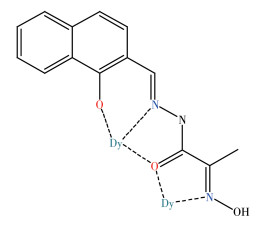
Scheme 1.
Synthetic route of H2L

Synthesis, Crystal Structure and Magnetic Properties of Dinuclear Dy(Ⅲ) Complex Based on Multidentate Schiff Base
Qin WANG , Yuan-Yuan LIU , Li NIU , Jing YAN , Yin-Ling HOU


Recently, the increasing studies for single - molecule magnets (SMMs) based on lanthanides have elucidated the important role of Ln (Ⅲ)ions in constructing new SMMs with intriguing architectures and fascinating magnetic behaviors[1-4]. Among these Ln (Ⅲ)ions, Dy (Ⅲ)ion is widely used, because of not only its large spin magnetic moments but also its large intrinsic magnetic anisotropy. So far, some multinuclear Dy - based SMMs exhibiting excellent magnetic properties have been reported, such as Dy2[5], Dy3[6], Dy4[7], Dy5[8], Dy6[9], and Dy76[10]. Impressively, a hydroxide - bridged centrosymmetric Dy2 compound synthesized by Gao group displays slow magnetic relaxation with a large anisotropy energy barrier of 721 K[11]. Additionally, Powell et al. reported a novel triangular Dy3 cluster with interesting SMM behaviors despite the almost non-magnetic ground state[12]. All these excellent works stimulate us to further design and explore other Dy-based SMMs.
In this context, we prepared a new Dy2 complex [Dy2(L)2(acac)2(CH3CH2OH)2] (1) by reaction of the multi-dentate Schiff base H2L (H2L=N′-(2-hydroxynaphthalen-1-ylmethylene)-2-(hydroxyimino)propanehydrazide, Scheme 1) with the β - diketonate salt Dy(acac)3·2H2O (Hacac=acetylacetone). The Schiff base H2L was selected as ligand due to the excellent structural features: (1) it possesses many N/O donor atoms, which can provide different coordination modes; (2) the carbonyl oxygen atom of H2L can act as a bridge to connect different Dy (Ⅲ)ions and can also transmit magnetic exchange efficiently. Single - crystal X - ray diffraction analysis reveals that 1 is a centrosymmetric dinuclear Dy (Ⅲ) complex, each Dy (Ⅲ)ion is eight - coordinate and every L2- adopts μ2∶η1η1η2η1 binding mode. Magnetic studies indicate that complex 1 exhibited single-molecule magnet behavior with the energy barrier ΔE/kB=14.52 K and the pre-exponential factor τ0=7.58×10⁻⁶ s.
All reagents and solvents were purchased from commercial sources and used as received. The β-diketonate salt (Dy(acac)3·2H2O) was prepared accord- ing to a procedure reported previously[13]. Elemental analyses for C, H, and N were determined by a PerkinElmer 240 CHN analyzer. Magnetic data were obtained using a Quantum Design MPMS - XL7 magnetometer and a PPMS-9 ACMS magnetometer.
As shown in Scheme 1, the Schiff base ligand H2L was prepared by a simple condensation reaction of 2-hydroxy-1-naphthaldehyde (0.5 mmol) and 2-(hydroxyimino)propane hydrazide (0.5 mmol) in ethanol. The mixed solution was then stirred at room temperature for 4 h, the obtained yellow precipitates were washed with ethanol.
Dy(acac)3·2H2O (0.05 mmol) and H2L (0.05 mmol) were stirred together in a EtOH -CH2Cl2 mixture (15 mL+3 mL) for 4 h at room temperature and filtered. The resulting mixture was allowed to stand undisturbed and slowly concentrated by evaporation. Block - shaped yellow crystals appeared after five days. Elemental analysis Calcd. for C42H48Dy2N6O12(%): C 43.72, H 4.19, N 7.28; Found(%): C 43.60, H 4.25, N 7.21.
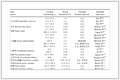
Single-crystal X-ray diffraction data for complex 1 were collected on a Rigaku Saturn CCD area detector diffractometer (Mo Kα radiation, λ =0.071 073 nm). The structure of 1 was solved by direct methods and refined by full-matrix least-square against F2 using the SHELXL - 2018 crystallographic software package. All non - hydrogen atoms were refined anisotropically. All the H atoms were positioned geometrically and refined using a riding model. A summary of the crystal data and cell parameters for 1 is given in Table 1, and selected bond lengths (nm) and angles (°) for 1 are listed in Table 2.
 下载:
导出CSV
下载:
导出CSV
| Parameter | 1 | Parameter | 1 | |
| Empirical formula | C42H48Dy2N6O12 | Dc / (Mg·m-3) | 1.719 | |
| Formula weight | 1 153.86 | Absorption coefficient / mm-1 | 3.392 | |
| T / K | 150.15 | Crystal size / mm | 0.26×0.21×0.14 | |
| Crystal system | Triclinic | F(000) | 1 140 | |
| Space group | P1 | θ range for data collection / (°) | 2.235-26.449 | |
| a / nm | 1.183 41(5) | Index ranges | -14 ≤ h ≤ 14, -15 ≤ k ≤ 15, -23 ≤ l ≤ 23 | |
| b / nm | 1.211 11(6) | Reflection collected | 48 711 | |
| c / nm | 1.851 90(8) | Unique (Rint) | 9 171 (0.042 7) | |
| α / (°) | 96.434(2) | Data, restraint, parameter | 9 171, 6, 575 | |
| β / (°) | 103.827(2) | Goodness-of-fit (GOF) on F2 | 1.045 | |
| γ / (°) | 116.612(2) | Final R indices [I > 2σ(I)] | R1=0.028 7, wR2=0.064 8 | |
| V / nm3 | 2.229 66(18) | R indices (all data) | R1=0.043 9, wR2=0.072 9 | |
| Z | 2 | Largest peak and hole / (e·nm-3) | 2 083 and -673 |
下载:
导出CSV
| Dy1—O2 | 0.235 9(3) | Dy1—O2a | 0.235 3(3) | Dy1—O3 | 0.220 2(3) |
| Dy1—O4 | 0.232 3(3) | Dy1—O5 | 0.234 0(3) | Dy1—O6 | 0.243 5(3) |
| Dy1—N1a | 0.253 9(4) | Dy1—N3 | 0.247 5(4) | ||
| O2—Dy1—N1a | 127.69(11) | O2a—Dy1—O2 | 67.14(12) | O2a—Dy1—O6 | 73.45(10) |
| O2—Dy1—O6 | 76.66(10) | O2—Dy1—N3 | 63.73(11) | O2a—Dy1—N3 | 130.84(11) |
| O2a—Dy1—N1a | 62.10(11) | O3—Dy1—O2a | 142.59(10) | O3—Dy1—O2 | 127.36(11) |
| O3—Dy1—O6 | 77.31(11) | O3—Dy1—O5 | 77.55(12) | O3—Dy1—N3 | 73.24(11) |
| O3—Dy1—N1a | 89.43(12) | O3—Dy1—O4 | 127.20(11) | O4—Dy1—O2a | 88.46(10) |
| O4—Dy1—O2 | 74.66(10) | O4—Dy1—O6 | 150.33(11) | O4—Dy1—O5 | 72.35(11) |
| O4—Dy1—N3 | 80.49(11) | O4—Dy1—N1a | 114.66(12) | O5—Dy1—O2 | 146.79(10) |
| O5—Dy1—O2a | 107.97(11) | O5—Dy1—O6 | 135.16(10) | O5—Dy1—N3 | 113.64(12) |
| O5—Dy1—N1a | 65.45(12) | O6—Dy1—N1a | 77.79(12) | O6—Dy1—N3 | 93.58(11) |
| N3—Dy1—N1a | 162.07(12) | ||||
| Symmetry code: a: -x, -y-1, -z+2. | |||||
CCDC: 2096910.
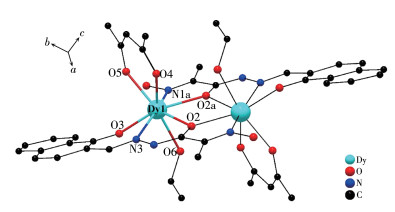
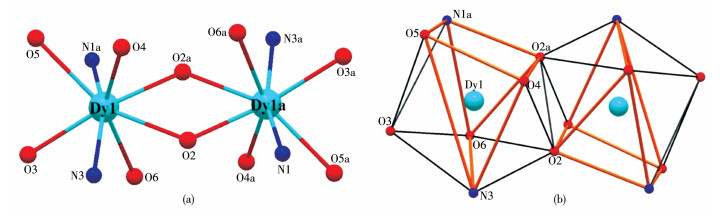
Single-crystal X-ray diffraction studies reveal that complex 1 crystallizes in the triclinic system with the space group P1 (Z=2). As shown in Fig. 1, the molecular structure of 1 is centrosymmetric and comprised of two Dy (Ⅲ)ions, two ligands (L2-), two acac- and two CH3CH2OH. Each Dy (Ⅲ)ion is eight - coordinate, connected by six oxygen atoms (O2, O2a, O3, O4, O5, and O6) and two nitrogen atoms (N1a and N3) (Fig. 2a). The eight - coordinate Dy (Ⅲ)ions are located in distorted bicapped trigonal - prismatic geometric configuration (Fig. 2b). Two adjacent Dy(Ⅲ)ions are linked by two μ2 - O bridges (O2 and O2a) coming from the ketone oxygen atoms of two L2- ligands. The ligand L2- adopt μ2∶ η1η1η2η1 coordination mode (Scheme 2). The Dy1… Dy1a distance is 0.392 59(4) nm, and Dy1—O2—Dy1a angle is 112.86(11)°. The bond lengths of Dy1— O2, Dy1—O2a, Dy1—O3, Dy1—O4, Dy1—O5, and Dy1—O6 are found to be 0.235 9(3), 0.235 3(3), 0.220 2(3), 0.232 3(3), 0.234 0(3), and 0.243 5(3) nm, respectively. Furthermore, the Dy1—N3 and Dy1—N3a bond lengths are 0.247 5(4) and 0.253 9(4) nm. The angles of O—Dy—O are in a range of 67.14(12)°- 150.33(11)°.
Hydrogen atoms have been omitted for clarity; Symmetry code: a: -x, -y-1, -z+2
Symmetry code: a: -x, -y-1, -z+2
The direct - current (dc) magnetic susceptibility of complex 1 was investigated in a temperature range of 300.0 - 2.0 K under an applied magnetic field of 1 000 Oe. The χMT vs T plot is shown in Fig. 3. The room - temperature χMT value for 1 was 28.55 cm3·K·mol-1, which was close to 28.34 cm3·K·mol-1 of two uncoupled Dy (Ⅲ)ions (6H15/2, g=4/3). Upon lowering the temperature, the χMT value of 1 decreased slowly from 300 to 50 K and then declined abruptly to a minimum value of 9.29 cm3·K·mol-1 at 2 K. This decline tendency can be ascribed to the thermal depopulation of the Dy (Ⅲ) Stark sublevels and/or the weak antiferromagnetic interactions between the adjacent Dy(Ⅲ)ions in 1.
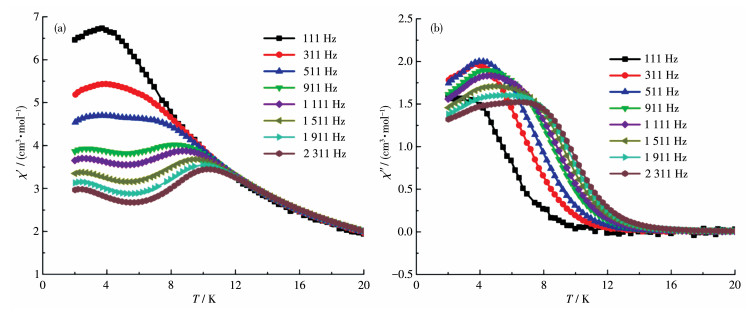
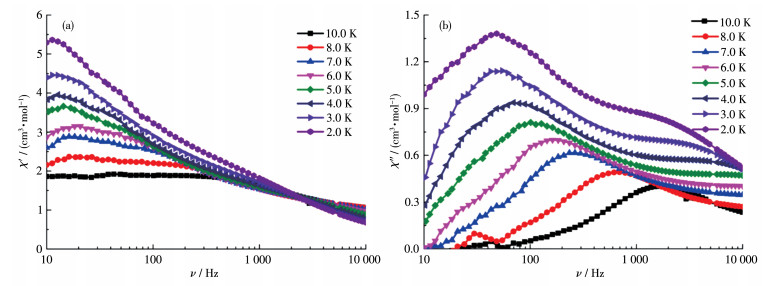
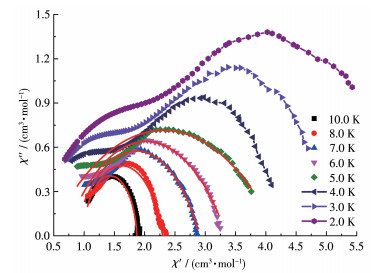
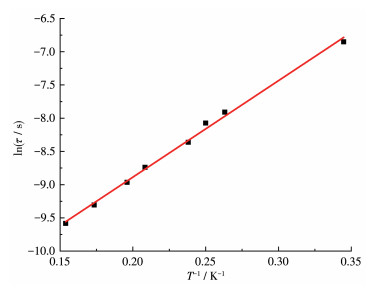
To deeply study the dynamic magnetic behaviors of complex 1, the alternating - current (ac) susceptibilities were measured at various frequencies under a zerodc field. Interestingly, both in - phase (χ′) and out - of - phase (χ″) ac magnetic susceptibilities data display frequency dependence under the zero - dc field and obvious peaks in the χ″ signals can be detected (Fig. 4), which is typical features of SMMs behavior. To further investigate the dynamic magnetic behaviors of 1, the frequency - dependent susceptibility of 1 was also measured. As shown in Fig. 5, the χ′ and χ″ signals both show obvious temperature dependences, further confirming the presence of slow relaxation of the magnetization in 1. Notably, two peaks in the χ″ signals can be observed in the low - temperature zone, suggesting two relaxation processes may exist in 1. The Cole - Cole plots for 1 derived from the plots of χ″ vs χ′ are shown in Fig. 6, which could be fitted based on the generalized Debye model, giving the parameter α =0.05 - 0.54. But some Cole - Cole plots exhibited two approximate semicircles and cannot be well fitted. The relaxation time τ data extracted from the higher temperature χ″ peaks can be well fitted with the Arrhenius law τ = τ0exp[ΔE/(kBT)][14], yielding the effective energy barrier ΔE/kB=14.52 K and pre - exponential factor τ0=7.58×10⁻⁶ s (Fig. 7). The obtained τ0 was in the normal range of the reported Dy-based SMMs[15]. By contrast with some previously reported Dy2 complexes constructed based on Schiff base ligands, the obtained value of ΔE/kB for 1 is larger than those of some Dy2 compounds (Table 3). The diverse magnetic properties in them can be attributed to the different coordinated Schiff bases and β - diketone co-ligands, which inspire us to further explore the relationship between the structures and magnetic properties of lanthanide SMMs.
Solid lines indicate the best fits to the experiments with the generalized Debye model
Solid red line is the best fit of the Arrhenius law
下载:
导出CSV
| Complex | ΔE/kB / K | τ0 / s | Ref. |
| [Dy2(L1)2(hfac)6]·C7H16 | 0.72 | 6.28×10⁻⁵ | [16] |
| [Dy2(dbm)4(H2L2)(CH3O)(CH3OH)] | 0.87 | 1.3×10⁻⁵ | [17] |
| [Dy2(hfac)4(L3)2] | 6.77 | 9.12×10⁻⁶ | [18] |
| [Dy2(L4)2(hfac)6]·C7H16 | 6.81 | 2.56×10⁻⁵ | [16] |
| [Dy2(hfac)4(L5)2] | 9.91 | 1.99×10⁻⁶ | [19] |
| [Dy2(L)2(acac)2(CH3CH2OH)2] | 14.52 | 7.58×10⁻⁶ | This work |
| [Dy2(dbm)5(H2L2)] | 18.68 | 1.1×10⁻⁶ | [17] |
| [Dy2(tfac)4(L3)2] | 19.83 | 7.62×10⁻⁸ | [18] |
| [Dy2(hfac)4(L6)2] | 20.57 | 2.71×10⁻⁶ | [19] |
| [Dy2(dbm)4(L7)2] | 22.04 | 2.204×10⁻⁴ | [20] |
| HL1=5-(2-thenylidene)-8-hydroxylquinoline; H3L2=(2E, N′E)-2-(hydroxyimino)-N′-(pyridin-2-plmethylene)propanehydrazide; HL3=2-(((4-fluorophenyl)imino) methyl)-8-hydroxyquinoline; HL4=5-(4-methoxylbenzylidene)-8-hydroxyquinoline; HL5=2-((4-methylaniline-imino)methyl)-8-hydroxyquinoline; HL6=2-(((3, 4-dimethylaniline)-imino)methyl)-8-hydroxyquinoline; HL7=2-(((4-fluorophenyl)imino)methyl)-8-hydroxyquinoline. | |||
In summary, one new Dy2 complex 1 was successfully obtained by the reaction of Dy3+ ions and a Schiff base ligand. The structures and magnetic properties of 1 were investigated in detail. Structural analysis shows that 1 contains a centrosymmetric dinuclear dysprosium center. Magnetic investigations reveal that slow magnetic relaxation behaviors can be observed in 1 with the effective energy barrier ΔE/kB=14.52 K and the pre-exponential factor τ0=7.58×10⁻⁶ s.
任旻, 郑丽敏. 稀土单分子磁体[J]. 化学学报, 2015,73,(11): 1091-1113. REN M, ZHENG L M. Lanthanide-Based Single Molecule Magnets[J]. Acta Chim. Sinica, 2015, 73(11): 1091-1113.
Xie S F, Huang L Q, Zhong L, Lai B L, Yang M, Chen W B, Zhang Y Q, Dong W. Structures, Single-Molecule Magnets, and Fluorescent Properties of Four Dinuclear Lanthanide Complexes Based on 4-Azotriazolyl-3-hydroxy-2-naphthoic Acid[J]. Inorg. Chem., 2019, 58(9): 5914-5921. doi: 10.1021/acs.inorgchem.9b00260
Wang W M, Wu Z L, Zhang Y X, Wei H Y, Gao H L, Cui J Z. Self-Assembly of Tetra-nuclear Lanthanide Clusters via Atmospheric CO2 Fixation: Interesting Solvent-Induced Structures and Magnetic Relaxation Conversions[J]. Inorg. Chem. Front., 2018, 5(9): 2346-2354. doi: 10.1039/C8QI00573G
Guo M, Xu Y H, Wu J F, Zhao L, Tang J K. Geometry and Magnetic Interaction Modulations in Dinuclear Dy2 Single-Molecule Magnets[J]. Dalton Trans., 2017, 46(25): 8252-8258. doi: 10.1039/C7DT01121K
王庭玮, 陈星晗, 陈洪进, 邵峻岩, 石恒, 邢洁妮, 吕光宇, 张蕤, 刘建. 蒎烯吡啶基吡嗪双核镝(Ⅲ)配合物的合成、晶体结构及磁性[J]. 无机化学学报, 2019,35,(7): 1183-1187. WANG T W, CHEN X H, CHEN H J, SHAO J Y, SHI H, XING J N, LU G Y, ZHANG R, LIU J. Synthesis, Structure and Magnetic Proper-ties of Binuclear Pinene Pyridyl Pyrazine Dy (Ⅲ) Complex[J]. Chinese J. Inorg. Chem., 2019, 35(7): 1183-1187.
Zhu Z H, Ma X F, Wang H L, Zou H H, Mo K Q, Zhang Y Q, Yang Q Z, Li B, Liang F P. A Triangular Dy3 Single-Molecule Toroic with High Inversion Energy Barrier: Magnetic Properties and Multiple-Step Assembly Mechanism[J]. Inorg. Chem. Front., 2018, 5(12): 3155-3162. doi: 10.1039/C8QI01069B
Tang G P, Zhang X H, Liu H, Li J K, Yu X B, Zhang A K, Yang J G, Wu Z L. One New Planar Dy4 Compound: Synthesis, Structure and Its Magnetic Dynamics Behaviors[J]. Polyhedron, 2017, 137: 265-269. doi: 10.1016/j.poly.2017.08.034
Blagg R J, Muryn C A, Mclnnes E J L, Tuna F, Winpenny R E P. Single Pyramid Magnets: Dy5 Pyramids with Slow Magnetic Relaxation to 40 K[J]. Angew. Chem. Int. Ed., 2011, 50(29): 6530-6533. doi: 10.1002/anie.201101932
Wang W M, Yue R X, Gao Y, Wang M J, Hao S S, Shi Y, Kang X M, Wu Z L. Large Magnetocaloric Effect and Remarkable Single-Molecule-Magnet Behavior in Triangle-Assembled Ln6Ⅲ Clusters[J]. New J. Chem., 2019, 43(42): 16639-16646. doi: 10.1039/C9NJ03921J
Li X Y, Su H F, Li Q W, Feng R, Bai H Y, Chen H Y, Xu J, Bu X H. A Giant Dy76 Cluster: A Fused Bi-Nanopillar Structural Model for Lanthanide Clusters[J]. Angew. Chem. Int. Ed., 2019, 58(30): 10184-10188. doi: 10.1002/anie.201903817
Xiong J, Ding H Y, Meng Y S, Gao C, Zhang X J, Meng Z S, Zhang Y Q, Shi W, Wang B W, Gao S. Hydroxide-Bridged Five-Coordinate DyⅢ Single-Molecule Magnet Exhibiting the Record Thermal Relaxation Barrier of Magnetization Among Lanthanide-Only Dimers[J]. Chem. Sci., 2017, 8(2): 1288-1294. doi: 10.1039/C6SC03621J
Tang J K, Hewitt I, Madhu N T, Chastanet G, Wernsdorfer W, Anson C E, Benelli C, Sessoli R, Powell A K. Dysprosium Triangles Showing Single-Molecule Magnet Behavior of Thermally Excited Spin States[J]. Angew. Chem. Int. Ed., 2006, 45(11): 1729-1733. doi: 10.1002/anie.200503564
Zhang Y X, Li M, Liu B Y, Wu Z L, Wei H Y, Wang W M. A Series of Planar Tetranuclear Lanthanide Complexes: Axial Ligand Modulated Magnetic Dynamics in Dy4 Species[J]. RSC Adv., 2017, 7(87): 55523-55535. doi: 10.1039/C7RA11750G
Wang W M, He L Y, Wang X X, Shi Y, Wu Z L, Cui J Z. Linear-Shaped Ln4Ⅲ and Ln6Ⅲ Clusters Constructed by a Polydentate Schiff Base Ligand and a β-Diketone Co-ligand: Structures, Fluorescence Properties, Magnetic Refrigeration and Single-Molecule Magnet Behavior[J]. Dalton Trans., 2019, 48(44): 16744-16755. doi: 10.1039/C9DT03478A
Lin S Y, Zhao L, Ke H S, Guo Y N, Tang J K, Guo Y, Dou J M. Steric Hindrances Create a Discrete Linear Dy4 Complex Exhibiting SMM Behavior[J]. Dalton Trans., 2012, 41(11): 3248-3252. doi: 10.1039/c2dt11539e
Wang W M, Wang S, Wu Z L, Ran Y G, Ren Y H, Zhang C F, Fang M. Two Phenoxo-O Bridged Dy2 Complexes Based On 8-Hydroxy-quinolin Derivatives with Different Magnetic Relaxation Features[J]. Inorg. Chem. Commun., 2017, 76: 48-51. doi: 10.1016/j.inoche.2017.01.001
Xue Y S, Yang J X, Han J Q, Liu S S, Cui Y Y, Tan Y, Hua Y P, Wang W M. Solvent-Induced Two Dy2 Compounds with Different Structures Showing Distinct Slow Magnetization Relaxation Behav-iors[J]. Polyhedron, 2019, 160: 139-144.
Wang W M, Zhang H X, Wang S Y, Shen H Y, Gao H L, Cui J Z, Zhao B. Ligand Field Affected Single-Molecule Magnet Behavior of Lanthanide (Ⅲ) Dinuclear Complexes with an 8-Hydroxyquinoline Schiff Base Derivative as Bridging Ligand[J]. Inorg. Chem., 2015, 54(22): 10610-10622.
Wang W M, Zh ao, X Y, Qiao H, Bai L, Han H F, Fang M, Wu Z L, Zou J Y. Modulating the Single-Molecule Magnet Behaviour in Phenoxo-O Bridged Dy2 Systems via Subtle Structural Variations[J]. J. Solid State Chem., 2017, 253: 154-160.
Wang W M, Wang S Y, Zhang H X, Zhao B, Zou J Y, Gao H L, Cui J Z. Single-Molecule Magnet Behavior of a Dinuclear Dysprosium Compound Constructed by 8-Hydroxyquinoline Schiff Base and β-Diketonate Ligands[J]. Inorg. Chim. Acta, 2016, 439: 106-110.

Figure 1 Molecular structure of complex 1
Hydrogen atoms have been omitted for clarity; Symmetry code: a: -x, -y-1, -z+2

Figure 2 Core structural representation (a) and coordination polyhedra of Dy ions (b) in 1
Symmetry code: a: -x, -y-1, -z+2

Figure 4 Temperature dependence of in-phase (a) and out-of-phase (b) ac magnetic susceptibilities for 1 in zero-dc field

Figure 5 Frequency dependence of in-phase (a) and out-of-phase (b) ac magnetic susceptibility for 1 in zero-dc field

Figure 6 Cole-Cole plots for complex 1 at T=2.0-10.0 K
Solid lines indicate the best fits to the experiments with the generalized Debye model

Figure 7 Plot of ln τ vs T-1 for 1
Solid red line is the best fit of the Arrhenius law
Table 1. Crystal data and structure refinement parameters for complex 1
| Parameter | 1 | Parameter | 1 | |
| Empirical formula | C42H48Dy2N6O12 | Dc / (Mg·m-3) | 1.719 | |
| Formula weight | 1 153.86 | Absorption coefficient / mm-1 | 3.392 | |
| T / K | 150.15 | Crystal size / mm | 0.26×0.21×0.14 | |
| Crystal system | Triclinic | F(000) | 1 140 | |
| Space group | P1 | θ range for data collection / (°) | 2.235-26.449 | |
| a / nm | 1.183 41(5) | Index ranges | -14 ≤ h ≤ 14, -15 ≤ k ≤ 15, -23 ≤ l ≤ 23 | |
| b / nm | 1.211 11(6) | Reflection collected | 48 711 | |
| c / nm | 1.851 90(8) | Unique (Rint) | 9 171 (0.042 7) | |
| α / (°) | 96.434(2) | Data, restraint, parameter | 9 171, 6, 575 | |
| β / (°) | 103.827(2) | Goodness-of-fit (GOF) on F2 | 1.045 | |
| γ / (°) | 116.612(2) | Final R indices [I > 2σ(I)] | R1=0.028 7, wR2=0.064 8 | |
| V / nm3 | 2.229 66(18) | R indices (all data) | R1=0.043 9, wR2=0.072 9 | |
| Z | 2 | Largest peak and hole / (e·nm-3) | 2 083 and -673 |
 下载: 导出CSV
Table 2. Selected bond lengths (nm) and angles (°) of 1
| Dy1—O2 | 0.235 9(3) | Dy1—O2a | 0.235 3(3) | Dy1—O3 | 0.220 2(3) |
| Dy1—O4 | 0.232 3(3) | Dy1—O5 | 0.234 0(3) | Dy1—O6 | 0.243 5(3) |
| Dy1—N1a | 0.253 9(4) | Dy1—N3 | 0.247 5(4) | ||
| O2—Dy1—N1a | 127.69(11) | O2a—Dy1—O2 | 67.14(12) | O2a—Dy1—O6 | 73.45(10) |
| O2—Dy1—O6 | 76.66(10) | O2—Dy1—N3 | 63.73(11) | O2a—Dy1—N3 | 130.84(11) |
| O2a—Dy1—N1a | 62.10(11) | O3—Dy1—O2a | 142.59(10) | O3—Dy1—O2 | 127.36(11) |
| O3—Dy1—O6 | 77.31(11) | O3—Dy1—O5 | 77.55(12) | O3—Dy1—N3 | 73.24(11) |
| O3—Dy1—N1a | 89.43(12) | O3—Dy1—O4 | 127.20(11) | O4—Dy1—O2a | 88.46(10) |
| O4—Dy1—O2 | 74.66(10) | O4—Dy1—O6 | 150.33(11) | O4—Dy1—O5 | 72.35(11) |
| O4—Dy1—N3 | 80.49(11) | O4—Dy1—N1a | 114.66(12) | O5—Dy1—O2 | 146.79(10) |
| O5—Dy1—O2a | 107.97(11) | O5—Dy1—O6 | 135.16(10) | O5—Dy1—N3 | 113.64(12) |
| O5—Dy1—N1a | 65.45(12) | O6—Dy1—N1a | 77.79(12) | O6—Dy1—N3 | 93.58(11) |
| N3—Dy1—N1a | 162.07(12) | ||||
| Symmetry code: a: -x, -y-1, -z+2. | |||||
下载: 导出CSV
Table 3. Magnetic relaxation barriers and pre-exponential factors for selected Dy2 complex under a zero-dc field
| Complex | ΔE/kB / K | τ0 / s | Ref. |
| [Dy2(L1)2(hfac)6]·C7H16 | 0.72 | 6.28×10⁻⁵ | [16] |
| [Dy2(dbm)4(H2L2)(CH3O)(CH3OH)] | 0.87 | 1.3×10⁻⁵ | [17] |
| [Dy2(hfac)4(L3)2] | 6.77 | 9.12×10⁻⁶ | [18] |
| [Dy2(L4)2(hfac)6]·C7H16 | 6.81 | 2.56×10⁻⁵ | [16] |
| [Dy2(hfac)4(L5)2] | 9.91 | 1.99×10⁻⁶ | [19] |
| [Dy2(L)2(acac)2(CH3CH2OH)2] | 14.52 | 7.58×10⁻⁶ | This work |
| [Dy2(dbm)5(H2L2)] | 18.68 | 1.1×10⁻⁶ | [17] |
| [Dy2(tfac)4(L3)2] | 19.83 | 7.62×10⁻⁸ | [18] |
| [Dy2(hfac)4(L6)2] | 20.57 | 2.71×10⁻⁶ | [19] |
| [Dy2(dbm)4(L7)2] | 22.04 | 2.204×10⁻⁴ | [20] |
| HL1=5-(2-thenylidene)-8-hydroxylquinoline; H3L2=(2E, N′E)-2-(hydroxyimino)-N′-(pyridin-2-plmethylene)propanehydrazide; HL3=2-(((4-fluorophenyl)imino) methyl)-8-hydroxyquinoline; HL4=5-(4-methoxylbenzylidene)-8-hydroxyquinoline; HL5=2-((4-methylaniline-imino)methyl)-8-hydroxyquinoline; HL6=2-(((3, 4-dimethylaniline)-imino)methyl)-8-hydroxyquinoline; HL7=2-(((4-fluorophenyl)imino)methyl)-8-hydroxyquinoline. | |||
下载: 导出CSV

 扫一扫看文章


扫一扫关注我们


 下载:
下载: