

表 1
Selected bond lengths (nm) and bond angles (°) for 1 and 2


The design and synthesis of metal-organic coordination polymers relied on the selection of ligands and metal ions has become a very attractive research field. This is motivated not only by the intriguing structural diversity but also by the demand of applying functional materials into the fields of catalysis, porosity, magnetism, luminescence and nonlinear optics[1-3]. In general, grids with various sizes and shapes can be synthesized by choosing suitable single metal ions and organic ligands such as carboxylates and N-donor groups[4-6]. Self-assembly is a complex process, highly influenced by many factors, such as the coordination geometry of metal ions, the nature of organic ligands, solvent system, temperature, pH value of the solution, the ratio between metal salt and ligand, the templates and the counter anions[7-14]. These factors have been well-studied, but there are other forces such as hydrogen-bonding, π-π interac-tions, metal-metal interactions that can greatly influence the supramolecular topology and its dimensionality[15-17]. Therefore, these considerations made us investigate new coordination structures with 4, 4'-(1, 3-phenylene-bis(methyleneoxy)) dibebzoic acid (H2pmda), and brid-ging ligands (bib/bix). In this manuscript, we reported the syntheses, crystal structures, IR and fluorescence properties of two new complexes, namely {[Co(bib)3](ClO4)2}n (1) and {[Cu3(bix)4.5](ClO4)3}n (2). Complexes 1 and 2 all exhibit intense purple luminescence, and appears to be good candidates for novel hybrid inorganic-organic photoactive materials.
All reagents were purchased commercially and used without further purification. Elemental analyses (C, H and N) were measured on a Vario EL(Ⅲ) Elemental Analyzer. IR spectrum was recorded in a range of 4 000~400 cm-1 on a Nicolet 6700 spectro-meter using a KBr pellet. The fluorescence spectra were performed on an F-7000 photospectrometer (Hitachi, High-Tech, Science, Japan). The powder X-ray diffraction (PXRD) studies were performed with a Bruker D8 Discover instrument (Cu Kα radiation, λ=0.154 184 nm, U=40 kV, I=40 mA) over the 2θ range of 5°~50° at room temperature.
{[Co(bib)3](ClO4)2}n (1):H2pmda (0.075 6 g, 0.2 mmol), Co(ClO4)2·6H2O (0.2 mmol, 0.075 g), bib (0.038 g, 0.2 mmol) and 18 mL H2O were mixed, and the pH value of the mixture was adjust to about 8 with 40% NaOH. Then it was sealed in a Teflon-lined stainless steel vessel, heated to 120℃ for 7 days, and followed by slow cooling to room temperature. Pink block crystals were obtained. Unfortunately, H2pmda ligand did not participate in the coordination. Yield:34%. Anal. Calcd. for C30H42Cl2CoN12O8(%):C, 43.49; H, 5.11; N, 20.29. Found(%):C, 43.00; H, 4.99; N, 19.95. IR (cm-1):3 126m, 2 952w, 1 657w, 1 605w, 1 521s, 1 465w, 1 443w, 1 404w, 1 373m, 1 303w, 1 280m, 1 236s, 1 096s, 936m, 870w, 834m, 772m, 743w, 729w, 667m, 623m.
{[Cu3(bix)4.5](ClO4)3}n (2):H2pmda (0.075 6 g, 0.2 mmol), Cu(ClO4)2·6H2O (0.2 mmol, 0.08 g), bix (0.048 g, 0.2 mmol) and 18 mL H2O were mixed, and the pH value of the mixture was adjust to about 6 with 40% NaOH, Then it was sealed in a Teflon-lined stainless steel vessel, heated to 120℃ for 7 days, and followed by slow cooling to room temperature. Pale yellow block crystals were obtained. Unfortunately, H2pmda ligand did not participate in the coordination. Yield:23%. Anal. Calcd. for C63H63Cl3Cu3N18O12(%):C, 48.46; H, 4.07; N, 16.15. Found(%):C, 48.01; H, 3.71; N, 15.85. IR (cm-1):3 448w, 3 128m, 2 948w, 1 655w, 1 618w, 1 521s, 1 450m, 1 430w, 1 401w, 1 351w, 1 302w, 1 279m, 1 237s, 1 181w, 1 126w, 1 081s, 1 023w, 978w, 942w, 869w, 824w, 815w, 764w, 742m, 714s, 653m, 624s, 517w, 436w.
Single-crystal X-ray diffraction data for 1 with dimensions of 0.45 mm×0.35 mm×0.34 mm and 2 with dimensions of 0.30 mm×0.22 mm×0.18 mm were recorded on a Bruker D8 QUEST CMOS diffractometer with graphite-monochromated Mo Kα radiation (λ=0.071 073 nm) at 293 K. The structures were solved with the direct method of SHELXS-97 and refined with full-matrix least-squares techniques using the SHELXL-97 program[18-19]. The non-hydrogen atoms of the complexes were refined with anisotropic temperature parameters. The hydrogen atoms attached to carbons were generated geometrically. Selected bond lengths and bond angles are listed in Table 1.
 下载:
导出CSV
下载:
导出CSV
| 1 | |||||
| Co(1)-N(1) | 0.218 2(2) | Co(1)-N(1A) | 0.218 2(2) | Co(1)-N(1B) | 0.218 2(2) |
| Co(1)-N(1C) | 0.218 2(2) | Co(1)-N(1D) | 0.218 2(2) | Co(1)-N(1E) | 0.218 2(2) |
| N(1)-Co(1)-N(1B) | 90.82(9) | N(1)-Co(1)-N(1E) | 89.18(9) | N(1B)-Co(1)-N(1E) | 180.000(1) |
| N(1)-Co(1)-N(1C) | 180.0 | N(1B)-Co(1)-N(1C) | 89.18(9) | N(1E)-Co(1)-N(1C) | 90.82(9) |
| N(1)-Co(1)-N(1A) | 90.82(9) | N(1B)-Co(1)-N(1A) | 90.82(9) | N(1E)-Co(1)-N(1A) | 89.18(9) |
| N(1C)-Co(1)-N(1A) | 89.18(9) | N(1)-Co(1)-N(1D) | 89.18(9) | N(1C)-Co(1)-N(1D) | 89.18(9) |
| N(1E)-Co(1)-N(1D) | 90.82(9) | N(1C)-Co(1)-N(1D) | 90.82(9) | N(1A)-Co(1)-N(1D) | 180.00(9) |
| 2 | |||||
| Cu(1)-N(5) | 0.196 5(2) | Cu(1)-N(5A) | 0.196 5(2) | Cu(1)-N(5B) | 0.196 5(2) |
| Cu(2)-N(1) | 0.196 4(3) | Cu(2)-N(1C) | 0.196 4(3) | Cu(2)-N(1D) | 0.196 4(3) |
| Cu(3)-N(4) | 0.197 4(2) | Cu(3)-N(4E) | 0.197 4(2) | Cu(3)-N(4F) | 0.197 4(2) |
| N(5A)-Cu(1)-N(5B) | 119.955(7) | N(5A)-Cu(1)-N(5) | 119.955(7) | N(5B)-Cu(1)-N(5) | 119.955(6) |
| N(1C)-Cu(2)-N(1) | 119.819(14) | N(1D)-Cu(2)-N(1C) | 119.819(14) | N(1)-Cu(2)-N(1C) | 119.819(14) |
| N(4)-Cu(3)-N(4E) | 119.990(3) | N(4)-Cu(3)-N(4F) | 119.990(3) | N(4E)-Cu(3)-N(4F) | 119.990(3) |
| Symmetry codes:A: 1-y, x-y-1, z; B: 2-x+y, 1-x, z; C: 2-x, -y, 2-z; D: 1+y, 1-x+y, 2-z; E: x-y, x-1, 2-z for 1; A: 1-y, x-y, z; B: 1-x+y, 1-x, z; C: -y, x-y, z; D: -x+y, -x, z; E: -y, x-y-1, z; F: 1-x+y, -x, z for 2. | |||||
CCDC:1950200, 1; 1950184, 2.
Single crystal X-ray analysis reveals that complex 1 crystalizes in trigonal system with P
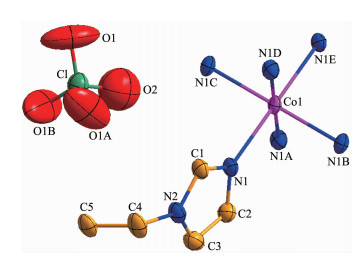
Symmetry codes:A:1-y, x-y-1, z; B:2-x+y, 1-x, z; C:2-x, -y, 2-z; D:1+y, 1-x+y, 2-z; E:x-y, x-1, 2-z
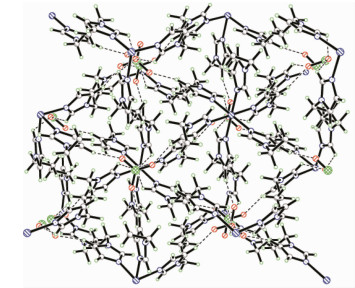
In complex 1, the bib ligand takes trans-conformation bridging mode with a dihedral angle between the two imidazole rings of 0°. As depicted in Fig. 2, three Co(Ⅱ) ions are bridged by six nitrogen atoms of bib ligands to give crystallographically isosceles triangle trimers with Co…Co distance of 1.411 9 nm, which are further connected to a two-dimensional network with a 36-membered ring, and to the best of our knowledge, this structure is relatively rare. Single crystal X-ray diffraction reveals that [Co(bib)3]2+ and ClO4- units form 3D supramolecular architectures (Fig. 3) through two hydrogen bonds:C(1)-H(1)…O(2) (C(1)…O(2) 0.323 5(17) nm) and C(3)-H(3)…O(1) (C(3)…O(1) 0.315 6(8) nm), undoubtedly stabilizing the 3D structure of complex 1.
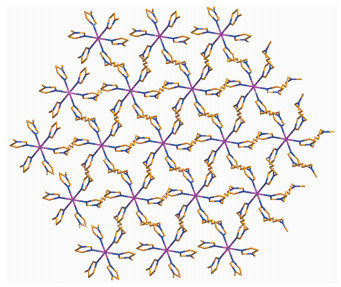
ClO4- ions are omitted for clarity
A single-crystal X-ray diffraction study reveals that complex 2 crystallizes in trigonal system with R
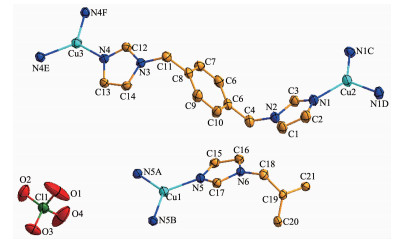
Symmetry codes:A:1-y, x-y, z; B:1-x+y, 1-x, z; C:-y, x-y, z; D:-x+y, -x, z; E:-y, x-y-1, z; F:1-x+y, -x, z
In the crystal structure of complex 2, the bix ligand adopts a trans-conformation bridging mode with a dihedral angle between two imidazole rings of 28.81° and link the Cu(Ⅰ) ions to form a two-dimensional network structure with 84-membered ring, as shown in Fig. 5.
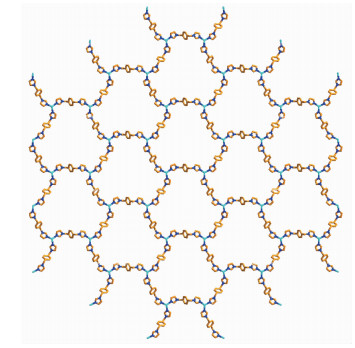
ClO4- ions are omitted for clarity
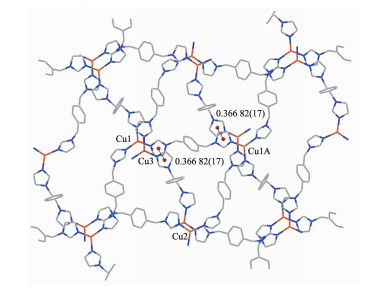
Hydrogen bonding interactions are frequently chief in the synthesis of supramolecular structure. Single crystal X-ray reveals that[Cu3(bix)4.5]3+ and ClO4- units form 3D supramolecular architectures through two hydrogen bonds:C(12)-H(12A)…O(1) (C(12)… O(1) 0.334 9(7) nm) and C(20)-H(20A)…O(4) (C(20)…O(4) 0.348 4(5) nm). In addition, there are π-π interactions (Fig. 6) in complex 2 between imidazole rings of bix ligands. The centroid-to-centroid distance between adjacent ring is 0.366 82(17) nm for N(3)C(12)N(4)C(13)C(14) and N(5)C(15)C(16)N(6)C(17) (Sym-metry code:y, -x+y, 1-z) imidazole rings. The perpendicular distance is 0.338 23(12) nm and the dihedral angle is 0.00(17)°. Thus, through hydrogen bonds and π-π interactions, a three-dimensional supramolecular architecture is formed and plays an important role in stabilizing complex 2.
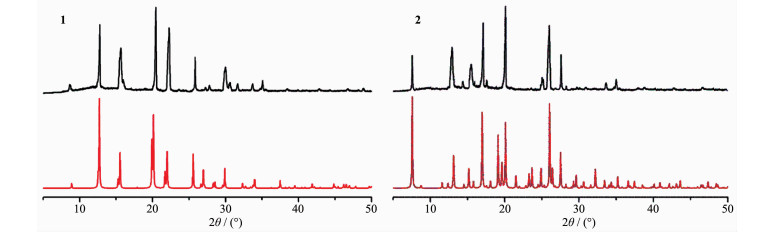
To investigate whether the analyzed crystal structure is truly representative of the bulk materials, X-ray powder diffraction (PXRD) analysis has been performed for the complex at room temperature (Fig. 7). The main peak positions observed are in good agreement with the simulated ones. Although minor differences can be found in the positions, widths, and intensities of some peaks, the bulk synthesized materials and analyzed crystal can still be considered as homogeneous. The differences may be due to the preferred orientation of the powder samples[23-24].
Metal-organic coordination polymers and conjugated organic linker have been studied because of their fluorescent properties and potential applications as fluorescent-emitting materials, chemical sensors and electroluminescent displays[25]. Therefore, in the present work, the photoluminescent properties of bib, bix, complexes 1 and 2 have been investigated in the solid state at room temperature, as depicted in Fig. 8. The free ligands bib and bix showed photoluminescence with the emission maximum at 408 nm(λex=348 nm) and 450 nm (λex=350 nm), respe-ctively, which can be assigned to intraligand (π→π*) transition[26]. Compared with the free bib ligand, a wide range of the emission with maximum peaks at ca. 438 nm upon excitation at ca. 350 nm for complex 1 was observed, which was red-shift. This emission band can be tentatively attributed to a ligand-to-metal charge transfer (LMCT)[27]. While the emission peak of complex 2 (λem=434 nm, λex=350 nm) was blue-shift as compared to the free ligand bix. Therefore, this emission band may be assigned as ligand-to-ligand charge transfer (LLCT) transitions[28-29]. The fluorescence emissions of the complexes make them potentially useful photoactive materials.

In general, we have prepared two new complexes with bib/bix ligands. The bib/bix ligands adopt bridging mode, and link neighboring Co(Ⅱ)/Cu(Ⅰ) ions to generate 2D network structure. Furthermore, the 3D supramolecular architectures are formed by hydrogen bonding or π-π interactions. They all exhibit intense purple luminescence. These materials will give new impetus to the construction of novel functional material with potentially useful physical properties.
Ma L Q, Wu C D, Wanderley M M, et al. Angew. Chem. Int. Ed., 2010, 49:8244-8248 doi: 10.1002/anie.201003377
张中强, 黄如丹, 许颜清, 等.高等学校化学学报, 2008, 29(8):1528-1531 doi: 10.3321/j.issn:0251-0790.2008.08.007ZHANG Zhong-Qiang, HUANG Ru-Dan, XU Yan-Qing, et al. Chem. J. Chinese Universities, 2008, 29(8):1528-1531 doi: 10.3321/j.issn:0251-0790.2008.08.007
Liu G Z, Xin L Y, Wang L Y. CrystEngComm, 2011, 13:3013-3020 doi: 10.1039/c0ce00873g
李秀梅, 潘亚茹, 刘博, 等.无机化学学报, 2019, 35(7):1275-1282 http://www.wjhxxb.cn/wjhxxbcn/ch/reader/view_abstract.aspx?flag=1&file_no=20190720&journal_id=wjhxxbcnLI Xiu-Mei, PAN Ya-Ru, LIU Bo, et al. Chinese J. Inorg. Chem., 2019, 35(7):1275-1282 http://www.wjhxxb.cn/wjhxxbcn/ch/reader/view_abstract.aspx?flag=1&file_no=20190720&journal_id=wjhxxbcn
Sorace L, Benellib C, Gatteschi D. Chem. Soc. Rev., 2011, 40:3092-3104 doi: 10.1039/c0cs00185f
Jiang D Y, Sui W, Li X M, et al. Chin. J. Struct. Chem., 2016, 35:505-513
Dechambenoit P, Long J R. Chem. Soc. Rev., 2011, 40:3249-3265 doi: 10.1039/c0cs00167h
Hong M C, Zhao Y J, Su W P, et al. J. Am. Chem. Soc., 2000, 122:4819-4820 doi: 10.1021/ja000247w
Abrahams B F, Batten S R, Grannas M J, et al. Angew. Chem. Int. Ed., 1999, 38:1475-1477 doi: 10.1002/(SICI)1521-3773(19990517)38:10<1475::AID-ANIE1475>3.0.CO;2-3
Bu X H, Chen W, Lu S L, et al. Angew. Chem. Int. Ed., 2001, 40:3201-3203 doi: 10.1002/1521-3773(20010903)40:17<3201::AID-ANIE3201>3.0.CO;2-Z
Qi Y, Che Y X, Zheng J M. CrystEngComm, 2008, 10:1137-1139 doi: 10.1039/b801387j
Aakeröy C B, Champness N R, Janiak C. CrystEngComm, 2010, 12:22-43 doi: 10.1039/B919819A
Kasai K, Aoyagi M, Fujita M. J. Am. Chem. Soc., 2000, 122:2140-2141 doi: 10.1021/ja992553j
Du M, Bu X H, Guo Y M, et al. Chem. Commun., 2002, 38:2550-2551 https://www.researchgate.net/publication/244540543_Proton-controlled_inter-conversion_between_an_achiral_discrete_molecular_square_and_a_chiral_interpenetrated_double-chain_architecture
Li X M, PanY R, Ji J Y, et al. J. Inorg. Organomet Polym., 2014, 24:836-841 doi: 10.1007/s10904-014-0059-3
Pan Y R, Sun M, Li X M. Chin. J. Struct. Chem., 2015, 34:576-584
Tang Y Z, Zhou M, Huang J, et al. Inorg. Chem., 2013, 52:1679-1681 doi: 10.1021/ic302411r
Sheldrick G M. SHELXS-97, Program for the Solution of Crystal Structure, University of Göttingen, Germany, 1997.
Sheldrick G M. SHELXL-97, Program for the Refinement of Crystal Structure, University of Göttingen, Germany, 1997.
Wang Z T, Ji J Y, Li X M, et al. Chin. J. Struct. Chem., 2013, 32:296-300
王庆伟, 隋薇, 王亚楠, 等.无机化学学报, 2016, 32(6):1120-1126 http://www.wjhxxb.cn/wjhxxbcn/ch/reader/view_abstract.aspx?flag=1&file_no=20160625&journal_id=wjhxxbcnWANG Qing-Wei, SUI Wei, WANG Ya-Nan, et al. Chinese J. Inorg. Chem., 2016, 32(6):1120-1126 http://www.wjhxxb.cn/wjhxxbcn/ch/reader/view_abstract.aspx?flag=1&file_no=20160625&journal_id=wjhxxbcn
Gohera M A S, Mak T C W. Polyhedron, 1998, 17:3485-3494 doi: 10.1016/S0277-5387(98)00135-1
Gilbert A, Baggott J. Essentials of Molecular Photochemistry. Boca Raton: CRC Press, 1991.
Han Z B, He Y K, Ge C H, et al. Dalton Trans., 2007, 46:3020-3024 https://www.researchgate.net/publication/6216487_Hydrothermal_syntheses_crystal_structures_and_magnetic_properties_of_two_copperII_complexes_involved_in_situ_ligand_synthesis
Kreno L E, Leong K, Farha O K, et al. Chem. Rev., 2012, 112:1105-1125 doi: 10.1021/cr200324t
Li J D, Long X F, Lin P, et al. Cryst. Growth Des., 2010, 10:146-157 doi: 10.1021/cg9007476
Cui Y, Yue Y, Qian G, et al. Chem. Rev., 2012, 112:1126-1162 doi: 10.1021/cr200101d
Li G L, Liu G Z, Huang L L, et al. J. Inorg. Organomet. Polym., 2014, 24:617-623 doi: 10.1007/s10904-014-0024-1
Mohamed G G, El-Gamel N E A. Spectrochim. Acta Part A, 2004, 60:3141-3154 doi: 10.1016/j.saa.2004.01.035

图 1 View of coordination environment (at 30% probability level) of Co(Ⅱ)ion of 1
Symmetry codes:A:1-y, x-y-1, z; B:2-x+y, 1-x, z; C:2-x, -y, 2-z; D:1+y, 1-x+y, 2-z; E:x-y, x-1, 2-z

图 2 View of 2D network structure with 36-membered ring of complex 1
ClO4- ions are omitted for clarity

图 4 View of coordination environment (at 30% probability level) of Cu(Ⅰ)ion of 2
Symmetry codes:A:1-y, x-y, z; B:1-x+y, 1-x, z; C:-y, x-y, z; D:-x+y, -x, z; E:-y, x-y-1, z; F:1-x+y, -x, z

图 5 Two-dimensional network structure with 84-membered ring along c axis of complex 2
ClO4- ions are omitted for clarity

图 8 Solid-state emission spectra of the ligands, complexes 1 and 2 at room temperature
表 1 Selected bond lengths (nm) and bond angles (°) for 1 and 2
| 1 | |||||
| Co(1)-N(1) | 0.218 2(2) | Co(1)-N(1A) | 0.218 2(2) | Co(1)-N(1B) | 0.218 2(2) |
| Co(1)-N(1C) | 0.218 2(2) | Co(1)-N(1D) | 0.218 2(2) | Co(1)-N(1E) | 0.218 2(2) |
| N(1)-Co(1)-N(1B) | 90.82(9) | N(1)-Co(1)-N(1E) | 89.18(9) | N(1B)-Co(1)-N(1E) | 180.000(1) |
| N(1)-Co(1)-N(1C) | 180.0 | N(1B)-Co(1)-N(1C) | 89.18(9) | N(1E)-Co(1)-N(1C) | 90.82(9) |
| N(1)-Co(1)-N(1A) | 90.82(9) | N(1B)-Co(1)-N(1A) | 90.82(9) | N(1E)-Co(1)-N(1A) | 89.18(9) |
| N(1C)-Co(1)-N(1A) | 89.18(9) | N(1)-Co(1)-N(1D) | 89.18(9) | N(1C)-Co(1)-N(1D) | 89.18(9) |
| N(1E)-Co(1)-N(1D) | 90.82(9) | N(1C)-Co(1)-N(1D) | 90.82(9) | N(1A)-Co(1)-N(1D) | 180.00(9) |
| 2 | |||||
| Cu(1)-N(5) | 0.196 5(2) | Cu(1)-N(5A) | 0.196 5(2) | Cu(1)-N(5B) | 0.196 5(2) |
| Cu(2)-N(1) | 0.196 4(3) | Cu(2)-N(1C) | 0.196 4(3) | Cu(2)-N(1D) | 0.196 4(3) |
| Cu(3)-N(4) | 0.197 4(2) | Cu(3)-N(4E) | 0.197 4(2) | Cu(3)-N(4F) | 0.197 4(2) |
| N(5A)-Cu(1)-N(5B) | 119.955(7) | N(5A)-Cu(1)-N(5) | 119.955(7) | N(5B)-Cu(1)-N(5) | 119.955(6) |
| N(1C)-Cu(2)-N(1) | 119.819(14) | N(1D)-Cu(2)-N(1C) | 119.819(14) | N(1)-Cu(2)-N(1C) | 119.819(14) |
| N(4)-Cu(3)-N(4E) | 119.990(3) | N(4)-Cu(3)-N(4F) | 119.990(3) | N(4E)-Cu(3)-N(4F) | 119.990(3) |
| Symmetry codes:A: 1-y, x-y-1, z; B: 2-x+y, 1-x, z; C: 2-x, -y, 2-z; D: 1+y, 1-x+y, 2-z; E: x-y, x-1, 2-z for 1; A: 1-y, x-y, z; B: 1-x+y, 1-x, z; C: -y, x-y, z; D: -x+y, -x, z; E: -y, x-y-1, z; F: 1-x+y, -x, z for 2. | |||||
 下载: 导出CSV

 扫一扫看文章


扫一扫关注我们


 下载:
下载: