
Scheme 1.
Preparation of complexes 1 and 2

Syntheses, Crystal Structures and Properties of Zn(Ⅱ), Mn(Ⅱ) Complexes Based on 5-Amino-1H-1, 2, 4-triazole-3- carboxylic Acid
Kang YANG , Yu-Hui TAN , Bin WANG , Hai-Tao ZHOU , Chao LI , Chang-Shang YANG , Yi LIU , Ji-Xing GAO , Yun-Zhi TANG


Coordination polymers (CPs) based on multiden-tate N-heterocyclic ligands have attracted an upsurge of research interest from past few years owing to their intriguing moleculer topologies and potential applica-tions in gas sorption and storage, catalysis and photo-active devices[1-11]. In this context, the triazole functional groups is particularly prominent in medicinal chemistry and materials science due to metabolically stable surrogates for a carboxylic acid groups and high density energy materials, respectively[12]. Especially, triazoles have attracted increasing attention in coor-dination chemistry due to the need for new multi-functional materials and the improvement of research equipment and levels[13-20]. Based on the use of triazoles as a ligand, the researchers synthesized a series of functional complexes with properties of optics, magnetism, ferroelectric, dielectric and adsorption[21].
Herein, we report the syntheses, crystal structures, thermal and fluorescence properties of two new complexs, [Zn(Athy)Br]n (1, HAthy=HAthy=5-amino-1H-1, 2, 4-triazol-3-ol) and [Mn(Atca)2(H2O)2] (2, HAtca=5-amino-1H-1, 2, 4-triazole-3-carboxylic acid). The two complexes were synthesized in different ways. Complex 1 was discovered from hydrothermal synthesis, but 2 was synthesied by solution diffusion. One of the carboxyl groups in the ligands was reduced to hydroxyl in the synthesis of Complex 1 for synthesis environment with high temperature and high pressure, it is different to the classical reduction of carboxyl reaction[22]. Complex 1 has a 2D mesh structure, and 2 has a 3D framework with rich hydrogen bonding interactions. To our surprise, Complexes 1 and 2 both have strong photoluminescence properties, and might be potential blue fluorescent materials.
All reagents and solvents were obtained from commercial sources and used directly without further purification. PL emission spectra were measured at room temperature on a fluorophotometer (JASCO, FP-6500). The elemental analyses were measured on a Vario EL Ⅲ elemental analyzer. Powder X-ray diffraction (PXRD) data were recorded on a Rigaku D/MAX 2000 PC X-ray diffraction instrument(Cu Kα, λα1=0.015 405 98 nm, λα2=0.015 444 26 nm), under the generator voltage (40 kV) and tube current (40 mA), by using continuous scan type from 5.0° to 50.0° at room temperature.
As shown in Scheme 1, hydrothermal reaction of HAtca (0.025 6 g, 0.2 mmol) and ZnBr2 (0.045 g, 0.2 mmol) in a mixed solution of ethanol (1 mL) and water (6 mL) at 140 ℃ for 2 days gave the colorless block crystals for 1. Yield: 17.97mg, 70.2% based on HAtca. Anal. Calcd. for C16H18Br8N32O2Zn8(%): C, 10.37; H, 0.98; N, 24.19. Found(%): C, 10.35; H, 0.94; N, 24.09. IR (KBr, cm-1): 3 608(m), 3 450(s), 2 331(m), 1 631(s), 1 487(s), 1 295(s), 1 148(w), 829(w), 712 (m), 463(w).
As shown in Scheme 1, complex 2 has been synthezied by solution diffusion. Single crystals were obtained by a three-layer crystallization: the lower layer was MnCl2 (0.063 g, 0.5 mmol) dissolved in a mixed solution of ethanol (3 mL) and water (1 mL); the middle layer was a mixed solution of ethanol (3 mL) and water (3 mL); and the top layer was a neutral HAtca aqueous (0.064 g, 0.5 mmol, 5 mL) with pH value adjusted by NaOH (0.10 mL, 1 mol·L-1). Colorless block crystals appeared after 9~10 days. Yield: 13.50 mg, 21.1% based on HAtca. Anal. Calcd. for C6H10N8O6Mn(%): C, 20.88; H, 2.92; N, 32.46. Found(%): C, 20.94; H, 2.31; N, 32.52. IR (KBr, cm-1): 3 422(m), 3 370(m), 1 633(s), 1 476(m), 1 411(w), 1 285(s), 1 103(s), 835(w), 719(w), 471(w).
X-ray single crystal diffraction data for 1 and 2 was collected on a Bruker P4 diffractometer with Mo Kα radiation (λ=0.071 073 nm) at 293 K using φ-ω scan technique and corrected by Lorentz-polarization and absorption corrections[23-24]. Both crystal structures were solved by direct method and refined by full-matrix method based on F2 by means of SHELXTL software package[25]. Non-H atoms were refined anisotropically using all reflections with I>2σ(I). The organic H atoms were generated geometrically; the water H atoms were generated geometrically and refined with isotropic temperature factors. Crystal data and structure refinement parameters for 1 and 2 are listed in Table 1.
 下载:
导出CSV
下载:
导出CSV
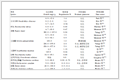
| Complex | 1 | 2 |
| Empirical formula | C16H18Br8N32O2Zn8 | C6H10N8O6Mn |
| Formula weight | 1 852.86 | 345.16 |
| Crystal system | Orthorhombic | Monoclinic |
| Space group | Pbca | P21/c |
| a/nm | 0.942 86(8) | 0.945 38(9) |
| b/nm | 1.003 95(8) | 0.931 54(9) |
| c/nm | 1.228 81(11) | 0.679 09(7) |
| β/(°) | 98.005(2) | |
| V/nm3 | 1.163 17(17) | 0.592 22(10) |
| Dc/(g·cm-3) | 2.645 | 1.936 |
| Z | 1 | 2 |
| μ/mm-1 | 10.984 | 1.164 |
| F(000) | 874.0 | 350 |
| Data, restraint, parameter | 1 331, 1, 83 | 2 891, 2, 97 |
| GOF | 1.161 | 1.072 |
| Final R indexes [I>2σ(I)] | 0.054 1, 0.108 7 | 0.028 1, 0.071 3 |
| Final R indexes (all data) | 0.063 5, 0.112 1 | 0.033 5, 0.074 3 |
| (Δρ)max, (Δρ)min/(e·nm-3) | 1 490, -2 260 | 652, -327 |
| aR1=∑||Fo|-|Fc||/∑|Fo|; bwR2=[∑w(Fo2-Fc2)2/w(Fo2)2]1/2. | ||
CCDC: 1833088, 1; 1575499, 2.
The complexes were synthesized in different ways: 1 was discovered from hydrothermal synthesis, but 2 was synthesized by solution diffusion. It is worth mentioning that HAthy ligand in 1 underwent a de-carbonyl reaction and changed into hydroxyl functional groups under hydrothermal conditions, in which the Zn2+ ions act as Lewis acid. The carboxyl groups are prone to de-acidification at high temperature in the presence of Lewis acid. This kind of organic synthesis reaction has been applied in chemical production[26].
Single crystal X-ray diffraction analyses reveal that 1 belongs to orthorhombic crystal system with Pbca space group. The asymmetric unit consists of one Zn(Ⅱ) cation, one deprotonated HAthy ligand, and one coordination Br anion. The coordination environment of 1 is depicted in Fig. 1a.

Symmetry codes: ⅰ-x, -y, -z; ⅱ -1/2+x, 1/2-y, -z for 1; ⅰ -x+1, -y+1, -z+1 for 2
Meanwhile, the O atom in the hydroxyl group is not involved in the coordination. Complementary, the N atoms in pyrrol group play a very important role because the deprotonated N atoms balance the charge of complex. As shown in Fig. 1a. The center Zn(Ⅱ) cation is coordinated with three N atoms (N2, N3, N4) from HApyo ligand and one Br anion. The selected bond lengths and angles for Complex 1 are summarized in Table 2. All the data indicate that the center Zn(Ⅱ) adopts slightly distorted tetra-coordinated tetrahedron geometry. The 2D structure of Complex 1 can be found that the layers are interlaced with each other through Zn coordinated with the N atoms in deprotonated HAthy ligand observed along a, b and c axis. (Fig.S1).
下载:
导出CSV
| Zn1(Ⅱ)Br1 | 0.234 77(12) | N2(Ⅱ)C1 | 0.133 4(8) | N3(Ⅱ)N2ⅰ | 0.138 2(8) | |
| Zn1(Ⅱ)N2 | 0.199 8(6) | N4(Ⅱ)C1ⅱ | 0.134 3(8) | N3(Ⅱ)C2ⅳ | 0.132 3(9) | |
| Zn1(Ⅱ)N3 | 0.199 5(6) | N4(Ⅱ)C2 | 0.134 9(8) | C2(Ⅱ)N3ⅴ | 0.132 3(9) | |
| Zn1(Ⅱ)N4 | 0.200 8(5) | C1(Ⅱ)N4ⅲ | 0.134 3(8) | C2(Ⅱ)O1 | 0.127(3) | |
| N2(Ⅱ)N3ⅰ | 0.138 2(8) | N1(Ⅱ)C1 | 0.133 8(11) | |||
| N2(Ⅱ)Zn1(Ⅱ)Br1 | 111.99(17) | C1(Ⅱ)N2(Ⅱ)N3i | 105.6(5) | N1(Ⅱ)C1(Ⅱ)N4ⅲ | 123.5(7) | |
| N2(Ⅱ)Zn1(Ⅱ)N4 | 108.2(2) | N3ⅰ(Ⅱ)N2(Ⅱ)Zn1 | 126.1(4) | N2ⅰ(Ⅱ)N3(Ⅱ)Zn1 | 125.7(4) | |
| N4(Ⅱ)Zn1(Ⅱ)Br1 | 107.45(16) | C1ⅱ(Ⅱ)N4(Ⅱ)Zn1 | 130.8(5) | C2ⅳ(Ⅱ)N3(Ⅱ)Zn1 | 127.8(5) | |
| N3(Ⅱ)Zn1(Ⅱ)Br1 | 114.66(18) | C1ⅱ(Ⅱ)N4(Ⅱ)C2 | 103.8(6) | C2ⅳ(Ⅱ)N3(Ⅱ)N2ⅰ | 106.5(5) | |
| N3(Ⅱ)Zn1(Ⅱ)N2 | 107.7(2) | C2(Ⅱ)N4(Ⅱ)Zn1 | 125.4(5) | N3ⅴ(Ⅱ)C2(Ⅱ)N4 | 111.9(6) | |
| N3(Ⅱ)Zn1(Ⅱ)N4 | 107.6(2) | N2(Ⅱ)C1(Ⅱ)N4ⅲ | 112.1(6) | O1(Ⅱ)C2(Ⅱ)N4 | 125.7(13) | |
| C1(Ⅱ)N2(Ⅱ)Zn1 | 127.5(5) | N2(Ⅱ)C1(Ⅱ)N1 | 124.4(7) | O1(Ⅱ)C2(Ⅱ)N3v | 122.2(13) | |
| Symmetry codes: ⅰ -x, -y, -z; ⅱ 1/2+x, 1/2-y, -z; ⅲ -1/2+x, 1/2-y, -z; ⅳ1/2-x, -1/2+y, z; ⅴ1/2-x, 1/2+y, z. | ||||||
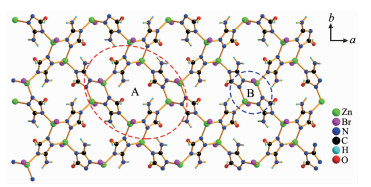
Four metal ions and four deprotonated HAthy ligand ligands are arranged alternately into a 16-membered big ring (A) structure, and two deprotonated HAthy ligands also form a 6-membered little ring (B) structure with two metal ions, as shown in Fig. 2. Each little ring is surrounded by four big rings, meanwhile, each big ring is adjacent to four big rings and four small rings, forming a stable 2D network structure.
Complex 2 crystallizes in the monoclinic system, space group P21/c. The asymmetric unit of 2 is composed of half Mn(Ⅱ) cation, one Atca ligand and one coordinated water molecule. As shown in Fig. 1b, the coordination of metal Mn(Ⅱ) and Atca ligands is relatively simple, and the coordinated geometry around Mn(Ⅱ) center can be viewed as a slightly distorted octahedron. The angle between the line L (O1W-Mn-O1Wⅰ) and plane S (N1-O2-N1ⅰ-O2ⅰ) is 86.822(31)°, which is surrounded by two N atoms and two O atoms from two chelating Atca ligands and two coordinated water molecules. Selected bond lengths and angles for 2 are listed in Table 3.
下载:
导出CSV
| Mn(1)-N(1) | 0.220 52(7) | Mn(1)-O(1W) | 0.220 86(7) | Mn(1)-O(2) | 0.224 06(7) | |
| N(1)-Mn(1)-N(1)ⅰ | 180.0 | N(1)-Mn(1)-O(1W)ⅰ | 90.77(3) | O(1W)-Mn(1)-O(2) | 86.82(3) | |
| N(1)-Mn(1)-O(1W) | 89.23(3) | O(1)-C(1)-O(2) | 125.59(8) | O(1W)ⅰ-Mn(1)-O(1W) | 180.0 | |
| N(1)-Mn(1)-O(2)ⅰ | 104.66(2) | N(1)ⅰ-Mn(1)-O(2)ⅰ | 75.34(2) | O(2)ⅰ-Mn(1)-O(2) | 180.00(4) | |
| O(1W)-Mn(1)-O(2)ⅰ | 93.18(3) | N(1)-Mn(1)-O(2) | 75.34(2) | |||
| Symmetry codes: ⅰ -x+1, -y+1, -z+1. | ||||||
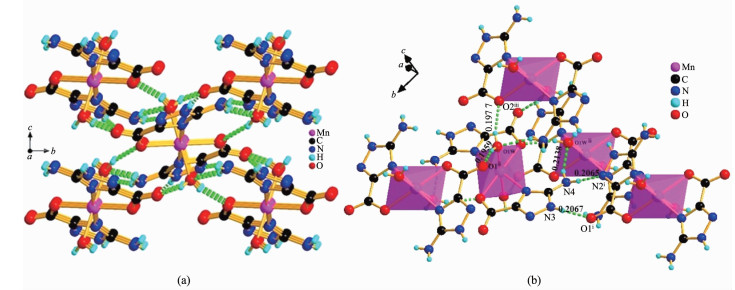
Metal cations are aligned in parallel lines, no matter which axis they are viewed from(Fig.S2). Meanwhile, the alternate arrangement of adjacent pairs of complex can be observed from a axis. It can be seen clearly from the structure of 2 that carboxyl group acts as a receptor, amino group as a donor, and the coordinated water as both a receptor and a donor in hydrogen bond. The molecules of each complex are connected to the surrounding molecules by hydrogen bonds (Fig. 3a). The bond lengths and bond angles of hydrogen bonds of the complex are 0.25~0.32 nm and 130°~180°(Table 4), respectively, so they can be judged as a moderate hydrogen bond interaction (Fig. 3b). Obviously, two strong hydrogen bonds, O1W…O1ⅰ and O2ⅲ…O1W connect two adjacent parts, and form a stable 12-membered ring (#-metal ion-coordination water…carboxyl-metal ion-coordination water…carboxyl-#), which is then connected into a two-dimensional mesh structure. At the same time, the relatively weak hydrogen bond (N4…O1Wⅱ) also increases the stability of structure. The other two relatively weak hydrogen bonds, N4…N2ⅰ and N3…O1ⅰ connects the two adjacent complex at the upper right to form a 10-membered ring between the two ligands. The above two-dimensional mesh structure is connected to form a highly stable 3D grid structure (Fig.S3).
下载:
导出CSV
| D-H…A | d(D-H)/nm | d(H…A)/nm | d(D…A)/nm | ∠D-H…A/(°) |
| N(4)-H(4B)…O(1W)ⅱ | 0.085 | 0.214 | 0.293 54(12) | 159.6 |
| N(4)-H(4A)…N(2)ⅰ | 0.084 | 0.207 | 0.290 57(12) | 168.3 |
| N(3)-H(3)…O(1)ⅰ | 0.083 | 0.207 | 0.289 30(10) | 175.4 |
| O(1W)-H(1WB)…O(1)ⅱ | 0.082 | 0.196 | 0.275 41(10) | 164.6 |
| O(1W)-H(1WA)…O(2)ⅲ | 0.080 | 0.198 | 0.274 94(9) | 164.0 |
| Symmetry codes: ⅰx, 1/2+y, 1/2-z; ⅱ 1-x, -1/2+y, 1/2-z; ⅲ x, 3/2-y, -1/2+z. | ||||
Symmetry codes: ⅰx, 1/2+y, 1/2-z; ⅱ1-x, -1/2+y, 1/2-z; ⅲx, 3/2-y, -1/2+z
It is generally assumed that transition metal coordination complexes formed by Zn or Mn centers possess excellent luminescent properties, because core-liked d-orbitals and d-d transitions. At the same time, most of the functional complexes constructed by nitrogen heterocyclic organic ligands also have potential applications in the field of fluorescence emission materials. Organic materials can influence the emission of wavelength. So the reasonable selection of organic ligands and central metals (such as Zn(Ⅱ), Cd(Ⅱ), Mn(Ⅱ)) to synthesize functional complexes is an effective way to obtain luminescent materials.
The photoluminescent properties of 1 and 2 were investigated in solid state at room temperature (Fig. 4), while the ligand had no photoluminescent properties. When excited at 281 nm (Fig.S4), Complex 1 showed two broad emissions at 400 and 490 nm, which is probably due to a mixture of intra-ligand and ligand-to-ligand charge transition (LLCT)[27-28]. Complex 2 exhibited two broad emissions at 382 and 402 nm when excited at 349 nm, similarly. The emissions of 2 also may be a mixture of intra-ligand and ligand-to-ligand charge transition (LLCT). And complex 2 had a hypsochromic shift of 60 nm considered to mainly originate from the influence of the coordination of the ligand to Mn(Ⅱ) ion[29-30].
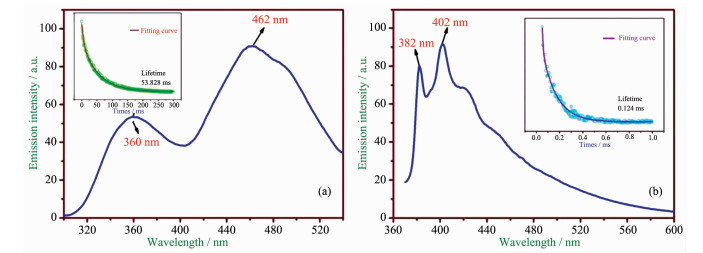
In addition, the significant increase in fluore-scence lifetime of 1 compared with 2 (the fluorescence lifetime of Complex 1 is 400 times that of complex 2) is tentatively attributed to the relative proportion of central metal cations and the difference of coordina-tion Br anions in coordination polymers (Fig. 4). It means that the complexes 1 may have better application prospects in blue light materials.
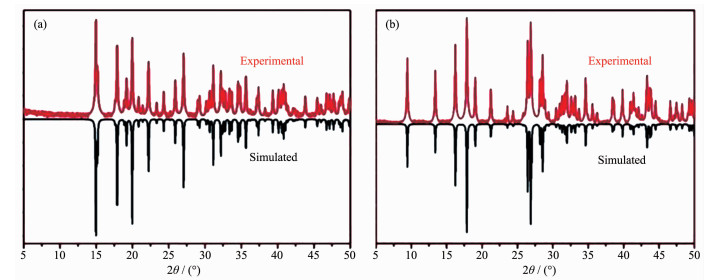
As shown in Fig. 5, the PXRD patterns of complexes of 1 and 2 show that their products are very highly crystalline[31-33].
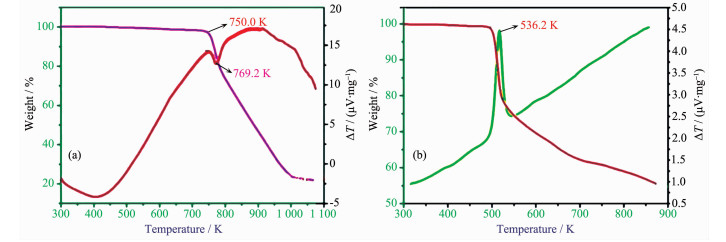
Complexes 1 and 2 are two-dimensional structures and flexible mononuclear structures respectively, but all have been constructed three dimensions grid structure by hydrogen bonds. Moreover, the hydrogen bonds in the complex 2 also increase the thermal stability of the structure. The thermal stabilities of Complex 1 and 2 were tested in a range of 300~1 100 K under a nitrogen atmosphere at a heating of 10 K·min-1, and TGA curves of complexes 1 and 2 are shown in Fig. 6.
As shown in Fig. 6a, when the temperature was less than 750 K, Complex 1 had higher thermal stability. Complex 1 had a downward peak near 769 K in the DTA curve, which may be due to high nitrogen content and high energy content of Complex 1. As well, it was preliminarily determined that the decomposition rate of 1 near 769K was the fastest, and then the structure completely collapsed and decomposed. However, the DTA curve of complex 2 had an upward peak in vicinity of 536 K (Fig. 6b), which may be caused by coordination of complex 2 with more water and a relatively high proportion of water in 2.
The results indicate that Complex 1 has better thermal stability than 2, and the changes of their structure with temperature are represented by DSC, respectively (Fig.S5).
In summary, we have successfully synthesized two novel transition metal triazole carboxylic complexes [Zn(Athy)Br]n (1) and [Mn(Atca)2(H2O)2] (2) through hydrothermal method and diffusion method, respectively. In the process of hydrothermal synthesis, the carboxyl group on triazole of Complex 1 was reduced to the hydroxyl group. Complexes 1 and 2 have blue and violet fluorescence properties, respectively, indicating potential applications in photoluminescence materials.
Acknowledgments: Dr. Tan is grateful for the support from the National Natural Science Foundation of China (Grants No.21471070, 21761013, 21671086, 21461010), the Academic leader Foundation of Jiangxi Province and Jiangxi Science and Technology Department (Grant No.20153BCB22006).
Supporting information is available at http://www.wjhxxb.cn
Fermi A, Bergamini G, Roy M, et al. J. Am. Chem. Soc., 2014, 136(17):6395-6400 doi: 10.1021/ja501458s
Huang Y B, Wang Q, Liang J, et al. J. Am. Chem. Soc., 2016, 138(32):10104-10107 doi: 10.1021/jacs.6b06185
Decadt R, Hecke K V, Depla D, et al. Inorg. Chem., 2012, 51(21):11623-11634 doi: 10.1021/ic301544q
Tian D, Chen Q, Li Y, et al. Angew. Chem. Int. Ed., 2014, 53:837-841 doi: 10.1002/anie.201307681
He K H, Song W C, Li Y W, et al. Cryst. Growth Des., 2012, 12:1064-1068 doi: 10.1021/cg2014495
Li L, Zhang S, Han L, et al. Cryst. Growth Des., 2013, 13:106-110 doi: 10.1021/cg301243e
Wang H, Yang W, Sun Z M, et al. Chem. Asian J., 2013, 8:982-989 doi: 10.1002/asia.v8.5
Hasegawa S, Horike S, et al. J. Am. Chem. Soc., 2007, 129(9):2607-2614 doi: 10.1021/ja067374y
Zhang Y J, Liu T, Kanegawa S, et al. J. Am. Chem. Soc., 2010, 132(3):912-913 doi: 10.1021/ja908670u
Singh R, Mrozinski J, Bharadwaj P K. Cryst. Growth Des., 2014, 14(7):3623-3633 doi: 10.1021/cg5005775
Kusaka S, Sakamoto R, Kitagawa Y, et al. Chem. Asian J., 2012, 7:907-910 doi: 10.1002/asia.v7.5
Zhao H, Qu Z R, Ye H Y, et al. Chem. Soc. Rev., 2008, 37:84-100 doi: 10.1039/B616738C
Gao J X, Xiong J B, Tang Y Z, et al. Cryst. Growth Des., 2016, 16:1559-1564 doi: 10.1021/acs.cgd.5b01684
Tang Y Z, Yu Y M, Xiong J B, et al. Sci. China Chem., 2014, 57(11):1516-1519
Tan Y H, Yu Y M, Xiong J B, et al. Polyhedron, 2014, 70:47-51 doi: 10.1016/j.poly.2013.12.027
Tang Y Z, Xiong J B, Tan Y H, et al. Inorg. Chim. Acta, 2014, 10:82-87
Tang Y Z, Huang J, Zhou M, et al. Z. Anorg. Allg. Chem., 2013, 639(2):409-413 doi: 10.1002/zaac.v639.2
Tan Y H, Wu J S, Yang C S, et al. Polyhedron, 2013, 57:24-29 doi: 10.1016/j.poly.2013.04.030
Tang Y Z, Huang J, Zhou M, et al. Bull. Korean Chem. Soc., 2013, 34(1):295-297 doi: 10.5012/bkcs.2013.34.1.295
Tang Y Z, Zhou M, Huang J, et al. Inorg. Chem., 2013, 52:1679-1681 doi: 10.1021/ic302411r
Huang D, Zhao P, Astruc D. Coord. Chem. Rev., 2014, 272:145-165 doi: 10.1016/j.ccr.2014.04.006
GAO Hong Bin(高鸿宾). Organic Chemistry(有机化学). Beijing: Higher Education Press, 2005: 438-439
Sheldrick G M. SHELXS-97, Program for X-ray Crystal Structure Determination, University of Göttingen, Germany, 1997.
Sheldrick G M. SHELXL-97, Program for the Refinement of Crystal Structures, University of Göttingen, Germany, 1997.
Flack H D. Acta Crystallogr. Sect. A:Found. Crystallogr., 1983, A39:876-881
(a) Fraga-Dubreuil J, Garcia-Serna Juan, Garcia-Verdugo Eduardo, et al. J. Supercrit. Fluids, 2006, 39(2): 220-227
(b)Buijs W. J. Mol. Catal. A: Chem., 1999, 146(1/2): 237-246
蒋正静, 殷竞洲, 李荣清, 等.无机化学学报, 2018, 34(4):719-727 http://www.wjhxxb.cn/wjhxxbcn/ch/reader/view_abstract.aspx?file_no=20180415
毛盼东, 陈泽华, 王媛, 等.无机化学学报, 2017, 33(10):1849-1854 http://www.wjhxxb.cn/wjhxxbcn/ch/reader/view_abstract.aspx?file_no=20171019
Su Z, Fan J, Chen M, et al. Cryst. Growth Des., 2011, 11:1159-1169 doi: 10.1021/cg101365v
Wan X Y, Jiang F L, Chen L, et al. CrystEngComm, 2015, 17:3829-3837 doi: 10.1039/C5CE00420A
Xu Z, Ma Y, Xiao Y, et al. Cryst. Growth Des., 2015, 15:5901-5909 doi: 10.1021/acs.cgd.5b01359
Li M, Li D. Chem. Commun., 2008, 29:3390-3392
Tan Y H, Xiong J B, Gao J X, et al. J. Mol. Struct., 2015, 1086:49-55 doi: 10.1016/j.molstruc.2015.01.005

Figure 1 Coordinated environment of 1 (a) and 2 (b)
Symmetry codes: ⅰ-x, -y, -z; ⅱ -1/2+x, 1/2-y, -z for 1; ⅰ -x+1, -y+1, -z+1 for 2

Figure 3 Hydrogen bonds in complex 2
Symmetry codes: ⅰx, 1/2+y, 1/2-z; ⅱ1-x, -1/2+y, 1/2-z; ⅲx, 3/2-y, -1/2+z

Figure 4 Fluorescence emission spectra and fluorescence lifetime of 1 (a) and 2 (b) in solid-sate at room temperature
Table 1. Crystal data and structure refinement parameters for 1 and 2
| Complex | 1 | 2 |
| Empirical formula | C16H18Br8N32O2Zn8 | C6H10N8O6Mn |
| Formula weight | 1 852.86 | 345.16 |
| Crystal system | Orthorhombic | Monoclinic |
| Space group | Pbca | P21/c |
| a/nm | 0.942 86(8) | 0.945 38(9) |
| b/nm | 1.003 95(8) | 0.931 54(9) |
| c/nm | 1.228 81(11) | 0.679 09(7) |
| β/(°) | 98.005(2) | |
| V/nm3 | 1.163 17(17) | 0.592 22(10) |
| Dc/(g·cm-3) | 2.645 | 1.936 |
| Z | 1 | 2 |
| μ/mm-1 | 10.984 | 1.164 |
| F(000) | 874.0 | 350 |
| Data, restraint, parameter | 1 331, 1, 83 | 2 891, 2, 97 |
| GOF | 1.161 | 1.072 |
| Final R indexes [I>2σ(I)] | 0.054 1, 0.108 7 | 0.028 1, 0.071 3 |
| Final R indexes (all data) | 0.063 5, 0.112 1 | 0.033 5, 0.074 3 |
| (Δρ)max, (Δρ)min/(e·nm-3) | 1 490, -2 260 | 652, -327 |
| aR1=∑||Fo|-|Fc||/∑|Fo|; bwR2=[∑w(Fo2-Fc2)2/w(Fo2)2]1/2. | ||
 下载: 导出CSV
Table 2. Selected bond lengths (nm) and angles (°) of complex 1
| Zn1(Ⅱ)Br1 | 0.234 77(12) | N2(Ⅱ)C1 | 0.133 4(8) | N3(Ⅱ)N2ⅰ | 0.138 2(8) | |
| Zn1(Ⅱ)N2 | 0.199 8(6) | N4(Ⅱ)C1ⅱ | 0.134 3(8) | N3(Ⅱ)C2ⅳ | 0.132 3(9) | |
| Zn1(Ⅱ)N3 | 0.199 5(6) | N4(Ⅱ)C2 | 0.134 9(8) | C2(Ⅱ)N3ⅴ | 0.132 3(9) | |
| Zn1(Ⅱ)N4 | 0.200 8(5) | C1(Ⅱ)N4ⅲ | 0.134 3(8) | C2(Ⅱ)O1 | 0.127(3) | |
| N2(Ⅱ)N3ⅰ | 0.138 2(8) | N1(Ⅱ)C1 | 0.133 8(11) | |||
| N2(Ⅱ)Zn1(Ⅱ)Br1 | 111.99(17) | C1(Ⅱ)N2(Ⅱ)N3i | 105.6(5) | N1(Ⅱ)C1(Ⅱ)N4ⅲ | 123.5(7) | |
| N2(Ⅱ)Zn1(Ⅱ)N4 | 108.2(2) | N3ⅰ(Ⅱ)N2(Ⅱ)Zn1 | 126.1(4) | N2ⅰ(Ⅱ)N3(Ⅱ)Zn1 | 125.7(4) | |
| N4(Ⅱ)Zn1(Ⅱ)Br1 | 107.45(16) | C1ⅱ(Ⅱ)N4(Ⅱ)Zn1 | 130.8(5) | C2ⅳ(Ⅱ)N3(Ⅱ)Zn1 | 127.8(5) | |
| N3(Ⅱ)Zn1(Ⅱ)Br1 | 114.66(18) | C1ⅱ(Ⅱ)N4(Ⅱ)C2 | 103.8(6) | C2ⅳ(Ⅱ)N3(Ⅱ)N2ⅰ | 106.5(5) | |
| N3(Ⅱ)Zn1(Ⅱ)N2 | 107.7(2) | C2(Ⅱ)N4(Ⅱ)Zn1 | 125.4(5) | N3ⅴ(Ⅱ)C2(Ⅱ)N4 | 111.9(6) | |
| N3(Ⅱ)Zn1(Ⅱ)N4 | 107.6(2) | N2(Ⅱ)C1(Ⅱ)N4ⅲ | 112.1(6) | O1(Ⅱ)C2(Ⅱ)N4 | 125.7(13) | |
| C1(Ⅱ)N2(Ⅱ)Zn1 | 127.5(5) | N2(Ⅱ)C1(Ⅱ)N1 | 124.4(7) | O1(Ⅱ)C2(Ⅱ)N3v | 122.2(13) | |
| Symmetry codes: ⅰ -x, -y, -z; ⅱ 1/2+x, 1/2-y, -z; ⅲ -1/2+x, 1/2-y, -z; ⅳ1/2-x, -1/2+y, z; ⅴ1/2-x, 1/2+y, z. | ||||||
下载: 导出CSV
Table 3. Selected bond lengths (nm) and angles (°) of complex 2
| Mn(1)-N(1) | 0.220 52(7) | Mn(1)-O(1W) | 0.220 86(7) | Mn(1)-O(2) | 0.224 06(7) | |
| N(1)-Mn(1)-N(1)ⅰ | 180.0 | N(1)-Mn(1)-O(1W)ⅰ | 90.77(3) | O(1W)-Mn(1)-O(2) | 86.82(3) | |
| N(1)-Mn(1)-O(1W) | 89.23(3) | O(1)-C(1)-O(2) | 125.59(8) | O(1W)ⅰ-Mn(1)-O(1W) | 180.0 | |
| N(1)-Mn(1)-O(2)ⅰ | 104.66(2) | N(1)ⅰ-Mn(1)-O(2)ⅰ | 75.34(2) | O(2)ⅰ-Mn(1)-O(2) | 180.00(4) | |
| O(1W)-Mn(1)-O(2)ⅰ | 93.18(3) | N(1)-Mn(1)-O(2) | 75.34(2) | |||
| Symmetry codes: ⅰ -x+1, -y+1, -z+1. | ||||||
下载: 导出CSV
Table 4. Hydrogen bond parameters of complex 2
| D-H…A | d(D-H)/nm | d(H…A)/nm | d(D…A)/nm | ∠D-H…A/(°) |
| N(4)-H(4B)…O(1W)ⅱ | 0.085 | 0.214 | 0.293 54(12) | 159.6 |
| N(4)-H(4A)…N(2)ⅰ | 0.084 | 0.207 | 0.290 57(12) | 168.3 |
| N(3)-H(3)…O(1)ⅰ | 0.083 | 0.207 | 0.289 30(10) | 175.4 |
| O(1W)-H(1WB)…O(1)ⅱ | 0.082 | 0.196 | 0.275 41(10) | 164.6 |
| O(1W)-H(1WA)…O(2)ⅲ | 0.080 | 0.198 | 0.274 94(9) | 164.0 |
| Symmetry codes: ⅰx, 1/2+y, 1/2-z; ⅱ 1-x, -1/2+y, 1/2-z; ⅲ x, 3/2-y, -1/2+z. | ||||
下载: 导出CSV

 扫一扫看文章


扫一扫关注我们


 下载:
下载: