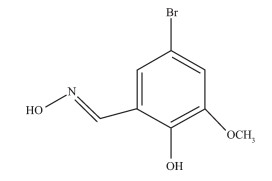
图 Scheme 1
Molecular structure of HL
Figure Scheme 1.
Molecular structure of HL

Dinuclear Gd(Ⅲ)/Dy(Ⅲ) Complexes Based on Schiff base Ligands: Structures and Magnetic Properties
Ping-Ning JIN , Rui-Fang YAN , Peng HU , Yan-Ni WU , Yuan-Yuan GAO , Ling-Zhu HUANG , Yi-Xuan ZHU , Yan SU , Ying-Ling WANG


Since the discovery of Single-molecule magnets (SMMs) during the 1990s, the study of SMMs has a booming development for its potential application in high-density information storage and quantum comput-ing devices[1-4]. To achieve these applications, carefully designed structures of SMMs are required. Among all the central ions, owning to their significant magnetic anisotropy which arising from the large, unquenched orbital angular momentum, lanthanide-ions are widely used to construct SMMs[5-15]. For example, Zheng's group reported a monometallic Dy complex of magnetization reached an effective energy barrier to magnetic relaxa-tion of Ueff=1 815(1) K[16]. Tong's group reported another Dy-based compound with a record anisotropy barrier up to 1 837 K in zero field and a record magnetic blocking temperature of 60 K[17]. Notably, previous studies show that the magnetic interaction between centre metals and the alteration of coordination geometry on them are two important factors to adjust the relaxation dynamics of lanthanide-based SMMs[18-19]. For example, Tang's group reported an asymmetric dinuclear Dy(Ⅲ) complex which shows the high axiality and Ising exchange interaction that can efficiently suppress quantum tunneling of magnetization and the exchange interaction between the Dy sites contribution leading to an increase of the relaxation time by 3 orders of magnitude[20]. In addition, the dinuclear SMMs are ideal configurations to study the single-ion effective anisotropic barriers versus the energy barriers which arising from the two interaction metal centers[21-22]. To date, various researches have been performed to study how the exchange coupling affects magnetic properties of lanthanide-based complexes and some innovative results have been reported[23-25].
To construct dinuclear SMMs, the choice of ligands is very important. As ligands can influence the construction of coordination polymers and moreover, ligand field is a key factor to control the magnetic anisotropy of SMMs. Therefore, Schiff-base ligands with rich O, N-based multichelating sites have been regarded as excellent candidates to construct lanthanide-based multinuclear coordination com-pounds. In addition, by modifying the terminal group of acylhydrazine derivatives, various ligand systems will be built in which ligand field will also affect the SMM properties of Ln(Ⅲ) coordination compounds[26-28].
Herein, we choose 2-hydroxy-3-methoxy-5-bromo-benzaldehyde oxime(HL) as ligand in combination with methane acid and acetic acid to build new Ln-based coordination polymers. Two new complexes, namely, [Gd2(L)4(HCOO)2(CH3OH)2] (1) and [Dy2(L)4(CH3COO)2(CH3OH)2] (2) have been constructed succe-ssfully. Their syntheses, crystal structures and magnetic properties are reported.
All reagents and solvents were purchased from Aladdin and used without further purification. The ligand HL was synthesized according to the literature[29]. Elemental analyses for C, H and N were performed on a Perkin-Elmer elemental analyzer model 240. IR spectra were recorded on a Nicolet IS10. IR spectro-meter using KBr pellets in the range of 4 000~500 cm-1. Variable temperature magnetic susceptibilities were measured on SQUID MPMSXL-7 magnetometer in the temperature range of 2~300 K.
Ligand HL (0.1 mmol) was dissolved in mixed solvent of 10 mL CH3OH and 5 mL CH3CN followed by addition of GdCl3·6H2O (0.1 mmol) and sodium methoxide (0.2 mmol), which gave a clear solution after stirring for 2.5 h. Diethyl ether was diffused slowly into the solution at room temperature, and light-yellow single crystals were obtained in 5 days. Yield: 42.5% based on rare-earth. Elemental analysis calculated for C40H54Br4Gd2N4O22(%): C 30.47; H 3.45; N 3.55. Found(%): C 30.61; H 3.52; N 3.61. FT-IR (KBr, cm-1): 1 689(w), 1 612(m), 1 568(m), 1 473(s), 1 312(w), 1 174(w), 1 072(m), 1 010(w), 952(w), 842(s), 753(m), 587(m).
Ligand HL (0.1 mmol) was dissolved in mixed solvent of 10 mL CH3OH and 5 mL CH3CN followed by the addition of Dy(CH3COO)3·4H2O (0.1 mmol) and triethylamine (0.2 mmol). A clear solution was obtained after stirring for 3 h. Diethyl ether was used to diffuse slowly into this solution at room temperature, and light-yellow single crystals were obtained in 5 days. Yield: 44.5% based on rare-earth. Elemental analysis calculated for C40H50Br4Dy2N4O20(%): C 30.97; H 3.25; N 3.61. Found(%): C 30.81; H 3.21; N 3.51. FTIR (KBr, cm-1): 1 860(w), 1 601(m), 1 478(m), 1 380(s), 1 221(m), 1 110(s), 1 005(w), 941(w), 840(m), 734(s), 558(w).
The suitable single crystals of complexes 1 and 2, with crystal size of 0.34 mm×0.34 mm×0.29 mm and 0.32 mm×0.31 mm×0.28 mm respectively, were used for X-ray diffraction data collection with a BRUKER SMART 1000 CCD, all using graphite-monochromated Mo Kα radiation (λ=0.071 073 nm). The structures were solved primarily by direct methods and refined by the full-matrix least squares method. The computations were performed with the SHELX-97 program[30]. All non-hydrogen atoms were refined with anisotropic thermal parameters. The hydrogen atoms were set in calculated positions and refined as riding atoms with a common fixed isotropic thermal parameter. The crystal data and refinement parameters of complexes 1 and 2 are summarized in Table 1.
 下载:
导出CSV
下载:
导出CSV
| Complex | 1 | 2 |
| Empirical formula | C40H54Br4Gd2N4O22 | C40H50Br4Dy2N4O20 |
| Formula weight | 1 577.01 | 1 551.44 |
| T/K | 173(2) | 173(2) |
| Crystal system | Triclinic | Monoclinic |
| Space group | P1 | P21/c |
| a/nm | 1.093 9(8) | 1.188 5(6) |
| b/nm | 1.128 8(9) | 2.513 6(12) |
| c/nm | 1.310 5(9) | 0.835 8(5) |
| α/(°) | 103.689(13) | |
| β/(°) | 100.567(15) | 95.923(7) |
| γ/(°) | 116.970(12) | |
| V/nm3 | 1.319 9(16) | 2.484(2) |
| Z | 1 | 2 |
| Dc/(g·cm-3) | 1.984 | 2.075 |
| μ/mm-1 | 5.598 | 6.283 |
| Rint | 0.033 2 | 0.056 1 |
| F(000) | 766 | 1 500 |
| Reflection collected | 9 747 | 17 798 |
| GOF on F2 | 1.016 | 1.015 |
| R1a[I > 2σ(I)] | 0.038 7 | 0.042 7 |
| wR2b[I > 2σ(I)] | 0.100 7 | 0.097 8 |
| aR1=∑(‖Fo|-|Fc‖)/∑|Fo|; bwR2={∑w(Fo2-Fc2)2/∑w(Fo)2}1/2. | ||
CCDC: 1570377, 1; 1570378, 2.
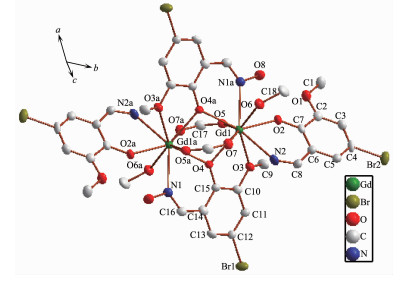
The crystal structure of complex 1 is depicted in Fig. 1. Complex 1 crystallizes in the space group of P1 in triclinic structure. Two symmetric nine-coordinated Gd(Ⅲ) ions are bridged by two phenoxide groups from two Schiff base ligands and two molecules of formate ion with Gd-Ophenoxide bond length of 0.241 7(5) and 0.237 4(3) nm, respectively. Then, each Gd(Ⅲ) ion is further coordinated with two N ions, one Ohydroxyl ion and one Omethoxyl ion. The intramolecular Gd…Gd distance is 0.376 6(2) nm, as well as Gd-O-Gd angle of 103.65(3)°.
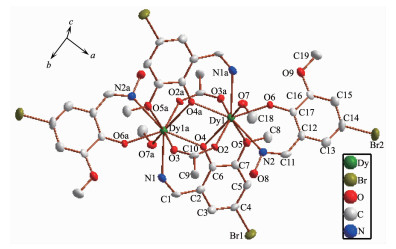
Complex 2 crystallize in monoclinic with space group of P21/c (Fig. 2). The crystal structure of complex 2 is similar to complex 1 except that Dy(Ⅲ) ions are bridged by two acetate ions instead of formate ions. The Dy-O and Dy-N distances are in the range of 0.228 9(4)~0.265 0(4) nm and 0.257 7(3)~0.262 9(2) nm, respectively. The intramolecular Dy…Dy distance is 0.375 7(1) nm with Dy-O-Dy angle of 103.30(5)°. Selected bond lengths and angles for two complexes are shown in Table 2.
 下载:
导出CSV
下载:
导出CSV
| 1 | |||||
| Gd(1)-O(2) | 0.228 6(4) | Gd(1)-O(7)a | 0.244 0(4) | Gd(1)-O(3) | 0.263 7(4) |
| Gd(1)-O(4)a | 0.237 2(4) | Gd(1)-O(6) | 0.245 3(4) | Gd(1)-Gd(1)a | 0.376 7(3) |
| Gd(1)-O(5) | 0.240 7(4) | Gd(1)-N(2) | 0.259 2(6) | O(3)-C(10) | 0.138 0(7) |
| Gd(1)-O(4) | 0.241 8(4) | Gd(1)-N(1)a | 0.259 3(6) | O(3)-C(9) | 0.142 9(7) |
| O(2)-Gd(1)-O(4)a | 139.32(1) | O(2)-Gd(1)-O(4) | 135.76(1) | O(2)-Gd(1)-O(7)a | 130.99(2) |
| O(2)-Gd(1)-O(5) | 85.39(1) | O(4)a-Gd(1)-O(4) | 76.31(1) | O(4)a-Gd(1)-O(7)a | 76.04(2) |
| O(4)a-Gd(1)-O(5) | 77.67(1) | O(5)-Gd(1)-O(4) | 77.91(1) | O(5)-Gd(1)-O(7)a | 143.18(2) |
| 2 | |||||
| Dy(1)-O(6) | 0.229 0(4) | Dy(1)-O(4) | 0.242 3(4) | Dy(1)-O(5) | 0.265 0(4) |
| Dy(1)-O(4)a | 0.236 8(4) | Dy(1)-O(7) | 0.246 6(4) | Dy(1)-Dy(1)a | 0.375 7(4) |
| Dy(1)-O(3) | 0.237 9(4) | Dy(1)-N(1)a | 0.257 8(5) | O(3)-C(10) | 0.124 5(8) |
| Dy(1)-O(2)a | 0.241 2(4) | Dy(1)-N(2) | 0.262 9(6) | O(7)-C(18) | 0.141 8(8) |
| O(6)-Dy(1)-O(4)a | 140.38(1) | O(6)-Dy(1)-O(2)a | 130.53(1) | O(6)-Dy(1)-O(4) | 134.74(2) |
| O(6)-Dy(1)-O(3) | 86.24(1) | O(4)a-Dy(1)-O(2)a | 76.99(1) | O(4)a-Dy(1)-O(4) | 76.70(2) |
| O(4)a-Dy(1)-O(3) | 79.21(1) | O(3)-Dy(1)-O(2)a | 141.49(1) | O(3)-Dy(1)-O(4) | 75.67(2) |
| Symmetry codes: a: -x, -y, -z for 1; a: -x+1, -y, -z+2 for 2. | |||||
Variable-temperature magnetic susceptibilities of complexes 1 and 2 were measured from 300 to 2.0 K in an applied field of 1 kOe. As showed in Fig. 3, the χMT value for complex 1 at 300 K is 15.67 cm3·K·mol-1, which is in agreement with the expected value of 15.76 cm3·K·mol-1 for two uncoupled Gd(Ⅲ) ions (8S7/2, S=7/2). The χMT value is almost constant until the temperature cooling to 30 K, after that, this value decreases rapidly, reaching a minimum value of 11.04 cm3·K·mol-1 at 2.0 K. This phenomenon indicates the presence of a weak antiferromagnetic interaction between the Gd(Ⅲ) ions.
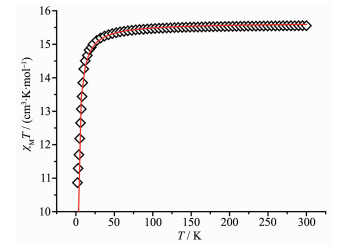
To evaluate the coupling parameters, the magnetic data were analyzed by a theoretical expression[31]. The best fit from equation below gives g=1.99, J=-0.1348 which confirms the weak antiferromagnetic interaction between the Gd ions.
|
$ \begin{array}{l} {\chi _{\rm{M}}} = \frac{{2N_g^2{\beta ^2}}}{{kT}} \cdot \frac{{\exp \left( y \right) + 5\exp \left( {3y} \right) + 14\exp \left( {6y} \right) + 30\exp \left( {10y} \right) + 55\exp \left( {15y} \right) + 91\exp \left( {21y} \right) + 140\exp \left( {28y} \right)}}{{\exp \left( y \right) + 5\exp \left( {3y} \right) + 7\exp \left( {6y} \right) + 9\exp \left( {10y} \right) + 11\exp \left( {15y} \right) + 13\exp \left( {21y} \right) + 15\exp \left( {28y} \right)}}\\ y = J/\left( {kT} \right) \end{array} $ |
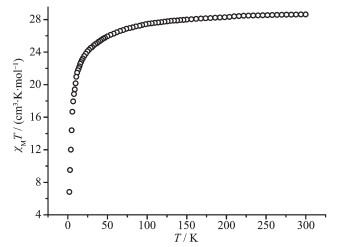
For complex 2 (Fig. 4), at room temperature, the χMT value (28.61 cm3·K·mol-1) is close to the theoretical value of 28.34 cm3·K·mol-1 for two non-interacting Dy(Ⅲ) ions (6H15/2, g=4/3). Upon cooling, the χMT value decreases gradually in the temperature range of 300~50 K, then drops quickly and reaches 6.8 cm3·K·mol-1 at 2 K. This observed decrease of χMT value under high temperatures results from the depopulation of the excited Stark sublevels. However, the decrease behavior at low temperature mainly results from intramolecular antiferromagnetic interaction between Dy(Ⅲ) ions[32].
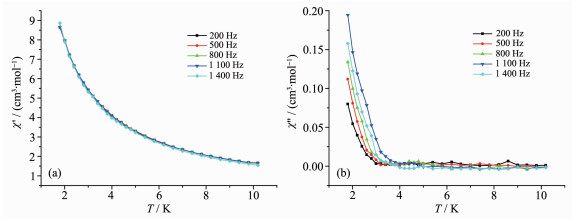
To investigate the dynamic magnetic properties of complex 2, the temperature frequency dependencies of magnetic susceptibility measurements under alternat-ing current were measured in the range of 200~1 400 Hz. As shown in Fig. 5, no maximum in-phase signal(χ') and out-of-phase signal (χ") values are observed until 2 K which might arise from the quantum tunneling of magnetization (QTM). However, the values of in-phase signal (χ') and out-of-phase signal (χ") exhibit a frequency dependent character, indicating the slow relaxation of magnetization.
Two novel dinuclear Ln(Ⅲ) based complexes have been successfully synthesized. These two complexes have similar structures, in which two symmetric nine-coordinated Ln(Ⅲ) ions are bridged by two phenoxide groups from two Schiff base ligands, two molecules of formate ion for 1 and acetate ion for 2. The magnetic studies show that weak antiferromagnetic interaction between the Gd ions existing in complex 1, while complex 2 shows slow relaxation of magnetization.
Vincent R, Klyatskaya S, Ruben M, et al. Nature, 2012, 488:357-360 doi: 10.1038/nature11341
Thiele S, Balestro F, Ballou R, et al. Science, 2014, 344:1135-1138 doi: 10.1126/science.1249802
Bar A K, Pichon C, Gogoi N. Chem. Commun., 2015, 51:3616-3619 doi: 10.1039/C4CC10182K
Cervetti C, Rettori A, Pini M G, et al. Nat. Mater., 2016, 15:164-168 doi: 10.1038/nmat4490
李承辉, 顾志国, 左景林, 等.无机化学学报, 2007, 23(9):1583-1586 http://www.airitilibrary.com/Publication/alDetailedMesh?DocID=10014861-200709-23-9-1582-1586-aLI Cheng-Hui, GU Zhi-Guo, ZUO Jing-Lin, et al. Chinese J. Inorg. Chem., 2007, 23(9):1583-1586 http://www.airitilibrary.com/Publication/alDetailedMesh?DocID=10014861-200709-23-9-1582-1586-a
Pointillart F, Gal Y L, Golhen S, et al. Dalton Trans., 2013, 42:1949-1960 doi: 10.1039/C2DT32150E
Hu P, Gao Y Y, Xiao F P, et al. Polyhedron, 2017, 130:40-46 doi: 10.1016/j.poly.2017.03.021
Han H, Li X, Zhu X, et al. Eur. J. Inorg. Chem., 2017:2088-2093
Du F X, Hu P, Gao Y Y, et al. Inorg. Chem. Commun., 2014, 48:166-170 doi: 10.1016/j.inoche.2014.08.035
Escobar L B L, Guedes G P, Soriano S, et al. Inorg. Chem., 2014, 53:7508-7517 doi: 10.1021/ic5008044
Li C, Sun J, Yang M, et al. Cryst. Growth Des., 2016, 16:7155-7162 doi: 10.1021/acs.cgd.6b01369
Hu P, Guo H F, Li Y, et al. Inorg. Chem. Commun., 2015, 59:91-94 doi: 10.1016/j.inoche.2015.07.003
刘遂军, 崔雨, 宋伟朝, 等.无机化学学报, 2015, 31(9):1894-1902 http://www.wanfangdata.com.cn/details/detail.do?_type=perio&id=wjhxxb201509025LIU Sui-Jun, CUI Yu, SONG Wei-Chao, et al. Chinese J. Inorg. Chem., 2015, 31(9):1894-1902 http://www.wanfangdata.com.cn/details/detail.do?_type=perio&id=wjhxxb201509025
胡鹏, 高媛媛, 肖凤仪, 等.无机化学学报, 2017, 33(1):34-40 http://en.cnki.com.cn/Article_en/CJFDTotal-WJHX201701004.htmHU Peng, GAO Yuan-Yuan, XIAO Feng-Yi, et al. Chinese J. Inorg. Chem., 2017, 33(1):34-40 http://en.cnki.com.cn/Article_en/CJFDTotal-WJHX201701004.htm
Yang M, Li H D, Li L C. Inorg. Chem. Commun., 2017, 76:59-61 doi: 10.1016/j.inoche.2017.01.014
Ding Y S, Chilton N F, Winpenny R E P, et al. Angew. Chem. Int. Ed., 2016, 55:1-5 doi: 10.1002/anie.201510990
Guo F S, Day B M, Chen Y C, et al. Angew. Chem. Int. Ed., 2017, 56:1-6 doi: 10.1002/anie.201610955
Sorace L, Benelli C, Gatteschi D. Chem. Soc. Rev., 2011, 40:3092-3104 doi: 10.1039/c0cs00185f
Guo Y N, Chen X H, Xue S, et al. Inorg. Chem., 2011, 50:9705-9713 doi: 10.1021/ic2014978
Guo Y N, Xu G F, Wernsdorfer W, et al. J. Am. Chem. Soc., 2011, 133:11948-11951 doi: 10.1021/ja205035g
Xue S F, Guo Y N, Ungur L, et al. Chem. Eur. J., 2015, 12:14099-14106 https://www.sciencedirect.com/science/article/pii/S1387700317304458
Zhang L, Jung J L, Zhang P, et al. Chem. Eur. J., 2016, 22:1392-1398 doi: 10.1002/chem.201503422
Zhang K, Yuan C, Guo F S, et al. Dalton Trans., 2017, 46:186-192 doi: 10.1039/C6DT04231G
Li M, Wu H P, Zhang S, et al. Eur. J. Inorg. Chem., 2017:811-819
Zhang K, Guo F S, Wang Y Y. Inorg. Chem. Commun., 2017, 76:95-99 doi: 10.1016/j.inoche.2017.01.005
Bag P, Rastogi C K, Biswas S, et al. Dalton Trans., 2015, 44:4328-4340 doi: 10.1039/C4DT03429E
Biswas S, Das S, Hossain S, et al. Eur. J. Inorg. Chem., 2016:4683-4692 doi: 10.1002/ejic.v2016.28/issuetoc
Hutchings A J, Habib F, Holmberg R J, et al. Inorg. Chem., 2014, 53:2102-2112 doi: 10.1021/ic402682r
许涛, 李连之, 冀海伟.合成化学, 2004, 12:22-24 doi: 10.3969/j.issn.1005-1511.2004.01.009XU Tao, LI Lian-Zhi, JI Hai-Wei. Chinese Journal of Synthetic Chemistry, 2004, 12:22-24 doi: 10.3969/j.issn.1005-1511.2004.01.009
Sheldrick G M. SHELXS-97, Program for the Refinement of Crystal Structures, University of Göttingen, Germany, 1997.
Mukherjee S, Lu J J, Velmurugan G, et al. Inorg. Chem., 2016, 55:11283-11298 doi: 10.1021/acs.inorgchem.6b01863
Kahn M L, Ballou R, Porcher P, et al. Chem. Eur. J., 2002, 8:525-531 doi: 10.1002/(ISSN)1521-3765

Figure 1 Crystal structure of complex 1 with thermal ellipsoids drawn at 30% probability
All hydrogen atoms are omitted for clarity; Symmetry codes: a:-x, -y, -z

Figure 2 Crystal structure of complex 2 with thermal ellipsoids drawn at 30% probability
All hydrogen atoms are omitted for clarity; Symmetry codes: a:-x+1, -y, -z+2

Figure 3 Temperature dependence of χMT for complex 1
Solid line represents the theoretical values based on the corresponding equation

Figure 5 In-phase (a) and out-of-phase susceptibilities (b) of complex 2 at different frequencies under zero applied field
Table 1. Crystal data and structure refinement for complexes 1 and 2
| Complex | 1 | 2 |
| Empirical formula | C40H54Br4Gd2N4O22 | C40H50Br4Dy2N4O20 |
| Formula weight | 1 577.01 | 1 551.44 |
| T/K | 173(2) | 173(2) |
| Crystal system | Triclinic | Monoclinic |
| Space group | P1 | P21/c |
| a/nm | 1.093 9(8) | 1.188 5(6) |
| b/nm | 1.128 8(9) | 2.513 6(12) |
| c/nm | 1.310 5(9) | 0.835 8(5) |
| α/(°) | 103.689(13) | |
| β/(°) | 100.567(15) | 95.923(7) |
| γ/(°) | 116.970(12) | |
| V/nm3 | 1.319 9(16) | 2.484(2) |
| Z | 1 | 2 |
| Dc/(g·cm-3) | 1.984 | 2.075 |
| μ/mm-1 | 5.598 | 6.283 |
| Rint | 0.033 2 | 0.056 1 |
| F(000) | 766 | 1 500 |
| Reflection collected | 9 747 | 17 798 |
| GOF on F2 | 1.016 | 1.015 |
| R1a[I > 2σ(I)] | 0.038 7 | 0.042 7 |
| wR2b[I > 2σ(I)] | 0.100 7 | 0.097 8 |
| aR1=∑(‖Fo|-|Fc‖)/∑|Fo|; bwR2={∑w(Fo2-Fc2)2/∑w(Fo)2}1/2. | ||
 下载: 导出CSV
Table 2. Selected bond lengths (nm) and angles (°) for complexes 1 and 2
| 1 | |||||
| Gd(1)-O(2) | 0.228 6(4) | Gd(1)-O(7)a | 0.244 0(4) | Gd(1)-O(3) | 0.263 7(4) |
| Gd(1)-O(4)a | 0.237 2(4) | Gd(1)-O(6) | 0.245 3(4) | Gd(1)-Gd(1)a | 0.376 7(3) |
| Gd(1)-O(5) | 0.240 7(4) | Gd(1)-N(2) | 0.259 2(6) | O(3)-C(10) | 0.138 0(7) |
| Gd(1)-O(4) | 0.241 8(4) | Gd(1)-N(1)a | 0.259 3(6) | O(3)-C(9) | 0.142 9(7) |
| O(2)-Gd(1)-O(4)a | 139.32(1) | O(2)-Gd(1)-O(4) | 135.76(1) | O(2)-Gd(1)-O(7)a | 130.99(2) |
| O(2)-Gd(1)-O(5) | 85.39(1) | O(4)a-Gd(1)-O(4) | 76.31(1) | O(4)a-Gd(1)-O(7)a | 76.04(2) |
| O(4)a-Gd(1)-O(5) | 77.67(1) | O(5)-Gd(1)-O(4) | 77.91(1) | O(5)-Gd(1)-O(7)a | 143.18(2) |
| 2 | |||||
| Dy(1)-O(6) | 0.229 0(4) | Dy(1)-O(4) | 0.242 3(4) | Dy(1)-O(5) | 0.265 0(4) |
| Dy(1)-O(4)a | 0.236 8(4) | Dy(1)-O(7) | 0.246 6(4) | Dy(1)-Dy(1)a | 0.375 7(4) |
| Dy(1)-O(3) | 0.237 9(4) | Dy(1)-N(1)a | 0.257 8(5) | O(3)-C(10) | 0.124 5(8) |
| Dy(1)-O(2)a | 0.241 2(4) | Dy(1)-N(2) | 0.262 9(6) | O(7)-C(18) | 0.141 8(8) |
| O(6)-Dy(1)-O(4)a | 140.38(1) | O(6)-Dy(1)-O(2)a | 130.53(1) | O(6)-Dy(1)-O(4) | 134.74(2) |
| O(6)-Dy(1)-O(3) | 86.24(1) | O(4)a-Dy(1)-O(2)a | 76.99(1) | O(4)a-Dy(1)-O(4) | 76.70(2) |
| O(4)a-Dy(1)-O(3) | 79.21(1) | O(3)-Dy(1)-O(2)a | 141.49(1) | O(3)-Dy(1)-O(4) | 75.67(2) |
| Symmetry codes: a: -x, -y, -z for 1; a: -x+1, -y, -z+2 for 2. | |||||
下载: 导出CSV

 扫一扫看文章


扫一扫关注我们


 下载:
下载: