
图 Scheme 1
Synthetic route to the Salamo-type ligand H2L
Figure Scheme 1.
Synthetic route to the Salamo-type ligand H2L

Two Trinuclear Cobalt(Ⅱ) Salamo-Type Complexes: Syntheses, Crystal Structures, Solvent Effect and Fluorescent Properties
Li WANG , Quan-Peng KANG , Jing HAO , Yang ZHANG , Yang BAI , Wen-Kui DONG


Recently, a lot of researchers have focused their researches mainly on the investigation of the structures of transition metal complexes possessing Salen-type ligands and their derivatives[1-6]. These complexes could be utilized in obtaining optical materials[7-13], biological systems[14-22], interesting magnetic properties[23], fluorescent sensor[24-36], catalytic activity[37], and building blocks for supramolecular features[38-46]. Therefore, the research on Salen-type ligands and their Co(Ⅱ) complexes, without gainsaying, remains a focus of many current investigations.
Synthesis of Salamo-type ligands when compared with Salen-type ligands, is more important, because the electronic and steric effects of the ligands on Salamo-metal-assisted catalysis may be controlled by the introduction of proper substituents into the benzene rings. The configuration would provide opportunities for a greater structural variation and infinite coordination polymers, which would be expected to lead to novel characteristics. Furthermore, this change could offer better ways to control and monitor polymerization in the context of the infinite coordination polymer structures (different functionality permits the use of different metals in the polymerization process)[23]. In order to study the structural features and spectral characteristics of transition metal complexes with Salamo-type bisoxime ligands, we herein report two trinuclear Co(Ⅱ) complexes possessing solvent effect with an Salamo-type bisoxime ligand, 4, 4′-dinitro-2, 2′-(1, 2-ethylenedioxybis(nitrilomethylidyne))diphenol (H2L).
All chemicals were of analytical reagent grades and were used without further purification. C, H and N analyses were obtained using a GmbH VarioEL V3.00 automatic elemental analysis instrument. Elemental analyses for Co(Ⅱ) were performed by an IRIS ER/S-WP-1 ICP atomic emission spectrometer. IR spectra were recorded on a VERTEX70 FT-IR spectrophotometer (500~4 000 cm-1), with samples prepared as KBr pellets. Melting points were obtained by the use of an X4 microscopic melting point apparatus produced by Beijing Taike Instrument Limited Company and were uncorrected. Fluorescent spectra were taken on a LS-55 fluorescence photometer. X-ray single crystal structure determinations were carried out on a Bruker Smart Apex CCD diffractometer.
The reaction step involved in the synthesis of H2L is given in Scheme 1. H2L was prepared by the modification of the reported method[47-53]. A mixture of 5-nitrosalicylicaldehyde (341.6 mg, 2.01 mmol) and 1, 2-bis(aminooxy)ethane (93.4 mg, 1.00 mmol) in ethanolic solution was stirred at 55 ℃ for 5 h. After cooling to room temperature, the precipitate was filtered, and washed successively with ethanol and ethanol/hexane (1:4, V/V), respectively. he product was dried under vacuum, and obtained 298.69 mg of colorless micro-crystal. Yield: 85.1%. m.p. 202~203 ℃. Anal. Calcd. for C16H14N4O8(%): C, 49.24; H, 3.62; N, 14.35. Found(%): C, 49.23; H, 3.70; N, 14.16.
A dropwise solution of Co(OAc)2·4H2O (2.47 mg, 0.01 mmol) in ethanol (4 mL) was added to a solution of H2L (3.52 mg, 0.01 mmol) in chloroform (4 mL) at room temperature, and the resulting mixed solution immediately turned yellow, and was stirred for 4 h at ambient temperature. The mixed solution was filtered and the filtrate was allowed to stand at room temperature for about three weeks, the solvent was partially evaporated and finally obtained several red prismatic single crystals suitable for X-ray crystallo-graphic analysis. Anal. Calcd. for C46H56Cl6Co3N8O24(%) C, 36.97; H, 3.78; N, 7.50; Co, 11.83; Found(%): C, 36.99; H, 3.78; N, 7.47; Co, 11.86.
A dropwise solution of Co(OAc)2·4H2O (2.47 mg, 0.01 mmol) in n-propanol (3 mL) was added to a solution of H2L (3.52 mg, 0.01 mmol) in chloroform (3 mL) at room temperature, and the resulting mixed solution immediately turned yellow, and then continued stirring for 4 h at ambient temperature. The mixed solution was filtered and the filtrate was allowed to stand at room temperature for about four weeks, the solvent was partially evaporated and finally obtained several red prismatic single crystals suitable for X-ray crystallographic analysis. Anal. Calcd. for C42H46Co3N8O22(%): C, 42.33; H, 3.89; N, 9.40; Co, 14.84. Found(%): C, 42.34; H, 3.89; N, 9.37; Co, 14.81.
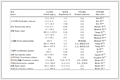
The single crystals of complexes 1 and 2 with approximated dimensions of 0.28 mm×0.24 mm×0.22 mm and 0.26 mm×0.24 mm×0.23 mm, respectively, were placed on a Bruker Smart 1000 CCD area detector. The diffraction data were collected using a graphite monochromated Mo Kα radiation (λ=0.071 073 nm) at 298(2) K. The structures were solved by direct method using SHELXS-2014[54], and refined by full-matrix least-squares method on F2 using SHELXL-2014[54]. Hydrogen atoms were added in their idealized positions. Details of the data collection and refinements are given in Table 1.
 下载:
导出CSV
下载:
导出CSV
| Complex | 1 | 2 |
| Empirical formula | C46H56Cl6Co3N8O24 | C42H46Co3N8O22 |
| Formula weight | 1 494.48 | 1 191.66 |
| Crystal system | Triclinic | Monoclinic |
| Space group | P1 | P21/c |
| a/nm | 1.111 93(12) | 1.092 54(6) |
| b/nm | 1.177 21(9) | 1.517 22(5) |
| c/nm | 1.380 91(11) | 1.767 84(9) |
| α/(°) | 69.184(7) | 99.992(5) |
| β/(°) | 69.437(9) | |
| γ/(°) | 81.852(7) | |
| V/nm3 | 1.581 6(2) | 2.886 0(2) |
| Z | 1 | 2 |
| Dc/(g·cm-3) | 1.569 | 1.371 |
| μ/mm-1 | 1.113 | 0.930 |
| F(000) | 763.0 | 1 222.0 |
| θ range/(°) | 3.53~26.02 | 3.52~26.02 |
| Limiting indices | -13≤h≤9, -14≤k≤14, -17≤l≤16 | -7≤h≤13, -18≤k≤11, -20≤l≤21 |
| Independent reflections | 6 196 | 5 676 |
| Completeness to θ/% | 99.52 | 99.80 |
| Data, restraint, parameter | 438, 0, 51 | 363, 0, 27 |
| GOF on F2 | 1.034 | 0.977 |
| Final R indices [I > 2σ(I)] | R=0.049 1, wR=0.113 2 | R=0.057 2, wR=0.116 5 |
| Largest diff. peak and hole/(e·nm-3) | 692 and -812 | 430 and -362 |
CCDC: 1511306, 1; 1511308, 2.
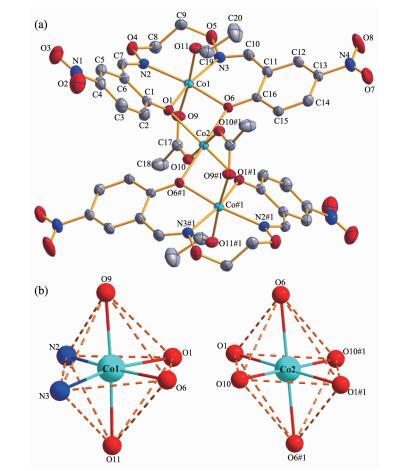
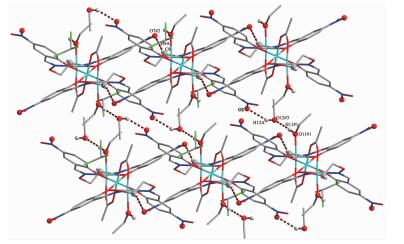
X-ray single crystal structural analysis reveals that through intermolecular hydrogen bonds, complex 1 demonstrated a self-assembling continual zigzag chain supramolecular structure. The molecular structure and monomeric octahedral unit are shown in Fig. 1(a) and 1(b), respectively, while the polymeric representation of the structure is depicted in Fig. 2. Selected bond lengths and angles of complexes 1 and 2 are listed in Table 2. Hydrogen bonding for complexes 1 and 2 are given in Table 3.
 下载:
导出CSV
下载:
导出CSV
| 1 | |||||
| Co1-O1 | 0.204 8(2) | Co2-O1#1 | 0.212 7(2) | Co1-O11 | 0.213 2(2) |
| Co1-O6 | 0.207 3(2) | Co1-O2 | 0.213 3(3) | Co2-O10#1 | 0.204 9(2) |
| Co1-O9 | 0.206 4(2) | Co2-O6#1 | 0.213 1(2) | Co1-N3 | 0.213 0(2) |
| Co2-O6 | 0.213 1(2) | Co2-O10 | 0.204 9(2) | Co2-O1 | 0.212 7(2) |
| O1-Co1-O6 | 81.42(9) | O1-Co1-O9 | 92.22(9) | O1-Co1-O11 | 88.23(9) |
| O1-Co1-O2 | 86.39(10) | O1-Co1-O3 | 165.92(11) | O6-Co1-O9 | 92.98(10) |
| O6-Co1-O11 | 91.74(10) | O6-Co1-O2 | 167.72(10) | O6-Co1-N3 | 85.92(10) |
| O9-Co1-O11 | 175.28(10) | O9-Co1-O2 | 88.92(11) | O9-Co1-N3 | 94.59(10) |
| O11-Co1-O2 | 86.41(11) | O11-Co1-O3 | 86.00(10) | N2-Co1-N3 | 106.03(11) |
| O1-Co2-O6 | 78.27(8) | O1-Co2-O10 | 86.82(9) | O1-Co2-O1#1 | 179.999(1) |
| O1-Co2-O6#1 | 101.73(8) | O1-Co2-O10#1 | 93.18(9) | O6-Co2-O10 | 89.66(9) |
| O6-Co2-O1#1 | 101.73(8) | O6-Co2-O6#1 | 180.00 | O6-Co2-O10#1 | 90.34(9) |
| O10-Co2-O1#1 | 93.18(9) | O10-Co2-O6#1 | 89.66(9) | O10-Co2-O10#1 | 179.999(1) |
| O1#1-Co2-O6#1 | 78.27(8) | O1#1-Co2-O10#1 | 86.82(9) | O6#1-Co2-O10#1 | 90.34(9) |
| 2 | |||||
| Co1-O1 | 0.204 4(3) | Co1-O10 | 0.204 9(3) | Co2-O1 | 0.213 2(3) |
| Co1-O6 | 0.205 8(3) | Co1-O2 | 0.211 9(4) | Co2-O6 | 0.212 4(2) |
| Co1-O9 | 0.216 6(3) | Co1-O3 | 0.213 4(4) | Co2-O11 | 0.203 2(3) |
| O6-Co1-O9 | 89.00(12) | O6-Co1-O2 | 167.40(13) | O6-Co1-N3 | 85.08(13) |
| O1-Co1-O6 | 81.40(10) | O1-Co1-O9 | 89.37(11) | O1-Co1-O10 | 91.21(11) |
| O1-Co1-O2 | 87.64(12) | O1-Co1-O3 | 166.27(14) | O10-Co1-O6 | 93.72(12) |
| O10-Co1-O9 | 177.27(13) | O10-Co1-O2 | 91.51(13) | O10-Co1-N3 | 92.03(15) |
| O2-Co1-O9 | 85.87(13) | N2-Co1-N3 | 106.20(15) | N3-Co1-O9 | 88.02(15) |
| O6-Co2-O6 | 180.00 | O6-Co2-O1#2 | 102.11(9) | O6-Co2-O1#2 | 77.89(9) |
| O6#2-Co2-O1#2 | 77.89(9) | O6#2-Co2-O1 | 102.11(9) | O1-Co2-O1 | 180.00 |
| O11-Co2-O6#2 | 87.37(11) | O11-Co2-O6#2 | 92.63(11) | O11-Co2-O6 | 87.37(11) |
| O11#2-Co2-O6 | 92.63(11) | O11-Co2-O1#2 | 90.57(11) | O11-Co2-O1 | 89.43(11) |
| O11-Co2-O1#2 | 89.43(11) | O11#2-Co2-O1 | 90.57(11) | O11-Co2-O11#2 | 180.00 |
| Symmetry codes: #1: 1-x, -y, 2-z; #2: 1-x, 2-y, 1-z. | |||||
下载:
导出CSV
| D-H…A | d(D-H)/nm | d(H…A)/nm | d(D…A)/nm | ∠DHA/(°) |
| Complex 1 | ||||
| O11#1-H11#1…O12 | 0.085 | 0.187 | 0.269 8(5) | 167 |
| C8-H8B…O9 | 0.097 | 0.244 | 0.328 1(5) | 144 |
| C9-H9A…O7#2 | 0.097 | 0.247 | 0.3338(6) | 149 |
| O12#3-H12A…O2 | 0.082 | 0.218 | 0.292 0(5) | 151 |
| C15-H15…O10#1 | 0.093 | 0.259 | 0.321 3(4) | 124 |
| C19-H19A…O10#1 | 0.097 | 0.252 | 0.348 7(6) | 176 |
| C21-H21…O9 | 0.098 | 0.249 | 0.339 7(6) | 153 |
| Complex 2 | ||||
| O9-H9…O3#1 | 0.085 | 0.202 | 0.286 0(8) | 172 |
| C2-H2…O11#2 | 0.093 | 0.259 | 0.321 7(5) | 125 |
| C14-H14…O2#3 | 0.093 | 0.259 | 0.347 3(7) | 158 |
| C19-H19A…O8#3 | 0.096 | 0.261 | 0.355 8(2) | 169 |
| C8-H8A…N3 | 0.097 | 0.260 | 0.295 7(15) | 102 |
| C9-H9A…O10 | 0.097 | 0.219 | 0.308 1(10) | 153 |
| C13-H13…O11#2 | 0.093 | 0.257 | 0.322 5(5) | 127 |
| C17-H17A…O11#2 | 0.097 | 0.255 | 0.350 4(6) | 167 |
| Symmetry codes: #1: 1-x, -y, 2-z; #2: -1+x, y, z; #3: -x, 1-y, 2-z for 1; #1: -x, -1/2+y, 1/2-z; #2: 1-x, 2-y, 1-z; #3: 1-x, -1/2+y, 1/2-z for 2. | ||||
As revealed by the crystal structure, complex 1 crystallizes in the triclinic, space group P1. The complex consists of three Co(Ⅱ) ions, two deprotonated L2- units, two μ-acetate ions, two coordinated ethanol molecules, and two non-coordinated ethanol and chloroform molecules resulting in a trinuclear Co(Ⅱ) complex. All the hexa-coordinated Co(Ⅱ) ions lie in a slightly distorted octahedron coordination environment. The two terminal Co(Ⅱ) (Co1 and Co1#1) ions are located in the N2O2 coordination sphere of L2-. One oxygen atom (O10) comes from the acetato bridge and the other oxygen atom (O9) comes from the ethanol molecule. The coordination sphere of the central Co(Ⅱ) (Co2) ion contains four phenoxo oxygen atoms (O1, O6, O1#1 and O6#1) from two L2- and double μ-acetato oxygen atoms (O10 and O10#1) that adopt a similar μ-O-C-O. All the six oxygen atoms that are coordinated to Co2 atom constitute octahedral geometry. As illustrated in Fig. 2, complex 1 is linked by three intermolecular hydrogen bonding interactions to form an infinite 2D supramolecular chain[55-61].
X-ray crystallographic analysis reveals that complex 2 crystallizes in the monoclinic system, space group P21/c. Fig. 3(a) and 3(b) show the molecular structure and the monomeric octahedral unit of complex 2. Selected bond lengths and angles are provided in Table 2.
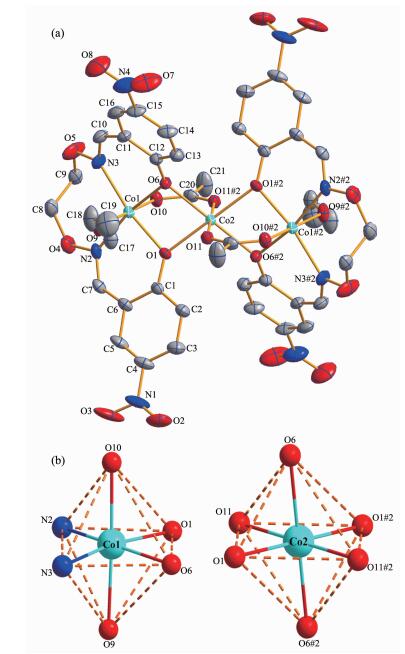
The complex 2 contains three Co(Ⅱ) ions, two deprotonated L2- units, two μ-acetate ions, and two coordinated n-propanol molecules as expected from the analytical data. All the hexa-coordinated Co(Ⅱ) ions adopt a slightly distorted octahedron coordination sphere. The two terminal Co(Ⅱ) (Co1 and Co1#2) ions are situated on the N2O2 coordination sphere of L2- with one oxygen (O10) atom from the acetato bridge and another oxygen (O9) atom from the n-propanol molecule. The coordination sphere of the central Co(Ⅱ) (Co2) ion consists of four phenoxo oxygen atoms (O1, O6, O1#2 and O6#2) from two L2- and double μ-acetato oxygen atoms (O11 and O11#2) that adopt a similar μ-O-C-O. Similar to complex 1, all the six oxygen atoms that are coordinated to Co2(Ⅱ) ion construct an octahedron. And the structure of complex 2 resides in the formation of a 3D supramolecular structure via three intermolecular hydrogen bonding interactions[62-68] (Fig. 4).
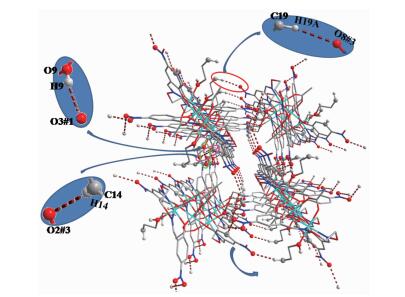
Two Co(Ⅱ) complexes could been synthesized by the reaction of the Salamo-type ligand H2L with Co(OAc)2·4H2O in different solvents. Complexes 1 and 2 present similar stoichiometric ratio when the introduction of different solvent molecules (ethanol or n-propanol). Although the molecule structures of the Co(Ⅱ) complexes obtained in different mixture solutions are similar to each other, the complexes 1 and 2 possess different supramolecular structural features (Table 3, Fig. 2 and 4). As illustrated in Fig. 2, complex 1 is linked by three intermolecular hydrogen bonding interactions to form an infinite 2D supramolecular chain. However, an infinite 3D supramolecular network of complex 2 is formed through three intermolecular hydrogen bonding interactions. The influence of solvent effect is clearly revealed in selected bond distances (nm) and angles (°) for complexes 1 and 2 (Table 2). It is noteworthy that the bond lengths from the oxygen atoms (O11 or O8) of coordinated solvent molecules (ethanol or n-propanol) to the terminal Co(Ⅱ) ions (Co1) in complexes 1 and 2 are 0.212 7(2) and 0.216 2(4) nm, respectively, which do not present a regular elongation when the steric hindrance successively becomes larger from ethanol to n-propanol.
The FT-IR spectra of H2L and its corresponding Co(Ⅱ) complexes 1 and 2 exhibit various bands in the range of 400~4 000 cm-1 so as to identify frequencies owing to the Co-O and Co-N bonds. IR spectra of H2L and its complexes are given in Fig. 5. IR spectra indicate that complexes 1 and 2 have similar structures. The free ligand H2L shows Ar-O and C=N stretching bands at 1 274 and 1 627 cm-1, respectively, and are shifted to lower frequencies by ca. 40 and 23 cm-1 upon complexation. Besides, the O-H stretching bands that appear at 3 405 and 3 448 cm-1 in complexes 1 and 2 are evidence of the existence of coordinated ethanol and n-propanol molecules, respectively[53]. The far-infrared spectra of complexes 1 and 2 are also obtained in the region of 500~100 cm-1 in order to identify frequencies due to the Co-O and Co-N bonds. These assignments are consistent with the frequency values reported in the literature[48-50].

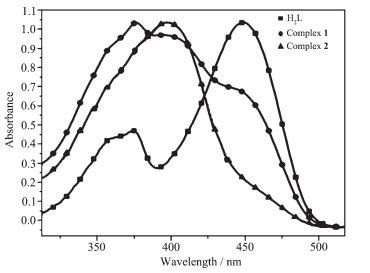
UV-Vis absorption spectra of the ligand (H2L) and its corresponding trinuclear Co(Ⅱ) complexes 1 and 2 in DMF solutions at 298 K are shown in Fig. 6. The spectral shapes of the two complexes are similar to one another, and different from the shape of the ligand (H2L). The UV-Vis spectrum of the free ligand (H2L) exhibits two absorption peaks at ca. 375 and 448 nm[47-48]. The former absorption peak could be assigned to the π-π* transition of the benzene rings and the latter could be attributed to the intra-ligand π-π* transition of the C=N bonds[47-51]. Compared with the absorption peak of the ligand, the corresponding absorption peaks at 496 and 498 nm are observed in complexes 1 and 2 which are bathochromically shifted by ca. 48 and 50 nm, indicating the coordination of Co(Ⅱ) ions with the ligand. It is worthy to note that similar pattern in the UV-Vis absorption spectra of complexes 1 and 2 clearly indicate that the structures of the two complexes are alike.
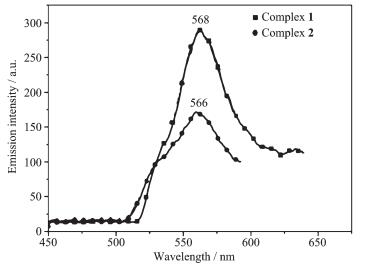
The emission spectra of complexes 1 and 2 in dilute DMF solution at ambient temperature are shown in Fig. 7. The complexes 1 and 2 show an intense photoluminescence with maximum emission at ca. 568 and 566 nm, respectively, when excited at 450 nm. Compared with the ligand, strong fluorescence intensity of the Co(Ⅱ) complexes are observed, indicating that fluorescence characteristic has been influenced by the introduction of the Co(Ⅱ) ions[48, 51].
We have designed and synthesized two supramolecular trinuclear Co(Ⅱ) complexes with a Salamo-type ligand. The Co(Ⅱ) complexes were characterized by physicochemical methods and single-crystal X-ray diffraction. In complex 1, all the three Co(Ⅱ) ions are hexa-coordinated via two deprotonated L2- units, two μ-acetato anions and two coordinated ethanol molecules. However, the coordination fashion for complex 2 is similar to that of complex 1. In the IR spectra of the two complexes, the (M-O) and (M-N) vibrational absorption bands were observed. Consequently, the O-H stretching bands of complexes 1 and 2 found at 3 405 and 3 448 cm-1 simply proved the evidence of the coordinated ethanol and n-propanol molecules, respectively. The UV-Vis spectra clearly indicate that the structures of the two Co(Ⅱ) complexes are similar and different from that of the ligand (H2L). X-ray crystal structures reveal that the structural features of complexes 1 and 2 are very similar except for the differences in the coordinated solvent molecules. Interestingly, the existence of solvent effect in complexes 1 and 2 may be responsible for the slight differences in their crystal and supramolecular structures.
Zhao L, Dang X T, Chen Q, et al. Synth. React. Inorg. Met.-Org. Nano-Metal Chem., 2013, 43:1241-1246 doi: 10.1080/15533174.2012.757236
Sun Y X, Zhang S T, Ren Z L, et al. Synth. React. Inorg. Met.-Org. Nano-Metal Chem., 2013, 43:995-1000 doi: 10.1080/15533174.2012.753614
Dong X Y, Sun Y X, Wang L, et al. J. Chem. Res., 2012, 36: 387-390 doi: 10.3184/174751912X13366711594575
Sun Y X, Gao X H. Synth. React. Inorg. Met.-Org. Nano-Metal Chem., 2011, 41:973-978 doi: 10.1080/15533174.2011.591329
Sun Y X, Xu L, Zhao T H, et al. Synth. React. Inorg. Met.-Org. Nano-Metal Chem., 2013, 43:509-513 doi: 10.1080/15533174.2012.740756
Dong X Y, Akogun S F, Zhou W M, et al. J. Chin. Chem. Soc., 2017, 64:412-419 doi: 10.1002/jccs.2017.64.issue-4
Liu P P, Sheng L, Song X Q, et al. Inorg. Chim. Acta, 2015, 434:252-257 doi: 10.1016/j.ica.2015.05.026
Song X Q, Liu P P, Xiao Z R, et al. Inorg. Chim. Acta, 2015, 438:232-244 doi: 10.1016/j.ica.2015.09.022
Song X Q, Peng Y J, Chen G Q, et al. Inorg. Chim. Acta, 2015, 427:13-21 doi: 10.1016/j.ica.2014.12.008
Song X Q, Liu P P, Liu Y A, et al. Dalton Trans., 2016, 45: 8154-8163 doi: 10.1039/C6DT00212A
Song X Q, Wang L, Zheng Q F, et al. Inorg. Chim. Acta, 2012, 391:171-178 doi: 10.1016/j.ica.2012.04.007
Liu P P, Wang C Y, Zhang M, et al. Polyhedron, 2017, 129: 133-140 doi: 10.1016/j.poly.2017.03.019
Yu T Z, Zhang K, Zhao Y L, et al. Inorg. Chim. Acta, 2008, 361:233-240 doi: 10.1016/j.ica.2007.07.012
Wu H L, Bai Y C, Zhang Y H, et al. J. Coord. Chem., 2014, 67:3054-3066 doi: 10.1080/00958972.2014.959507
Chen C Y, Zhang J W, Zhang Y H, et al. J. Coord. Chem., 2015, 68:1054-1071 doi: 10.1080/00958972.2015.1007965
Wu H L, Bai Y H, Zhang Y H, et al. Z. Anorg. Allg. Chem., 2014, 640:2062-2071 doi: 10.1002/zaac.v640.10
Wu H L, Pan G L, Bai Y C, et al. J. Photochem. Photobiol. B, 2014, 135:33-43 doi: 10.1016/j.jphotobiol.2014.04.005
Wu L, Pan G L, Bai Y C, et al. J. Chem. Res., 2014, 38: 211-217 doi: 10.3184/174751914X13933417974082
Wu H L, Wang C P, Wang F, et al. J. Chin. Chem. Soc., 2015, 62:1028-1034 doi: 10.1002/jccs.v62.11
Wu H L, Wang H, Wang X L, et al. New J. Chem., 2014, 38:1052-1061 doi: 10.1039/c3nj01145c
Wu H L, Pan G L, Bai Y C, et al. J. Coord. Chem., 2013, 66:2634-2646 doi: 10.1080/00958972.2013.812725
Wu H L, Pan G L, Bai Y C, et al. Res. Chem. Intermed., 2015, 41:3375-3388 doi: 10.1007/s11164-013-1440-5
Dong W K, Ma J C, Zhu L C, et al. Cryst. Growth Des., 2016, 16:6903-6915 doi: 10.1021/acs.cgd.6b01067
Hu J H, Sun Y, Qi J, et al. Spectrochim. Acta A, 2017, 175: 125-133 doi: 10.1016/j.saa.2016.12.009
Hu J H, Li J B, Qi J, et al. New J. Chem., 2015, 39:843-848 doi: 10.1039/C4NJ01147C
Sun Y, Hu J H, Qi J, et al. Spectrochim. Acta A, 2016, 167: 101-105 doi: 10.1016/j.saa.2016.05.017
胡京汉, 颜农平, 陈娟娟, 等.高等学校化学学报, 2013, 34(6):1368-1373 doi: 10.7503/cjcu20120875HU Jing-Han, YAN Nong-Ping, CHEN Juan-Juan, et al. Chem. J. Chinese Universities, 2013, 34(6):1368-1373 doi: 10.7503/cjcu20120875
Hu J H, Li J B, Qi J, et al. New J. Chem., 2014, 39:843-848 http://pubs.rsc.org/en/Content/ArticleLanding/2015/NJ/C4NJ01147C#!divAbstract
Li J B, Hu J H, Chen J J, et al. Spectrochim. Acta A, 2014, 133:773-777 doi: 10.1016/j.saa.2014.06.060
Hu J H, Li J B, Qi J, et al. Sens. Actuators B, 2015, 208: 581-587 doi: 10.1016/j.snb.2014.11.066
Hu J H, Li J B, Qi J, et al. New J. Chem., 2015, 39:4041-4046 doi: 10.1039/C5NJ00089K
胡京汉, 陈娟娟, 李建斌, 等.无机化学学报, 2014, 30(11):2544-2548 http://www.wjhxxb.cn/wjhxxbcn/ch/reader/view_abstract.aspx?flag=1&file_no=20141113&journal_id=wjhxxbcnHU Jing-Han, CHEN Juan-Juan, LI Jian-Bin, et al. Chinese J. Inorg. Chem., 2014, 30(11):2544-2548 http://www.wjhxxb.cn/wjhxxbcn/ch/reader/view_abstract.aspx?flag=1&file_no=20141113&journal_id=wjhxxbcn
Qi J, Hu J H, Chen J J, et al. Curr. Anal. Chem., 2016, 12: 119-123 doi: 10.2174/1573411011666150827194259
Hu J H, Li J B, Qi J, et al. Phosphorus Sulfur Silicon Relat. Elem., 2016, 191:984-987 doi: 10.1080/10426507.2015.1050016
Hu J H, Sun Y, Qi J, et al. RSC Adv., 2016, 6:100401-100406 doi: 10.1039/C6RA16378E
Hu J H, Yan N P, Chen J J. J. Chem. Res., 2012, 36:619-622 doi: 10.3184/174751912X13463433858357
Li L H, Dong W K, Zhang Y, et al. Appl. Organomet. Chem., 2017:DOI: 10.1002/aoc.3818
Chai L Q, Wang G, Sun Y X, et al. J. Coord. Chem., 2012, 65:1621-1631 doi: 10.1080/00958972.2012.677836
Chai L Q, Huang J J, Zhang H S, et al. Spectrochim. Acta A, 2014, 131:526-533 doi: 10.1016/j.saa.2014.04.127
Chai L Q, Liu G, Zhang J Y, et al. J. Coord. Chem., 2013, 66:3926-3938 doi: 10.1080/00958972.2013.857016
Chai L Q, Zhang H S, Huang J J, et al. Spectrochim. Acta A, 2015, 137:661-669 doi: 10.1016/j.saa.2014.08.084
Chai L Q, Tang L J, Chen L C, et al. Polyhedron, 2017, 122: 228-240 doi: 10.1016/j.poly.2016.11.032
Chai L Q, Zhang K Y, Tang L J, et al. Polyhedron, 2017, 130: 100-107 doi: 10.1016/j.poly.2017.04.010
Xu L, Zhu L C, Ma J C, et al. Z. Anorg. Allg. Chem., 2015, 641:2520-2524 doi: 10.1002/zaac.201500619
董文魁, 吕忠武, 孙银霞, 等.无机化学学报, 2009, 25(9):1627-1634 http://www.wjhxxb.cn/wjhxxbcn/ch/reader/view_abstract.aspx?flag=1&file_no=20090920&journal_id=wjhxxbcnDONG Wen-Kui, LÜ Zhong-Wu, SUN Yin -Xia, et al. Chinese J. Inorg. Chem., 2009, 25(9):1627-1634 http://www.wjhxxb.cn/wjhxxbcn/ch/reader/view_abstract.aspx?flag=1&file_no=20090920&journal_id=wjhxxbcn
Wang L, Ma J C, Dong W K, et al. Z. Anorg. Allg. Chem., 2016, 42:834-839 doi: 10.1002/zaac.201600125/pdf
Dong W K, Zheng S S, Zhang J T, et al. Spectrochimi. Acta A, 2017, 184:141-150 doi: 10.1016/j.saa.2017.04.061
Zheng S S, Dong W K, Zhang Y, et al. New J. Chem., 2017, 41:4966-4973 doi: 10.1039/C6NJ04090J
Pu L M, Long H T, Zhang Y, et al. Polyhedron, 2017, 128: 57-67 doi: 10.1016/j.poly.2017.02.033
Hao J, Li L L, Zhang J T, et al. Polyhedron, 2017, 134:1-10 doi: 10.1016/j.poly.2017.05.060
Li X Y, Chen L, Gao L, et al. RSC Adv., 2017, 7:35905-35916 doi: 10.1039/C7RA06796H
Dong W K, Zhu L C, Ma J C, et al. Inorg. Chim. Acta, 2016, 453:402-408 doi: 10.1016/j.ica.2016.08.050
Dong W K, He X N, Yan H B, et al. Polyhedron, 2009, 28: 1419-1428 doi: 10.1016/j.poly.2009.03.017
Sheldrick G M. SHELX-97, Program for the Solution and the Refinement of Crystal Structures, University of Göttingen, Germany, 1997.
Chen L, Dong W K, Zhang H, et al. Cryst. Growth Des., 2017, 17:3636-3648 doi: 10.1021/acs.cgd.6b01860
Tao C H, Ma J C, Zhu L C, et al. Polyhedron, 2017, 128:38-45 doi: 10.1016/j.poly.2017.02.040
Dong W K, Zhu L C, Dong Y J, et al. Polyhedron, 2016, 117:148-154 doi: 10.1016/j.poly.2016.05.055
Wang P, Zhao L. Spectrochim. Acta A, 2015, 135:342-350 doi: 10.1016/j.saa.2014.06.129
Sun Y X, Wang L, Dong X Y, et al. Synth. React. Inorg. Met.-Org. Nano-Metal Chem., 2013, 43:599-603 doi: 10.1080/15533174.2012.751424
Song X Q, Cheng G Q, Wang X R, et al. Inorg. Chim. Acta, 2015, 425:145-153 doi: 10.1016/j.ica.2014.09.028
Dong Y J, Ma J C, Zhu L C, et al. J. Coord. Chem., 2017, 70:103-115 doi: 10.1080/00958972.2016.1262537
Dong Y J, Dong X Y, Dong W K, et al. Polyhedron, 2017, 123:305-315 doi: 10.1016/j.poly.2016.12.010
董文魁, 冯建华, 张玉洁, 等.无机化学学报, 2011, 27(9):1865-1870 http://www.wjhxxb.cn/wjhxxbcn/ch/reader/view_abstract.aspx?flag=1&file_no=20110932&journal_id=wjhxxbcnDONG Wen-Kui, FENG Jian-Hua, ZHANG Yu-Jie, et al. Chinese J. Inorg. Chem., 2011, 27(9):1865-1870 http://www.wjhxxb.cn/wjhxxbcn/ch/reader/view_abstract.aspx?flag=1&file_no=20110932&journal_id=wjhxxbcn
Zhao L, Wang L, Sun Y X, et al. Synth. React. Inorg. Met.-Org. Nano-Metal Chem., 2012, 42:1303-1308 doi: 10.1080/15533174.2012.684235
Dong X Y, Kang Q P, Jin B X, et al. Z. Naturforsch., B: Chem. Sci., 2017, 72:415-420 https://www.degruyter.com/view/j/znb.2017.72.issue-6/znb-2016-0268/znb-2016-0268.xml
董文魁, 王莉, 孙银霞, 等.无机化学学报, 2011, 27(2):372-376 http://www.wjhxxb.cn/wjhxxbcn/ch/reader/view_abstract.aspx?flag=1&file_no=20110228&journal_id=wjhxxbcnDONG Wen-Kui, WANG Li, SUN Yin-Xia, et al. Chinese J. Inorg. Chem., 2011, 27(2):372-376 http://www.wjhxxb.cn/wjhxxbcn/ch/reader/view_abstract.aspx?flag=1&file_no=20110228&journal_id=wjhxxbcn
Wang P, Zhao L. Synth. React. Inorg. Met.-Org. Nano-Metal Chem., 2016, 46:1095-1101 doi: 10.1080/15533174.2015.1004416
董文魁, 唐晓璐, 何雪妮, 等.无机化学学报, 2009, 25(3):528-532 http://www.wjhxxb.cn/wjhxxbcn/ch/reader/view_abstract.aspx?flag=1&file_no=20090328&journal_id=wjhxxbcnDONG Wen-Kui, TANG Xiao-Lu, HE Xue -Ni, et al. Chinese J. Inorg. Chem., 2009, 25(3):528-532 http://www.wjhxxb.cn/wjhxxbcn/ch/reader/view_abstract.aspx?flag=1&file_no=20090328&journal_id=wjhxxbcn

Figure 1 (a) Molecular structure of complex 1; (b) Coordination polyhedron of Co(Ⅱ) ions
Thermal ellipsoids at 30% probability; Hydrogen atoms are omitted for clarity; Symmetry codes: #1: 1-x, -y, 2-z

Figure 2 Part of the infinite 1D chain motif of complex 1
Symmetry codes: #1: 1-x, -y, 2-z; #2:-1+x, y, z; #3:-x, 1-y, 2-z

Figure 3 (a) Molecular structure of complex 2; (b) Coordination polyhedron of Co(Ⅱ) ions
Thermal ellipsoids at 30% probability; Hydrogen atoms are omitted for clarity; Symmetry codes: #2: 1-x, 2-y, 1-z

Figure 4 Part of the infinite 3D net motif of complex 2
Symmetry codes: #1:-x, -1/2+y, 1/2-z; #3: 1-x, -1/2+y, 1/2-z
Table 1. Crystal data and structure refinements for complexes 1 and 2
| Complex | 1 | 2 |
| Empirical formula | C46H56Cl6Co3N8O24 | C42H46Co3N8O22 |
| Formula weight | 1 494.48 | 1 191.66 |
| Crystal system | Triclinic | Monoclinic |
| Space group | P1 | P21/c |
| a/nm | 1.111 93(12) | 1.092 54(6) |
| b/nm | 1.177 21(9) | 1.517 22(5) |
| c/nm | 1.380 91(11) | 1.767 84(9) |
| α/(°) | 69.184(7) | 99.992(5) |
| β/(°) | 69.437(9) | |
| γ/(°) | 81.852(7) | |
| V/nm3 | 1.581 6(2) | 2.886 0(2) |
| Z | 1 | 2 |
| Dc/(g·cm-3) | 1.569 | 1.371 |
| μ/mm-1 | 1.113 | 0.930 |
| F(000) | 763.0 | 1 222.0 |
| θ range/(°) | 3.53~26.02 | 3.52~26.02 |
| Limiting indices | -13≤h≤9, -14≤k≤14, -17≤l≤16 | -7≤h≤13, -18≤k≤11, -20≤l≤21 |
| Independent reflections | 6 196 | 5 676 |
| Completeness to θ/% | 99.52 | 99.80 |
| Data, restraint, parameter | 438, 0, 51 | 363, 0, 27 |
| GOF on F2 | 1.034 | 0.977 |
| Final R indices [I > 2σ(I)] | R=0.049 1, wR=0.113 2 | R=0.057 2, wR=0.116 5 |
| Largest diff. peak and hole/(e·nm-3) | 692 and -812 | 430 and -362 |
 下载: 导出CSV
Table 2. Selected bond lengths (nm) and angles (°) for complexes 1 and 2
| 1 | |||||
| Co1-O1 | 0.204 8(2) | Co2-O1#1 | 0.212 7(2) | Co1-O11 | 0.213 2(2) |
| Co1-O6 | 0.207 3(2) | Co1-O2 | 0.213 3(3) | Co2-O10#1 | 0.204 9(2) |
| Co1-O9 | 0.206 4(2) | Co2-O6#1 | 0.213 1(2) | Co1-N3 | 0.213 0(2) |
| Co2-O6 | 0.213 1(2) | Co2-O10 | 0.204 9(2) | Co2-O1 | 0.212 7(2) |
| O1-Co1-O6 | 81.42(9) | O1-Co1-O9 | 92.22(9) | O1-Co1-O11 | 88.23(9) |
| O1-Co1-O2 | 86.39(10) | O1-Co1-O3 | 165.92(11) | O6-Co1-O9 | 92.98(10) |
| O6-Co1-O11 | 91.74(10) | O6-Co1-O2 | 167.72(10) | O6-Co1-N3 | 85.92(10) |
| O9-Co1-O11 | 175.28(10) | O9-Co1-O2 | 88.92(11) | O9-Co1-N3 | 94.59(10) |
| O11-Co1-O2 | 86.41(11) | O11-Co1-O3 | 86.00(10) | N2-Co1-N3 | 106.03(11) |
| O1-Co2-O6 | 78.27(8) | O1-Co2-O10 | 86.82(9) | O1-Co2-O1#1 | 179.999(1) |
| O1-Co2-O6#1 | 101.73(8) | O1-Co2-O10#1 | 93.18(9) | O6-Co2-O10 | 89.66(9) |
| O6-Co2-O1#1 | 101.73(8) | O6-Co2-O6#1 | 180.00 | O6-Co2-O10#1 | 90.34(9) |
| O10-Co2-O1#1 | 93.18(9) | O10-Co2-O6#1 | 89.66(9) | O10-Co2-O10#1 | 179.999(1) |
| O1#1-Co2-O6#1 | 78.27(8) | O1#1-Co2-O10#1 | 86.82(9) | O6#1-Co2-O10#1 | 90.34(9) |
| 2 | |||||
| Co1-O1 | 0.204 4(3) | Co1-O10 | 0.204 9(3) | Co2-O1 | 0.213 2(3) |
| Co1-O6 | 0.205 8(3) | Co1-O2 | 0.211 9(4) | Co2-O6 | 0.212 4(2) |
| Co1-O9 | 0.216 6(3) | Co1-O3 | 0.213 4(4) | Co2-O11 | 0.203 2(3) |
| O6-Co1-O9 | 89.00(12) | O6-Co1-O2 | 167.40(13) | O6-Co1-N3 | 85.08(13) |
| O1-Co1-O6 | 81.40(10) | O1-Co1-O9 | 89.37(11) | O1-Co1-O10 | 91.21(11) |
| O1-Co1-O2 | 87.64(12) | O1-Co1-O3 | 166.27(14) | O10-Co1-O6 | 93.72(12) |
| O10-Co1-O9 | 177.27(13) | O10-Co1-O2 | 91.51(13) | O10-Co1-N3 | 92.03(15) |
| O2-Co1-O9 | 85.87(13) | N2-Co1-N3 | 106.20(15) | N3-Co1-O9 | 88.02(15) |
| O6-Co2-O6 | 180.00 | O6-Co2-O1#2 | 102.11(9) | O6-Co2-O1#2 | 77.89(9) |
| O6#2-Co2-O1#2 | 77.89(9) | O6#2-Co2-O1 | 102.11(9) | O1-Co2-O1 | 180.00 |
| O11-Co2-O6#2 | 87.37(11) | O11-Co2-O6#2 | 92.63(11) | O11-Co2-O6 | 87.37(11) |
| O11#2-Co2-O6 | 92.63(11) | O11-Co2-O1#2 | 90.57(11) | O11-Co2-O1 | 89.43(11) |
| O11-Co2-O1#2 | 89.43(11) | O11#2-Co2-O1 | 90.57(11) | O11-Co2-O11#2 | 180.00 |
| Symmetry codes: #1: 1-x, -y, 2-z; #2: 1-x, 2-y, 1-z. | |||||
下载: 导出CSV
Table 3. Hydrogen bonding parameters for complexes 1 and 2
| D-H…A | d(D-H)/nm | d(H…A)/nm | d(D…A)/nm | ∠DHA/(°) |
| Complex 1 | ||||
| O11#1-H11#1…O12 | 0.085 | 0.187 | 0.269 8(5) | 167 |
| C8-H8B…O9 | 0.097 | 0.244 | 0.328 1(5) | 144 |
| C9-H9A…O7#2 | 0.097 | 0.247 | 0.3338(6) | 149 |
| O12#3-H12A…O2 | 0.082 | 0.218 | 0.292 0(5) | 151 |
| C15-H15…O10#1 | 0.093 | 0.259 | 0.321 3(4) | 124 |
| C19-H19A…O10#1 | 0.097 | 0.252 | 0.348 7(6) | 176 |
| C21-H21…O9 | 0.098 | 0.249 | 0.339 7(6) | 153 |
| Complex 2 | ||||
| O9-H9…O3#1 | 0.085 | 0.202 | 0.286 0(8) | 172 |
| C2-H2…O11#2 | 0.093 | 0.259 | 0.321 7(5) | 125 |
| C14-H14…O2#3 | 0.093 | 0.259 | 0.347 3(7) | 158 |
| C19-H19A…O8#3 | 0.096 | 0.261 | 0.355 8(2) | 169 |
| C8-H8A…N3 | 0.097 | 0.260 | 0.295 7(15) | 102 |
| C9-H9A…O10 | 0.097 | 0.219 | 0.308 1(10) | 153 |
| C13-H13…O11#2 | 0.093 | 0.257 | 0.322 5(5) | 127 |
| C17-H17A…O11#2 | 0.097 | 0.255 | 0.350 4(6) | 167 |
| Symmetry codes: #1: 1-x, -y, 2-z; #2: -1+x, y, z; #3: -x, 1-y, 2-z for 1; #1: -x, -1/2+y, 1/2-z; #2: 1-x, 2-y, 1-z; #3: 1-x, -1/2+y, 1/2-z for 2. | ||||
下载: 导出CSV

 扫一扫看文章


扫一扫关注我们


 下载:
下载: