School of Materials Science and Engineering, University of Jinan, Ji'nan 250022, China
✩ Authors dedicate this article to Professor Lin Xu of Northeast Normal University
honoring his pioneering contributions in Polyoxometalates Chemistry on the occasion of his 70th birthday. * Corresponding authors. E-mail addresses: mse_caoyd@ujn.edu.cn (Y.D. Cao)
Received Date:
23 January 2026 Accepted Date:
29 April 2026 Revised Date:
23 April 2026 Available Online:
15 November 2026
Abstract:
The sluggish redox kinetics and limited conversion efficiency of lithium polysulfides (LiPSs) constitute major bottlenecks in achieving optimized sulfur utilization and long-term cycling stability in lithium-sulfur (Li-S) batteries. This study addresses above challenge by constructing a highly efficient synergistic catalyst (Cu20−Mo154) via the hydrogen-bonding assembly of atomically precise copper nanoclusters (Cu20) and high-nuclear polyoxomolybdate clusters (Mo154) into a supramolecular composite. When deployed as a functional separator coating in Li-S batteries, the Cu20−Mo154 composite effectively captures LiPSs and catalytically promotes their conversion to insoluble lithium sulfides (Li2S/Li2S2) through synergistic effects. The supramolecular architecture crucially inhibits the dissolution of individual clusters in the electrolyte, preserving the catalyst's integrity and activity. Mechanism investigations reveal that Mo154 provides the primary catalytic sites, while the Cu20 clusters facilitate efficient electro-transport, collectively stabilizing the structure and enhancing the overall catalytic performance. As a result, the batteries equipped with the Cu20−Mo154 modified separator exhibit exceptional cycling stability, sustaining over 1000 cycles with remarkable capacity retention at a high rate of 10 C, which represents a performance metric rarely achieved in Li-S batteries. This work demonstrates a novel cluster-assembly strategy to attain exceptional synergistic catalytic performance for LiPSs conversion, offering a promising technical route for the development of high-energy-density and fast-charging Li-S batteries.
Lithium-sulfur (Li-S) batteries are widely regarded as among the most promising candidates for next-generation renewable-energy storage, owing to their high theoretical capacity (1672 mAh/g) and gravimetric energy density (2600 Wh/kg) [1,2]. Despite these advantages, practical deployment is hindered by the shuttle of soluble long-chain lithium polysulfides (LiPSs) between the cathode and anode and by intrinsically sluggish redox kinetics, which together precipitate rapid capacity fading, shortened cycle life, and depressed Coulombic efficiency [3,4]. Prior efforts have largely focused on chemical confinement of LiPSs via electrolyte additives [5], membrane modifications [6,7] and hybridization with polar compounds [8] to suppress shuttling and enhance cyclability. However, these approaches primarily immobilize LiPSs rather than fundamentally overcoming the kinetic bottlenecks inherent to sulfur redox chemistry. Critically, incomplete reduction of LiPSs to Li2S and inefficient re-oxidation to S8 during cycling drive sulfur agglomeration and electrolyte depletion. Accordingly, there is an urgent need to develop highly active electrocatalysts that concurrently strengthen LiPSs adsorption and accelerate bidirectional (reduction/oxidation) conversion kinetics in Li-S batteries.
Polyoxometalates are a diverse class of anionic, transition metal oxygen clusters (typically based on Mo, W, V, Nb, etc.) that feature exceptional multi-electron storage capacity, pronounced redox activity, and excellent stability under electrochemical operating conditions [9,10]. Owing to these attributes, polyoxometalates have been extensively investigated as versatile electron reservoirs and redox mediators to promote a broad spectrum of electrocatalytic reactions. In the context of Li-S batteries, cluster-based polyoxometalates catalysts are frequently integrated as functional interlayers or coatings on commercial polypropylene separators (PP), thereby directly participating in cell operation to catalyze the rapid, bidirectional conversion between Li2S/Li2S2 and soluble LiPSs species [11,12]. Among the various polyoxometalates families, high-nuclear species (e.g., Mo132, Mo138, Mo154) arise from the orderly, atomically precise assembly of metal-oxide building units [13,14]. Compared with classical polyoxometalates, these high-nuclear analogues offer a higher density of metal-oxygen assembly units, while their mixed-valent MoⅥ/MoⅤ subunits provide abundant redox-active centers and adsorption sites, thereby imparting superior catalytic potential [15–17]. Consequently, incorporating high-nuclear polyoxometalates into Li-S battery systems is expected to markedly enhance both polysulfide anchoring and catalytic conversion. However, recent studies have shown that the reductive "heteropoly blue" species formed during lithiation are highly soluble in typical electrolytes [18]. During subsequent charging, these reductive moieties tend to leach into the electrolyte, progressively degrading the high-nuclear framework. Thus, engineering polyoxometalates catalysts with suppressed solubility and robust structural integrity under operating conditions remains a pressing challenge.
Atomically precise copper nanoclusters have attracted substantial attention in catalysis, because they not only retain the advantages of copper nanoparticles but also feature precise chemical compositions, tunable metal cores, and functional ligand shells [19,20]. Unlike conventional copper nanoparticles, the copper nanoclusters exhibited a precise number of copper atoms and various coordination environments, such as Cu-C, Cu-S and Cu-Cu interactions, which modulate the electronic structure of the metal core and, in turn, its catalytic behavior [21,22]. These clusters are stabilized by surface ligands that, beyond preserving structural integrity, strongly influence the electronic and catalytic properties of the nanoclusters [23]. For example, multiple studies have demonstrated that tailoring ligand substituents markedly alters the highest occupied molecular orbital (HOMO) and lowest unoccupied molecular orbital (LUMO) of gold clusters [24,25]. By analogy, the electronic structures of Cu(I) clusters can, in principle, be systematically tuned via ligand engineering, thereby endowing them with the potential for outstanding catalytic performance [26]. Moreover, appropriately designed ligands can engage in covalent bonding or strong coordination with complementary catalyst/host frameworks, enabling synergistic pathways that further enhance activity [27]. Despite these advantages and notable advances, atomically precise copper nanoclusters remain largely unexplored as electrocatalysts for Li-S batteries, primarily because Cu species are prone to dissolution in organic electrolytes, leading to leaching and rapid deactivation [28]. Accordingly, the central challenge lies in devising robust strategies to immobilize and stabilize copper nanoclusters under Li-S battery operating conditions, ensuring their long-term retention and catalytic functionality within the battery environment.
Building on the above, a new cluster-to-cluster composite (abbr. as Cu20−Mo154) has been constructed by integrating an atomically precise copper nanocluster of ([(O)Cu20(C20H24O2)12(CH3COO)6]) (abbr. as Cu20) with a high-nuclear polyoxometalate of (Na14[Mo154O462H14(CH3OH)8(H2O)62·mH2O·nCH3OH] (m ≈ 400, n ≈ 10) (abbr. as Mo154). The two clusters assemble predominantly via pervasive hydrogen-bonding interactions, thereby preserving the inherent structural features and catalytic sites of each component while substantially suppressing their solubility in aqueous or organic media. Given the rich redox activity of both constituents, we further elucidate the mechanisms by which the Cu20−Mo154 composite enhances Li-S battery performance when deployed as a separator interlayer. With a Cu20−Mo154 modified separator, a conventional sulfur cathode containing 68.5 wt% S delivers a high reversible capacity of 1355 mAh/g at 0.1 C, together with excellent cycling stability. Remarkably, even at a high rate of 10 C, the cell retains 317 mAh/g after 1100 cycles, indicative of outstanding high-rate capability and suggestive of flash-charging potential. Moreover, Li-S batteries equipped with the Cu20−Mo154 modified separator exhibit durable lithium protection for up to 3000 h at a current density of 1 mA/cm2.
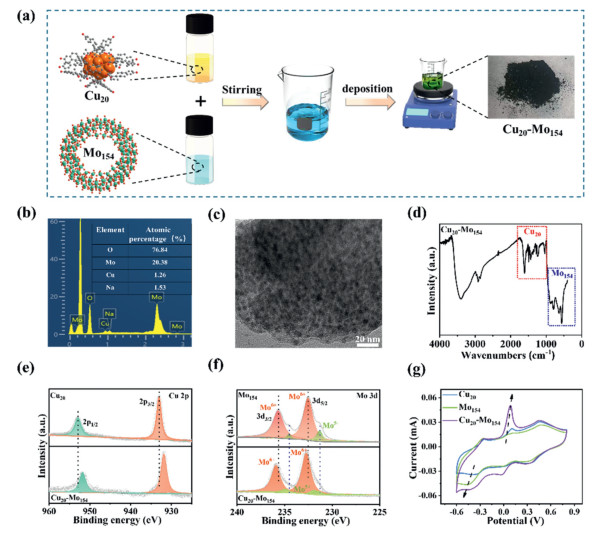
The structural and morphological analysis of Mo154 and Cu20 are presented in Figs. S1 and S2 (Supporting information). Cu20—Mo154 was synthesized by adding an ethanol solution of Cu20 nanoclusters to an aqueous solution of Mo154 (Fig. 1a). Briefly, the mixed solution is stirred at room temperature for 0.5 h, followed by precipitation in diethyl ether, Cu20−Mo154 can be obtained in a 95% yield. Energy dispersive X-ray spectroscopy (EDS) analysis reveals that the atomic fractions of Cu and Mo are 1.26% and 20.38% (Fig. 1b), respectively. Meanwhile, inductively coupled plasma mass spectrometry (ICP-MS) results confirm that the mass percentages of Cu and Mo in the Cu20−Mo154 composite are 8.3% and 43.3%, respectively (Fig. S3 in Supporting information). Both sets of quantitative results are consistent with an approximate 2:1 molar ratio of Mo154 to Cu20 in the as-prepared Cu20−Mo154 composite. Through structural and surface elemental characterization and analysis of the Cu20−Mo154 composite, it is confirmed that the Cu20−Mo154 composite has been successfully synthesized (Fig. S4 in Supporting information). High-resolution transmission electron microscope (HRTEM) studies were displayed large particles but mostly of par reduced crystallinity because of higher weathering inside the microscope column (Fig. 1c). The FTIR spectrum of Cu20−Mo154 retains characteristic bands of both constituents (Fig. 1d). The Mo154 component exhibits features at 1618 cm−1 (m; δ(H2O)), 978 cm−1 (m), 912 cm−1 (w − m; ν(Mo=O)), 810 cm−1 (sh), 745 cm−1 (s), 628 cm−1 (s), and 555 cm−1 (s), attributable to ν(Mo=O), ν(Mo−O−Mo), and δ(Mo−O) vibrations, while the Cu20 cluster shows characteristic bands in excellent agreement with our previous report [29]. The composition and surface electronic structure of Cu20, Mo154 and Cu20−Mo154 are further investigated by X-ray photoelectron spectroscopy (XPS). As shown in Fig. 1e, the Cu 2p spectra peaks of Cu20 shift to lower binding energy, from 933.0 eV to 931.0 eV (Cu 2p3/2) and from 953.0 eV to 952.8 eV (Cu 2p1/2) after interacting with Mo154, consistent with Cu0 or Cu+ species [30]. The results indicate that the introduction of Mo donates electrons to the Cu sites, enhancing the overall reducibility of the Cu sites. On the contrary, compared with Mo154 (Fig. 1f), the Mo 3d peaks assigned to Mo6+ and Mo5+ [31] in Cu20−Mo154 shift to higher binding energy, accompanied by a decreased Mo5+ ratio. Specifically, the Mo6+ 3d peaks shift from 232.5 to 232.7 eV (Mo 3d5/2) and from 235.7 eV to 235.9 eV (Mo 3d3/2), while the Mo5+ 3d peaks move from 234.5 eV to 234.9 eV (Mo 3d3/2) and from 231.3 eV to 231.9 eV (Mo 3d5/2). These changes reflect a reduced local electron density at the Mo sites. Together with the low binding energy shift of Cu 2p peaks, these results confirm net electron transfer from Mo to Cu at the Cu20 and Mo154 interface. The O 1s spectra provides further insight into interfacial interactions. For Cu20 (Fig. S5a in Supporting information), a single peak at 532.2 eV is observed, corresponding to surface hydroxyl oxygen from ethinyl-estradiol. For Mo154 (Fig. S5b in Supporting information), peaks at 530.5 and 531.6 eV are assigned to lattice oxygen and surface-adsorbed oxygen, respectively. In Cu20−Mo154, the O 1s peak at 530.6 eV corresponds to lattice oxygen, while the peak at 532.0 eV is attributed to surface-adsorbed oxygen. The hydroxyl oxygen of Cu20 shifts to lower binding energy, whereas the surface-adsorbed oxygen of Mo154 shifts to higher binding energy after Cu20−Mo154 composite material formation. These opposite shifts indicate the formation of hydrogen bonds between surface hydroxyl oxygen on Cu20 and surface-adsorbed oxygen on Mo154 [32]. Cyclic voltammetry (Fig. 1g) shows that both anodic and cathodic peak potential of Cu20 are more positive than those of Mo154, reflecting the stronger oxidizing character of Cu20. Upon composite formation, hydrogen bond assisted interfacial interactions drive electron transfer from Mo154 to Cu20 [33], in agreement with the XPS results. For Mo154, the cathodic peak current substantially exceeds the anodic counterpart, evidencing that the Mo6+ to Mo5+ reduction predominates while the reverse oxidation (Mo5+ to Mo6+) is sluggish, indicating the redox process is poorly reversible. After incorporating Cu20, the anodic peak current of Cu20−Mo154 increases markedly, while the anodic peak potential remains close to that of Mo154, indicating that Mo154 remains the principal redox active center in the composite. Meanwhile, Cu20 promotes the re-oxidation of Mo5+ to Mo6+, lowers the apparent polarization (sharper peaks with higher intensities), and thereby enhances the redox reversibility and kinetics.
Figure 1
Figure 1.
(a) Schematic illustration for the synthesis process of the Cu20−Mo154. (b) Atomic fractions on Cu20−Mo154. (c) HRTEM images of Cu20−Mo154. (d) FTIR spectra of Cu20−Mo154. XPS patterns of (e) Cu 2p and (f) Mo 3d. (g) CV curves of different materials.
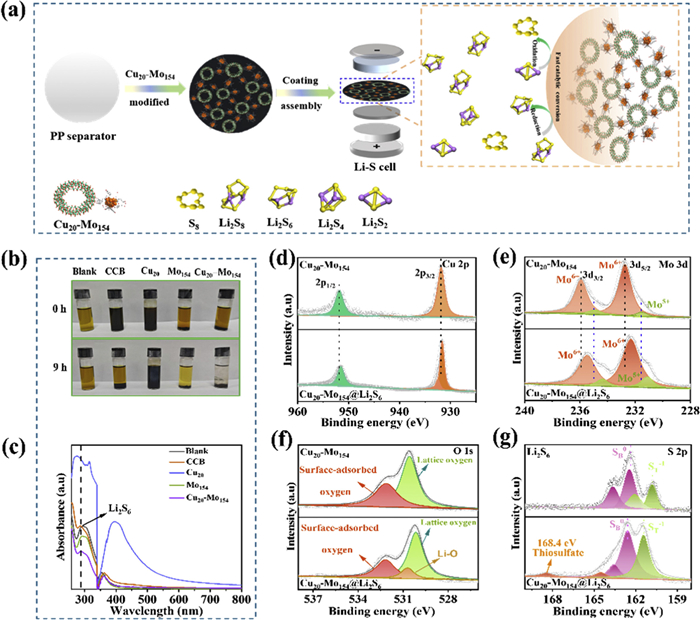
Compared with strategies such as anode host design, electrolyte optimization, and interface engineering, separator modification has attracted particular attention owing to its simplicity and low cost. We employed the Cu20−Mo154 composite catalyst to functionalize the Li-S battery separator. This interfacial coating is designed to catalyze polysulfide conversion, accelerating both reduction and oxidation pathways to promote efficient LiPSs transformation. As illustrated in Fig. 2a, a homogeneous slurry comprising Cu20−Mo154, conductive carbon black (CCB), and polyvinylidene fluoride (PVDF) binder was prepared and cast onto one side of a commercial polypropylene (PP) separator to form a functional interlayer. The Cu20−Mo154 modification layer forms a physical barrier on the PP surface to prevent LiPSs migration from the cathode to the anode. As displayed in Fig. S6a (Supporting information), the electrolyte rapidly and completely wets the Cu20−Mo154 modified separator within 1.0 s, yielding a markedly smaller contact angle than the untreated PP separator. This enhanced wettability indicates improved interfacial compatibility between the electrolyte and the separator after Cu20−Mo154 modification. Superior electrolyte affinity mitigates interfacial Li+ concentration gradients during transport and thus promotes faster Li+ migration kinetics. In the folding/recovery tests, the Cu20−Mo154 modified separator exhibits no visible cracks or delamination (Fig. S6b in Supporting information), indicating strong interfacial adhesion and robust mechanical integrity. In addition, only a negligible amount of Cu20−Mo154 is dissolved in the electrolyte (Fig. S7 in Supporting information), and its chemical structure remained unchanged (Fig. S8 in Supporting information). Its stability in the electrolyte is favorable for the stable catalytic effect toward polysulfides on the battery separator surface. Elemental mapping by EDS (Fig. S9 in Supporting information) confirms a homogeneous distribution of Cu, Mo, O, and Na throughout the modified layer. Ionic transport was evaluated using electrochemical impedance spectroscopy (EIS) on stainless-steel symmetric cells (SS//separator//SS). The bulk resistance, taken from the high-frequency x axis intercept of the Nyquist plot, together with the separator thickness (Fig. S10 in Supporting information), was used to calculate ionic conductivity via Eq. S2 (Supporting information). At room temperature the Cu20−Mo154 modified separator exhibits the lowest resistance of 3.19 Ω (Fig. S11 in Supporting information), corresponding to Li+ conductivity of 0.77 mS/cm (Fig. S12 in Supporting information), which exceeds those of the Mo154 modified (0.66 mS/cm), Cu20 modified (0.18 mS/cm), and PP (0.31 mS/cm) separators. Collectively, these results demonstrate that Cu20−Mo154 modification enhances electrolyte separator interfacial wettability and facilitates Li+ transport, enabling high flux Li+ diffusion across the separator.
Figure 2
Figure 2.
(a) The schematic illustration that Cu20−Mo154 suppresses LiPSs shuttling. (b) electronic photograph of different material immersion in the Li2S6 solution for 9 h. (c) UV–vis spectra of different samples after immersion in the Li2S6 solution for 9 h. XPS analysis of (d) Cu 2p, (e) Mo 3d and (f) O 1s of Cu20−Mo154 and Cu20−Mo154@Li2S6. (g) XPS analysis of S 2p spectra for Li2S6 and Cu20−Mo154@Li2S6.
To visually assess the adsorption of Li2S6 by different materials, conductive carbon black, Cu20, Mo154, and Cu20−Mo154 were introduced into a 0.5 mol/L Li2S6 solution (1,3-dioxane/1,2-dimethoxyethane) and allowed to react (Fig. 2b). After 9 h, the supernatant for conductive carbon black no noticeable change compared with the blank. In contrast, the supernatant for Cu20 turned deep black, consistent with dissolution of Cu20 into the electrolyte and the concurrent adsorption of Li2S6, which intensified the coloration. The supernatant of Mo154 became light yellow, indicating a modest adsorption capacity for Li2S6. Strikingly, Cu20−Mo154 rendered the supernatant nearly colorless, evidencing strong adsorption of Li2S6 and implying that the interaction between Cu20 and Mo154 suppresses Cu20 dissolution in the electrolyte while enhancing Li2S6 capture. UV–vis spectra of the supernatants corroborate these observations, confirming the Li2S6 adsorption capacity in the order Cu20−Mo154 > Mo154 > Cu20 > CCB (Fig. 2c). The chemical interaction between Cu20−Mo154 and Li2S6 was further probed by XPS. The Cu 2p, Mo 3d and O 1s spectra reveal binding-energy shifts after Li2S6 adsorption indicative of electronic interactions between Cu20−Mo154 and Li2S6 [34,35]. This behavior is attributed to the strong electronegativity of terminal O sites, which withdraw electron density from Li (Fig. S13 in Supporting information) and modulate the electronic structure of the embedded metal centers via the "collision effect" [35,36]. Specifically, the Cu 2p peaks shift to lower binding energies after exposure to Li2S6, with Cu 2p3/2 moving from 931.85 eV to 931.6 eV and Cu 2p1/2 from 951.9 eV to 951.5 eV (Fig. 2d). In the Mo 3d region of Cu20−Mo154@Li2S6, both Mo6+ and Mo5+ features shift to lower binding energies, accompanied by an increased ration of Mo5+ (Fig. 2e), consistent with the partial reduction of Mo6+ upon electron gain. When Li2S6 adsorption, a new O 1s component emerges at 530.7 eV, assignable to Li−O bonds (Fig. 2f) [36]. For S 2p, pristine Li2S6 exhibits the characteristic doublets of terminal sulfur (ST−1) and bridging sulfur (SB0) at 160.2–162.8 eV [37]. In Cu20−Mo154@Li2S6, these polysulfide signals are attenuated and a new peak appears at 168.4 eV, characteristic of thiosulfate (Fig. 2g). The S 2p data indicate oxidation of sulfur in Li2S6 (−1/0) to higher-valence oxy-sulfur species (e.g., sulfate) [38] on Cu20−Mo154. The shuttle of lithium polysulfides through the modified separator under a concentration gradient was detected using an H-type glass bottle (Fig. S14 in Supporting information). It is worth noting that the original PP separator could not prevent the diffusion of lithium polysulfides, while the penetration of polysulfides was inhibited when using the Mo154 modified separator. However, the Cu20 modified separator could not prevent the polysulfide shuttle due to the dissolution of Cu20 in the electrolyte. Fortunately, there was no significant change in the right chamber using the Cu20−Mo154 modified separator, which indicates that Cu20−Mo154 has a more excellent ability to inhibit polysulfide shuttle due to the synergistic effect of physical barrier and strong chemical adsorption. Collectively, these results demonstrate that Cu20−Mo154 composite affords strong adsorption of LiPSs.
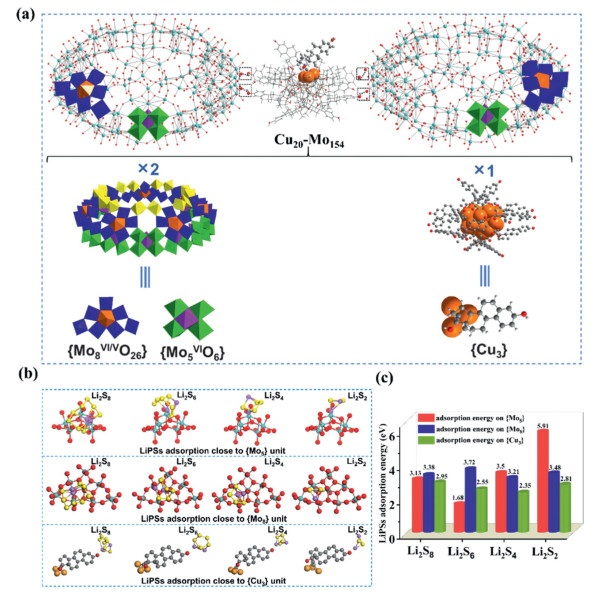
Density functional theory (DFT) calculations were performed to elucidate the adsorption behavior of lithium polysulfides on Cu20−Mo154. Prior studies on large molybdenum-oxide clusters (Mo80, Mo154, and Mo160) have reported that the reduced electrons are delocalized within the {Mo5O6} unit of Mo154 [39], whereas the semi-closed architectures of Mo80 and Mo160 exhibit Mo 4d electrons delocalization not only between the wheel-like {Mo5O6} and {Mo7O9} units but also toward the central vertices {Mo3O14} and {Mo8O36} [16]. The reduction degree of Mo and the energetic position of Mo 3d states are known to govern electronic delocalization in polyoxomolybdate. Structurally, Mo154 is composed of {Mo5O6} (abbr. as {Mo5}) and {Mo8O26} (abbr. as {Mo8}) building units [13]. While previous work has emphasized electron delocalization within {Mo5}, the role of {Mo8} has been less explored. To address this gap, we computed the adsorption energies of representative LiPSs on {Mo8}, {Mo5} and {Cu3} [29] site (Fig. 3a). The optimized configurations (Fig. 3b) show that {Mo8}, {Mo5}, and {Cu3} all bind LiPSs primarily via Li–O coordination. Li+ (Lewis acidic sites) interacts with terminal O atoms (Lewis basic sites) on the Mo–O framework or with the −OH group of ethinyl estradiol in {Cu3}. The trend of adsorption strength for long-chain lithium polysulfides (Li2S8 and Li2S6) on different structural units is {Mo8} > {Mo5} > {Cu3}, whereas for short-chain lithium polysulfides (Li2S4 and Li2S2), the adsorption strength patterns are {Mo5} > {Mo8} > > {Cu3} (Fig. 3c). Long-chain lithium polysulfides possess more delocalized charge distributions [40]. The {Mo8} structural unit provides a dense array of terminal Mo=O and bridging Mo–O–Mo sites that offer multiple Li+ coordination points, together with mix-valent Mo6+ and Mo5+ centers that afford notable electron accepting capacity [41]. This combination facilitates charge redistribution and stabilization of dissolved Li2S8/Li2S6, yielding stronger and more numerous binding motifs. By contrast, shorter chains (Li2S4 and Li2S2) feature more concentrated electron density at terminal S atoms [42], resulting in stronger chemical adsorption to exposed Mo sites in {Mo5}. Such interactions promote S–S bond cleavage and nucleation, thereby favoring deep conversion of LiPSs and uniform Li2S deposition. The {Cu3} site engages LiPSs mainly through the hydroxyl functionality of its organic ligand, providing weaker direct Li+ coordination than the oxygen rich Mo–O framework. Nevertheless, the Cu d electrons can assist S–S activation and electron transfer, facilitating reversibility, albeit with limited adsorption strength. In summary, the synergistic interplay between Cu20 and Mo154 endows Cu20−Mo154 with functions of "strong anchoring" for LiPSs, thereby suppressing LiPSs shuttling.
Figure 3
Figure 3.
(a) The structure of sandwiched skeleton in Cu20−Mo154 and constituent structural unit for Mo154 ({Mo5}, {Mo8}) and Cu20 ({Cu3}). (b) Optimized adsorption configurations of various LiPSs on unit of {Mo5}, {Mo8} and {Cu3}. (c) Binding energies between various LiPSs on unit of {Mo5}, {Mo8} and {Cu3}.
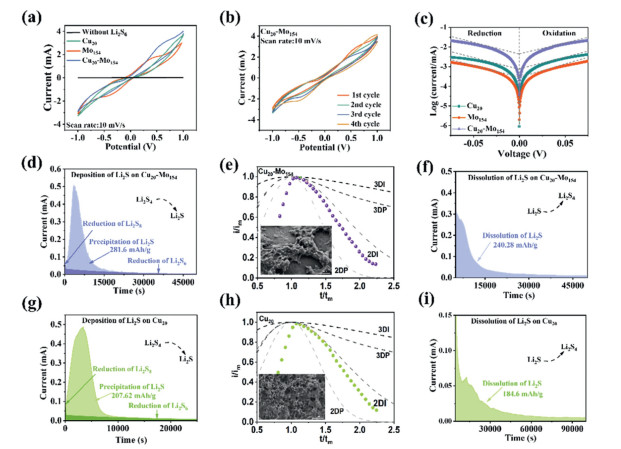
A symmetrical battery was assembled using Li2S6 to investigate the conversion reaction kinetics of LiPSs. Cyclic voltammetry (CV) of symmetric cells (Fig. 4a) shows that introducing Li2S6 yields pronounced redox currents compared with symmetrical cells without Li2S6, confirming that the current arises from the reversible polysulfide conversion in the Li2S6 electrolyte. At identical overpotential, Cu20−Mo154 delivers the largest current and integrated area indicative of the fastest LiPSs redox kinetics and the lowest polarization. After four cycles, the CV traces of the Cu20−Mo154 symmetric cell nearly overlap, with the forward and reverse currents remaining highly symmetric and only a slight increase in current observed (Fig. 4b), evidencing high reversibility, a stable interface, and sustained electrocatalytic activity. The XRD results (Fig. S15 in Supporting information) show that the characteristic peaks of Cu20−Mo154 remains unchanged in position and shape after 10 cycles, with no new impurity peaks detected, confirming that the structure of Cu20−Mo154 remains intact after long-term cycling. Electrochemical impedance spectroscopy (EIS) of Li2S6 symmetric cells equipped with Cu20, Mo154, or Cu20−Mo154 electrodes (Fig. S16a in Supporting information) shows that Cu20−Mo154 exhibits the smallest high frequency semicircle (lowest charge transfer resistance) and the weakest Warburg diffusion feature, consistent with the fastest LiPSs oxidation/reduction kinetics. This enhancement is attributed to strong multipoint Li–O interactions at the {Mo8} and {Mo5} sites of Mo154, which rapidly capture and activate LiPSs, while the Cu sites provide efficient electronic pathways. The synergistic effect accelerates LiPSs conversion and markedly lowers impedance. Tafel analysis (Fig. 4c) further reveals that Cu20−Mo154 has the highest exchange current density in agreement with EIS result and a larger i0 corresponds to a lower charge transfer resistance. The chronoamperometry curves of symmetric cells with Li2S6 exhibit an enhanced current response compared to cells without Li2S6 (Fig. S16b in Supporting information), suggesting that the current responses are primarily influenced by the lithiation and delithiation reaction pathway rather than the double-layer capacitance. Furthermore, Cu20−Mo154 electrode exhibits the highest current response, which proves the enhanced LiPSs affinity and re-dox kinetics [43]. Among the tested electrodes, Cu20−Mo154 demonstrates the highest current response, reflecting enhanced LiPSs adsorption, favorable redox kinetics, and reduced charge transfer barriers. This is mainly attributed to the multisite Li−O coordination of LiPSs on Mo154 combined with Cu20 mediated electron pathways, which facilitates S–S bond activation and accelerates electron transfer. The deposition and dissolution capabilities of Li2S on Cu20−Mo154 and Cu20 are evaluated through Faraday's law. The initial peak corresponds to instantaneous nucleation of Li2S, followed by a decay characteristic of diffusion-controlled growth. The early segment reflects Li2S8 to Li2S4 reduction, followed by Li2S4 to Li2S deposition process, and continued reduction of Li2S6 still present in the long tail segment. The deposition capacity of Li2S on Cu20−Mo154 (Fig. 4d) is approximately 281.6 mAh/g by integrated of curve. By contrast, Cu20 (Fig. 4g) exhibits a smaller peak and rapid decay, yielding a significantly lower integrated Li2S capacity. These results indicate that Mo154 furnishes abundant, uniformly distributed active sites featuring Li–O interactions on Cu20−Mo154, which promote Li2S nucleation and enrich and catalyze LiPSs, thereby accelerating deposition kinetics. The experimentally measured potentiostatic deposition curves were compared and fitted with the classical nucleation theory model (Figs. 4e and h). The results demonstrate that the reductive deposition and growth process of lithium sulfide (Li2S) on both Cu20−Mo154 and Cu20 electrodes is dominated by the two-dimensional progressive (2DI) nucleation mechanism. This nucleation mode corresponds to the formation of a continuous film-like Li2S deposition layer (insets of Figs. 4e and h), which is in excellent agreement with the high-density and uniformly distributed active sites on the electrode surface. Both Cu20−Mo154 and Cu20 support reversible Li2S dissolution (Figs. 4f and i), indicating effective bidirectional catalysis that facilitates both deposition and electrochemical regeneration of Li2S. Collectively, Cu20−Mo154 couples strong chemical anchoring for LiPSs (multipoint Li–O coordination at Mo154) with efficient electronic conduction (Cu sites), delivering rapid and reversible LiPSs conversion, reduced impedance, accelerated Li2S nucleation/growth via 2DI pathways, and mitigated passivation features that underpin superior rate capability and cycling stability in Li-S batteries.
Figure 4
Figure 4.
(a) CV curves for Li2S6 symmetric cells with the Cu20, Mo154 and Cu20−Mo154 electrodes. (b) CV curves of Cu20−Mo154 modified separator symmetric cell at different cycles. (c) The Tafel curves at the scan rate of 5 mV/s. Potentiostatic discharge at 2.08 V on (d) Cu20−Mo154 and (g) Cu20. Dimensionless transient profiles at 2.08 V for (e) Cu20−Mo154 and (h) Cu20, and the insets are the corresponding SEM images after Li2S deposition. (f) Potentiostatic charge profiles at 2.35 V for Cu20−Mo154 and (i) Cu20.
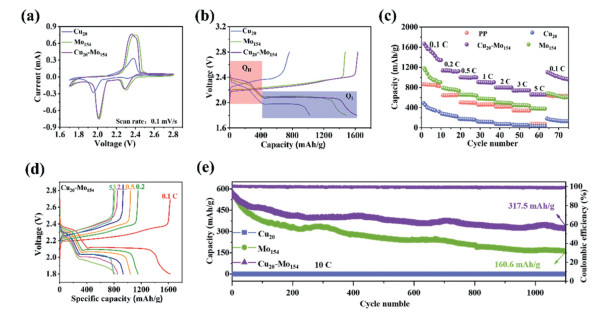
Li-S batteries were assembled with separators modified by Cu20, Mo154, and Cu20−Mo154, and their electrochemical performance was evaluated. As shown in Fig. 5a, all three cells exhibit the characteristic of CV features Li-S batteries, including two reduction peaks during discharge and one oxidation peak during charge. The peak currents follow the order Cu20−Mo154 > Mo154 > Cu20, indicating that Cu20−Mo154 has the highest reaction rate and the greatest density of active sites. The cathodic peak potentials obey the trend of Cu20−Mo154 > Mo154 > Cu20, suggesting that Cu20−Mo154 most effectively promotes the conversion of solid sulfur to soluble long-chain and medium-chain polysulfides and affords the fastest kinetics and best reversibility for subsequent Li2S deposition. Consistently, the anodic peak of Cu20−Mo154 appears at a lower potential than those of Mo154 and Cu20, indicating that Li2S is more readily oxidized and dissolved. Galvanostatic charge-discharge profiles (Fig. 5b) further corroborate these trends. The high-voltage discharge plateau (QH) of the Cu20−Mo154 cell occurs at a higher potential and shows largest QH (447 mAh/g, Fig. S17 in Supporting information), reflecting stronger adsorption and activation of LiPSs, together with improved electron transport, thereby accelerating sulfur dissolution and the formation/transition of long- and medium-chain LiPSs [44]. The low-voltage discharge plateau (QL) is the longest and flattest for Cu20−Mo154 and performs largest QL (1173 mAh/g, Fig. S17), indicating the highest sulfur utilization and the fastest deposition kinetics. These results collectively demonstrate that Cu20−Mo154 delivers superior Li2S nucleation and growth, along with deep conversion capability, relative to Mo154 and Cu20. The cycling stability of Li-S batteries using modified separators prepared from different materials was evaluated. The Cu20−Mo154 cell exhibits the highest initial capacity of 1561.5 mAh/g, surpassing that of Mo154 (1434.9 mAh/g) and Cu20 (1022 mAh/g), and it retains 762.2 mAh/g after 300 cycles at a current density of 1 C (Fig. S18 in Supporting information). To further substantiate the enhanced electrochemical performance, the rate capability of Li-S cells was measured at current densities ranging from 0.1 C to 5.0 C and then returned to 0.1 C (Fig. 5c). Specifically, the Cu20−Mo154 battery delivers discharge capacities of 1626.4, 1152.8, 1040.5, 932.7, 850, 812, 795 and 1103 mAh/g at rates of 0.1, 0.2, 0.5, 1.0, 2.0, 3.0, 5.0 and 0.1 C, respectively (Fig. 5d), outperforming the other materials modified separator. In contrast, the Cu20 electrode exhibits the poorest rate performance. There is no capacity release when the current density exceeds 2 C. It is worth noting that the Cu20−Mo154 battery delivers an initial capacity of 569.3 mAh/g at an ultrahigh current density of 10 C and maintains 317.5 mAh/g after 1100 cycles (Fig. 5e), corresponding to a low average capacity fade of 0.048% per-cycle. By comparison, the Mo154 battery starts at 564.5 mAh/g and declines to 160.6 mAh/g after 1100 cycles, corresponding to an average capacity decay rate of 0.1% per cycle. However, the Cu20 electrode does not exhibit any capacity release. The Cu20 battery shows negligible effective capacity, which can be attributable to the rapid dissolution of Cu20 in the electrolyte. The combination of Mo154 with Cu20 suppresses Cu20 dissolution, enhances cycling stability, and increases the discharge capacity. The Cu20−Mo154 interface layer can effectively adsorb and catalyze the conversion of polysulfides, thus significantly inhibiting the shuttle effect, resulting in a stable coulombic efficiency of over 99.5% throughout the 1100 cycles. The self-discharge (Fig. S19 in Supporting information) tests of batteries indicates that the cell with Cu20−Mo154 modified separator shows only a slight open-circuit voltage (OCV) decay from 2.41 V to 2.36 V after resting 160 h. For comparison, the cells with individual Cu20 and Mo154 modified separators show voltage fades from 2.41 V to 2.04 V and from 2.42 V to 2.12 V, respectively. Thereby, the batteries with separators modified by Cu20−Mo154 layer on long-term storage performance. Overall, the Cu20−Mo154 modified separator delivers superior cycling stability and rate capability by coupling strong polysulfide adsorption and catalytic conversion with robust interfacial stability, thereby outperforming the Mo154 and Cu20 as well as commercial PP separators across abroad range of operating conditions.
Figure 5
Figure 5.
(a) CV curves and (b) galvanostatic charge/discharge profiles of Li-S cells with Cu20, Mo154 and Cu20−Mo154 modified separators. (c) Rate capabilities of Li-S cells based on polypropylene separators (PP) and with Cu20, Mo154 and Cu20−Mo154 modified separators at different current densities. (d) Discharge-charge profiles of cell with Cu20−Mo154 modified separator at different current rates. (e) Long cycle performance of cell with Cu20, Mo154 and Cu20−Mo154 modified separators at current densities of 10 C and coulombic efficiency of Cu20−Mo154.
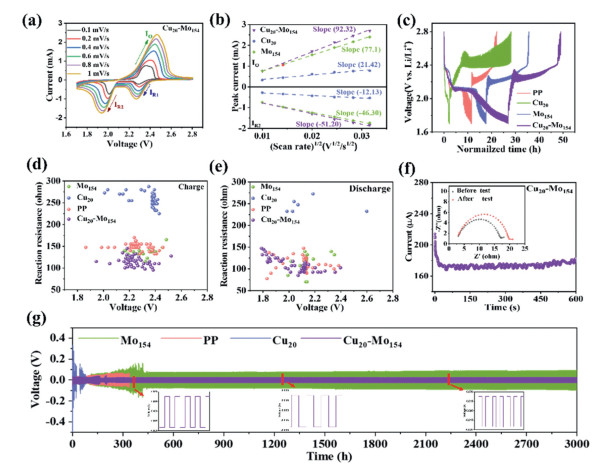
Cyclic voltammetry was conducted at scan rates from 0.1 mV/s to 1.0 mV/s to probe Li+ diffusion. According to the Randles-Sevcik equation, the peak current ip scales linearly with ν1/2, and the slope of ipvs. ν1/2 reflects the Li+ diffusion coefficient [45]. As shown in Figs. 6a and b, Figs. S20a and b (Supporting information), the Cu20−Mo154 modified separator exhibits the largest slopes for both anodic and cathodic peaks, indicating faster interfacial Li+diffusion during charge and discharge. This enhanced Li+ transport improves the redox kinetics and overall performance of Li-S battery [46]. The electrochemical behavior of the operating battery was analyzed using the galvanostatic intermittent titration technique (GITT) under near quasi-equilibrium conditions (Fig. 6c). From the GITT transients, the internal resistance (Figs. 6d and e) and the apparent Li+ diffusion coefficient (Figs. S21a and b in Supporting information) were determined during both charge and discharge. As summarized in, the Cu20−Mo154 modified separator exhibits the lowest internal resistance and the highest Li+ diffusion coefficient across the state of charge. Meanwhile, EIS measurements reveal that the cell with the Cu20−Mo154 modified separator exhibits a lower interfacial resistance compared to those with Cu20 modified and Mo154 modified separators, and the equivalent circuit in Fig. S22 (Supporting information) is employed to simulate the obtained ESI results, evidencing the fastest diffusion and phase-transition kinetics [47]. Mechanistically, polar sites in Mo154 (e.g., Li–O coordination) strongly anchor and enrich polysulfides, increasing the local concentration of LiPSs and suppressing the shuttle effect, while Cu sites furnish rapid electronic pathways that lower charge-transfer resistance. The resulting synergy accelerates LiPSs conversion and transport. A Li||Li symmetric cell was employed to assess the cycling durability of lithium stripping/deposition under different materials modified separators, thereby exploring the impact of the modified layer on the uniformity of lithium deposition [48]. EIS before and after constant-potential polarization (Fig. 6f, Figs. S23a and b in Supporting information) enabled determination of the Li+ transference number tLi+ according to Eq. S3 (Supporting information). In PP separators, Li+ migrates predominantly as large solvation clusters, leading to sluggish diffusion. In contrast, the high electronegativity of anionic clusters can facilitate Li+ transport [49]. When employing Cu20−Mo154 modified separators, the ion-dipole and electrostatic interactions between Mo154 anionic clusters and Li+ lead to changes in the solvation structure of Li+. Consequently, the high negativity of the Mo154 surface ensures high flux diffusion of Li+ and achieves uniform lithium deposition. Fig. 6g shows the cycling voltage curves at 1 mA/cm2 with areal capacity of 1 mA/cm2. The Li||Li symmetrical cell using the PP separator experienced a short circuit after approximately 340 h. The Cu20 modified separator exhibited an overpotential of 330 mV during the initial 7 h, followed by pronounced polarization fluctuations due to Cu20 dissolution. By comparison, the Mo154 modified separator consistently maintained an overpotential of 99 mV during continuous cycling. The magnified plots clearly show that the Cu20−Mo154 cell exhibits a low and stable voltage hysteresis after the initial SEI formation, with no irregular voltage spikes, fluctuations, or sudden polarization increase throughout the steady and late cycle stages. This confirms that the Cu20−Mo154 interface layer can effectively regulate uniform Li deposition, stabilize the electrode-electrolyte interface, and inhibit the growth of Li dendrites, which is the core reason for the excellent long-cycle stability of the cell. Notably, the Cu20−Mo154 modified separator sustains consistent polarization for up to 3000 h, indicating high flux Li+ transport and uniform Li deposition. Together, accelerated ion and electron transport, stabilized solvation, uniform deposition, and shuttle suppression underpin the superior kinetics and durability of Cu20−Mo154 enabled Li-S batteries.
Figure 6
Figure 6.
(a) CV curves of Cu20−Mo154 modified separator at various scan rates. (b) Corresponding linear fitting for the peak current vs. the square root of the scanning rate of Cu20, Mo154 and Cu20−Mo154. (c) GITT profiles and corresponding reaction resistances of cells with Cu20, Mo154 and Cu20−Mo154 modified separators during (d) charge and (e) discharge processes. (f) Measurement of tLi+ using potentiostatic polarization of Li||Li symmetric cell with Cu20−Mo154 modified separator (inset: Nyquist plots of impedance before and after polarization). (g) Galvanostatic cycling of Li||Li symmetric cells with Cu20, Mo154 and Cu20−Mo154 modified separators at 1 mA/cm2 with areal capacity of 1 mA/cm2 and the inset shows magnified views of the galvanostatic cycling curves for the Cu20−Mo154 modified separator cell at different cycling stages.
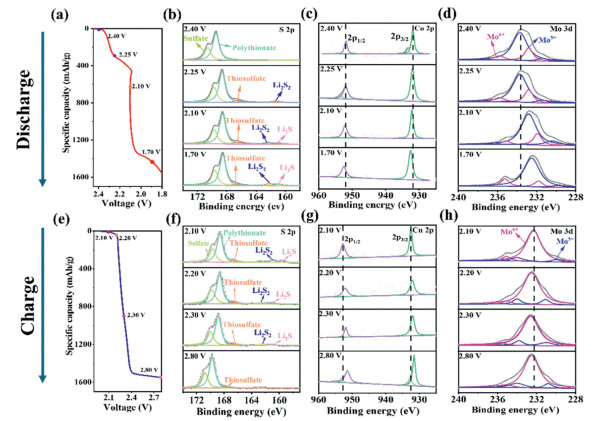
In ex-situ XPS was used to investigate the kinetics of LiPSs conversion in Cu20−Mo154 during the charge-discharge process, confirming the synergistic effect of Cu20 and Mo154 in Li-S batteries (Figs. 7a-h). As illustrated in Fig. 7b, when the discharge voltage is approximately 2.10 V, the S 2p spectrum can be deconvoluted into five distinct peaks. The peaks at 169.6, 168.3, and 166.3 eV are corresponded to sulfate, polysulfides, and thiosulfate, respectively. The peaks at 162.2 and 160.0 eV correspond to Li2S2 and Li2S, respectively [50]. Upon further discharge to 1.70 V, the Li2S2 and Li2S signals intensify, consistent with the complete reduction of S8 to Li2S2 and Li2S. Concurrently (Fig. 7c), the Cu 2p3/2 and Cu 2p1/2 peaks shift to higher binding energies as the discharge proceeds, indicating oxidation of Cu (decreased electron density), whereas the Mo 3d peaks shift to lower binding energies (Fig. 7d), accompanied by an increasing fraction of Mo5+, evidencing the reduction of Mo centers. These opposite shifts signify electron transfer from Cu20 to LiPSs and Mo154 during discharge. In contrast, during the charging process, at the fully charged state (2.80 V), the S 2p (Fig. 7f) spectrum exhibits two dominant high binding energy features assigned to sulfate and polysulfide, indicating complete oxidation of long-chain LiPSs. In the case of the Cu20 spectrum (Fig. 7g), both Cu 2p3/2 and Cu 2p1/2 shift to lower binding energies as charging progresses, consistent with Cu reduction. While the Mo 3d spectrum (Fig. 7h) shows the conversion of Mo5+ back to Mo6+, reflecting the oxidation of Mo. These trends indicate reverse electron flow from Mo154 and LiPSs to Cu20 during charging, with Mo154 acting primarily to oxidize LiPSs. The binding energy shifts across S, Cu, and Mo demonstrate that Cu20−Mo154 operates as a redox mediating, synergistic catalyst. Cu20 donates electrons (via hydrogen bond) to activate LiPSs while Mo154 is reduced during discharge. Mo154 promotes LiPSs oxidation and returns electrons toward Cu20 during charge. This bidirectional electron mediation accelerates polysulfide redox kinetics, underpinning the high-rate capability and long-term cycling stability observed in Li-S battery with the Cu20−Mo154 modified separator.
Figure 7
Figure 7.
(a) Galvanostatic discharge profiles and corresponding ex-situ XPS analysis for (b) S 2p, (c) Cu 2p and (d) Mo 3d spectra of the cell with Cu20−Mo154 modified separator. (e) Galvanostatic charge profiles and corresponding ex-situ XPS analysis for (f) S 2p, (g) Cu 2p and (h) Mo 3d spectra of the cell with Cu20−Mo154 modified separator.
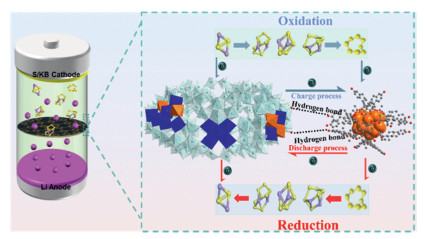
The Li-S electrochemical performance using the Cu20−Mo154 modified separator is shown in Fig. 8. The Cu20−Mo154 modified layer functions as both a physical barrier and a chemical catalyst for LiPSs. Physically, it hinders LiPSs migration across the separator. Chemically, Cu20 and Mo154 act synergistically to anchor LiPSs and catalyze their reversible transformation (LiPSs ⇌ Li2S) during cycling. Specifically, Mo154 captures LiPSs via Li–O coordination at terminal oxygens (Mo=O), while Cu20 provides additional Li–O coordination through hydroxyl groups of surface ligands. Together, these interactions effectively suppress the shuttle effect, enhance active sulfur utilization, and mitigate corrosion of the lithium anode. During discharge, electrons are transferred from Cu20 to Mo154 and LiPSs, which accelerates the conversion of solid S8 to Li2S and markedly improves the catalytic reduction kinetics of polysulfides. During charge, Mo154 and LiPSs transfer electrons to Cu20, promoting LiPSs oxidation, lowering internal resistance, and enhancing overall reaction efficiency. Consistent with the in situ XPS trends in Fig. 7, these reciprocal electron flows confirm that Cu20 and Mo154 operate as a cooperative redox mediator pair. Beyond catalysis, Cu20 serves as an "electron buffer reservoir" for Mo154, storing and supplying electrons to maintain an appropriate electronic density on the Mo154 surface. This stabilizes the local electronic structure of Mo154, reduces the likely of surface and structural degradation during operation, and enhances the stability of the Cu20−Mo154 composite. Collectively, the integrated physical obstruction, multisite chemical adsorption, bidirectional redox mediation, and electron reservoir buffering significantly improve Li-S battery performance, making this system more advantageous for practical applications.
Figure 8
Figure 8.
Schematic illustration for the catalytic mechanism of the high-performance Li-S cell equipped with Cu20−Mo154 modified separator.
In this study, we successfully constructed a novel synergistic catalyst Cu20−Mo154, composed of atomically precise copper nanoclusters and giant Keplerian molybdenum clusters, designed to accelerate LiPSs conversion and enhance the electrochemical performance of Li-S batteries. The synergy between Cu20 and Mo154 provides more active surface sites for LiPSs conversion, increasing the available surface area for catalytic reactions and thereby enhancing the overall catalytic efficiency. During the charging and discharging process, rapid electron transfer occurs between Cu20 and Mo154, maintaining an optimal electron density on Cu20 and Mo154, which enhancing catalytic activity and improving the structural stability of Cu20−Mo154. A high reversible capacity of 1355 mAh/g is observed at 0.1 C, and an excellent cycling stability of 317 mAh/g remains even after 1100 cycles at 10 C. It is confirmed that the synergistic effect between Cu20 and Mo154 enhances the bidirectional catalytic conversion rate of LiPSs ⇌ Li2S. This study offers a viable route for designing efficient cluster-to-cluster synergistic catalysts, with the goal of suppressing the shuttling effect of LiPSs in Li-S batteries and realizing excellent rate capability.
The authors declare that they have no known competing financial interests or personal relationships that could have appeared to influence the work reported in this paper.
Acknowledgments
The authors gratefully acknowledge the financial support from the National Natural Science Foundation of China (No. 22471095), Natural Science Foundation of Shandong Province (Nos. ZR2024QE440 and ZR2024QB211), Postdoctoral Fellowship Program of CPSF (No. GZC20250015), Postdoctoral Innovation Program of Shandong Province (No. SDCX-ZG-202502050). the Jinan City "New University 20″ Project (No. 202228113), and Science and Technology Program of University of Jinan (No. XBS2404)
Supplementary materials
Supplementary material associated with this article can be found, in the online version, at doi:10.1016/j.cclet.2026.112867.
[1]
C.Y. Zhang, X. Lu, X. Han, et al., J. Am. Chem. Soc. 145 (2023) 18992–19004. doi: 10.1021/jacs.3c06288
[2]
Y. Lei, C. Wu, X. Lu, et al., Angew. Chem. Int. Ed. 61 (2022) e202200384. doi: 10.1002/anie.202200384
[3]
C. Ma, W. Cui, Q. Zhang, et al., Adv. Funct. Mater. 36 (2026) e15760. doi: 10.1002/adfm.202515760
[4]
J. Li, Y. Li, T. Liu, et al., Adv. Funct. Mater. 36 (2026) 2504546. doi: 10.1002/adfm.202504546
Figure 1
(a) Schematic illustration for the synthesis process of the Cu20−Mo154. (b) Atomic fractions on Cu20−Mo154. (c) HRTEM images of Cu20−Mo154. (d) FTIR spectra of Cu20−Mo154. XPS patterns of (e) Cu 2p and (f) Mo 3d. (g) CV curves of different materials.
Figure 2
(a) The schematic illustration that Cu20−Mo154 suppresses LiPSs shuttling. (b) electronic photograph of different material immersion in the Li2S6 solution for 9 h. (c) UV–vis spectra of different samples after immersion in the Li2S6 solution for 9 h. XPS analysis of (d) Cu 2p, (e) Mo 3d and (f) O 1s of Cu20−Mo154 and Cu20−Mo154@Li2S6. (g) XPS analysis of S 2p spectra for Li2S6 and Cu20−Mo154@Li2S6.
Figure 3
(a) The structure of sandwiched skeleton in Cu20−Mo154 and constituent structural unit for Mo154 ({Mo5}, {Mo8}) and Cu20 ({Cu3}). (b) Optimized adsorption configurations of various LiPSs on unit of {Mo5}, {Mo8} and {Cu3}. (c) Binding energies between various LiPSs on unit of {Mo5}, {Mo8} and {Cu3}.
Figure 4
(a) CV curves for Li2S6 symmetric cells with the Cu20, Mo154 and Cu20−Mo154 electrodes. (b) CV curves of Cu20−Mo154 modified separator symmetric cell at different cycles. (c) The Tafel curves at the scan rate of 5 mV/s. Potentiostatic discharge at 2.08 V on (d) Cu20−Mo154 and (g) Cu20. Dimensionless transient profiles at 2.08 V for (e) Cu20−Mo154 and (h) Cu20, and the insets are the corresponding SEM images after Li2S deposition. (f) Potentiostatic charge profiles at 2.35 V for Cu20−Mo154 and (i) Cu20.
Figure 5
(a) CV curves and (b) galvanostatic charge/discharge profiles of Li-S cells with Cu20, Mo154 and Cu20−Mo154 modified separators. (c) Rate capabilities of Li-S cells based on polypropylene separators (PP) and with Cu20, Mo154 and Cu20−Mo154 modified separators at different current densities. (d) Discharge-charge profiles of cell with Cu20−Mo154 modified separator at different current rates. (e) Long cycle performance of cell with Cu20, Mo154 and Cu20−Mo154 modified separators at current densities of 10 C and coulombic efficiency of Cu20−Mo154.
Figure 6
(a) CV curves of Cu20−Mo154 modified separator at various scan rates. (b) Corresponding linear fitting for the peak current vs. the square root of the scanning rate of Cu20, Mo154 and Cu20−Mo154. (c) GITT profiles and corresponding reaction resistances of cells with Cu20, Mo154 and Cu20−Mo154 modified separators during (d) charge and (e) discharge processes. (f) Measurement of tLi+ using potentiostatic polarization of Li||Li symmetric cell with Cu20−Mo154 modified separator (inset: Nyquist plots of impedance before and after polarization). (g) Galvanostatic cycling of Li||Li symmetric cells with Cu20, Mo154 and Cu20−Mo154 modified separators at 1 mA/cm2 with areal capacity of 1 mA/cm2 and the inset shows magnified views of the galvanostatic cycling curves for the Cu20−Mo154 modified separator cell at different cycling stages.
Figure 7
(a) Galvanostatic discharge profiles and corresponding ex-situ XPS analysis for (b) S 2p, (c) Cu 2p and (d) Mo 3d spectra of the cell with Cu20−Mo154 modified separator. (e) Galvanostatic charge profiles and corresponding ex-situ XPS analysis for (f) S 2p, (g) Cu 2p and (h) Mo 3d spectra of the cell with Cu20−Mo154 modified separator.


 DownLoad:

 下载:


 下载:

