Citation:
Guoqing Wu, Xubiao Luo, Yanbo Zhou. Recent advance of heavy metal complexes treatment: Conventional, oxidative, and reductive strategies[J]. Chinese Chemical Letters,
2026, 37(11): 112569.
doi:
10.1016/j.cclet.2026.112569
Recent advance of heavy metal complexes treatment: Conventional, oxidative, and reductive strategies
English
Recent advance of heavy metal complexes treatment: Conventional, oxidative, and reductive strategies
School of Life Sciences, Key Laboratory of Jiangxi Province for Functional Biology and Pollution Control in Red Soil Regions, Jinggangshan University, Ji’an 343009, China
b.
State Environmental Protection Key Laboratory of Environmental Risk Assessment and Control on Chemical Process, East China University of Science and Technology, Shanghai 200237, China
c.
Engineering Research Center of Resource Utilization of Carbon-containing Waste with Carbon Neutrality, Ministry of Education, Shanghai 200237, China
Received Date:
30 July 2025 Accepted Date:
02 March 2026 Revised Date:
17 January 2026 Available Online:
15 November 2026
Abstract:
The widespread use of complexing agents (e.g., ethylenediaminetetraacetic acid, citrate) in industrial processes has resulted in the predominance of highly stable heavy metal complexes (HMCs) in wastewater. Conventional treatment technologies are rendered ineffective due to steric hindrance and strong coordination stability inherent to these complexes. To address this emerging challenge, diverse strategies for treating HMCs-contaminated wastewater have been developed. While advanced oxidation processes (AOPs) dominate current research, the adaptive optimization of conventional methods and the untapped potential of efficient reduction technologies remain significantly understudied. This review systematically integrates three technological frameworks, enhanced conventional processes, AOPs-based decomplexation, and high-efficiency reductive recovery, thereby bridging a critical knowledge gap. We comprehensively evaluate recent advances in HMCs treatment technologies, discussing their mechanisms, performance-enhancing strategies, and key limitations. Furthermore, we identify fundamental barriers to industrial translation and propose potential solutions, aiming to provide actionable guidance for managing complex heavy metal pollution.
Heavy metals have been widely recognized as an important raw material in modern industrial production. The increasing scale of industrial production has correspondingly raised the risk of environmental pollution from heavy metal contamination, which has attracted growing global attention [1–4]. According to the Report on the State of the Ecology and Environment in China 2023 of the Ministry of Ecology and Environment, heavy metals containing in industrial wastewater exhibited significant emissions, reaching an unprecedented 38.8 tons annually [5]. The discharge of untreated wastewater into natural water bodies poses a toxicological risk and is highly hazardous. Heavy metals infiltrate biological systems through multiple pathways, including ingestion, contact, and neurotoxicity, leading to chronic accumulation and severe damage to the nervous system, digestive tract, respiratory system, and other organs, resulting in irreversible injury [6,7]. Traditional treatment technologies for heavy metal wastewater, such as precipitation, ion exchange and adsorption, have been widely utilized and fulfilled the early emission standards [8–13]. However, with advancements in industrial technology, from conventional electroplating to high-precision electronic industries, a variety of chelants such as ethylenediaminetetraacetic acid (EDTA), citrate, and glycine were introduced to the production process for high products quality [14,15]. Heavy metal cyanide complexes are commonly generated in the metallurgical industry [16]. In livestock breeding and medical-related sectors, heavy metal–antibiotic complexes may be produced [17,18]. Furthermore, even under natural conditions, heavy metals can form complexes with humic acid, resulting in heavy metal–humic acid complexes [19]. To ensure the heavy metal ions are in a stable chelated state, the addition of chelating agents often exceeds heavy metals [20]. Consequently, the industrial wastewater containing heavy metals often presents as a stable complex.
Heavy metal complexes (HMCs) exhibit higher stability compared to heavy metal alkaline precipitates, rendering the conventional method of heavy metal precipitation by increasing alkalinity completely ineffective [21]. The stability of these complexes is predominantly influenced by the functional groups of the coordinating ligands. In general, the stability of metal complexes follows the order: amino groups > hydroxyl groups > carboxyl groups. It is noteworthy that chelation: the coordination of heavy metals with polydentate organic ligands, results in a significant enhancement of complex stability. Additionally, chelating agents allow steric hindrance around the central metal ion, enabling HMCs to resist capture by adsorbents [22]. The extent of steric hindrance and the corresponding resistance to treatment are determined by the specific ligand structure. Central encapsulated metal ions experience significantly greater steric shielding compared to those situated on the surface. These structural characteristics and their associated resistance mechanisms illustrate the constraints of current treatment technologies in addressing HMCs, underscoring the urgent need for innovative strategies in heavy metal wastewater treatment. Furthermore, stringent environmental regulations and increasingly strict pollution control standards for heavy metals further emphasize significant limitations in current treatment processes.
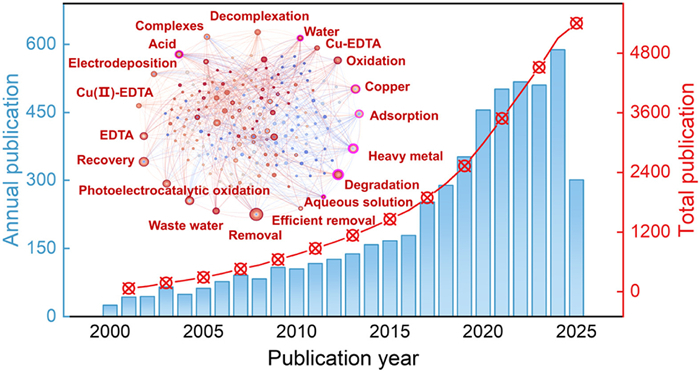
To address these challenges, researchers modified conventional treatment technologies based on the physicochemical characteristics of HMCs, enhancing the treatment capacity of traditional methods to a limited extent [23,24]. Alternatively, advanced oxidation processes (AOPs), such as electrochemical oxidation (EO), photocatalysis (and photoelectrocatalysis), Fenton (Fenton-like) reaction, and ozonation, have been applied to HMCs treatment. These methods can effectively break the strong bonds between heavy metals and organic chelating agents (decomplexation) by direct electron transfer or attacked from active radicals, which releases the metal ions into a more unstable form for easier subsequent removal [25–29]. Moreover, heightened emphasis on sustainable development has reinforced the recognition of heavy metals as valuable secondary resources with significant recovery potential. Consequently, potent reduction-based techniques enable direct recovery of heavy metals from HMCs with simultaneous separation of ligands [30,31]. The effective treatment of HMCs has attracted growing scholarly attention, with over 5400 publications retrieved from Web of Science using "heavy metal complexes removal" as the key search term (Fig. 1). The annual publication counts show a steadily rising trend. However, most studies predominantly focus on oxidative decomplexation processes, overlooking significant advances in upgraded conventional treatment technologies and direct reduction approaches for HMCs. In the keyword co-occurrence network analysis (Fig. 1 inset), the prominence of terms such as “oxidation” and “degradation” reflects a strong research emphasis on AOPs in the existing literature. This trend corresponds to the extensive investigation of AOPs for decomplexation. However, given the diverse industrial sources and highly variable wastewater characteristics of HMCs, it is essential to adopt context-specific strategies for selecting treatment technologies, rather than relying exclusively on oxidative approaches. It highlights the critical need for a state-of-the-art review that systematically addresses enhanced conventional techniques, AOPs mediated decomplexation, and potent reduction-based recovery strategies for HMCs treatment.
Figure 1
Figure 1.
Number of peer-reviewed papers published on heavy metal complex removal since 2000 (data from Web of Science). Inset: Keyword co-occurrence network visualization for "heavy metal complex removal" between 2015 and 2025, generated using CiteSpace.
In this review, we examine the current research and future development of HMCs treatment technologies in wastewater. We categorize existing technical approaches into three groups: enhanced conventional technologies, AOPs based decomplexation technologies, and potent reduction-based technologies, systematically discussing their respective mechanisms, performance enhancement strategies, and key challenges. Finally, we focus on the critical barriers hindering the transition of these technologies from laboratory-scale to industrial applications, while proposing potential solutions. We hope this review could provide valuable insights for addressing emerging challenges in treating increasingly complex heavy metal contamination and facilitate the development of more efficient treatment solutions aligned with practical needs.
2.
Enhanced conventional treatment
Precipitation, adsorption, and membrane separation are conventional mainstream for ionic heavy metal treatment. Yet their efficiency drops for HMCs (steric hindrance, strong coordination), prompting optimization via new materials/techniques.
2.1
Precipitation
The high stability constants of HMCs, particularly with ligands such as EDTA, hinder the effective displacement of metal ions by hydroxide ions during conventional alkaline precipitation. In industrial applications, supplementary complex-breaking agents are commonly used to improve heavy metal removal efficiency, followed by coagulation-precipitation processes to achieve separation of contaminants and comply with discharge standards [32]. Due to its operational simplicity and cost-effectiveness, precipitation remains the most widely adopted approach in practice. Based on their mechanisms of action, precipitation technologies can be systematically classified into two main categories: coagulation-precipitation and Fe3+ displacement-precipitation.
The general mechanism of coagulation-precipitation involves specific interactions between coagulants and HMCs that disrupt the stable coordination structure of the complexes, facilitating subsequent flocculation and precipitation. Key sub-mechanisms include charge neutralization, Lewis acid-base interactions, and ion/ligand exchange. Most HMCs (e.g., complexes with citrate, malate, tartrate, or oxalate) carry negative charges due to ligand dissociation. Cationic coagulants counteract these charges, leading to destabilization of the complexes [24]. Other coagulants, such as organic silicate-aluminum hybrids, employ multiple functional groups (-N+(CH3)2RCl− and Al-OH) to facilitate simultaneous ligand exchange, ion exchange, and Lewis acid-base interactions, enabling the removal of multiple metal ions and complexed species like Cu-citrate [33].
Metal replacement-precipitation, particularly effective for highly stable complexes, relies on thermodynamic favorability. The Fe3+ replacement method exploits the higher stability constant of Fe(Ⅲ)-EDTA compared to that of Cu(Ⅱ)-EDTA, allowing displacement of the central metal ion [34]. This is followed by alkaline precipitation of the released metal ions. The use of scrap iron as a sacrificial electrode can significantly reduce operational costs. However, oxidative side reactions (formation of Fe(OH)3) may reduce process efficiency [35].
Although these strategies are compatible with existing infrastructure, these methods are limited by non-target co-precipitation, sludge management challenges, limited reagent selectivity, and sensitivity to water matrix effects. Selection and optimization must therefore account for specific HMC speciation, ligand type, and water chemistry.
2.2
Adsorption
Adsorption has been demonstrated as an effective technology for heavy metal wastewater treatment [4,36–38]. Through electrostatic interactions and functional group binding, heavy metal ions can be efficiently concentrated on adsorbent surfaces and subsequently separated from aqueous solutions. However, the strong coordination between organic ligands and metal ions in metal complexes may lead to the deactivation of functional groups on adsorbent surfaces. Furthermore, the steric hindrance of strong chelates prevents direct interaction between functional groups and heavy metal ions, significantly reducing adsorption efficiency. Comparative studies have shown that when the EDTA/Cu molar ratio reaches 1.0, the removal efficiency of Cu2+ decreases dramatically from > 95% to merely 0.5%, in contrast to ionic Cu2+ solutions [39].
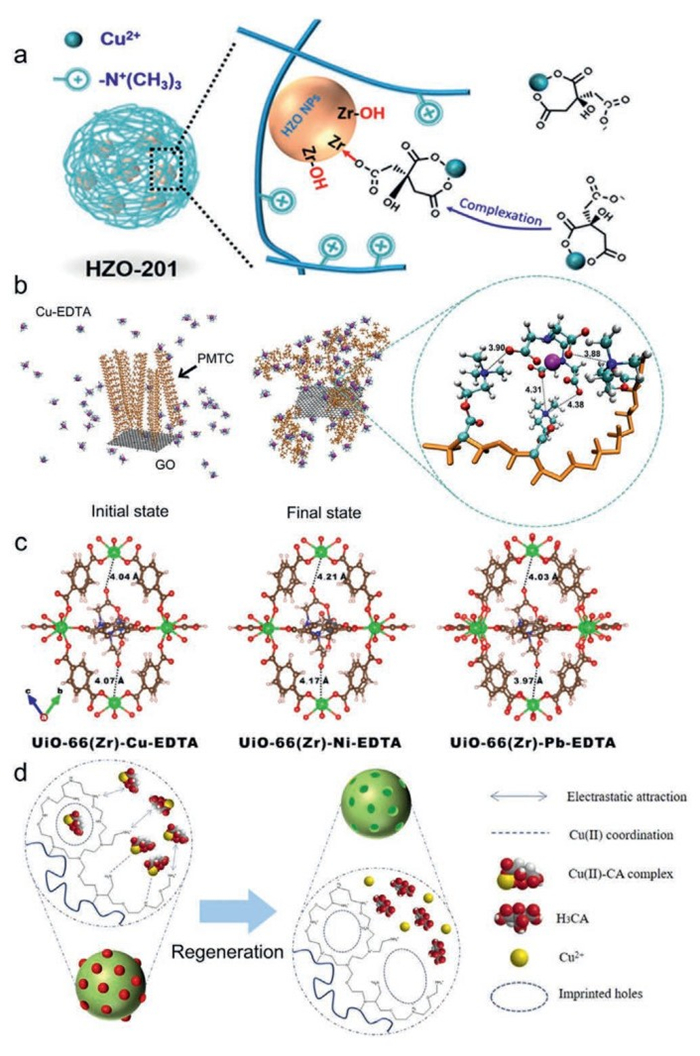
To address the low efficiency of traditional adsorption technologies in HMC treatment, two mechanism-based optimization strategies have been developed so far, namely functional group-mediated ligand bridging and cavity confinement based on the spatial structure of HMCs. Among them, the functional group-mediated ligand bridging strategy does not require breaking the complex structure of HMCs. Instead, it achieves the capture of target contaminants through specific interactions between adsorbent functional groups and HMCs ligands. The nano-hydrated zirconium oxide adsorbent uses carboxylate ligands in Cu-citrate complexes as bridges. Through ligand exchange between the hydroxyl groups on the zirconium oxide surface and citric acid, stable Zr-citrate-Cu ternary complexes are formed, ultimately realizing the efficient removal of Cu-citrate (Fig. 2a) [23]. Che et al. constructed a polyelectrolyte brush (rGO-PMTC) by grafting poly[2-(methacryloyloxy) ethyl trimethylammonium chloride] onto reduced graphene oxide [21]. The polyelectrolyte brush, with its high charge density, captured Cu-EDTA through electrostatic interactions and confined the complex within its structure by bridge contraction (Fig. 2b). This strategy enhanced the Cu-EDTA adsorption capacity by >30 times compared to the parent reduced graphene oxide.
Figure 2
Figure 2.
(a) Schematic illustration for the adsorption and regeneration of Cu-citrate by nano-hydrated zirconium oxide. Reprinted with permission [23]. Copyright 2019, American Chemical Society. (b) Schematic illustration for Cu-EDTA adsorption by rGO-PMTC. Reprinted with permission [21]. Copyright 2024, Elsevier B.V. (c) Schematic illustration of the most favorable location of single Cu-EDTA, Ni-EDTA, and Pb-EDTA molecule inside of the octahedral cage of UiO-66(Zr). Reprinted with permission [40]. Copyright 2021, Elsevier B.V. (d) Schematic diagram of adsorption recognition mechanism of Cu-citrate on Cu-CA-SIP. Reprinted with permission [41]. Copyright 2022, Elsevier B.V.
The core of the cavity confinement strategy based on the spatial structure of HMCs is to regulate the spatial structure of adsorbents and construct cavities matching the spatial characteristics of HMCs, thereby achieving selective recognition and immobilization of target complexes. Lou et al. developed a microwave-assisted solvothermal method to prepare UiO-66(Zr) with dimensions and geometry matching those of heavy metal-EDTA complexes [40]. It could effectively immobilize heavy metal-EDTA complexes through Lewis acid/base coordination and anion-π interactions (Fig. 2c), enabling efficient removal of these complexes from wastewater. In a similar approach, Sun et al. synthesized a surface-imprinted polymer (Cu-CA-SIP) containing recognition cavities that match the size, shape, and chemical functionality of Cu-citrate complexes (Fig. 2d) [41]. Notably, even in the competitive adsorption system containing other metal-citrate complexes (Fe-citrate, Ni-citrate, Zn-citrate) with identical citrate ligands but different metal centers, Cu-CA-SIP still maintains a prominent selective binding capability for Cu-citrate. This exceptional selectivity is attributed to the specific Lewis acid-base coordination between the central Cu2+ (as a Lewis acid) of the target Cu-citrate complex and the functional groups (as Lewis bases) in the recognition cavities of Cu-CA-SIP. The interaction that enables the adsorbent to precisely recognize and capture specific heavy metals from multi-HMC systems.
2.3
Membrane separation
Membrane technology represents a water purification approach that utilizes porous membranes as selective barriers. When pressure is applied, water permeates through the membrane while contaminants are retained, achieving water purification. The unified separation mechanisms of this technology can be categorized into three types: Size exclusion (based on the mismatch between the molecular size of contaminants and membrane pore size), membrane surface adsorption (based on interactions between membrane materials and contaminants), and charge repulsion (based on electrostatic repulsion between the membrane and contaminants) [42]. Based on differences in membrane pore size and separation mechanisms, membrane technologies suitable for heavy metal and HMC removal can be further divided into two major categories: Ultrafiltration (UF) and nanofiltration (NF).
Due to their relatively large pore sizes (2–100 nm), UF membranes have almost no retention effect on heavy metals via their inherent size exclusion mechanism. Technical optimization is therefore required to achieve effective HMC removal, with the optimization idea focusing on strengthening separation driving forces and mainly divided into two strategies: increasing aggregates size to match the pore size retention range of UF membranes by adding coagulants or complexing, incorporating adsorbents into the membrane to improve retention efficiency through specific binding (coordination and electrostatic interaction) between adsorbents and HMCs [43–47]. Additionally, polymer-enhanced and micellar-enhanced UF, as derivative directions, further enlarge the size through interactions between polymers/micelles and HMCs which essentially belong to the strengthened application of the size exclusion mechanism [48,49]. The core limitation of UF technology lies in its passive dependence on contaminant size optimization. This not only increases operational costs and sludge production but also may introduce the risk of secondary pollution. Therefore, UF technology is more suitable for scenarios where HMCs have formed large aggregates after pretreatment, or for composite treatment systems combined with coagulation or adsorption technologies.
Different from UF, NF membranes have smaller pore sizes (usually <2 nm). HMCs have larger inherent sizes than ionic heavy metals, enabling partial retention via size exclusion [50]. NF has been successfully employed for Co(Ⅲ)-EDTA removal from alkaline borate solutions, achieving a rejection rate of 96% at pH 11.5 [51]. Moreover, the charged properties of the membrane surface further strengthen the retention effect through electrostatic repulsion exhibiting a size-charge synergistic effect mechanism. Zhang et al. incorporated monolayer α-zirconium phosphate into graphene oxide membranes, which reduced the wet interlayer spacing through strong van der Waals forces that counteracted the electrostatic and hydration repulsion between graphene oxide nanosheets. This modification effectively blocked the permeation of large HMCs. Furthermore, the α-zirconium phosphate enhanced surface potential, strengthening electrostatic repulsion between the membrane and negatively charged HMCs. The composite membrane achieved 98% rejection of Cu-EDTA2− while maintaining a water flux of ~5.8 L m−2 h−1 [52]. In summary, the common advantages of membrane technology for HMC removal include high separation efficiency, simple operation, and stable effluent quality, suitable for industrial wastewater treatment scenarios with strict water quality requirements. However, membrane fouling remains a critical challenge that cannot be overlooked. Pretreatment becomes particularly crucial when treating high-turbidity wastewater. Additionally, balancing membrane performance, cost, and recyclability presents another significant challenge for practical implementation.
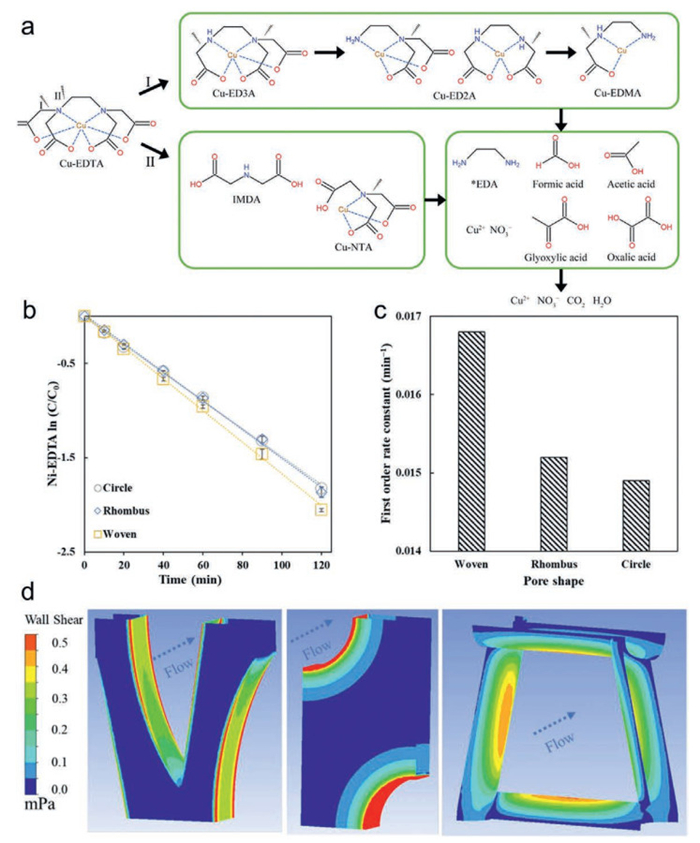
To free heavy metal ions from the bondage of organic ligands, rendering them more amenable to post-treatment methods such as precipitation or adsorption, AOPs are employed to destroy ligand structures or break the bonds between ligands and metal centers. Typically, AOPs involve the generation of strong oxidative species [53,54]. For instance, hydroxyl radicals (•OH), the second strongest oxidant with a standard electrode potential (E0) of 2.8 V, can degrade organic compounds through dehydrogenation, hydroxylation, and charge transfer reactions [55]. In the decomplexation of Cu-EDTA, •OH can attack C—N bonds, causing Cu-EDTA2− to undergo stepwise decarboxylation and cleavage into intermediates such as ethylenediamine-N,N',N''-triacetic acid (ED3A), ethylenediamine-N,N'-diacetic acid (ED2A), and ethylenediamine-N,N'-di-α-propionic acid (EDMA), which are further oxidized into small organic acids and inorganic ions. Another degradation pathway produces intermediates including nitrilotriacetic acid (NTA) and iminodiacetic acid (IMDA) (Fig. 3a) [56]. In recent years, EO, photocatalysis (and photoelectrocatalysis), Fenton (Fenton-like) reactions, and ozonation have been reported as effective technologies for HMCs decomplexation.
Figure 3
Figure 3.
(a) Degradation pathways of Cu-EDTA. Adapted and reprinted with permission [56]. Copyright 2023, Elsevier B.V. Effect of aperture shape on the Ni-EDTA log removal (b) and Ni-EDTA removal rate constant (c). (d) Wall shear distribution on the electrode surface for different aperture shape. Reprinted with permission [60]. Copyright 2022, American Chemical Society.
EO facilitates pollutant degradation through electric field driven electron transfer or bond cleavage reactions between contaminants and reactive species (e.g., •OH, H2O2). The efficiency of EO is governed by critical operational parameters including electrode materials, electrolyte composition, and reactor configuration.
3.1.1
Electrode material design
Anode materials play a critical role in governing both direct pollutant oxidation and •OH generation efficiency. Bi-doped PbO2 electrodes show a 2.5-fold extended service life, yet their degradation efficiency is limited by the competing oxygen evolution reaction (OER) [57]. Sun et al. enhanced the OER potential of PbO2 electrodes via Ni doping, thereby strengthening both direct oxidation and •OH-mediated processes [58]. The Ni-PbO2 electrode achieved 96.5% ± 1.2% Ni-EDTA removal efficiency with reduced energy consumption (2.6 kWh/m3). However, electrically neutral or positively charged intermediates suffer electrostatic repulsion from the anode, leading to limited total organic carbon (TOC) removal (≤35%) [59].
Mass transfer kinetics restrict Ni-EDTA electro-oxidation, optimized electrode structures (e.g., mesh electrodes) and smaller pores boost mass transfer, promoting Ni-EDTA interaction with anode-generated •OH (Figs. 3b–d) [60]. Additionally, cathodically deposited Ni(0) facilitates •H generation, supporting H2O2 and reactive oxygen species (ROS) (•OH, 1O2) production, which highlights the significance of integrated electrode engineering [61].
3.1.2
Electrolyte regulation
The electrolyte composition significantly influences reaction pathways by mediating electron transfer and modulating reaction kinetics. The introduction of Fe(Ⅱ)-tetrapolyphosphate (Fe(Ⅱ)-TPP) complexes into the electrolyte can induce molecular oxygen activation through consecutive single-electron transfer processes, generating •OH radicals that achieve 99.9% Cu-EDTA decomplexation efficiency [62]. In NaCl electrolytes, anodic generation of reactive chlorine species (RCS) provides an alternative decomplexation pathway. Notably, RCS preferentially attack organic ligands through addition reactions, whereas •OH radicals predominantly target metal centers via electron transfer mechanisms [63,64].
3.1.3
Reactor architecture optimization
Reactor architecture optimization effectively enhances reaction efficiency and metal recovery in electrochemical oxidation (EO) systems. Mao et al. developed a dual-cathode system (oxygen-affinitive carbon aerogel + metal-affinitive Ti sheet) to resolve kinetic limitations of single cathodes handling both metal reduction and H2O2 generation [65]. Wu et al. further showed such systems decompose Cu-EDTA/Ni-EDTA and enable selective Cu/Ni recovery via precise potential control [66].
For large-flow industrial wastewater, continuous-flow reactors overcome batch reactors’ mass transfer limits [67], flow velocity affects mineralization efficiency [68], and baffles improve EO performance by homogenizing flow and reducing dead zones [69]. Conductive particle electrodes form three-dimensional electrochemical reactors (3DERs), adding active sites to achieve 86.2% TOC removal [70,71]. Electrochemical membrane filtration (EMF) systems combine electrocatalysis and separation: Autocatalysis destroys EDTA (Section 3.3.3) while Cu2+ deposits on cathodic membranes [72]. 1-Pyrenesulfonic acid-modified N-doped graphene membranes enhance decomplexation via sulfonyl hydroxide-Cu ion exchange [73].
EO shows potential for high-concentration, high-salinity HMCs wastewater but faces challenges (electrode limitations, mass transfer issues, side reactions [74], and anode fouling/corrosion [75]). Future research should develop robust electrodes (enhanced catalysis/corrosion resistance) and optimize flow fields/parameters to reduce parasitic electrolysis and energy loss for industrial application.
3.2
Photocatalytic and photoelectrocatalysis decomplexation
Photocatalytic utilizes the photoexcitation properties of semiconductor materials to drive redox reactions for pollutant degradation through photogenerated electron-hole pairs [76,77]. The efficacy of this technology fundamentally depends on the design of photocatalysts, whose performance directly determines the pollutant removal efficiency.
3.2.1
Photocatalyst design
TiO2, a classical photocatalyst, is active in HMCs treatment [78]. Its nanofibers enable simultaneous Cu-EDTA degradation and Cu recovery [25]. Oxygen-doped g-C3N4 shows enhanced photocatalytic activity, with •O2− and photogenerated holes as main active species for HMCs decomposition, while oxygen doping promotes hole separation [79]. Yet photogenerated charge carrier recombination limits efficiency.
Metal-organic frameworks (MOFs) are ideal photocatalysts due to tunable metal sites, linkers, and pores [80]. MIL-53(Fe) degrades HMCs [81], and Ag/AgCl-MIL-53(Fe) Z-scheme composites enhance visible-light activity via bandgap narrowing and improved charge separation [82], offering strategies for efficiency improvement through bandgap engineering.
3.2.2
Photoelectrocatalysis
Photoelectrocatalysis enhances HMCs degradation efficiency by applying an external electric field to suppress electron-hole recombination. Zhao et al. showed a TiO2 photoelectrode system had higher Cu-EDTA degradation efficiency than standalone photocatalysis and EO [26]. Its superior performance comes from more •OH radicals and photogenerated electrons, which are key for complex decomposition and Cu reduction. A TiO2/Ni-Sb-SnO2 composite photoanode produces •OH and O3 synergistically [83], and Ni(Ⅲ) in deposited nickel on the photoanode provides extra oxidation pathways for Ni-EDTA decomplexation [84].
Like EO, photoelectrocatalytic reactions occur near the electrode-electrolyte interface, so optimizing mass transfer is critical for performance [26]. Zhao et al. developed a tubular reactor to enhance mass transport by increasing electrode surface area-to-solution volume ratio [85]. Rotating cathode designs also improve turbulent mixing and mass transfer [86]. Adding oxidants (e.g., H2O2, S2O82−) or Cl− can boost radical generation [87,88], but cost-efficiency and byproduct risks need balancing.
Photocatalysis has theoretically clean energy and unique advantages for HMCs treatment. Future research should focus on broad-spectrum responsive catalysts (visible to near-infrared) for solar use. However, practical application faces challenges, such as light shielding and catalyst fouling in high-turbidity wastewater reducing efficiency. This requires fouling-resistant materials and optimized pretreatment. Long-term stability in real wastewater also needs pilot-scale validation for technology maturation.
3.3
Fenton (Fenton-like) reaction decomplexation
The conventional Fenton reaction refers to the catalytic generation of hydroxyl radicals through the Fe(Ⅱ)/Fe(Ⅲ) redox cycle in acidic conditions (pH ≈ 3). Reactions employing alternative catalysts (beyond Fe2+) to activate H2O2 or other oxidants are termed Fenton-like reaction [89,90]. Fenton and Fenton-like systems can be further classified into homogeneous and heterogeneous categories based on the solubility and physical state of the catalyst.
3.3.1
Homogeneous Fenton (Fenton-like) reaction
Homogeneous Fenton (Fenton-like) reactions use aqueous transition metal ions (Fe2+, Cu+, Co2+, etc.) to activate H2O2 [91]. They are widely applied advanced oxidation technologies due to high efficiency, simple operation, and low cost. Fu et al. studied a homogeneous Fenton-alkaline precipitation system for Ni-EDTA treatment and determined optimal parameters, achieving 92.8% Ni removal [92]. Their later work also showed ultrasonic irradiation can enhance Ni-EDTA removal in such systems [93].
Homogeneous Fenton systems have imbalanced Fe cycling, causing catalyst loss and higher costs. An activated carbon (AC)-assisted Fenton system improved Ni-EDTA treatment in electroplating wastewater. Carbonyl groups on AC act as electron donors to reduce Fe(Ⅲ), and increased redox potential promotes Fe(Ⅱ)/Fe(Ⅲ) cycling [94].
Conventional homogeneous reactions are limited to acidic conditions, but Wang et al. developed a bicarbonate-catalyzed Fenton system for alkaline use [95]. Its main reactive species (•O2−, •OH, and 1O2) attack Cu-O and Cu-N bonds, and inherent alkalinity enables Cu(Ⅱ) removal via precipitation.
3.3.2
Heterogeneous Fenton (Fenton-like) reaction
Heterogeneous Fenton (Fenton-like) reaction systems have emerged to address the limitations of homogeneous systems, particularly the constrained Fe(Ⅱ)/Fe(Ⅲ) cycling and the secondary pollution caused by iron sludge [96]. These systems immobilize catalysts on solid supports, enabling easier separation and enhanced reusability while eliminating iron sludge issues. Among various catalysts, magnetite (Fe3O4) has emerged as a research focus due to its characteristics of convenient magnetic separation and low cost, as a classic natural mineral catalyst. The surface Fe sites (Fesurf) of Fe3O4 can transfer electrons to H2O2 through Fe(Ⅱ)/Fe(Ⅲ) valence cycling, generating oxidative species such as •OH and providing a core active basis for HMCs degradation [97–99]. To enhance catalytic performance and synergy, current studies focus on Fe3O4-based composite catalysts. Special structures like yolk-shell combine Fe3O4 with adsorptive components such as Zr(OH)x to achieve catalysis and adsorption synergy, where Fe3O4 exerts decomplexation effects and Zr(OH)x immobilize released heavy metals [28]. Hydrated Fe(Ⅲ) oxides derived from Fe3O4 are supported on carriers including cation exchange resins, and these composites drive ligand decarboxylation through N—C bond cleavage via•OH-dominated pathways [100].
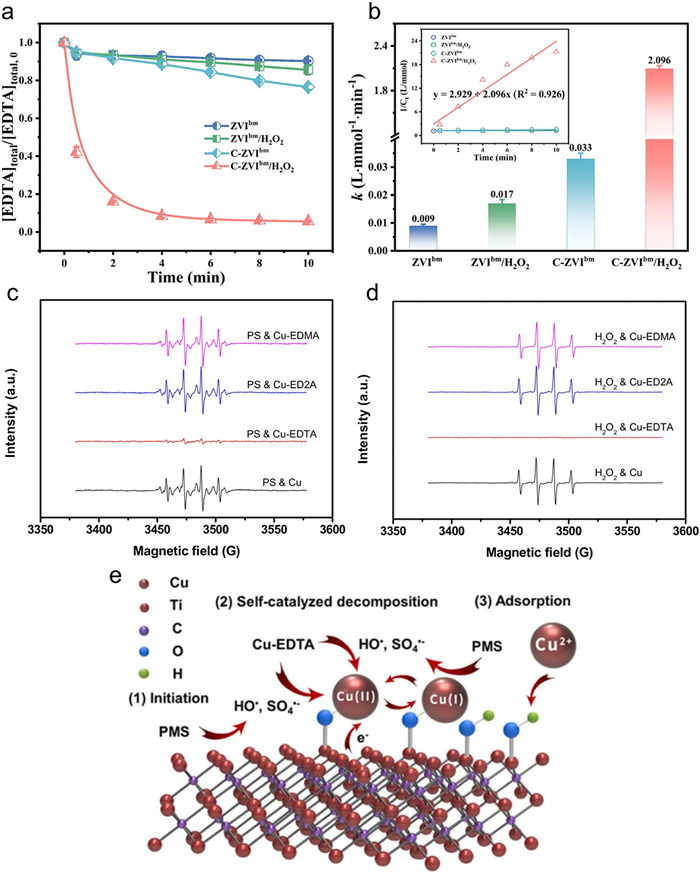
The activity of zero-valent iron (ZVI) depends on its sustained Fe2+ release. Under acidic conditions, Fe2+ from the Fe(0) core activates H2O2 to generate •OH (reducing Ni-EDTA wastewater COD) and activates dissolved oxygen to form 1O2 (selectively cleaving M-O/M-N bonds) [101,102]. However, the inherent core-shell structure of ZVI easily forms an oxidative passivation layer, hindering electron transfer between the Fe(0) core and oxidants. This issue has been addressed via L-cysteine modification. Amino and carboxyl groups on L-cysteine immobilize Fe2+, Fe3+, and heavy metal ions on ZVI surface, eliminating passivation-induced electron transfer barriers and regenerating Fe2+ sites. This boosts the pseudo-second-order kinetic rate of EDTA removal by the ZVI/ H2O2 system by 123.3 times (Figs. 4a and b), highlighting functional group modification’s role in regulating electron transfer efficiency and active site regeneration [103].
Figure 4
Figure 4.
(a, b) Temporal variation of EDTA concentration and corresponding pseudo-second-order rate constants in the L-cysteine-functionalized ZVI/H2O2 system. Reprinted with permission [103]. Copyright 2024, Elsevier B.V. EPR spectra demonstrating radical generation from (c) PS and (d) H2O2 systems in the presence of Cu-complexes. Reprinted with permission [107]. Copyright 2017, Elsevier B.V. (e) Proposed self-catalytic mechanism of Cu-EDTA degradation by Ti3C2Tx/PMS. Reprinted with permission [109]. Copyright 2022, Elsevier B.V.
Material defect structures (e.g., oxygen vacancies, VO) are also critical features for regulating catalytic activity [104]. Combining electrochemical characterization and DFT calculations, Pan et al. confirmed that VO induces the Cu2+/Cu+ valence cycle, enhances the interaction between Cu and peroxydisulfate (PDS), and accelerates electron transfer from VO (as an electron donor) to PDS (as an electron acceptor), significantly reducing the kinetic resistance of PDS activation [105]. In addition, Vo acts as an electron trap to directionally regulate the generation of ROS and lower the energy barrier for the conversion of •O2− to 1O2. This simultaneously addresses the issues of lagging PDS activation kinetics and insufficient targeting of active species, making Vo a core regulatory site for improving the degradation efficiency of Cu-EDTA.
3.3.3
Distinct mechanisms of HMCs degradation
The core mechanisms underlying the degradation of HMCs by differing significantly from those of ordinary organic pollutants. This difference is primarily reflected in the unique self-catalytic effect of and the activity quenching of metal active sites by complexing agents. In terms of the self-catalytic effect, Cu-EDTA degradation serves as a typical example, and this characteristic represents a key process absent in the degradation of ordinary organic pollutants: Initial Cu-EDTA inhibits H2O2 decomposition, but most degradation intermediates (e.g., Cu2+, Cu-ED2A, and Cu-EDMA, with the exception of Cu-NTA) can undergo electron transfer with oxidants (PDS and H2O2) via the Cu(Ⅰ)/Cu(Ⅱ) valence cycle (Figs. 4c and d). This process generates additional reactive species, thereby triggering an accelerated degradation phase [106–108]. The introduction of Ti3C2Tx MXene can further enhance this cycle. Ti atoms on its surface, leveraging strong reducibility, reduce free Cu2+ to Cu(Ⅰ) and stabilize the form of Cu ions through Ti-O-Cu(Ⅱ) bonds. This ensures the sustained participation of the Cu(Ⅰ)/Cu(Ⅱ) redox cycle in Cu-EDTA degradation and addresses the insufficient generation of reactive species during self-catalytic effect (Fig. 4e) [109].
Another core feature distinguishing HMC degradation from ordinary organic pollutant degradation is the activity quenching of metal active sites by complexing agents. For the degradation of ordinary organic pollutants, metal catalysts only need to activate oxidants to generate reactive species. However, complexing agents (e.g., EDTA) in HMCs may form stable chelates with metal catalysts, leading to catalyst deactivation. For instance, when Xu et al. compared combinations of various metal ion catalysts (Cu2+, Ni2+, Mn2+, Co2+) with different oxidants, they found that although the Co2+/PMS system exhibited the highest oxidation efficiency, the catalytic activity of these metal ions decreased significantly when they formed chelates with EDTA instead of remaining in the free state [110]. This phenomenon indicates that complexing agents alter the form of catalysts and the effect does not occur in the case of ordinary organic pollutants, which do not directly damage catalyst active sites.
Fenton and Fenton-like decomplexation technologies have advanced notably, but still face challenges in treating high-concentration EDTA-containing HMCs wastewater from electroplating. Such wastewater (neutral/alkaline pH) needs extra chemicals for pH adjustment, and high Cl− (common additive) quenches radicals (e.g., •OH) [111], lowering efficiency. Thus, developing robust catalysts with wide pH adaptability, high efficiency and strong anti-interference remains key.
3.4
Ozonation decomplexation
Ozone (O3), a potent oxidant with a standard redox potential of 2.076 V versus the standard hydrogen electrode (SHE), offers an environmentally benign oxidation approach that yields only H2O and O2 as products [112]. This strong oxidant degrades contaminants through two distinct pathways: Direct molecular oxidation and indirect radical-mediated oxidation.
3.4.1
Direct molecular oxidation and indirect radical-mediated oxidation
Direct ozone oxidation reacts selectively with specific functional groups. It preferentially undergoes cycloaddition with aromatic rings (e.g., phenols) and unsaturated bonds (C=C), and targets electron-rich moieties (e.g., -OH) [113–115]. This selectivity ensures reaction specificity but limits ozone’s use in complex wastewater. In contrast, indirect ozone oxidation realizes non-selective degradation via radicals (mainly •OH) from ozone decomposition, with much faster kinetics [116]. Huang et al. found EDTA enhances •OH production and forms an autocatalytic cycle, where amine-containing products further catalyze ozone decomposition [117], greatly improving HMCs treatment efficiency.
Conventional ozonation can treat acidic Cu-EDTA wastewater, with intermediates (e.g., Cu-ED3A) promoting ozone decomposition and •OH generation. Yet it still has limitations like long oxidation time and low ozone utilization [29].
3.4.2
Heterogeneous catalytic ozonation
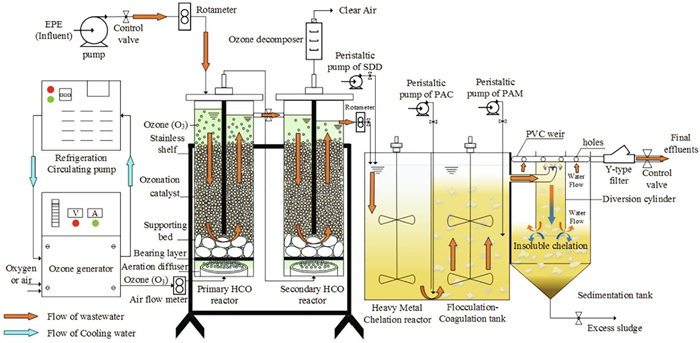
Heterogeneous catalytic ozonation significantly enhances treatment efficiency through the introduction of solid catalysts that effectively activate ozone to generate ROS. Research demonstrates that commercial catalysts can increase the production of •OH and •O2− radicals, reducing the treatment time required for nickel complexes in actual wastewater by 25% [118]. Guan et al. employed a pilot-scale heterogeneous catalytic ozonation system to treat HMCs (primarily Ni-EDTA and Cu-citrate) in electroless plating effluent. The system consistently achieved > 95% heavy metal removal over 300 days of continuous operation, with effluent concentrations remaining below China's discharge limits throughout the testing period [119]. The schematic diagram of the experimental setup is shown in Fig. 5. Their study also identified catalyst surface abrasion and gradual catalyst loss during operation [118]. While these factors did not cause significant variations in effluent quality, they represent important considerations for ensuring the system's long-term operational stability.
Figure 5
Figure 5.
Schematic diagram of the continuous heterogeneous catalytic ozonation system. Reprinted with permission [119]. Copyright 2022, Elsevier B.V.
Although ozonation demonstrates high efficacy in treating HMCs, its practical application is constrained by ozone’s instability and the substantial costs linked to generation, storage, and transportation. Electrochemical ozone production (EOP) offers a promising alternative by enabling in situ generation via water electrolysis, thereby mitigating storage and transport challenges [120]. A major technical barrier is the competition with the four-electron oxygen evolution reaction (OER) at the anode [121]. To address this, heterojunction anodes (e.g., Ni-Sb-SnO2 and SiOx-modified ATO/NATO) have been developed to raise the OER overpotential and enhance ozone yield [122,123]. Operating at 10 mA/cm2, these electrodes achieved decomplexation efficiencies up to 98.8% and copper recovery rates exceeding 92.9%. Further optimization of electrode materials remains essential to improve energy efficiency.
Ozonation shows high potential for treating HMCs, as common complexing agents (e.g., EDTA, citric acid, thiourea) contain electron-rich functional groups such as amines that promote ozone reactivity. However, ozonation alone cannot achieve complete EDTA mineralization, which may limit heavy metal removal efficiency [117,124]. Recent studies indicate that high-valent Ni(Ⅲ) species (e.g., NiOOH), formed during Ni-EDTA ozonation, enhance mineralization by oxidizing small-molecule intermediates like glyoxylic acid and oxalates [125]. Despite these advances, key challenges impede practical application, including ozone’s low solubility leading to mass transfer limitations, incomplete degradation of organics, and high operational costs. Further research is needed to optimize ozonation processes for industrial use.
3.5
Coupling decomplexation technologies
Current standalone decomplexation technologies face inherent limitations including low oxidant utilization efficiency, poor mass transfer, high energy consumption, and incomplete mineralization, which significantly constrain their practical application in industrial wastewater treatment. The synergistic effects achieved through integrating different decomplexation approaches offer new opportunities for enhanced purification of HMCs. Recent studies have reported various coupled decomplexation technologies that achieve breakthrough performance (as summarized in Table S1 in Supporting information), primarily through two mechanisms: Enhanced oxidant activation via external energy (electricity/light/heat) or cocatalysts to substantially increase radical yields, and combined oxidation processes that establish multi-stage reaction cascades to promote deep mineralization. While these synergistic strategies effectively compensate for the shortcomings of individual technologies through complementary advantages, further research is needed to address system complexity, operational cost control, coordinated process parameter optimization, and long-term operational stability to facilitate the translation of coupled technologies from laboratory-scale to engineering applications.
4.
Potent reduction-based treatment
Current research on HMC removal predominantly focuses on developing AOPs to destroy organic ligands prior to metal ion purification or recovery. However, the inability of these oxidative approaches to achieve complete ligand mineralization results in residual degradation byproducts that can re-complex with heavy metal ions, thereby interfering with subsequent treatment [124]. Furthermore, most used complexing agents contain nitrogen functional groups, whose degradation yields various organic and inorganic nitrogen species that pose potential eutrophication risks, necessitating additional treatment measures [126]. In response, recent studies have explored alternative reductive strategies that directly target the metal centers within complexes, inducing their dissociation from ligands while enabling concurrent recovery of both components. Currently reported techniques primarily include: (1) Zero-valent metal reduction, (2) direct electrochemical reduction, and (3) active hydrogen-mediated reduction.
4.1
Zero-valent metal reduction
Zero-valent metals represent a class of potent reducing agents, among which ZVI serves as a classical example. Composed of a Fe(0) core and an iron oxide shell, ZVI possesses abundant reactive sites with reducing capability and adjustable particle size [127]. The mechanism involves Fe(Ⅱ) release from ZVI, followed by its oxidation to Fe(Ⅲ) that displaces Cu(Ⅱ) from complexes, ultimately reducing Cu(Ⅱ) to metallic Cu(0) deposited on ZVI surfaces [128]. While nanosized ZVI (nZVI) typically exhibits enhanced reactivity due to its large specific surface area and exposed active sites, it suffers from rapid passivation and particle aggregation. Liu et al. addressed this limitation by employing polymeric anion exchangers as nZVI supports, which not only mitigated particle agglomeration but also enhanced CuEDTA2− permeability through quaternary ammonium groups, improving Cu removal efficiency from 32.4% to 88.3% [129]. Additional studies have demonstrated the effectiveness of sulfidized nZVI and zero-valent aluminum for Cu-EDTA reduction [130,131]. Despite these advances, current applications of zero-valent metals in HMC reduction remain limited, with persistent challenges including the subsequent treatment of Fe-EDTA byproducts and the technical difficulty of separating Cu(0) from EDTA for resource recovery.
4.2
Direct electrochemical reduction
The discovery that Cu(Ⅱ) in Cu-EDTA complexes can undergo direct decomplexation through two-electron reduction at the cathode has challenged the conventional paradigm of exclusive EO for HMC treatment [132]. Song et al. experimentally demonstrated this reduction pathway using an electrodialysis system, where Cu-EDTA was effectively reduced to Cu(0) and EDTA at the cathode [133]. Further corroborating this mechanism, Hu et al. reported that Cu-EDTA decomplexation in 3DERs occurs predominantly through electrochemical reduction rather than oxidation processes [134]. These findings collectively establish a novel electrochemical reduction approach for HMCs treatment, significantly expanding the methodological repertoire beyond traditional oxidative strategies.
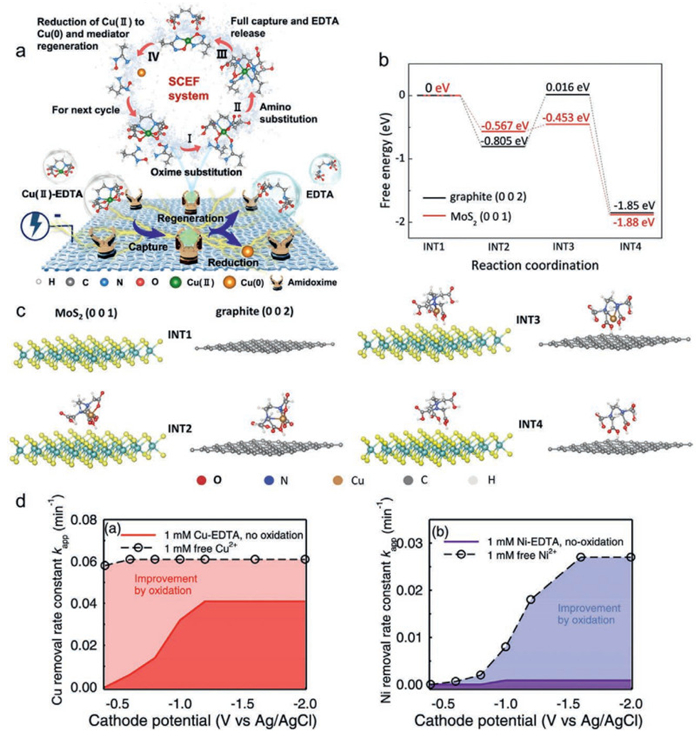
Shi et al. developed a flow-through electrode modified with strongly coordinating amidoxime groups, which achieved 97.6% Cu recovery with exceptional energy efficiency (340.1 g/kWh) at 3 V applied potential [30]. The -N-OH and -NH2 groups on amidoxime progressively liberated Cu(Ⅱ) from carboxylate coordination in EDTA while facilitating electron transfer at the cathode (Fig. 6a). Despite these advances, similar to EO, the practical implementation of electrochemical reduction faces two fundamental constraints: Limited current efficiency and high energy consumption.
Figure 6
Figure 6.
(a) Schematic illustration of the amidoxime-mediated spontaneous capture and in situ electroreduction pathway. Reprinted with permission [30]. Copyright 2024, Springer Nature. (b) Energy states of different Cu-EDTA configurations on MoS2 (100) and graphite (002) surfaces. (c) Modeling of Cu-EDTA reduction processes on MoS2 and graphite surfaces with different configurations. Reprinted with permission [135]. Copyright 2023, Springer Nature. (d) Area plot of metal removal rate constants as a function of cathode potential. Reprinted with permission [136]. Copyright 2023, American Chemical Society.
Addressing these challenges, Qin et al. designed an innovative system combining 2D MoS2 nanosheet catalysts with a Cu-EDTA/Zn galvanic cell [135]. The MoS2 nanosheets exhibited superior catalytic activity (activation energy: 0.114 eV) compared to graphite electrodes (0.821 eV) for Cu-EDTA reduction (Figs. 6b and c). The galvanic cell spontaneously generated electrical energy (maximum power density: 1.05 mW/cm2 at 1.95 mA/cm2) while simultaneously removing 75% Cu-EDTA with 77% Faradaic efficiency.
To quantify direct electrochemical reduction’s contribution to HMCs removal, Wu et al. compared the removal mechanisms of Cu-EDTA and Ni-EDTA in electrochemical systems [136]. Their results revealed distinct pathways: Cu-EDTA was primarily removed via cathodic reductive decomplexation, while Ni-EDTA relied on •OH-generated oxidative degradation at the anode. These observations hint at the potential for selective Cu-EDTA reduction in mixed HMC systems, suggesting that metal redox potential may be a key factor enabling preferential Cu-EDTA decomplexation over other HMCs (e.g., Ni-EDTA), which could support targeted Cu recovery (Fig. 6d). Ligand characteristics and applied potential likely further modulate this process, though metal redox potential orients as a core regulatory factor.
Despite its innovation, electrochemical reduction is underexplored and faces challenges. These include unclear selective reduction mechanisms for different metal complexes, unproven long-term stability, and insufficient economic assessments for scaling up, all of which require further research to advance its practical application.
4.3
Active hydrogen-mediated reduction
Atomic hydrogen (H*) generated during cathodic reduction has attracted significant attention due to its strong reducing capability and environmental benignity [137]. This reactive species forms in situ in aqueous solutions without requiring chemical additives, existing primarily in two states: Surface-adsorbed (H*ads) and lattice-absorbed (H*abs) [138]. The H*ads species, produced via the Volmer pathway and single-electron reduction on metal or metal oxide cathodes, exhibits atomic-scale dimensions and superior diffusivity [139]. These unique characteristics enable H* to penetrate the steric hindrance of Cu-EDTA complexes, achieving precise reduction of copper sites.
Building upon the H*-mediated reduction mechanism, Li et al. developed a hydroxyphenyl cobalt porphyrin/nitrogen-doped graphene composite catalyst (CoTH@NG) that demonstrated exceptional performance for Cu-EDTA treatment [31]. The system achieved a Cu-EDTA removal energy efficiency of 279.3 g/kWh and a copper recovery efficiency of 48.6 g/kWh, representing 2–3 orders of magnitude improvement over conventional carbon cloth electrodes. The in situ formed Cu(0) nanowires on the electrode surface underwent continuous regeneration through galvanic reactions in formic acid, ensuring long-term operational stability. In a technologically significant advancement, Mu et al. established a commercial copper metal/formaldehyde synergistic reduction system with substantial engineering value [126]. Operating across pH 10.0–14.0, this system utilized •H generated from formaldehyde decomposition on Cu(0) catalysts to enhance both Cu(Ⅱ)-EDTA decomplexation and copper recovery. When treating real wastewater containing ≈ 2000 mg/L Cu-EDTA, the process attained 99.9% copper and 99.2% EDTA recovery, yielding a net profit of $ 72.38 per ton of wastewater treated. The system exhibited pH-dependent coordination-reactivity synergy: Under strong alkaline conditions (pH > 13), nucleophilic •H attacks the loosely[2,3 coordinated [EDTA-Cu(Ⅱ)-OH]3− complex, facilitating decomplexation and reduction, whereas tighter coordination in Cu-EDTA2− at milder alkaline/neutral pH (pH < 11) inhibits •H attack and copper recovery.
Active hydrogen-mediated reduction technology has opened new avenues for resource recovery from HMCs, yet several critical aspects require further investigation. First, the interaction mechanisms between active hydrogen species and different metal complexes need in-depth exploration, particularly regarding selective reduction principles in complex wastewater systems containing multiple coexisting metal ions. Second, the rational design of active sites on non-precious metal catalysts must be optimized to enhance both the generation and utilization efficiency of active hydrogen. For practical implementation, particular attention should be paid to scaling challenges, including processing capacity and long-term operational stability when enlarging reactor systems.
5.
Comparison of HMC treatment technologies
This section aims to summarize and compare the HMCs treatment technologies introduced previously. This chapter systematically evaluates them from aspects of Technology Readiness Level (TRL, per the International Energy Agency (IEA) standards), pros/cons, main cost drivers and suitable scenarios (Table S2 in Supporting information), aiming to guide their selection in practical engineering. The IEA defines TRL 1–3 as basic research/concept verification, 4–6 as laboratory-pilot validation, and 7–9 as full-scale application.
Enhanced conventional strategies exhibit high maturity and reliable performance, yet they face difficulties in recovering metal resources from wastewater. AOP strategies (e.g., Fenton, electro-oxidation) have been applied in practical engineering. Specifically, the Fenton process demonstrates stable treatment efficiency and high decomplexation performance for various HMCs such as Cu-EDTA and Ni-EDTA. However, it requires substantial consumption of oxidants. Additionally, electro-oxidation technology is characterized by significant energy consumption. Overall, the consumption of chemicals and energy constitutes the primary cost burden for the engineering application of AOP strategies. Reduction strategies enable direct metal recovery to generate economic benefits, but their long-term operational reliability and scalability remain to be verified. For instance, electrochemical reduction methods rely on modified electrodes and are currently mostly at the laboratory to pilot-scale stage (TRL 4–6). Further technical breakthroughs are required for their full-scale industrial application.
6.
Conclusion and prospect
Recent years have witnessed significant advancements in treating highly stable HMCs through enhanced conventional, AOPs, and potent reduction technologies, offering new breakthroughs for wastewater purification and resource recovery. This review systematically summarizes successful application cases, optimization strategies, and practical limitations of current HMCs treatment technologies, providing valuable references for developing efficient degradation and recovery methods. Nevertheless, despite these important progresses, several critical challenges remain for both technological development and industrial implementation:
(1) Lab-industry technology mismatch: Accurate identification of wastewater components is essential for selecting appropriate HMC treatment technologies. However, this process is often hindered by environmental complexity and analytical limitations, resulting in a significant gap between laboratory research and practical application. For instance, while the Fenton process is commonly studied using neutral simulated wastewater, real electroplating wastewater (pH 8–11) induces precipitation of Fe(Ⅱ), thereby inhibiting decomplexation. Industrial effluents may also contain organic additives, such as brighteners and surfactants, that are seldom considered in laboratory studies. Although known HMC species can be quantitatively analyzed, the detection and quantification of unknown compounds in complex matrices remain challenging. Consequently, treatment methods that demonstrate high efficiency under idealized laboratory conditions frequently fail to meet industrial discharge standards.
(2) Technology roadmap: Current single-treatment technologies often struggle to achieve complete mineralization of HMCs and generally fail to meet stringent deep purification requirements (e.g., residual HMCs < 0.1 mg/L to comply with strict discharge standards). Consequently, the development of HMC treatment technologies is shifting toward integrated coupling systems that combine the advantages of multiple processes to overcome the limitations of individual technologies. For instance, in an ozone–adsorption coupled system, ozone first disrupts the stable coordination bonds of refractory HMCs, dissociating them into free metal ions and organic intermediates. Subsequently, adsorption effectively captures these released ions and residual intermediates. This synergistic approach ensures that the effluent meets regulatory discharge standards.
(3) Economic viability and sustainability: Emerging HMCs technologies face high capital/operational costs, with scarce comprehensive cost-benefit analyses (critical for industrial adoption). While resource recovery strategies, such as high-purity metal electrodeposition, can reduce sludge management costs and generate economic benefits, the product characteristics and market value require further quantification. Life cycle assessment (LCA) studies are currently limited: AOPs (e.g., Fenton) exhibit high carbon footprints due to chemical consumption, whereas membrane technologies typically entail lower emissions but higher embodied energy. Future research should prioritize standardized LCA methodologies to systematically evaluate environmental impacts, including carbon footprints and resource consumption.
The authors declare that they have no known competing financial interests or personal relationships that could have appeared to influence the work reported in this paper.
Acknowledgment
This work was supported by the National Key R&D Program of China (No. 2024YFC3907802).
Supplementary materials
Supplementary material associated with this article can be found, in the online version, at doi:10.1016/j.cclet.2026.112569.
[1]
M. Nakahata, A. Sumiya, Y. Ikemoto, et al., Nat. Commun. 15 (2024) 5824. doi: 10.1038/s41467-024-49869-8
[2]
C. Ma, M. Wang, Q. Li, et al., Front. Environ. Sci. Eng. 19 (2025) 16. doi: 10.1145/3758316.3762822
[3]
Q. Duan, P. Yan, Y. Feng, et al., Front. Environ. Sci. Eng. 18 (2024) 55. doi: 10.1007/s11783-024-1815-4
W. Zhang, Y. Yao, Z. Chen, et al., Environ. Sci. Technol. 58 (2024) 7208–7216. doi: 10.1021/acs.est.4c00151
Figure 1
Number of peer-reviewed papers published on heavy metal complex removal since 2000 (data from Web of Science). Inset: Keyword co-occurrence network visualization for "heavy metal complex removal" between 2015 and 2025, generated using CiteSpace.
Figure 2
(a) Schematic illustration for the adsorption and regeneration of Cu-citrate by nano-hydrated zirconium oxide. Reprinted with permission [23]. Copyright 2019, American Chemical Society. (b) Schematic illustration for Cu-EDTA adsorption by rGO-PMTC. Reprinted with permission [21]. Copyright 2024, Elsevier B.V. (c) Schematic illustration of the most favorable location of single Cu-EDTA, Ni-EDTA, and Pb-EDTA molecule inside of the octahedral cage of UiO-66(Zr). Reprinted with permission [40]. Copyright 2021, Elsevier B.V. (d) Schematic diagram of adsorption recognition mechanism of Cu-citrate on Cu-CA-SIP. Reprinted with permission [41]. Copyright 2022, Elsevier B.V.
Figure 3
(a) Degradation pathways of Cu-EDTA. Adapted and reprinted with permission [56]. Copyright 2023, Elsevier B.V. Effect of aperture shape on the Ni-EDTA log removal (b) and Ni-EDTA removal rate constant (c). (d) Wall shear distribution on the electrode surface for different aperture shape. Reprinted with permission [60]. Copyright 2022, American Chemical Society.
Figure 4
(a, b) Temporal variation of EDTA concentration and corresponding pseudo-second-order rate constants in the L-cysteine-functionalized ZVI/H2O2 system. Reprinted with permission [103]. Copyright 2024, Elsevier B.V. EPR spectra demonstrating radical generation from (c) PS and (d) H2O2 systems in the presence of Cu-complexes. Reprinted with permission [107]. Copyright 2017, Elsevier B.V. (e) Proposed self-catalytic mechanism of Cu-EDTA degradation by Ti3C2Tx/PMS. Reprinted with permission [109]. Copyright 2022, Elsevier B.V.
Figure 6
(a) Schematic illustration of the amidoxime-mediated spontaneous capture and in situ electroreduction pathway. Reprinted with permission [30]. Copyright 2024, Springer Nature. (b) Energy states of different Cu-EDTA configurations on MoS2 (100) and graphite (002) surfaces. (c) Modeling of Cu-EDTA reduction processes on MoS2 and graphite surfaces with different configurations. Reprinted with permission [135]. Copyright 2023, Springer Nature. (d) Area plot of metal removal rate constants as a function of cathode potential. Reprinted with permission [136]. Copyright 2023, American Chemical Society.


 DownLoad:

 下载:


 下载:

