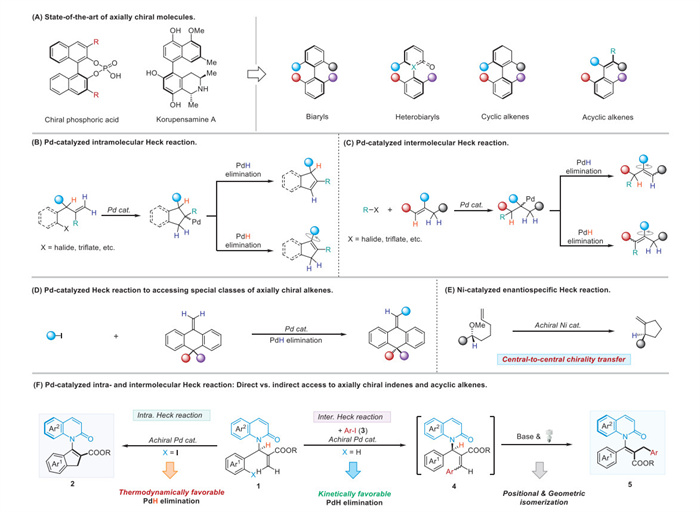
Scheme 1.
Advances in axially chiral molecules and intra-/intermolecular Heck reactions.

Divergent β-hydride elimination in Pd-catalyzed intra- and intermolecular Heck reactions toward axially chiral alkene frameworks
Jun Gu , Wan-Yi Xu , Rong-Gui Zhou , Zhiwen Ye , Ying He


Axially chiral compounds have become indispensable structural motifs with wide-ranging applications from asymmetric catalysis to pharmaceutical development (Scheme 1A) [1–7]. While impressive advances have been made in synthesizing biaryls and heterobiaryls [8–15], the construction of alkene atropisomers [16–22], particularly conformationally flexible acyclic axially chiral alkenes, continues to present unique and persistent synthetic challenges [23]. The dynamic nature of these systems requires precise engineering of rotational energy barriers to ensure configurational stability while maintaining synthetic accessibility. Recent years have seen significant progress in this area [24–38], including our group's development of Asymmetric Allylic Substitution-Isomerization (AASI) reactions [39–46], yet the creation of general and divergent strategies capable of simultaneously controlling both cyclic and acyclic frameworks remains an outstanding challenge.
The palladium-catalyzed asymmetric Heck reaction represents a cornerstone method for C=C bond formation [47–56], where the intrinsic nature of β-hydride elimination enables the conversion of sp3-hybridized centers into stereogenic elements [57–60]. However, extending this powerful transformation to axial chirality induction presents unique challenges. While intramolecular variants could in principle establish chiral axes, severe steric constraints during the Pd-H elimination step render this approach largely impractical for accessing atropisomers directly (Scheme 1B). Intermolecular versions face even greater hurdles, as poorly regulated E/Z selectivity coupled with product flexibility fundamentally compromises axial chirality control. These combined limitations have prevented the development of general synthetic strategies for acyclic aryl-alkene atropisomers via classical Heck couplings (Scheme 1C). While recent advances on Heck reaction have enabled stereocontrol in the synthesis of specialized axially chiral alkene classes (Scheme 1D) [61,62], the development of general asymmetric Heck reactions for alkene atropisomers pose a substantial challenge in organic chemistry [63].
In 2014, the Jarvo group reported a seminal work on nickel-catalyzed intramolecular enantiospecific Heck reactions [64]. Their study utilized a methoxy (-OMe) group as a coupling partner, reacting with a terminal alkene to achieve central-to-central chirality transfer (Scheme 1E). Inspired by this work as well as enantiospecific transition-metal catalysis [65], we hypothesized that intra- and intermolecular Pd-catalyzed enantiospecific Heck reactions could likewise be employed to construct alkene atropisomers, enabling a novel central-to-axial chirality transfer process (Scheme 1F). Using compound 1, which incorporates a quinolinone moiety and a strategically positioned C=C bond, as the substrate, the intramolecular enantiospecific Heck reaction proceeds under thermodynamic control, wherein the conformational rigidity imparted by cyclization effectively mitigates steric repulsion while extensive conjugative stabilization provides a substantial thermodynamic driving force (X = I, Br). Intermolecular Heck reactions (X = H, aryl halides as coupling partner) face a pronounced stereochemical challenge due to their kinetic control: The β-hydride elimination lacks the thermodynamic driving force of cyclization and is dominated by steric effects. This may lead to divergent elimination pathways and prevents effective control of axial chirality during the elimination step. However, precise stereocontrol of the acyclic axially chiral alkenes may be achieved via an orchestrated sequence of base-mediated positional isomerization [66–73] and photochemical E/Z isomerization [74–79]. To this end, we herein report a divergent β-hydride elimination in Pd-catalyzed intra- and intermolecular Heck reactions for access to both cyclic and acyclic axially chiral alkene frameworks.
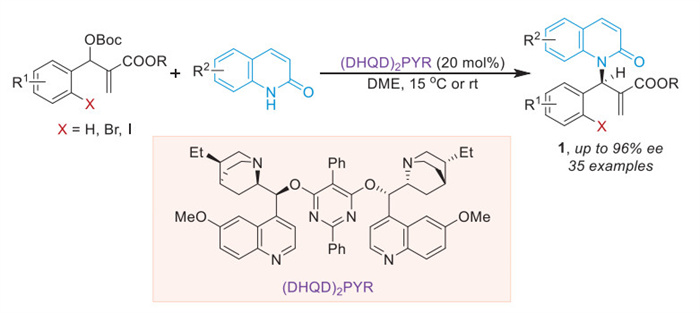
We initiated our research by exploring the Lewis base-catalyzed asymmetric allylic substitution of quinolin-2(1H)-ones using aryl Morita-Baylis-Hillman (MBH) carbonates as electrophiles (Scheme 2) [42]. After systematic optimization of the reaction conditions, the transformations proceeded efficiently to deliver the desired products in good yields and with high enantioselectivities, regardless of the presence or absence of ortho-substituted halides on the benzene ring (see Supporting information for the details).
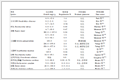
Having established a robust route to enantioenriched precursors 1, we next optimized the reaction conditions for their palladium-catalyzed intramolecular Heck cyclization via the ortho-halobenzene moiety. Employing enantioenriched substrate 1a (96% ee), the palladium-catalyzed intramolecular Heck cyclization proceeded efficiently using a bidentate phosphine ligand, Ag2CO3 as base, and toluene as solvent, affording the product 2a in 36%−69% yield with moderate to good enantioselectivity (73%−81% ee) (entries 1–4). The use of other alternative bases, including N,N,N',N'-tetramethylethylenediamine (TMEDA), N,N-diisopropylethylamine (DIPEA), and Na2CO3, resulted in diminished yields of 2a, despite excellent enantiocontrol being achieved in some cases (entries 5–7). The implementation of Ag3PO4 as the base afforded product 2a in a significantly improved yield of 70% with an acceptable enantioselectivity (83% ee) (entry 8). Increasing the amount of Ag3PO4 enhanced both the yield and enantioselectivity of 2a (entry 9). The use of Xantphos as the ligand further improved the yield to 81% while maintaining a high level of enantioselectivity (entry 10). Variation of the solvent resulted in either diminished yield or trace formation of 2a (entries 11–18). To our delight, replacement of the bromide with an iodide group (1a') significantly improved the reaction outcome, affording product 2a in 90% yield with 93% ee (entry 19). Under these optimized conditions, both the base loading and reaction temperature could be reduced (to 0.3 mmol and 40 ℃, respectively) while still affording product 2a in high yield (91%) and enantioselectivity (93% ee), corresponding to an enantiospecificity (es) factor of 97% (entry 20). It is noteworthy that in all cases, the alternative regioisomeric product 3a was not observed. On the other hand, the absolute configuration of 2a was unambiguously confirmed as P configuration by single-crystal X-ray analysis (Table 1).
 DownLoad:
CSV
 |
|||||||||||||||||||||||||||||||||||||||||||||||||||||||||||||||||||||||||||||||||||||||||||||||||||||||||||||||||||||||
| Entry | Ligand | Base | Solvent | Yield (%) | ee (%) | ||||||||||||||||||||||||||||||||||||||||||||||||||||||||||||||||||||||||||||||||||||||||||||||||||||||||||||||||||
| 1 | DPPE | Ag2CO3 | Toluene | 63 | 81 | ||||||||||||||||||||||||||||||||||||||||||||||||||||||||||||||||||||||||||||||||||||||||||||||||||||||||||||||||||
| 2 | DPEphos | Ag2CO3 | Toluene | 36 | 76 | ||||||||||||||||||||||||||||||||||||||||||||||||||||||||||||||||||||||||||||||||||||||||||||||||||||||||||||||||||
| 3 | Xantphos | Ag2CO3 | Toluene | 67 | 73 | ||||||||||||||||||||||||||||||||||||||||||||||||||||||||||||||||||||||||||||||||||||||||||||||||||||||||||||||||||
| 4 | BINAP | Ag2CO3 | Toluene | 69 | 81 | ||||||||||||||||||||||||||||||||||||||||||||||||||||||||||||||||||||||||||||||||||||||||||||||||||||||||||||||||||
| 5 | BINAP | TMEDA | Toluene | trace | - | ||||||||||||||||||||||||||||||||||||||||||||||||||||||||||||||||||||||||||||||||||||||||||||||||||||||||||||||||||
| 6 | BINAP | DIPEA | Toluene | 59 | 82 | ||||||||||||||||||||||||||||||||||||||||||||||||||||||||||||||||||||||||||||||||||||||||||||||||||||||||||||||||||
| 7 | BINAP | Na2CO3 | Toluene | 42 | 88 | ||||||||||||||||||||||||||||||||||||||||||||||||||||||||||||||||||||||||||||||||||||||||||||||||||||||||||||||||||
| 8 | BINAP | Ag3PO4 | Toluene | 70 | 83 | ||||||||||||||||||||||||||||||||||||||||||||||||||||||||||||||||||||||||||||||||||||||||||||||||||||||||||||||||||
| 9b | BINAP | Ag3PO4 | Toluene | 76 | 86 | ||||||||||||||||||||||||||||||||||||||||||||||||||||||||||||||||||||||||||||||||||||||||||||||||||||||||||||||||||
| 10b | Xantphos | Ag3PO4 | Toluene | 81 | 86 | ||||||||||||||||||||||||||||||||||||||||||||||||||||||||||||||||||||||||||||||||||||||||||||||||||||||||||||||||||
| 11b | Xantphos | Ag3PO4 | Xylene | 72 | 87 | ||||||||||||||||||||||||||||||||||||||||||||||||||||||||||||||||||||||||||||||||||||||||||||||||||||||||||||||||||
| 12b | Xantphos | Ag3PO4 | DME | 63 | 82 | ||||||||||||||||||||||||||||||||||||||||||||||||||||||||||||||||||||||||||||||||||||||||||||||||||||||||||||||||||
| 13b | Xantphos | Ag3PO4 | PhCF3 | 67 | 86 | ||||||||||||||||||||||||||||||||||||||||||||||||||||||||||||||||||||||||||||||||||||||||||||||||||||||||||||||||||
| 14b | Xantphos | Ag3PO4 | Mesitylene | 71 | 88 | ||||||||||||||||||||||||||||||||||||||||||||||||||||||||||||||||||||||||||||||||||||||||||||||||||||||||||||||||||
| 15b | Xantphos | Ag3PO4 | MeCN | trace | - | ||||||||||||||||||||||||||||||||||||||||||||||||||||||||||||||||||||||||||||||||||||||||||||||||||||||||||||||||||
| 16b | Xantphos | Ag3PO4 | 1, 4-Dioxane | trace | - | ||||||||||||||||||||||||||||||||||||||||||||||||||||||||||||||||||||||||||||||||||||||||||||||||||||||||||||||||||
| 17b | Xantphos | Ag3PO4 | DMF | trace | - | ||||||||||||||||||||||||||||||||||||||||||||||||||||||||||||||||||||||||||||||||||||||||||||||||||||||||||||||||||
| 18b | Xantphos | Ag3PO4 | THF | trace | - | ||||||||||||||||||||||||||||||||||||||||||||||||||||||||||||||||||||||||||||||||||||||||||||||||||||||||||||||||||
| 19b,d | Xantphos | Ag3PO4 | Toluene | 90 | 93 | ||||||||||||||||||||||||||||||||||||||||||||||||||||||||||||||||||||||||||||||||||||||||||||||||||||||||||||||||||
| 20c,d | Xantphos | Ag3PO4 | Toluene | 91 | 93 | ||||||||||||||||||||||||||||||||||||||||||||||||||||||||||||||||||||||||||||||||||||||||||||||||||||||||||||||||||
| a 1a (0.1 mmol), Pd(OAc)2 (0.01 mmol), Ligand (L, 0.02 mmol), base (0.2 mmol), solvent (1.0 mL), 50 ℃ for 72 h, isolated yield, ee values were determined by chiral high performance liquid chromatography (HPLC). b Ag3PO4 (0.5 mmol). c Ag3PO4 (0.3 mmol), 40 ℃. d 1a' was used instead of 1a. |
|||||||||||||||||||||||||||||||||||||||||||||||||||||||||||||||||||||||||||||||||||||||||||||||||||||||||||||||||||||||
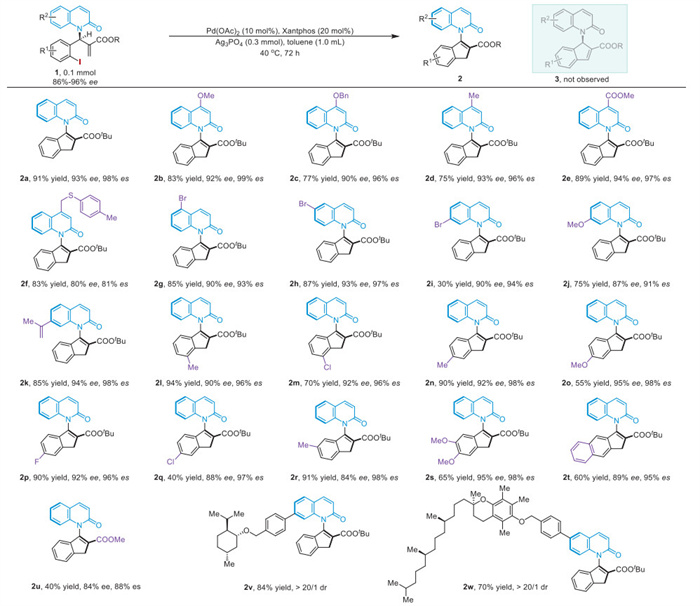
With the optimal conditions in hand, we then investigated the substrate scope (Scheme 3). Substrates 1 bearing varied quinolinone units were first examined. The reaction proceeded efficiently with C4-substituted quinolinones, irrespective of the electronic nature of the substituent, to furnish products 2a-2e in good to excellent yields with high ee (90%−94%) and es (96%−99%). The quinolinone bearing a C4 thioether substituent also afforded an excellent yield (83%), albeit with a moderate es of 81% (2f). Substrates bearing substituents at the C5, C6, or C7 positions were all well tolerated under the standard conditions, affording the corresponding products (2g-2k) in high enantioselectivities (87%−94% ee). Notably, a substrate bearing a bromo group at the C7 position delivered the product in diminished yield of 30% (2i), likely due to its electron-withdrawing nature, yet still achieved high enantiospicificity control (94% es). Moreover, the scope of R1 substituents on the benzene ring was investigated. Substrates bearing diverse R1 groups at various positions all underwent smoothly, delivering axially chiral indene products 2l-2r with excellent enantioselectivity (84%−95% ee). It should be noted that moderate yields were observed in specific cases (2o and 2q). Difunctionalized benzene ring or fused ring systems were also compatible with the reaction conditions, delivering products 2s and 2t in 65% and 60% yield, respectively, with excellent enantioselectivity (95% and 89% ee) and remarkable enantiospecificity (98% and 95% es). In addition, the tert–butyl ester group proved amenable to substitution with a methyl ester, affording product 2u with good enantioselectivity and enantiospecificity (84% ee, 88% es), albeit in moderate yield (40%). The reaction also proceeded efficiently with structurally diverse and biologically relevant moieties derived from l-menthol and vitamin E, affording products 2v and 2w in good yields with excellent diastereoselectivity (dr > 20:1). It is noteworthy that in all cases, the indene atropisomers were generated exclusively, with no regioisomeric products 3 being detected. These results suggest that the transformation proceeds via thermodynamic rather than kinetic β-hydride elimination, thereby enabling direct central-to-axial chirality transfer process.
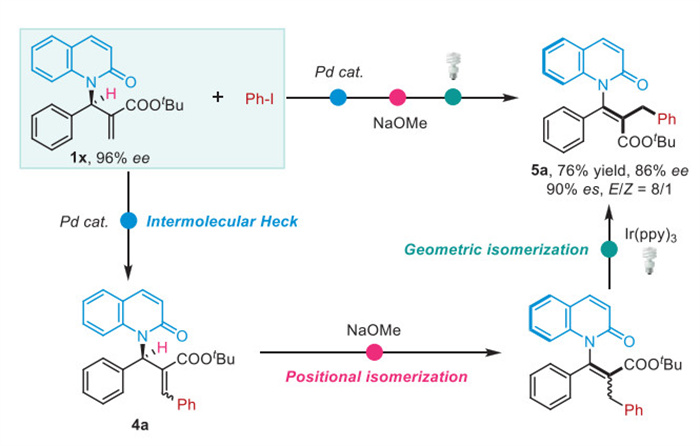
Having established a Pd-catalyzed enantiospecific intramolecular Heck reaction for the synthesis of cyclic axially chiral alkenes, we subsequently questioned whether an enantiospecific intermolecular variant could be developed to access acyclic analogues. The Pd-catalyzed Heck coupling between 1x and iodobenzene was selected as a model reaction under conditions similar to those employed in the intramolecular system (Scheme 4). Interestingly, in contrast to the intramolecular pathway, the intermolecular coupling proceeded efficiently to afford kinetically controlled alkene 4a as the exclusive product with a moderate Z/E ratio. Although the direct Heck reaction in this case did not furnish acyclic axially chiral alkenes, our previous studies on terminal alkene positional and geometric isomerization confirmed that such architectures may be efficiently constructed from the Heck adducts [42]. Consequently, the initial Z/E ratio of the Heck reaction becomes inconsequential. To our delight, the one-pot sequential positional and geometric isomerization of the internal alkenes herein obtained via Heck reaction also proceeded efficiently, furnishing atropisomer 5a in 76% yield, 86% ee, and with a high E/Z ratio (8:1). Notably, the major (E)-isomer was obtained with 90% es from enantioenriched substrate 1x, demonstrating efficient chirality transfer throughout the sequential transformation.
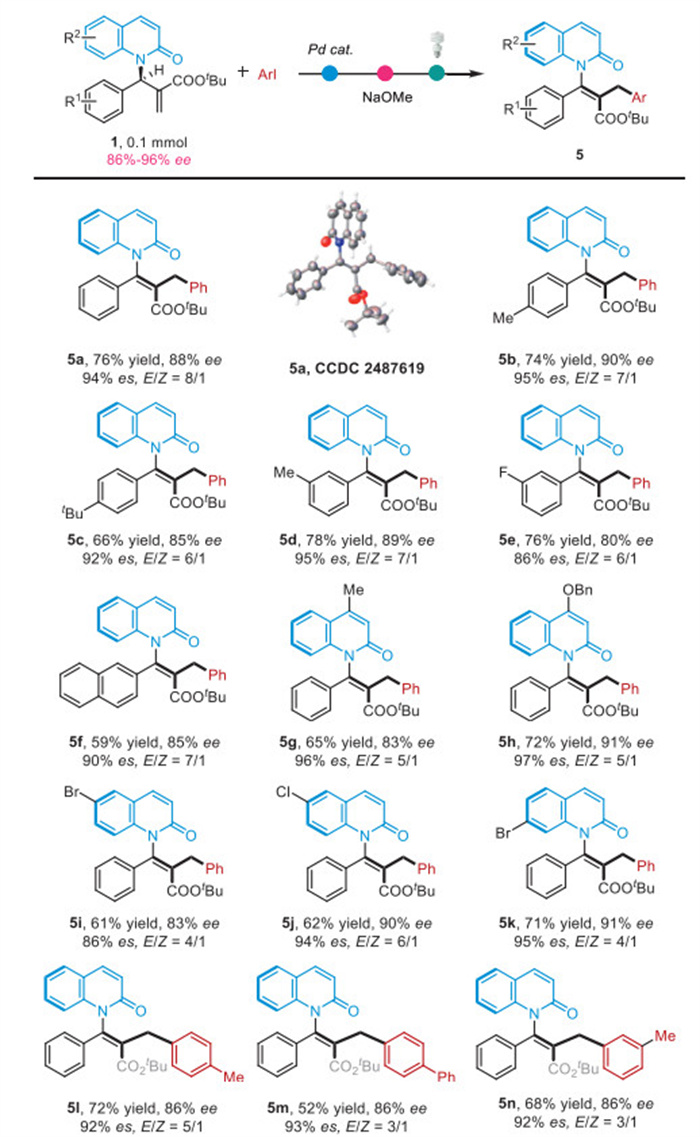
The substrate scope of acyclic axially chiral alkenes was then explored (Scheme 5). Substrates 1, bearing an R¹ group at either the para or meta position of the benzene ring, were compatible with the one-pot, three-step reaction. This protocol afforded products 5a–5e in good yields with high enantioselectivity (up to 90% ee), enantiospecificity (up to 95% es) and good stereoselectivity (up to 8:1 E/Z ratio). The absolute configuration of 5a was unambiguously assigned as (P) by single-crystal X-ray diffraction analysis. This configuration is consistent with axially chiral indenes obtained via enantiospecific intramolecular Heck reactions, indicating that the chirality transfer process is governed solely by the configuration of substrate 1, irrespective of whether the Heck reaction proceeds through an intramolecular or intermolecular pathway. The reaction also tolerated a 2-naphthyl group, affording product 5f in 59% yield with 85% ee and a 7:1 E/Z ratio. The reaction proceeded smoothly with quinolinones bearing substituents at the C4, C5, and C6 positions, providing access to products 5g-5k in 61%−72% yield and 83%−91% ee, with E/Z ratios of up to 6/1. Finally, we evaluated the scope of the reaction with respect to aryl iodides. Several representative substrates performed well, delivering products with excellent ee and es values, though with moderate E/Z selectivity (5l-5n).
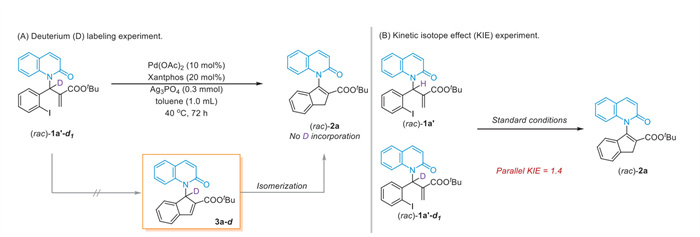
The divergent β-hydride elimination pathways in Pd-catalyzed intra- and intermolecular Heck reactions prompted us to investigate their respective mechanisms. In contrast to the intermolecular reaction, compound 2 was obtained as the exclusively observed Heck product with no other isomers detected. To confirm the thermodynamic pathway of the intramolecular Heck reaction, we then undertook a deuterium labeling experiment. As shown in Scheme 6A, under the optimal conditions, the reaction of substrate 1a'-d1 yielded product 2a with no deuterium incorporation. The lack of deuterium incorporation in 2a is inconsistent with a pathway involving intermediate 3a-d1. Such a pathway would necessitate alkene isomerization, leading to deuterium migration and ultimately affording deuterated 2a, which was not observed. This result provides the evidence that the axially chiral indenes 2 are generated via a direct β-hydride elimination, rather than proceeding through intermediate 3. We then conducted a kinetic isotope effect (KIE) experiment (Scheme 6B). The small KIE value (1.4) reveals that β-hydride elimination is not the rate-determining step. This finding suggests that the 2-quinolinone moiety facilitates β-H elimination, likely through a hydrogen-bonding interaction involving its carbonyl oxygen, thereby rendering the preceding migratory insertion step turnover-limiting.
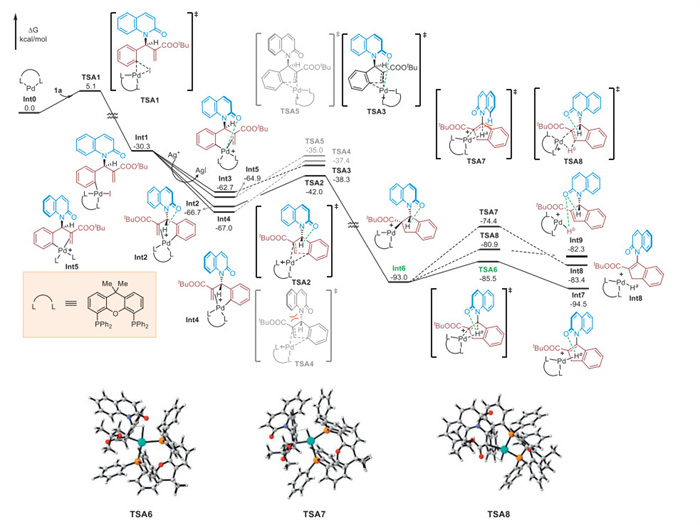
Guided by the experimental finding, we complemented our study with density functional theory (DFT) calculations to probe the distinct mechanisms of the Pd-catalyzed intra- and intermolecular Heck reaction. As shown in Fig. 1, for the intramolecular Heck reaction of 1a', the oxidative addition of Xantphos-Pd(0) to the substrate proceeds via transition state TSA1 to afford intermediate Int1. The silver salt serves as a halide scavenger, converting Int1 into a cationic Pd(Ⅱ) complex with concomitant AgI formation. The coordination of the C=C bond to this cationic center then produces an intermediate that adopts four readily interconvertible conformations (Int2, Int3, Int4 and Int5). It should be noted that non-hydrogen-bonded intermediate Int4 is slightly more stable than Int2, which can be attributed to reduced steric repulsion between the substrate and the Xantphos ligand, outweighing the absence of the H-bond interaction in this conformation. Nevertheless, the conformational flexibility enables the system to undergo migratory insertion through the most favorable transition state, TSA2 (−42.0 kcal/mol), yielding Int6. From Int6, three β-hydride elimination pathways were located via TSA6, TSA7 and TSA8, leading to Int7, Int8 and Int9, respectively. The TSA6 pathway, featuring a PdHa elimination assisted by a hydrogen bond, presents the lowest energy barrier (−85.5 kcal/mol) and is thus the predominant route. The significantly lower energy of TSA6 compared to TSA7 and TSA8 is primarily due to a stabilizing intramolecular hydrogen-bonding non-covalent effect between the quinolinone carbonyl oxygen and the eliminating β-hydrogen (Ha or Hb), which is uniquely possible in the TSA6 conformation. The optimized transition state TSA6 exhibits a Pd-Cα-Cβ-Ha dihedral angle of 18°, which satisfies the near-ideal syn-coplanar geometry required for concerted β-hydride elimination. This key interaction, coupled with minimized steric repulsion in this pathway, dictates the high atroposelectivity observed. Moreover, the low energy barrier (7.5 kcal/mol) for the hydrogen-bond-assisted elimination pathway (TSA6) corroborates that the quinolinone moiety facilitates this step. Consequently, this acceleration accounts for the observed small KIE value by making migratory insertion turnover-limiting, providing a coherent explanation that integrates our computational and experimental findings.
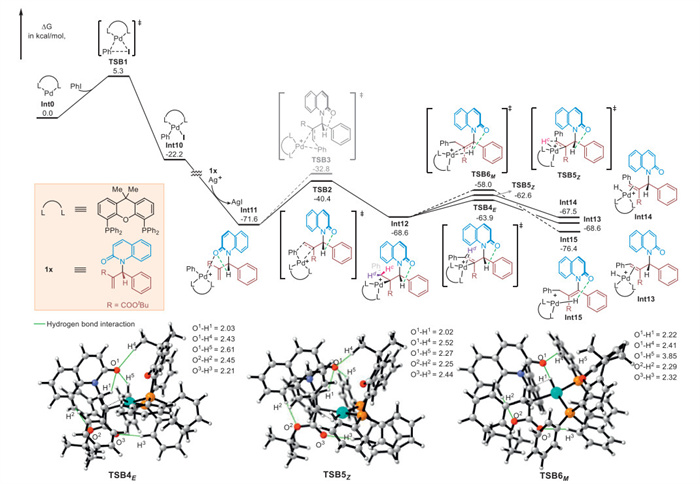
We subsequently performed DFT calculations to elucidate the intermolecular Heck reaction between 1x and iodobenzene. As illustrated in Fig. 2, the catalytic cycle commences with the oxidative addition of iodobenzene to Xantphos-Pd(0) (Int0), proceeding via transition state TSB1 with an energy barrier of 5.3 kcal/mol to form Int10. The cationic intermediate Int10 is subsequently generated through halide abstraction by Ag3PO4 to access Int11. In Int11, the carbonyl group of the substrate stabilizes the system via coordination to palladium and simultaneous hydrogen bonding to the benzylic proton. This pre-organized arrangement facilitates migratory insertion through transition state TSB2, affording the key intermediate Int12 with a substantial energy barrier of 31.2 kcal/mol, which rationalizes the need for elevated reaction temperatures. From Int12, three competing β-hydride elimination pathways were identified, proceeding through transition states TSB4E, TSB5Z, and TSB6M to form intermediates Int13, Int14, and Int15, respectively. The pathway via TSB6M is energetically disfavored due to its significantly higher barrier relative to TSB4E and TSB5Z. The modest Z/E selectivity observed for product 5a is attributed to the narrow energy gap of only 1.3 kcal/mol between TSB4E and TSB5Z, an effect that becomes particularly relevant under the high-temperature reaction conditions.
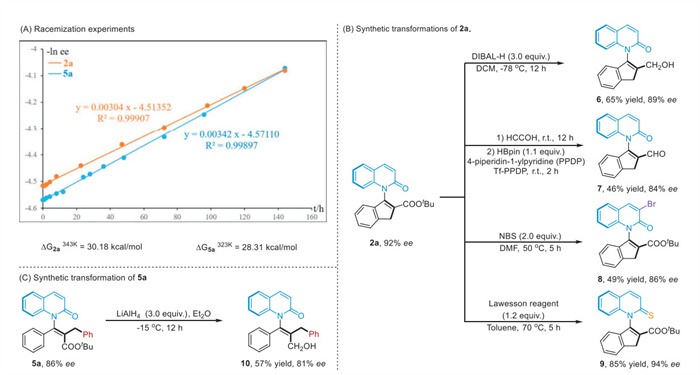
To evaluate the configurational stability of the synthesized cyclic and acyclic axially chiral alkenes, racemization experiments were conducted on compounds 2a and 5a, respectively. As illustrated in Scheme 7A, both 2a and 5a demonstrated relatively good configurational stability under the tested conditions. Notably, 2a exhibited superior stability compared to 5a, even when assessed at a higher measurement temperature of 70 ℃. Finally, the synthetic utility of axially chiral alkenes 2a and 5a was demonstrated through a series of derivatization reactions (Schemes 7B and C). As illustrated in Scheme 7B, reduction of 2a afforded product 6 in 65% yield with excellent enantioretention. Subsequent hydrolysis and reduction of 2a yielded compound 7 in 46% yield and 84% ee [80]. Bromination of 2a proceeded smoothly to provide 8 in 49% yield and 86% ee. Treatment with Lawesson's reagent delivered the thio-derivative 9 in high yield (85%) with well-maintained stereochemical integrity (94% ee). Similarly, reduction of the acyclic alkene 5a furnished product 10 in 57% yield and 81% ee (Scheme 7C).
In summary, we have successfully developed an efficient palladium-catalyzed system for constructing both cyclic and acyclic axially chiral alkenes via intra- and intermolecular Heck reactions. This work mechanistically unveils that the divergent behaviors of the β-hydride elimination step dictate the distinct reaction pathways. Combined experimental and computational studies elucidate that the intramolecular cyclization is thermodynamically driven by conjugation stabilization and steric strain relief upon ring formation, facilitating direct atroposelective synthesis. Conversely, the intermolecular pathway, devoid of such significant energetic advantages and further complicated by steric encumbrance, proceeds through a different β-hydride elimination manifold. Nevertheless, the resulting acyclic intermediates can be efficiently reconfigured into axially chiral alkenes through subsequent olefin positional and geometric Z/E isomerization. The methodology exhibits broad substrate generality and delivers both classes of valuable chiral scaffolds with high enantioselectivity via chirality transfer, providing a promising strategy for accessing axially chiral alkene architectures.
Jun Gu: Writing – review & editing, Investigation, Conceptualization. Wan-Yi Xu: Writing – review & editing, Investigation. Rong-Gui Zhou: Investigation. Zhiwen Ye: Investigation. Ying He: Writing – review & editing, Writing – original draft, Methodology, Conceptualization.
The authors declare that they have no known competing financial interests or personal relationships that could have appeared to influence the work reported in this paper.
This work was supported by the National Natural Science Foundation of China (No. 22201131) and the Opening Project of Jiangsu Key Laboratory of Advanced Structural Materials and Application Technology (No. ASMA202504).
Supplementary material associated with this article can be found, in the online version, at doi:
M. Basilaia, M.H. Chen, J. Secka, et al., Acc. Chem. Res. 55 (2022) 2904–2919. doi: 10.1021/acs.accounts.2c00500
B.A. Lanman, A.T. Parsons, S.G. Zech, Acc. Chem. Res. 55 (2022) 2892–2903. doi: 10.1021/acs.accounts.2c00479
S.T. Toenjes, J.L. Gustafson, Future Med. Chem. 10 (2018) 409–422. doi: 10.4155/fmc-2017-0152
S. Perreault, J. Chandrasekhar, L. Patel, Acc. Chem. Res. 55 (2022) 2581–2593. doi: 10.1021/acs.accounts.2c00485
P.W. Glunz, Bioorg. Med. Chem. Lett. 28 (2018) 53–60. doi: 10.1016/j.bmcl.2017.11.050
S.J. Liu, Q. Zhao, X.C. Liu, et al., Med. Res. Rev. 44 (2024) 1971–2014. doi: 10.1002/med.22037
X.F. Bai, Y.M. Cui, J. Cao, et al., Acc. Chem. Res. 55 (2022) 2545–2561. doi: 10.1021/acs.accounts.2c00417
J.K. Cheng, S.H. Xiang, B. Tan, Acc. Chem. Res. 55 (2022) 2920–2937. doi: 10.1021/acs.accounts.2c00509
J.K. Cheng, S.H. Xiang, S. Li, et al., Chem. Rev. 121 (2021) 4805–4902. doi: 10.1021/acs.chemrev.0c01306
H.H. Zhang, T.Z. Li, S.J. Liu, et al., Angew. Chem. Int. Ed. 63 (2024) e202311053. doi: 10.1002/anie.202311053
A. Gaucherand, E. Yen-Pon, A. Domain, et al., Chem. Soc. Rev. 53 (2024) 11165–11206. doi: 10.1039/d3cs00238a
P. Rodríguez-Salamanca, R. Fernández, V. Hornillos, et al., Chem. Eur. J. 28 (2022) e202104442. doi: 10.1002/chem.202104442
G.J. Mei, W.L. Koay, C.Y. Guan, et al., Chem 8 (2022) 1855–1893. doi: 10.1016/j.chempr.2022.04.011
E. Kumarasamy, R. Raghunathan, M.P. Sibi, et al., Chem. Rev. 115 (2015) 11239–11300. doi: 10.1021/acs.chemrev.5b00136
L.L. Xi, R.R. Liu, Trends Chem. 6 (2024) 556–571. doi: 10.1016/j.trechm.2024.06.013
T. Shibata, M. Otomo, Y.K. Tahara, et al., Org. Biomol. Chem. 6 (2008) 4296–4298. doi: 10.1039/b814014f
J. Feng, B. Li, Y. He, et al., Angew. Chem. Int. Ed. 55 (2016) 2186–2190. doi: 10.1002/anie.201509571
C. Pan, Z. Zhu, M. Zhang, et al., Angew. Chem. Int. Ed. 56 (2017) 4777–4781. doi: 10.1002/anie.201701467
F. Wang, J. Jing, Y. Zhao, et al., Angew. Chem. Int. Ed. 60 (2021) 16628–16633. doi: 10.1002/anie.202105093
P. Wu, W.T. Zhang, J.X. Yang, et al., Angew. Chem. Int. Ed. 63 (2024) e202410581.
J.D. Jolliffe, R.J. Armstrong, M.D. Smith, Nat. Chem. 9 (2017) 558–562. doi: 10.1038/nchem.2710
S. Fang, J. He, Z. Liu, et al., ACS Catal. 13 (2023) 13077–13088. doi: 10.1021/acscatal.3c03304
T. Kawabata, K. Yahiro, K. Fuji, J. Am. Chem. Soc. 113 (1991) 9694–9696. doi: 10.1021/ja00025a057
J. Feng, Z. Gu, Synopen 5 (2021) 68–85. doi: 10.1055/s-0040-1706028
P.F. Qian, T. Zhou, B.F. Shi, Chem. Commun. 59 (2023) 12669–12684. doi: 10.1039/d3cc03592a
J.Y. Zou, W.Y. Xu, J. Wang, et al., Synthesis 56 (2024) 1862–1872. doi: 10.1055/a-2230-0759
S.C. Zheng, S. Wu, Q. Zhou, et al., Nat. Commun. 8 (2017) 15238. doi: 10.1038/ncomms15238
Y. Tan, S. Jia, F. Hu, et al., J. Am. Chem. Soc. 140 (2018) 16893–16898. doi: 10.1021/jacs.8b09893
S. Jia, Z. Chen, N. Zhang, et al., J. Am. Chem. Soc. 140 (2018) 7056–7060. doi: 10.1021/jacs.8b03211
S. Wu, S.H. Xiang, S. Li, et al., Nat. Catal. 4 (2021) 692–702. doi: 10.1038/s41929-021-00660-8
L. Jin, Q.J. Yao, P.P. Xie, et al., Chem 6 (2020) 497–511. doi: 10.1016/j.chempr.2019.12.011
C. Ma, F.T. Sheng, H.Q. Wang, et al., J. Am. Chem. Soc. 142 (2020) 15686–15696. doi: 10.1021/jacs.0c00208
W. Li, S. Chen, J. Xie, et al., Nat. Synth. 2 (2023) 140–151. doi: 10.1038/s44160-022-00201-6
F. Guo, S. Fang, J. He, et al., Nat. Commun. 14 (2023) 5050. doi: 10.1038/s41467-023-40840-7
Y. Cui, Y.B. Wang, H.H. Liu, et al., J. Am. Chem. Soc. 147 (2025) 3450–3458. doi: 10.1021/jacs.4c14589
D. Ji, J. Jing, Y. Wang, et al., Chem 8 (2022) 3346–3362. doi: 10.1016/j.chempr.2022.08.019
X. Zhu, R. Mi, J. Yin, et al., Chem. Sci. 14 (2023) 7999–8005. doi: 10.1039/d3sc02714g
Z. Lin, Y. Jiang, F. Wang, et al., Chem. Sci. 16 (2025) 14252–14261. doi: 10.1039/d5sc04080a
J. Wang, X. Qi, X.L. Min, et al., J. Am. Chem. Soc. 143 (2021) 10686–10694. doi: 10.1021/jacs.1c04400
X.L. Zhang, J. Gu, W.H. Cui, et al., Angew. Chem. Int. Ed. 61 (2022) e202210456. doi: 10.1002/anie.202210456
J.Y. Zou, Y.Y. Yang, J. Gu, et al., Angew. Chem. Int. Ed. 62 (2023) e202310320. doi: 10.1002/anie.202310320
J. Wang, J. Gu, J.Y. Zou, et al., Nat. Commun. 15 (2024) 3254. doi: 10.3390/polym16233254
Y.X. Wu, Q. Liu, Q. Zhang, et al., Cell Rep. Phys. Sci. 3 (2022) 101005. doi: 10.1016/j.xcrp.2022.101005
X.L. Zhang, X. Qi, Y.X. Wu, et al., Cell Rep. Phys. Sci. 2 (2021) 100594. doi: 10.1016/j.xcrp.2021.100594
C. Sun, X. Qi, X.L. Min, et al., Chem. Sci. 11 (2020) 10119–10126. doi: 10.1039/d0sc02828b
H.F. Zhuang, J. Gu, Z. Ye, et al., Angew. Chem. Int. Ed. 64 (2025) e202418951. doi: 10.1002/anie.202418951
J.Q. Xie, R.X. Liang, Y.X. Jia, Chin. J. Chem. 39 (2020) 710–728. doi: 10.1007/978-3-030-43306-2_100
L.J. Oxtoby, J.A. Gurak Jr., S.R. Wisniewski, et al., Trends Chem. 1 (2019) 572–587. doi: 10.1016/j.trechm.2019.05.007
I.T. Crouch, R.K. Neff, D.E. Frantz, J. Am. Chem. Soc. 135 (2013) 4970–4973. doi: 10.1021/ja401606e
C. Zhu, H. Chu, G. Li, et al., J. Am. Chem. Soc. 141 (2019) 19246–19251. doi: 10.1021/jacs.9b10883
J. Han, S. Liu, H. Wang, et al., Sci. Adv. 9 (2023) eadg1002. doi: 10.1126/sciadv.adg1002
L.Z. Zhang, P.C. Zhang, Q. Wang, et al., Nat. Commun. 16 (2025) 930. doi: 10.1017/s0047404524001118
B. Xu, D. Ji, L. Wu, et al., Chem 8 (2022) 836–849. doi: 10.1016/j.chempr.2021.12.019
Z. Yang, J. Zhou, J. Am. Chem. Soc. 134 (2012) 11833–11835. doi: 10.1021/ja304099j
X. Li, B. Zhou, R.Z. Yang, et al., J. Am. Chem. Soc. 140 (2018) 13945–13951. doi: 10.1021/jacs.8b09186
S. Zhu, M. Chen, H. Shen, et al., Chin. Chem. Lett. 35 (2024) 109879. doi: 10.1016/j.cclet.2024.109879
C. Ma, Y. Sun, S. Liu, et al., Chem Catal. 2 (2022) 3196–3206.
B.R. Shao, W.F. Jiang, C. Zheng, et al., Chem Catal. 3 (2023) 100697.
B.R. Shao, W.F. Jiang, C. Wang, et al., Angew. Chem. Int. Ed. 64 (2025) e202421287. doi: 10.1002/anie.202421287
S. Sun, S. Sun, W. Zi, Nat. Commun. 16 (2025) 2227. doi: 10.1038/s41467-025-57437-x
S.J. He, B. Shen, L.Z. Zuo, et al., J. Am. Chem. Soc. 146 (2024) 19137–19145. doi: 10.1021/jacs.4c04024
B. Wang, J. Zhao, J. Ying, et al., Angew. Chem. Int. Ed. 64 (2025) e202421500. doi: 10.1002/anie.202421500
A.K. Simlandy, Y. Hu, T.M. Alturaifi, et al., J. Am. Chem. Soc. 147 (2025) 40244–40252. doi: 10.1021/jacs.5c10118
M.R. Harris, M.O. Konev, E.R. Jarvo, J. Am. Chem. Soc. 136 (2014) 7825–7828. doi: 10.1021/ja5026485
A.H. Cherney, N.T. Kadunce, S.E. Reisman, Chem. Rev. 115 (2015) 9587–9652. doi: 10.1021/acs.chemrev.5b00162
Q. Liu, W.Y. Xu, C.C. You, et al., Trends Chem. 6 (2024) 627–640. doi: 10.1016/j.trechm.2024.08.004
D. Fiorito, S. Scaringi, C. Mazet, Chem. Soc. Rev. 50 (2021) 1391–1406. doi: 10.1039/d0cs00449a
A. Vasseur, J. Bruffaerts, I. Marek, Nat. Chem. 8 (2016) 209–219. doi: 10.1038/nchem.2445
I. Massad, I. Marek, ACS Catal. 10 (2020) 5793–5804. doi: 10.1021/acscatal.0c01174
V. Bizet, X. Pannecoucke, J.L. Renaud, et al., Angew. Chem. Int. Ed. 51 (2012) 6467–6470. doi: 10.1002/anie.201200827
S. Martinez-Erro, A. Sanz-Marco, A.B. Gómez, et al., J. Am. Chem. Soc. 138 (2016) 13408–13414. doi: 10.1021/jacs.6b08350
D.M.H. Ascough, F. Duarte, R.S. Paton, J. Am. Chem. Soc. 140 (2018) 16740–16748. doi: 10.1021/jacs.8b09874
Q. Liu, J. Gu, H.F. Zhuang, et al., Nat. Commun. 16 (2025) 6782. doi: 10.1038/s41467-025-61990-w
J.J. Molloy, T. Morack, R. Gilmour, Angew. Chem. Int. Ed. 58 (2019) 13654–13664. doi: 10.1002/anie.201906124
A.H. Obeid, J. Hannedouche, Adv. Synth. Catal. 365 (2023) 1100–1111. doi: 10.1002/adsc.202300052
M. Wienhold, B. Kweon, C. McLaughlin, et al., Angew. Chem. Int. Ed. 62 (2023) e202304150. doi: 10.1002/anie.202304150
J.J. Molloy, M. Schäfer, M. Wienhold, et al., Science 369 (2020) 302–306. doi: 10.1126/science.abb7235
H. Zhang, C. Huang, X.A. Yuan, et al., J. Am. Chem. Soc. 144 (2022) 10958–10967. doi: 10.1021/jacs.2c04040
A. Huang, H.R. Xu, Z.J. Yang, et al., Nat. Synth. 4 (2025) 1565–1576. doi: 10.1038/s44160-025-00870-z
D. Chen, L. Xu, Y. Yu, et al., Angew. Chem. Int. Ed. 62 (2023) e202215168. doi: 10.1002/anie.202215168

Scheme 1 Advances in axially chiral molecules and intra-/intermolecular Heck reactions.

Scheme 3 Substrate scope of Pd-catalyzed enantiospecific intramolecular Heck reaction. 1 (0.1 mmol), Pd(OAc)2 (0.01 mmol), Xantphos (0.02 mmol), Ag3PO4 (0.3 mmol), toluene (1.0 mL), 40 ℃ for 72 h, isolated yield, ee values were determined by HPLC. es = (ee2/ee1) × 100%.

Scheme 4 Initial studies of cascade reaction system for the synthesis of acyclic axially chiral alkenes.

Scheme 5 Substrate scope of sequential Pd-catalyzed enantiospecific intermolecular Heck reaction, positional and Z/E geometric isomerization. 1 (0.1 mmol), ArI (0.2 mmol), Pd(OAc)2 (0.01 mmol), Xantphos (0.02 mmol), Ag3PO4 (0.3 mmol), toluene (1.0 mL), 100 ℃ for 24 h; then NaOMe (0.15 mmol), r.t. for 2 h; then Ir(ppy)3 (0.001 mmol), 420 nm LED, r.t. for 18 h. Isolated yield, ee values were determined by HPLC. E/Z ratios were calculated by 1H NMR analysis.

Figure 2 DFT studies of Pd-catalyzed intramolecular Heck reaction of 1x. Bond lengths are in units of Å.
Table 1. Optimized conditions of Pd-catalyzed enantiospecific intramolecular Heck reaction.a
|
|||||||||||||||||||||||||||||||||||||||||||||||||||||||||||||||||||||||||||||||||||||||||||||||||||||||||||||||||||||||
| Entry | Ligand | Base | Solvent | Yield (%) | ee (%) | ||||||||||||||||||||||||||||||||||||||||||||||||||||||||||||||||||||||||||||||||||||||||||||||||||||||||||||||||||
| 1 | DPPE | Ag2CO3 | Toluene | 63 | 81 | ||||||||||||||||||||||||||||||||||||||||||||||||||||||||||||||||||||||||||||||||||||||||||||||||||||||||||||||||||
| 2 | DPEphos | Ag2CO3 | Toluene | 36 | 76 | ||||||||||||||||||||||||||||||||||||||||||||||||||||||||||||||||||||||||||||||||||||||||||||||||||||||||||||||||||
| 3 | Xantphos | Ag2CO3 | Toluene | 67 | 73 | ||||||||||||||||||||||||||||||||||||||||||||||||||||||||||||||||||||||||||||||||||||||||||||||||||||||||||||||||||
| 4 | BINAP | Ag2CO3 | Toluene | 69 | 81 | ||||||||||||||||||||||||||||||||||||||||||||||||||||||||||||||||||||||||||||||||||||||||||||||||||||||||||||||||||
| 5 | BINAP | TMEDA | Toluene | trace | - | ||||||||||||||||||||||||||||||||||||||||||||||||||||||||||||||||||||||||||||||||||||||||||||||||||||||||||||||||||
| 6 | BINAP | DIPEA | Toluene | 59 | 82 | ||||||||||||||||||||||||||||||||||||||||||||||||||||||||||||||||||||||||||||||||||||||||||||||||||||||||||||||||||
| 7 | BINAP | Na2CO3 | Toluene | 42 | 88 | ||||||||||||||||||||||||||||||||||||||||||||||||||||||||||||||||||||||||||||||||||||||||||||||||||||||||||||||||||
| 8 | BINAP | Ag3PO4 | Toluene | 70 | 83 | ||||||||||||||||||||||||||||||||||||||||||||||||||||||||||||||||||||||||||||||||||||||||||||||||||||||||||||||||||
| 9b | BINAP | Ag3PO4 | Toluene | 76 | 86 | ||||||||||||||||||||||||||||||||||||||||||||||||||||||||||||||||||||||||||||||||||||||||||||||||||||||||||||||||||
| 10b | Xantphos | Ag3PO4 | Toluene | 81 | 86 | ||||||||||||||||||||||||||||||||||||||||||||||||||||||||||||||||||||||||||||||||||||||||||||||||||||||||||||||||||
| 11b | Xantphos | Ag3PO4 | Xylene | 72 | 87 | ||||||||||||||||||||||||||||||||||||||||||||||||||||||||||||||||||||||||||||||||||||||||||||||||||||||||||||||||||
| 12b | Xantphos | Ag3PO4 | DME | 63 | 82 | ||||||||||||||||||||||||||||||||||||||||||||||||||||||||||||||||||||||||||||||||||||||||||||||||||||||||||||||||||
| 13b | Xantphos | Ag3PO4 | PhCF3 | 67 | 86 | ||||||||||||||||||||||||||||||||||||||||||||||||||||||||||||||||||||||||||||||||||||||||||||||||||||||||||||||||||
| 14b | Xantphos | Ag3PO4 | Mesitylene | 71 | 88 | ||||||||||||||||||||||||||||||||||||||||||||||||||||||||||||||||||||||||||||||||||||||||||||||||||||||||||||||||||
| 15b | Xantphos | Ag3PO4 | MeCN | trace | - | ||||||||||||||||||||||||||||||||||||||||||||||||||||||||||||||||||||||||||||||||||||||||||||||||||||||||||||||||||
| 16b | Xantphos | Ag3PO4 | 1, 4-Dioxane | trace | - | ||||||||||||||||||||||||||||||||||||||||||||||||||||||||||||||||||||||||||||||||||||||||||||||||||||||||||||||||||
| 17b | Xantphos | Ag3PO4 | DMF | trace | - | ||||||||||||||||||||||||||||||||||||||||||||||||||||||||||||||||||||||||||||||||||||||||||||||||||||||||||||||||||
| 18b | Xantphos | Ag3PO4 | THF | trace | - | ||||||||||||||||||||||||||||||||||||||||||||||||||||||||||||||||||||||||||||||||||||||||||||||||||||||||||||||||||
| 19b,d | Xantphos | Ag3PO4 | Toluene | 90 | 93 | ||||||||||||||||||||||||||||||||||||||||||||||||||||||||||||||||||||||||||||||||||||||||||||||||||||||||||||||||||
| 20c,d | Xantphos | Ag3PO4 | Toluene | 91 | 93 | ||||||||||||||||||||||||||||||||||||||||||||||||||||||||||||||||||||||||||||||||||||||||||||||||||||||||||||||||||
| a 1a (0.1 mmol), Pd(OAc)2 (0.01 mmol), Ligand (L, 0.02 mmol), base (0.2 mmol), solvent (1.0 mL), 50 ℃ for 72 h, isolated yield, ee values were determined by chiral high performance liquid chromatography (HPLC). b Ag3PO4 (0.5 mmol). c Ag3PO4 (0.3 mmol), 40 ℃. d 1a' was used instead of 1a. |
|||||||||||||||||||||||||||||||||||||||||||||||||||||||||||||||||||||||||||||||||||||||||||||||||||||||||||||||||||||||
 下载: 导出CSV

 扫一扫看文章


扫一扫关注我们


 下载: