College of Chemistry and Material Science, The Technological Innovation Center of Supramolecular Chinese (Mongolian) Medicine, Innovation Team of Optical Functional Molecular Devices, Inner Mongolia Minzu University, Tongliao 028000, China
b.
College of Chemistry, Nankai University, Tianjin 300071, China
Biomimetic materials capable of exhibiting the characteristics of space-time control of their structural and functional properties have attracted great interest from chemists in the development of advanced intelligent materials [1,2]. Generally, these systems have a metastable and non-equilibrium state related to structure and properties to achieve intelligent bionic functions, and it is necessary to add "fuel" in the system and consume a certain amount of energy to be pushed out of balance so that they can exhibit functional assembly states with specific properties on demand. Wang et al. [3] constructed a chemical fuel-driven dissipative self-assembly gel system through hydrophilic polycarboxylate derivatives with benzyl and tetraphenylethylene as cores. As compared with common chemical fuels, the use of light as a fuel has more advantages, such as cleanliness, non-invasiveness, remote controllability, precise positioning, and on-demand adjustment. Chen et al. [4] constructed a time-dependent fluorescence regulation assembly was achieved through the dissipative assembly of photo-induced amphiphilic molecule sulfonated cyanine and polyethyleneimine further co-assemble with red, green and blue fluorescent molecules. Yan et al. [5] designed and constructed a new type of light-driven dissipative self-assembly system with dipeptide-modified naphthalimide (NDI-GV). In this system, the π-stacked nanoribbon structure of NDI-GV molecules could be destroyed by light excitation into high-energy free radical anions and recovered by spontaneous oxidation, leading to application in information encryption and spatio-temporal patterning. Although the fuel-driven supramolecular smart materials constructed by macrocycles have made some progress, the macrocyclic supramolecular smart luminescent materials based on photo-fuels still face great challenges.
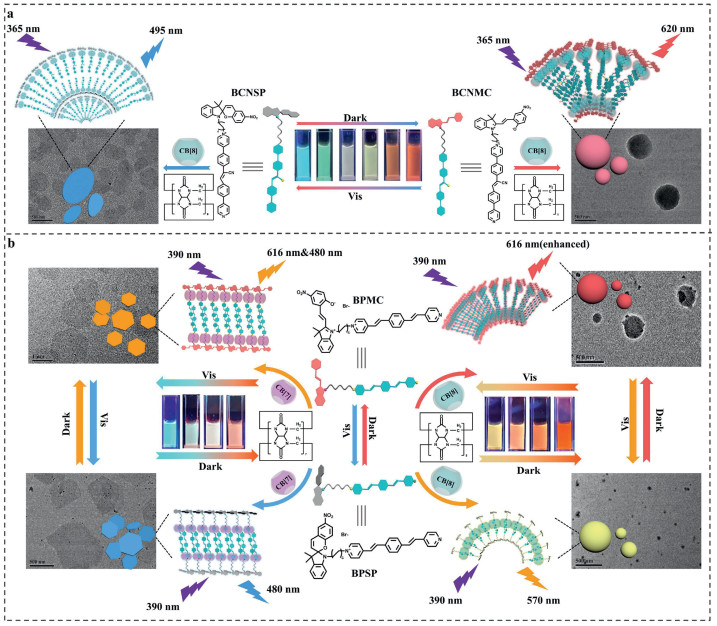
Spiropyran (SP) is a classic photoisomerizable and chromic compound. Its spiro ring C-O bond readily cleaves upon specific wavelength irradiation or mechanical force to form open-ring merocyanine (MC), which rapidly reverts to closed-ring SP under darkness or different wavelength light. This reversible transformation, enabled by alternating external stimuli, is accompanied by distinct spectral and color changes. Therefore, SP was widely used in light-driven intelligent luminescent materials and molecular machines. Recently, Liu et al. [6,7] designed a variety of spiropyran derivatives by modifying cyanostilbene derivatives (BCNSP) on the closed-ring spiropyran molecules, and the resultant molecule changed into an open-ring structure (BCNMC) after being placed in dark for 120 min. In the UV spectrum, the absorption peak at 370 nm enhanced, and a new absorption peak appeared at 510 nm. Interestingly, when the spiropyran derivative formed a 1:1 inclusion complex with CB[8], BCNSP showed an enhanced fluorescence maximum at 495 nm, while BCNMC obtained two enhanced intramolecular FRET fluorescence maximum at 495 nm and 620 nm. The transition from BCNSP@CB[8] to BCNMC@CB[8] by being placed in dark for 120 min accompanied by a color change of blue → green → white → yellow → orange-red as well as the topological change from nanosheets to nanospheres. The whole process can be repeated by alternating visible light irradiation and dark conditions. Recently, they further constructed a cucurbit[n]uril allosteric multicolor supramolecular optical actuator based on p-styrene-modified spiropyran (BPSP) and cucurbit[n]uril (CB[7] or CB[8]) through host-guest interaction. The BPSP@CB[7] assembly showed a regular hexagonal structure and emitted the blue fluorescence at 480 nm. In contrast, BPSP@CB[8] formed nanospheres and emitted yellow fluorescence at 570 nm. Interestingly, after BPSP underwent ring-opening in the dark, BPSP@CB[7] and BPSP@CB[8] displayed distinct multicolor transitions. This included an efficient intramolecular FRET process between the yellow emission of BPSP@CB[8] (570 nm) and the red emission of BPMC (616 nm).
This cucurbit[n]uril allosteric multicolor assembly can be reversibly regulated under alternating visible light irradiation and dark treatment, which successfully exhibits excellent properties in dynamic logic information encryption and tunable cell imaging (Fig. 1).
Figure 1
Figure 1.
(a) Scheme illustration of fabrication and regulation of the multicolor reversible supramolecular shuttle BCNMC@CB[8]. (b) Schematic illustration of a photo-controlled, time-dependent multicolor luminescent supramolecular shuttle with tunable morphology.
In this work, they synthesized two pyridinium guest molecules BCNSP and BPSP by substitution reaction of alkyl bromide modified spiropyran with cyanostyrene and p-styrene derivatives. The UV absorption peaks at 510-530 nm of the two guest molecules aqueous solution can be alternately conversed by being placed in dark for 120 min and under visible light irradiation for 30 s, accompanied by a mixed fluorescence from blue fluorescence to red fluorescence at an excitation wavelength of 390 nm, and the recovery rate can reach > 90%. Job plots according to the UV-visible titration showed that the binding ratios of BCNSP and BCNMC with CB[8] were both 1:1, and the binding constants were 1.02 × 10⁷ and 7.21 × 10⁶ L/mol, respectively. The binding ratios of BPSP and BPMC with CB[7] were also 1:1, and the binding constants were 1.56 × 10⁶ and 3.97 × 10⁷ L/mol, respectively. Interestingly, the binding ratio of BPSP with CB[8] was 2:1 with the primary binding constant Ka1 = 1.54 × 10³ L/mol, and the binding ratio of BPMC with CB[8] was 1:1 with the binding constant Ka = 3.96 × 10⁷ L/mol.
The reversible tautomerism transformation of spiropyran-merocyanine derivatives in response to structural stimuli will be accompanied by changes in molecular polarity, which will cause changes in morphology, especially after assembly with macrocyclic host compounds for achieving multi-dimensional regulation of macrocyclic and photo-reversible responses. Through transmission electron microscopy (TEM) and dynamic light scattering (DLS) experiments, they found that BCNSP@CB[8] changed from dispersed nanosheets to 500 nm nanospheres after being placed in dark, and the morphology of macrocycles with different sizes will also be allosteric after assembly, while BPMC@CB[7] assemblies formed regular hexagonal sheets and BPMC@CB[8] formed nanospheres. However, the change of various configurations will definitely affect the electronic structure and then realize the regulation of multi-level optical properties. The blue fluorescence intensity at 495 nm of the BCNSP@CB[8] assembly increased by > 8 times due to the macrocyclic confinement, and the fluorescence emission at 620 nm can be regulated by alternating dark treatment and visible light irradiation. By adjusting the ratio of the two different peaks, the assembly underwent a multi-color reversible transition of blue → green → white → yellow → orange-red. Interestingly, the fluorescence at 495 nm gradually weakens with the increase of luminescence at 620 nm under dark conditions in this process, owing that the fluorescence emission peak at 495 nm of the cyanostyrene group in the assembly BCNMC@CB[8] overlaps with the absorption peak of the spiropyran group, resulting in intramolecular fluorescence resonance energy transfer (energy transfer efficiency = 59%). If the cyanostyrene group is replaced by a conjugated group to be modified with a larger group to achieve a red shift in the emission after assembly with CB[n], the intramolecular FRET will be improved, which may further increase the color-tunable diversity of the assembly by changing the size of the macrocycle. Subsequently, they assembled different CB[n] with a planar conjugated molecule styrene-modified spiropyran. BPSP@CB[7] (480 nm) and BPMC@CB[7] (480 nm and 616 nm) regulate the emission of BPMC@CB[7] at 616 nm through visible light and dark conditions, and the fluorescence gradually changes from blue → white → yellow → orange. Surprisingly, after the addition of CB[8] to their newly designed conjugated molecule BPSP, a new excimer fluorescence peak appeared at 570 nm, a larger overlap with the absorption peak at 540 nm of BPMC, which was more conducive to promoting FRET in the guest molecule, thereby making BPMC@CB[8] almost completely converted to red fluorescence emission. Unlike CB[7], the regulation of the assemblies BPSP@CB[8] and BPMC@CB[8] is accompanied by a luminescence transition from yellow to red. They simply use CB[n] of different sizes combined with light-driven to achieve multi-dimensional regulation of the four morphologies of guest molecules, along with a reversible transformation of multiple colors without repetition, which is conducive to the creation of advanced anti-counterfeiting applications with complex functions. In view of the bi-directional reversible tunable multicolor excellent luminescence properties of cucurbituril-activated allosteric supramolecular optical actuators BCNSP@CB[8], BPSP@CB[7], BPSP@CB[8], they are applied to logical dynamic information encryption and tunable cell imaging. BCNMC@CB[8] solution was placed in a 96-well plate, covered with a self-made hollow plate with specific information, and irradiated under visible light for 30 s to obtain a blue fluorescent letter combination "NK", number "582", and drawing Morse password pattern (transmitting information "MAX"). Similarly, the aqueous solutions of BPMC@CB[8] and BPMC@CB[7] were applied to design red fluorescence hidden information with specific significance in 96-well plates, and the hidden information "NK" was gradually displayed after the whole well plate was irradiated with visible light. The information of these assemblies can be encrypted again under the dark processing, and the dynamic adjustable information anti-counterfeiting is realized.
In summary, several CB-modified multicolor luminescent supramolecular optical actuators were successfully constructed via host-guest interactions between CB[n] and spiropyran-derived styryl molecules. Intramolecular energy transfer was achieved by regulating spiropyran switching, enabling red → yellow → white → green → blue multicolor fluorescence emission and reversible topological transitions (nanosheets/nanospheres) upon alternating visible light irradiation. BPSP@CB[7-8] exhibited distinct morphologies (hexagonal nanosheets for CB[7], nanospheres for CB[8]) and multicolor transitions due to different assembly modes. The supramolecular assembly constructed in this paper is not only simple and novel at the level of guest molecule design, but also combines the time-resolved red luminescent spiropyran molecule with blue light luminescence p-styrene derivatives, which can realize single-molecule FRET. After assembling with different host compounds, the molecular luminescence properties are not only promoted, but also the intramolecular FRET effect is greatly improved. Through the photo-response to the spiropyran molecule, the assembly under different host compounds can achieve different color changes and structural changes, which realizes the deep integration of structural dynamics and time dimension information, resulting in the emergence advantage of "1 + 1 > > 2". These CB-promoted time-dependent dissipative supramolecular allosteric assemblies have many characteristics such as simple structure, multidimensional reversibility, tunability and precise spatiotemporal responsiveness which are expected to be applied to logic gate information storage devices, new bionic intelligent materials, and high-sensitivity detection of disease-related markers and other nanomaterials and biomedical intelligent molecular frontier research fields. Future research may focus on developing NIR-responsive photo-allosteric molecules via aromatic fused ring conjugation, and exploring their biological applications in disease marker-responsive accurate diagnosis, intelligent photodynamic agents, and soft robots.
Declaration of competing interest
The authors declare that they have no known competing financial interests or personal relationships that could have appeared to influence the work reported in this paper.
This work was supported by the National Natural Science Foundation of China (Nos. 22361036, 22571173), the China Postdoctoral Science Foundation (No. 2021M691661), the Program for Youth Science and Technology Leading Talent of Inner Mongolia (No. GXKY25Z045), Inner Mongolia Natural Science Excellent Youth Foundation (No. 2025YQ050)
[1]
B. A. Grzybowski, K. Fitzner, J. Paczesny, et al., Chem. Soc. Rev. 46 (2017) 5647-5678. doi: 10.1039/C7CS00089H
M. Cheng, D. Chen, L. Zhang, et al., Org. Chem. Front. 10 (2023) 1380-1385. doi: 10.1039/d2qo01888h
[4]
X.M. Chen, W.J. Feng, H. K. Bisoyi, et al., Nat. Commun. 13 (2022) 3216. doi: 10.1038/s41467-022-30969-2
[5]
Y. Zhang, X. Liang, C. Yang, et al., Angew. Chem. Int. Ed. (2025), e202512915. doi: 10.1002/anie.202512915
[6]
R. Zhang, Y. Chen, Y. Liu, Angew. Chem. Int. Ed. 62 (2023) e202315749. doi: 10.1002/anie.202315749
[7]
R. Zhang, Z. Lei, Z. Yu, et al., Adv. Sci. 12 (2025) e07090. doi: 10.1002/advs.202507090
Figure 1
(a) Scheme illustration of fabrication and regulation of the multicolor reversible supramolecular shuttle BCNMC@CB[8]. (b) Schematic illustration of a photo-controlled, time-dependent multicolor luminescent supramolecular shuttle with tunable morphology.


 DownLoad:

 下载:
下载:


 下载:
下载:

