
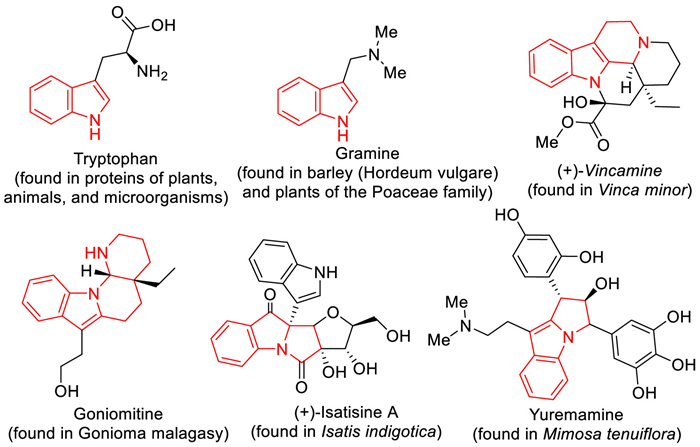
Figure 1.
Indole and indole-based fused polycycles in natural products.


Over the past few decades, indole and indole-based fused polycyclic ring systems have attracted notable attention. It is due to their unique structural characteristics and broad occurrence in natural products and pharmaceuticals [1–8]. By incorporating additional rings fused to the central indole scaffold, these systems frequently confer improved biological and physicochemical properties to the molecules [9–11]. Due to their structural diversity and ability to interact with multiple biological targets, these structures play a pivotal role in medicinal chemistry, drug discovery, and the design of advanced functional molecules. Consequently, the development of efficient strategies for constructing functionalized indole-fused polycycles remains a dynamic and growing research frontier, offering substantial potential for pioneering new therapeutics [12–15].
Indole and indole-based fused polycyclic ring systems have fundamental structural features found in a vast array of natural products and bioactive compounds. These include simple indole derivatives as well as more complex fused polycyclic indoles. Many of these compounds exhibit a remarkable spectrum of significant biological activities. For example, tryptophan, found in proteins of plants, animals, and microorganisms, serves as a precursor of serotonin and melatonin. Other notable examples include gramine, isolated from barley and other Poaceae species, which display antimicrobial properties. (+)-Vincamine, isolated from the leaves of Vinca minor, is known for its cerebral anti-ischemic effects, whereas goniomitine demonstrates antiproliferative and anticancer potentials. Furthermore, compounds such as (+)-Isatisine A, isolated from Isatis indigotica, show promise with anti-HIV activity, and yuremamine from Mimosa tenuiflora exhibits CNS activity and neuroactive properties (Fig. 1) [16–21].
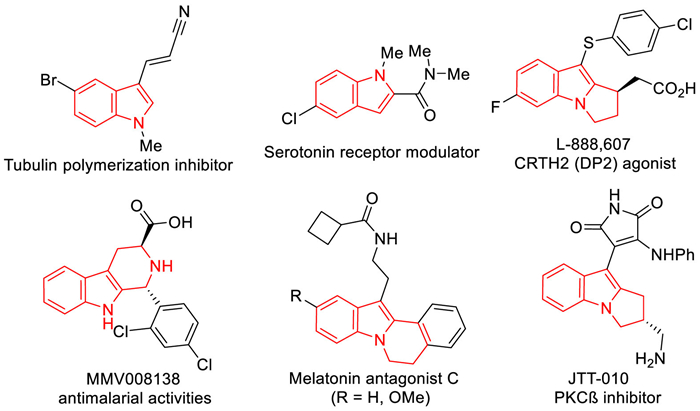
Beyond its presence in natural products, this heterocyclic motif serves as the core structure for many synthetic compounds with diverse pharmacological activities. These bioactive derivatives include agents such as tubulin polymerization inhibitors and serotonin receptor modulators. In addition, L-888,607 acts as a potent CRTH2 (DP2) agonist, while MMV008138 shows strong antimalarial activity, making it a promising candidate in antiparasitic drug discovery. Additionally, melatonin antagonists (C, R = H, OMe) have been designed to regulate circadian rhythm disorders, and JTT-010, a selective PKCβ inhibitor, demonstrates potential in managing diabetic complications and related cardiovascular diseases. Structures of these compounds are collected in Fig. 2 [22–24].
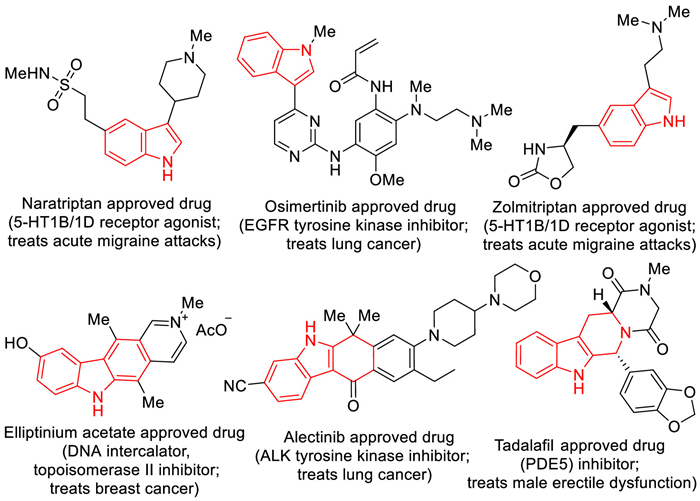
Furthermore, the therapeutic significance of the indole scaffold is demonstrated by its presence in numerous approved drugs, including Osimertinib, an EGFR tyrosine kinase inhibitor used to treat non-small cell lung cancer (NSCLC) and Alectinib, an ALK tyrosine kinase inhibitor used for the treatment of ALK-positive NSCLC. Naratriptan and Zolmitriptan are migraine medications that function as agonists for the 5-HT1B/1D receptors. Elliptinium acetate is a DNA intercalator and topoisomerase Ⅱ inhibitor that was historically used to treat breast cancer. Tadalafil is a widely known erectile dysfunction medication (Fig. 3) [25–30].
Due to the extreme importance in chemistry and biological chemistry, numerous methods have been developed for the construction of indole-containing polycyclic compounds in the past decades [31–43]. On the other hand, alkenes are amongst the most powerful chemical scaffolds because of their versatile reactivity. Thus, cyclization of the synthetic intermediates via introduction of alkenyl species into the indole core is emerging as a hot topic in the construction of indole-containing polycyclic molecules [44,45]. Notably, great achievements have been made in the area of cyclization of indole-tethered alkenes in the past two decades.
This review aims to summarize recent advancements (up to June 2025) in the cyclization reaction of indole-tethered alkenes for the construction of polyheterocycles, including the reaction development, mechanism investigation, and the advantages in the construction of indole-containing polycyclic molecules.
2-Aryl-N-acryloyl indoles are a very important type of 1-(2′-alkenyl) indoles, which can be used as efficient intermediates for the cyclization reaction. In particular, they have been well established for the synthesis of various functionalized indole[2,1-a]isoquinolines. Several radical precursors have been reported for the cyclization reaction of 2-aryl-N-acryloyl indoles prior to 2024 [46–62].
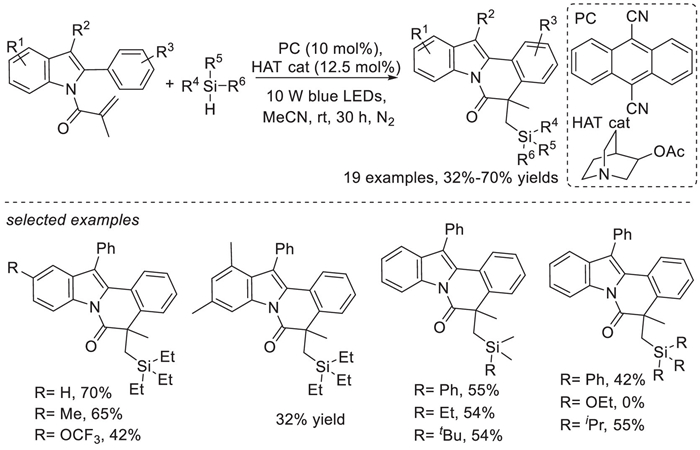
Liu's research group has recently developed a method for constructing silylated indolo[2,1-a]isoquinoline-6(5H)-one frameworks through photocatalytic and silyl radical-mediated cascade cyclization reactions [63]. This innovative approach involved the visible-light-induced transformation of 2-aryl-N-acryloyl indoles with hydrosilanes (tris(trimethylsilyl)silane) under a photocatalytic protocol employing photocatalyst, 9,10-dicyanoanthracene (DCA) as an organophotocatalyst in combination with 3-acetoxyquinuclidine as a hydrogen atom transfer (HAT) catalyst in dry acetonitrile at room temperature for 30 h. This reaction also tolerated a diverse pool of substrates, affording the desired silylated tetracyclic products in good yields (Scheme 1).
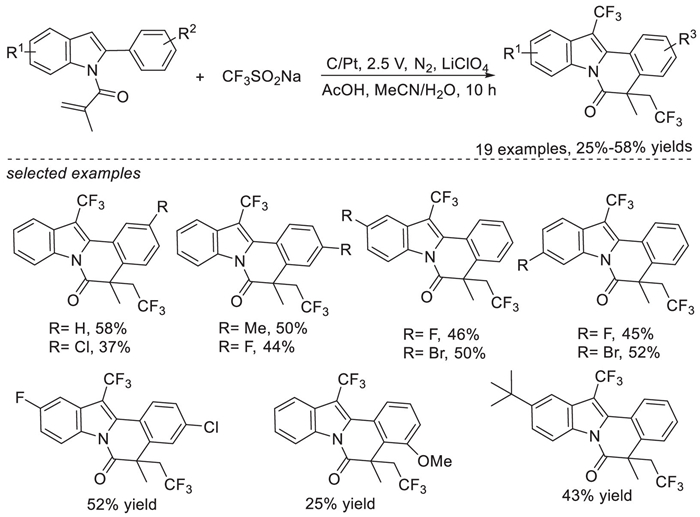
In 2025, an electrochemical cascade radical cyclization of 2-aryl-N-acryloyl indoles with sodium trifluoromethanesulfinate for the synthesis of bistrifluoromethylated indole[2,1-a]isoquinolines was reported by Han and co-workers [64]. This novel approach was accomplished by subjecting 2-aryl-N-acryloyl indoles to electrochemical oxidation in the presence of CF3SO2Na (as the CF3 source), LiClO4, and AcOH in a MeCN/H2O solvent mixture under 2.5 V, leading to the formation of bis-trifluoromethylated indole-fused tricycles in moderate to good yields (Scheme 2). This method performed without the use of a transition metal proceeded under mild conditions and provided a sustainable strategy for the construction of bis-trifluoromethylated indole-fused heterocycles.
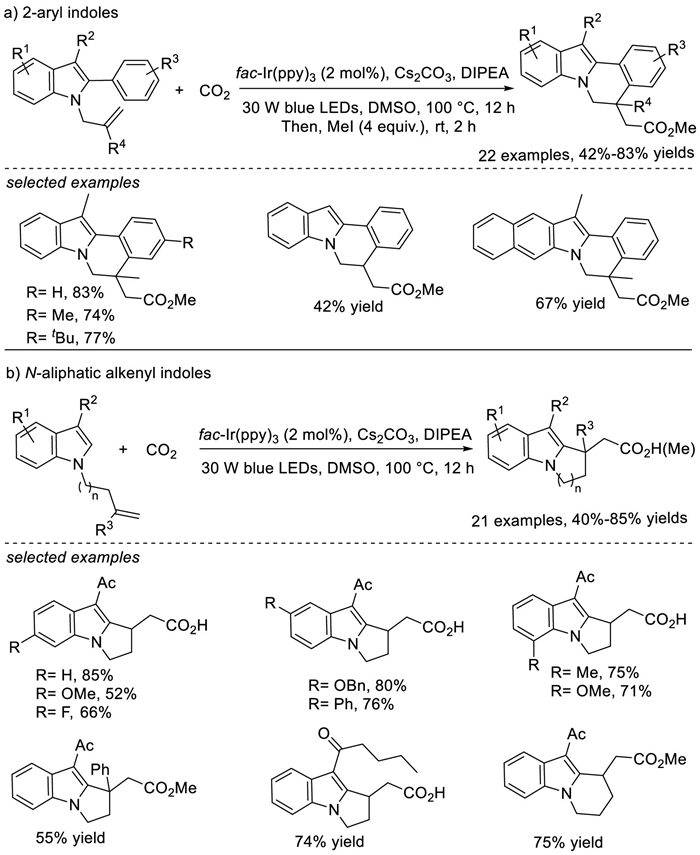
In 2024, Sun and co-workers reported a visible-light-promoted cascade carboxylation/arylation of indole-tethered unactivated alkenes with CO2 to access carboxylated indolo[2,1-a]isoquinolines and pyrrolo[1,2-a]indoles [65]. The reaction was carried out under photoredox conditions using fac-Ir(ppy)3 as the catalyst in DMSO under 1 atm of CO2 at 100 ℃ for 12 h, with 2-aryl indoles (Scheme 3a) or N-aliphatic alkenyl Indoles (Scheme 3b). The desired carboxylated indole-fused heterocycles were obtained in moderate to high yields ranging from 30% to 80% (Scheme 3). The transformation proceeded via the initial addition of a CO2 radical anion to the alkene motif, generating an alkyl carbon radical that underwent intramolecular arylation followed by rearomatization to afford the heterocyclic products.
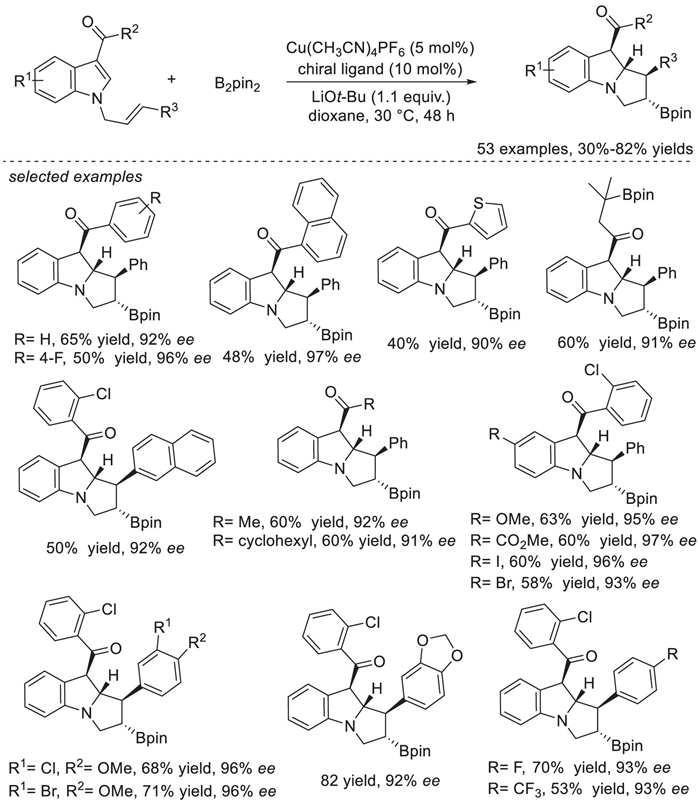
Recently, a new copper-catalyzed enantioselective dearomative borylative cyclization of indoles under mild conditions was reported, providing efficient access to highly functionalized pyrrolo-fused [1,2-a]indolines bearing four consecutive stereogenic centers [66]. This transformation was achieved using 5 mol% of Cu(CH3CN)4PF6, 10 mol% of a chiral ligand (L5), and 1.1 equiv. of LiOt-Bu with B2pin2 as the boron source in dry dioxane at 30 ℃ over 48 h. The method exhibited excellent levels of enantio- and diastereoselectivity and a good tolerance of functional groups, resulting in a series of > 50 pyrrolo-fused [1,2-a]indolines in good yields ranging from 30% to 82% (Scheme 4).
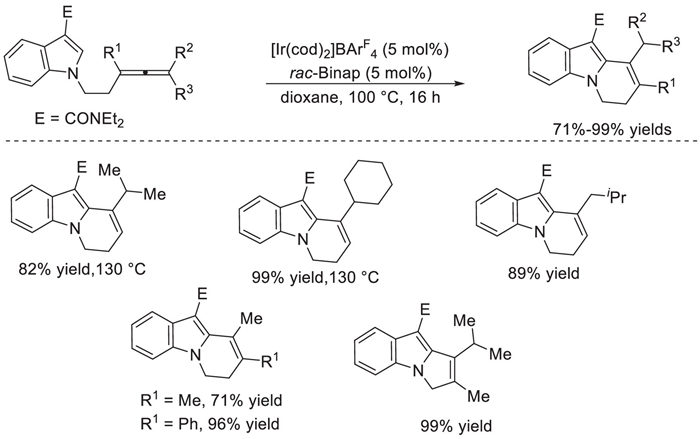
With the application of iridium catalysis, a novel approach for the synthesis of azaheterocycles from N-allenyl-tethered indoles was developed by Lopez and co-workers [67]. The method using [Ir(cod)2]BAr4F in combination with bis(diphenylphosphino)-1,1′-binaphthalene (BINAP) as the ligand enabled efficient cycloisomerization reactions initiated by C–H activation. Notably, the reactions delivered a variety of structurally diverse products, including dihydroindolizines, pyridoindoles, as well as cyclopropane-fused analogs, all in excellent yields with high selectivity (Scheme 5).
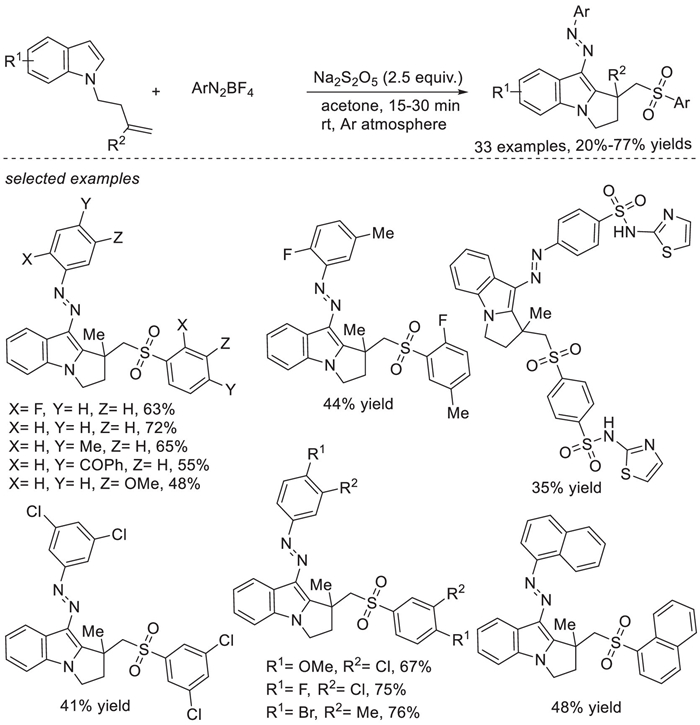
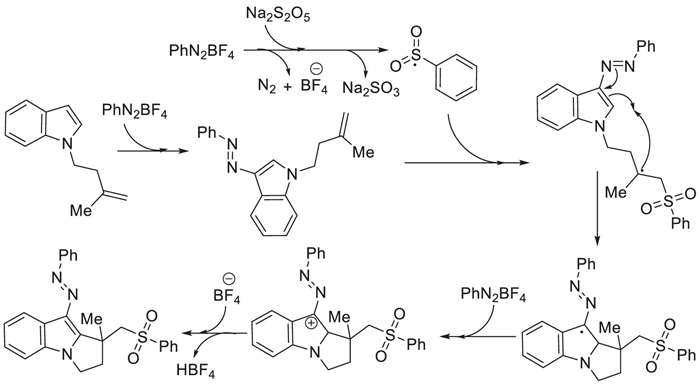
Das et al. reported an arylsulfonyl radical-triggered cascade cyclization of unactivated alkene-tethered indoles for the synthesis of 2,3-dihydro-1H-pyrrolo[1,2-a]indole scaffolds in the absence of any external photocatalyst [68]. This innovative approach involved the reaction of alkene-tethered indoles with tryptophan methyl ester and aryldiazonium tetrafluoroborates as readily available starting materials, using sodium metabisulfite (Na2S2O5) at room temperature under an argon atmosphere for 15–30 min. This protocol enabled the incorporation of sulfonyl and azo functionalities with good functional group tolerance, providing a diverse range of functionalized pyrrolo[1,2-a]indole derivatives in moderate to good yields ranging from 20% to 77% (Scheme 6).
The proposed mechanism was depicted in Scheme 7. The reaction began with the coupling reaction between diazonium salt and the starting alkene-tethered indole to form phenylazoindole. Subsequently, decomposition of diazonium salt in the presence of sodium metabisulfite generated phenylsulfonyl radical. This sulfonyl radical addition to phenylazoindole created a new radical intermediate, which underwent intramolecular radical cyclization to produce a benzyl radical intermediate. Oxidation of benzyl radical intermediate by phenyldiazonium tetrafluoroborate afforded a cationic intermediate along with the regeneration of a phenyl radical to continue the chain reaction. Finally, BF₄⁻ removed a proton from the cationic intermediate delivered the desired product.
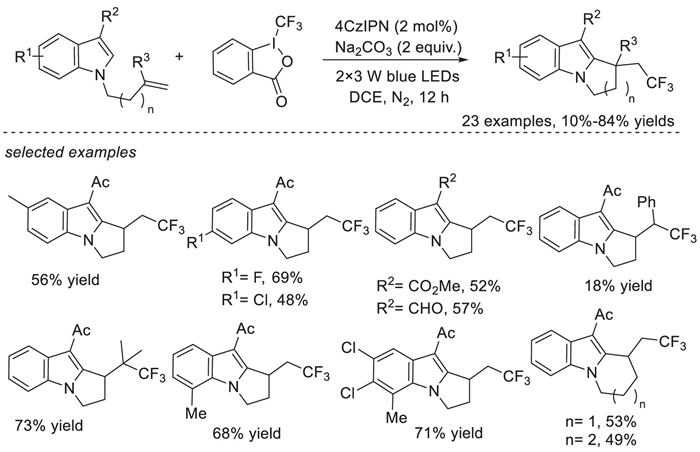
Recently, a visible-light-promoted trifluoromethylation/arylation of unactivated alkenes with Togni-CF3 (Togni Ⅱ reagent) for the synthesis of trifluoromethylated indole-fused heterocycles was described by Song et al. [69]. The reaction was performed under photoredox conditions employing 4CzIPN as the photocatalyst and Na2CO3 as a base in DCE under blue LED irradiation for 12 h, delivering the desired heterocycles in moderate to good yields of 10%–84% (Scheme 8). The transformation proceeded via radical addition of a CF3 radical to the alkene motif, generating an alkyl carbon radical. The carbon radical intermediate underwent intramolecular arylation followed by rearomatization to afford trifluoromethylated pyrrolo[1,2-a]indoles.
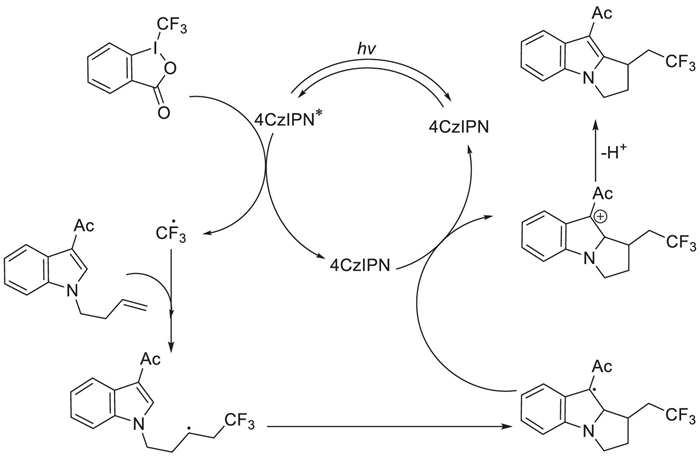
A plausible mechanism was shown in Scheme 9. Initially, the photocatalyst 4CzIPN was excited under LED irradiation to form the active species. This excited photocatalyst underwent reductive quenching with Togni-CF3, affording a trifluoromethyl CF3 radical along with 4CzIPN•+. Then, addition of the radical CF3• to the C=C bond of the substrate afforded the carbon-centered radical intermediate, which underwent intramolecular radical cyclization to form the cyclic radical intermediate. Subsequent oxidation of the cyclic radical intermediate by 4CzIPN•+ produced a cationic intermediate with the regeneration of the catalyst. Finally, a base deprotonation of the cationic intermediate delivered the desired product (Scheme 9).
You and co-workers reported a visible-light-induced dearomative cycloaddition of indole-tethered vinylcyclopropanes (VCPs), enabling the controlled formation of polycyclic indoline derivatives [70]. This innovative approach employed 1 mol% of an iridium-based photosensitizer in CH3CN under blue LED irradiation at room temperature. The method tolerated a broad range of substrates and efficiently furnished polycyclic indoline derivatives with high chemo- and diastereoselectivity (Scheme 10).
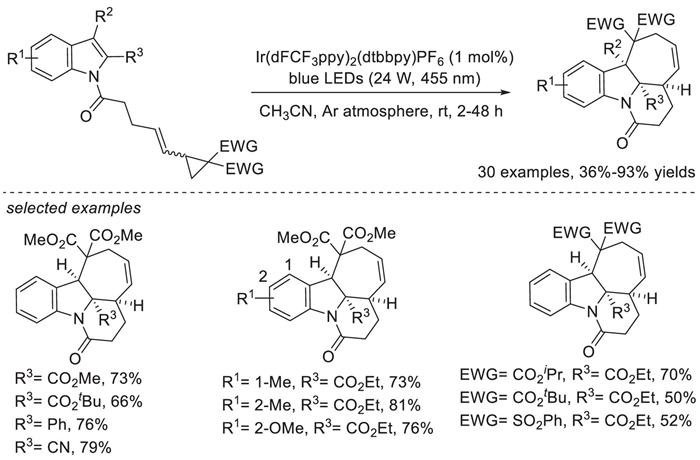
As outlined in this section, cyclization of 1-alkenyl indoles typically occurs at the C2 position of indolyl moiety to generate pyrrolo[1,2-a]indole derivatives. An important future direction is the development of strategies to access polycyclic pyrrolo[1,2-a]indole derivatives, especially in an asymmetric manner.
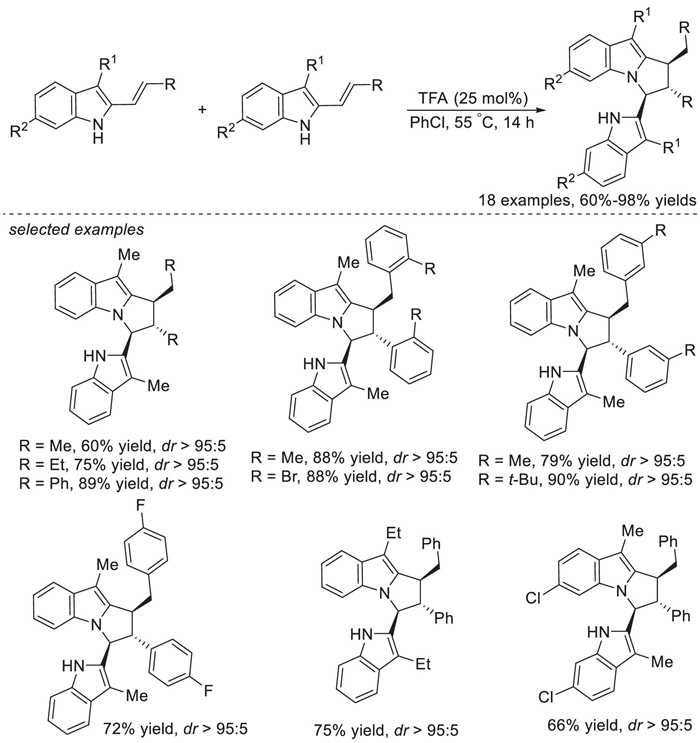
In 2015, Shi and co-workers explored Brønsted acid-catalyzed strategies for the construction of nitrogen-containing heterocycles from vinylindole derivatives. The strategy involved a novel [3 + 2] cyclodimerization of 3-alkyl-2-vinylindoles, enabling the diastereoselective synthesis of pyrroloindole frameworks in excellent yields (up to 98%) with high diastereoselectivity (> 95:5 dr) (Scheme 11). Reactions catalyzed by trifluoroacetic acid in chlorobenzene at 55 ℃ proceeded via activation of the vinylindole moiety, with the free N–H group and the C-3 alkyl substituent playing a key role in facilitating cyclodimerization. Remarkably, this transformation marked the first use of 3-alkyl-2-vinylindoles as nitrogen–carbon–carbon (NCC) building blocks and it introduced a previously unreported [3 + 2] dimerization mode for 2-vinylindoles [71].
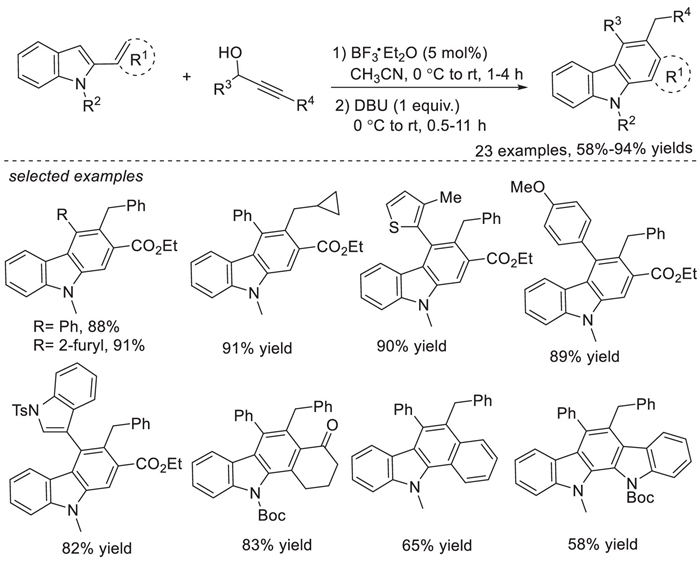
One year later, Dilipkumar and co-workers developed a Lewis acid-catalyzed strategy for the construction of substituted carbazoles. This one-pot [4 + 2] benzannulation approach involved C3-propargylation of 2-alkenyl/aryl indoles with 1-aryl propargylic alcohols, followed by cycloisomerization [72]. This reaction was conducted in the presence of BF3·Et2O and 1,8-diazabicyclo[5.4.0]undec-7-ene (DBU), affording a library of structurally varied carbazoles. In particular, aryl- or heteroaryl-annulated carbazoles were easily obtained in good to excellent yields up to 94% (Scheme 12).
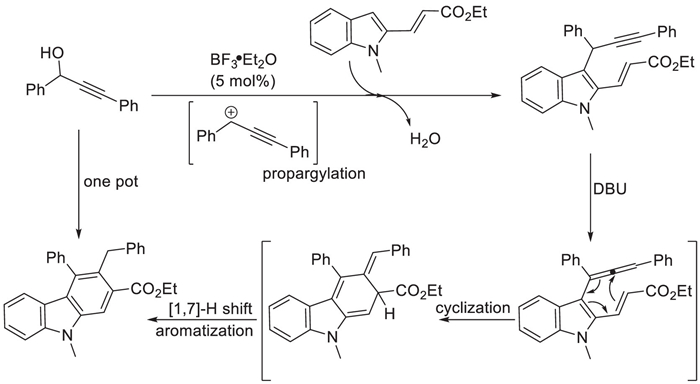
The proposed mechanism, as illustrated in Scheme 13, began with an acid-catalyzed propargylation of the starting indole material with 1,3-diphenylprop-2-yn-1-ol to give a key enyne intermediate. Then a base-induced isomerization turned enyne into an allene intermediate, which underwent a 1,3,5-triene electrocyclization to form the cyclic intermediate. The final step was an aromatization providing the benzannulated product.
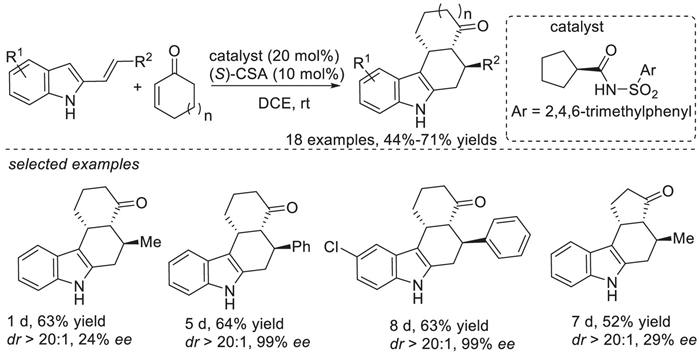
In the same year, an enantioselective exo-Diels–Alder cycloaddition of cyclic enones with 2-vinyl-1H-indoles catalyzed by a readily available prolinosulfonamide was reported by Yang group's [73]. The reaction was carried out in the presence of prolinosulfonamide and (S)-camphorsulfonic acid (CSA) in 1,2-dichloroethane, enabling the cross-annulation of a broad range of 2-vinyl-1H-indoles and cyclic enones with exhibiting high chemoselectivity. The reaction tolerated diverse functional groups such as electron-donating and electron-withdrawing substituents. Tetracyclic tetrahydrocarbazole derivatives were obtained in good yields (up to 87%) with excellent diastereoselectivities (> 20:1 dr) and enantioselectivities (up to > 99% ee), offering a practical and efficient approach for the construction of polycyclic scaffolds (Scheme 14).
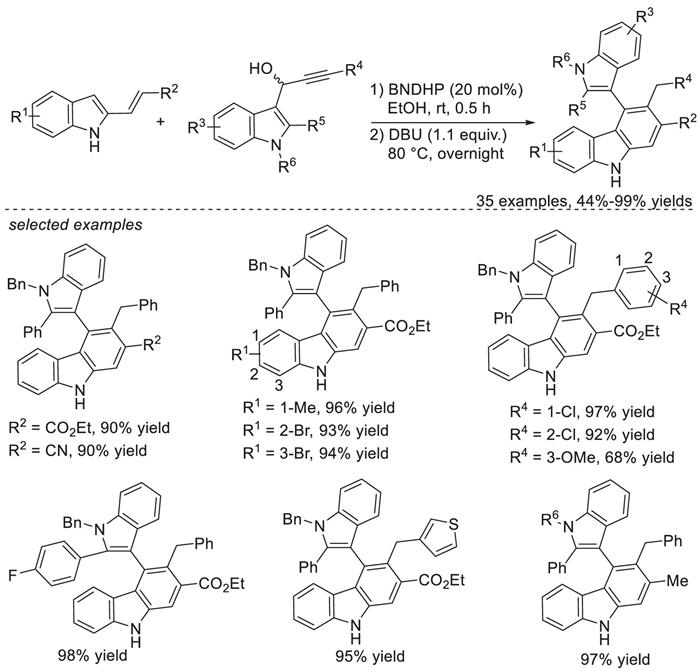
A novel strategy for the synthesis of atropisomeric carbazolyl-indoles was developed by Zhao and co-workers, featuring a metal- and oxidant-free one-pot [4 + 2]-benzannulation reaction under mild conditions [74]. This protocol employed an acid-catalyzed propargylation of 2-alkenyl indoles with 1-indolyl propargylic alcohols in ethanol as solvent, followed by a DBU-promoted cycloisomerization to afford the desired products. The methodology demonstrated broad substrate scope, efficiently tolerating a wide range of electron-donating and electron-withdrawing groups on both 2-alkenyl indoles and propargylic alcohols, and delivering a large series of the corresponding carbazolyl-indoles in good to excellent yields up to 99% (Scheme 15). Notably, the operational simplicity, scalability, and avoidance of chromatography highlight the practicality and green nature of this approach.
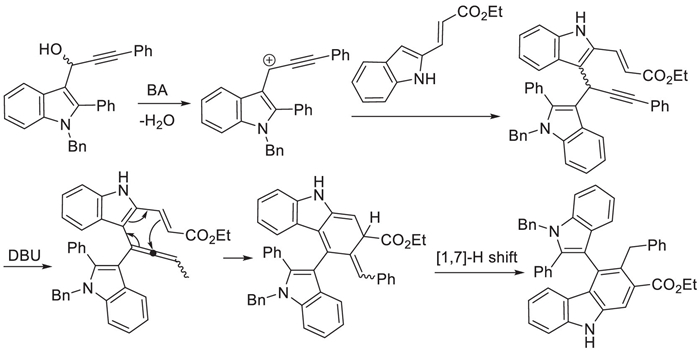
The plausible reaction pathway was illustrated in Scheme 16. In the first step, the acid-catalyzed reaction of 1-indolyl propargylic alcohol generated the carbocation intermediate, which reacted with 2-alkenyl indole to give the enyne intermediate. Then, a base prompted rearrangement afforded the allene intermediate, which underwent a 1,3,5-triene electrocyclization to afford the cyclic intermediate. Final aromatization of the cyclic intermediate provided the benzannulated product.
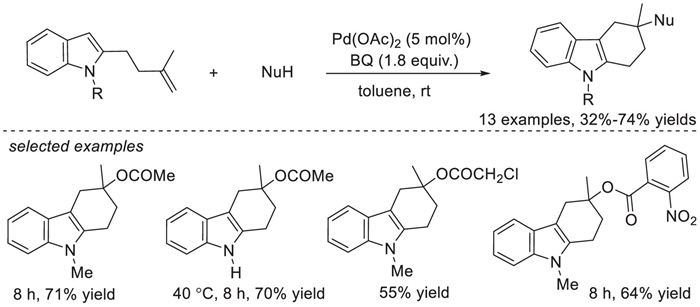
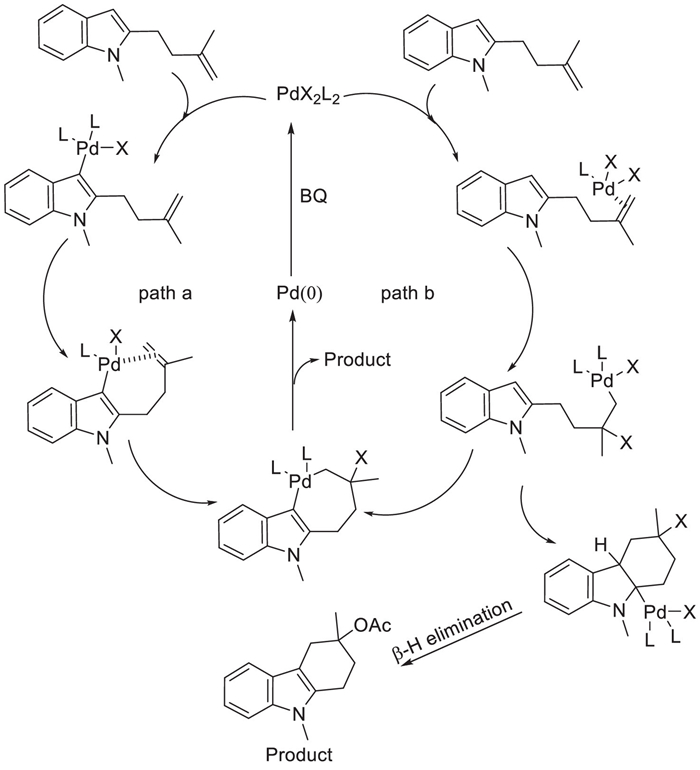
In 2009, Lu and co-workers developed a new and mild palladium(Ⅱ)-catalyzed intramolecular acyloxylation/cyclization of 2-(3′-alkenyl)indoles, providing efficient access to polycyclic structures containing oxygen-functionalized groups. This method, carried out under ambient conditions, exhibited good functional group tolerance using 5 mol% Pd(OAc)2, 1.8 equiv. of benzoquinone (BQ), and 10 equiv. of nucleophile in toluene at room temperature for 8 h (Scheme 17). Overall, this strategy offered a valuable approach for the synthesis of structurally diverse indole derivatives with potential for further functionalization.
The proposed mechanism, as illustrated in Scheme 18, involved two possible pathways. In path A, C–H activation of the indole core by Pd(Ⅱ) formed an initial palladium intermediate, which underwent oxypalladation to generate a key palladacycle intermediate, followed by reductive elimination to afford the cyclized product and Pd(0). In path B, oxypalladation of the coordinated olefin occurred first, followed by intramolecular C–H activation, converging on the same palladacycle intermediate. In both pathways, Pd(0) was reoxidized to Pd(Ⅱ) by BQ. Importantly, BQ served not only as an oxidant, but it also played a crucial role in steering the reaction toward acyloxypalladation over carbopalladation [75].
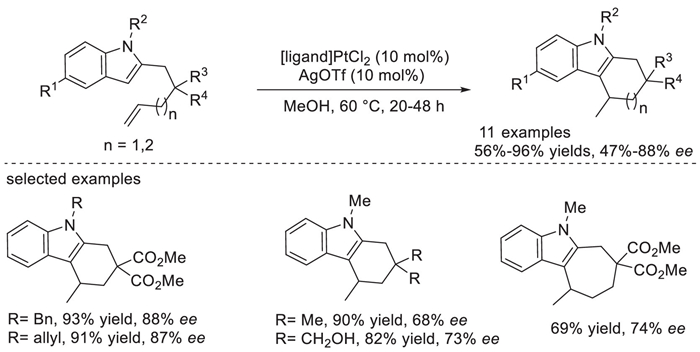
In 2006, the use of platinum as a transition metal catalyst was successfully applied to the asymmetric intramolecular hydroarylation of 2-(4-pentenyl)indoles, offering an efficient method for constructing enantioenriched indole-based tricyclic scaffolds. A 1:1 mixture of the platinum bis(phosphine) complex and AgOTf catalyzed the cyclization reactions in moderate to good yields (56%–96%) with ee values up to 88% (Scheme 19). This method demonstrated broad substrate compatibility, tolerating various electron-donating and electron-withdrawing groups of the indole ring. Overall, this platinum-catalyzed strategy provided a mild and stereoselective route to synthetically valuable tricyclic indole derivatives [76].
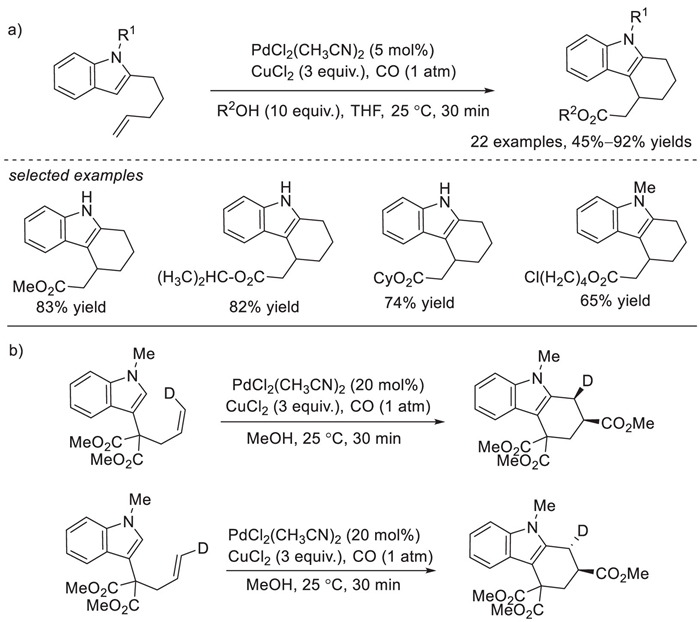
In 2004, Liu and Widenhoefer reported a palladium-catalyzed cyclization/carboalkoxylation of a broad range of alkenyl indole derivatives under mild reaction conditions, enabling the efficient synthesis of functionalized tricyclic indole frameworks [77]. The developed protocol employed PdCl2(CH3CN)2 (5 mol%) in combination with CuCl2 (3 equiv.) in MeOH at room temperature, allowing the conversion of a wide range of 2-(4-pentenyl)indoles, including unprotected, electron-rich, and electron-deficient variants into the desired tricyclic products (Scheme 20). Furthermore, the method was extended toward substitution along the alkenyl chain and at both internal and terminal olefinic positions. This methodology represented the catalytic addition of both a carbon nucleophile and a carbonyl group across the C=C bond of an olefin in alkenyl indoles, offering a powerful approach to the rapid access to structurally complex and functionally rich polycyclic indole architectures.

Two years later, the same group extended their work by palladium-catalyzed cyclization/carboalkoxylation of alkenyl indoles. Treatment of a wide range of alkenyl indoles with a catalytic amount of PdCl2(CH3CN)2 and a stoichiometric amount of CuCl2 in THF and an alcohol under CO at room temperature for 30 min led to the formation of polycyclic indole derivatives in moderate to excellent yields, with high levels of regio- and diastereoselectivity (Scheme 21). Further stereochemical studies using deuterium-labeled (Z)- and (E)-3-(butenyl)indoles confirmed that the reaction proceeded with high stereospecificity, affording cis- or trans-configured products depending on the alkene geometry (Scheme 21b). These results highlight the versatility of this palladium-catalyzed system in constructing complex, stereodefined indole-based frameworks [78].
Typically, multi-functionalized carbazoles or hydrocarbazoles are generated via the cyclization of 2-alkenyl indoles, which occurs at the C3 position of indole ring under transition-metal catalytic conditions. Interestingly, in addition to intramolecular cyclization pathways, intermolecular cyclization of 2-alkenyl indoles with other alkenes or alkynes also are developed.
3-Alkenyl indoles are also an important type of organic synthetic intermediates which have been widely used in the construction of several types of heterocycles [79–84], including carbazole, carbolines, spirooxindoles.
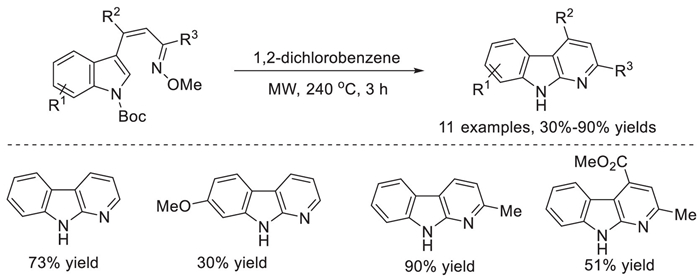
Intramolecular cyclization of 3-(1′-alkenyl)indoles is a useful strategy, which can assemble fused polycyclic compounds and natural products in a highly efficient manner [85]. In 2013, Moody and co-authors reported an intramolecular 6π-electrocyclization of indole-3-alkenyl oximes under microwave irradiation conditions, which afforded α-carbolines as products in 30%−90% chemical yields (Scheme 22) [86]. The authors also mentioned that the indole-3-alkenyl oximes substrates were prepared from indoles via three steps, which included acylation at C-3 of indole, Boc-protection, and Horner-Wadsworth-Emmons reaction with the corresponding phosphonates. Notably, the olefination reaction provided the desired alkenyl oxime ethers generally as mixtures of E/Z-alkene isomers, which could be directly used as substrates without isolation of E/Z isomers. Although this reaction was conducted under extremely high temperature, this reaction afforded an alternative strategy for the synthesis of α-carbolines.
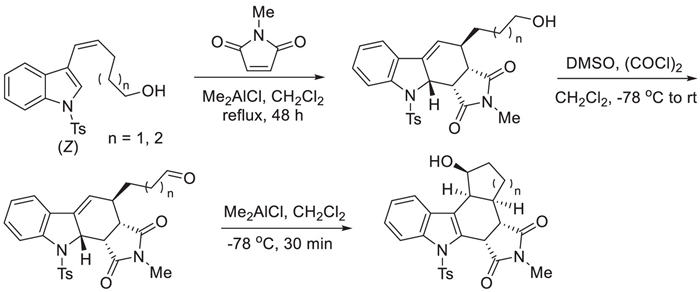
Intermolecular cyclization reaction of 3-(1′-alkenyl)indoles was developed by Hall's group in 2016 [87]. The intermolecular Dielse-Alder reaction between an N-protected 3-vinyl indole and N-methyl maleimide could afford a cycloadduct as the product with Me2AlCl as an additive in high stereoselectivity (Scheme 23). Also, the tetrahydrocarbazole product could be converted into cyclopentyl- or cyclohexyl-fused tetrahydrocarbazole via Swern oxidation and intramolecular carbonyl-ene cyclization by variation in the length of the alkyl chain.
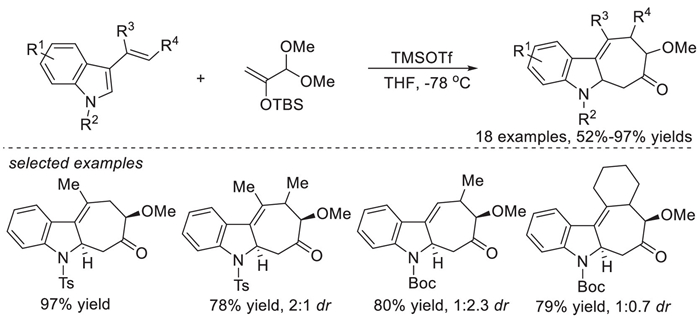
Interestingly, cyclohepta[b]indoles also could be efficiently constructed with 3-alkenylindoles as the staring materials. In 2022, Rawal and co-authors reported a dearomative [4 + 3] cycloaddition reactions of 3-(1′-alkenyl)indoles with dimethoxysilylenolether as oxyallyl cation precursors, which afforded varieties of cyclohepta[b]indole deriatives in good to excellent yields (Scheme 24) [88]. It should be mentioned that the reaction was conducted under extremely low temperature (−78 ℃). Dramatically decreased yield was observed when it was performed at 0 ℃. Lewis acid additive was essential for this transformation. Compared with the metal Lewis acid, TMSOTf was the best one to furnish the corresponding [4 + 3] product in excellent yields. Notably, substrates with terminal alkenyl usually showed excellent diastereoselectivity. However, the diastereomer was observed for the substrates with an internal alkenyl moiety.
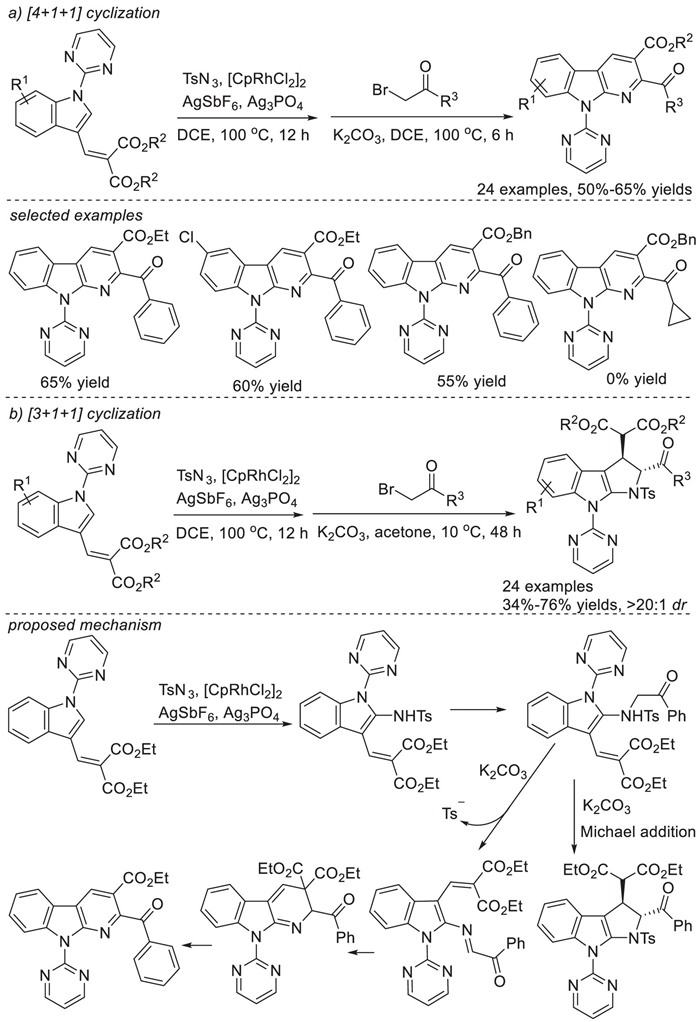
Very recently, Xing, Zhu, and co-authors developed an interesting Rh-catalyzed cyclization reaction of 3-vinylindoles with sulfonylazides and α-bromoketones using AgSbF6 and Ag3PO4 as additives (Scheme 25) [89]. This one-pot two-step reaction could afford α-carbolines and tetrahydropyrrolo[2,3-b]indoles as products just by changing the reaction temperature. This reaction began with the Rh-catalyzed C—N cross-coupling of 3-vinylindoles with sulfonylazides occurring at the C2-position of 3-vinylindoles. At 100 ℃ in dichloroethane, the following reaction with α-bromoketones proceeded through [4 + 1 + 1] cyclization delivering α-carbolines as products in moderate yields. Interestingly, [3 + 1 + 1] cyclization via Michael addition occurred when the reaction with α-bromoketones was carried out at 10 ℃ affording tetrahydropyrrolo[2,3-b]indoles in 34%−76% yields and high diastereoselectivities (> 20:1 dr). Notably, this one-pot reaction showed excellent chemoselectivity, and only α-carbolines or tetrahydropyrrolo[2,3-b]indoles were observed at high temperature and low temperature, respectively. It should be mentioned that the N-pyrimidyl group played a key role in this reaction, which acted as a directing group in the formation of the cyclic products.
3-(2′-Alkenyl)indoles are also especially useful intermediates among various indole derivatives in synthetic organic chemistry. They were usually prepared by Pd-catalyzed allylation of indoles or cyclization with aniline derivatives. Moreover, fused cyclic compounds could be rapidly constructed with 3-(2′-alkenyl)indoles as the starting materials [90–93].
In 2019, Li and co-authors developed a Mn-catalyzed redox-neutral coupling/cyclization reaction of 3-allylindoles with propargylic carbonates affording indole fused [3,2,0] cycles as products (Scheme 26) [94]. This reaction was carried out by using MnBr(CO)5 as a catalyst and sodium acetate as an additive in the presence of dicyclohexylamine at 100 ℃. The reaction also showed good tolerance of substituents on 3-allylindoles or propargylic carbonates, successfully generating the corresponding cyclobuta[4,5]cyclopenta[1,2-b]indole products in good to excellent yields. Moreover, excellent diastereoselectivity (> 20:1 dr) was observed, and only a single diastereomer was obtained for all the examined cases.
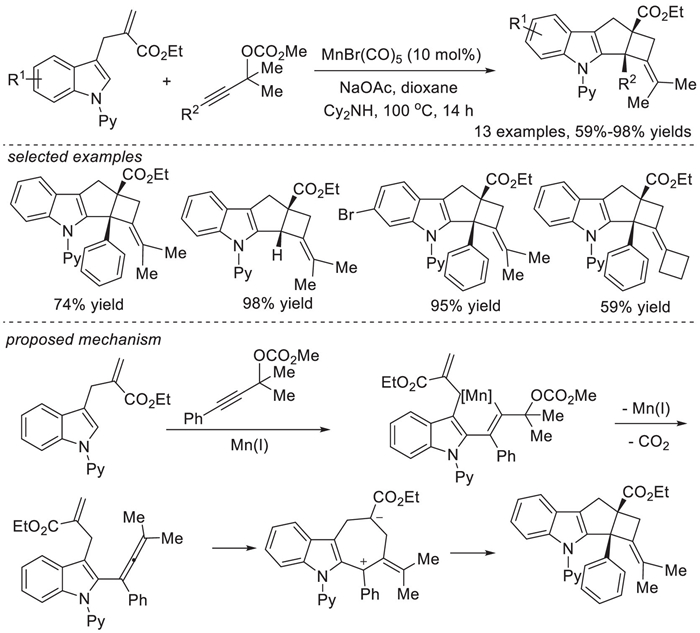
The reaction was proposed to proceed via two cyclization steps, and the mechanism was shown in Scheme 26. Initially, C−H activation of 3-allylindole gave the metallacyclic intermediate, which underwent a regioselective migratory insertion of the Mn−C bond into the alkynyl bond of propargylic carbonate. Then, β-oxygen elimination of the metallacyclic intermediate generated the allenylation intermediate. Finally, the allene intermediate underwent an ionic, stepwise formal [2 + 2] cycloaddition to afford the desired product.
In this work, the authors also described a Mn-catalyzed transformation of 3-alkenylindoles with propargylic carbonates under similar reaction conditions at 90 ℃, which afforded the indole fused eight-membered carbocycles as products.
In 2006, Lu and co-author developed an efficient method for the synthesis of carbazoles via Pd-catalyzed oxidative cyclization with 3-(3′-alkenyl)indoles as starting materials (Scheme 27) [95]. This cyclization reaction was conducted at 80 ℃ with BQ as an oxidant in the presence of acetic acid. A total of fourteen examples were examined delivering the corresponding carbazoles in 22%−88% chemical yields. The substituent on the indole moiety showed an obvious effect on the reaction outcome, and the substrate bearing an electron-withdrawing ester group provided a dramatically lower yield (33%).
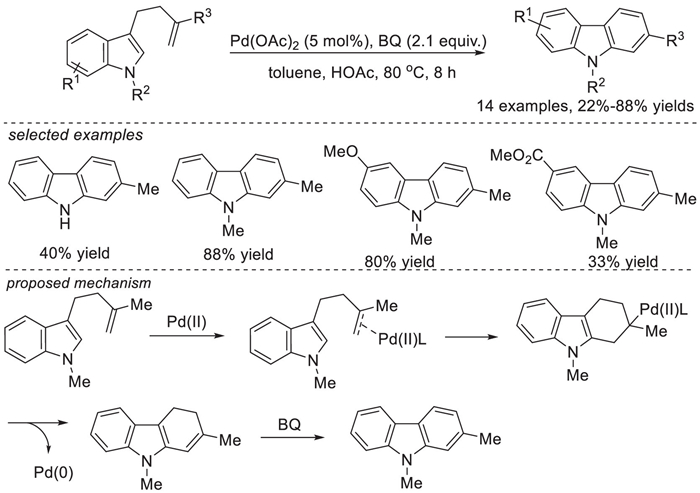
The reaction was proposed to start from the interaction between Pd(Ⅱ) and 3-alkenyl indole. Then, the organic palladium intermediate underwent olefin insertion to generate an alkyl palladium intermediate, which was converted into dihydro-3H-carbazole via β-elimination. Finally, oxidation by BQ afforded the desired carbazole product.
Later in 2007, Yu and co-authors mentioned that 3-alkenyl indole could undergo intramolecular selenation-cyclization by using N-phenylselenophthalimide as selenizing reagent in the presence of p-TsOH generating tetrahydrocarbazole and tetrahydrocyclopenta[b]indole as products [96].
Moreover, cyclization reaction of 3-(3′-alkenyl)indole derivatives has also been used for the synthesis of cyclopenta[b]indoles [97]. In 2019, Coelho and co-authors developed a Pd-catalyzed Fujiwara−Moritani reaction of 5-indolyl-α, β-unsaturated compounds affording exo-alkenyl cyclopenta[b]indoles as products (Scheme 28) [98]. This Pd-catalyzed oxidative intramolecular C−C bond formation reaction was conducted with 3-chloropyridine as a ligand and oxygen as the oxidant at 100 ℃. Interestingly, the 5-indolyl-α, β-unsaturated compounds were prepared via Wittig reaction and the corresponding α, β-unsaturated esters were obtained as a mixture of diastereoisomers with good diastereoselectivities with the E-isomers being the major species. The Z/E isomers mixture could be used directly as the substrates for the cyclization. Also, moderate Z/E stereoselectivity was observed in almost all cases. Notably, the functional group on the alkenyl moiety and N-substituent on the indolyl moiety played an important role in the diastereoselectivity.
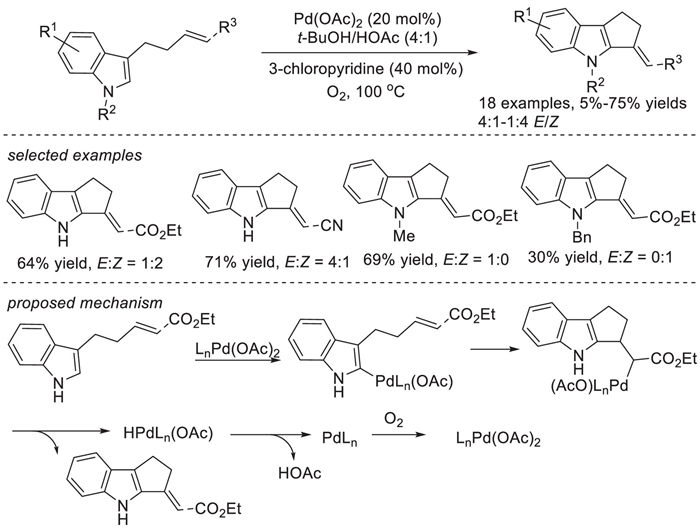
The reaction was proposed to begin with initial palladation at C-2 of indolyl moiety, followed by insertion of alkene to form the cyclic intermediate. Finally, β-elimination occurred, leading to the desired cyclopenta[b]indole product and the palladium hydride species. Decomposition and oxidation by molecular oxygen of palladium hydride generated the palladium catalyst for the next cycle.
In 2021, Han's group reported a type of 3-alkenyl indoles prepared with gramine derivatives as the starting materials. Also, these new 3-alkenyl indole derivatives were developed as radical acceptors with sodium sulfinates as radical sources in a cyclization reaction under electrochemical conditions (Scheme 29) [99]. This electrochemical reaction did not need any transition-metal catalyst and chemical oxidizing reagent, affording multiple-functionalized tetrahydrocarbazoles as products in 32%−83% chemical yields. A variety of 3-alkenyl indoles with different substituted groups on the indolyl or alkenyl moiety were examined in this cyclization reaction. The results showed that substrates containing N1-substitued indolyl or methyl substituted alkenyl were all suitable for this reaction. The scope studies of sodium sulfinates showed that both aromatic and aliphatic sulfinates were well tolerated in this reaction. It should be mentioned that this reaction provided an efficient and green strategy to sulfonylalkyl-substituted tetrahydrocarbazoles. The authors proposed a mechanism based on several control experiments, which began with anodic oxidation of sulfinate to sulfonyl radical. Radical addition to the alkenyl moiety of 3-alkenyl indole, followed by radical cyclization at the C2 position to give the cyclic intermediate. Finally, anodic oxidation and deprotonation of the cyclic intermediate led to the desired tetrahydrocarbazole.
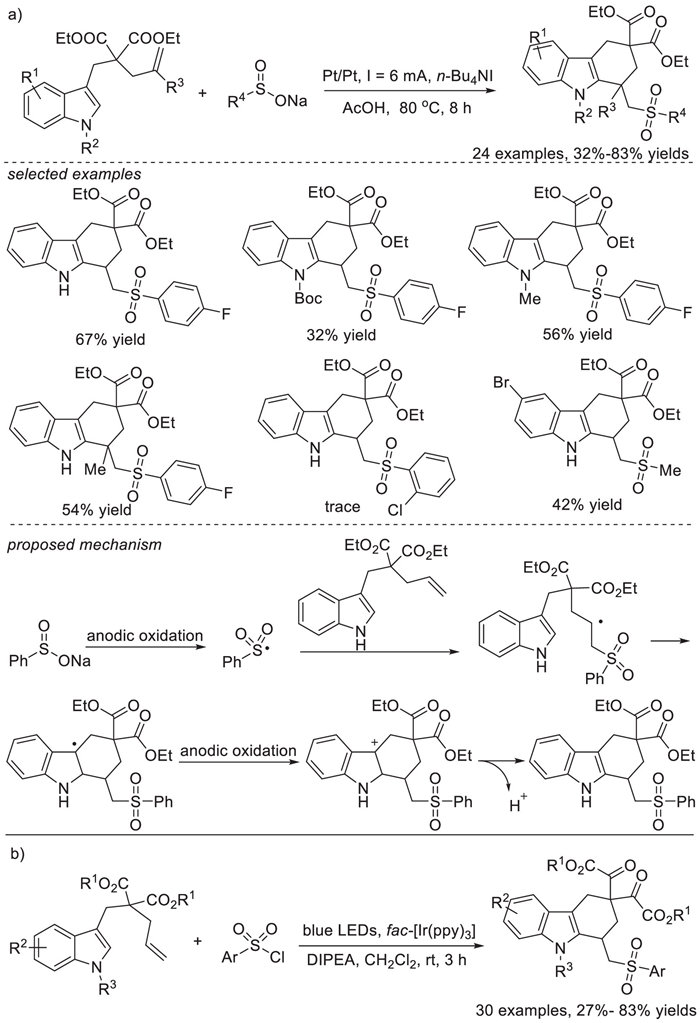
Besides the electrochemical sulfonylation/cyclization, the authors also reported a visible-light-irradiated radical sulfonylation/cyclization of these 3-(4′-alkenyl)indoles by using sulfonyl chlorides as sulfonyl sources, which also delivered tetrahydrocarbazoles as the products (Scheme 29b) [100].
Later in 2023, the same group extended the study of these 3-alkenyl indoles, and they reported a new series of indole-tethered terminal alkynes [101]. These indole-tethered terminal alkynes could also undergo the electrochemical sulfonylation-triggered cyclization reaction with sulfinates as sulfonyl sources, and afforded exocyclic alkenyl tetrahydrocarbazoles as products in good chemical yields.
These 3-(4′-alkenyl)indole compounds were also developed for the construction of tetracyclic tetrahydrocarbazoles by Han's group in 2022. They developed an interesting visible-light-promoted cascade reaction of 3-(4′-alkenyl)indoles with bromodifluoroacetate esters as radical coupling partners and electrophiles (Scheme 30) [102]. This cascade reaction was carried out at room temperature in the presence of base TMEDA, affording the functionalized tetracyclic tetrahydrocarbazoles in 11%−84% yields. Although the ester group on 3-alkenyl indoles did not participate in the transformation, it showed an obvious effect on the reaction outcome. No reaction was observed when changing the ethyl ester to methyl ester. Besides functionalized tetracyclic tetrahydrocarbazoles, the authors also applied this photocatalytic cascade strategy in the preparation of tetracyclic tetrahydro-γ-carboline derivatives [103].
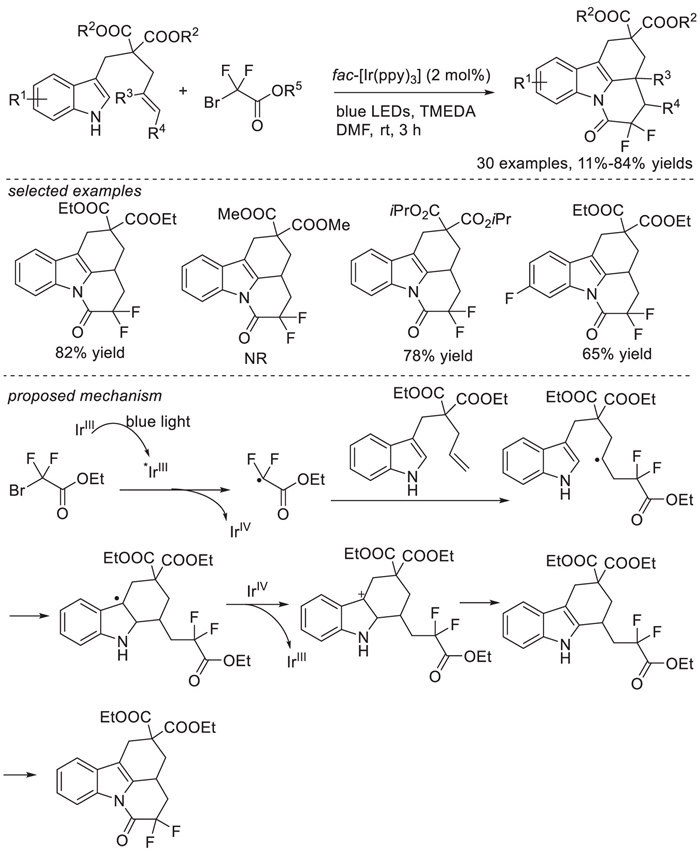
The reaction mechanism was shown in Scheme 30. Reduction by the excited state IrⅢ generated difluoroacetate radical, which added to the alkene moiety to afford a new radical intermediate. Then, intramolecular cyclization, oxidation, and deprotonation delivered the difluoroacetyl tetrahydrocarbazole, which underwent intramolecular substitution to give the final tetracyclic product.
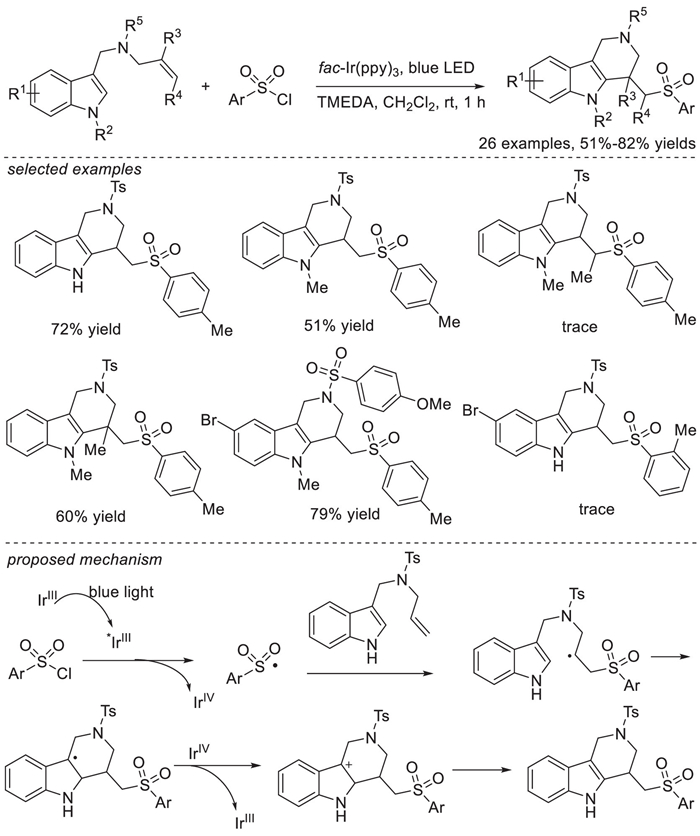
Based on their previous works, Han's group reported a new type of 3-(4′-alkenyl)indoles, N-((1H-indol-3-yl)methyl)-N-allyl sulfonamides in 2022. These 3-(4′-alkenyl)indoles could be used as radical acceptors leading to the formation of functionalized tetrahydro-γ-carbolines (Scheme 31) [104]. The visible-light promoted reaction using Ir(ppy)3 as the catalyst and sulfonyl chlorides as radical sources in the presence of TMEDA efficiently generated sulfonylmethyl tetrahydro-γ-carbolines in 51%−82% yields. Notably, substrate scope studies disclosed that the steric hindrance showed an obvious effect on the reaction outcome. Substrate bearing an internal alkenyl moiety did not work in this reaction. Also, almost no tetrahydro-γ-carboline product was observed in the case of o-methylphenylsulfonyl chloride. Similar to the previous reactions [102,103], this photoredox reaction also proceeded through the sequence of reductive generation of sulfonyl radical, radical addition to olefin bond, cyclization, oxidation, and deprotonation.
They also developed a series of indole-tethered terminal alkynes and applied these alkynes in an electrochemical reaction with sulfinates as sulfonyl sources to furnish exo-vinyl tetrahydro-γ-carbolines [105].
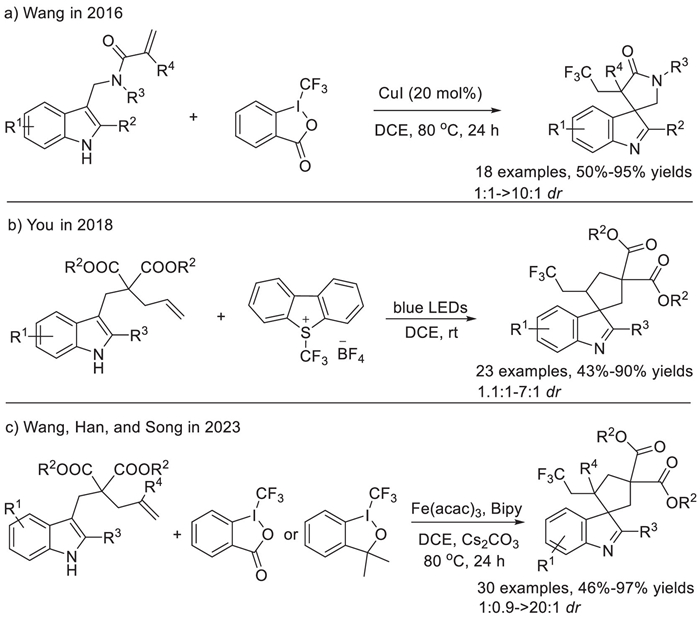
Spiroindolenines are important skeletons existing in numerous bioactive molecules and natural products. These useful compounds also could be constructed by cyclization reaction of indole-tethered alkenes [106,107]. In 2016, Wang and co-authors developed a CuI-catalyzed trifluoromethylation-triggered cyclization/indole dearomatization of indole-containing acrylamides. The reaction with Togni's reagent as a trifluoromethyl source was conducted under 80 ℃ delivering the corresponding spiro[indole-3,3′-pyrrolidine] in 50%−95% yields and moderate to good diastereoselectivity (Scheme 32a) [108]. Later in 2018, You and co-authors reported a synthetic method for the preparation of trifluoromethyl-substituted spiroindolenines via a visible-light-promoted cyclization/dearomatization reaction (Scheme 32b) [109]. The reaction used Umemoto's reagent as the trifluoromethyl source affording the corresponding products in 43%−90% yield and 1:1- > 20:1 diastereoselectivities. This reaction was carried out at room temperature and proceeded via an EDA complex in situ generated between indole derivatives and Umemoto's reagent. In 2023, Wang, Han, Song, and co-authors used Togni's reagents (Togni Ⅰ or Togni Ⅱ reagent) as trifluoromethyl sources and Fe(acac)3 as a catalyst to achieve a similar trifluoromethylated initiated cyclization/dearomatization reaction (Scheme 32c) [110]. The reaction also was conducted at 80 ℃ affording the corresponding products in moderate to excellent yields.
In 2024, an interesting electrochemical cascade multicomponent reaction N-((1H-indol-3-yl)methyl)-N-allyl sulfonamides with sodium trifluoromethylsulfinate, tetrabutyl ammonium iodide, and water (Scheme 33) [111]. Surprisingly, the reaction did not afford the trifluoromethylated tetrahydro-γ-carbolines as products. The reaction was conducted under a consistent current of 10 mA with acetonitrile/water as a co-solvent at 80 ℃ delivering the spiropyrrolidinyl-oxindoles as products in good yields and high diastereoselectivity. The substituted group on the indole moiety showed an obvious effect on the reaction outcome. The substrate containing an N1-alkyl substituted indolyl moiety did not work in this electrochemical transformation. The authors also carried out several control experiments and density functional theory (DFT) calculation studies, and provided a possible mechanism for this reaction.
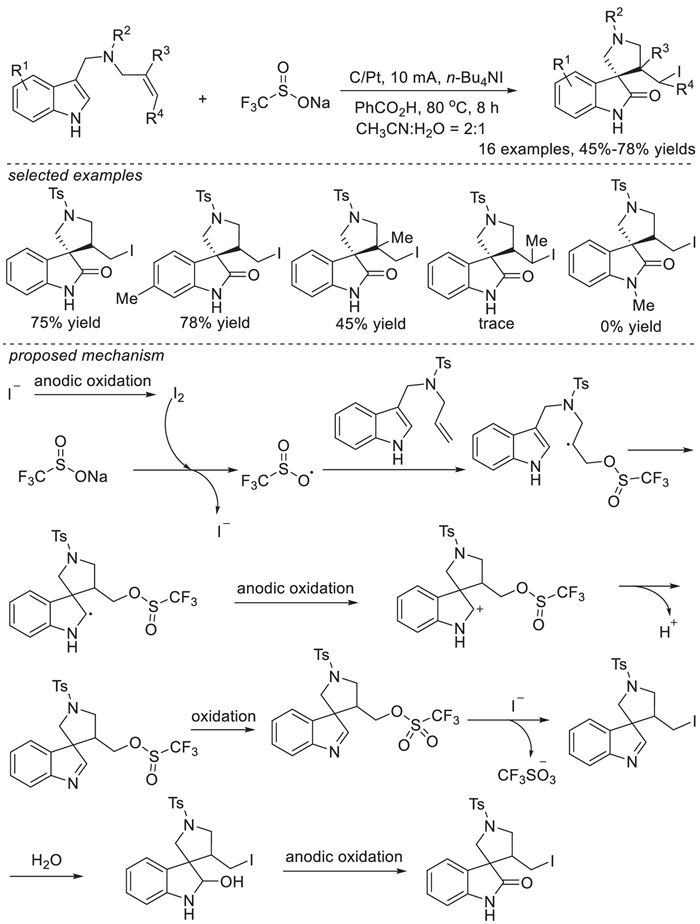
Initially, addition of CF3S(O)O· radical to the alkenyl moiety generated the alkyl radical intermediate, which underwent regioselective intramolecular spirocyclization at the C3 position of indole to provide the radical spirointermediate. Then, anodic oxidation of the spirointermediate followed by deprotonation gave the indolenine intermediate. Subsequently, anodic oxidation of sulfinate to give sulfonic ester followed by a substitution reaction by iodide anion to form iodomethyl indolenine intermediate. Finally, water addition of the iodomethyl indolenine intermediate followed by anodic oxidation generated the desired spiropyrrolidinyl-oxindole product.
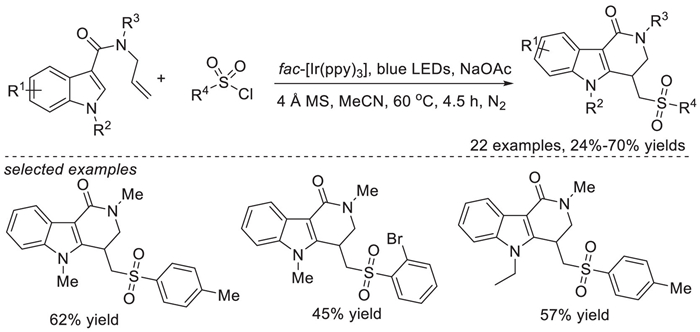
In 2024, 3-indolylallylamides were developed as an efficient type of radical acceptors in a visible-light-promoted cyclization. The cyclization reaction of 3-indolylallylamides with sulfonyl chlorides as radical coupling partners proceeded smoothly at 60 ℃ in the presence of sodium acetate under nitrogen atmosphere, which delivered the functionalized sulfonylmethyl tetrahydrocarbolinones in 24%−70% yields (Scheme 34) [112]. This reaction proceeded via a similar pathway [104], which involved the reduction of sulfonyl chlorides to sulfonyl radicals, addition of sulfonyl radicals to the alkenyl moiety, and cycloaddition to indolyl at the C2 position.
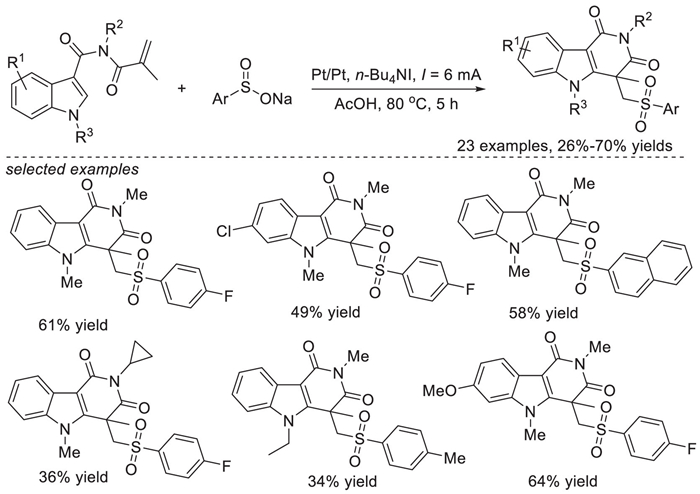
Very recently, Mei, Han, and co-authors reported the first example of the electrochemical radical cyclization reaction of N-acryloyl-indole-3-carboxamides with sodium sulfinates as coupling partners. This electrochemical reaction was performed at 80 ℃ in the presence of acetic acid, which delivered multi-substituted γ-carbolinones as products in 26%−70% chemical yields (Scheme 35) [113]. The reaction showed good tolerance of the substituent on different positions of N-acryloyl-indole-3-carboxamides. For example, the substrate bearing cyclopropanyl on the carboxamide moiety also worked well in this reaction to afford the corresponding γ-carbolinone product in 36% yield. A possible mechanism was provided based on the experimental results, which included oxidation of iodide anion, reaction with sulfinate to give sulfonyl iodide, cleavage of sulfonyl iodide to give sulfonyl radical, radical addition, cyclization, anodic oxidation, and deprotonation. It should be mentioned that visible-light-promoted sulfonylation-triggered cyclization of N-alkyl-acryloyl-1H-indole-3-carboxamides with sulfonyl chloride as sulfonyl precursors has been reported by He, Guan, and co-authors in 2021 [114].
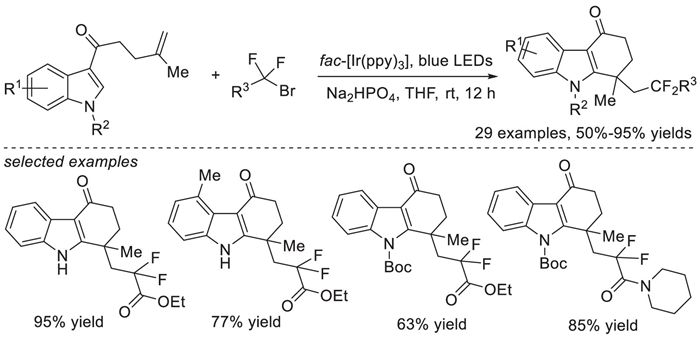
In 2023, Li and co-authors also developed a type of 3-(4′-alkenyl)indoles, which were employed in a visible-light-promoted cyclization (Scheme 36) [115]. The photoredox reaction of 1-(1H-indol-3-yl)pent-4-en-1-ones used fac-Ir(ppy)3 as a catalyst and bromodifluoroalkyl compounds as the radical coupling partners, affording difluoroalkylindoles as products at room temperature in moderate to excellent chemical yields. Several radical difluoroalkyl precursors, including bromodifluoroacetate esters, bromodifluoroacetamides, and bromodifluorophosphonate, were all well tolerated in this visible-light-initiated reaction. The reaction proceeded via a similar difluoroalkylation triggered cyclization pathway, which involved the generation of a difluoroalkyl radical, radical addition to 3-alkenyl indole, intramolecular cyclization, oxidation, and deprotonation.
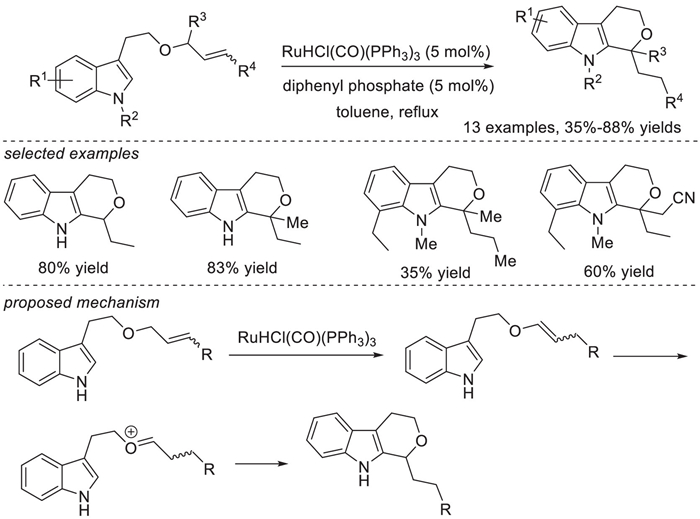
Cyclization reaction of 3-(5′-alkenyl)indoles has also been developed in 2014. Nielsen and co-authors reported a dual ruthenium hydride/Brønsted acid-catalyzed isomerization/cyclization of 3-(5′-alkenyl)indoles, affording 1,3,4,9-tetrahydropyrano[3,4-b]indoles as products in 35%−88% yields (Scheme 37) [116]. The reaction used RuHCl(CO)(PPh3) and diphenyl phosphate as the co-catalyst converting several indole-tethered allylic ethers into the corresponding products. It should be mentioned that the substituent on the allylic ether moiety showed almost no effect on the reaction outcome. The reaction was proposed to begin with ruthenium hydride-catalyzed isomerization of alkenyl bond of allylic ether. The generated vinyl ether intermediate was transferred into oxocarbenium ion catalyzed by diphenyl phosphate. Finally, intramolecular cyclization occurred to afford the desired tetrahydropyrano[3,4-b]indole product. Notably, this dual catalyzed reaction provided an alternative way for the preparation of tetrahydropyrano[3,4-b]indole derivatives.
In 2015, Tang, Shi, and co-authors applied 3-(5′-alkenyl)indole derivatives in the synthesis of spiroindoline piperidines (Scheme 38) [117]. They employed a series of nitrogen or carbon-tethered indolylcyclopropenes as substrates in a silver-catalyzed intramolecular cyclization reaction. The Ag-catalyzed reaction was conducted in toluene at 80 ℃ affording the desired spiroindoline piperidines or spiroindoline cyclohexane products in up to 82% yields. For the nitrogen-tethered indolylcyclopropene substrates, o-nitrobenzenesulfonyl substituted compound was not tolerated in this reaction, and no desired product was obtained. Interestingly, changing the sulfonylamide moiety to a malonate unit was also successful, and the corresponding spiroindoline cyclohexane was obtained in 43% yield.

Later in 2016, Shi and co-workers developed a chiral phosphoric acid (CPA)-catalyzed [3 + 2] cyclization of 3-vinylindoles with isatin-derived 3-indolyl-methanols, which afforded the enantio-enriched spirooxindolyl-cyclopenta[b]indole scaffolds linking a 3-indolyl moiety in 49%−93% yields (Scheme 39) [118]. As the research in the field progressed, a wide variety of CPAs bearing bulky 3,3′-substituentson the 1,1′-bi-2,2′-naphthol (BINOL) backbones have been developed to enhance the catalytic efficiency. The results showed that CPA with 3,3′-p-chlorophenyl groups exhibited the best activity with up to > 95:5 diastereoselectivities and > 99.5:0.5 enantioselectivities. The reaction was proposed to proceed via activation of isatin-derived 3-indolyl-methanols by CPA anion via ion pair and/or hydrogen-bonding interactions, while N-protected 3-vinylindole could not be activated due to the existence of the N-methyl group. Scale-up synthesis with increasing the amount of isatin-derived 3-indolyl-methanols substrate from 0.1 to 0.5 mmol was also developed, and also good result was obtained with 78% yield, 78:22 dr and 99:1 er. This reaction was conducted under mild conditions, which provided an efficient strategy for the construction of chiral spirooxindolyl-cyclopenta[b]indole derivatives.

As shown in this section, when the alkenyl moiety is linked to the indole skeleton, several types of cyclization reactions have been reported for this class of indole-tethered alkenes. Cyclization can occur at C2 to afford carbazoles and carbolines. Even cyclization at C3 position has been reported, providing an alternative route to spiroindole derivatives. Notably, a recent trend in this area involves the use of green strategies, such as visible-light photocatalysis and electrosynthesis.
Cyclization reaction of 1,6-enynes is a well-known method for the synthesis of polycyclic compounds. Among these enynes, indole-tethered enynes represent a powerful type of synthetic intermediates, and provide an efficient way for the rapid assembly of indole-fused polycycles [119] or bridged polycycles [120].
In 2024, Zuo, Yan, Jiang, and co-authors developed an interesting photocatalytic bicyclization of readily available 1-acryloyl-2-alkynyl indoles with α-benzyl-α-bromomalonates as radical coupling partners (Scheme 40) [121]. The optimization of reaction conditions showed that using fac-Ir(ppy)3 as a catalyst, K2CO3 as a base at room temperature under a nitrogen atmosphere provided the best results. The reaction showed a good substrate structure generality, and a series of functionalized pyrrolo[3,2,1-jk]carbazoles were obtained in 34%−68% chemical yields. Also, the reaction exhibited good diastereoselecitivty and > 19:1 disatereoselecitivites were observed for most cases.
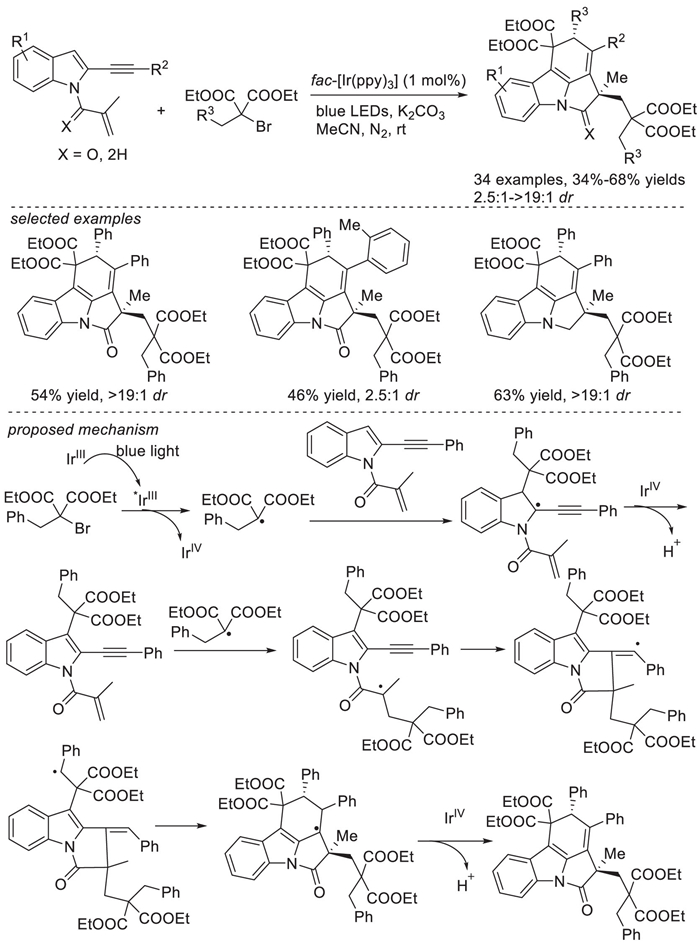
The authors also carried out the mechanism investigation as well as DFT calculations, and provided a possible mechanism for this transformation. Firstly, generation of diethyl 2-benzylmalonate radical from 2-benzyl-2-bromomalonate via single-electron transfer occurred, which added to the indolyl moiety at C3 position leading to the indole radical intermediate. Then, oxidation and deprotonation happened to give the C3 functionalized intermediate, which underwent a radical addition at the vinyl moiety by diethyl 2-benzylmalonate again. The resulting radical intermediate then underwent a 5-exo-dig cyclization and regioselective 1,6-hydrogen atom transfer. The resulting cyclic intermediate underwent a 6-endo-trig cyclization to deliver the radical tetracyclic intermediate. Finally, oxidation and deprotonation afforded the desired pyrrolo[3,2,1-jk]carbazoles.
Shortly after this work, the same group extended this photocatalytic bicyclization of indole-tethered 1,6-enynes by utilizing thiosulfonates or selenosulfonates as radical precursors [122]. The thio/seleno-sulfonylation−bicyclization reaction was proposed to proceed via the sequence of homolytic cleavage, radical addition, 5-exo-dig, radical coupling, and a Mallory reaction. The reaction was also conducted under mild conditions affording various thiosulfonylated or selenosulfonylated benzo[c]pyrrolo[1,2,3-lm]carbazoles in moderate to high yields.
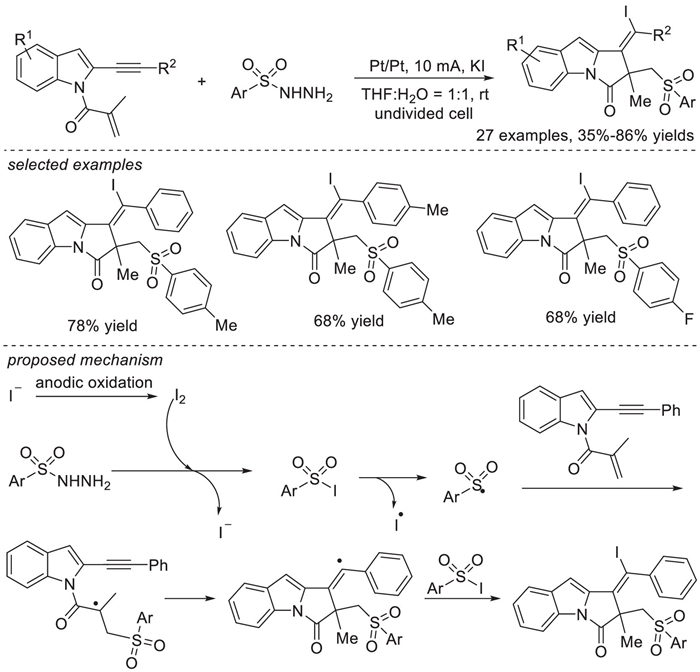
Also, they developed the first example of electrochemical cyclization–iodosulfonylation of indole-tethered 1,6-enynes with arylsulfonyl hydrazides as sulfonyl sources and KI as an iodo source. The reaction was carried out at room temperature with THF/H2O as a co-solvent under an undivided cell, affording iodosulfonated pyrrolo[1,2-a]indoles in 35%−86% chemical yields with high stereoselectivity (Scheme 41) [123]. The proposed mechanism was shown in Scheme 41, which began with the anodic oxidation of iodide ions to molecular iodine. Then, molecular iodine reacted with sulfonyl hydrazides to sulfonyl iodide, which underwent homolytic cleavage to form the S-centered sulfonyl radical and an iodine radical. Subsequently, radical addition to the alkenyl moiety followed by intramolecular cyclization gave the vinyl radical intermediate. Finally, reaction of the vinyl radical intermediate with arylsulfonyl iodide delivered the desired pyrrolo[1,2-a]indole product.
Besides arylsulfonoyl hydrazides and KI as radical coupling partners, Zuo and co-authors further developed this cyclization reaction by using haloacetonitrile as a radical coupling partner. They reported in the same year a Cu-catalyzed radical cyclization/halocyanomethylation of indole-linked 1,6-enynes, enabling the synthesis of halovinyl and cyanomethylated pyrrolo[1,2-a]indoles with yields ranging from 42% to 81% and excellent Z/E selectivities. Interestingly, bicyanomethylated pyrrolo[1,2-a]indole products were obtained when the reaction temperature was increased from 70 ℃ to 100 ℃ [124].
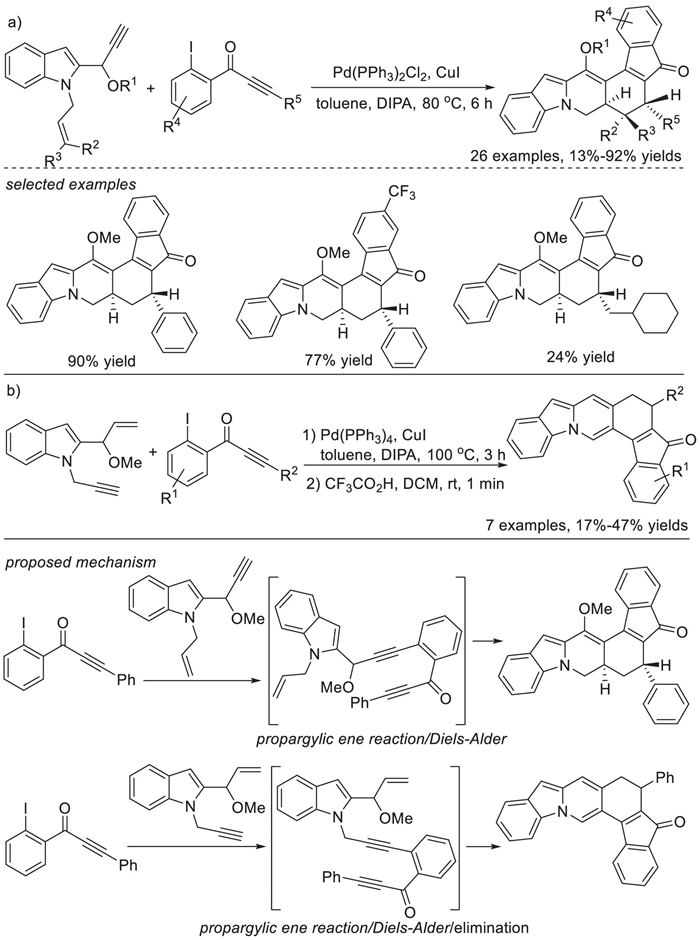
In 2025, Zhu and co-authors developed a Pd/Cu-catalyzed reaction between iodoalkynones with propargylic ethers bearing indole-tethered unactivated alkenes affording the fused polycyclic indole-indenone derivatives as products (Scheme 42) [125]. Interestingly, when 1-alkenyl-2-alkynyl indoles were used as substrates to react with iodoalkynones, the reaction proceeded through the sequence of Sonogashira coupling, Alder-ene reaction, and Diels−Alder cycloaddition to generate the polycyclic dihydropyrido[1,2-a]indole products. On the other hand, when the substrates were changed into 1-alkynyl-2-alkenyl indoles, the reaction with iodoalkynones under an increased temperature (100 ℃) afforded polycyclic compounds containing pyrido[1,2-a]indole after treatment with trifluoroacetic acid. It should be mentioned that the reaction showed high selectivity and only one diastereomer was observed for all the cases.
Cyclization reaction of the indole-tethered alkenes with unsaturated chains linked at C2 and C3 positions has also been reported by Ye and co-authors in 2019. The indole-tethered alkene substrates contained an ynamide moiety at the C3 position and an allyl ether chain at the C2 position. This reaction used HNTf2 as a Brønsted acid catalyst and was conducted at 40 ℃ affording the bridged [4.2.1] lactones as products in 42%−86% yields and high diastereoselectivities. It is worthy of mention that chiral products with excellent enantioselectivity (98% ee) could be generated when the substrates bearing an oxazolidinone-derived chiral ynamide (Scheme 43) [126].
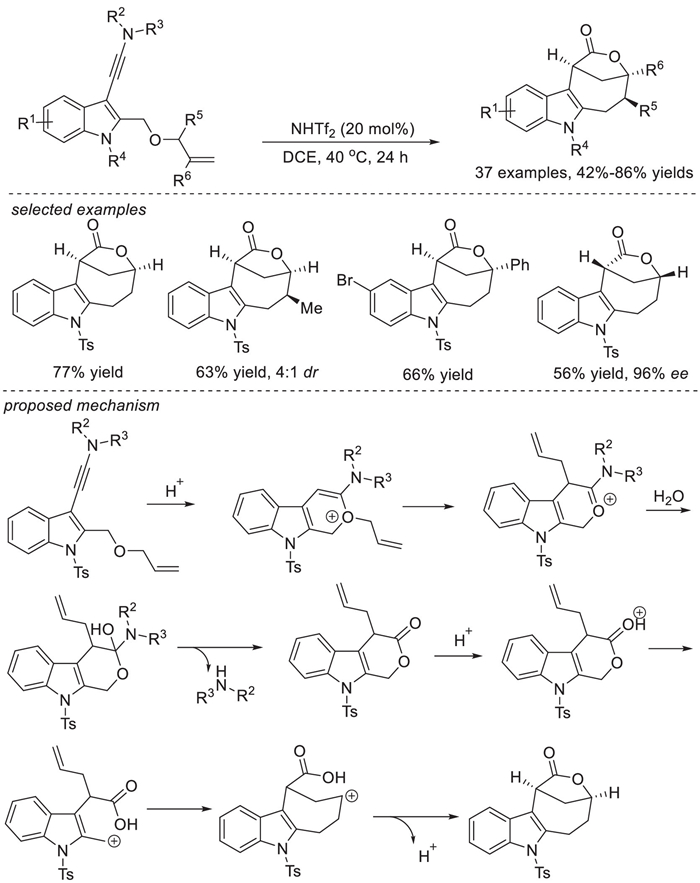
The authors proposed a Brønsted acid-catalyzed intramolecular alkoxylation-initiated tandem sequence for this reaction based on their experimental results. The reaction began with the alkoxy group attacking the ynamide to generate the Claisen rearrangement precursor, which underwent [3,3] rearrangement. Then, the obtained cyclic cation intermediate was trapped by water followed by leaving of the sulfonamide group, affording the indole-fused lactone intermediate. Brønsted acid promoted the ring opening of lactone delivered the carbocation intermediate, which underwent an intramolecular cyclization generating another carbocation intermediate. Finally, the carbocation was further captured by the carboxylic acid group to afford the final product.
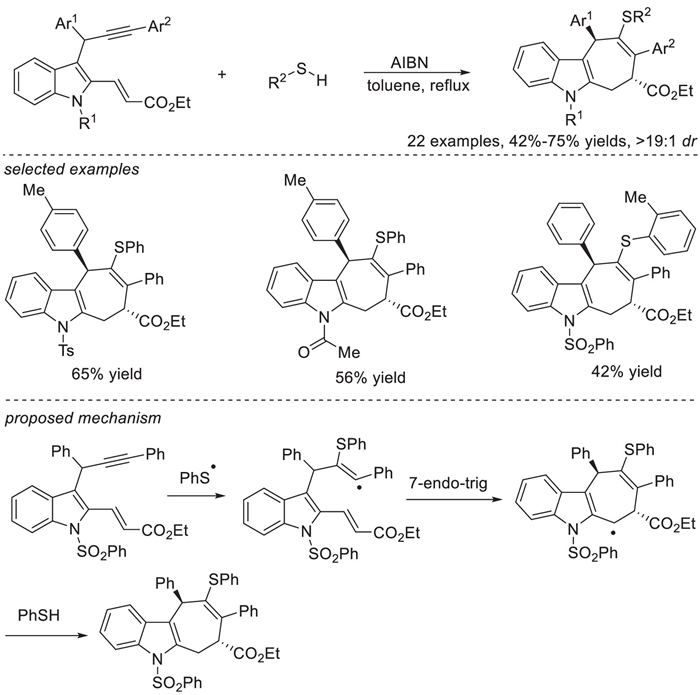
Later in 2024, Gharpure and co-author reported a series of indole-tethered alkenes/alkynes and their application in radical cyclization reaction (Scheme 44) [127]. The cyclization reaction of these 3-propargyl-2-alkenyl indoles with thiols was promoted by azodiisobutyronitrile (AIBN) and refluxed in toluene, affording seven-membered ring fused indole compounds as the products. The cyclohepta[b]indole products were obtained in moderate yields (42%−75%) with tolerance of a variety of substituted groups. Notably, excellent diastereoselectivities were observed for all the cases and > 19:1 dr was detected. It should be mentioned that for some substrates bearing N-alkyl indole moiety provided carbazole product at the same time. Accordingly, the authors proposed a mechanism involving the generation of thiyl radical, regioselective radical addition to the alkynyl moiety of 3-propargyl-2-alkenyl indole, 7-endo-trig radical cyclization, and absorption of a hydrogen atom. An alternative pathway involving 6-exo-trig radical cyclization, 3-exo-trig radical cyclization, and ring expansion was also proposed.
In 2020, cyclization reaction of the indole-tethered alkenes with unsaturated chains linked at C3 and C4 positions was reported by Reddy and co-authors (Scheme 45a) [128]. They developed a Rh-catalyzed cyclization reaction of 4-alkynyl-3-alkenyl indoles with N-(pivaloyloxy)arylamides and N-(pivaloyloxy)-1H-indole-1-carboxamides affording polycyclic 3,4-fused indoles as products. Seventeen examples were shown in this work and were smoothly converted into the final products in moderate to good chemical yields. It should be mentioned that the substituent on the alkynyl moiety showed an obvious effect on the reaction outcome. Internal alkynyl-containing substrate was not a suitable substrate for this cyclization.

The reaction was proposed to begin with the formation of a five-membered rhodocycle intermediate via C—H bond activation. Then, insertion of the alkynyl moiety led to the seven-membered rhodocycle intermediate, which underwent reductive elimination and protonation to construct the first cycle. Finally, intramolecular aza-Michael addition in the presence of CsOAc generated the corresponding polycyclic 3,4-fusedindole product.
Later in 2022, the same group subjected these 4-alkynyl-3-alkenyl indoles into a one-pot carbometalation reaction of alkyne followed by intramolecular Michael addition (Scheme 45b). The reaction proceeded via the sequence of Pd-catalyzed reaction of alkyne moiety with boronic acids, TfOH-promoted Michael addition, and isomerization delivering benzo[c, d]indoles as products in 51%−72% yields [129].
Cyclization reaction of multi-alkenyl indoles has attracted increasing attention, as it enables the construction of diverse indole-fused polycycles, bridged polycycles, and spirocycles by varying the positions of the alkenyl groups. Most of the studies have focused on the substrates with alkenyl/alkynyl moieties linked to the N1, C2, and C3 positions. In contrast, there remains a great challenge in the cyclization reaction of indole-tethered alkenes involving C4 and C7-alkenyl due to the formation of rigid cyclic frameworks.
In this review, the recent development on the construction of indole-containing polycyclic compounds via cyclization reactions of indole-tethered alkenes was summarized, including the reaction development, substrate tolerance, and the preparation of polycyclic molecules bearing an indole core. The indole-tethered alkenes with alkenyl moiety linked at N1, C2, and C3 positions was covered and discussed. In the past years, great achievements have been made on the cyclization of indole-tethered alkenes. However, there are still growing interests involved in the research of this area due to the extreme importance of the indole-containing heterocyclic scaffolds in chemistry and biochemistry. For example, there is an obvious trend in the applications of green tools, such as electrosynthesis, in the cyclization reactions of indole-tethered alkenes. On the other hand, there is still ample room for the design of new indole-tethered alkenes, such as 1-(1′-alkenyl)indoles and 2-(2′-alkenyl)indoles, which can be used for the construction of novel heterocycles. Indeed, cyclization of indole-tethered alkenes is really a hot research topic, and several related works have been reported very recently [130–135]. All in all, as varieties of indole-containing polyheterocycles could be rapidly assembled via cyclization of indole-tethered alkenes just by variations of the position of the alkenyl group linked to indole species, we believe that more and more attention will be involved in this promising and fast-growing multidisciplinary area.
The authors declare no conflicts.
Haibo Mei: Writing – original draft, Validation, Investigation, Formal analysis. Anas Semghouli: Writing – original draft, Methodology, Formal analysis. Loránd Kiss: Writing – review & editing, Validation, Supervision, Conceptualization. Jianlin Han: Writing – review & editing, Validation, Supervision, Project administration, Data curation, Conceptualization.
We gratefully acknowledge the financial support from the National Natural Science Foundation of China (No. 21761132021). The authors gratefully acknowledge financial support from the National Research, Development and Innovation Office of Hungary (NKFIH/OTKA K 142266).
S.M. Umer, M. Solangi, K.M. Khan, R.S.Z. Saleem, Molecules 27 (2022) 7586. doi: 10.3390/molecules27217586
X. Mo, D.P. Rao, K. Kaur, et al., Molecules 29 (2024) 4770. doi: 10.3390/molecules29194770
S. Fernández, V. Arnáiz, D. Rufo, Y. Arroyo, Mar. Drugs 22 (2024) 126. doi: 10.3390/md22030126
A. Dorababu, RSC Med. Chem. 11 (2020) 1335–1353. doi: 10.1039/d0md00288g
V.M. Norwood IV, R.W. Huigens Ⅲ, ChemBioChem 20 (2019) 2273–2297. doi: 10.1002/cbic.201800768
W. Zeng, C. Han, S. Mohammed, et al., RSC Med. Chem. 15 (2024) 788–808. doi: 10.1039/d3md00677h
Z. Zhu, S. Lu, W. Chen, J. Agric. Food Chem. 73 (2025) 22979–22993. doi: 10.1021/acs.jafc.5c04293
M.J. Nieto, H.K. Lupton, Curr. Med. Chem. 28 (2021) 4828–4844. doi: 10.2174/0929867327666201102114923
T. Yu, W. Liu, B. Chen, et al., Org. Lett. 27 (2025) 1459–1464. doi: 10.1021/acs.orglett.4c04814
L. Fan, X. Zhu, X. Liu, et al., Molecules 28 (2023) 1647. doi: 10.3390/molecules28041647
J.Y. Kim, W. Lee, H.J. Kang, et al., ACS Catal. 11 (2021) 12821–12832. doi: 10.1021/acscatal.1c03797
A.N. Singh Chauhan, G. Mali, G. Dua, et al., ACS Omega 8 (2023) 27894–27919. doi: 10.1021/acsomega.3c02510
Y.S. Zhang, X.Y. Tang, M. Shi, Org. Chem. Front. 2 (2015) 1516–1520. doi: 10.1039/C5QO00216H
B.A. Babalola, M. Malik, O. Olowokere, A. Adebesin, L. Sharma, Eur. J. Med. Chem. Rep. 13 (2025) 100252.
S. Das, ACS Omega 9 (2024) 36023–36042.
M. Friedman, Int. J. Tryptophan Res. 11 (2018) 1178646918802282. doi: 10.1177/1178646918802282
G.E. Zúñiga, M.S. Salgado, L.J. Corcuera, Phytochemistry 24 (1985) 945–947. doi: 10.1016/S0031-9422(00)83158-1
Y. Ren, K. DeRose, L. Li, et al., Bioorg. Med. Chem. 92 (2023) 117439. doi: 10.1016/j.bmc.2023.117439
J.C. Alves, ISRN Org. Chem. 2013 (2013) 292396.
J.F. Liu, Z.Y. Jiang, R.R. Wang, et al., Org. Lett. 9 (2007) 4127–4129. doi: 10.1021/ol701540y
M.B. Calvert, J. Sperry, Chem. Commun. 51 (2015) 6202–6205. doi: 10.1039/C5CC00380F
F.G. Gervais, J.P. Morello, C. Beaulieu, et al., Mol. Pharmacol. 67 (2005) 1834–1839. doi: 10.1124/mol.104.009068
M. Ghavami, E.F. Merino, Z.K. Yao, et al., ACS Infect. Dis. 4 (2017) 549–559.
M. Tanaka, M. Ubukata, T. Matsuo, et al., Org. Lett. 9 (2007) 3331–3334. doi: 10.1021/ol071336h
Y. Miyashita, R. Ko, N. Shimada, et al., Thorac. Cancer 12 (2021) 329–338. doi: 10.1111/1759-7714.13742
S. Peters, D.R. Camidge, A.T. Shaw, et al., N. Engl. J. Med. 377 (2017) 829–838. doi: 10.1056/NEJMoa1704795
P. Tfelt-Hansen, Cephalalgia 41 (2021) 1499–1505. doi: 10.1177/03331024211028959
C. Dahlöf, H.C. Diener, P.J. Goadsby, et al., Eur. J. Neurol. 5 (1998) 535–543. doi: 10.1046/j.1468-1331.1998.560535.x
J. Treat, A. Greenspan, A. Rahman, M.S. McCabe, P.J. Byrne, Invest. New Drugs 7 (1989) 231–234. doi: 10.1007/BF00170864
G.V. Frajese, F. Pozzi, G. Frajese, Clin. Interv. Aging 1 (2006) 439–449. doi: 10.2147/ciia.2006.1.4.439
J.L. Li, Q. Zhao, C. Guo, et al., Adv. Synth. Catal. 363 (2021) 4497–4515. doi: 10.1002/adsc.202100714
Y.C. Zhang, F. Jiang, F. Shi, Acc. Chem. Res. 53 (2020) 425–446. doi: 10.1021/acs.accounts.9b00549
B. Baruah, C.D. Pegu, M.L. Deb, Topics Curr. Chem. 382 (2024) 18. doi: 10.1007/s41061-024-00463-y
J.S.S. Neto, G. Zeni, Org. Chem. Front. 7 (2020) 155–210. doi: 10.1039/c9qo01315f
A. Palmieri, M. Petrini, Adv. Synth. Catal. 367 (2025) e202401237. doi: 10.1002/adsc.202401237
M. Shiri, Chem. Rev. 112 (2012) 3508–3549. doi: 10.1021/cr2003954
F. Feng, S. Xu, X. Wang, et al., Chin. J. Org. Chem. 45 (2025) 52632017.
J. Bariwal, L.G. Voskressensky, E.V. Van der Eycken, Chem. Soc. Rev. 47 (2018) 3831–3848. doi: 10.1039/c7cs00508c
W. Wang, Y. Xu, X. Liao, Tetrahedron Lett. 156 (2025) 155451. doi: 10.1016/j.tetlet.2024.155451
M. Petrini, Chem. Eur. J. 23 (2017) 16115–16151. doi: 10.1002/chem.201702124
J. Shao, J. Liu, H. Mei, J. Han, Tetrahedron 173 (2025) 134467. doi: 10.1016/j.tet.2025.134467
Y. Du, A. Semghouli, H. Mei, L. Kiss, J. Han, Adv. Synth. Catal. 366 (2024) 3050–3084. doi: 10.1002/adsc.202400306
H. Mei, K. Aradi, L. Kiss, J. Han, Chin. Chem. Lett. 34 (2023) 108657. doi: 10.1016/j.cclet.2023.108657
D. Bag, S. Sawant, Chem. Eur. J. 27 (2021) 1165–1218. doi: 10.1002/chem.202002154
Y. Tang, K. Dai, X. Xiang, Y. Yang, M. Li, Org. Biomol. Chem. 20 (2022) 5704–5711. doi: 10.1039/d2ob00934j
J.R. Zhang, H.Y. Liu, T. Fan, Y.Y. Chen, Y.L. Xu, Adv. Synth. Catal. 363 (2021) 497–504. doi: 10.1002/adsc.202000983
Y. Luo, T. Tian, Y. Nishihara, L. Lv, Z. Li, Chem. Commun. 57 (2021) 9276–9279. doi: 10.1039/d1cc03907e
P. Zhao, Y. Wang, X. Wang, D. Zhuang, R. Yan, J. Org. Chem. 87 (2022) 9056–9068. doi: 10.1021/acs.joc.2c00735
F.L. Zeng, K. Sun, X.L. Chen, et al., Adv. Synth. Catal. 361 (2019) 5176–5181. doi: 10.1002/adsc.201901016
B. Zhao, G.B. Hammond, B. Xu, J. Org. Chem. 86 (2021) 12851–12861. doi: 10.1021/acs.joc.1c01486
H.C. Li, K. Sun, X. Li, et al., J. Org. Chem. 86 (2021) 9055–9066. doi: 10.1021/acs.joc.1c01022
X. Yuan, X. Duan, Y.S. Cui, et al., Org. Lett. 23 (2021) 1950–1954. doi: 10.1021/acs.orglett.1c00476
H. Cui, C. Niu, C. Zhang, J. Org. Chem. 86 (2021) 15835–15844. doi: 10.1021/acs.joc.1c02027
B. Qin, S. Huang, J.Q. Chen, W. Xiao, J. Wu, Org. Chem. Front. 9 (2022) 3521–3526. doi: 10.1039/d2qo00487a
X. Yuan, J. Liu, L.Z. Qin, et al., Adv. Synth. Catal. 365 (2023) 555–567. doi: 10.1002/adsc.202201294
S. Bag, S. Ojha, S. Venugopalan, B. Sahoo, J. Org. Chem. 88 (2023) 12121–12130. doi: 10.1021/acs.joc.3c01149
Y. Tang, J. Duan, B. Yang, et al., Org. Biomol. Chem. 21 (2023) 8152–8161. doi: 10.1039/d3ob01289a
X.Q. Liu, Y. Guo, W.Q. Yu, J. Org. Chem. 88 (2023) 9293–9305. doi: 10.1021/acs.joc.3c00863
G.C. Upreti, T. Singh, D. Chaudhary, A. Singh, J. Org. Chem. 88 (2023) 11801–11808. doi: 10.1021/acs.joc.3c01090
G.C. Upreti, T. Singh, K. Khanna, A. Singh, J. Org. Chem. 88 (2023) 4422–4433. doi: 10.1021/acs.joc.2c03028
Q.Q. Kang, W.K. Zhang, G.P. Ge, H. Zheng, W.T. Wei, Org. Biomol. Chem. 19 (2021) 8874–8885. doi: 10.1039/d1ob01465j
Q.G. Mei, Q.H. Li, Tetrahedron 160 (2024) 134050. doi: 10.1016/j.tet.2024.134050
Z. Lei, F. Xue, B. Wang, et al., Chin. Chem. Lett. 35 (2024) 108633. doi: 10.1016/j.cclet.2023.108633
H. Mei, Y. Zhang, J. Liu, et al., Adv. Synth. Catal. 367 (2025) e202401225. doi: 10.1002/adsc.202401225
H. Yang, Q. Yang, Y. Yao, et al., Org. Lett. 26 (2024) 6341–6346. doi: 10.1021/acs.orglett.4c01967
Y. Li, X. Li, Z. Zhang, et al., Sci. China Chem. 68 (2025) 670–678. doi: 10.1007/s11426-024-2214-0
A. Arribas, M. Calvelo, A. Rey, J.L. Mascarenas, F. Lopez, Angew. Chem. Int. Ed. 63 (2024) e202408258. doi: 10.1002/anie.202408258
P. Kumar, A. Rai, M. Kumar, G. Rama Krishna, U. Das, J. Org. Chem. 88 (2023) 9123–9129. doi: 10.1021/acs.joc.3c00759
H. Qin, Y. Zhang, S. Sun, Tetrahedron Lett. 157 (2025) 155468. doi: 10.1016/j.tetlet.2025.155468
M. Zhu, X.L. Huang, S. Sun, C. Zheng, S.L. You, J. Am. Chem. Soc. 143 (2021) 13441–13449. doi: 10.1021/jacs.1c07082
L. Yin, Y. Wang, M. Sun, et al., Adv. Synth. Catal. 358 (2016) 1093–1102. doi: 10.1002/adsc.201501116
C.R. Reddy, R.R. Valleti, U. Dilipkumar, Chem. Eur. J. 22 (2016) 2501–2506. doi: 10.2166/wst.2016.112
J.W. Ren, Z.F. Zhou, J.A. Xiao, H. Yang, Eur. J. Org. Chem. 2016 (2016) 1264–1268. doi: 10.1002/ejoc.201501619
S.J. Liu, X.C. Liu, S.N. Wen, et al., Org. Chem. Front. 11 (2024) 3397–3403. doi: 10.1039/d4qo00256c
X. Han, X. Lu, Org. Lett. 11 (2009) 2381–2384. doi: 10.1021/ol9007348
X. Han, R.A. Widenhoefer, Org. Lett. 8 (2006) 3801–3804. doi: 10.1021/ol061441b
C. Liu, R.A. Widenhoefer, J. Am. Chem. Soc. 126 (2004) 10250–10251. doi: 10.1021/ja046810i
C. Liu, R.A. Widenhoefer, Chem. Eur. J. 12 (2006) 2371–2382. doi: 10.1002/chem.200500787
D. Bag, S.D. Sawant, Org. Lett. 24 (2022) 4930–4934. doi: 10.1021/acs.orglett.2c01845
M. Solas, M.A. Muñoz-Torres, F. Martínez-Lara, ChemPlusChem 88 (2023) e202300382. doi: 10.1002/cplu.202300382
N. Inprung, H.E. Ho, J.A. Rossi-Ashton, et al., Org. Lett. 24 (2022) 668–674. doi: 10.1021/acs.orglett.1c04098
J. He, X. Zhou, H. Mei, Chem. Commun. 61 (2025) 7454–7457. doi: 10.1039/d5cc01342a
C.H. Oh, H.S. Park, N. Park, S.Y. Kim, L. Piao, Synlett 25 (2014) 579–585. doi: 10.3904/kjm.2014.87.5.579
C. Ferrer, C.H.M. Amijs, A.M. Echavarren, Chem. Eur. J. 13 (2007) 1358–1373. doi: 10.1002/chem.200601324
P.A. Grieco, M.D. Kaufman, J. Org. Chem. 64 (1999) 7586–7593. doi: 10.1021/jo9909960
S.J. Markey, W. Lewis, C.J. Moody, Org. Lett. 15 (2013) 6306–6308. doi: 10.1021/ol403191k
M. Abualnaja, P.G. Waddell, W. Clegg, M.J. Hall, Tetrahedron 72 (2016) 5798–5806. doi: 10.1016/j.tet.2016.08.008
F. Taenzler, J. Xu, S. Athe, V.H. Rawal, Org. Lett. 24 (2022) 8109–8114. doi: 10.1021/acs.orglett.2c02983
S. Xing, L. Jin, F. Jiang, et al., J. Org. Chem. 90 (2025) 7818–7831. doi: 10.1021/acs.joc.5c00683
T. Mino, T. Yamaoka, K. Watanabe, et al., J. Org. Chem. 87 (2022) 7365–7377. doi: 10.1021/acs.joc.2c00588
S. Cacchi, G. Fabrizi, P. Pace, J. Org. Chem. 63 (1998) 1001–1011. doi: 10.1021/jo971237p
M. Kimura, M. Futamata, R. Mukai, Y. Tamaru, J. Am. Chem. Soc. 127 (2005) 4592–4593. doi: 10.1021/ja0501161
K. Watanabe, K. Nakano, H. Sato, et al., J. Org. Chem. 89 (2024) 8111–8119. doi: 10.1021/acs.joc.4c00771
Y. Xu, G. Zheng, L. Kong, X. Li, Org. Lett. 21 (2019) 3402–3406. doi: 10.1021/acs.orglett.9b01139
A. Kong, X. Han, X. Lu, Org. Lett. 8 (2006) 1339–1342. doi: 10.1021/ol060039u
X. Zhao, Z. Yu, T. Xu, P. Wu, H. Yu, Org. Lett. 9 (2007) 5263–5266. doi: 10.1021/ol7024795
E.M. Ferreira, B.M. Stoltz, J. Am. Chem. Soc. 125 (2003) 9578–9579. doi: 10.1021/ja035054y
A.C. Agy, M.T. Rodrigues Jr., L.A. Zeoly, D.A. Simoni, F. Coelho, J. Org. Chem. 84 (2019) 5564–5581. doi: 10.1021/acs.joc.9b00505
Z. Yin, Y. Yu, H. Mei, J. Han, Green Chem. 23 (2021) 3256–3260. doi: 10.1039/d1gc00609f
Y. Yu, A. Liu, J. He, et al., Chin. Chem. Lett. 33 (2022) 4886–4890. doi: 10.1016/j.cclet.2022.03.038
J. He, A. Liu, Y. Yu, et al., J. Org. Chem. 88 (2023) 6962–6972. doi: 10.1021/acs.joc.3c00267
H. Mei, Y. Yu, C. Wang, A. Liu, J. Han, Org. Chem. Front. 9 (2022) 2516–2521. doi: 10.1039/d2qo00247g
H. Mei, A. Liu, J. He, Y. Yu, J. Han, Org. Lett. 24 (2022) 2630–2635. doi: 10.1021/acs.orglett.2c00626
A. Liu, J. He, Y. Yu, et al., J. Org. Chem. 87 (2022) 11469–11477. doi: 10.1021/acs.joc.2c01033
J. He Wang, H. Mei, J. Han, Tetrahedron Lett. 127 (2023) 154664. doi: 10.1016/j.tetlet.2023.154664
X. Zhang, W.B. Liu, Q.F. Wu, S.L. You, Org. Lett. 15 (2013) 3746–3749. doi: 10.1021/ol4016578
Q.F. Wu, H. He, W.B. Liu, S.L. You, J. Am. Chem. Soc. 132 (2010) 11418–11419. doi: 10.1021/ja105111n
G. Han, Q. Wang, L. Chen, Y. Liu, Q. Wang, Adv. Synth. Catal. 358 (2016) 561–566. doi: 10.1002/adsc.201500988
M. Zhu, K. Zhou, X. Zhang, S.L. You, Org. Lett. 20 (2018) 4379–4383. doi: 10.1021/acs.orglett.8b01899
Y. Zhao, T. Hou, L. Zhang, et al., Eur. J. Org. Chem. 26 (2023) e202300253. doi: 10.1002/ejoc.202300253
J. He, H. Mei, J. Escorihuela, J. Han, Chin. J. Chem. 42 (2024) 1691–1698. doi: 10.1002/cjoc.202400127
J. He, C. Wang, H. Mei, A. Makarem, V.A. Soloshonok, J. Han, Tetrahedron 150 (2024) 133776. doi: 10.1016/j.tet.2023.133776
D. Luo, Q. Wang, J. Liu, H. Mei, J. Han, Org. Biomol. Chem. 23 (2025) 1309–1313. doi: 10.1039/d4ob01703j
D.Y. Yang, L. Liu, J.Y. Gu, Y.H. He, Z. Guan, J. Org. Chem. 86 (2021) 18042–18055. doi: 10.1021/acs.joc.1c02335
J. Zhao, T. Wei, S. Ke, Y. Li, Chin. J. Org. Chem. 43 (2023) 1102–1114. doi: 10.6023/cjoc202212032
E. Ascic, R.G. Ohm, R. Petersen, et al., Chem. Eur. J. 20 (2014) 3297–3300. doi: 10.1002/chem.201304270
P.L. Zhu, Z. Zhang, X.Y. Tang, I. Marek, M. Shi, ChemCatChem 7 (2015) 595–600. doi: 10.1002/cctc.201402940
T. Fan, H.H. Zhang, C. Li, Y. Shen, F. Shi, Adv. Synth. Catal. 358 (2016) 2017–2031. doi: 10.1002/adsc.201501175
B. Alcaide, P. Almendros, I. Fernández, F. Herrera, A. Luna, Chem. Eur. J. 24 (2018) 1448–1454. doi: 10.1002/chem.201705294
M.L. Bennasar, D. Solé, E. Zulaica, S. Alonso, Org. Lett. 13 (2011) 2042–2045. doi: 10.1021/ol200437k
H.D. Zuo, X. Chen, Y.Y. Yuan, et al., Org. Lett. 26 (2024) 3810–3815. doi: 10.1021/acs.orglett.4c00935
H.D. Zuo, X. Chen, Y. Zhang, et al., Org. Lett. 26 (2024) 3828–3833. doi: 10.1021/acs.orglett.4c00981
Y.Y. Yuan, X. Chen, J.Y. Wang, et al., Eur. J. Org. Chem. 27 (2024) e202301256. doi: 10.1002/ejoc.202301256
H.D. Zuo, Y.Y. Yuan, X. Chen, et al., Adv. Synth. Catal. 366 (2024) 3578–3584. doi: 10.1002/adsc.202400475
T. Xia, R. Yu, J. Chen, et al., Org. Lett. 27 (2025) 6415–6421. doi: 10.1021/acs.orglett.5c01722
L. Li, X.Q. Zhu, Y.Q. Zhang, et al., Chem. Sci. 10 (2019) 3123–3129. doi: 10.1039/C9SC00079H
S.J. Gharpure, S. Kumari, Chem. Commun. 60 (2024) 538–541. doi: 10.1039/d3cc05237k
C.R. Reddy, P. Sathish, K. Mallesh, Y.L. Prapurna, ChemistrySelect 5 (2020) 12736–12739. doi: 10.1002/slct.202002689
P. Sathish, M. Subbarao, Y.L. Prapurna, Chem. Data Collect. 39 (2022) 100865. doi: 10.1016/j.cdc.2022.100865
X. Zou, Y.T. Wang, P.C. Xu, et al., J. Org. Chem. 90 (2025) 15804–15818. doi: 10.1021/acs.joc.5c02081
P. Singh, M.V. Mane, S.K. Mahto, A.C. Shaikh, Org. Lett. 27 (2025) 8217–8222. doi: 10.1021/acs.orglett.5c02333
H. Liao, J. Yang, Chen, et al., J. Org. Chem. 90 (2025) 16193–16199. doi: 10.1021/acs.joc.5c02230
Y. Liu, L. Bao, X. Lyu, et al., Chin. Chem. Lett. 36 (2025) 112201.
C. Sun, Y. Bu, J. Chen, et al., Eur. J. Org. Chem. 28 (2025) e202500602. doi: 10.1002/ejoc.202500602
S.J. Gharpure, R.S. Chavan, K.C. Pansuriya, A. Khandelwal, Org. Lett. 27 (2025) 14017–14022. doi: 10.1021/acs.orglett.5c04595

Scheme 1 Photocatalytic silyl radical-mediated cascade cyclization of 2-aryl-N-acryloyl indoles.

Scheme 3 Visible-light-promoted cascade carboxylation/arylation of indole-tethered alkenes with CO2.

Scheme 4 Copper-catalyzed enantioselective dearomative borylative cyclization of indoles.

Scheme 6 Arylsulfonyl radical-triggered cascade cyclization of alkene-tethered indoles for the synthesis of functionalized 2,3-dihydro-1H-pyrrolo[1,2-a]indole.

Scheme 8 Visible-light-promoted trifluoromethylation/arylation of unactivated alkenes with Togni Ⅱ reagent.

Scheme 10 Visible-light-induced intramolecular dearomative cycloaddition of indole-tethered vinylcyclopropanes.

Scheme 11 Brønsted acid-catalyzed diastereoselective [3 + 2] cyclodimerization of 3-alkyl-2-vinylindoles.

Scheme 12 Lewis acid-catalyzed one-pot [4 + 2]-benzannulation of 2-alkenyl/aryl indoles.

Scheme 17 Palladium-catalyzed intramolecular acyloxylation/cyclization of alkenyl indoles.

Scheme 19 Platinum-catalyzed asymmetric intramolecular hydroarylation of alkenyl indoles.

Scheme 21 Palladium-catalyzed arylation/carboalkoxylation of unactivated olefins with indoles.

Scheme 23 Intermolecular Dielse-Alder and intramolecular carbonyl-ene reaction of 3-(1′-alkenyl)indole.

Scheme 26 Mn-catalyzed redox-neutral coupling/cyclization reaction of 3-allylindoles with propargylic carbonates.

Scheme 31 Visible-light promoted sulfonylation/cyclization of N-((1H-indol-3-yl)methyl)-N-allyl sulfonamides.

Scheme 33 Electrochemical spirocyclization of N-((1H-indol-3-yl)methyl)-N-allyl sulfonamides.

Scheme 35 Electrochemical radical cyclization reaction of N-acryloyl-indole-3-carboxamides.

Scheme 37 Dual ruthenium hydride/Brønsted acid-catalyzed isomerization/cyclization of 3-(5′-alkenyl)indoles.

Scheme 39 CPA-catalyzed [3 + 2] cyclization of 3-vinylindoles with 3-indolylmethanols.

Scheme 41 Electrochemical three-component cyclization/iodosulfonylation of indole-tethered 1,6-enynes.

Scheme 42 Pd-catalyzed sequential cycloaddition reactions of propargylic ethers bearing indole-tethered unactivated alkenes.

Scheme 43 Tandem intramolecular alkoxylation/Claisen rearrangement of indole-tethered ynamides.

 扫一扫看文章


扫一扫关注我们
 DownLoad:

 下载:
下载:


 下载:
下载: