Key Laboratory of Medicinal Molecule Science and Pharmaceutics Engineering of Ministry of Industry and Information Technology, School of Chemistry and Chemical Engineering, Beijing Institute of Technology, Beijing 102488, China
Received Date:
31 October 2025 Accepted Date:
06 January 2026 Revised Date:
28 December 2025 Available Online:
15 November 2026
Abstract:
The specific recognition and stable pairing of nucleobases in aqueous solution are challenging due to strong competitive solvation effects. Although synthetic hosts based on cationic scaffolds have successfully stabilized base pairs through synergistic electrostatic and hydrophobic effects, whether hydrogen bonding alone, given its high adaptability and programmability, can drive nucleobase pairing remains an open question. Herein, we present a neutral and expanded oligourea macrocycle, H[14]U, which features a preorganized cavity tailored for nucleotides binding. This host first strongly binds the phosphate groups of mononucleotides through up to fourteen hydrogen bonds. Within its confined microenvironment, the macrocycle facilitates the formation of both homodimers (U·U) and, more importantly, biologically relevant heterodimer (A·U). The 1:2 host-guest complexes were comprehensively characterized by a combination of NMR, ITC, MS, and CD spectroscopy. ITC studies revealed high-affinity binding with remarkable positive cooperativity. This work demonstrates that hydrogen-bonding interactions, without electrostatic assistance, are sufficient to drive nucleotide base pairing, offering a new design strategy for artificial systems targeting nucleobase recognition and assembly.
The specific hydrogen-bonded base pairing between nucleobases constitutes the molecular foundation of genetic information storage and transfer in DNA and RNA [1–4]. This highly selective recognition mechanism enables the precise assembly of duplex structures that are essential for replication, transcription, and translation [5–8]. These nucleobase pairings could also support high-order supramolecular architecture or self-adaptative materials [9–13]. However, stabilizing base pairs of free mononucleotides in highly polar solutions (especially in water) remains a substantial challenge: DMSO and water are strongly competitive hydrogen-bonding media that can screen hydrogen bonds of host and anion, respectively. In addition, the charged phosphate groups of nucleotides further complicate the energetics of association by favoring strong anion hydration [14–16]. Consequently, complementary mononucleotides or short oligonucleotides typically do not form stable duplexes in bulk solutions under physiological conditions, unless their pairing is sheltered within either enzymatic pockets or artificial microenvironments, which can provide spatial confinement, desolvation, and extra complementary interactions [17,18].
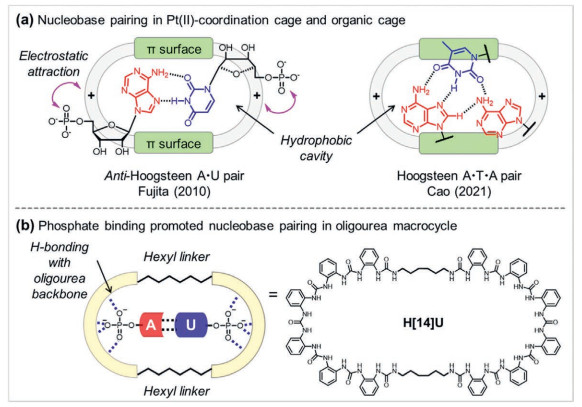
Inspired by the confined binding sites of ribosomes and polymerases, supramolecular chemists have built artificial hosts to mimic enzymatic microenvironments and thereby promote nucleobase pairing in solutions [19–24]. Successful strategies reported to date employ spatial confinement together with hydrophobic desolvation and electrostatic attraction to stabilize base-pairing motifs: examples include coordination cages and organic cationic cages (Fig. 1a) that can encapsulate two or more nucleotides and stabilize A·U/A·T (A: adenosine; U: uridine, T: thymidine) pairs through a combination of size-matching, hydrophobic packing, and Coulombic compensation of the phosphate charges. Recent work even demonstrates that elegantly designed cationic cages can promote H-bonded base pairing of nucleoside triphosphates in aqueous solution, highlighting the importance of cavity desolvation and multi-point host-guest contacts for overcoming water competition [25]. Despite these advances, the role of custom-designed hydrogen bonding between the host and the phosphate group of nucleotides, without Coulombic attraction, has been underexplored. In contrast to electrostatic attraction, hydrogen-bonding hosts would offer exceptional programmability in size, shape, and cavity length. This versatility makes them a promising alternative for not only inducing nucleobase pairing but also regulating its binding mode.
Figure 1
Figure 1.
Nucleobase pairing in (a) cationic hosts (metal-coordination cage and covalent cage, previous work) driven by hydrophobic effect and (b) oligourea macrocycle driven by phosphate coordination (hydrogen bonding, this work).
Recently, our group and others have reported a series of oligourea receptors, including linear [26], macrocyclic [27–33], and cage hosts [34–36], exhibiting remarkable efficiency in selective recognition, transport, and separation of phosphate anions in aqueous and highly polar media. Such behaviors originate from the formation of multiple hydrogen bonds between urea motifs and phosphate. To address the above-mentioned gap and build on our previous findings, herein we designed and synthesized a charge-neutral, expanded hexyl-linked oligourea macrocycle, H[14]U (H indicates a hexyl linkage, 14 indicates the total number of urea motifs, Fig. 1b) that can encapsulate two monophosphate nucleotides through oligourea–phosphate hydrogen bonds within a single cavity as supported by single-crystal X-ray diffraction structure and solution experiments. Importantly, distinctly diverging from cationic cage host, we find that primary oligourea-phosphate hydrogen bonding could also facilitate nucleobase pairing in highly polar solvents.
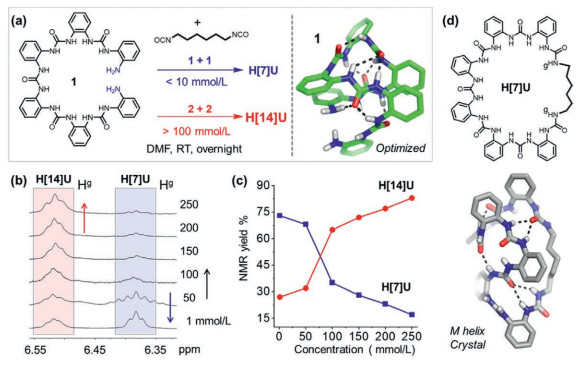
Akin to the chelating effect of bipyridine (compared to monopyridine) in metal coordination chemistry [37–42], the ortho-phenylene-bridged bis(urea) motif exhibits strong anion coordination affinity and forms characteristic hydrogen bonds with oxyanions, capable of engaging in up to 12 hydrogen bonds with phosphate [43–47]. In the absence of an anion, the free bis(urea) motif forms intramolecular C═O⋯H–N hydrogen bonds, which have been shown to pre-organize the oligourea backbone and facilitate efficient macrocyclization [48], as demonstrated in the synthesis of tetraurea and octaurea macrocycles. This strategy of intramolecular hydrogen bond-directed macrocyclization is expected to extend to longer oligourea chains, such as the pentaurea-based precursor 1 (Fig. 2a) [49]. Given that the phosphate headgroup of a nucleotide carries two negative charges and typically requires more than ten hydrogen bonds for effective coordination, a pentaurea monomer was selected. As anticipated and further supported by theoretical calculations [50–57], the pentaurea diamine adopts a folded conformation stabilized by seven intramolecular hydrogen bonds (Fig. 2a), with the terminal amine groups positioned in a satisfying proximity (~3 Å) for macrocyclization. Through macrocyclization, two additional urea units can be incorporated, resulting in a total of seven urea units in the [1 + 1] macrocycle, thereby providing a flexible and adaptive oligourea chain suitable for phosphate coordination. A hexyl linker was chosen as the central spacer, as the commercially available hexamethylene diisocyanate (HDI) monomer has a length of approximately 6 Å, sufficient to accommodate nucleotide base pairing (typically 6–9 Å; Fig. S14 in Supporting information). Accordingly, diamine 1 and HDI were mixed in anhydrous N, N-dimethylformamide (DMF) at room temperature without any catalyst, readily undergoing [1 + 1] and [2 + 2] macrocyclization to afford the H[7]U and H[14]U macrocycles, respectively.
Figure 2
Figure 2.
(a) Concentration-dependent macrocyclization from pentaurea-based diamine (1) and hexamethylene diisocyanate to afford H[7]U and H[14]U macrocycles. The DFT-optimized geometry of the diamine precursor is shown as an inset. (b) Stacked 1H NMR spectra (DMSO–d6, 400 MHz, 298 K) for the reaction of macrocyclization at variable concentrations, and (c) NMR data derived distribution of target macrocycles. (d) Single crystal X-ray diffraction structures of H[7]U macrocycle indicating multiple intramolecular hydrogen bonds. Nonpolar hydrogens and solvent molecules are omitted for clarity.
The macrocyclization process exhibits concentration-dependent behavior. At dilute reaction concentrations (below 50 mmol/L), the [1 + 1] macrocyclization pathway is favored, while the [2 + 2] pathway becomes predominant at higher concentrations. The resulting macrocycles, H[7]U and H[14]U, were initially identified by mass spectrometry (Figs. S6 and S9 in Supporting information) and isolated straightforwardly by precipitation in tetrahydrofuran (THF). The smaller H[7]U macrocycle is readily soluble in THF, whereas the larger H[14]U analogue shows limited solubility. The distribution of the two macrocycles can be conveniently monitored by 1H NMR spectroscopy (Fig. 2b). The newly formed urea proton (Hg) resonates at 6.52 ppm for H[14]U and 6.38 ppm for H[7]U. In highly diluted reaction solutions (1 mmol/L), H[7]U is obtained in 73% yield. As the concentration increases to 250 mmol/L, the formation of H[14]U rises significantly, reaching 83% yield (Fig. 2c). This concentration-dependent product distribution aligns with previous reports. It can be rationalized by enhanced intramolecular hydrogen bonding at relatively high concentrations, in which the folded oligourea precursor 1 introduces increased steric hindrance around the terminal amine groups and disfavors the [1 + 1] macrocyclization, thereby promoting the [2 + 2] pathway [58].
The structures of obtained macrocycles were unambiguously established by single-crystal X-ray diffraction. Crystallographic analysis reveals that the free H[7]U macrocycle crystallizes as a racemic mixture of right-handed (P) and left-handed (M) folded conformers. The folded structure is clearly stabilized by an extensive network of six intramolecular hydrogen bonds (Fig. 2d), aligning well with the DFT-optimized geometry of the pentaurea precursor (Fig. 2a). This structural insight corroborates the role of efficient intramolecular hydrogen bonding in directing the macrocyclization process, highlighting the potential of this strategy for constructing functional oligourea-based macrocyclic hosts with tailored cavities [59–64].
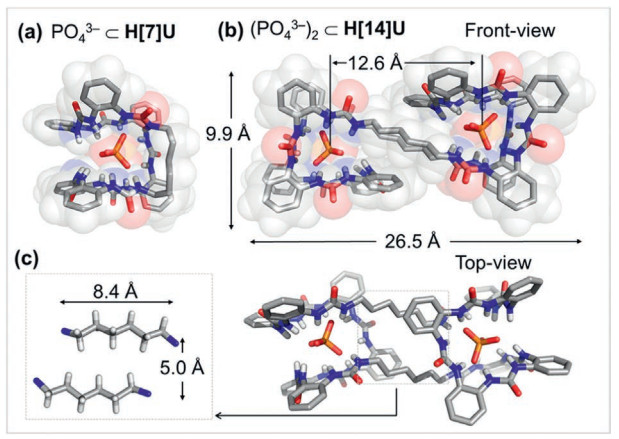
Fortunately, single crystals suitable for X-ray diffraction were obtained for the phosphate-bound macrocycles, providing direct structural evidence of strong phosphate coordination (Fig. 3). In the H[7]U complex, a 1:1 host–guest stoichiometry is observed, with the macrocycle adopting a "U"-shaped conformation that encapsulates one phosphate anion (PO43–) within its central cavity. The anion is secured by up to fourteen N–H···O hydrogen bonds with a mean N–H···O distance of 2.04 Å, indicating very strong phosphate coordination affinity [65–67]. Notably, phosphate coordination induces a notable conformational change: unlike the folded, helical structure of free H[7]U, the complex exhibits approximate planar symmetry. In the case of H[14]U, a 1:2 host–guest complex is formed, with two phosphate anions bound at a P···P distance of 12.6 Å (Fig. 3b). Each anion is clamped by the oligourea chains via fourteen hydrogen bonds, with an average N–H···O distance of 2.06 Å, comparable to that in the H[7]U complex. A key structural feature is the full extension of the two central hexyl linkers, which adopt an almost parallel alignment with an N···N distance of approximately 8.4 Å (Fig. 3c). This spatial separation matches well with the typical length required to accommodate a nucleotide base pair (ca. 6–9 Å), suggesting the cavity's suitability for such recognition.
Figure 3
Figure 3.
Single-crystal X-ray diffraction structures of phosphate coordinated macrocycles (a) H[7]U and (b, c) H[14]U in front and top views. Nonpolar hydrogens and solvent molecules are omitted for clarity.
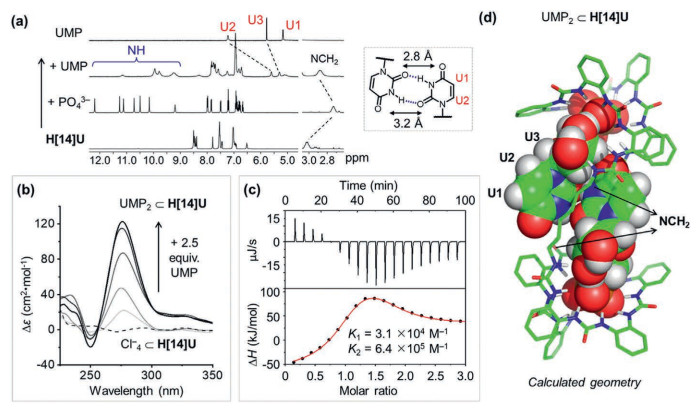
The phosphate coordination properties of the macrocycles were further investigated in solution using 1H NMR spectroscopy. Upon addition of 2 equiv. of phosphate anions, the NH protons of H[14]U exhibited significant downfield shifts of approximately 2.6 ppm (Fig. 4a, bottom two spectra), consistent with the formation of strong hydrogen bonds between the oligourea chain and phosphate. Similar downfield shift changes were observed for H[7]U upon phosphate coordination (Fig. S3 in Supporting information). These spectral changes align with previous reports on oligourea-based hosts, where phosphate binding affinities on the order of 106 L/mol (in DMSO) have been measured for 1:1 complexes. Encouraged by the strong phosphate coordination demonstrated in both solid and solution, and by the suitable spatial separation provided by the extended hexyl linkers in the H[14]U structure (Fig. 3c), we proceeded to evaluate the complexation profiles of these macrocycles with monophosphate nucleotides.
Figure 4
Figure 4.
(a) Stacked 1H NMR spectra of free UMP guest, free H[14]U macrocycle and its complexes with PO43– and UMP (DMSO–d6, 400 MHz, 298 K, 1 mmol/L). (b) CD spectra of Cl4–⊂H[14]U complex by adding UMP guest (as TBA+ salts, 20 µmol/L, CH3CN). (c) ITC plots for the titration of H[14]U macrocycle with UMP guest (DMSO, 298 K, 0.1 mmol/L). (d) Optimized structures of the UMP2⊂H[14]U complex indicating self-complementary hydrogen bonding of uridine units (GFN2-xTB).
The host-guest complexation behavior of the macrocycles was evaluated with four monophosphate nucleotides, adenosine monophosphate (AMP), uridine monophosphate (UMP), guanosine monophosphate (GMP), and cytidine monophosphate (CMP), used as their tetrabutylammonium (TBA) salts. As expected, free nucleotides in the absence of a host do not undergo spontaneous base pairing. This is corroborated by the single-crystal X-ray structure of AMP isolated from DMSO (Fig. S10 in Supporting information), in which no direct adenosine–adenosine dimerization is observed. Instead, the AMP molecules self-assemble into a one-dimensional supramolecular polymer through hydrogen bonding between the phosphate group and the nucleobase of adjacent molecules. This observation underscores the inherent hydrogen-bonding basicity of the phosphate anion and highlights the significant challenge of achieving specific nucleobase pairing in the absence of a shielding microenvironment.
The monophosphate nucleotides binding with H[14]U were comprehensively investigated using a combination of 1H NMR spectroscopy, circular dichroism (CD), mass spectrometry (MS), and isothermal titration calorimetry (ITC). These techniques collectively confirmed that H[14]U encapsulates two nucleotide guests within its cavity. Using UMP as a representative example, MS analysis first verified the 1:2 binding stoichiometry, displaying a peak at 926.71 (m/z) corresponding to the complex [H[14]U + 2UMP + TBA]3–. In the 1H NMR spectra, upon addition of two equivalents of UMP, the urea NH protons of H[14]U exhibited significant downfield shifts, resonating between 9 ppm and 12 ppm (Fig. 4a, middle two spectra). This change is similar to that observed upon phosphate anion binding, confirming that the oligourea chain maintains strong hydrogen-bonding interactions with the phosphate group of the nucleotide. In contrast, these NH protons are observed to be relatively broad, indicating low fidelity and dynamic nature of the complexation. Such behavior suggests the macrocycle could undergo conformational adjustments for UMP complexation in solution, consistent with adaptable hydrogen bonding with the oligourea backbone. Notably, the U2 and U3 protons of the uridine nucleobase experienced clear upfield shifts compared to free UMP. This behavior aligns with the characteristic chemical shift changes reported for nucleobase pairing within the confined cavities of cationic cages in previous studies [19], suggesting potential base-pairing interactions inside H[14]U macrocycle. Furthermore, the methylene protons (NCH2) adjacent to the hexyl linker also showed an upfield shift relative to the free H[14]U. This observation is tentatively attributed to C–H···π interactions between the hexyl spacer and the uridine units, indicating close contact and a constrained aromatic environment within the complexation with UMP.
CD spectroscopy provided further evidence for the formation of a 1:2 host-guest complex between H[14]U and UMP. The chloride-complexed form of H[14]U (prepared as the complex with TBACl to enhance its solubility in acetonitrile) exhibited a newly emerging Cotton effect centered around 275 nm upon UMP addition. This signal is attributed to the induced supramolecular chirality originating from the encapsulated UMP guests. The CD intensity reached a saturation plateau after the addition of 2.5 equiv. of UMP (Fig. 4b), confirming the encapsulation of two UMP molecules per macrocycle. In contrast, the CD titration for H[7]U reached saturation at 1.0 equiv. of UMP, consistent with its 1:1 binding stoichiometry. Furthermore, distinct CD spectral responses were observed for H[14]U upon complexation with other nucleotides (AMP, GMP, CMP, Fig. S24).
The specific chiroptical signatures induced in each case correlate with the identity of the nucleobase unit, suggesting that the supramolecular chirality is highly sensitive to the nature of the encapsulated nucleobase. These differential CD responses not only confirm the close interaction between the nucleobase units and the oligourea macrocycle but also align with the observed contacts between the nucleobases and the central hexyl linkages, as inferred from NMR analysis.
ITC measurements quantitatively determined the binding affinity of H[14]U for UMP in DMSO (Fig. 4c). The titration data were well-fitted to a 1:2 binding model, yielding binding constants of K1 = 3.1×10⁴ L/mol and K2 = 6.5×10⁵ L/mol. The system exhibits strong positive cooperativity, with a cooperative factor (α = 4K2/K1) of 83. Cooperative factor (α) quantifies the cooperativity of stepwise guest binding and is defined as α = 4K2/K1, where K1 and K2 denote the first and second binding constants corresponding to the sequential binding of two guest molecules to the host, respectively [68]. A notable biphasic binding profile was observed: the first UMP binding is highly endothermic (ΔH1 = 199 kJ/mol), suggesting a conformationally demanding encapsulation process driven by hydrogen bonding. In contrast, the second binding event is exothermic (ΔH2 = –56 kJ/mol) and enthalpy-driven. This distinct thermodynamic shift implies that the first binding induces significant structural preorganization of H[14]U, such as realigning the oligourea chain, displacing ordered solvent, and flattening the macrocyclic framework, to facilitate the subsequent nucleotide inclusion. The two-step mechanism, transitioning from entropy-driven to enthalpy-driven binding, underscores the adaptive nature of the synthetic macrocyclic host.
Theoretical calculations were carried out to gain deeper insight into UMP encapsulation within the H[14]U macrocycle. The optimized structure confirms stable inclusion of a self-paired UMP dimer inside the macrocyclic cavity, stabilized by a complementary hydrogen-bonding network (Fig. 4d). Between the uridine bases, two intramolecular N–H···O hydrogen bonds (2.8 Å and 3.2 Å) are formed, while twelve N–H···O interactions (d = 1.97 Å) are seen between the phosphate groups and the oligourea chain. We also observe C–H···π interactions between the hexyl linkers and the nucleobase pairs (Fig. S16 in Supporting information), correlating with the upfield shift of hexyl protons seen in 1H NMR spectrum (Fig. 4a).
For the AMP nucleotide, ITC measurements revealed binding behavior comparable to that of UMP with the H[14]U macrocycle. The determined binding constants are K1 = 7.0 × 10⁴ L/mol and K2 = 5.0 × 10⁵ L/mol, yielding a cooperative factor of 29. 1H NMR spectra showed chemical shift changes similar to those observed in the UMP case. Furthermore, the optimized structure indicates the formation of two hydrogen bonds within the adenosine dimer (Fig. S17 in Supporting information), supporting a stable base-paired arrangement inside the macrocyclic cavity.
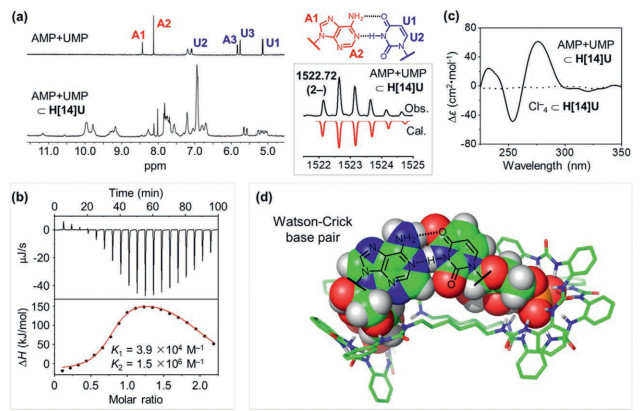
Finally, we investigated whether a heterodimeric A·U base pair, representative of canonical RNA/DNA interactions, could form within the H[14]U macrocycle. A 1:1 mixture of AMP and UMP was prepared and used for binding studies. The 1H NMR spectrum of the resulting host-guest complex showed increased complexity (Fig. 5a), yet key features support nucleotide binding: the urea NH protons resonate between 9.0–11.0 ppm, confirming phosphate coordination to the oligourea chain, while nucleobase protons (5.0–6.0 ppm) exhibit marked upfield shifts, analogous to those reported for A·U pairing in a Pt(Ⅱ)-coordinated cage. ESI-MS further substantiated the 1:1:1 complex of (AMP+UMP)⊂H[14]U assembly, with a peak observed at m/z 1522.72 (Fig. 5a). ITC titration of the AMP-UMP mixture into H[14]U yielded apparent binding constants of K1 = 3.9 × 10⁴ L/mol and K2 = 1.5 × 10⁶ L/mol. These values reflect enhanced affinity relative to titrations with individual nucleotides (Fig. 4c), and the significantly increased cooperative factor (α = 154) strongly suggests stabilization of the complementary A·U dimer. Enhanced cooperativity of A·U heterodimerization (α = 154) than UMP homodimer (α = 83) is presumably due to its relatively expanded macrocycle backbone (vide infra), where nucleobase pairing occurs outside the cavity thus reducing extra entropy compensation for the binding with the second guest. A relatively large K2 binding constant is demonstrated (Fig. 5b).
Figure 5
Figure 5.
(a) Stacked 1H NMR spectra for the 1:1 mixture of AMP and UMP, and their complex with H[14]U macrocycle (DMSO–d6, 400 MHz, 298 K, 1 mmol/L), MS spectra for the nucleotide complex is inserted. (b) ITC plots for the titration of H[14]U with the 1:1 mixture of AMP and UMP (DMSO, 298 K, 0.1 mmol/L). (c) CD spectra of (AMP+UMP)⊂H[14]U complex (TBA+ salts, 20 µmol/L, CH3CN). (d) Optimized structures (GFN2-xTB) of the (AMP+UMP)⊂H[14]U complex indicating Watson-Crick base pairing.
Additional support comes from CD spectroscopy studies, where a distinct Cotton effect emerges near 270 nm (Fig. 5c), indicative of supramolecular chirality for an organized heterodimer in the macrocyclic cavity. Collectively, these results confirm the co-encapsulation and stabilization of an A·U base pair inside the H[14]U macrocycle. The high binding affinity not only validates our design premise that phosphate-directed oligourea coordination can promote selective nucleobase pairing, but also provides a structural foundation for developing synthetic hosts toward biomimetic recognition.
To gain structural insight into the (AMP+UMP)⊂H[14]U assembly, theoretical calculations were performed to evaluate possible base-pairing modes within the macrocyclic cavity. Geometries were optimized using the semi-empirical GFN2-xTB method [51,52], and single point energies were calculated at the ωB97M-V/def2-TZVPP level of theory [54–57]. Gibbs free energies (ΔG, [298 K]) were then obtained with Shermo using thermochemical corrections from the xTB vibrational analysis [69]. Among the A·U pairing patterns examined, including Watson-Crick, anti-Watson-Crick, Hoogsteen, and anti-Hoogsteen, the Watson-Crick type was the most stable hydrogen-bonded dimer, featuring two characteristic N–H···O hydrogen bonds between the adenine and uracil units (Fig. 5d). Notably, a non-base-paired 1:1:1 co-encapsulation structure was computed to be energetically more favorable than any hydrogen-bonded dimer. While this suggests that full Watson–Crick pairing is not the dominant driving force under the modeled conditions, the results do not preclude the occurrence of base pairing under experimental settings, where solvation and dynamic effects play significant roles. Importantly, the fact that hydrogen-bonded A·U pair can be accommodated and stabilized inside the macrocycle confirms that hydrogen bonding alone, without auxiliary electrostatic or strong hydrophobic contributions, can indeed promote nucleobase pairing within an extended oligourea cavity.
In conclusion, we have successfully designed a neutral oligourea macrocycle, H[14]U, that functions as an effective synthetic host for nucleotide base pairing in solution. The key to its function lies in the strong, multiple hydrogen-bonding interactions between oligourea backbone and the phosphate anionic head, which anchors the nucleotides within a sufficiently large and adaptive cavity. This setup effectively creates a local microenvironment that shields the nucleobases from the bulk solvent, enabling hydrogen-bonding interactions. Comprehensive experimental data and theoretical calculations consistently support the encapsulation and stabilization of both homodimers and the complementary A·U Watson-Crick base pair. The observed high binding affinity and significant positive cooperativity underscore the efficiency of this design. Our findings validate the fundamental premise that hydrogen bonding alone can induce and stabilize nucleobase pairing within a well-designed neutral host, providing a new paradigm for the development of supramolecular systems for biomolecular recognition and assembly. Capitalizing on its phosphate-binding specificity and cavity adaptability, this neutral oligourea macrocycle holds promise for recognition and transport of anions and biological molecules, thus providing alternative candidates for designing new supramolecular biomaterials.
The authors declare that they have no known competing financial interests or personal relationships that could have appeared to influence the work reported in this paper.
Acknowledgments
This work was supported by the National Natural Science Foundation of China (Nos. 22101024, 22171023, 22101025) and the Beijing Municipal Natural Science Foundation (No. 2222025). We also thank support from Analysis & Testing Center of Beijing Institute of Technology for data collection.
Supplementary materials
Supplementary material associated with this article can be found, in the online version, at doi:10.1016/j.cclet.2026.112372.
Figure 2
(a) Concentration-dependent macrocyclization from pentaurea-based diamine (1) and hexamethylene diisocyanate to afford H[7]U and H[14]U macrocycles. The DFT-optimized geometry of the diamine precursor is shown as an inset. (b) Stacked 1H NMR spectra (DMSO–d6, 400 MHz, 298 K) for the reaction of macrocyclization at variable concentrations, and (c) NMR data derived distribution of target macrocycles. (d) Single crystal X-ray diffraction structures of H[7]U macrocycle indicating multiple intramolecular hydrogen bonds. Nonpolar hydrogens and solvent molecules are omitted for clarity.
Figure 3
Single-crystal X-ray diffraction structures of phosphate coordinated macrocycles (a) H[7]U and (b, c) H[14]U in front and top views. Nonpolar hydrogens and solvent molecules are omitted for clarity.
Figure 4
(a) Stacked 1H NMR spectra of free UMP guest, free H[14]U macrocycle and its complexes with PO43– and UMP (DMSO–d6, 400 MHz, 298 K, 1 mmol/L). (b) CD spectra of Cl4–⊂H[14]U complex by adding UMP guest (as TBA+ salts, 20 µmol/L, CH3CN). (c) ITC plots for the titration of H[14]U macrocycle with UMP guest (DMSO, 298 K, 0.1 mmol/L). (d) Optimized structures of the UMP2⊂H[14]U complex indicating self-complementary hydrogen bonding of uridine units (GFN2-xTB).
Figure 5
(a) Stacked 1H NMR spectra for the 1:1 mixture of AMP and UMP, and their complex with H[14]U macrocycle (DMSO–d6, 400 MHz, 298 K, 1 mmol/L), MS spectra for the nucleotide complex is inserted. (b) ITC plots for the titration of H[14]U with the 1:1 mixture of AMP and UMP (DMSO, 298 K, 0.1 mmol/L). (c) CD spectra of (AMP+UMP)⊂H[14]U complex (TBA+ salts, 20 µmol/L, CH3CN). (d) Optimized structures (GFN2-xTB) of the (AMP+UMP)⊂H[14]U complex indicating Watson-Crick base pairing.


 DownLoad:

 下载:


 下载:

