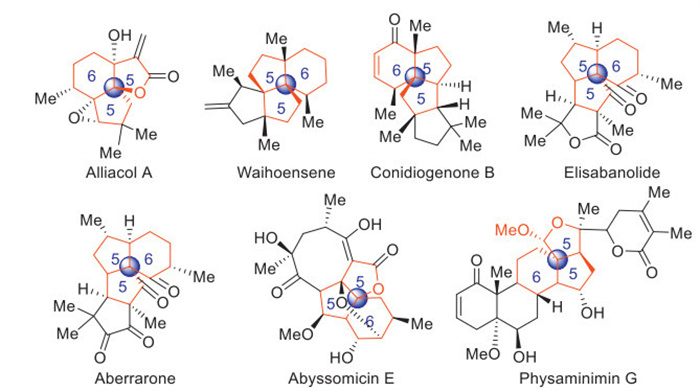
Figure 1.
Selected natural products containing angularly fused 6-5-5 tricyclic scaffold.

Synthesis of angularly fused tricyclic isoxazolines through cycloaddition of N-cyclopentenyl nitrones with nitroalkenes
Yan-Jiao Lu , Li-Fen Ning , Yue Leng , Zi-Han Hu , Chun-Hua Chen , Gui-Fa Su , Dong-Liang Mo


Numerous natural products and important biochemical intermediates consist of angularly fused tricyclic scaffolds, which have attracted great interest from synthesis community because these scaffolds are distinguished by the presence of quaternary carbon center that connected with the three rings together and the high strain with 3D-structure of these scaffolds make their constructions highly difficult and challenging [1–5]. For examples, Alliacol A, Waihoensene, Conidiogenone B, Elisabanolide, Aberrarone, Abyssomicin E, and Physaminimin G, all these natural products contain a remarkable 6-5-5 tricyclic unit (Fig. 1) [6–12]. From the total synthesis of these natural products containing angularly fused 6-5-5-tricyclic scaffolds, the construction of 6-5-5 tricyclic unit is the key step for the whole total synthesis and some of them usually required multiple-step synthesis over than five steps from the easily available starting materials. Up to date, the synthesis of angularly fused 6-5-5 tricyclic scaffolds in a one pot reaction is rarely reported [13–18]. For example, in 2024, Liu and coworkers developed a photoinduced electron transfer-triggered radical cyclization for the synthesis of angularly fused 6-5-5 tricyclic compounds containing two or three stereocenters in a one-pot reaction from 1,8-enyne or 1,8-diyne substrates (Scheme 1A) [19, 20]. However, racemic products were obtained in moderate to good yields with high diastereoselectivity. Consequently, the development of novel strategies to prepare the angularly fused 6-5-5 tricyclic scaffolds in a one-pot reaction, especially for their diastereoselectivity and enantioselectivity control, is still desirable.
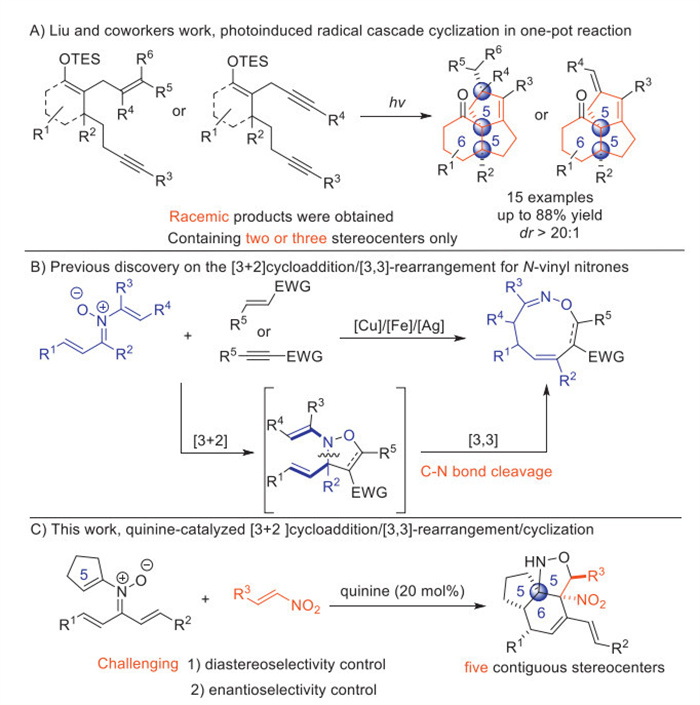
Cycloaddition reactions, as one of the most powerful and versatile strategies in the synthesis of cyclic molecules, have been made great progress toward the construction of five to seven-membered ring or polycyclic skeletons with high atom economy [21–27]. Nitrones, served as one of the most important 1,3-dipoles, have been extensively applied in the cycloadditions to synthesize various fused N- or N,O-heterocyclic compounds and some of them have been applied in the total synthesis of natural products [28–36]. On the other hand, fused N-heterocycles are very important pharmacophores for drug design and the introduction of fused N-heterocyclic unit into drug molecules plays important roles on the biological activity studies for these angularly fused 6-5-5 tricyclic compounds [37–41]. Recently, N-vinyl nitrones have been paid much attention due to the rich chemical transformations of the C=C bond on the N-atom of the nitrones [42–46]. For examples, N-vinyl nitrones could undergo electrocyclization to form four to six-membered N-heterocycles [47–52], and [3+2] cycloadditions or sequential [1,3]/[3,3] rearrangements [53–58]. As previous report on the [3+2] cycloaddition/[3,3]-rearrangement cascade strategy of N-vinyl-α, β-unsaturated nitrones with various alkenes, alkynes, or related 1,3-dipoles to afford nine- or ten-membered N-heterocyclic compounds were developed (Scheme 1B) [59–65]. Continuing to study the scope of this cascade reaction of N-vinyl-α, β-unsaturated nitrones with alkenes to construct nine-membered ring compounds, we found an [3+2] cycloaddition/[3,3]-rearrangement/intramolecular cyclization of N-cyclopentenyl nitrones with nitroalkenes to afford angularly fused 6-5-5 tricyclic isoxazolines bearing five contiguous stereocenters with high diastereoselectivity (Scheme 1C). Herein, we are the first time to report a quinine-catalyzed [3+2] cycloaddition/[3,3]-rearrangement/intramolecular cyclization cascade reaction in a one-pot reaction to prepare angularly fused 6-5-5 tricyclic isoxazolines bearing five contiguous stereocenters under mild reaction conditions.
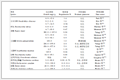
Our investigations started with N-cyclopentenyl-α, β-unsaturated nitrone 1a and nitroalkene 2a as the model substrates to test the efficiency for the formation of angularly fused tricyclic isoxazolines. As shown in Table 1, the reaction of 1a and 2a in CHCl3 at room temperature did not work to afford product 3aa without the addition of a catalyst or in the presence of Lewis acid catalysts even after 72 h, such as Sc(OTf)3, Yb(OTf)3, or Cu(OTf)2, however, a nine-membered ring compound 4aa was obtained in 5%-10% yields (Table 1, entries 1-4). To our delight, the addition of 10 mol% of BINOL-derived phosphoric acid C1 delivered the desired product 3aa in 9% yield as a single diastereomer companied by trace amount of 4aa (Table 1, entry 5). The structure of 3aa was determined by its X-ray diffraction analysis (CCDC: 2482447). Then, the effect of bifunctional organocatalysts were investigated. The yield of 3aa was improved to 36% accompanied by 4aa in 12% yield when thiourea catalyst C2 was used (Table 1, entry 6). When C3 and C4 were used as the catalysts, product 3aa was obtained in 50% and 52% yields accompanied by 4aa in 18% and 10% yields, respectively (Table 1, entries 7 and 8). The solvent screening trials by using C4 as the catalyst revealed that CHCl3 gave better yield of 3aa than those in DCM, DCE, MeCN, Et2O, and EtOAc (Table 1, entries 9-13). The reaction almost did not work in DMF, DMSO, and MeOH (Table 1, entries 14-16). Interestingly, when the reaction temperature was increased to 60 ℃, the yield of 3aa was improved to 70% after 72 h and further improved to 72% at 80 ℃ only after 20 h (Table 1, entries 17 and 18). But further improving the temperature to 100 ℃ diminished the yield of 3aa to 52% after 10 h (Table 1, entry 19). Under the thermal conditions, the decomposition of nitrone 1a to the corresponding ketone was also observed in the reaction. Consequently, the optimal reaction conditions for the formation of product 3aa were 20 mol% of C4 catalyst in CHCl3 at 80 ℃ after 20 h.
 DownLoad:
CSV
 |
||||||||||||||||||||||||||||||||||||||||||||||||||||||||||||||||||||||||||||||||||||||||||||||||||||||||||||||||||||||||||||||||||||
| Entry | Cat. | Solvent | Temp (℃) | Time (h) | Yield (%)b | |||||||||||||||||||||||||||||||||||||||||||||||||||||||||||||||||||||||||||||||||||||||||||||||||||||||||||||||||||||||||||||||
| 3aa | 4aa | |||||||||||||||||||||||||||||||||||||||||||||||||||||||||||||||||||||||||||||||||||||||||||||||||||||||||||||||||||||||||||||||||||
| 1 | - | CHCl3 | rt | 72 | < 5 | 5 | ||||||||||||||||||||||||||||||||||||||||||||||||||||||||||||||||||||||||||||||||||||||||||||||||||||||||||||||||||||||||||||||
| 2 | Sc(OTf)3 | CHCl3 | rt | 72 | < 5 | 6 | ||||||||||||||||||||||||||||||||||||||||||||||||||||||||||||||||||||||||||||||||||||||||||||||||||||||||||||||||||||||||||||||
| 3 | Yb(OTf)3 | CHCl3 | rt | 72 | < 5 | 8 | ||||||||||||||||||||||||||||||||||||||||||||||||||||||||||||||||||||||||||||||||||||||||||||||||||||||||||||||||||||||||||||||
| 4 | Cu(OTf)2 | CHCl3 | rt | 72 | < 5 | 10 | ||||||||||||||||||||||||||||||||||||||||||||||||||||||||||||||||||||||||||||||||||||||||||||||||||||||||||||||||||||||||||||||
| 5 | C1 | CHCl3 | rt | 72 | 9 | < 5 | ||||||||||||||||||||||||||||||||||||||||||||||||||||||||||||||||||||||||||||||||||||||||||||||||||||||||||||||||||||||||||||||
| 6 | C2 | CHCl3 | rt | 72 | 36 | 12 | ||||||||||||||||||||||||||||||||||||||||||||||||||||||||||||||||||||||||||||||||||||||||||||||||||||||||||||||||||||||||||||||
| 7 | C3 | CHCl3 | rt | 72 | 50 (4)c | 18 | ||||||||||||||||||||||||||||||||||||||||||||||||||||||||||||||||||||||||||||||||||||||||||||||||||||||||||||||||||||||||||||||
| 8 | C4 | CHCl3 | rt | 72 | 52 (4)c | 10 | ||||||||||||||||||||||||||||||||||||||||||||||||||||||||||||||||||||||||||||||||||||||||||||||||||||||||||||||||||||||||||||||
| 9 | C4 | DCM | rt | 72 | 44 | 11 | ||||||||||||||||||||||||||||||||||||||||||||||||||||||||||||||||||||||||||||||||||||||||||||||||||||||||||||||||||||||||||||||
| 10 | C4 | DCE | rt | 72 | 45 | 11 | ||||||||||||||||||||||||||||||||||||||||||||||||||||||||||||||||||||||||||||||||||||||||||||||||||||||||||||||||||||||||||||||
| 11 | C4 | MeCN | rt | 72 | 42 | < 5 | ||||||||||||||||||||||||||||||||||||||||||||||||||||||||||||||||||||||||||||||||||||||||||||||||||||||||||||||||||||||||||||||
| 12 | C4 | Et2O | rt | 72 | 16 | < 5 | ||||||||||||||||||||||||||||||||||||||||||||||||||||||||||||||||||||||||||||||||||||||||||||||||||||||||||||||||||||||||||||||
| 13 | C4 | EtOAc | rt | 72 | 16 | < 5 | ||||||||||||||||||||||||||||||||||||||||||||||||||||||||||||||||||||||||||||||||||||||||||||||||||||||||||||||||||||||||||||||
| 14 | C4 | DMSO | rt | 72 | < 5 | < 5 | ||||||||||||||||||||||||||||||||||||||||||||||||||||||||||||||||||||||||||||||||||||||||||||||||||||||||||||||||||||||||||||||
| 15 | C4 | DMF | rt | 72 | < 5 | < 5 | ||||||||||||||||||||||||||||||||||||||||||||||||||||||||||||||||||||||||||||||||||||||||||||||||||||||||||||||||||||||||||||||
| 16 | C4 | MeOH | rt | 72 | < 5 | < 5 | ||||||||||||||||||||||||||||||||||||||||||||||||||||||||||||||||||||||||||||||||||||||||||||||||||||||||||||||||||||||||||||||
| 17 | C4 | CHCl3 | 60 | 72 | 70 | < 5 | ||||||||||||||||||||||||||||||||||||||||||||||||||||||||||||||||||||||||||||||||||||||||||||||||||||||||||||||||||||||||||||||
| 18 | C4 | CHCl3 | 80 | 20 | 72 | < 5 | ||||||||||||||||||||||||||||||||||||||||||||||||||||||||||||||||||||||||||||||||||||||||||||||||||||||||||||||||||||||||||||||
| 19 | C4 | CHCl3 | 100 | 10 | 52 | < 5 | ||||||||||||||||||||||||||||||||||||||||||||||||||||||||||||||||||||||||||||||||||||||||||||||||||||||||||||||||||||||||||||||
| a Reaction conditions: 1a (0.2 mmol), 2a (0.4 mmol, 2.0 equiv.), cat. (20 mol%, unless noted), solvent (2 mL). b Isolated yield. c The ee value of product 3aa. |
||||||||||||||||||||||||||||||||||||||||||||||||||||||||||||||||||||||||||||||||||||||||||||||||||||||||||||||||||||||||||||||||||||
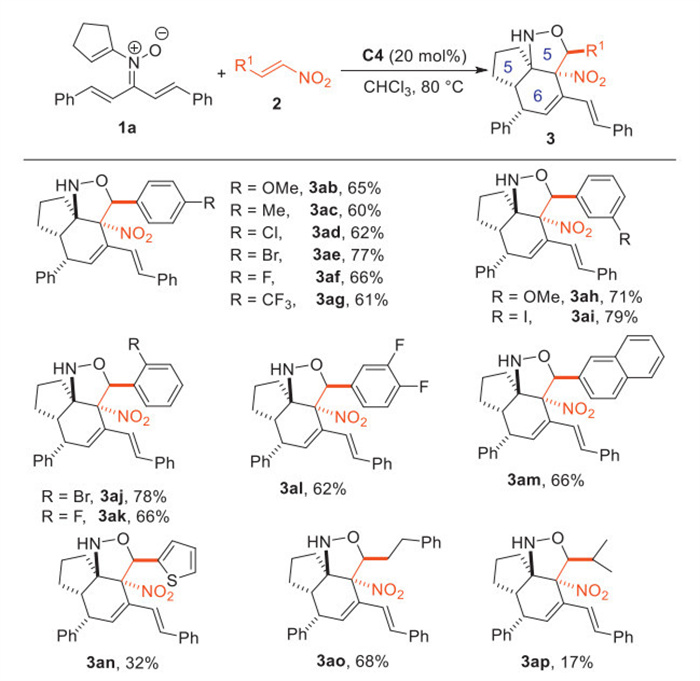
With the optimized conditions in hand, the scope of nitroalkenes 2 reacting with 1a was explored to test the efficiency for the preparation of angularly fused tricyclic isoxazolines. As shown in Scheme 2, a variety of nitroalkenes bearing electron-donating and electron-withdrawing groups at the para, meta, and ortho-positions of the aryl ring could proceed smoothly to afford the corresponding products 3ab-3ak as only one diastereomer in good yields (60%-79%). Nitroalkene 2l with 3,4-difluoro group and 2m with 2-naphthyl group delivered the desired products 3al and 3am in 62% and 66% yields, respectively. To our delight, 2-thienyl substituted nitroalkene 2n also afforded product 3an in 32% yield. The alkyl substituted nitroalkenes were also tested. The alkyl substituted nitroalkenes tolerated PhCH2CH2 and i-Pr groups giving products 3ao and 3ap in 68% and 17% yields, respectively. These results revealed that the steric hindrance of substituted nitroalkenes had great influence on the reaction. In all these cases, the reaction only furnished the angularly fused tricyclic isoxazolines bearing five stereocenters with only one diastereomer. Other alkenes instead of nitroalkenes, such as chalcone and methyl cinnamate, were also tested under the standard conditions, but no desired products were observed and only the starting materials were recovered.
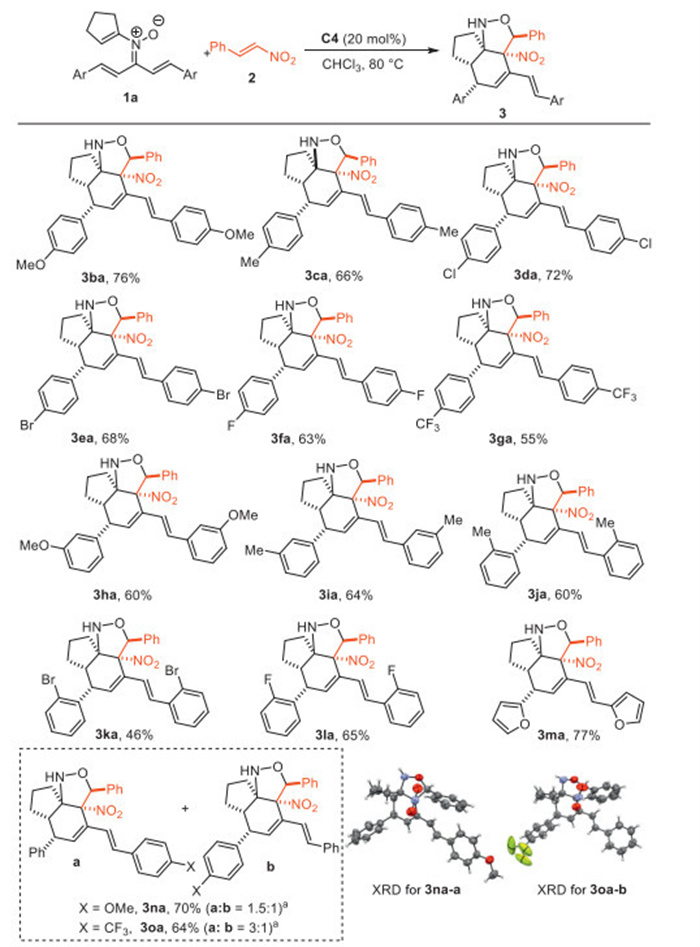
Next, a variety of dibenzylideneacetone-derived N-cyclopentenyl nitrones were evaluated to determine the scope of the preparation of angularly fused tricyclic isoxazolines containing five stereocenters. As shown in Scheme 3, various dibenzylideneacetone-derived N-cyclopentenyl nitrones bearing electron-donating and electron-withdrawing groups at the para-, meta-, and ortho-positions of the aryl ring proceeded smoothly under the standard conditions to afford the corresponding tricyclic compounds 3ba-3la in moderate to good yields (46%-76%) with single diastereomers only. Pleasingly, the reaction tolerated 2-furanyl group and delivered product 3ma in 77% yield. Finally, the regioselectivity of cyclization was evaluated by using unsymmetrical dibenzylideneacetone-derived N-cyclopentenyl nitrones. When a 1.5:1 E/Z ratio of nitrone 1n with 4-OMeC6H4 and Ph groups was carried out under the standard conditions, the desired product 3na was obtained in 70% yield with a 1.5:1 mixture of regioisomers. A 2.6:1 E/Z ratio of nitrone 1o with 4-CF3C6H4 and Ph groups afforded 3oa in 64% yield with a 3:1 regioselective ratio. To our delight, the two regioisomers of compounds 3na and 3oa were easily separated by flash column chromatography, whose structures were determined by their X-ray diffraction analyses of compounds 3na-a and 3oa-b (CCDCs: 2482448, 2482449). Dibenzylideneacetone-derived N-hexenyl nitrones were also tested under the standard conditions, but no desired products were observed and only the starting materials were recovered.
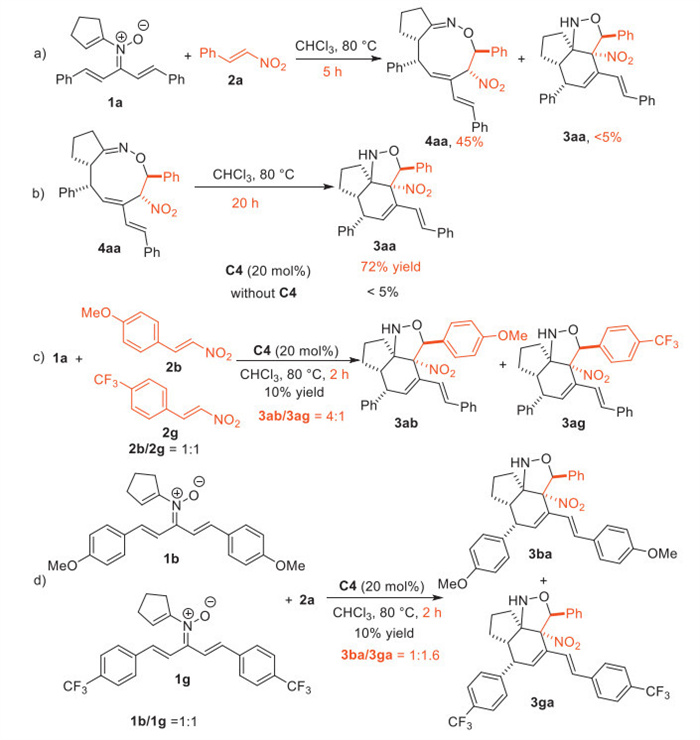
To better understand the mechanism for the formation of angularly fused tricyclic isoxazoline 3aa, control experiments were performed (Scheme 4). When the reaction time of 1a and 2a was shortened to 5 h, it was found that 3aa was observed with trace amount only and compound 4aa was obtained in 45% yield (Scheme 4a). Compound 4aa was carried out under the standard conditions affording the desired product 3aa in 72% yield whereas trace amount of 3aa was observed in the absence of C4 catalyst (Scheme 4b). These results suggested that the nine-membered ring compound 4aa should be the key intermediate for the formation of compound 3aa and C4 catalyst played an important role on the conversion of 4aa to 3aa. When a 1:1 mixture of nitroalkenes 2b with 4-OMe and 2g with 4-CF3 was subjected to the standard conditions for 2 h, the initial rate of 3ab and 3ag was 4:1, showing that nitroalkenes bearing donating group at the para-position of aryl ring facilitated to give tricyclic isoxazoline than those with electron-withdrawing groups (Scheme 4c). When a 1:1 mixture of nitrone 1b with 4-OMe and 1g with 4-CF3 was carried out under the standard conditions for 2 h, the initial rate of 3ba and 3ga was 1:1.6 (Scheme 4d). These results indicated that nitrones bearing electron-withdrawing groups at the para-position of aryl ring facilitated to give tricyclic isoxazoline than those with donating groups.
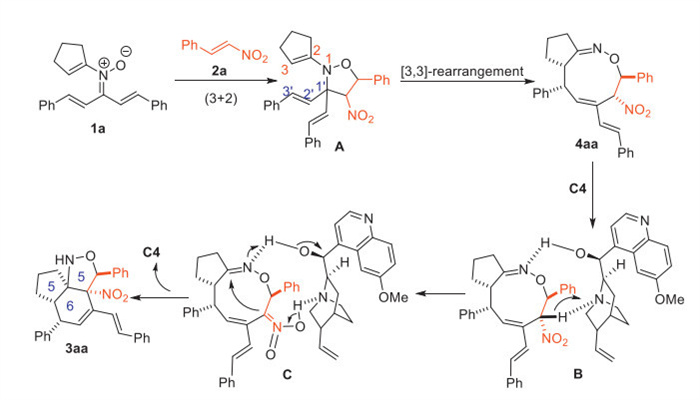
Based on the above experimental results, a possible mechanism for the formation of angularly fused tricyclic isoxazoline 3aa from nitrone 1a and nitroalkene 2a was proposed (Scheme 5). Nitrone 1a initially underwent [3+2] cycloaddition with nitroalkene 2a to afford cycloadduct A, which then took place [3,3]-rearrangement to give the nine-membered ring compound 4aa. C4-catalyst played as bifunctional catalyst to activate 4aa by hydrogen-bonding effect to form intermediate B and sequential isomerization of B furnished intermediate C. Finally, intramolecular cyclization of α-carbanion of the NO2 group to the C=N bond via intermediate C afforded the desired angularly fused tricyclic isoxazoline 3aa and released C4 catalyst to finish the catalytic cycle.
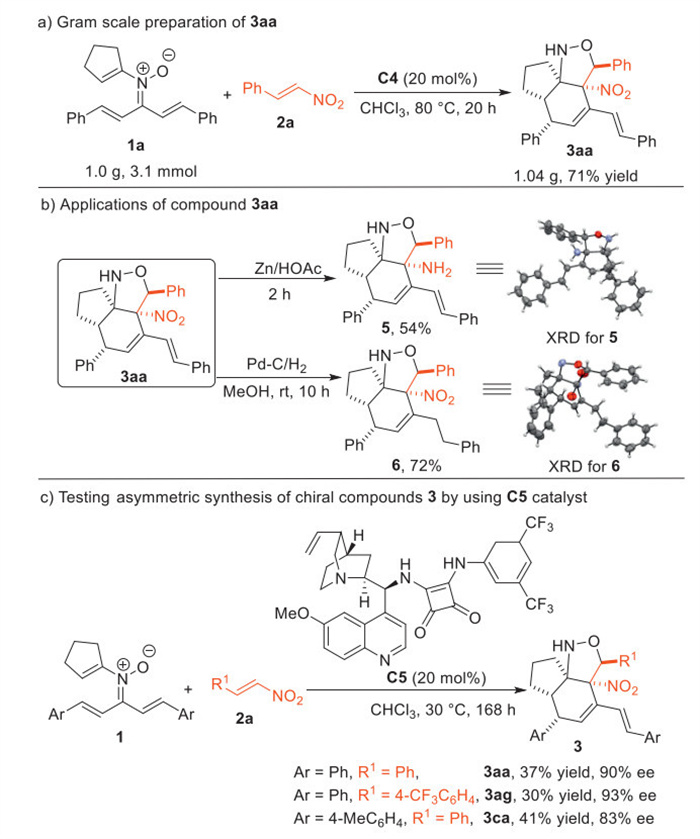
To show the utility of this cascade reaction to access angularly fused tricyclic isoxazolines, gram scale preparation of 3aa and its transformations were performed (Scheme 6). As shown in Scheme 6a, when 1.0 g of nitrone 1a (3.1 mmol) was reacted with nitroalkene 2a under the standard reactions, product 3aa was obtained in 71% yield (1.04 g). As shown in Scheme 6b, the treatment of 3aa with Zn and HOAc reduction conditions furnished compound 5 bearing free NH2 in 54% yield. Reduction of the styryl bond of 3aa with Pd-C and hydrogen gas in MeOH provided selective reduction product 6 in 72% yield. The structures of compound 5 and 6 were determined by their X-ray diffraction analyses (CCDC: 2482450, 2482451). Finally, the asymmetric synthesis of angularly fused tricyclic isoxazolines was tested (Scheme 6-c). When chiral quinine-derived squaramide C5 was used as the catalyst at room temperature for 168 h, the desired products 3aa, 3ag, and 3ca were obtained in 30%-41% yields as single diastereomers with 83%-93% ee. The use of C5 catalyst gave products 3aa, 3ag and 3ca in low yields at room temperature, but excellent enantioselectivities and diastereoselectivities of these compounds were obtained. This method offers an approach to access chiral angularly fused tricyclic isoxazolines with five contiguous stereocenters.
In summary, we have identified a facile method to prepare various angularly fused 6-5-5 tricyclic isoxazolines bearing five contiguous stereocenters in good yields and high diastereoselectivities through quinine-catalyzed cascade reaction of N-cyclopentenyl nitrones with nitroalkenes under mild reaction conditions. The reaction shows broad substrate scope and good functional group tolerance for nitrones and nitroalkenes. Moreover, an asymmetric synthesis of these angularly fused 6-5-5 tricyclic isoxazolines bearing five contiguous stereocenters was realized by using quinine-derived squaramide catalyst. We anticipate that this novel cascade reaction provides an efficient approach to access these angularly fused tricyclic isoxazolines and offers an opportunity to study their biological activities in the future.
Yan-Jiao Lu: Data curation. Li-Fen Ning: Methodology. Yue Leng: Investigation. Zi-Han Hu: Data curation. Chun-Hua Chen: Supervision. Gui-Fa Su: Writing – original draft. Dong-Liang Mo: Writing – review & editing.
The authors declare that they have no known competing financial interests or personal relationships that could have appeared to influence the work reported in this paper.
Financial support from the National Natural Science Foundation of China (Nos. 22071035, 22571050), the Natural Science Foundation of Guangxi (Nos. 2025GXNSFGA069003, 2025GXNSFBA069568, 2023GXNSFDA026025), the Student Innovation Training Program (Nos. S202510602232, 202510602226X), and Guangxi Bagui Youth Program is greatly appreciated.
Supplementary material associated with this article can be found, in the online version, at doi:
R. Kumar, Y. Hoshimoto, E. Tamai, et al., Nat. Commun. 8 (2017) 32. doi: 10.1177/2321023017698258
S.G. Liao, H.D. Chen, J.M. Yue, Chem. Rev. 109 (2009) 1092–1140. doi: 10.1021/cr0782832
Z. Xu, X. Li, J.A. Rose, et al., Nat. Prod. Rep. 40 (2023) 1393–1431. doi: 10.1039/d3np00008g
Y. Qu, Z. Wang, Z. Zhang, et al., J. Am. Chem. Soc. 142 (2020) 6511–6515. doi: 10.1021/jacs.0c02143
Y.P. Wang, K. Fang, Y.Q. Tu, et al., Nat. Commun. 13 (2022) 2335. doi: 10.1038/s41467-022-29947-5
J. Mihelcic, K.D. Moeller, J. Am. Chem. Soc. 125 (2003) 36–37. doi: 10.1021/ja029064v
C. Peng, P. Arya, Z. Zhou, et al., Angew. Chem. Int. Ed. 59 (2020) 13521–13525. doi: 10.1002/anie.202004177
S.H. Hou, Y.Q. Tu, S.H. Wang, et al., Angew. Chem. Int. Ed. 55 (2016) 4456–4460. doi: 10.1002/anie.201600529
A.D. Rodriguez, E. Gonzalez, S.D. Huang, J. Org. Chem. 63 (1998) 7083–7091. doi: 10.1021/jo981385v
I.I. Rodriguez, A.D. Rodriguez, H. Zhao, J. Org. Chem. 74 (2009) 7581–7584. doi: 10.1021/jo901578r
X.M. Niu, S.H. Li, H. Gorls, et al., Org. Lett. 9 (2007) 2437–2440. doi: 10.1021/ol0705999
X.M. Xu, Y.Z. Guan, S.M. Shan, Phytochem. Lett. 15 (2016) 1–6.
B.V.S. Reddy, D. Medaboina, S.G. Reddy, et al., J. Org. Chem. 80 (2015) 12580–12587. doi: 10.1021/acs.joc.5b02241
F.J. Chang, R. Gurubrahamam, K. Chen, Adv. Synth. Catal. 359 (2017) 1277–1282. doi: 10.1002/adsc.201700023
Y.J. Zhu, J.Q. Huo, Z.J. Fan, et al., Org. Biomol. Chem. 16 (2018) 1163–1166. doi: 10.1039/c7ob02701j
H.P. Kalmode, K.L. Handore, D.S. Reddy, J. Org. Chem. 82 (2017) 7614–7620. doi: 10.1021/acs.joc.7b00794
H. Lee, T. Kang, H.Y. Lee, Angew. Chem. Int. Ed. 56 (2017) 8254–8257. doi: 10.1002/anie.201704492
C. Prakash, A.K. Mohanakrishnan, Eur. J. Org. Chem. 2008 (2008) 1535–1543. doi: 10.1002/ejoc.200700986
J. Du, S. Fu, B. Liu, Org. Lett. 26 (2024) 4721–4726. doi: 10.1021/acs.orglett.4c01497
M. Hu, W. Cao, Z. Wang, et al., Chin. J. Chem. 41 (2023) 2502–2506. doi: 10.1002/cjoc.202300246
N.I. Jessen, D. McLeod, K.A. Jørgensen, et al., Chem 8 (2022) 20–30. doi: 10.1016/j.chempr.2021.10.024
J. Du, Y.F. Li, C.H. Ding, Chin. Chem. Lett. 34 (2023) 108401. doi: 10.1016/j.cclet.2023.108401
L. Klier, F. Tur, P.H. Poulsen, et al., Chem. Soc. Rev. 46 (2017) 1080–1102. doi: 10.1039/C6CS00713A
J. Wang, S.A. Blaszcyk, X. Li, et al., Chem. Rev. 121 (2021) 110–139. doi: 10.1021/acs.chemrev.0c00160
N. Li, J.T. Chen, Y.Z. Liu, et al., ACS Catal. 15 (2025) 11587–11593. doi: 10.1021/acscatal.5c01939
B. Baruah, C.D. Pegu, M.L. Deb, Top. Curr. Chem. 382 (2024) 18. doi: 10.1007/s41061-024-00463-y
X. Liu, H. Zheng, Y. Xia, et al., Acc. Chem. Res. 50 (2017) 2621–2631. doi: 10.1021/acs.accounts.7b00377
S.I. Murahashi, Y. Imada, Chem. Rev. 119 (2019) 4684–4716. doi: 10.1021/acs.chemrev.8b00476
W.M. Shi, X.P. Ma, G.F. Su, et al., Org. Chem. Front. 3 (2016) 116–130. doi: 10.1039/C5QO00122F
D.A. Biodeau, K.D. Margison, M. Serhan, et al., Chem. Rev. 121 (2021) 6699–6717. doi: 10.1021/acs.chemrev.0c00832
N. Zou, X.T. Qin, Z.X. Wang, et al., Chin. J. Org. Chem. 42 (2021) 4535–4553. doi: 10.6023/cjoc202109007
S. Yokoshima, Nat. Prod. Rep. 42 (2025) 1071–1090. doi: 10.1039/d4np00062e
M.F. Li, S.Q. Shi, T. Xu, et al., Chin. Chem. Lett. 34 (2023) 107751. doi: 10.1016/j.cclet.2022.107751
J. Zhang, J.Y. Su, H. Zheng, et al., Angew. Chem. Int. Ed. 63 (2024) e202318476. doi: 10.1002/anie.202318476
T.-Z. Li, S.-J. Liu, Y.-W. Sun, et al., Angew. Chem. Int. Ed. 60 (2021) 2355–2363. doi: 10.1002/anie.202011267
J. Qi, F. Wei, C.H. Tung, et al., Angew. Chem. Int. Ed. 60 (2021) 13814–13818. doi: 10.1002/anie.202100601
X. Zhang, J.Q. Zhang, Z.H. Sun, et al., Angew. Chem. Int. Ed. 64 (2025) e202420390. doi: 10.1002/anie.202420390
Y.H. Lu, C. Wu, J.C. Hou, et al., ACS Catal. 13 (2023) 13071–13076. doi: 10.1021/acscatal.3c02268
H.T. Ji, Q.X. Luo, K.L. Wang, et al., Green Chem. 25 (2023) 7983–7987. doi: 10.1039/d3gc02575f
H.Y. Song, F. Xiao, J. Jiang, et al., Chin. Chem. Lett. 34 (2023) 108509. doi: 10.1016/j.cclet.2023.108509
W.T. Ouyang, J. Jiang, Y.F. Jiang, et al., Chin. Chem. Lett. 35 (2024) 110038. doi: 10.1016/j.cclet.2024.110038
T.W. Reidl, J. Son, D.J. Wink, et al., Angew. Chem. Int. Ed. 56 (2017) 11579–11583. doi: 10.1002/anie.201705681
J.Y. Liao, Q.Y. Wu, X. Lu, et al., Green Chem. 21 (2019) 6567–6573. doi: 10.1039/c9gc01811e
A.S. Alshreimi, G. Zhang, T.W. Reidl, et al., Angew. Chem. Int. Ed. 59 (2020) 15244–15248. doi: 10.1002/anie.202004652
Y.Z. Wu, Y. Leng, Y.X. Chen, Chin. J. Chem. 43 (2025) 417–422. doi: 10.1002/cjoc.202400937
I. Nakamura, Y. Kudo, M. Terada, Angew. Chem. Int. Ed. 52 (2013) 7536–7539. doi: 10.1002/anie.201302751
N. Zou, J.X. Lan, G.G. Yan, et al., Org. Lett. 22 (2020) 8446–8450. doi: 10.1021/acs.orglett.0c02947
L.Y. Ding, Y.J. Lu, J.H. Pang, et al., Chin. J. Chem. 43 (2025) 1287–1292. doi: 10.1002/cjoc.202401287
Y.J. Lu, F.L. Lu, J.Q. Zhang, et al., Org. Chem. Front. 11 (2024) 2277–2282. doi: 10.1039/d3qo01999c
J.Q. Zhang, P.W. Qiu, C. Liang, et al., Org. Lett. 24 (2022) 7801–7805. doi: 10.1021/acs.orglett.2c03156
N. Zou, Z.W. Liu, G.G. Yan, et al., Adv. Synth. Catal. 364 (2022) 1671–1676. doi: 10.1002/adsc.202200066
C.H. Chen, Q.Y. Wu, C. Wei, et al., Green Chem. 20 (2018) 2722–2729. doi: 10.1039/c8gc00630j
G. Zhang, A.S. Alshreimi, L. Alomso, et al., Angew. Chem. Int. Ed. 60 (2021) 13089–13097. doi: 10.1002/anie.202101511
X.T. Qin, Y. Leng, L.F. Ning, et al., Org. Lett. 27 (2025) 5101–5106. doi: 10.1021/acs.orglett.5c01182
C. Wei, X.-L. Cheng, Y.-J. Chen, et al., Adv. Synth. Catal. 365 (2023) 2976–2981. doi: 10.1002/adsc.202300382
C.M. Nong, S.N. Lv, W.M. Shi, et al., Org. Lett. 25 (2023) 267–271. doi: 10.1021/acs.orglett.2c04121
H. Yuan, D.L. Lu, C. Laing, Adv. Synth. Catal. 364 (2022) 1409–1414. doi: 10.1002/adsc.202101372
M.L. Luo, Q. Hou, S.J. Liu, et al., Org. Lett. 24 (2022) 8493–8497. doi: 10.1021/acs.orglett.2c03349
Y. Luo, Y.J. Lu, M.M. Pan, et al., Chin. Chem. Lett. 36 (2025) 110207. doi: 10.1016/j.cclet.2024.110207
X.T. Qin, N. Zou, X.L. Cheng, et al., Adv. Synth. Catal. 364 (2022) 500–505. doi: 10.1002/adsc.202101199
X.P. Ma, C.M. Nong, Y.F. Liang, et al., Green Chem. 22 (2020) 3827–3834. doi: 10.1039/d0gc00929f
X.P. Ma, C.M. Nong, J. Zhao, et al., Adv. Synth. Catal. 362 (2020) 478–486. doi: 10.1002/adsc.201901206
N. Zou, J.W. Jiao, Y. Feng, et al., Org. Lett. 21 (2019) 481–485. doi: 10.1021/acs.orglett.8b03767
X.P. Ma, L.G. Li, H.P. Zhao, et al., Org. Lett. 20 (2018) 4571–4574. doi: 10.1021/acs.orglett.8b01761
N. Zou, J.W. Jiao, Y. Feng, et al., Adv. Synth. Catal. 359 (2017) 2741–2746. doi: 10.1002/adsc.201700462

Figure 1 Selected natural products containing angularly fused 6-5-5 tricyclic scaffold.

Scheme 1 Cycloaddition strategies toward the preparation of angularly fused 6-5-5 tricyclic isoxazolines.

Scheme 2 Substrate scope for nitroalkenes 2. Reaction conditions: 1a (0.2 mmol), 2 (0.4 mmol, 2.0 equiv.), C4 (20 mol%), CHCl3 (2.0 mL), 80 ℃, 20-72 h; isolated yield.

Scheme 3 Substrate scope for N-cyclopentenyl nitrones 1. Reaction conditions: 1 (0.2 mmol), 2a (0.4 mmol, 2.0 equiv.), C4 (20 mol%), CHCl3 (2.0 mL), 80 ℃, 20-72 h; isolated yield. a The cyclization regioselectivity ratio of the styryl group.
Table 1. Optimization of the reaction conditions.a
|
||||||||||||||||||||||||||||||||||||||||||||||||||||||||||||||||||||||||||||||||||||||||||||||||||||||||||||||||||||||||||||||||||||
| Entry | Cat. | Solvent | Temp (℃) | Time (h) | Yield (%)b | |||||||||||||||||||||||||||||||||||||||||||||||||||||||||||||||||||||||||||||||||||||||||||||||||||||||||||||||||||||||||||||||
| 3aa | 4aa | |||||||||||||||||||||||||||||||||||||||||||||||||||||||||||||||||||||||||||||||||||||||||||||||||||||||||||||||||||||||||||||||||||
| 1 | - | CHCl3 | rt | 72 | < 5 | 5 | ||||||||||||||||||||||||||||||||||||||||||||||||||||||||||||||||||||||||||||||||||||||||||||||||||||||||||||||||||||||||||||||
| 2 | Sc(OTf)3 | CHCl3 | rt | 72 | < 5 | 6 | ||||||||||||||||||||||||||||||||||||||||||||||||||||||||||||||||||||||||||||||||||||||||||||||||||||||||||||||||||||||||||||||
| 3 | Yb(OTf)3 | CHCl3 | rt | 72 | < 5 | 8 | ||||||||||||||||||||||||||||||||||||||||||||||||||||||||||||||||||||||||||||||||||||||||||||||||||||||||||||||||||||||||||||||
| 4 | Cu(OTf)2 | CHCl3 | rt | 72 | < 5 | 10 | ||||||||||||||||||||||||||||||||||||||||||||||||||||||||||||||||||||||||||||||||||||||||||||||||||||||||||||||||||||||||||||||
| 5 | C1 | CHCl3 | rt | 72 | 9 | < 5 | ||||||||||||||||||||||||||||||||||||||||||||||||||||||||||||||||||||||||||||||||||||||||||||||||||||||||||||||||||||||||||||||
| 6 | C2 | CHCl3 | rt | 72 | 36 | 12 | ||||||||||||||||||||||||||||||||||||||||||||||||||||||||||||||||||||||||||||||||||||||||||||||||||||||||||||||||||||||||||||||
| 7 | C3 | CHCl3 | rt | 72 | 50 (4)c | 18 | ||||||||||||||||||||||||||||||||||||||||||||||||||||||||||||||||||||||||||||||||||||||||||||||||||||||||||||||||||||||||||||||
| 8 | C4 | CHCl3 | rt | 72 | 52 (4)c | 10 | ||||||||||||||||||||||||||||||||||||||||||||||||||||||||||||||||||||||||||||||||||||||||||||||||||||||||||||||||||||||||||||||
| 9 | C4 | DCM | rt | 72 | 44 | 11 | ||||||||||||||||||||||||||||||||||||||||||||||||||||||||||||||||||||||||||||||||||||||||||||||||||||||||||||||||||||||||||||||
| 10 | C4 | DCE | rt | 72 | 45 | 11 | ||||||||||||||||||||||||||||||||||||||||||||||||||||||||||||||||||||||||||||||||||||||||||||||||||||||||||||||||||||||||||||||
| 11 | C4 | MeCN | rt | 72 | 42 | < 5 | ||||||||||||||||||||||||||||||||||||||||||||||||||||||||||||||||||||||||||||||||||||||||||||||||||||||||||||||||||||||||||||||
| 12 | C4 | Et2O | rt | 72 | 16 | < 5 | ||||||||||||||||||||||||||||||||||||||||||||||||||||||||||||||||||||||||||||||||||||||||||||||||||||||||||||||||||||||||||||||
| 13 | C4 | EtOAc | rt | 72 | 16 | < 5 | ||||||||||||||||||||||||||||||||||||||||||||||||||||||||||||||||||||||||||||||||||||||||||||||||||||||||||||||||||||||||||||||
| 14 | C4 | DMSO | rt | 72 | < 5 | < 5 | ||||||||||||||||||||||||||||||||||||||||||||||||||||||||||||||||||||||||||||||||||||||||||||||||||||||||||||||||||||||||||||||
| 15 | C4 | DMF | rt | 72 | < 5 | < 5 | ||||||||||||||||||||||||||||||||||||||||||||||||||||||||||||||||||||||||||||||||||||||||||||||||||||||||||||||||||||||||||||||
| 16 | C4 | MeOH | rt | 72 | < 5 | < 5 | ||||||||||||||||||||||||||||||||||||||||||||||||||||||||||||||||||||||||||||||||||||||||||||||||||||||||||||||||||||||||||||||
| 17 | C4 | CHCl3 | 60 | 72 | 70 | < 5 | ||||||||||||||||||||||||||||||||||||||||||||||||||||||||||||||||||||||||||||||||||||||||||||||||||||||||||||||||||||||||||||||
| 18 | C4 | CHCl3 | 80 | 20 | 72 | < 5 | ||||||||||||||||||||||||||||||||||||||||||||||||||||||||||||||||||||||||||||||||||||||||||||||||||||||||||||||||||||||||||||||
| 19 | C4 | CHCl3 | 100 | 10 | 52 | < 5 | ||||||||||||||||||||||||||||||||||||||||||||||||||||||||||||||||||||||||||||||||||||||||||||||||||||||||||||||||||||||||||||||
| a Reaction conditions: 1a (0.2 mmol), 2a (0.4 mmol, 2.0 equiv.), cat. (20 mol%, unless noted), solvent (2 mL). b Isolated yield. c The ee value of product 3aa. |
||||||||||||||||||||||||||||||||||||||||||||||||||||||||||||||||||||||||||||||||||||||||||||||||||||||||||||||||||||||||||||||||||||
 下载: 导出CSV

 扫一扫看文章


扫一扫关注我们


 下载: