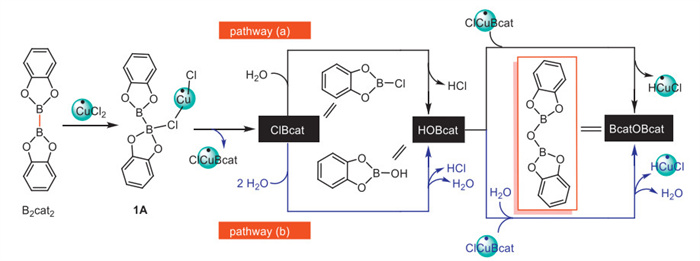
Figure 1.
The possible hydrolytic cleavage of B2cat2 catalyzed by CuCl2.

Mechanistic insights into copper-mediated dehydroboration of alkane C(sp3)-H bonds: Triple roles of CuCl2
Nana Ma , Qiongjin Wang , Die Zhao , Bowen Duan , Dihao Kang , Shujun Li


Boronic acids and esters are pivotal synthetic building blocks [1,2]. Catalytic C–H borylation offers an atom-economical approach, with recent advances enabling mild and regioselective aromatic C(sp2)–H borylation [3–6]. However, the borylation of unactivated alkane C(sp3)–H bonds remains challenging, typically requiring harsh conditions and exhibiting a preference for primary C–H bonds [7–14]. While noble metal catalysis enables oxidant-free dehydrogenative borylation, photoinduced radical methods generally rely on stoichiometric oxidants [15]. A significant breakthrough was reported by Aggarwal et al. [16], who developed a CuCl2-catalyzed, light-mediated, oxidant-free C(sp3)–H borylation of alkanes using bis(catecholato)diboron (B2cat2). The key innovation involves copper oxidizing B2cat2 to generate electrophilic diboron oxide intermediates (e.g., BcatOBcat), enabling redox-neutral borylation. Experimental characterization confirmed the formation of BcatOBcat and chlororadical-borate complexes, leading to the proposed mechanistic pathway outlined in Fig. S1 (Supporting information). The combination of versatile ligands and the multiple oxidation states of Cu enables the pivotal photocatalytic processes under visible light [17,18]. Here, photoexcitation of CuCl2 generates CuCl and a chlorine radical (Cl•). This Cl• is captured by BcatOBcat (formed via CuCl2-catalyzed reaction of B2cat2 with H2O), yielding the chlororadical-borate complex [ClBcatOBcat]•. Subsequent hydrogen atom transfer (HAT) from an alkane to [ClBcatOBcat]• produces an alkyl radical (R•). The R• is then borylated by BcatOBcat, facilitated by CuCl, to form the C–B bond. Despite this progress, key mechanistic aspects remain unclear. These include: the specific agent responsible for HAT (Cl• or [BcatOBcatCl]•), the fundamental role of BcatOBcat beyond intermediate formation, the precise identity of the key active species, and the origin of the rate-enhancing effect observed upon H2O addition. To resolve these uncertainties, we aim to employ density functional theory (DFT) calculations (computational details and Cartesian coordinates of all the calculated systems are provided in Supporting information) to systematically investigate the formation of experimentally observed elusive intermediates and elucidate the functional contributions of the essential reaction conditions.
All computational investigations in this study were conducted with strict adherence to quantum chemical rigor. Initial mechanistic analysis focused on the experimentally proposed CuCl2-catalyzed hydrolytic cleavage of B2cat2 to generate electrophilic diboron oxide (BcatOBcat). As illustrated in Fig. 1, two distinct pathways were identified for the hydrolytic cleavage.
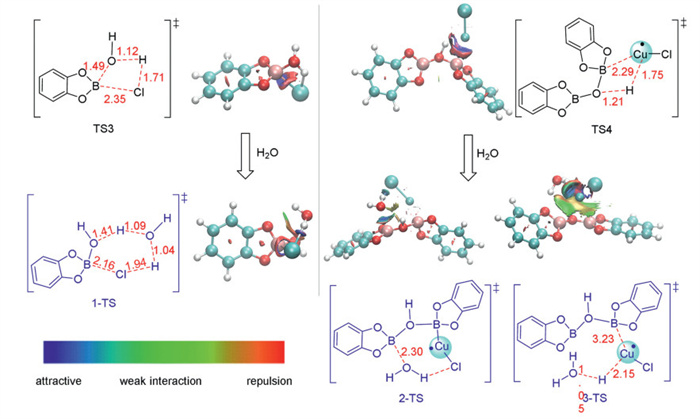
The process initiates with the interaction between CuⅡCl2 and B2cat2, requiring an activation barrier of 5.8 kcal/mol to form intermediate 1A featuring a B–Cl bond as depicted in Fig. S2 (Supporting information). Subsequent B–B bond cleavage in 1A proceeds via an 18.3 kcal/mol barrier to yield electrophilic ClBcat and the CuⅡ-boryl complex ClCuⅡBcat. Then, as pathway (a), reaction of BcatCl with one H2O through transition state TS3 (ΔG°‡ = 22.6 kcal/mol) generates HCl and hydroboric acid HOBcat. Geometric analysis of TS3 revealed elongated B···O (1.49 Å) and B···Cl (2.35 Å) distances in the four-membered transition state, rationalizing the elevated activation energy. Thermodynamically unfavorable coupling of HOBcat with ClCuⅡBcat to produce HCuⅡCl and BcatOBcat necessitates overcoming a prohibitive 31.1 kcal/mol barrier, rendering this pathway kinetically disfavored. By analyzing the structural feature. Simultaneous B–Cu bond cleavage and O–H dissociation in intermediate 2A to form final products proved structurally challenging. Notably, the prevalence of Lewis acid-based Bδ+···Oδ– interaction and Hδ+···Oδ– interactions in key intermediates prompted further exploration of H2O participation effects. Pathway (b) further demonstrates enhanced feasibility. Reaction of BcatCl with two H2O molecules proceeds through a six-membered transition state (1-TS, ΔG°‡ = 18.2 kcal/mol) to form HOBcat with concomitant H2O elimination. Subsequent interaction of HOBcat with ClCuⅡBcat and H2O generates complex 1B via Bδ+···Oδ– interactions. 1B then undergoes B–O and O–H bond cleavage forming 2B (ΔG°‡ = 6.8 kcal/mol), followed by formation of HCuⅡCl and BcatOBcat via 3-TS (ΔG°‡ = 8.3 kcal/mol). Based on these results, the rate-determining step exhibits ~7.8 kcal/mol reduction, conclusively demonstrating the critical role of H2O on stabilizing transition states through enhanced Bδ+···Oδ– and Hδ+···Oδ– interactions. To offer more intuitive and quantitative evidence, we conducted a reduced density gradient (RDG) [19] analysis of the key transition states (1-TS TS3, 2-TS, 3-TS, and TS4), as shown in Fig. 2. The RDG results reveal that the presence of Bδ+···Oδ– and Hδ+···Oδ– interactions (indicated in green) when H2O involves. This explains the reaction's compatibility with both aqueous and anhydrous environments [16].
Subsequent mechanistic investigation addressed experimental hypotheses regarding BcatOBcat reactivity. Generally, reactive Cl•, generating from CuⅡCl2 photoexcitation, can abstract H atom of alkanes to form R• easily. However, the experiments observed high selectivity for primary C-H borylation, which seems to be different from the regioselectivity of HAT governed by C-H bond dissociation energies (BDEs) of alkanes [20]. Therefore, Aggarwal et al. proposed a mechanism involves Cl• reacting with diboron oxide O(Bcat)2 to form a chlororadical-borate complex [ClBcatOBcat]• (3A). Subsequent HAT by 3A selectively cleaves C–H bonds to generate R•.
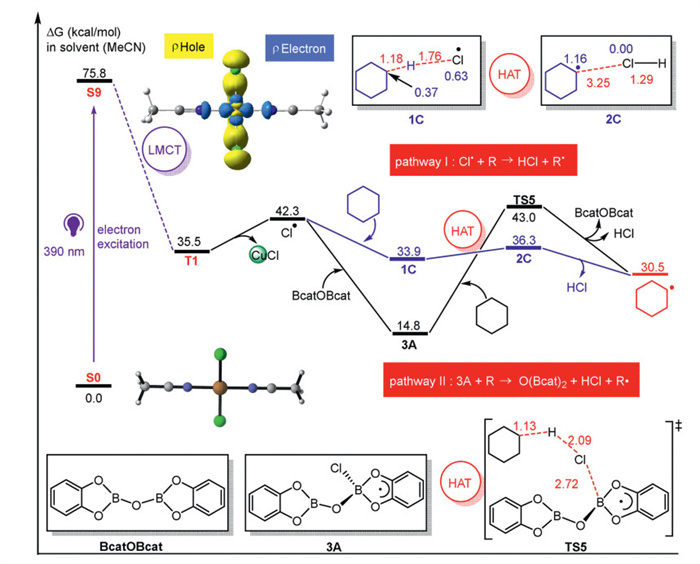
Herein, cyclohexane (a standard experimental substrate) was selected for computational analysis of HAT. As illustrated in Fig. 3, using a solvated CuⅡCl2(CH3CN)2 catalyst model [21], photoinduced cleavage of the Cu–Cl bond generates Cl•. Time-dependent density functional theory (TDDFT) calculations revealed a vertical excitation wavelength of λ = 390 nm for [CuⅡCl2(CH3CN)2], consistent with experimental irradiation conditions (λ = 378 nm) (Table S1 in Supporting information). Electron density difference analysis between ground and excited states showed hole localization on Cl− ligands (yellow isosurface) and electron accumulation at the CuⅡ center (blue isosurface), confirming ligand-to-metal charge transfer (LMCT)-triggered oxidation of Cl− to Cl• with concomitant formation of CuⅠCl(CH3CN)2 (T1). Subsequent Cl• releases from T1 is endothermic by 6.8 kcal/mol. Pathway Ⅰ (Cl• + R → HCl + R•) involves HAT between Cl• and cyclohexane, proceeding via a 2.4 kcal/mol endothermic step to intermediate 2C, followed by HCl dissociation (ΔG° = −5.8 kcal/mol). While Cl• reacts exothermically (ΔG° = −27.5 kcal/mol) with O(Bcat)2 to form stable intermediate 3A, and the HAT between 3A and cyclohexane requires traversing transition state TS5 with a ΔG°‡ value of 28.2 kcal/mol to generate R•. Comparative analysis demonstrates that R• formation predominantly follows direct HAT by Cl•. Further NPA charge and spin density analyses (Fig. S3 in Supporting information) of HAT by Cl• pathways revealed negligible charge variation on hydrogen atoms (0.07→0.05→0.07→0.09→0.12) and no spin density localization, while significant spin density redistribution at alkyl C (0.37→0.58→0.72→0.86→0.93) and Cl (0.63→0.46→0.29→ 0.19→0.10) centers confirms radical formation, as well the HAT by 3A pathways. These observations indicate a proton-coupled electron transfer (PCET) mechanism for both pathways.
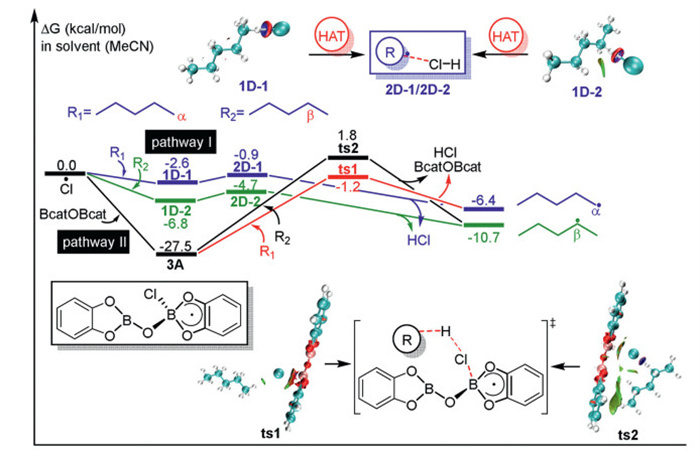
To exclude substrate-specific effects, two above HAT pathways were evaluated for five distinct substrates. The energy profiles consistently showed facile HAT to Cl• (while ΔG°‡ = 27.4~30.8 kcal/mol for HAT to 3A), shown in Fig. S4 (Supporting information), confirming Cl• as the dominant hydrogen-abstracting species for these substrates rather than 3A. For the experimental reports of higher primary vs. secondary C–H borylation yields, the calculations for n-pentane revealed that Cl• preferentially abstracts H of primary C–H bonds compared with intermediate 3A. For abstract H by Cl•, similar to cyclohexane, the process exhibits a monotonically increasing potential energy curve (Fig. S5 in Supporting information). Specifically, the abstraction of primary C–H is endothermic by 1.7 kcal/mol, and abstraction of the secondary C–H bond is endothermic by 2.1 kcal/mol (Fig. 4). To gain deeper insight into the difference between primary and secondary C–H bonds, we performed RDG analysis on the key intermediates (1D-1 and 1D-2), which revealed the presence of noncovalent interactions. Further energy decomposition analysis (EDA) (details in Supporting information) of the interactions indicated that, the key difference between primary and secondary C–H bonds lies in their steric effects, despite orbital interactions being the dominant factor in the H abstraction by Cl• [22–24]. The hydrogen abstraction by 3A was also analyzed to compare the activation energies for primary and secondary C–H bonds. The resulting ∆∆G°‡ value of 3.0 kcal/mol can be attributed primarily to steric effects based on the EDA results.
Conventionally, the resulting R• could be captured by B2cat2. However, given the experimental alkyl-to-B2cat2 stoichiometric ratio of 5:1, this pathway is deemed kinetically negligible. Instead, computational evidence suggests that O(Bcat)2 readily reacts with Cl•, prompting us to investigate its potential to capture R•. As shown in Fig. S6 (Supporting information), O(Bcat)2 captures R• via a 7.8 kcal/mol endothermic process to form complex 4A, which undergoes C–B bond formation through transition state TS8 (ΔG°‡ = 3.1 kcal/mol) to yield intermediate 5A in which B is sp3 hybrid. Spin density population of 5A confirms delocalization of the unpaired electron across the Bcat ligand. Subsequent CuⅠCl coordination to 5A via Cu–O bonding generates intermediate 6A (ΔG° = −6.2 kcal/mol). B–O bond cleavage in 6A with a ΔG°‡ value of a 17.7 kcal/mol produces the borylated product (P), accompanied by valence transition (CuⅠ→CuⅡ) as the delocalized electron transfers to CuⅠ, forming BcatOCuⅡCl. Theoretically, BcatOCuⅡCl could react with HCl to form HOBcat and regenerate photocatalyst CuⅡCl2. However, 1H NMR analysis of the crude reaction mixture detected only O(Bcat)2 intermediates, with no observable HOBcat [16]. This aligns with experimental observations that HCl and CuⅡCl2 act as dehydrating agents, accelerating condensation of two HOBcat molecules to regenerate O(Bcat)2, thereby amplifying the active borylation species. Crucially, H2O generated in this step serves as a cocatalyst in the tandem copper cycle, explaining the reaction still proceed even in anhydrous solvents [16].
To resolve ambiguities in the HOBcat→O(Bcat)2 dehydration pathway, we systematically evaluated the sequence of HCl and CuⅡCl2 addition. Given the possible catalytic role of H2O, elucidating its recycling mechanism is essential. Comprehensive analysis revealed three plausible reaction pathways for HOBcat dehydration and CuⅡCl2 regeneration, as detailed in Fig. 5.
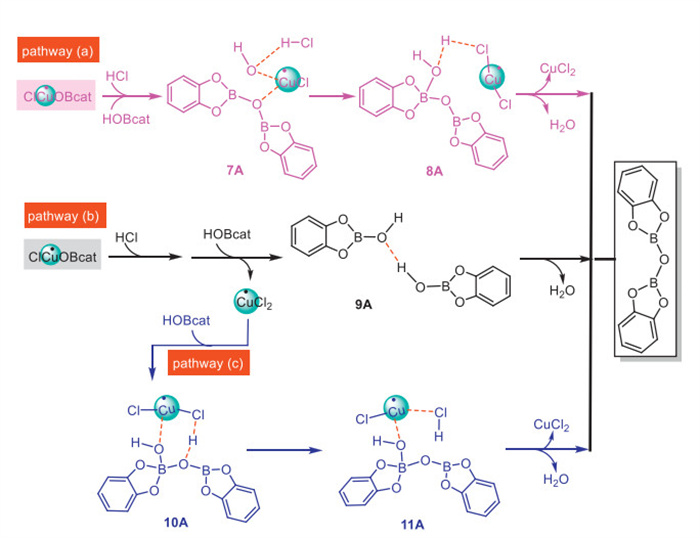
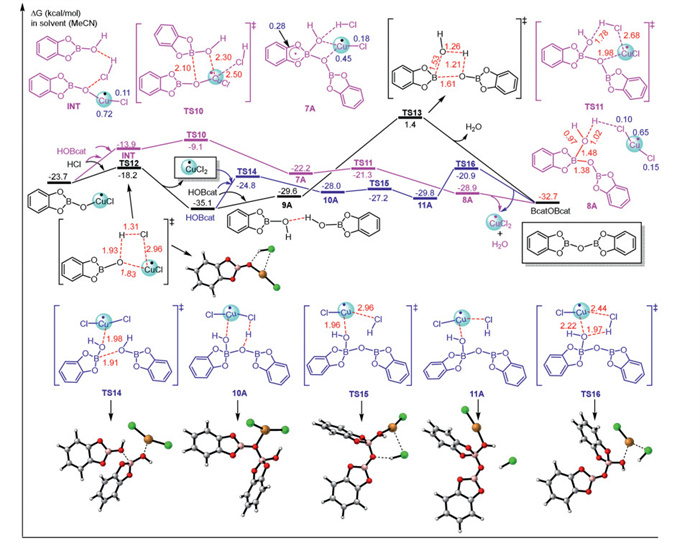
For Pathway (a), the energy profile in Fig. 6 reveals that BcatOCuⅡCl interacts with HCl and HOBcat to form a complex. This complex undergoes a four-membered transition state (TS10) to generate the O···Cu···O-coordinated complex 7A, with an activation barrier of ΔG°‡ = 22.7 kcal/mol. Subsequent intramolecular ligand exchange in 8A produces O(Bcat)2, regenerated catalyst CuⅡCl2 and H2O, overcoming a 10.5 kcal/mol barrier. While this step is exothermal 10.5 kcal/mol. Pathway (b) involves the reaction of BcatOCuⅡCl with HCl to form CuⅡCl2 and HOBcat (ΔG°‡ = 13.6 kcal/mol). Subsequent dehydration condensation of two HOBcat molecules (complex 9A) to yield O(Bcat)2 faces a prohibitive barrier of 33.2 kcal/mol, prompting investigation into the catalytic role of CuⅡCl2. Therefore, in pathway (c), CuⅡCl2 facilitates HOBcat dehydration by acting as a bridging catalyst. Initially, Lewis acid-based B···O and Cu···O interactions form intermediate 10A with a B–O–B bond (ΔG°‡ = 10.3 kcal/mol). A concerted O–H bond cleavage and H–Cl formation in 10A generates intermediate 11A (ΔG°‡ = 7.9 kcal/mol). Finally, 11A undergoes HCl dissociation and H transfer to oxygen, producing O(Bcat)2, H2O, and regenerated CuCl2 (ΔG°‡ = 14.2 kcal/mol). These results demonstrate that direct condensation of two HOBcat molecules is kinetically unfavorable, while CuCl2 significantly lowers the activation barrier, enabling efficient regeneration of the active borylation agent O(Bcat)2. This confirms the third role of CuCl2 as a catalyst for HOBcat dehydration condensation.
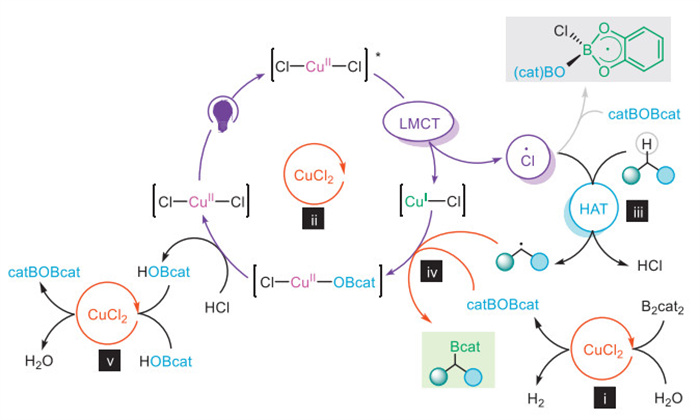
Based on the comprehensive computational analysis of the copper-mediated dehydrogenative borylation mechanism for alkane C(sp3)–H bonds discussed above, we can propose a plausible reaction mechanism as depicted in Fig. 7. That is, (ⅰ) B2cat2 reacts with H2O to generate (Bcat)2O catalyzed by CuⅡCl2, (ⅱ) the photosensitizer CuCl2 generates reactive Cl• via LMCT, (ⅲ) Cl• abstracts hydrogen atom from alkane to form alkane radical R•, (ⅳ) R• can be captured by the resulting (Bcat)2O forming the C‒B bond and CuⅠCl2 plays a crucial role, and (ⅴ) the resulting HOBcat molecules dehydrate to (Bcat)2O catalyzed by CuCl2. In this type of photocatalytic borylation reaction, the key step involves the reaction of the more electrophilic (Bcat)2O than B2cat2 with the alkyl radicals.
The mechanistic insights provide a revised perspective on the direct photoinduced C(sp3)–H borylation reaction involving N-alkoxy phthalimide oxidants reported by Aggarwal et al. [25]. Experimental mechanistic studies initially proposed that the chlororadical-borate complex selectively abstracts hydrogen from sterically accessible C(sp3)–H bonds to generate alkyl radicals R• (Fig. S7 in Supporting information). However, based on computational results from prior alkyl borylation mechanisms, we hypothesize that HAT in this system is mediated not by CF3CH2OBcatCl• (2M) but by reactive Cl•. To validate this, we computationally evaluated HAT pathways and subsequent borylation product formation. Using bicyclohexane as a model substrate, the energy profile in Fig. S4 revealed that Cl•-mediated hydrogen abstraction proceeds via a 4.1 kcal/mol endothermic step, followed by exothermic production of HCl and R•. In contrast, HAT process mediated by 2M, formed by the reaction of Cl• with CF3CH2OBcat (1M) exothermically (ΔG° = −25.9 kcal/mol), abstracts hydrogen via a prohibitively high barrier (ΔG°‡ = 29.2 kcal/mol), rendering this pathway kinetically unfavorable compared to direct Cl• involvement (Fig. S8 in Supporting information). The generated R• can be captured by B2cat2 through C–B bond formation (ΔG°‡ = 6.4 kcal/mol) to yield intermediate 4M This process undergoes a concerted B–Cl bond formation/B–B bond cleavage to produce borylation product P and ClBcat•⁻. Alternative B–B cleavage via 5TS (ΔG°‡ = 19.4 kcal/mol) is disfavored. Notably, 1M may also capture R•. Calculations show that 1M reacts with R• via transition state 3TS (ΔG°‡ = 11.6 kcal/mol) to form intermediate 2N, where spin density analysis confirms electron delocalization on the Bcat ligand. Subsequent O–B bond cleavage and B–O bond formation (ΔG°‡ = 4.7 kcal/mol) regenerates 2M and yields product P. The rate-determining step for this pathway (C–B bond formation, ΔG°‡ = 11.6 kcal/mol) is less favorable than B2cat2-mediated R• trapping (ΔG°‡ = 6.4 kcal/mol). However, the experimental alkyl-to-B2cat2 ratio (10:1) implies R• trapping by B2cat2 is impossible. Thus, we propose that CF3CH2OBcat serves as a critical intermediate for R• capture, ensuring efficient borylation product yields.
This study provides a comprehensive mechanistic elucidation of copper-catalyzed C(sp3)–H borylation through DFT calculations. Key findings are summarized as follows: (ⅰ) CuCl2 catalyzes hydrolytic cleavage of B2cat2 to generate electrophilic BcatOBcat, and CuCl2 functions as a photosensitizer to generate reactive Cl• radicals via LMCT and also as a catalyst for dehydrative condensation of HOBcat intermediates. This triple role ensures efficient regeneration of the active borylation agent O(Bcat)2, enabling the reaction to proceed under mild conditions even in anhydrous solvents. (ⅱ) While H2O is not stoichiometrically consumed, its regenerated presence stabilizes key transition states through Bδ+···Oδ– and Hδ+···Oδ– interactions, significantly lowering activation barriers in hydrolytic cleavage pathways. (ⅲ) Contrary to earlier hypotheses, HAT is predominantly mediated by Cl• radicals rather than chlororadical-borate complexes (e.g., [ClBcatOBcat]•). (ⅳ) The preferential borylation of primary C–H bonds, despite their higher BDEs, arises from steric effects rather than thermodynamic factors. These insights challenge conventional mechanistic assumptions and establish a unified framework for understanding radical-mediated C–H borylation. The work highlights the synergy between photoredox catalysis and Lewis acid-assisted bond activation, offering design principles for developing efficient, regioselective C–H functionalization systems.
Nana Ma: Writing – review & editing, Writing – original draft, Supervision, Funding acquisition, Data curation, Conceptualization. Qiongjin Wang: Writing – original draft, Investigation, Data curation. Die Zhao: Investigation, Data curation. Bowen Duan: Investigation, Data curation. Dihao Kang: Investigation, Data curation. Shujun Li: Writing – review & editing, Supervision, Investigation, Funding acquisition, Conceptualization.
The authors declare that they have no known competing financial interests or personal relationships that could have appeared to influence the work reported in this paper.
This work was supported by the National Natural Science Foundation of China (Nos. 22171073 and 22571070) and Natural Science Foundation of Henan Province (Nos. 252300421190 and 252300421042). We also thank the financial support from Henan Key Laboratory of Organic Functional Molecules and Drug Innovation.
Supplementary material associated with this article can be found, in the online version, at doi:
M.P. Silva, L. Saraiva, M. Pinto, et al., Molecules 25 (2020) 4323. doi: 10.3390/molecules25184323
C. Sandford, V.K. Aggarwal, Chem. Commun. 53 (2017) 5481–5494. doi: 10.1039/C7CC01254C
I.A.I. Mkhalid, J.H. Barnard, T.B. Marder, et al., Chem. Rev. 110 (2010) 890–931. doi: 10.1021/cr900206p
L. Xu, G.H. Wang, S. Zhang, et al., Tetrahedron 73 (2017) 7123–7157. doi: 10.1016/j.tet.2017.11.005
J. Lv, X. Chen, X.S. Xue, et al., Nature 575 (2019) 336–340. doi: 10.1038/s41586-019-1640-2
P. Guo, S. Dong, X.G. Zhang, et al., Chin. Chem. Lett. 36 (2025) 110052. doi: 10.1016/j.cclet.2024.110052
T. Ohmura, T. Torigoe, M. Suginome, Chem. Commun. 50 (2014) 6333–6336. doi: 10.1039/C4CC01262C
Q. Li, C.W. Liskey, J.F. Hartwig, J. Am. Chem. Soc. 136 (2014) 8755–8765. doi: 10.1021/ja503676d
R. Oeschger, B. Su, I. Yu, et al., Science 368 (2020) 736–741. doi: 10.1126/science.aba6146
M.R. Jones, C.D. Fast, N.D. Schley, J. Am. Chem. Soc. 142 (2020) 6488–6492. doi: 10.1021/jacs.0c00524
R. Kawazu, T. Torigoe, Y. Kuninobu, Angew. Chem. Int. Ed. 61 (2022) e202202327. doi: 10.1002/anie.202202327
T.J. Gong, Y.Y. Jiang, Y. Fu, Chin. Chem. Lett. 25 (2014) 397–400. doi: 10.1016/j.cclet.2014.01.006
C.W. Liskey, J.F. Hartwig, J. Am. Chem. Soc. 134 (2012) 12422–12425. doi: 10.1021/ja305596v
J.F. Hu, J.H. Lv, Z.Z. Shi., Trends Chem. 4 (2022) 685–698. doi: 10.1016/j.trechm.2022.04.011
S. Sarkar, S. Wagulde, X.Q. Jia, et al., Chem. 8 (2022) 3096–3108. doi: 10.1016/j.chempr.2022.07.022
R.C. Sang, W.Y. Han, H.W. Zhang, et al., J. Am. Chem. Soc. 145(2023) 15207–15217. doi: 10.1021/jacs.3c02185
N. Li, B. Li, K. Murugesan, et al., ACS Catal. 14 (2024) 11974–11989. doi: 10.1021/acscatal.4c03238
A. Hossain, A. Bhattacharyya, O. Reiser, Science 364 (2019) 450.
P. Wu, R. Chaudret, X. Hu, et al., J. Chem. Theory Comput. 9 (2013) 2226–2234. doi: 10.1021/ct4001087
M. Wang, Y.H. Huang, P. Hu, Science 383 (2024) 537–544. doi: 10.1126/science.adj9258
A. Chinchole, M.A. Henriquez, D. Cortes-Arriagada, et al., ACS Catal. 12 (2022) 13549–13554. doi: 10.1021/acscatal.2c03315
K. Morokuma, J. Chem. Phys. 55 (1971) 1236–1244. doi: 10.1063/1.1676210
T. Ziegler, A. Rauk, Theor. Chim. Acta 46 (1977) 1–10.
L. Zhao, M. von Hopffgarten, D.M. Andrada, et al., Comput. Mol. Sci. 8 (2018), e1345. doi: 10.1002/wcms.1345
C. Shu, A. Noble, V.K. Aggarwal, Nature 586 (2020) 714–719. doi: 10.1038/s41586-020-2831-6

Figure 2 The RDG analysis of the key transition states in the formation pathway of BcatOBcat.

Figure 3 The energy profile of photoexcitation of CuCl2 and possible HAT processes of R.

Figure 4 HAT processes of different depositions in n-pentane (steric effect was obtained by RDG method).

Figure 5 Three plausible reaction pathways for HOBcat dehydration and CuCl2 regeneration.

Figure 6 The energy profile for possible pathways of HOBcat dehydration (red values are bond length (Å) and blue values are spin densities).

 扫一扫看文章


扫一扫关注我们
 DownLoad:

 下载:

 下载: