
Scheme 1.
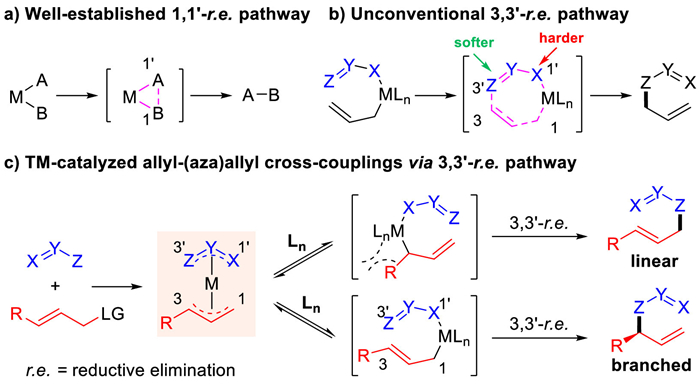
Pathways of reductive elimination and transition metal-catalyzed allyl-(aza)allyl cross-couplings.


The small size and high electronegativity of the fluorine atom endow it with a remarkable role in organic synthesis, materials science, and medicinal chemistry. The strategic incorporation of fluorine atoms and fluorine-containing motifs into organic molecules can significantly improve their physicochemical properties, leading to enhanced membrane permeability and superior metabolic stability. In this context, gem-difluorocyclopropane (gem-F2CP), which bears two fluorine atoms on a single carbon of the cyclopropane ring, has emerged as a particularly valuable building block. The strained gem-F2CP exhibits unique reactivity, especially under transition metal-catalyzed ring-opening transformations. For instance, oxidative addition of a transition metal into a gem-F2CP generates a gem-difluorinated metallacyclobutane intermediate. Subsequent β-fluorine elimination from this intermediate facilitates Tsuji-Trost-type allylation reactions, providing efficient access to structurally complex fluorinated scaffolds.
Reductive elimination is a fundamental elementary step in organometallic chemistry and often serves as the product-forming step in catalytic cycles. This process requires the two coupling atoms to overcome significant distortion energy to come into proximity. Consequently, reductive elimination from transition-metal complexes is typically facilitated by an appropriate ligand, whose electronic and steric properties are crucial for lowering the activation barrier. The concerted mechanism is the most common pathway for reductive elimination, proceeding through a nonpolar, three-membered transition state with retention of stereochemistry, also termed 1,1′-reductive elimination (Scheme 1a). Accordingly, the vast majority of transition metal-catalyzed ring-opening cross-couplings of gem-F2CPs proceed via 1,1′-reductive elimination. In these transformations, nucleophiles preferentially attack the less hindered terminal position to afford linear monofluorinated alkene derivatives.
The reaction pathway becomes particularly intriguing when allylic nucleophiles are employed. In this case, a bis(η3-allyl) metal intermediate can isomerize to various species, including η1-allyl-η3-allyl, η3-allyl-η1-allyl, and bis(η1-allyl) palladium complexes. An alternative inner-sphere σ-σ reductive elimination mode, termed 3,3′-reductive elimination, may then operate through the bis(η1-allyl) metal species (Scheme 1b). This 3,3′-reductive elimination enables bond formation at a remote position via a seven-membered ring transition state [1]. When a bulky auxiliary ligand is present, the bis(η1-allyl) intermediate is favored due to reduced steric congestion. This distinct reaction manifold provides selective access to branched fluoroalkene derivatives (Scheme 1c).
Recently, Leiyang Lv and co-workers at Renmin University of China reported a class of synergistic palladium/N-heterocyclic carbene (NHC) catalytic system, representing the significant advances in the ring-opening regioselective transformations of gem-F2CPs [2–5]. This strategy leverages π-conjugated ambident nucleophiles, which engage in an inner-sphere 3,3′-reductive elimination pathway. The key step is facilitated by a sterically hindered yet flexible Pd-NHC complex, steering nucleophilic attack toward the sterically more congested internal position. The bulky and electron-rich NHC ligand, with its strong binding affinity to palladium, is crucial for enhancing the thermal stability and lifetime of the catalyst.
Guided by this design, Lv and coworkers demonstrated its application in the Pd/SIPr-catalyzed defluorinative alkylation of gem-F2CPs using simple hydrazones to achieve branched regioselectivity (b/l > 20:1) with good yields. These hydrazones act as effective ambident nucleophiles that promote the inner-sphere 3,3′-reductive elimination, a process further accelerated by the facile loss of dinitrogen. Another challenge lies in the ambident reactivity of hydrazones, which is highly dependent on their substitution pattern; the nucleophilicity of the nitrogen atom is significantly greater in N,N-disubstituted hydrazones, which typically form as products. Despite this inherent bias, Lv's group successfully achieved branched selectivity (b/l > 20:1) in the ring-opening cross-coupling of gem-F2CPs with dialkyl ketone hydrazones. Under Pd/IPr catalysis, this reaction proceeds via 3,3′-reductive elimination to selectively furnish the C-alkylated products with good yields (Scheme 2).
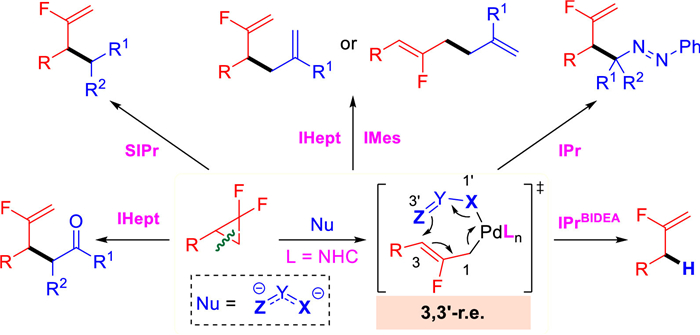
Furthermore, the authors demonstrated that enolates can function as π-conjugated ambident nucleophiles to undergo 3,3′-reductive elimination under the Pd/IHept catalytic system. The versatility of this mechanistic pathway was further illustrated with allylboronates as nucleophiles. By selecting the appropriate NHC ligand, the regioselectivity of the 1,5-diene products could be controlled: The less hindered and electron-deficient Pd/IMes system afforded the linear products (l/b > 30:1), whereas the bulky and electron-rich Pd/IHept system provided the branched products (b/l > 30:1), both via 3,3′-reductive elimination and with excellent yields. In 2024, Lv and coworkers also reported a regioselective reduction of gem-F2CPs to terminal monofluoroalkenes (rr > 100:1), which proceeds via an inner-sphere 3,4′-hydride transfer. Most recently, the authors extended the 3,3′-reductive elimination strategy to an allyl-alkyne cross-coupling for the synthesis of 1,5-enynes. Given the growing recognition of 3,3′-reductive elimination as an unconventional elementary step in organometallic chemistry, its further application in asymmetric transformations and the construction of complex drug or natural product scaffolds is highly anticipated.
The authors declare that they have no known competing financial interests or personal relationships that could have appeared to influence the work reported in this paper.
Rong-Nan Yi: Writing – original draft. Jun Jiang: Writing – original draft. Wei-Min He: Writing – review & editing.
We are grateful for financial support from the Scientific Research Fund of Hunan Provincial Education Department (No. 22B0435) and Changsha Natural Science Foundation (No. 104872).
L. Lv, H. Qian, Green Synth. Catal. 4 (2023) 190–205.
L. Lv, C.J. Li, Angew. Chem. Int. Ed. 60 (2021) 13098–13104. doi: 10.1002/anie.202102240
H. Qian, H.D. Nguyen, L. Lv, S. Chen, Z. Li, Angew. Chem. Int. Ed. 62 (2023) e202303271. doi: 10.1002/anie.202303271
H. Qian, Z.P. Cheng, Y. Luo, et al., J. Am. Chem. Soc. 146 (2024) 24–32. doi: 10.1021/jacs.3c07992
H. Qian, G.N. Morais, K.E. Colbaugh, et al., Angew. Chem. Int. Ed. 64 (2025) e202517878. doi: 10.1002/anie.202517878

Scheme 1 Pathways of reductive elimination and transition metal-catalyzed allyl-(aza)allyl cross-couplings.

 扫一扫看文章


扫一扫关注我们
 DownLoad:
 下载:
下载:

 下载:
下载: