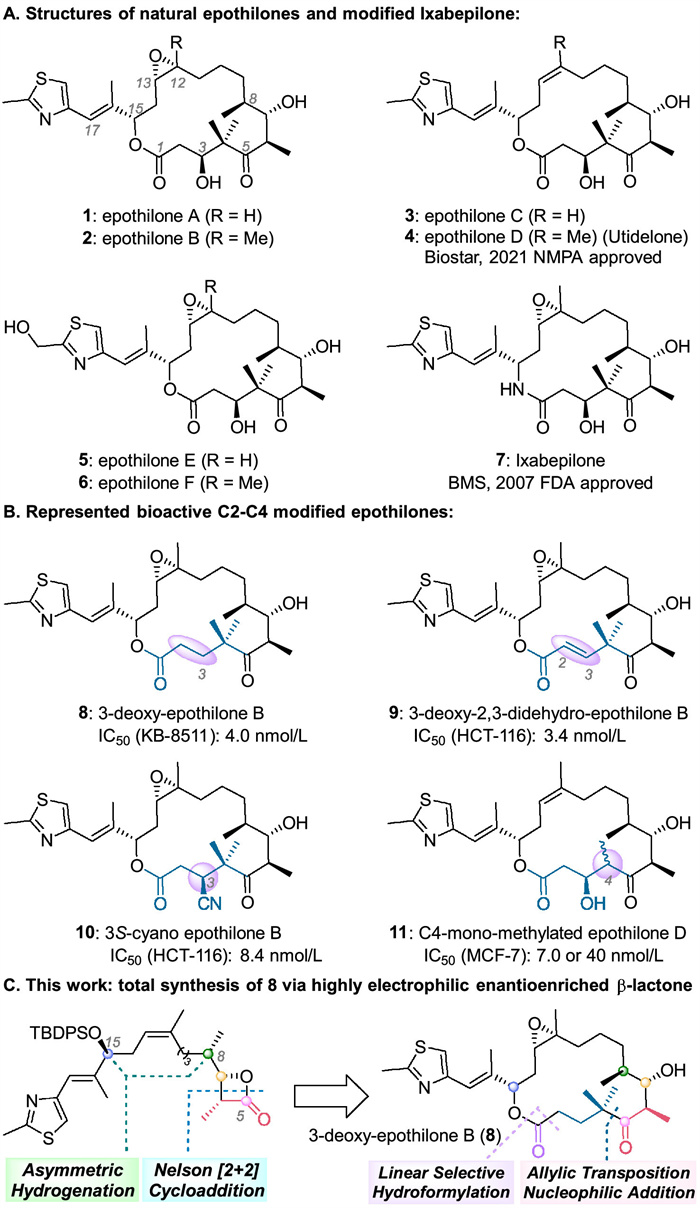
Figure 1.
(A) Natural epothilones and Ixabepilone. (B) Represented C2−C4 modified epothilones. (C) Total synthesis of 8 through the highly electrophilic enantioenriched β-lactone.

Enantioselective total synthesis of 3-deoxy-epothilone B enabled by efficient asymmetric catalysis
Yan Zong , Qiuchen Huang , Xiaomei Zou , Qifan Zhou , Yuanmei Wen , Dong Li , Yongzhi Chen , Xuefeng Tan , Gen-Qiang Chen , Xumu Zhang


Epothilones (1 − 6) are 16-membered macrolides isolated from Sorangium cellulosum, which act as novel microtubule stabilizing agents for the treatment of cancer [1–3]. During the past few decades, many synthetic routes to natural epothilones or synthetic analogues have been disclosed [4–6]. Epothilone D (4), also known as Utidelone (UTD1), is a new-generation microtubule targeted drug that offers advantages over paclitaxel on improved efficacy and safety [7–10]. It has won the approvement of NMPA in 2021 for the treatment of breast cancer. Another example based on the alteration of epothilone B core by the conversion of a macrolactone to a macrolactam ring, namely Ixabepilone [11], was exploited by Bristol−Myers Squibb (BMS), and has been approved by FDA for the treatment of breast cancer in 2007 (Fig. 1A).
The above success on treatment of cancer with natural or modified epothilones render this 16-membered macrolide backbone a notable target for more structural modifications and bioactivity studies. SAR (structure activity relationship) studies indicated that the cis/trans C6−C8 positions with C8−(S) and C12−C13 (Z) configuration were pivotal for retaining excellent biological activities of the natural epothilones [4–6,12–18]. Whereas, the C1−C4 positions have much space for structural modifications. Most of the bioactivities were retained after removal of 3(S)−OH [19–21] as well as the gem-dimethyl group at C4 position [3,22]. In 2005, Altmann and coworkers reported the first synthesis of 3-deoxy-epothilone B (8) [20], which retained most of the cytotoxicity of epothilone B (Fig. 1B) [5]. However, synthetic challenges limited the discovery of potent candidates with decorations on C1−C4 positions to improve the metabolic stability or to generate a new binding site for a better component of antibody-drug conjugates (ADCs).
Despite great advances have been made for the syntheses of epothilones and their diversified analogues, the construction of the C6−C7 bond still relied heavily on the aldol condensation, of which the diastereoselectivity was highly structure-dependent [23–35]. Moreover, the intermolecular aldol reaction was not suitable for the construction of southern fragment with active hydrogens at C4. In addition, the introduction of chiral centers at C8 or C15 exclusively depended on the utility of stoichiometric auxiliaries or enantioenriched natural occurring materials [27,28,36–40], and lengthy steps or detour are inevitable. Therefore, the development of an efficient access to a suitable common intermediate embodying all desired configurations on C5−C17 fragment was highly desirable for the efficient syntheses of diverse modified C1−C4 epothilones. Herein, we report an efficient strategy for the rapid construction of C5−C17 fragment of epothilones with Nelson’s alkaloid-catalyzed asymmetric [2 + 2] cycloaddition to forge the desired cis/trans configuration of C6−C8 position, and asymmetric hydrogenation (AH) to construct the stereogenic centers at C8 and C15. These methods were highly in accordance with the goal of building complexity in a fast and straightforward way for a modular approach [41]. And the total synthesis of bioactive 3-deoxy-epothilone B (8) was finally accomplished with subsequent allylic transposition nucleophilic addition, rhodium-catalyzed linear selective hydroformylation and macrolactonization as the key steps (Fig. 1C).
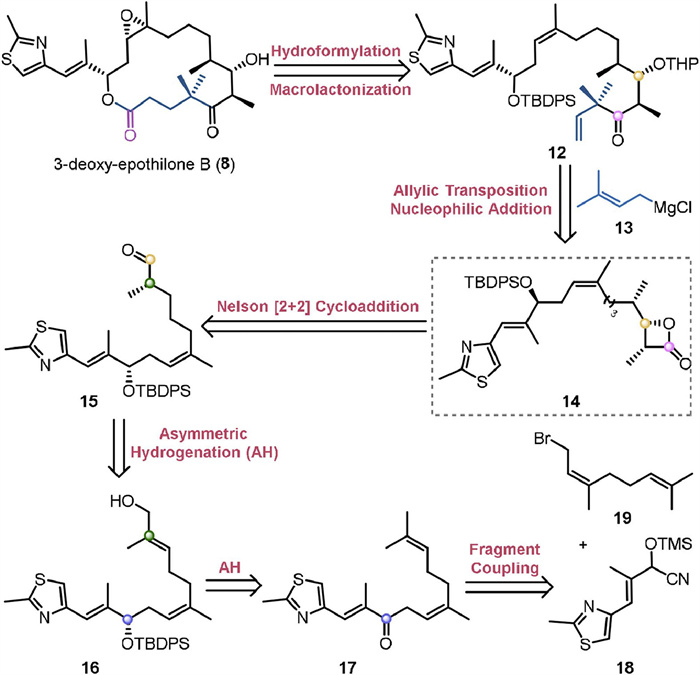
In our retrosynthetic plan toward 8 (Fig. 2), we anticipated that a highly chemo- and regioselective homologation via hydroformylation of triene 12 would install the C1 unit, thus delivering the 16-membered macrolide after a macrolactonization process. Triene 12 can be derived from nucleophilic addition via allylic transposition with the key highly electrophilic enantioenriched β-lactone 14. Since the alkaloid-catalyzed acyl halide-aldehyde cyclocondensation (AAC) for the construction of diverse enantioenriched β-lactones was initially reported by Nelson in 2004 [42,43], this asymmetric [2 + 2] cycloaddition has seen relatively few applications in natural product synthesis as alternative to the classic aldol reactions [44–52], despite its ability to expediently forge two contiguous chiral centers. Based on this efficient transformation, we envisioned 14 could be synthesized by Nelson’s alkaloid-catalyzed asymmetric [2 + 2] cycloaddition with propionyl chloride and aldehyde 15. Alternatively, the stereochemistry on C8 could be introduced by ruthenium-catalyzed AH of 16. In turn, the C15 chiral center of epothilones was also expected to be installed through the eco-friendly AH technique with ketone 17, which could be coupled through an umpolung reaction of the easily prepared TMS cyanohydrin 18 and neryl bromide 19.
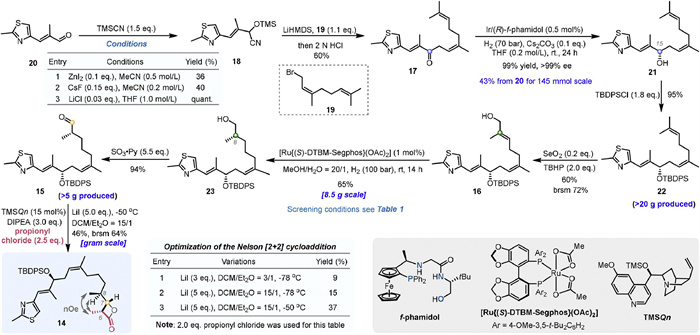
As was shown in Scheme 1, we started our synthetic endeavors with the initial aim of obtaining the TMS cyanohydrin 18 from the known aldehyde 20, which could be easily accessed from commercially available 4-formyl-2-methylthiazole in one step [53]. Fortunately, we noted that 18 could be produced quantitatively with 1.5 equiv. of TMSCN and catalytic amount of LiCl [54]. The efficient conversion of 20 to 18 was the result of extensive optimization with other additives such as ZnI2 as well as CsF, which led to either poor conversion or side reaction, giving the desired product in modest yields. With the requisite coupling partners in hand, we focused our efforts on the construction of the northern backbone 17 of epothilones. Initially, 18 was deprotonated with LDA followed by treatment with 1.2 equiv. of 19, whereas no desired product was detected after treatment with TBAF [55]. To our delight, little amount of 17 was obtained when hydrochloric acid aqueous solution was utilized instead of TBAF for subsequent removal of the TMS group. Encouraged by this result, other bases were evaluated, and LiHMDS exhibited the best result, providing the coupling product 17 in 60% isolated yield (see Table S1 in Supporting information for details). With ketone 17 in hand, we then set the stage for the installation of the chiral center at C15. Gratifyingly, the tetradentate ligand f-phamidol, which was disclosed by our group in 2022 [56–58], displayed excellent performance and the AH of 17 proceeded smoothly with 0.5 mol% iridium catalyst under hydrogen, giving rise to the desired alcohol 21 in 99% yield and >99% ee (see Table S2 in Supporting information for details). Notably, 21 could be obtained in 43% yield over three steps from 20 on a 145 mmol scale. After protection of the C15-OH with 1.8 equiv. of TBDPSCl, 22 could be produced on over 20 g scale in a single pass, which verified the robustness of this sequence. And the desired hydroxy group was thus introduced precisely to give the allylic alcohol 16 in 60% yield via Riley oxidation [59]. The usage of bulky TBDPS was significant for the high regioselectivity of this transformation probably because it could increase the steric hindrance of the adjacent double bonds (C12–C13 and C16–C17) which could also possibly competitively participate the following AH of C8–C9 double bond to generate C8 stereogenic center.
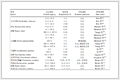
At this stage, we concentrated our efforts on the challenging AH of C8–C9 double bond in 16 (Table 1). Despite great progress have been made for the AH of α,β-unsaturated carboxylic acids [60–63]. The enantiocontrol for AH of 2-substituted-2-alkenols is difficult, due to the poor coordinating ability of the hydroxyl group. Moreover, the nitrogen atom embedded in thiazole adjacent to the C16–C17 double bond could also serve as a directing group, thereby leading to the competitive hydrogenation. Initially, we screened various ligands such as Binap, Segphos, and MeO-Biphep (L1-L6) for ruthenium-catalyzed (10 mol%) AH at 40 ℃. L1 could give the desired product 23 in 30% yield along with 10% over-reduced product 23″, and 34% of 16 was recovered (entry 1, Table 1). Besides, 36% yield and the highest 7.1:1 dr was observed with L5 as ligand combining with 38% yield of 23″ (entry 5, Table 1). Delightedly, the yield of 23 was improved to 62% with retention of the high diastereoselectivity by lowering the catalyst loading to 1 mol% at 25 ℃ for 14 h (entry 7, Table 1). Notably, the efficacy maintained well on a multigram-scale, providing 23 in 65% isolated yield (entry 8, Table 1). The rhodium/ChenPhos (L7) catalytic system [64] was also applied with 16, albeit with unsatisfactory result (entry 9, Table 1) (see Table S3 in Supporting information for more details).
 DownLoad:
CSV
DownLoad:
CSV
 |
||||||||
| Entry | Catalyst (mol%) | Temp. (℃) | Time (h) | Yield (%) | dr (23/23′) | |||
| 23 | 23′ | 23″ | 16 | |||||
| 1 | Ru(L1)(OAc)2 (10 mol%) | 40 | 6 | 30 | 7.5 | 10 | 34 | 4.0/1 |
| 2 | Ru(L2)(OAc)2 (10 mol%) | 40 | 6 | 16 | <5 | 60 | 0 | / |
| 3 | Ru(L3)(OAc)2 (10 mol%) | 40 | 6 | 20 | 4.3 | 66 | 0 | 4.6/1 |
| 4 | Ru(L4)(OAc)2 (10 mol%) | 40 | 6 | 9 | 1.5 | 74 | 1.5 | 6.0/1 |
| 5 | Ru(L5)(OAc)2 (10 mol%) | 40 | 6 | 36 | 5.1 | 38 | 0 | 7.1/1 |
| 6 | Ru(L6)(OAc)2 (10 mol%) | 40 | 6 | 11 | 2.3 | 54 | 0 | 4.8/1 |
| 7 | Ru(L5)(OAc)2 (1 mol%) | 25 | 14 | 62 | 9.4 | 5.7 | 0 | 6.6/1 |
| 8b | Ru(L5)(OAc)2 (1 mol%) | 25 | 14 | 65c | 10 | 1.3 | 2.8 | 6.5/1 |
| 9d | Rh/L7 (1 mol%) | 25 | 20 | 18 | 7.1 | 9.0 | 51 | 2.5/1 |
| a Reaction conditions: 16 (0.10 mmol), Ru complex, solvent (MeOH/H2O = 20/1, 0.5 mL). Diastereomeric ratios (dr) and yields of 23 were determined by 1H NMR spectroscopy. b 8.5 g scale, solvent (0.5 mol/L). c Isolated yield. d Performed with Rh/ChenPhos (1 mol%), in 0.5 mL DCM (0.2 mol/L) under 25 bar of H2 at room temperature for 20 h. |
||||||||
After Parikh–Doering oxidation, aldehyde 15 was obtained in excellent yield, which finished the synthesis of northern fragment of epothilones within 7 total steps from 20 (8 steps from commercially available 4-formyl-2-methylthiazole) as opposed to 11–18 total steps by the previous work [27,28,36–40,65,66]. With access to aldehyde 15 secured, we then continued our exploration on the synthesis of pivotal enantioenriched β-lactone 14. Initially, we treated 15 under Nelson’s standard condition [42], whereas, only 9% yield of 14 was obtained and most of starting material was recovered. A slight improvement in yield was realized by dropping the proportion of diethyl ether and increasing the quantities of lithium iodide [67]. Extensive screening of conditions revealed that a higher temperature promoted the conversion dramatically, providing 14 with 37% isolated yield at −50 ℃ (for other condition alterations including solvents combinations and bases see Table S4 in Supporting information for details). Notably, the isolated yield was further improved to 46% when we carried out the gram-scale reaction with an increased 2.5 equiv. of propionyl chloride. The configuration of 14 was determined to be C6(R) and C7(S) based on NOESY correlation analysis.
With the key enantioenriched β-lactone 14 in hand, we then set the stage for the exploration of 3-deoxy-epothilone B (8) (Scheme 2A). Driven by the inherent ring-strain of the four-membered lactone, the nucleophilic ring-opening process could proceed smoothly at −78 ℃ with excess 13, thus delivered the desired 25 through allylic transposition nucleophilic addition in high yield with the newly formed sterically hindered C5-carbonyl undisturbed [68]. Note that the protection of C7 hydroxy group was essential to prevent the competitive lactonization during the following macrolactonization process. TBS protection of 25 provided 26 with a high yield of 92%. Nevertheless, the selective removal of TBDPS with 20 equiv. of TBAF under air delivered an unexpected ketone 27 in high yield, which was possibly resulted from a retro-aldol reaction followed by oxidative dehomologation of the in-situ formed aldehyde with oxygen via Int1 [69,70]. And this hypothesis was further verified by the reaction of aldehyde 15 to give 27 in 80% yield (see Supporting information for details). The reported common intermediate 24 for epothilone B (2) and D (4) was obtained by treatment of 15 with 15 equiv. of strictly deoxygenated TBAF (other conditions such as TBAF/AcOH, HF·TEA or HCl gave low conversion or decomposition of 15) and subsequent protection with TBSCl in high yield albeit with slight epimerization at C8 (9:1 dr), thereby the formal syntheses of epothilone B (2) and D (4) were accomplished according to the previous literatures (Scheme 2B) [27,28,36–40]. Subsequently, after a brief screening of protecting groups, the THP was superior both in stability and efficiency and was identified to be the optimal choice (TIPS and Troc were not compatible with hot TBAF solution; the installation of PMB and BOM was difficult possibly due to steric hindrance). The THP protection of 25 with DHP generated 12 smoothly in 85% yield.
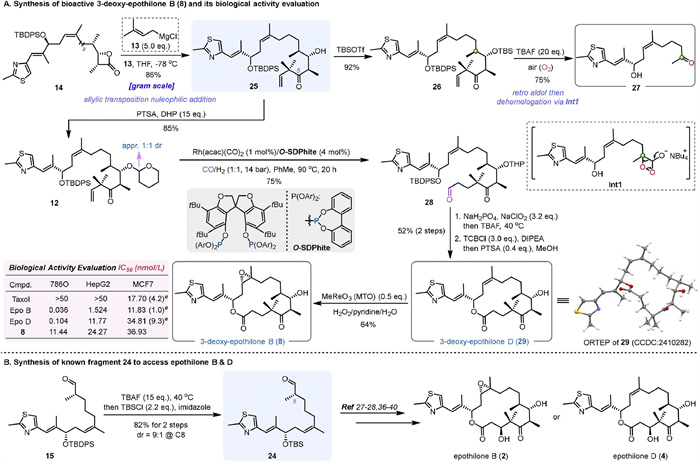
At this stage, one pivotal task was the installation of the C1 unit. Very recently, our research group reported a new diphosphite ligand, termed as O-SDPhite, which featured a unique rigid oxa-spirocyclic backbone, has been applied in hydroformylation (HF) or isomerization hydroformylation (isoHF) of various olefins with excellent linear selectivity [70]. Fortunately, the desired aldehyde 28 was obtained in 75% yield under 14 bar of syngas at 90 ℃ for 20 h (see Table S5 in Supporting information for more details). With all carbon units of 8 secured, we then took our efforts to the construction of the final 16-membered macrolide. After Pinnick oxidation and desilylation, the precursor for the macrolactonization was produced. The subsequent macrolactonization was carried out under the classic Yamaguchi’s condition followed by removal of THP protection with catalytic amount of PTSA, providing the desired 3-deoxy-epothilone D (29) in 52% overall yield. Nevertheless, our 1H NMR data was discrepant from that of 29 reported by Altmann and coworkers, and the 13C NMR spectra as well as the optical rotation of 3-deoxy-epothilone D was not disclosed [21]. The structure of the synthesized 29 was further elucidated unambiguously by X-ray crystallographic analysis, which further confirmed the stereochemisty of C15 and C6-C8 region. Subsequent epoxidation with methyl rhenium trioxide (MTO) [20] proceeded smoothyl with 9:1 dr, and the major diastereomer 3-deoxy-epothilone B (8) was obtained in 64% yield after isolation through a preparative HPLC. The relative configuration of the epoxide was determined by NOESY correlation analysis, which is in consistence with the reported structure. In addition, the biological activities of 3-deoxy-epothilone B (8) were evaluated against a panel of human tumor cell lines (Scheme 2A), and 8 exhibited significant cytotoxicity albeit with reduced biological activities compared with epothilone B (2) and D (4) (see Section 6 in Supporting information for details).
In summary, we have successfully accomplished the total synthesis of bioactive 3-deoxy-epothilone B (8) in 14 total steps, which featured Nelson’s alkaloid-catalyzed asymmetric [2 + 2] cycloaddition to forge the C6–C7 stereogenic centers in a stereospecific manner, ruthenium and iridium-catalyzed AH to introduce the C8 and C15 stereogenic centers, and the innovation with rhodium-catalyzed chemo- and regioselective HF to install the C1 unit. The use of effective asymmetric catalysis is a key advantage to our synthesis, which evaded the utilization of classic stoichiometric chiral auxiliaries or chiral reagents. Potentially allowing us to expedite access to various C1−C4 modified epothilones in a modular manner from the highly electrophilic enantioenriched β-lactone 14. Furthermore, the key intermediate 24 was synthesized with high efficiency, which enabled the formal syntheses of epothilone B (2) and D (4). Bioactivity investigations showed that 3-deoxy-epothilone B (8) could maintain most of the cytotoxicity against a panel of human tumor cell lines. And these results encourage us to take more efforts on decoration of C1−C4 modified epothilones with this approach. Further studies were underway in our group and the results will be reported in due course.
The authors declare that they have no known competing financial interests or personal relationships that could have appeared to influence the work reported in this paper.
Yan Zong: Writing – review & editing, Writing – original draft, Project administration, Methodology, Investigation, Data curation. Qiuchen Huang: Methodology, Investigation. Xiaomei Zou: Validation, Investigation, Formal analysis, Data curation. Qifan Zhou: Investigation, Data curation. Yuanmei Wen: Data curation. Dong Li: Investigation, Data curation. Yongzhi Chen: Data curation. Xuefeng Tan: Investigation, Data curation. Gen-Qiang Chen: Writing – review & editing, Writing – original draft, Investigation, Funding acquisition, Data curation. Xumu Zhang: Writing – review & editing, Methodology, Funding acquisition.
X. Zhang is indebted to the financial support from the National Key R&D Program of China (No. 2021YFA1500200), National Natural Science Foundation of China (No. 21991113), Chemistry and Chemical Engineering Guangdong Laboratory (Nos. 2011006 and 2132013) and Innovative Team of Universities in Guangdong Province (No. 2020KCXTD016). G.-Q. Chen gratefully acknowledges the National Natural Science Foundation of China (No. 22171129), Shenzhen Science and Technology Innovation Committee (Nos. JCYJ20210324104202007, JCYJ20240813095106009) and the Guangdong Basic and Applied Basic Research Foundation (No. 2022B1515020055) for financial support. Y. Zong appreciate the support of China Postdoctoral Science Foundation (No. 2023M731516). We sincerely thank Prof. Jing Xu of SUSTech for helpful discussion. The authors acknowledge the assistance of SUSTech Core Research Facilities. We gratefully acknowledge the Center for Computational Science and Engineering at SUSTech for the support of computational work.
Supplementary material associated with this article can be found, in the online version, at doi:
K. Gerth, N. Bedorf, G. Hoefle, H. Irschik, H. Reichenbach, J. Antibiot. 49 (1996) 560–563. doi: 10.7164/antibiotics.49.560
G. Höfle, N. Bedorf, H. Steinmetz, et al., Angew. Chem. Int. Ed. 35 (1996) 1567–1569. doi: 10.1002/anie.199615671
I.H. Hardt, H. Steinmetz, K. Gerth, et al., J. Nat. Prod. 64 (2001) 847–856. doi: 10.1021/np000629f
K.H. Altmann, B. Pfeiffer, S. Arseniyadis, B.A. Pratt, K.C. Nicolaou, ChemMedChem 2 (2007) 396–423. doi: 10.1002/cmdc.200600206
K.H. Altmann, Preclinical pharmacology and structure-activity studies of epothilones, in: K.H. Altmann, G. Höfle, R. Müller, J. Mulzer, K. Prantz (Eds.), The Epothilones: An Outstanding Family of Anti-Tumor Agents: From Soil to the Clinic, Springer Vienna, Vienna, 2009, pp. 157–220.
T.K. Allred, F. Manoni, P.G. Harran, Chem. Rev. 117 (2017) 11994–12051. doi: 10.1021/acs.chemrev.7b00126
P. Zhang, M. Sun, R. Qiu, et al., Cancer Chemoth. Pharm. 68 (2011) 971–978. doi: 10.1007/s00280-011-1571-6
P. Zhang, Z. Tong, F. Tian, et al., J. Hematol. Oncol. 9 (2016) 68. doi: 10.1080/02286203.2016.1188344
P. Zhang, T. Sun, Q. Zhang, et al., Lancet Oncol. 18 (2017) 371–383. doi: 10.1016/S1470-2045(17)30088-8
F. Li, T. Huang, Y. Tang, et al., Cell Death Dis. 12 (2021) 338. doi: 10.1038/s41419-021-03619-6
R.M. Borzilleri, X. Zheng, R.J. Schmidt, et al., J. Am. Chem. Soc. 122 (2000) 8890–8897. doi: 10.1021/ja001899n
W. Zhan, Y. Jiang, S. Sharma, et al., Chem. Eur. J. 17 (2011) 14792–14804. doi: 10.1002/chem.201102630
R.E. Taylor, Y. Chen, A. Beatty, D.C. Myles, Y. Zhou, J. Am. Chem. Soc. 125 (2003) 26–27. doi: 10.1021/ja028196l
K.C. Nicolaou, D. Rhoades, Y. Wang, et al., J. Am. Chem. Soc. 139 (2017) 7318–7334. doi: 10.1021/jacs.7b02655
K.C. Nicolaou, D. Vourloumis, T. Li, et al., Angew. Chem. Int. Ed. 36 (1997) 2097–2103. doi: 10.1002/anie.199720971
D.S. Su, A. Balog, D. Meng, et al., Angew. Chem. Int. Ed. 36 (1997) 2093–2096. doi: 10.1002/anie.199720931
S.J. Danishefsky, J. Org. Chem. 64 (1999) 8434–8456. doi: 10.1021/jo991006d
M. Wang, X. Xia, Y. Kim, et al., Org. Lett. 1 (1999) 43–46. doi: 10.1021/ol990521v
A. Regueiro-Ren, K. Leavitt, S.H. Kim, et al., Org. Lett. 4 (2002) 3815–3818. doi: 10.1021/ol026589j
F. Cachoux, T. Isarno, M. Wartmann, K.H. Altmann, Angew. Chem. Int. Ed. 44 (2005) 7469–7473. doi: 10.1002/anie.200501760
K.H. Altmann, Preparation of epothilone derivatives, WO2005090335 A1, 2005.
R. Qiu, Production of epothilones derivatives in Myxococcus or Sorangium comprising PKS mutant gene, CN1521258A, 2004.
K.C. Nicolaou, Y. He, D. Vourloumis, H. Vallberg, Z. Yang, Angew. Chem. Int. Ed. 35 (1996) 2399–2401. doi: 10.1002/anie.199623991
K.C. Nicolaou, F. Sarabia, S. Ninkovic, Z. Yang, Angew. Chem. Int. Ed. 36 (1997) 525–527. doi: 10.1002/anie.199705251
D. Schinzer, A. Limberg, A. Bauer, et al., Angew. Chem. Int. Ed. 37 (1998) 2675–2678. doi: 10.1002/(SICI)1521-3773(19981016)37:19<2675::AID-ANIE2675>3.0.CO;2-O
C.R. Harris, S.D. Kuduk, A. Balog, et al., J. Am. Chem. Soc. 121 (1999) 7050–7062. doi: 10.1021/ja991189l
J. Mulzer, A. Mantoulidis, E. Öhler, J. Org. Chem. 65 (2000) 7456–7467. doi: 10.1021/jo0007480
C.B. Lee, Z. Wu, F. Zhang, et al., J. Am. Chem. Soc. 123 (2001) 5249–5259. doi: 10.1021/ja010039j
J.D. White, R.G. Carter, K.F. Sundermann, M. Wartmann, J. Am. Chem. Soc. 123 (2001) 5407–5413. doi: 10.1021/ja010454b
G. Koch, O. Loiseleur, D. Fuentes, A. Jantsch, K.H. Altmann, Org. Lett. 4 (2002) 3811–3814. doi: 10.1021/ol026480b
D. Schinzer, Model Aldol Reactions, Wiley-VCH Verlag GmbH & Co. KGaA, 2004, pp. 311–328.
J.D. Frein, R.E. Taylor, D.L. Sackett, Org. Lett. 11 (2009) 3186–3189. doi: 10.1021/ol900971r
J. Wang, B.F. Sun, K. Cui, G.Q. Lin, Org. Lett. 14 (2012) 6354–6357. doi: 10.1021/ol303148g
A.M. Haydl, B. Breit, Chem. Eur. J. 23 (2017) 541–545. doi: 10.1002/chem.201605011
K.C. Nicolaou, S. Ninkovic, F. Sarabia, et al., J. Am. Chem. Soc. 119 (1997) 7974–7991. doi: 10.1021/ja971110h
K.C. Nicolaou, N. Winssinger, J. Pastor, et al., Nature 387 (1997) 268–272. doi: 10.1038/387268a0
D. Schinzer, A. Bauer, J. Schieber, Chem. Eur. J. 5 (1999) 2492–2500. doi: 10.1002/(SICI)1521-3765(19990903)5:9<2492::AID-CHEM2492>3.0.CO;2-R
R.E. Taylor, Y. Chen, Org. Lett. 3 (2001) 2221–2224. doi: 10.1021/ol010094x
T. Gaich, J. Mulzer, Org. Lett. 7 (2005) 1311–1313. doi: 10.1021/ol0500923
A.W. Sun, S. Lackner, B.M. Stoltz, Trends Chem. 1 (2019) 630–643. doi: 10.1016/j.trechm.2019.05.008
X. Shen, A.S. Wasmuth, J. Zhao, C. Zhu, S.G. Nelson, J. Am. Chem. Soc. 128 (2006) 7438–7439. doi: 10.1021/ja061938g
C. Zhu, X. Shen, S.G. Nelson, J. Am. Chem. Soc. 126 (2004) 5352–5353. doi: 10.1021/ja0492900
B. Chandra, D. Fu, S.G. Nelson, Angew. Chem. Int. Ed. 49 (2010) 2591–2594. doi: 10.1002/anie.200906245
Z. Guo, R. Bao, Y. Li, et al., Angew. Chem. Int. Ed. 60 (2021) 14545–14553. doi: 10.1002/anie.202102614
M. Mohammad, V. Chintalapudi, J.M. Carney, et al., Angew. Chem. Int. Ed. 58 (2019) 18177–18181. doi: 10.1002/anie.201908917
S. Schulthoff, J.Y. Hamilton, M. Heinrich, et al., Angew. Chem. Int. Ed. 60 (2021) 446–454. doi: 10.1002/anie.202011472
X. Wang, Z. Wang, X. Ma, et al., Angew. Chem. Int. Ed. 61 (2022) e202200258. doi: 10.1002/anie.202200258
E. Yiannakas, M.I. Grimes, J.T. Whitelegge, A. Fürstner, A.N. Hulme, Angew. Chem. Int. Ed. 60 (2021) 18504–18508. doi: 10.1002/anie.202105732
J. Egger, S. Fischer, P. Bretscher, et al., Org. Lett. 17 (2015) 4340–4343. doi: 10.1021/acs.orglett.5b02181
C. Tan, W. Chen, X. Mu, et al., Org. Lett. 17 (2015) 2338–2341. doi: 10.1021/acs.orglett.5b00831
S. Zhang, S. Zhang, Y. Fan, et al., Angew. Chem. Int. Ed. 62 (2023) e202313186. doi: 10.1002/anie.202313186
J. Wang, B.F. Sun, K. Cui, G.Q. Lin, Org. Lett. 14 (2012) 6354–6357. doi: 10.1021/ol303148g
H. Ece, Y. Tange, T. Yurino, T. Ohkuma, Synlett 32 (2021) 935–939. doi: 10.1055/a-1373-7017
H. Zhang, G. Li, B. Su, et al., Sci. Rep. 7 (2017) 16916. doi: 10.1038/s41598-017-17015-8
J. Yu, F. Huang, W. Fang, et al., Green Synth. Catal. 3 (2022) 175–178.
C. Yin, Y.F. Jiang, F. Huang, et al., Nat. Commun. 14 (2023) 3718. doi: 10.1038/s41467-023-39375-8
Y. Zong, X. Zou, J. Song, G.Q. Chen, X. Zhang, Org. Lett. 25 (2023) 6875–6880. doi: 10.1021/acs.orglett.3c02565
Z. Meng, H. Yu, L. Li, et al., Nat. Commun. 6 (2015) 6096. doi: 10.1038/ncomms7096
Y. Li, K. Dong, Z. Wang, K. Ding, Angew. Chem. Int. Ed. 52 (2013) 6748–6752. doi: 10.1002/anie.201302349
G.Q. Chen, J.M. Huang, B.J. Lin, et al., CCS Chem. 2 (2020) 468–477. doi: 10.31635/ccschem.020.202000176
X. Du, Y. Xiao, Y. Yang, et al., Angew. Chem. Int. Ed. 60 (2021) 11384–11390. doi: 10.1002/anie.202016705
S.F. Zhu, Y.B. Yu, S. Li, L.X. Wang, Q.L. Zhou, Angew. Chem. Int. Ed. 51 (2012) 8872–8875. doi: 10.1002/anie.201204363
Q. Wang, X. Liu, X. Liu, et al., Chem. Commun. 50 (2014) 978–980. doi: 10.1039/C3CC47727D
M. Valluri, R.M. Hindupur, P. Bijoy, et al., Org. Lett. 3 (2001) 3607–3609. doi: 10.1021/ol016173q
N. Martin, E.J. Thomas, Tetrahedron Lett. 42 (2001) 8373–8377. doi: 10.1016/S0040-4039(01)01795-6
M. Yoshino, K. Eto, K. Takahashi, J. Ishihara, S. Hatakeyama, Org. Biomol. Chem. 10 (2012) 8164–8174. doi: 10.1039/c2ob26084k
N.D. Bartolo, K.A. Woerpel, J. Org. Chem. 83 (2018) 10197–10206. doi: 10.1021/acs.joc.8b01430
B. Tiwari, J. Zhang, Y.R. Chi, Angew. Chem. Int. Ed. 51 (2012) 1911–1914. doi: 10.1002/anie.201107473
S.A. Shipilovskikh, A.E. Rubtsov, A.V. Malkov, Org. Lett. 19 (2017) 6760–6762. doi: 10.1021/acs.orglett.7b03512
Y. Zong, R. Zhang, B. Ma, et al., Sci. Adv. 10 (2024) eado9607. doi: 10.1126/sciadv.ado9607

Figure 1 (A) Natural epothilones and Ixabepilone. (B) Represented C2−C4 modified epothilones. (C) Total synthesis of 8 through the highly electrophilic enantioenriched β-lactone.

Scheme 2 Completion of 3-deoxy-epothilone B (8) and formal syntheses of epothilones B (2) and D (4). a Reported data [15].
Table 1. Optimization of the reaction conditions for AH of 16.a
|
||||||||
| Entry | Catalyst (mol%) | Temp. (℃) | Time (h) | Yield (%) | dr (23/23′) | |||
| 23 | 23′ | 23″ | 16 | |||||
| 1 | Ru(L1)(OAc)2 (10 mol%) | 40 | 6 | 30 | 7.5 | 10 | 34 | 4.0/1 |
| 2 | Ru(L2)(OAc)2 (10 mol%) | 40 | 6 | 16 | <5 | 60 | 0 | / |
| 3 | Ru(L3)(OAc)2 (10 mol%) | 40 | 6 | 20 | 4.3 | 66 | 0 | 4.6/1 |
| 4 | Ru(L4)(OAc)2 (10 mol%) | 40 | 6 | 9 | 1.5 | 74 | 1.5 | 6.0/1 |
| 5 | Ru(L5)(OAc)2 (10 mol%) | 40 | 6 | 36 | 5.1 | 38 | 0 | 7.1/1 |
| 6 | Ru(L6)(OAc)2 (10 mol%) | 40 | 6 | 11 | 2.3 | 54 | 0 | 4.8/1 |
| 7 | Ru(L5)(OAc)2 (1 mol%) | 25 | 14 | 62 | 9.4 | 5.7 | 0 | 6.6/1 |
| 8b | Ru(L5)(OAc)2 (1 mol%) | 25 | 14 | 65c | 10 | 1.3 | 2.8 | 6.5/1 |
| 9d | Rh/L7 (1 mol%) | 25 | 20 | 18 | 7.1 | 9.0 | 51 | 2.5/1 |
| a Reaction conditions: 16 (0.10 mmol), Ru complex, solvent (MeOH/H2O = 20/1, 0.5 mL). Diastereomeric ratios (dr) and yields of 23 were determined by 1H NMR spectroscopy. b 8.5 g scale, solvent (0.5 mol/L). c Isolated yield. d Performed with Rh/ChenPhos (1 mol%), in 0.5 mL DCM (0.2 mol/L) under 25 bar of H2 at room temperature for 20 h. |
||||||||
 下载: 导出CSV

 扫一扫看文章


扫一扫关注我们


 下载:
下载: