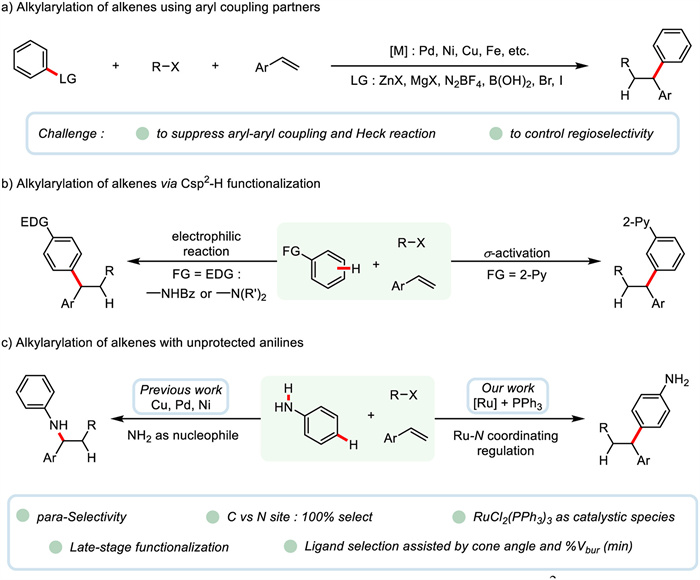
Scheme 1.
Strategies for alkylarylation across vicinal C(sp2) sites in alkenes.

Ruthenium-catalyzed alkylarylation of alkenes via para-selective C-H functionalization of unprotected anilines
Xin-Juan Wang , Yao-Hang Cheng , Xin-Yan Lv , Li-Ye Liang , Guang-Hui An , Guang-Ming Li


Metal-catalyzed formation of two carbon–carbon (C-C) bonds across vicinal C(sp2) sites in olefins is a powerful method to construct complex molecules rapidly from readily available starting materials [1-8]. Despite the great advances, the development of such a method is generally hindered by β-H elimination from β-H−C(sp3)-[M] intermediates [9-15] and regioselectivity placing two discrete carbon sources across the vicinal C(sp2) sites [1,16-20]. To address these issues, a coordinating group is normally required either by preinstallation or a native functional group to induce a proximity bias at the vicinal sites for regiocontrol and subsequently generate transient metallacycles for addressing β-H elimination [21-25]. An alternative approach that proceeds by reductive coupling via radical intermediates [26] is also emerging as a powerful complementary protocol [27]. In these strategies, pre-activated arenes are often used as aryl sources, including aryl metal reagents, [13,28-32] aryldiazonium salts [33,34] and aryl halides (Scheme 1a) [35-37]. Despite significant progress, the direct utilization of Csp2−H bond as carbon sources instead of pre-activated arenes remains elusive.
With the development of C-H activation catalyzed by transition metals, several types of arenes with special structures have been removed from dependence on leaving groups, and can directly undergo the alkylarylation of alkenes, with atomic economy and step economy, and with good site selectivity (Scheme 1b). Besides the electron rich N-heteroarenes (e.g., indole) [38-43], 8-aminoquinoline [44] and N,N-disubstituted aniline derivatives [45] successfully afforded 1,2-alkylarylation products from olefins via combination of radical pathways with electrophilic substitution at arenes. Additionally, σ-activation through inner-sphere electron transfer, and cyclometallation enables the difunctionalization of alkene using 2-phenylpyridine/pyrimidine [46-52]. Despite these progresses, Csp2−H coupling sources are limited and alkylarylation of alkenes using this protocol remains underdeveloped.
Aniline is one of the important amines and has a very wide range of uses in industry and manufacturing as well as in the pharmaceutical field [53-57]. Modification of anilines by site-selective C-H activation has attracted great attention to tune their function and activity [58-61]. Due to the good nucleophilicity of amino group and low steric hindrance of aniline, the alkylarylation of alkenes involving unprotected aniline normally led to alkylamination products [62-66], and alkylarylation of alkenes via para-C-H activation of unprotected aniline remains unsolved (Scheme 1c). Recently, Ru-catalyzed para-C-H alkylation of unprotected aniline via σ-activation was disclosed [67-74]. We herein successfully achieved the radical alkylarylation of alkenes via para-C-H activation of unprotected aniline. Cone angle and minimum percent buried volume (%Vbur) were used to evaluate the ligand effect. The protocol allows absolute C vs. N site selectivity and good functional group tolerance, which enables the late-stage functionalization of nature products. The mechanism studies reveal a dissociation of p-cymene during the catalytic processes, which is distinct from most previous σ-activation pathways.
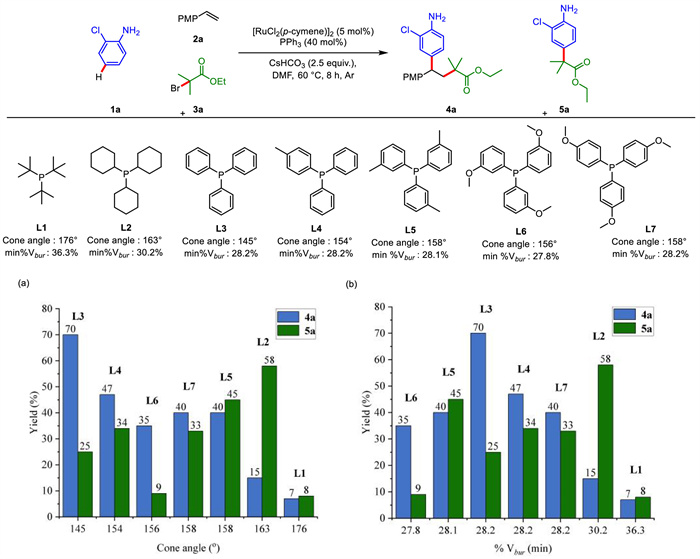
We commenced our study by investigating the alkylarylation of alkene 2a with aniline 1a and α–bromo alkane 3a. After rigorous screening of the reaction conditions (For detail screening, see Supporting information), the optimal catalytic system with [RuCl2(p-cymene)]2 (5 mol%), PPh3 (40 mol%), and CsHCO3 (2.5 equiv.) in DMF successfully afforded 4a in 70% isolated yield (Table 1, entry 1). The control experiments revealed that the reaction did not proceed in the absence of PPh3 (entry 2), which is consistent with previous phosphine ligand involving catalytic systems [75]. To elucidate the influence of different phosphine ligands, we correlated the experimental selectivities and yields with key descriptors of phosphine ligands, the cone angle (min) and the minimum percent buried volume (min %Vbur). In Scheme 2, we generated plots illustrating the yields of 4a (blue) and 5 (green) as a function of these parameters. The analysis revealed that phosphines with cone angles within a relatively narrow range (145°-156°) afforded slightly better selectivity for the three-component product 4a over 5. Increasing the cone angles led to the para-alkylated 5 as predominant product. Additionally, when the min %Vbur of the phosphine was approximately 28.2%, the reaction exhibited better combined yield of 4a and 5. The selectivity of the reaction with different phosphine ligands at the same min %Vbur differ greatly, which might be attributed to their different cone angles. Thus, we proposed in this catalytic system, cone angle might regulate the regioselectivity while min %Vbur would control the combined yields. The highest overall yield of and selectivity for 4a is observed with PPh3, ligand that have cone angle and min %Vbur in the optimal range (145° and 28.2%, respectively) along with three component products. The reaction failed to proceed in the absence of [RuCl2(p-cymene)]2 underscoring the critical role of Ru catalyst in the reaction (entry 3). Inert gas protection was also required, suggesting that a radical pathway was plausible (entry 4). Substituting [RuCl2(p-cymene)]2 with RuCl3·3H2O slightly decreased the reaction yield with better selectivity (entry 5). It suggests the reaction may proceed via Ru catalyst without p-cymene. In contrast, Ru(0) catalyst was not effective for the reaction (entry 6). Further optimization revealed that bases play an important role in this transformation (entries 7 and 8). KHCO3 displayed catalytic activity, but Cs2CO3 obtained product with trace yield.
 DownLoad:
CSV
DownLoad:
CSV
 |
|||
| Entry | Deviation from standard conditions | 4a (%) | 5 (%) |
| 1 | None | 70 | 25 |
| 2 | Without PPh3 | NR | NR |
| 3 | Without [RuCl2(p-cymene)]2 | NR | NR |
| 4 | Without Ar | NR | NR |
| 5 | RuCl3·3H2O instead of [RuCl2(p-cymene)]2 | 65 | 17 |
| 6 | Ru3(CO)12 instead of [RuCl2(p-cymene)]2 | Trace | Trace |
| 7 | KHCO3 instead of CsHCO3 | 40 | 9 |
| 8 | Cs2CO3 instead of CsHCO3 | Trace | Trace |
| a Standard conditions: 1a (0.6 mmol, 3 equiv.), 2a (0.6 mmol, 3 equiv.), 3a (0.2 mmol, 1 equiv.), [RuCl2(p-cymene)]2 (5 mol%), PPh3 (40 mol%), CsHCO3 (2.5 equiv.), DMF (1.0 mL), 60 ℃, 8 h, under Ar. Isolated yields. PMP = para-methoxyphenyl. | |||
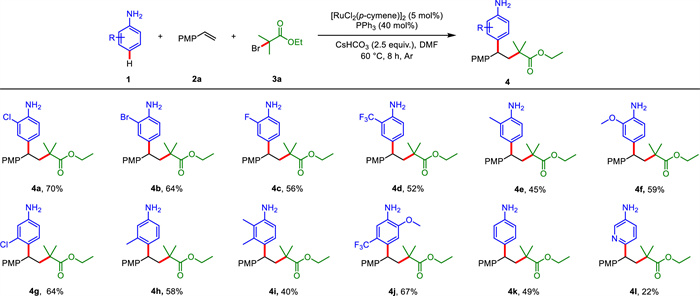
Under the optimized conditions, we systematically evaluated the functional group compatibility of this transformation using diverse anilines (Scheme 3). Both electron-withdrawing and electron-donating substituents including halogens (4a-4c, 4g), trifluoromethyl (4d), methyl (4e, 4h), and methoxy groups (4f) delivered 1,1-diarylation products 4a-4h in 45%−70% yields. Notably, ortho-position substitution with bulkier groups (such as CH3) rather than halogen led to lower yields. This was likely because the bulky substituent interfered with the coordination between the aniline and the Ru catalyst, thereby affecting the reaction efficiency. The protocol also accommodated disubstituted substrates (4i-4j). NnullHeteroarenes were also accessible substrates, delivering 4l in 22% yield.
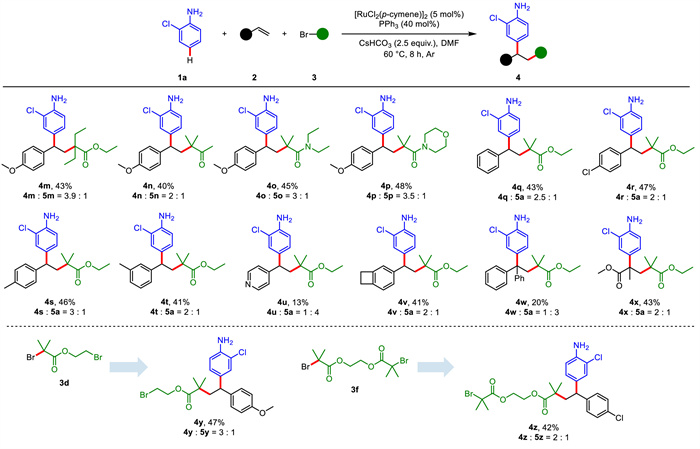
Substrate scope for α–bromo alkane derivatives and alkenes was subsequently investigated (Scheme 4). Sterically hindered α–bromo esters (4m), α–bromo ketones (4n), and α–bromo amides (4o-4p) proved to be compatible substrates. The reaction scope was further extended to styrene derivatives and α,β-unsaturated alkenes. para-Substituted styrenes with both electron-donating (4s) and electron-withdrawing groups (4r) exhibited good reactivity. meta-Substituents also demonstrated similar reactivity in three-component reaction (4t). The styrenes bearing pyridine moiety were also compatible with the reaction conditions to afford 4u Strained four-membered ring was maintained during the reaction of 4-vinylbenzocyclobutene (4v), further proving the mildness of the protocol. The reaction of the 1,1-diphenylethylene proceeded, yielding a three-component adduct (4w) rather than a simple radical adduct. α,β-Unsaturated esters (4x) were also viable substrates for 1,2-alkylarylation. Notably, in contrast to other substates, 4-vinylpyridine and 1,1-diphenylethylene afforded para-substituted anilines as main products. Besides monobromo substrates, the substrates bearing dibromo substituents were synthesized and subjected to the reaction conditions. 3d exhibited reactivity at α-position of ester group instead of primary bromo site (4y). When multiple α-positions of ester group were present in the polybrominated substrate, only monosubstituted products were obtained under our reaction conditions (4z).
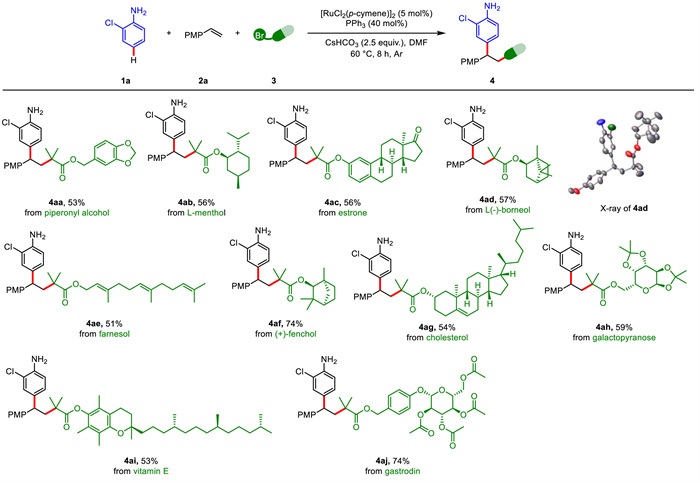
1,1-Diarylalkyl moiety is important building blocks in natural products and drugs [76]. Switching different 1,1-diarylalkyl moieties might improve the physicochemical properties via regulating the steric configuration, hydrophobicity, hydrogen bonding, etc. [77-79]. The robustness of this protocol was further demonstrated by the successful late-stage functionalization of α–bromo esters derived from complex pharmaceuticals and natural products by introducing the 1,1-diarylalkyl moieties (Scheme 5). The scope of the reaction was striking: α–bromo esters containing piperonyl alcohol (4aa), terpenoid (4ab, 4ad and 4af), sesquiterpenoid (4ae), steroid (4ac and 4ag), vitamin E (4ai), or glucose derivatives (4ah and 4aj) were shown to be compatible with our system. More specifically, sensitive functional groups, such as ethers (4aa), ketone (4ac), alkenes (4ae and 4ag), ketal (4aa, 4ah, 4aj) and aryl group (4ai) were retained. Additionally, the structures of products 4 were explicitly established by single-crystal X-ray diffraction analyses of representative 4ad (CCDC number: 2441323). Notably, the protocol also leaves the intact amino handle for further conversion of these nature product derivatives to antibody drug conjugate similar to previous reports [80].
To elucidate the radical generation of this reaction, we carried out a series free radical trapping experiments. In the presence of 2,2,6,6-tetramethyl-1-piperidinyloxy (TEMPO), the reaction was completely inhibited and a radical adduct 6 of 3a and TEMPO was obtained (Table 2, entry 1), indicating that the reaction involved a radical process. The absence of 1a led to less production of 6 (entry 2). According to previous literatures [46,48-51,67,69,73,81-86], styrene is not readily coordinate with Ru in this σ-activation reaction. Indeed, the yield of 6 is not decreased without styrene 2a (entry 3). Notably, 6 was not generated in the absence of PPh3 or Ru (entries 4 and 5), highlighting PPh3 and Ru played a crucial role in the production of free radicals. Thus, we considered that Ru and PPh3 would form a complex which is responsible for reduction of alkyl bromide 3a to generate corresponding radical. Furthermore, complex A, RuCl2(PPh3)3, which is readily generated from RuCl3 and PPh3 proved more effective in radical generation (entry 6), which is consistent with our optimal results in Table 1 (entry 5). It also suggests p-cymene might not be involved in the catalytic Ru species as ligands.
DownLoad:
CSV
 |
||
| Entry | Deviation from standard conditions with TEMPO | 6 (%) |
| 1 | None | 25 |
| 2 | Without 1a | 11 |
| 3 | Without 2a | 25 |
| 4 | Without PPh3 | NR |
| 5 | Without [RuCl2(p-cymene)]2 | NR |
| 6 | 10 mol% [RuCl2(PPh3)3] replace [RuCl2(p-cymene)]2 | 31 |
| a Standard conditions: 1a (0.6 mmol, 3 equiv.), 2a (0.6 mmol, 3 equiv.), 3a (0.2 mmol, 1 equiv.), [RuCl2(p-cymene)]2 (5 mol%), PPh3 (40 mol%), CsHCO3 (2.5 equiv.), DMF (1.0 mL), 60 ℃, 8 h, under Ar. Isolated yields. PMP = para-methoxyphenyl. | ||
According to literatures [87-89], C-H functionalization using [RuCl2(p-cymene)]2 normally undergoes two pathways: (1) p-cymene dissociates from [RuCl2(p-cymene)]2 and remaining Ru complex coordinate with substrates [90–95]; (2) [RuCl2(p-cymene)]2 directly coordinates with substrates [67,69,82-84,86]. To further identify the catalytic Ru species generated from [RuCl2(p-cymene)]2, a series of ruthenium complexes including complexes B-E with p-cymene were synthesized to compare with complex A, RuCl2(PPh3)3 (Table 3, and Supporting information for detail of their synthesis). When subjecting to the reaction without additional PPh3, complexes B-E exhibited poor catalytic efficiency (entries 2–5). Despite the increase of the yield of 4a by B and C after the addition of PPh3 (entries 7 and 8), the complex A, RuCl2(PPh3)3, without additional PPh3 almost afforded the same reaction yield to the optimal conditions (entry 6). Therefore, complex A without p-cymene was more likely to be a catalytic species in the reaction process, which is transformed from [RuCl2(p-cymene)]2. Notably, similar dissociation of p-cymene from [RuCl2(p-cymene)]2 was observed in many visible-light mediated processes [90-95].
DownLoad:
CSV
 |
||||
| Entry | Catalyst | PPh3 (mol%) | 4a (%) | 5 (%) |
| 1 | [RuCl2(p-cymene)]2 b | 40 | 70 | 25 |
| 2 | Complex B | - | 34 | 20 |
| 3 | Complex C | - | NR | NR |
| 4 | Complex D | - | 17 | NR |
| 5 | Complex E | - | 11 | NR |
| 6 | Complex A | - | 67 | 29 |
| 7 | Complex B | 30 | 54 | 13 |
| 8 | Complex C | 30 | 58 | 13 |
| 9 | Complex E | 30 | 29 | NR |
| a Reaction conditions: 1a (0.6 mmol, 3 equiv.), 2a (0.6 mmol, 3 equiv.), 3a (0.2 mmol, 1 equiv.), catalyst (10 mol%), PPh3 (40 mol%), CsHCO3 (2.5 equiv.), DMF (1.0 mL), 60 ℃, 8 h, under Ar. Isolated yields. b 5 mol% [RuCl2(p-cymene)]2 was used. PMP = para-methoxyphenyl. | ||||
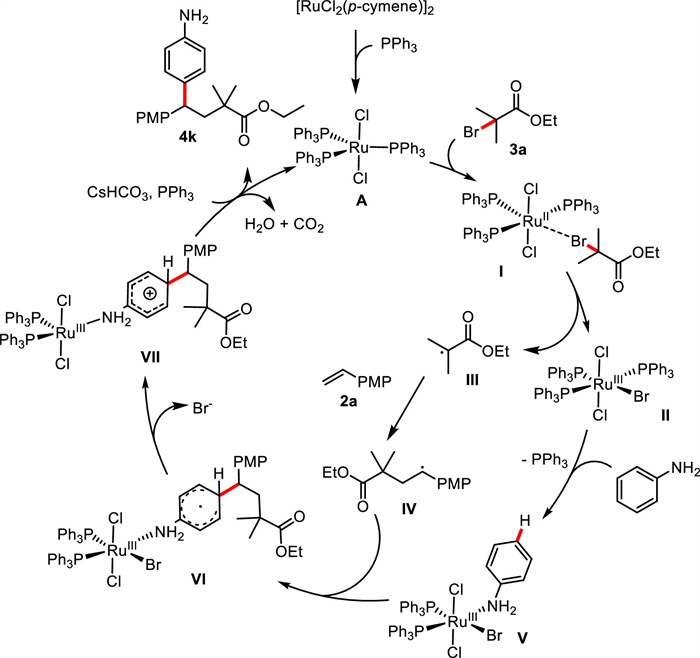
Based on these results and previous literatures [67], a plausible mechanism for this three-component reaction was proposed, as illustrated in Scheme 6. The reaction initiates with the dissociation of p-cymene to form complex A. Subsequently, A reacts with alkyl halide 3a to generate intermediate I, which is further converted to alkyl radical Ⅲ and a ruthenium(Ⅲ) intermediate Ⅱ via ligand-to-metal charge transfer (LMCT) processes. The alkyl radical Ⅲ promptly adds to alkene 2a, resulting in the formation of benzyl radical Ⅳ. Meanwhile, the ruthenium(Ⅲ) intermediate Ⅱ coordinates with aniline to form complex Ⅴ. The benzyl radical Ⅳ attacks the aromatic moiety para to the ruthenium center, leading to the formation of intermediate Ⅵ. This intermediate undergoes a LMCT process to yield complex Ⅶ. Finally, rearomatization of Ⅶ occurs, releasing the difunctionalization product 4k and regenerating the catalytically active ruthenium(Ⅱ) species A.
In summary, we report a mild ruthenium-catalyzed three-component reaction enabling alkylarylation of alkenes via para-selective C-H activation of unprotected anilines. Substrate scope encompasses electron-rich/depleted anilines, hindered α-bromo derivatives, and styrenes, with late-stage functionalization for complex natural products. Mechanistic studies reveal a dissociation of p-cymene during the catalytic processes, which is distinct from most previous σ-activation pathways. The method circumvents traditional limitations (e.g., protecting groups, harsh conditions) and offers applicability in pharmaceutical and natural product modification.
The authors declare that they have no known competing financial interests or personal relationships that could have appeared to influence the work reported in this paper.
Xin-Juan Wang: Writing – review & editing, Writing – original draft, Investigation. Yao-Hang Cheng: Investigation. Xin-Yan Lv: Investigation. Li-Ye Liang: Investigation. Guang-Hui An: Writing – review & editing, Writing – original draft, Supervision, Methodology, Investigation, Funding acquisition, Conceptualization. Guang-Ming Li: Supervision, Investigation.
This work was financially supported by the University Nursing Program for Young Scholars with Creative Talents in Heilongjiang Province (No. UNPYSCT-2017124).
Supplementary material associated with this article can be found, in the online version, at doi:
T. Qin, J. Cornella, C. Li, et al., Science 352 (2016) 801–805. doi: 10.1126/science.aaf6123
L. Zhang, G.J. Lovinger, E.K. Edelstein, et al., Science 351 (2016) 70–74. doi: 10.1126/science.aad6080
S.O. Badir, G.A. Molander, Chem 6 (2020) 1327–1339. doi: 10.1016/j.chempr.2020.05.013
J. Derosa, O. Apolinar, T. Kang, V.T. Tran, K.M. Engle, Chem. Sci. 11 (2020) 4287–4296. doi: 10.1039/C9SC06006E
R.K. Dhungana, S. Kc, P. Basnet, R. Giri, Chem. Rec. 18 (2018) 1314–1340. doi: 10.1002/tcr.201700098
X. Qi, T. Diao, ACS Catal. 10 (2020) 8542–8556. doi: 10.1021/acscatal.0c02115
L.M. Wickham, R. Giri, Acc. Chem. Res. 54 (2021) 3415–3437. doi: 10.1021/acs.accounts.1c00329
S. Zhu, X. Zhao, H. Li, L. Chu, Chem. Soc. Rev. 50 (2021) 10836–10856. doi: 10.1039/D1CS00399B
E.W. Werner, K.B. Urkalan, M.S. Sigman, Org. Lett. 12 (2010) 2848–2851. doi: 10.1021/ol1009575
V. Saini, L. Liao, Q. Wang, R. Jana, M.S. Sigman, Org. Lett. 15 (2013) 5008–5011. doi: 10.1021/ol4023358
P. Basnet, R.K. Dhungana, S. Thapa, et al., J. Am. Chem. Soc. 140 (2018) 7782–7786. doi: 10.1021/jacs.8b03163
R.K. Dhungana, S. Kc, P. Basnet, et al., ACS Catal. 9 (2019) 10887–10893. doi: 10.1021/acscatal.9b03574
W. Li, J.K. Boon, Y. Zhao, Chem. Sci. 9 (2018) 600–607. doi: 10.1039/C7SC03149A
V. Saini, M.S. Sigman, J. Am. Chem. Soc. 134 (2012) 11372–11375. doi: 10.1021/ja304344h
L.M. Wickham, R.K. Dhungana, R. Giri, ACS Omega 8 (2022) 1060–1066.
C.C. Chintawar, A.K. Yadav, N.T. Patil, Angew. Chem. Int. Ed. 59 (2020) 11808–11813. doi: 10.1002/anie.202002141
R.K. Dhungana, V. Aryal, D. Niroula, et al., Angew. Chem. Int. Ed. 60 (2021) 19092–19096. doi: 10.1002/anie.202104871
D. Wang, L. Ackermann, Chem. Sci. 13 (2022) 7256–7263. doi: 10.1039/D2SC02277J
Y. Zhang, G. Chen, D. Zhao, Chem. Sci. 10 (2019) 7952–7957. doi: 10.1039/C9SC02182E
L.J. Zhong, Z.Q. Xiong, X.H. Ouyang, et al., J. Am. Chem. Soc. 144 (2021) 339–348.
Z. Dong, Q. Tang, C. Xu, et al., Angew. Chem. Int. Ed. 62 (2023) e202218286. doi: 10.1002/anie.202218286
C.H. Xu, G.F. Lv, J.H. Qin, X.H. Xu, J.H. Li, J. Org. Chem. 89 (2023) 281–290.
W. Yu, S. Wang, M. He, et al., Angew. Chem. Int. Ed. 62 (2023) e202219166. doi: 10.1002/anie.202219166
B. Cui, Y. Zheng, H. Sun, et al., Nat. Commun. 15 (2024) 6647. doi: 10.1038/s41467-024-50757-4
J.Z. Wang, E. Mao, J.A. Nguyen, W.L. Lyon, D.W.C. MacMillan, J. Am. Chem. Soc. 146 (2024) 15693–15700. doi: 10.1021/jacs.4c05744
U. Mukherjee, J.A. Shah, D.G. Musaev, M.Y. Ngai, J. Am. Chem. Soc. 146 (2024) 21271–21279. doi: 10.1021/jacs.4c08984
F. Ye, S. Zheng, Y. Luo, X. Qi, W. Yuan, ACS Catal. 14 (2024) 8505–8517. doi: 10.1021/acscatal.4c01312
K. Chen, J. Lin, J. Guo, H. Chen, J. Li, ChemCatChem 16 (2024) e202401063. doi: 10.1002/cctc.202401063
X. Cheng, X. Liu, S. Wang, et al., Nat. Commun. 12 (2021) 4366. doi: 10.1038/s41467-021-24596-6
J.W. Gu, Q.Q. Min, L.C. Yu, X. Zhang, Angew. Chem. Int. Ed. 55 (2016) 12270–12274. doi: 10.1002/anie.201606458
S. Yang, P. Gao, M.T. Suo, et al., Chem. Commun. 56 (2020) 10714–10717. doi: 10.1039/D0CC04439C
L. Liu, W. Lee, C.R. Youshaw, et al., Chem. Sci. 11 (2020) 8301–8305. doi: 10.1039/D0SC02127J
Z. Kuang, K. Yang, Q. Song, Org. Chem. Front. 4 (2017) 1224–1228. doi: 10.1039/C7QO00097A
P. Zhang, M. Xing, Q. Guan, et al., Org. Lett. 21 (2019) 8106–8109. doi: 10.1021/acs.orglett.9b03114
X. Chen, Q. Wang, X.P. Gong, et al., Org. Chem. Front. 12 (2025) 57–63. doi: 10.1039/D4QO01875C
H.Y. Tu, F. Wang, L. Huo, et al., J. Am. Chem. Soc. 142 (2020) 9604–9611. doi: 10.1021/jacs.0c03708
D. Zheng, A. Studer, Angew. Chem. Int. Ed. 58 (2019) 15803–15807. doi: 10.1002/anie.201908987
M.Y. Min, R.J. Song, X.H. Ouyang, J.H. Li, Chem. Commun. 55 (2019) 3646–3649. doi: 10.1039/C9CC00469F
X.H. Ouyang, R.J. Song, M. Hu, Y. Yang, J.H. Li, Angew. Chem. Int. Ed. 55 (2016) 3187–3191. doi: 10.1002/anie.201511624
X.H. Ouyang, M. Hu, R.J. Song, J.H. Li, Chem. Commun. 54 (2018) 12345–12348. doi: 10.1039/C8CC06509H
R. Su, Y. Li, M.Y. Min, et al., Chem. Commun. 54 (2018) 13511–13514. doi: 10.1039/C8CC08274J
D. Yang, C. Wang, Org. Chem. Front. 10 (2023) 2465–2470. doi: 10.1039/D3QO00310H
H.Q. Zhao, W.T. Li, Y. Yao, Y.L. Zhao, X.H. Ouyang, Org. Lett. 26 (2024) 10183–10188. doi: 10.1021/acs.orglett.4c04095
W.Y. Shi, Y.N. Ding, C. Liu, et al., Chem. Commun. 56 (2020) 12729–12732. doi: 10.1039/D0CC05491G
X. Yong, Y.F. Han, Y. Li, R.J. Song, J.H. Li, Chem. Commun. 54 (2018) 12816–12819. doi: 10.1039/C8CC07587E
S. Chen, B. Yuan, Y. Wang, L. Ackermann, Angew. Chem. Int. Ed. 62 (2023) e202301168. doi: 10.1002/anie.202301168
P.C. Cui, G.W. Wang, Org. Lett. 26 (2024) 427–432. doi: 10.1021/acs.orglett.3c03266
H.C. Liu, X.P. Gong, Y.Z. Wang, et al., Org. Lett. 24 (2022) 3043–3047. doi: 10.1021/acs.orglett.2c00999
Y.Y. Luan, X.Y. Gou, W.Y. Shi, et al., Org. Lett. 24 (2022) 1136–1140. doi: 10.1021/acs.orglett.1c04182
X.G. Wang, Y. Li, H.C. Liu, et al., J. Am. Chem. Soc. 141 (2019) 13914–13922. doi: 10.1021/jacs.9b06608
J. Wu, W. Wei, J. Pöhlmann, R. Purushothaman, L. Ackermann, Angew. Chem. Int. Ed. 62 (2023) e202219319. doi: 10.1002/anie.202219319
J.L. Zhang, X.L. Zhao, Y.Z. Liao, Y. Zhao, F. Pan, Org. Lett. 27 (2025) 1106–1111. doi: 10.1021/acs.orglett.4c04445
X. Chen, Y. Wang, J. Wang, et al., J. Mater. Chem. A 10 (2022) 1359–1368. doi: 10.1039/D1TA08942K
T.K. Dutta, A. Patra, Chem. Asian J. 16 (2020) 158–164.
L. Li, Y. Ma, H. Yang, et al., Chem. Asian J. 17 (2022) e202200279. doi: 10.1002/asia.202200279
E. Weisberg, P. Manley, J. Mestan, et al., Br. J. Cancer 94 (2006) 1765–1769. doi: 10.1038/sj.bjc.6603170
Q. Zhu, Y. Zhang, H. Nie, et al., Chem. Sci. 6 (2015) 4690–4697. doi: 10.1039/C5SC01226K
O. Saidi, J. Marafie, A.E.W. Ledger, et al., J. Am. Chem. Soc. 133 (2011) 19298–19301. doi: 10.1021/ja208286b
N. Hofmann, L. Ackermann, J. Am. Chem. Soc. 135 (2013) 5877–5884. doi: 10.1021/ja401466y
J.A. Leitch, C.G. Frost, Chem. Soc. Rev. 46 (2017) 7145–7153. doi: 10.1039/C7CS00496F
L. Ackermann, K. Korvorapun, R.C. Samanta, T. Rogge, Synthesis 53 (2021) 2911–2946. doi: 10.1055/a-1485-5156
S.N. Gockel, T.L. Buchanan, K.L. Hull, J. Am. Chem. Soc. 140 (2017) 58–61.
T.D. Ho, B.J. Lee, T.L. Buchanan, et al., J. Am. Chem. Soc. 146 (2024) 25176–25189. doi: 10.1021/jacs.4c08945
S.L. Li, R. Wang, J. Chen, et al., Adv. Synth. Catal. 365 (2022) 17–22.
A.M. Nicely, A.G. Popov, H.C. Wendlandt, et al., Org. Lett. 25 (2023) 5302–5307. doi: 10.1021/acs.orglett.3c01866
J. Wang, B. Xu, Y. Wang, et al., J. Am. Chem. Soc. 146 (2024) 21231–21238. doi: 10.1021/jacs.4c07382
X. Lv, Y. Cheng, Y. Zong, et al., ACS Catal. 13 (2023) 7310–7321. doi: 10.1021/acscatal.3c00901
Y. Cheng, Y. He, J. Zheng, et al., Chin. Chem. Lett. 32 (2021) 1437–1441. doi: 10.1016/j.cclet.2020.09.044
Y. Cheng, X. Zhang, G. An, G. Li, Z. Yang, Chin. Chem. Lett. 34 (2023) 107625. doi: 10.1016/j.cclet.2022.06.048
C. Zhang, Y. He, G. An, Org. Chem. Front. 10 (2023) 2318–2323. doi: 10.1039/D2QO01985J
Y. He, C. Tian, G. An, G. Li, Chin. Chem. Lett. 35 (2024) 108546. doi: 10.1016/j.cclet.2023.108546
Y. Sun, L. Yang, Y. Cheng, G. An, G. Li, Chin. Chem. Lett. 35 (2024) 109250. doi: 10.1016/j.cclet.2023.109250
X. Wang, G. An, G. Li, ChemCatChem 16 (2024) e202301523. doi: 10.1002/cctc.202301523
H. Zhao, Y. Zong, Y. Sun, G. An, J. Wang, Org. Lett. 26 (2024) 1739–1744. doi: 10.1021/acs.orglett.4c00433
G. Duran-Camacho, D.C. Bland, F. Li, S.R. Neufeldt, M.S. Sanford, ACS Catal. 14 (2024) 6404–6412. doi: 10.1021/acscatal.4c00648
D. Ameen, T.J. Snape, MedChemComm 4 (2013) 893–907. doi: 10.1039/c3md00088e
T.M. Wróbel, F.S. Jørgensen, A.V. Pandey, et al., J. Med. Chem. 66 (2023) 6542–6566. doi: 10.1021/acs.jmedchem.3c00442
M. Ashraf-Uz-Zaman, S. Shahi, R. Akwii, et al., Eur. J. Med. Chem. 209 (2021) 112866. doi: 10.1016/j.ejmech.2020.112866
H. Yang, D. Zhang, Z. Yuan, et al., Eur. J. Med. Chem. 267 (2024) 116205. doi: 10.1016/j.ejmech.2024.116205
A.D. Hobson, M.J. McPherson, M.E. Hayes, et al., J. Med. Chem. 66 (2023) 6010. doi: 10.1021/acs.jmedchem.3c00494
M.G. Huang, Y.L.T. Fu, J.W. Li, Y.J. Liu, Chem. Sci. 16 (2025) 1957–1965. doi: 10.1039/D4SC06846G
J.A. Leitch, C.L. McMullin, A.J. Paterson, et al., Angew. Chem. Int. Ed. 56 (2017) 15131–15135. doi: 10.1002/anie.201708961
X.G. Wang, Y. Li, L.L. Zhang, et al., Chem. Commun. 54 (2018) 9541–9544. doi: 10.1039/C8CC05067H
C. Yuan, L. Zhu, C. Chen, et al., Nat. Commun. 9 (2018) 1189. doi: 10.1038/s41467-018-03341-6
Z.Y. Li, J.P. Zhang, Y.Y. Ying, et al., Org. Lett. 24 (2022) 7888–7893. doi: 10.1021/acs.orglett.2c02853
Z. Deng, W. Fan, J. Liu, et al., Chem. Eur. J. 29 (2023) e202300905. doi: 10.1002/chem.202300905
A. Jablonska-Wawrzycka, P. Rogala, S. Michalkiewicz, M. Hodorowicz, B. Barszcz, Dalton Trans. 42 (2013) 6092–6101. doi: 10.1039/c3dt32214a
O. Ablialimov, M. Kędziorek, M. Malińska, K. Woźniak, K. Grela, Organometallics 33 (2014) 2160–2171. doi: 10.1021/om4009197
S.Y. Lee, C.Y. Kim, T.G. Nam, Drug. Des. Devel. Ther. 14 (2020) 5375–5392. doi: 10.2147/DDDT.S275007
Q. Yu, L.a. Hu, Y. Wang, S. Zheng, J. Huang, Angew. Chem. Int. Ed. 54 (2015) 15284–15288. doi: 10.1002/anie.201507100
P. Marcé, A.J. Paterson, M.F. Mahon, C.G. Frost, Catal. Sci. Technol. 6 (2016) 7068–7076. doi: 10.1039/C6CY01254J
T. Rogge, L. Ackermann, Angew. Chem. Int. Ed. 58 (2019) 15640–15645. doi: 10.1002/anie.201909457
I. Choi, V. Muller, Y. Wang, et al., Chem. Eur. J. 26 (2020) 15290–15297. doi: 10.1002/chem.202003622
W. Wei, H. Yu, A. Zangarelli, L. Ackermann, Chem. Sci. 12 (2021) 8073–8078. doi: 10.1039/D1SC00986A
H.C. Liu, X. Kong, X.P. Gong, et al., Chem. Sci. 13 (2022) 5382–5389. doi: 10.1039/D2SC00764A

Scheme 2 Analysis of alkylarylation of 2a using steric parameters (a) cone angle (o) and (b) minimum percent buried volume (%Vbur). Standard conditions: 1a (0.6 mmol, 3 equiv.), 2a (0.6 mmol, 3 equiv.), 3a (0.2 mmol, 1 equiv.), [RuCl2(p-cymene)]2 (5 mol%), PPh3 (40 mol%), CsHCO3 (2.5 equiv.), DMF (1.0 mL), 60 ℃, 8 h, under Ar. Isolated yields. PMP = para-methoxyphenyl.

Scheme 3 Substrate scope of anilines. Standard conditions: 1 (0.6 mmol, 3 equiv.), 2a (0.6 mmol, 3 equiv.), 3a (0.2 mmol, 1 equiv.), [RuCl2(p-cymene)]2 (5 mol%), PPh3 (40 mol%), CsHCO3 (2.5 equiv.), DMF (1.0 mL), 60 ℃, 8 h, under Ar. Isolated yields. PMP = para-methoxyphenyl.

Scheme 4 Structure scope of α-alkyl bromides and alkenes. Standard conditions: 1a (0.6 mmol, 3 equiv.), 2 (0.6 mmol, 3 equiv.), 3 (0.2 mmol, 1 equiv.), [RuCl2(p-cymene)]2 (5 mol%), PPh3 (40 mol%), CsHCO3 (2.5 equiv.), DMF (1.0 mL), 60 ℃, 8 h, under Ar. Isolated yields. PMP = para-methoxyphenyl.

Scheme 5 Reaction with natural products and drugs. Standard conditions: 1a (0.6 mmol, 3 equiv.), 2a (0.6 mmol, 3 equiv.), 3 (0.2 mmol, 1 equiv.), [RuCl2(p-cymene)]2 (5 mol%), PPh3 (40mol%), CsHCO3 (2.5 equiv.), DMF (1.0 mL), 60 ℃, 8 h, under Ar. Isolated yields. PMP = para-methoxyphenyl.
Table 1. Optimization studies for three-component reactions of alkenes with anilines.a
|
|||
| Entry | Deviation from standard conditions | 4a (%) | 5 (%) |
| 1 | None | 70 | 25 |
| 2 | Without PPh3 | NR | NR |
| 3 | Without [RuCl2(p-cymene)]2 | NR | NR |
| 4 | Without Ar | NR | NR |
| 5 | RuCl3·3H2O instead of [RuCl2(p-cymene)]2 | 65 | 17 |
| 6 | Ru3(CO)12 instead of [RuCl2(p-cymene)]2 | Trace | Trace |
| 7 | KHCO3 instead of CsHCO3 | 40 | 9 |
| 8 | Cs2CO3 instead of CsHCO3 | Trace | Trace |
| a Standard conditions: 1a (0.6 mmol, 3 equiv.), 2a (0.6 mmol, 3 equiv.), 3a (0.2 mmol, 1 equiv.), [RuCl2(p-cymene)]2 (5 mol%), PPh3 (40 mol%), CsHCO3 (2.5 equiv.), DMF (1.0 mL), 60 ℃, 8 h, under Ar. Isolated yields. PMP = para-methoxyphenyl. | |||
 下载: 导出CSV
Table 2. Radical-trapping experiments of three-component reaction.a
|
||
| Entry | Deviation from standard conditions with TEMPO | 6 (%) |
| 1 | None | 25 |
| 2 | Without 1a | 11 |
| 3 | Without 2a | 25 |
| 4 | Without PPh3 | NR |
| 5 | Without [RuCl2(p-cymene)]2 | NR |
| 6 | 10 mol% [RuCl2(PPh3)3] replace [RuCl2(p-cymene)]2 | 31 |
| a Standard conditions: 1a (0.6 mmol, 3 equiv.), 2a (0.6 mmol, 3 equiv.), 3a (0.2 mmol, 1 equiv.), [RuCl2(p-cymene)]2 (5 mol%), PPh3 (40 mol%), CsHCO3 (2.5 equiv.), DMF (1.0 mL), 60 ℃, 8 h, under Ar. Isolated yields. PMP = para-methoxyphenyl. | ||
下载: 导出CSV
Table 3. Control expenriments.a
|
||||
| Entry | Catalyst | PPh3 (mol%) | 4a (%) | 5 (%) |
| 1 | [RuCl2(p-cymene)]2 b | 40 | 70 | 25 |
| 2 | Complex B | - | 34 | 20 |
| 3 | Complex C | - | NR | NR |
| 4 | Complex D | - | 17 | NR |
| 5 | Complex E | - | 11 | NR |
| 6 | Complex A | - | 67 | 29 |
| 7 | Complex B | 30 | 54 | 13 |
| 8 | Complex C | 30 | 58 | 13 |
| 9 | Complex E | 30 | 29 | NR |
| a Reaction conditions: 1a (0.6 mmol, 3 equiv.), 2a (0.6 mmol, 3 equiv.), 3a (0.2 mmol, 1 equiv.), catalyst (10 mol%), PPh3 (40 mol%), CsHCO3 (2.5 equiv.), DMF (1.0 mL), 60 ℃, 8 h, under Ar. Isolated yields. b 5 mol% [RuCl2(p-cymene)]2 was used. PMP = para-methoxyphenyl. | ||||
下载: 导出CSV

 扫一扫看文章


扫一扫关注我们


 下载:
下载: