Citation:
Zhi-Bo Wang, Lu Zhang, Xuedong Du, Chong-Chen Wang. Engineering MOF superstructures for enhanced environmental applications[J]. Chinese Chemical Letters,
2026, 37(6): 112070.
doi:
10.1016/j.cclet.2025.112070
Engineering MOF superstructures for enhanced environmental applications
English
Engineering MOF superstructures for enhanced environmental applications
Institute of Advanced Materials, Beijing Key Laboratory of Functional Materials for Building Structure and Environment Remediation, Beijing University of Civil Engineering and Architecture, Beijing 100044, China
b.
Hebei Key Laboratory of Heavy Metal Deep-Remediation in Water and Resource Reuse, School of Environmental and Chemical Engineering, Yanshan University, Qinhuangdao 066004, China
Metal-organic frameworks (MOFs) have garnered significant attention in environmental applications due to their exceptional adsorption and catalytic capabilities. However, their inherent microporous structure and powder morphology result into numerous challenges in practical implementation. For aqueous pollutants removal, the microporous structure of MOFs restricts the mass transfer efficiency of macromolecular contaminants. In gas pollutant treatment, the high packing density of traditional powdered materials leads to severe internal diffusion resistance, limiting their practical treatment efficiency. To address these challenges, researchers are actively developing innovative strategies by integrating MOFs powders with various substrates to construct macroscopic architectures. Typical examples include MOF-functionalized sponges (MOF@sponges) and MOF-incorporated expanded perlites (MOF@expanded perlites). These hybrid materials demonstrate significant potential in overcoming the practical limitations associated with the engineering applications of pure MOF powders [1]. Moreover, the inherent structural designability and surface modifiability of MOFs provide a viable route to engineer functional MOF superstructures. Such rationally designed architectures can significantly enhance batch synthesis feasibility and promote their large-scale practical deployment. Specifically, this strategy is the directional assembly of single MOF particles into ordered structures driven by forces such as van der Waals forces and capillary forces. The superiority of this hierarchical architecture lies in its ability to preserve the intrinsic microporosity of individual MOF units while simultaneously introducing additional structural advantages, including mesopores (2–50 nm) and macropores (> 50 nm), as well as hollow cavities formed by ordered particle assembly. This unique pore hierarchy not only substantially increases the material's specific surface area but also significantly enhances mass transfer efficiency, facilitating the diffusion of pollutant molecules to active sites. More importantly, the as-formed hierarchical structure allows for multi-dimensional regulation of material performance by modifying the functional groups (-NH2, -Cl) of the single catalyst or introducing special functional materials (magnetic components like Fe3O4), providing novel solutions for environmental remediation.
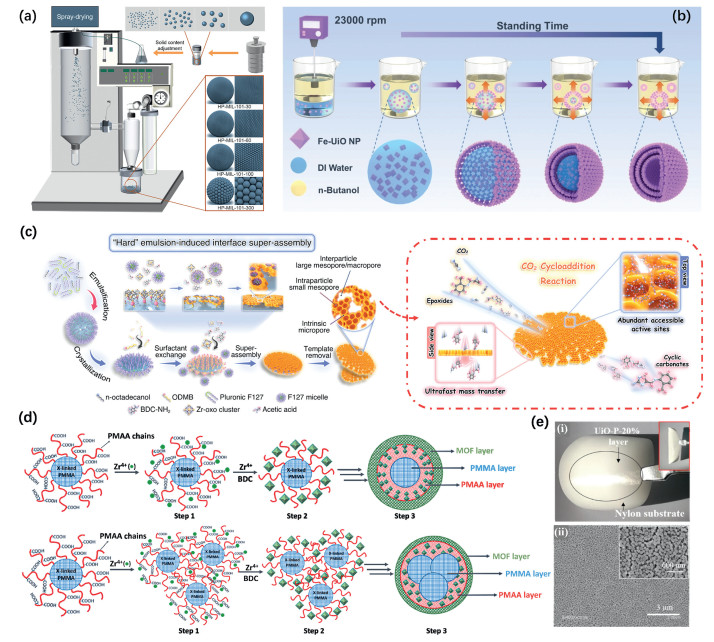
Recently, increasing research attention focused on the strategies of assembling MOF superstructures from single crystal, which included spray drying, emulsion templating, hard templating, and polymerization induced self-assembly. Among them, spray drying is a common method for constructing superstructures by rapidly vaporizing atomized droplets containing nano-MOF particles (N-MOF) to induce the self-assembly of N-MOF particles to spherical MOF superstructures with hierarchical porous structure (HP-MOF). This strategy not only significantly enhances the mechanical stability by forming a dense structure, but also enables precise control over the pore size by changing the size of the initial N-MOF. As a proof-of-concept, the MIL-101(Cr), as one of typical MOFs, was assembled as HP-MOF and further applied to the adsorption of tannic acid (TA) (Fig. 1a) [2]. By changing the initial N-MOF particle size (30–300 nm), the pore size in HP-MIL-101 could be precisely controlled within the range of 18–70 nm, allowing rapid diffusion of TA (molecular size of 2.16 nm × 2.5 nm × 6 nm) to internal adsorption sites. In TA adsorption tests (50 mg/L), HP-MIL-101–60 demonstrated complete TA removal, showing superior performance (~75% removal) to N-MIL-101(Cr)-60. Furthermore, the adsorption rate of HP-MIL-101–60 reached 1.56 times that of N-MIL-101-NH2–60 within 10 min, indicating that the adsorption performance advantage of HP-MIL-101 even surpasses the enhancement effect provided by the strong interaction between the amino groups in NH2−MIL-101(Cr) and the phenolic hydroxyl groups of TA. Notably, HP-MIL-101–30 exhibited an adsorption capacity for TA (1175 mg/g), and significantly surpassing most reported adsorbents [2].
Figure 1
Figure 1.
(a) Schematic diagram of HP-MIL-101 prepared by spray drying-assisted method. Adapted with permission [2]. Copyright 2022, Wiley-VCH GmbH. (b) The preparation of Fe-UiOSomes through the transient Pickering emulsion method. Adapted with permission [3]. Copyright 2022, Wiley-VCH GmbH. (c) 2D UiO-66-NH2 HPNS prepared by the "hard" emulsion-induced interface super-assembly strategy for the efficient CO2 cycloaddition reaction. Adapted with permission [4]. Copyright 2024, American Chemical Society. (d) Polymer-induced assembly of UiO-66. (e) UiO-66 nylon supported membrane images and morphology. Adapted with permission [5]. Copyright 2022, Elsevier.
To enhance the recyclability of MOF superstructures, magnetic Fe3O4 was used to modify NH2-UiO-66 to prepare Fe3O4@NH2-UiO-66 (Fe-UiO) NPs. Subsequently, the Fe-UiO NPs were dispersed in aqueous phase, and n-butanol was introduced to form emulsion systems. Leveraging the partial miscibility of water/n-butanol and employing the transient Pickering emulsion strategy, multi-layer hollow spherical structure of Fe3O4@NH2-UiO-66 (Fe-UiOSomes) with integrated magnetic recovery capability and high performance were successfully constructed (Fig. 1b) [3]. Characterization results showed that the specific surface area of Fe-UiOSomes (975 m2/g) was significantly higher than that of the Fe-UiO (544 m2/g). Benefiting from the self-assembled channels, hierarchical pores, and hollow structures, Fe-UiOSomes demonstrated superior adsorption performance for methyl orange (MO) and Cr(Ⅵ) under both standing and shaking conditions compared to Fe-UiO. Additionally, the Fe-UiOSomes were further designed as bubble-propelled micromotors, which achieved removal rates of 94% for MO and 91% for Cr(Ⅵ) without shaking, comparable to the results obtained with mechanical shaking (96% and 97%). And the removal rate remained stable over three consecutive adsorption-desorption cycles, which showed its excellent application performance and stability in practical aquatic environment remediation.
Beyond pollutant removal, MOF superstructures also show significant potential in catalytically converting the greenhouse gas CO2 into high-value chemicals. Han et al. [4] synthesized 2D hierarchically porous UiO-66-NH2 nanosheets (2D UiO-66NH2 HPNSs) via a "hard" emulsion-induced interface super-assembly strategy (Fig. 1c). Driven by the directed self-assembly of the F127 surfactant and the loose packing of nanocrystals on the hard template, hierarchical pores with sizes of 9 nm and 27 nm were formed. Benefiting from the highly open hierarchical porous channels and the ultrathin nanosheet thickness, mass transfer was significantly enhanced and more accessible active sites were fully exposed. In the catalytic CO2 cycloaddition reactions with 2-methyl glycidyl ether, 2D UiO-66NH2 HPNSs achieved a high cyclic carbonate yield of 96%, significantly outperforming traditional UiO-66-NH2 microporous crystals (29%) and UiO-66-NH2 mesoporous crystals (69%). Moreover, the MOF superstructures prepared by the hard-templating method exhibit exceptional durability during multiple cycling tests, maintained a yield of 95%−96% even after ten cycles of reuse.
Thin membranes fabricated by connecting individual MOF particles via polymers achieved uniform particle dispersion, resulting in MOF membrane with a homogeneous structure and enhanced flexibility. Fang et al. [5] employed a polymerization induced self-assembly strategy to synthesize UiO-66 (Fig. 1d). The poly(methacrylic acid)-b-poly(methyl methacrylate) nanoparticles utilized in the process exhibit well-defined morphology and controlled size, with surfaces rich in carboxyl groups, which serve as multivalent linkers to facilitate the directed assembly of UiO-66. The resulting MOF membranes demonstrate excellent colloidal stability and mechanical flexibility compared to most MOF membranes (Fig. 1e). Moreover, in dye separation applications, UiO-66 membranes achieved a water flux of approximately 20 L m−2 h−1 bar−1 while maintaining a rejection rate exceeding 93% for target dye molecules.
MOF superstructures themselves are composed of individual MOF units. Therefore, high-performance materials such as defective MOFs or multi-metallic MOFs can be selected as basic unit for further assembly to enhance performance of materials. Prioritizing the use of high-valent metal ion-based MOF or combining MOFs with stable polymer matrices or carbon and further constructing superstructures can effectively enhance the stability of the superstructures. Additionally, exploring multifunctional integrated bi-/multi-component MOF superstructures, including combinations of conductive MOFs, photocatalytic MOFs, fluorescent MOFs, and adsorptive MOFs, should be pursued to facilitate multi-functional applications.
Currently, the widespread adoption of MOF superstructures is hindered by challenges in scalable production and the high costs associated with conventional trial-and-error approaches. To facilitate large-scale implementation, future efforts should focus on advancing efficient, low-cost synthesis and assembly techniques, as well as developing specialized equipment for batch production, such as scaled-up spray dryers or continuous-flow-assisted spray drying systems. Furthermore, given the multi-parameter and highly complex nature of MOF superstructure synthesis, the integration of intelligent technologies including but not limited to machine learning, deep learning, and generative artificial intelligence, can help model, optimize, and predict critical process parameters and synthesis conditions. This intelligent approach would significantly reduce the material and time expenditures inherent in traditional empirical methods.
Up to now, research on MOF superstructures has progressively advanced from the synthesis stage to applications in environmental remediation. The application potential of MOF superstructures is closely linked to their dimensionality. Zero-dimensional (0D) superstructures exhibit exceptional performance in adsorption applications. One-dimensional (1D) architectures offer distinctive advantages in catalysis, benefiting from their efficient electron transport pathways. Meanwhile, two- and three-dimensional (2D/3D) frameworks provide unique benefits for membrane separation and catalytic processes, owing to their well-defined porous frameworks and high specific surface areas. To fully exploit their potential, future research should focus on broadening their environmental application scope. More importantly, a fundamental understanding of how environmental factors affect their performance and the underlying mechanisms is crucial. Achieving this requires the integration of advanced characterization techniques, such as multi-time-point scanning/transmission electron microscopy (SEM/TEM) and in situ small-angle X-ray scattering (SAXS), to uncover growth mechanisms and establish clear structure-property-application relationships. With ongoing technological advances, MOF superstructures are poised to play a pivotal role in the next generation of environmental technologies.
Declaration of interests
The authors declare that they have no known competing financial interests or personal relationships that could have appeared to influence the work reported in this paper.
CRediT authorship contribution statement
Zhi-Bo Wang: Writing – original draft, Software, Resources, Investigation, Conceptualization. Lu Zhang: Resources, Methodology, Investigation. Xuedong Du: Writing – review & editing. Chong-Chen Wang: Writing – review & editing, Conceptualization.
Acknowledgments
This work was supported by National Natural Science Foundation of China (Nos. 52370025, 22176012), the BUCEA Doctor Graduate Scientific Research Ability Improvement Project (No. DG2025021), and the Hebei Natural Science Foundation (No. E2023203123).
[1]
X.H. Yi, C.C. Wang, Chin. Chem. Lett. 35 (2024) 109094.
[2]
J. Liu, Y. Wei, M. Chang, et al., AlChE J. 68 (2022) e17522. doi: 10.1002/aic.17522
[3]
H. Huang, J. Li, M. Yuan, et al., Angew. Chem. Int. Ed. 61 (2022) e202211163. doi: 10.1002/anie.202211163
[4]
J. Han, H. Xu, B. Zhao, et al., J. Am. Chem. Soc. 146 (2024) 18979–18988. doi: 10.1021/jacs.4c02321
[5]
M. Fang, J. Cambedouzou, D. Cot, et al., J. Membr. Sci. 657 (2022) 120669.
Figure 1
(a) Schematic diagram of HP-MIL-101 prepared by spray drying-assisted method. Adapted with permission [2]. Copyright 2022, Wiley-VCH GmbH. (b) The preparation of Fe-UiOSomes through the transient Pickering emulsion method. Adapted with permission [3]. Copyright 2022, Wiley-VCH GmbH. (c) 2D UiO-66-NH2 HPNS prepared by the "hard" emulsion-induced interface super-assembly strategy for the efficient CO2 cycloaddition reaction. Adapted with permission [4]. Copyright 2024, American Chemical Society. (d) Polymer-induced assembly of UiO-66. (e) UiO-66 nylon supported membrane images and morphology. Adapted with permission [5]. Copyright 2022, Elsevier.


 DownLoad:

 下载:
下载:


 下载:
下载:

