Citation:
Zhenglong Hu, Liang Chu. C60-based ionic salt electron shuttle enables chemical bonding with perovskite surface for inverted photovoltaic[J]. Chinese Chemical Letters,
2026, 37(6): 112053.
doi:
10.1016/j.cclet.2025.112053
C60-based ionic salt electron shuttle enables chemical bonding with perovskite surface for inverted photovoltaic
English
C60-based ionic salt electron shuttle enables chemical bonding with perovskite surface for inverted photovoltaic
Perovskite solar cells (PSCs) have emerged as a highly promising photovoltaic technology, due to their impressive power conversion efficiency (PCE), cost-effective fabrication processes, and large-scale scalability. In PSCs, the electron transport layer (ETL) plays a crucial role. C60 is widely used in inverted PSCs due to its excellent electron-accepting ability and environmental stability [1]. However, the use of C60 in PSCs faces several significant challenges [2]. For instance, its low solubility and poor interface toughness lead to suboptimal interfacial electronic and mechanical properties. The limited solubility of C60 in common solvents poses a major obstacle, resulting in the aggregation of C60 cages during the solution process. While traditional thermal evaporation can produce high-quality C60 films, it is costly and complex, necessitating high-vacuum condition and precise deposition control. The weak interaction between C60 and perovskite surface gives rise to a suboptimal interface, leading to deep-level defects, interfacial recombination, and decreased charge transfer efficiency. Moreover, the energy-level mismatch between C60 and perovskite causes charge accumulation at the interface.
Although PCBM exhibits superior processability, it has critical limitations in PSCs. In humid and thermal conditions, the ester groups in PCBM undergo hydrolysis, leading to interface degradation. The electron-rich centers in PCBM are inadequate for effectively interacting with the under-coordinated ion defects found on perovskite surfaces. Moreover, the energy barrier between PCBM and perovskite leads to significant energy loss during carrier injection. Furthermore, C60 is more cost-effective than PCBM [2]. In this Highlight, we discuss the latest advancements on C60 ETLs in 2025, which address the challenges and improve the performance of inverted PSCs. The n-type polymer TPDI-BTI effectively solubilizes and stabilizes C60 cages [3]. Carbolong chemical manipulation, characterized by diverse functional groups and exceptional optoelectronic properties, can enhance the perovskite/C60 interfacial contact [4]. Alternatively, a C60-based ionic salt was developed as an electron shuttle, enabling ionic bonding with perovskite surface [5]. Consequently, these approaches significantly enhance both the efficiency and stability of inverted perovskite photovoltaic devices.
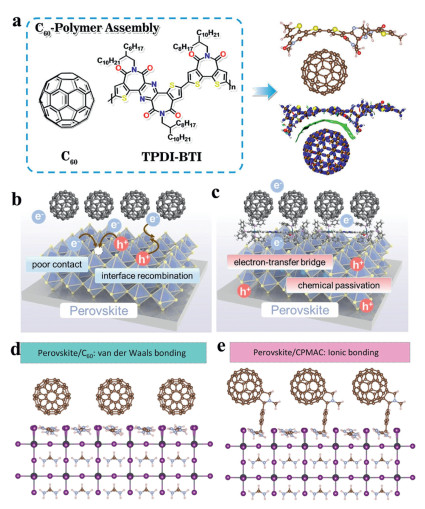
TPDI-BTI, an n-type polymer, was employed to solubilize and stabilize C60 cages during the solution process, which functions as a dispersant to prevent the C60 aggregation and enhance the solution processability (Fig. 1a) [3]. Additionally, the TPDI-BTI modified the C60 layer to improve electron dynamics and interfacial contact in PSCs. C60-based PSCs with 5 wt% TPDI-BTI achieved a champion PCE of 25.60% (certified 25.09%). The optimized devices exhibited significantly enhanced stability, with T95, light > 1800 h (time for efficiency decline to 95% under continuous light illumination) and T80, heat = 700 h (time for efficiency decline to 80% at 85 ℃). Concurrently, carbolong chemical manipulation was developed to enhance the interfacial contact between perovskite and C60 layers. Carbolong metallaaromatics, particularly dicarbolong-phenanthroline (DCP), possess diverse functional groups and exhibit excellent optoelectronic properties [4]. The triphenylphosphonium (PPh3+) derived from DCP can strongly interact with the C60 layer through strong π−π stacking, thereby enhancing the adhesion to perovskite films (Figs. 1b and c). The π-π stacking is a non-covalent interaction. The three benzene rings in PPh3+ create an extensive conjugated plane, enabling multiple sites for π-π stacking with the spherical conjugated structure of C60. This interaction exhibits considerable directionality and strength, thereby effectively enhancing the interfacial binding force. DCP can restructure the perovskite surface, reduce non-radiative recombination, and optimize energy-level alignment. Devices with DCP achieved an efficiency of 25.80%. The unencapsulated devices maintained > 98% of their original efficiency after 1400 h of maximum power point tracking (MPPT) under illumination, and exhibited excellent thermal stability, maintaining 93% of their initial efficiency after 2500 h at 85 ℃ in a nitrogen atmosphere.
Figure 1
Figure 1.
(a) Chemical structures of C60 and TPDI-BTI, and intermolecular interacting behavior between C60 and TPDI-BTI. Reprinted with permission [3]. Copyright 2025, Wiley. (b, c) Schematic of the perovskite/C60 surface layer without passivation and with carbolong interface modification. Reprinted with permission [4]. Copyright 2025, Cell Press. (d) C60 and (e) CPMAC on their different interactions with the perovskite surface. Reprinted with permission [5]. Copyright 2025, AAAS.
Recently, You et al. published a groundbreaking study in Science [5], presenting a novel strategy to overcome the challenges associated with C60-based ETLs. They synthesized an ionic salt, 4-(1′,5′-dihydro-1′-methyl-2′H-[5,6]fullereno-C60-Ih-[1,9-c]pyrrol-2′-yl)phenylmethanaminium chloride (CPMAC), which is derived from C60. The design of CPMAC aims to enhance the interface and packing of the ETL. The CH2—NH3+ head group in the cation of CPMAC exhibits structural similarity to the MA+ cation. DFT calculations indicate that CPMAC interacts with the FA-rich perovskite surface through the substitution of an FA+ cation, thus reducing the surface energy. CPMAC prefers to substitute FA+ in mixed-cation perovskites. Compared with C60, CPMAC is expected to have two interactions with the perovskite (Figs. 1d and e). Firstly, the CH2—NH3+ head group can occupy an FA+ vacancy, and the Cl− anion can fill an I− vacancy, providing double defect passivation. Secondly, the CPMA cation can substitute an FA+ cation on the perovskite surface, causing the resulting FACl molecule to escape during annealing. These interactions reinforce the interface and packing between CPMAC and the perovskite surface, enabling the use of a thinner CPMAC layer (10 nm) compared to the conventional 20-nm-thick C60 layer. Moreover, the C60 unit within CPMAC facilitates electron transport, making it an effective electron-conducting bridge.
The introduction of CPMAC does not induce a phase change in the perovskite; however, it enhances the diffraction intensity and growth orientation, suggesting a potential interaction between them. The CPMAC-treated perovskite film exhibits improved uniformity with fewer surface defects and a more homogeneous potential distribution. The enhanced interface minimizes interfacial recombination, enabling more efficient extraction of charge carriers. Moreover, the smaller conduction band offset between CPMAC and perovskite promotes energy level alignment and diminishes voltage loss of the PSCs. The fracture energy of CPMAC-based devices is significantly increased, indicating enhanced mechanical stability and reduced susceptibility to delamination during operation. The PCE of champion device increases from C60-based 25.5% (reverse scan) to CPMAC-based 26.1% (reverse scan) for the PSCs. The unencapsulated CPMAC-based device shows only 2% efficiency loss after 2100 h of continuous MPPT at 65 ℃ under 1-sun illumination, while the C60-based device experiences a 6% decrease. The CPMAC-based device maintains about 95% of its initial efficiency after 1500 h of MPPT at 85 ℃. Moreover, the CPMAC-based minimodule (4 subcells, 6 cm2) achieves a PCE of 23.2%, which is higher than the 21.8% of the C60-based minimodule. After 2200 h of operation at 55 ℃, the CPMAC-based minimodule maintains 91.5% of its initial efficiency, while the C60-based sample experiences a loss of over 30%.
The aforementioned studies in 2025 indicate significant progress in the development of C60-based PSCs, deepening our understanding of how to improve their performance and stability. The n-type TPDI-BTI polymer solubilize and stabilize C60, which pertains to surface treatment of the C60 cages. Meanwhile, carbolong modulation represents an interface treatment that effectively enhances the perovskite/C60 interface. The ionization of the surface of C60 cages altered their physicochemical properties for CPMAC. TPDI-BTI enabled efficient dispersion via intermolecular π-π interactions, preventing aggregation to enhance electron transport, which boosted PCE from 24.0% (conventional C60) to 25.6%. Compared to surfactants with weak van der Waals interactions, carbolong's PPh3+ groups established strong π-π stacking with C60 to reduce interfacial recombination, resulting in 25.8% efficiency and 93% stability after 2500 h at 85 ℃. Unlike physical adsorption in traditional C60, CPMAC forms ionic bonds with perovskite surfaces to achieve dual defect passivation, boosting efficiency to 26.1%, and enhancing mechanical and long-term operation stability. These three methodologies reflect different levels of processing techniques involving C60, including additive, interfacial treatment, and surface pretreatment of C60 cages. The treatment of perovskite/C60 interface with carbolong aims to address the issue of interface contact inefficiencies. The TPDI-BTI additive and the surface ionization of C60 cages tackle the challenges related to low solubility and poor interface toughness.
In light of the above approaches related to C60-based inverted perovskite photovoltaics, we propose several avenues for future research:
(1) The design of dual-purpose molecules, such as amino-sulfonic acid-functionalized fullerenes, will be pursued to achieve simultaneous defect passivation, energy level tuning, and mechanical reinforcement.
(2) The dissociative-group modified fullerenes should be explored (e.g., carboxyl and quaternary ammonium groups) to enhance interface adaptability through dynamic ionic bonds, which can also suppress halide volatility.
(3) Efforts will be directed towards optimizing solution-based printing methods for C60 ETLs, including inkjet and slot-die coating, to reduce production cost while enabling the fabrication of large-area modules.
These proposed directions are expected to further enhance the efficiency and stability of C60-based inverted perovskite photovoltaics, addressing the remaining challenges in the field and paving the way for practical applications.
The authors acknowledge funding support from the National Natural Science Foundation of China (No. 52172205), the Scientific Research Project of Hubei University of Science and Technology (Nos. 2020–22GP08, 2024–2025X08).
Figure 1
(a) Chemical structures of C60 and TPDI-BTI, and intermolecular interacting behavior between C60 and TPDI-BTI. Reprinted with permission [3]. Copyright 2025, Wiley. (b, c) Schematic of the perovskite/C60 surface layer without passivation and with carbolong interface modification. Reprinted with permission [4]. Copyright 2025, Cell Press. (d) C60 and (e) CPMAC on their different interactions with the perovskite surface. Reprinted with permission [5]. Copyright 2025, AAAS.


 DownLoad:

 下载:
下载:


 下载:
下载:

