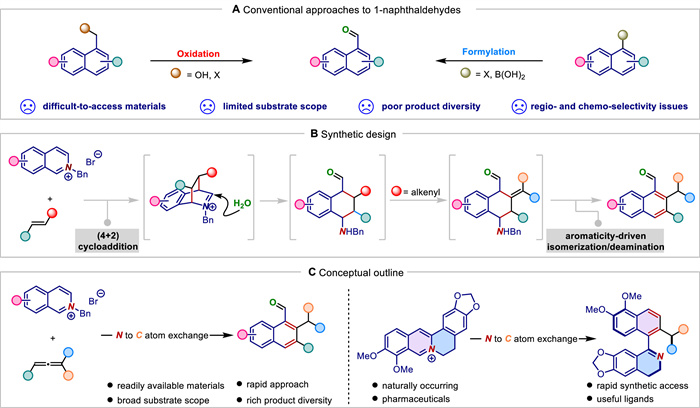
Scheme 1.
Approaches to 1-naphthaldehydes and our skeletal editing strategy.

Direct transformation of azaarenes into aromatic aldehydes and QUINAP-like atropisomers
Jianing Zhang , Weitao Guo , Chaoyang Li , Rongyu Yan , Yunlong Qin , Yang Zhao , Yong-Yuan Gui , Lili Zhao , Qilin Wang


Substituted aromatic aldehydes, particularly 1-naphthaldehydes, are crucial raw materials with extensive applications in the fields of material science, synthetic chemistry, and pharmaceuticals. Moreover, they also serve as significant synthetic precursors for chiral ligands and catalysts. However, only limited synthetic strategies have been reported for their synthesis (Scheme 1A), predominantly relying on peripheral modification of the naphthalene core through the introduction of a formyl group via oxidation of their alcohol and halide precursors [1–5] or formylation of 1-naphthyl halides or boronic acids [6–8]. Despite being efficient, it remains highly challenging to prepare differently substituted 1-naphthaldehydes due to difficulties in obtaining the necessary synthetic precursors and controlling regio- and chemoselectivities. Therefore, there is a pressing need to explore rapid and efficient approaches for synthesizing various multi-substituted 1-naphthaldehydes using readily available materials under simple conditions.
Skeletal editing has emerged as a potent strategy for modifying the inherent core skeleton at a profound level in recent years, which could directly convert already-existing or easy-to-make molecules into other challenging candidates, thereby avoiding time- and labour-consuming multistep sequences from scratch [9–49]. In view of the ready availability and ease functionalization of azaarenes, ideally, it would be promising to transform them into arenes via formal N-to-C transmutation. However, achieving this transformation remains highly challenging due to the high aromatic stability energy, unstrained ring architectures, and bond inertness. Only a few rare examples have been reported in this regard. In 2013, Kozmin and colleagues developed an inverse-electron-demand [4 + 2] cycloaddition between isoquinoline N-oxides or isoquinolinium salts with siloxyalkynes [50,51]. These transformations were limited to siloxyalkynes as dienophiles and required catalytic amounts of Au or stoichiometric amounts of Ag for their activation. Kano’s group demonstrated an effective approach by utilizing the Zincke reaction to eliminate nitrogen atoms from azaarenes followed by precise insertion of carbon atoms using suitable carbon sources [52–54]. Studer [55] and Boswell [56] independently achieved the conversion of pyridines into benzenes and naphthalenes through the transformation of electron-poor pyridines into electron-rich dihydropyridines as a crucial step. Greaney and colleagues also accomplished the conversion of pyridines into benzenes through a one-pot three-step process [57]. More recently, Song [58] and Sorensen [59] individually presented a robust strategy to convert pyridine and quinoline N-oxides into all-carbon arenes through a N-to-C single-atom swap with sulfoxide as the carbon source. Wei’s group utilized phosphonium ylide as the carbon source to precisely swap the N-atom for a CH unit, thus accomplishing the editing of C1-substituted isoquinolines into naphthalenes [60]. Despite these remarkable advancements, none of these achievements possess the capability to reshape commercially available azaarenes into valuable but difficultly accessible aromatic aldehydes.
Recently, our research group has been focused on exploring novel reactivities of azaarenes in order to expand their chemical space [61–64]. In continuation of our research interests and to address the challenges associated with synthesizing diverse 1-naphthaldehydes, we present here a protocol for skeletal editing of isoquinoliniums. These isoquinoliniums can be easily prepared from commercially available isoquinolines through quaternization, and subsequently transformed into synthetically valuable multi-substituted 1-naphthaldehydes. As depicted in Scheme 1B, this formal N-to-C transmutation strategy involves an initial inverse-electron-demand [4 + 2] cycloaddition between isoquinolinium salts and alkenes, leading to the formation of unstable strained bridged species. Subsequent cleavage of these bridged intermediates, followed by aromaticity-driven deamination processes, enables the generation of functionalized 1-naphthaldehydes. The key aspect in our design lies in the selection of allenes as reaction partners. The relatively electron-rich terminal olefin moieties serve as unconventional dienophiles that generate transient strained bridged rings containing an exocyclic C=C bond. This exocyclic C=C bond then facilitates N-atom extrusion and subsequent aromatization reactions. Interestingly, this strategy can also be extended to reshape naturally occurring pharmaceutical compounds such as berberine sulfate and palmatine chloride [65–67] into structurally unique axially chiral N/P ligands that are otherwise challenging to access (Scheme 1C) [68–75].
To begin our study, we choose N-benzyl isoquinolinilum salt 1, easily prepared from commercial isoquinoline and benzyl bromide by a simple filtration, and allenylphosphine oxide 2 as the model substrates for the development of skeletal editing reactions. The phosphine oxide moiety in allenes not only serves as an orientating group for regioselective control, but also endows the products some valuable functions, for example, behaving as useful synthetic handle for further modifications or as precursors to prepare various phosphine ligands. Gratifyingly, this reaction proceeded smoothly in the presence of Na2CO3 (1.0 equiv.) and water (10.0 equiv.) in DMSO at 80 ℃ to produce 3 in 91% yield (entry 1, Table 1). The water is important for the synthetic efficiency. In the absence of it, only a 73% yield of 3 was obtained. Increasing its amount to 20.0 equiv. was also detrimental to the yield (60%). Subsequent evaluation of bases indicated that replacement of Na2CO3 with other bases, such as K2CO3, Cs2CO3 and Na2HPO4, resulted in inferior yields. Given the fact that the imine group in 3 is susceptible to hydrolysis, 2 equiv. TFA was added to the reaction system after the skeletal editing process went completion, and the aldehyde 4 was afforded in 98% yield (footnote c, Table 1, entry 1).

 DownLoad:
CSV
DownLoad:
CSV
 |
||
| Entry | Variation from standard conditions | Yield (%) b |
| 1 | None | 91 (98) c |
| 2 | Water is omitted | 73 |
| 3 | Water (20 equiv.) | 60 |
| 4 | K2CO3 instead of Na2CO3 | 80 |
| 5 | Cs2CO3 instead of Na2CO3 | 75 |
| 6 | Na2HPO4 instead of Na2CO3 | 49 |
| 7 | At room temperature | (71) c,d |
| 8 | In N2 atmosphere | (96) c |
| 9 | CHCl3, EtOH, CH3CN instead of DMSO | (75, 80, 82) c |
| a Reaction conditions: 1 (0.40 mmol), 2 (0.20 mmol), water (2.0 mmol), Na2CO3 (0.20 mmol), DMSO (1.0 mL), 80 ℃, 4 h. b Isolated yields of 3 obtained by silica gel column chromatography. c The data in the bracket refers to the isolated yield of 4 after stirring 3 with TFA (0.40 mmol) for 30 min in the one-pot reaction system. d 72 h. |
||
The reaction could also proceed successfully at room temperature, for which a prolonged time for required to deliver a 71% yield of 4 (entry 7, Table 1). Conducting the reaction in nitrogen atmosphere had marginally influence on the yield (entry 8, Table 1). Replacement the solvent with CHCl3, EtOH and CH3CN resulted in inferior yields (entry 9, Table 1). Notably, in this skeletal editing reaction, we easily introduced two useful functional groups at one time, a formyl group on the C1-position of naphthalene core and a phosphinyl group, both of which are difficultly incorporated by other conventional methods. These two functional groups provided a versatile platform for further synthetic manipulation and functional development.
With the optimal conditions established, the compatibility of this skeletal editing strategy was explored using this operationally simple method (Scheme 2). Initially, we investigated the reactivity of various dienophiles, including allenes, alkynes and alkenes. A wide range of allenylphosphine oxides with different aryl substituents were tolerated, irrespective of their electronic nature and substitution positions, leading to 4–23 in 42%−98% yields. The allenylphosphine oxides bearing ortho-substituents were also competent substrates (19–21). Variation of substituted phenyl groups with 2-naphthyl and 2-thienyl groups were also compatible (22, 23). The substituents on the phosphine oxide moiety were not limited to phenyl, cyclohexyl-, isopropyl- and ethoxy-substituted ones were also amenable in this reaction (24, 84%; 25, 57%; 26, 78%). Unsubstituted and γ-phenyl substituted allenylphosphine oxide could also participate in this skeletal editing reaction successfully, to deliver 27 and 28 in 30% and 85% yields, respectively. Remarkably, the reaction sites changed for these two cases. The phosphine oxide group was not indispensable in this synthetic strategy. Replacement of it with ester group and sulfonyl group was also feasible (29, 68%; 30, 99%). Unfortunately, allenes with electron-donating substituents failed to participate in this transformation (for details, see Supporting information). Apart from allenes, ethoxyethyne and ynamine were also competent partners, which smoothly produced 31 and 32 in 95% and 69% yields, respectively. Both N-methyl-N-vinylacetamide and (vinyloxy)cyclohexane could also participate in the reaction successfully, in which they served as acetylene equivalent synthons, since the amino and the ether groups were eliminated during the aromatization step to give 33. Notably, when 2,3-dihydrofuran was used as dienophile, the skeletal editing strategy provided a rapid approach to 34 and 35 bearing a transformable hydroxy group.
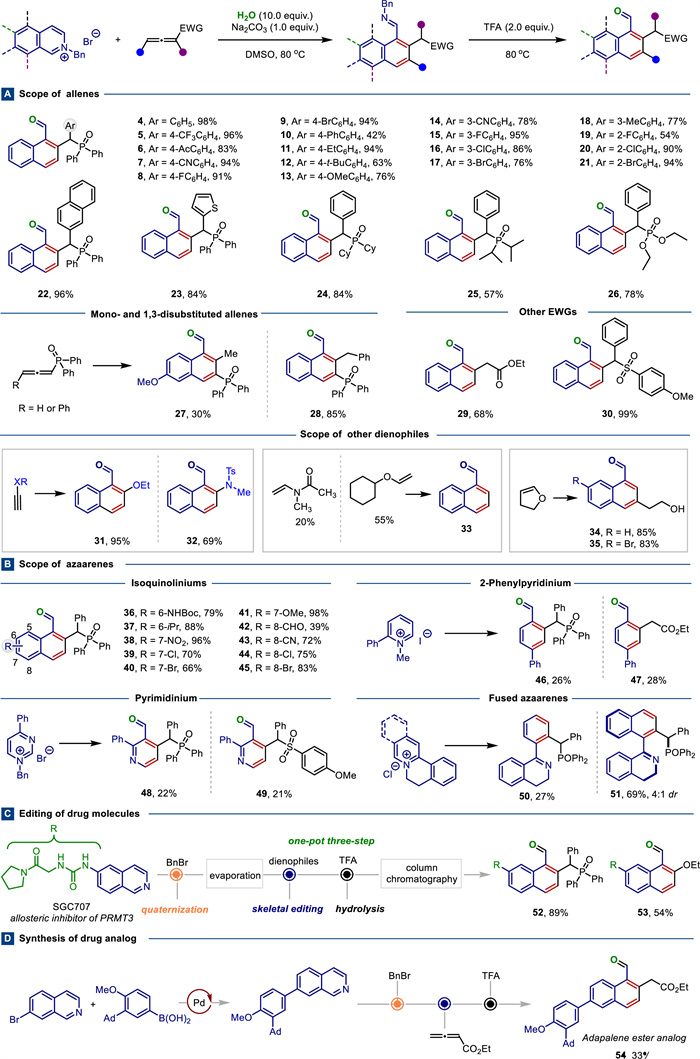
Then, we evaluated the scope of isoquinoliniums with various substitution patterns. This skeletal editing reaction was not sensitive to the electronic characters. Both electron-withdrawing and electron-donating substituents were tolerable, leading to 36–45 in 39%−98% yields. Among them, the 8-CHO (39) substituted isoquinolinium exhibited poorer synthetic efficiency, which may be caused by the steric bulkiness disfavoring the first [4 + 2] cycloaddition. Apart from isoquinoliniums, we could also edit 2-phenylpyridine and 4-phenylpyrimidine based onium salts into the corresponding multisubstituted benzaldehyde (46, 47) and nicotinaldehyde (48, 49) via a formal N-to-C switch. Notably, fused pyridinium and isoquinolinium were also suitable reaction partners, producing QUINAP-type products 50 and 51, that are difficultly accessible by conventional methods, in 27% and 69% yields, respectively [63–70]. We further demonstrated the developed skeletal editing strategy is a reliable method for the direct late-stage modification of SGC707drug molecule, a potent, selective, and cell-active allosteric inhibitor of PRMT3 [76], which smoothly afford 52 and 53 through a one-pot three-step operation (Scheme 2C). The synthetic application of this strategy was further explored to prepare drug analogue. As shown in Scheme 2D, after obtaining the isoquinoline precursor via a Pd-catalyzed Suzuki coupling from easily accessible materials, we could edit it into adapalene analogue 54 in an overall 33% yield via a one-pot three-step sequence.
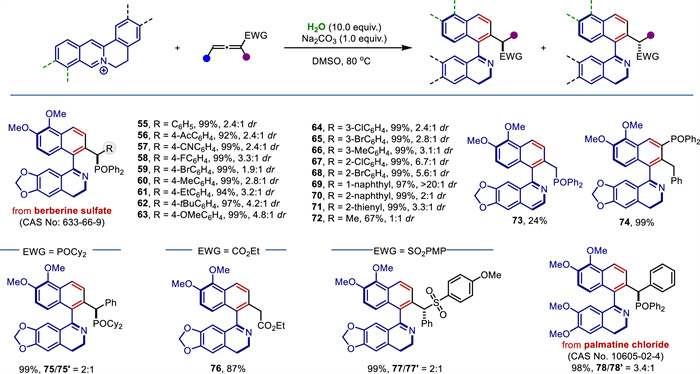
Motivated by the success of this skeletal editing strategy to transform isoquinolinium salts into functionalized naphthalenes, we further expanded its application to re-shape naturally occurring pharmaceutical, berberines (Scheme 3). To our delight, the attempt to edit commercially available berberine sulfate (CAS No. 633–66–9, 1.5 $/g) was proven to be quite successful, and a pair of atropisomeric diastereoisomers 55 and 55′ were produced in nearly quantitative yields (99%, 2.4:1 dr). Interestingly, we could get the pure major diastereomer by a simple recrystallization. Inspired by this promising result, we moved on to investigate the substrate scope for the construction of various atropisomeric N/P products (Scheme 3). This transformation could tolerate a wide range of allenylphosphine oxides bearing different phenyl substituents (56/56′−68/68′). It did not show any discrimination on their electronic characters. Both electron-withdrawing groups and electron-donating groups gave excellent performance. Increasing the bulkiness of the substituents was beneficial to improve the diastereoselectivity (67 vs. 64, 68 vs. 59 and 65). When 1-naphthyl substituted allenylphosphine oxide was used as the substrate, only one diastereomer 69 was afforded. Apart from aryl substituents, methyl group (72/72′) was also amenable. Likewise, unsubstituted allenylphosphine oxide turned out to be suitable reaction partner to produce the aromatized product 73 in 24% yield. Consistent with previous observation, the regioselectivity for γ-phenyl substituted allenylphosphine oxide preferred the phosphine-tethered olefinic site, giving rise to 74 in 99% yield. In addition to the phenyl substituent, dicyclohexyl-substituted phosphine oxide was also amenable (75/75′, 99%, 2:1 dr). Variation of the phosphine oxide group with an ester group and a sulfonyl group was also applicable to produce 76 and 77/77′ in 87% and 99% yields, respectively. This skeletal editing strategy was not limited to berberine sulfate. It could also be used to remould another pharmaceutical, palmatine chloride (CAS No. 10605–02–4, 1 $/g), and the desired products 78/78′ were obtained in 98% yield with 3.4:1 dr.
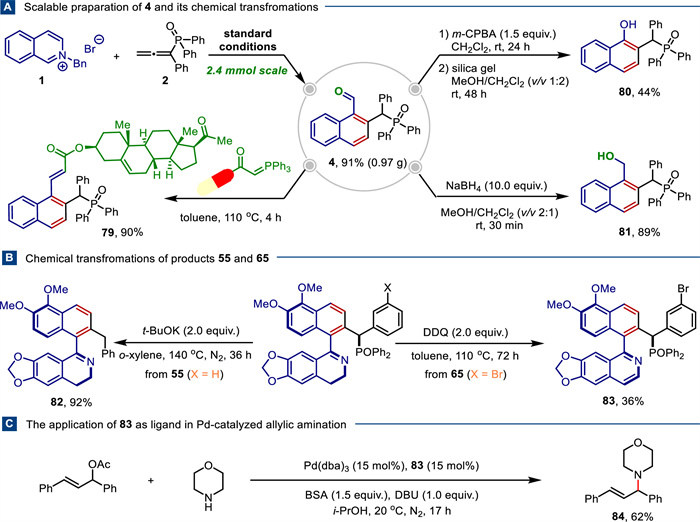
To highlight the synthetic value of our method, initially, a 2.4-mmol-scale preparation of 4 was carried out. Happily, this reaction proceeded smoothly with excellent efficiency (Scheme 4A). Then, some chemical transformations were performed based on the fruitful reactivity of the formyl group in 4. A biologically active pregnenlone scaffold could be efficiently incorporated via a Wittig reaction (79, 90%). The formyl group could be replaced by a hydroxy group through the Dakin reaction (80, 44%). The aldehyde could be reduced to primary alcohol by subjecting 4 to the reductive system of NaBH4, thus delivering 81 in 89% yield. Subsequently, the synthetic transformations of atropisomeric N/P products were conducted (Scheme 4B). The phosphine oxide group could be easily removed upon treatment of 55 with t-BuOK to produce 82 in 92% yield. In addition, the dihydroisoquinoline core in 65 could be oxidized by DDQ in toluene to generate atropisomeric azaheterobiaryl product 83. It should be noted that, although heterobiaryl compounds are of high value in catalysis, their synthesis remains troublesome, relying on transition metal-catalyzed multi-step synthesis from pre-functionalized materials [68–75]. Our strategy provides an easily operable, convenient method to atropisomeric azaheterobiaryl compounds from readily accessible, cheap natural products. Furthermore, the potential of 83 as a new N/P ligand was explored (Scheme 4C). The Pd-catalyzed allylic amination was attempted and product 84 was obtained in 62% yield.
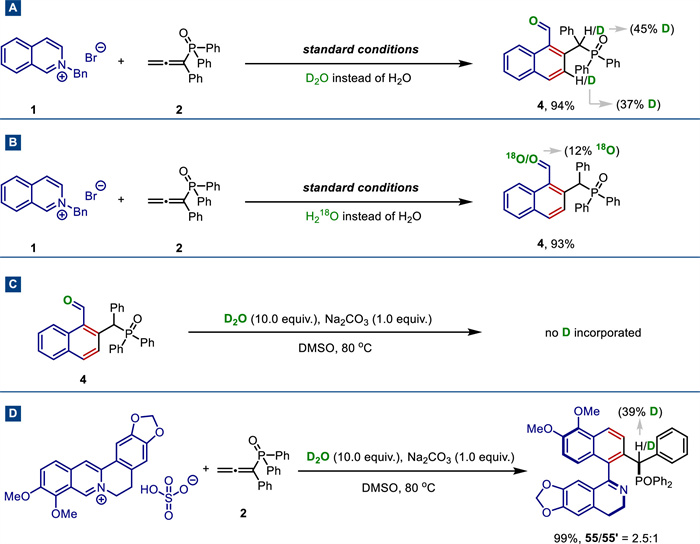
To elucidate the reaction mechanism, some isotope labeling experiments were carried out by adding D2O instead of H2O (Scheme 5). We found that 37% D was introduced on the naphthalene ring and 45% D was incorporated into the CH adjacent to the phosphine oxide group (Scheme 5A). By using H218O, we found that 12% 18O was introduced on the formyl group (Scheme 5B). Treatment of 4 with D2O under basic conditions resulted in no D incorporation (Scheme 5C). These three cases jointly suggested water participated in the reaction as a nucleophile and the D incorporation into the CH group vicinal to the phosphine oxide was not originated from protonation. Similarly, to form 55, 39% D was introduced to the CH close to the phosphine oxide group and no D could be introduced using 55 as substrate under basic conditions.
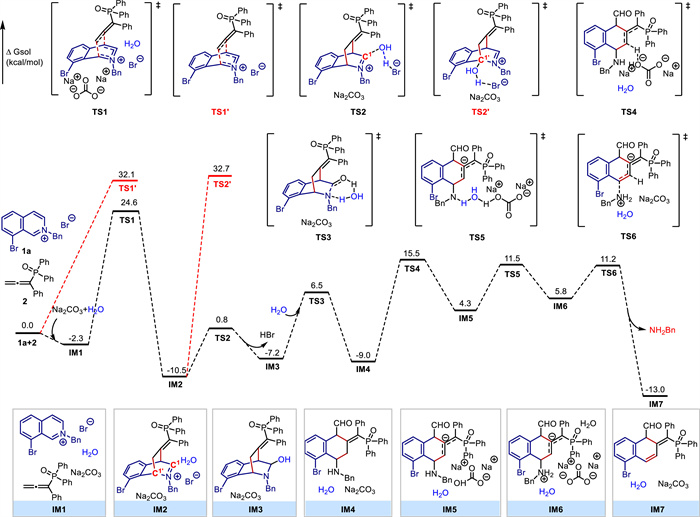
In addition, DFT calculations (see Supporting information for details) were performed to elucidate the reaction mechanism, by using the experimentally used N-benzyl 8-bromoisoqinolinilum salt 1a and allenylphosphine oxide 2 as model substrates under the catalytic effects of Na2CO3 and H2O, ultimately leading to the formation of the final product 45. As depicted in Scheme 6, the addition of Na2CO3 and H2O initially forms the slightly stable IM1 complex. After overcoming a barrier of 26.9 kcal/mol via a bridged ring transition state TS1, the [4 + 2] cycloaddition of 1a and 2 occurs, yielding the thermodynamically more stable intermediate IM2. The subsequent hydration step at the C1-center proceeds smoothly with a barrier of 11.3 kcal/mol (i.e., IM2 → TS2), leading to the formation of intermediate IM3. On the other hand, we also explored the reaction course for the hydration step at C1’-center. However, the very high barrier of 43.2 kcal/mol (i.e., IM2 → TS2’) excluded such possibility. With the assistance of H2O molecule, the free energy for the following hydrogen transfer step is predicted to be 13.7 kcal/mol (i.e., IM3 → TS3), which is experimentally feasible at mild conditions. Followed by the formation of the aldehyde intermediate IM4, the successive two H-abstraction steps (i.e., IM4 → TS4, IM5 → TS5) under the assistance of Na2CO3 can be easily achieved leading to the Zwitterionic intermediate IM7, and the two free energy barriers are predicted to be 24.5 and 7.2 kcal/mol, respectively. By crossing a small barrier of 5.4 kcal/mol (i.e., IM6 → TS6), the C—N bond is finally break down generating the NH2Bn and IM7 intermediate with exergonic by 13.0 kcal/mol.
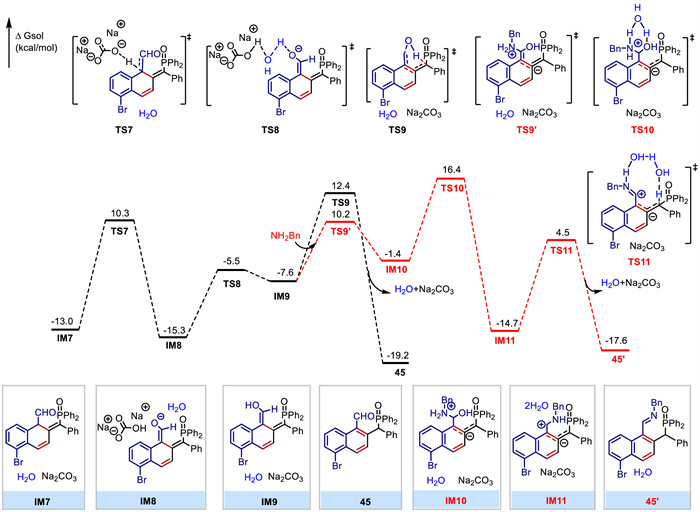
Subsequently, the H adjacent to the aldehyde group can be readily abstracted by the base Na2CO3 giving the enol anion intermediate IM8, which can subsequently capture a proton from H2O, leading to the formation of the slightly unstable enol intermediate IM9 (Scheme 7). Proceeding through a barrier of 20.0 kcal/mol via the six-membered ring transition state TS9, the H-atom of the hydroxyl group can be transferred to the neighboring phosphine-bond C-center, ultimately generating the final product 45. On the other hand, the NH2Bn species generated in the first stage can react with IM9 easily via TS9’ giving the IM10 intermediate, followed by water release step via TS10’ giving the IM11 intermediate. With the assistance of H2O molecule, the H(NH)-atom can be readily transferred to the C of imine via a barrier of 19.2 kcal/mol (i.e., IM11 → TS11), yielding the experimentally observed intermediate 45′ As comparisons in Scheme 6, the formation of product 45 is both kinetically and thermodynamically more favorable than that of key intermediate 45′, which explains very well the experimental observations. Each step is kinetically and thermodynamically feasible under mild conditions. The final hydrogen transfer step, with a barrier of 27.7 kcal/mol, serves as the rate-determining step (RDS) throughout the entire reaction pathway. Moreover, the whole reaction is exergonic by 19.2 kcal/mol, which can provide driving force to reach the final product 45.
In summary, we have developed a skeletal editing strategy to transform easily accessible azaarene-based onium salts, such as isoquinoliniums, pyridinium and pyrimidinium, into functionalized aromatic aldehydes through a formal N-to-C transmutation process. DFT mechanistic studies were also conducted to gain insight into the reaction mechanism, which established the significant catalytic role of the Na2CO3 and H2O, and disclosed the rate-determining step (RDS) throughout the whole catalysis. In addition, we could expand the utility of this synthetic strategy to re-shape natural products, such as berberine sulfate and palmatine chloride, into structurally novel atropisomeric N/P compounds, that are difficultly accessed by other methods. Our strategy could also be used to edit drug molecules and to prepare drug analogue. The salient features of this strategy include easily accessible materials, mild conditions, simple operation, and high value of products. This work not only offers a practical method to convert azaarenes into arenes, but also introduces a novel class of atropisomeric N/P ligands. We believe the disclosure of this strategy will prompt more interesting advances in molecular editing.
The authors declare that they have no known competing financial interests or personal relationships that could have appeared to influence the work reported in this paper.
Jianing Zhang: Methodology, Investigation, Formal analysis. Weitao Guo: Formal analysis. Chaoyang Li: Methodology, Investigation, Formal analysis, Data curation, Conceptualization. Rongyu Yan: Data curation. Yunlong Qin: Methodology, Investigation, Data curation. Yang Zhao: Formal analysis, Data curation. Yong-Yuan Gui: Supervision. Lili Zhao: Writing – review & editing, Writing – original draft, Validation, Supervision. Qilin Wang: Writing – review & editing, Writing – original draft, Supervision, Project administration, Funding acquisition, Conceptualization.
This work was financially supported by the National Natural Science Foundation of China (Nos. 22471059, 22101073, 22373050), the Natural Science Foundation of Henan (No. 242300421133), and the Key Teacher Project of Henan Province of China (No. 2021GGJS025). L. Zhao also acknowledges the financial support from the Natural Science Foundation of the Jiangsu Province (No. BK20250032), the State Key Laboratory of Material-Oriented Chemical Engineering (No. SKL-MCE-23A06), Nanjing Tech University (Nos. 39837123 and 39837132), the International Cooperation Project at Nanjing Tech University. Y.-Y. Gui thank the financial support from Sichuan Science and Technology Program (No. 2025ZNSFSC0129). We also appreciate the high performance center of Nanjing Tech University for supporting the computational resources.
Supplementary material associated with this article can be found, in the online version, at doi:
D. Tsukamoto, Y. Shiraishi, Y. Sugano, et al., J. Am. Chem. Soc. 134 (2012) 6309–6315. doi: 10.1021/ja2120647
F.Q. Chen, X.Y. Guan, J.H. Ding, et al., Angew. Chem. Int. Ed. 60 (2021) 22230–22235. doi: 10.1002/anie.202108357
S.S. Meng, L.R. Lin, X. Luo, et al., Green Chem. 21 (2019) 6187–6193. doi: 10.1039/c9gc02446h
Y.G. Zhu, B.G. Zhao, Y.A. Shi, Org. Lett. 15 (2013) 992–995. doi: 10.1021/ol303431h
I.B. Stone, J. Jermaks, S.N. MacMillan, T.H. Lambert, Angew. Chem. Int. Ed. 57 (2018) 12494–12498. doi: 10.1002/anie.201807134
S. Klaus, H. Neumann, A. Zapf, et al., Angew. Chem. Int. Ed. 45 (2006) 154–158. doi: 10.1002/anie.200502697
H. Huang, X.M. Li, Y.T. Zhang, P.S. Mariano, W. Wang, Angew. Chem. Int. Ed. 56 (2017) 1500–1505. doi: 10.1002/anie.201610108
H. Huang, C.G. Yu, X.M. Li, et al., Angew. Chem. Int. Ed. 56 (2017) 8201–8205. doi: 10.1002/anie.201703127
J. Jurczyk, J. Woo, S.F. Kim, et al., Nat. Synth. 1 (2022) 352–364. doi: 10.1038/s44160-022-00052-1
B.W. Joynson, L.T. Ball, Helv. Chim. Acta 106 (2023) e202200182. doi: 10.1002/hlca.202200182
C.H. Ma, C.W. Lindsley, J.B. Chang, B. Yu, J. Med. Chem. 67 (2024) 11459–11466. doi: 10.1021/acs.jmedchem.4c01347
Z.H. Liu, X.L. Zhang, P. Sivaguru, X.H. Bi, Acc. Chem. Res. 58 (2025) 130–149. doi: 10.1021/acs.accounts.4c00709
P. Xu, A. Studer, Acc. Chem. Res. 58 (2025) 647–658. doi: 10.1021/acs.accounts.4c00813
F.P. Wu, J.L. Tyler, F. Glorius, Acc. Chem. Res. 58 (2025) 893–906 58. doi: 10.1021/acs.accounts.4c00820
H. Lu, J. Chang, H. Wei, Acc. Chem. Res. 58 (2025) 933–946. doi: 10.1021/acs.accounts.4c00854
R. Zhang, G.B. Dong, Acc. Chem. Res. 25 (2025) 991–1002. doi: 10.1021/acs.accounts.5c00014
Z.R. Cheng, Z.B. Hu, N. Jiao, Acc. Chem. Res. 58 (2025) 1003–1022. doi: 10.1021/acs.accounts.4c00846
H. Yorimitsu, Acc. Chem. Res. 58 (2025) 1323–1334. doi: 10.1021/acs.accounts.5c00091
R. Al-Ahmad, M.J. Dai, Acc. Chem. Res. 58 (2025) 1392–1406. doi: 10.1021/acs.accounts.5c00030
J. Zhang, Z.Y. Zheng, C. Zhu, Chin. Chem. Lett. 35 (2024) 109160. doi: 10.1016/j.cclet.2023.109160
J.H. Li, P.C. Tang, Y. Fan, H.J. Lu, Science 389 (2025) 275–281. doi: 10.1126/science.adl4755
M. Purins, H. Nakahara, M.D. Levin, Science 389 (2025) 295–298. doi: 10.1126/science.adx4762
L.F. Dai, Y.X. Jiang, D.L. Yu, et al., ACS Catal. 15 (2025) 7792–7799. doi: 10.1021/acscatal.5c01519
H. Lu, Y. Zhang, X.H. Wang, et al., Nat. Commun. 15 (2024) 3772. doi: 10.1038/s41467-024-48265-6
T.J. Pearson, R. Shimazumi, J.L. Driscoll, et al., Science 381 (2023) 1474–1479. doi: 10.1126/science.adj5331
J. Woo, C. Stein, A.H. Christian, M.D. Levin, Nature 623 (2023) 77–82. doi: 10.1038/s41586-023-06613-4
H.M. Wang, H.L. Shao, A. Das, et al., Science 381 (2023) 75–81. doi: 10.1126/science.adh9737
J. Woo, A.H. Christian, S.A. Burgess, et al., Science 376 (2022) 527–532. doi: 10.1126/science.abo4282
J.C. Reisenbauer, O. Green, A. Franchino, P. Finkelstein, B. Morandi, Science 377 (2022) 1104–1109. doi: 10.1126/science.add1383
H. Lyu, I. Kevlishvili, X. Yu, P. Liu, G.B. Dong, Science 372 (2021) 175–182. doi: 10.1126/science.abg5526
J. Jurczyk, M.C. Lux, D. Adpressa, et al., Science 373 (2021) 1004–1012. doi: 10.1126/science.abi7183
X. Qiu, Y.Q. Sang, H. Wu, et al., Nature 597 (2021) 64–69. doi: 10.1038/s41586-021-03801-y
J.B. Roque, Y. Kuroda, L.T. Gӧttemann, R. Sarpong, Nature 564 (2018) 244–248. doi: 10.1038/s41586-018-0700-3
J.B. Roque, Y. Kuroda, L.T. Gӧttemann, R. Sarpong, Science 361 (2018) 171–174. doi: 10.1126/science.aat6365
X.L. Zhang, Q.M. Song, S.P. Liu, et al., Nat. Chem. 17 (2025) 215–225. doi: 10.1038/s41557-024-01680-0
Y. Liu, Z.H. Wang, G.H. Xue, et al., Chin. Chem. Lett. 35 (2024) 109138. doi: 10.1016/j.cclet.2023.109138
S.P. Liu, Y. Wang, Q.M. Song, et al., Nat. Chem. 16 (2024) 988–997. doi: 10.1038/s41557-024-01468-2
S.P. Liu, Y. Yang, Q.M. Song, et al., Nat. Commun. 15 (2024) 9998. doi: 10.1038/s41467-024-54379-8
L.X. Li, Y.Q. Ning, H.Z. Chen, et al., Angew. Chem. Int. Ed. 63 (2024) e202313807. doi: 10.1002/anie.202313807
Y.S. Luo, X.Y. Zhang, Y.Z. Xia, Chin. Chem. Lett. 35 (2024) 108778. doi: 10.1016/j.cclet.2023.108778
H.T. Qin, T. Guo, K. Lin, G.G. Li, H.J. Lu, Nat. Commun. 14 (2023) 7307. doi: 10.1038/s41467-023-43238-7
H.T. Qin, W.S. Cai, S. Wang, et al., Angew. Chem. Int. Ed. 60 (2021) 20678–20683. doi: 10.1002/anie.202107356
J.J. Wang, H. Lu, Y. He, C.X. Jing, H. Wei, J. Am. Chem. Soc. 144 (2022) 22433–22439. doi: 10.1021/jacs.2c10570
Q. Li, M.J. Liu, M.F. Jiang, et al., Chin. Chem. Lett. 35 (2024) 108576. doi: 10.1016/j.cclet.2023.108576
H. Li, N. Li, J.H. Wu, et al., J. Am. Chem. Soc. 145 (2023) 17570–17576. doi: 10.1021/jacs.3c07640
J. Zhang, J. Tang, Q. Zhou, et al., CCS Chem. 7 (2025) 3386–3395. doi: 10.31635/ccschem.025.202405265
W.X. Shi, J.Y. Lv, W.J. Xiao, et al., CCS Chem. 7 (2025) 1981–1987. doi: 10.31635/ccschem.025.202405166
L.J. Liu, M.Y. Tian, Z.Y. Lang, et al., Angew. Chem. Int. Ed. 64 (2025) e202501966. doi: 10.1002/anie.202501966
Y. Zhang, D.R. Han, D. Ye, H. Lu, H. Wei, Chin. Chem. Lett. 35 (2024) 108529. doi: 10.1016/j.cclet.2023.108529
J.R. Cebrera-Pardo, D.I. Chai, S. Liu, M. Mrksich, S.A. Kozmin, Nat. Chem. 5 (2013) 423–427. doi: 10.1038/nchem.1612
J.R. Cebrera-Pardo, D.I. Chai, S.A. Kozmin, Adv. Synth. Catal. 355 (2013) 2495–2498. doi: 10.1002/adsc.201300443
T. Morofuji, H. Kinoshita, N. Kano, Chem. Commun. 55 (2019) 8575–8578. doi: 10.1039/c9cc04012a
T. Morofuji, K. Inagawa, N. Kano, Org. Lett. 23 (2021) 6126–6130. doi: 10.1021/acs.orglett.1c02225
T. Morofuji, S. Nagai, A. Watanabe, K. Inagawa, N. Kano, Chem. Sci. 14 (2023) 485–490. doi: 10.1039/d2sc06225a
Q. Cheng, D. Bhattacharya, M. Haring, et al., Nat. Chem. 16 (2024) 741–748. doi: 10.1038/s41557-023-01428-2
B.R. Boswell, Z.S. Zhao, R.L. Gonciarz, K.M. Pandaya, J. Am. Chem. Soc. 146 (2024) 19660–19666. doi: 10.1021/jacs.4c05999
A. Conboy, M.F. Greaney, Chem 10 (2024) 1940–1949. doi: 10.1016/j.chempr.2024.05.004
T.Q. Wang, C. Li, J.X. Mi, et al., CCS Chem. 7 (2025) 392–402. doi: 10.31635/ccschem.024.202404133
N.A. Falcone, S. He, J.F. Hoskin, S. Mangat, E.J. Sorensen, Org. Lett. 26 (2024) 4280–4285. doi: 10.1021/acs.orglett.4c01263
T.T. Zhu, X.H. Cui, W.J. Ma, X.J. Qi, H. Wei, Sci. Adv. 11 (2025) eads5928. doi: 10.1126/sciadv.ads5928
H.J. Miao, L.L. Wang, H.B. Han, et al., Chem. Sci. 11 (2020) 1418–1424. doi: 10.1039/c9sc04880d
L.L. Wang, H.B. Han, L.J. Gu, et al., Chem. Sci. 12 (2021) 15389–15398. doi: 10.1039/d1sc05741c
L.J. Gu, H.B. Han, Z.W. Bu, Q.L. Wang, Org. Lett. 24 (2022) 2008–2013. doi: 10.1021/acs.orglett.2c00464
H.B. Han, C.Y. Li, X.Y. Niu, et al., Chem. Commun. 58 (2022) 4775–4778. doi: 10.1039/d2cc00155a
S. Gaba, A. Saini, G. Singh, V. Monga, Bioorg. Med. Chem. 38 (2021) 116143–116162. doi: 10.1016/j.bmc.2021.116143
Z.Y. Li, Y. Wang, Q. Xu, et al., Phytother. Res. 37 (2023) 2051–2066. doi: 10.1002/ptr.7806
X.R. Lin, N. Zhang, Phytother. Res. 32 (2018) 1501–1510. doi: 10.1002/ptr.6107
N. Sakiyama, D. Hojo, K. Noguchi, K. Tanaka, Chem. Eur. J. 17 (2011) 1428–1432. doi: 10.1002/chem.201003134
D.W. Gao, Q. Gu, S.L. You, ACS Catal. 4 (2014) 2741–2745. doi: 10.1021/cs500813z
J.M. Rosellό, S. Staniland, N.J. Truner, J. Clayden, Tetrahedron 72 (2016) 5172–5177. doi: 10.1016/j.tet.2016.01.037
P.Y. Jiang, K.F. Fan, S.Y. Li, S.H. Xiang, B. Tan, Nat. Commun. 12 (2021) 2384. doi: 10.1038/s41467-021-22621-2
Q.Y. Zhang, H.Y. Wang, S.L. Wang, J. Ma, H.M. Guo, Org. Chem. Front. 10 (2023) 5210–5215. doi: 10.1039/d3qo01083j
P.Y. Jiang, S. Wu, G.J. Wang, S.H. Xiang, B. Tan, Angew. Chem. Int. Ed. 62 (2023) e202309272. doi: 10.1002/anie.202309272
N.W. Alcock, J.M. Brown, D.I. Hulmes, Tetrahedron: Asymmetry 4 (1993) 743–756. doi: 10.1016/S0957-4166(00)80183-4
C.W. Lim, O. Tissot, A. Mattison, et al., Org. Proc. Res. Dev. 7 (2003) 379–384. doi: 10.1021/op034007n
H.Ü. Kaniskan, M.M. Szewczyk, Z.T. Yu, et al., Angew. Chem. Int. Ed. 54 (2015) 5166–5170. doi: 10.1002/anie.201412154

Scheme 2 Substrate scope for editing azaarene-based onium salts into aromatic aldehydes.

Scheme 3 Substrate scope to re-shape naturally occurring, bioactive berberine alkaloids.

Scheme 6 Free energy profile for stage Ⅰ at the M06–2X/6–311 G(d,p) (SMD, solvent = water)//M06–2X/6–31 G(d,p) (SMD, solvent = water) level of theory. The energies are in kcal/mol.

Scheme 7 Free energy profile for stage Ⅱ at the M06–2X/6–311 G(d,p) (SMD, solvent = water)//M06–2X/6–31 G(d,p) (SMD, solvent = water) level of theory. The energies are in kcal/mol.
Table 1. Optimization of reaction conditions.a
|
||
| Entry | Variation from standard conditions | Yield (%) b |
| 1 | None | 91 (98) c |
| 2 | Water is omitted | 73 |
| 3 | Water (20 equiv.) | 60 |
| 4 | K2CO3 instead of Na2CO3 | 80 |
| 5 | Cs2CO3 instead of Na2CO3 | 75 |
| 6 | Na2HPO4 instead of Na2CO3 | 49 |
| 7 | At room temperature | (71) c,d |
| 8 | In N2 atmosphere | (96) c |
| 9 | CHCl3, EtOH, CH3CN instead of DMSO | (75, 80, 82) c |
| a Reaction conditions: 1 (0.40 mmol), 2 (0.20 mmol), water (2.0 mmol), Na2CO3 (0.20 mmol), DMSO (1.0 mL), 80 ℃, 4 h. b Isolated yields of 3 obtained by silica gel column chromatography. c The data in the bracket refers to the isolated yield of 4 after stirring 3 with TFA (0.40 mmol) for 30 min in the one-pot reaction system. d 72 h. |
||
 下载: 导出CSV

 扫一扫看文章


扫一扫关注我们


 下载:
下载: