

Citation:
Hao Sun, Chenzi Li, Wanting Yu, Yang Chen, Zhe Sun, Zhuofei Li, Wei Huang, Dayu Wu, Liangliang Zhu. Excited-state intramolecular proton transfer (ESIPT)-triggered photochromic materials[J]. Chinese Chemical Letters,
2026, 37(6): 111971.
doi:
10.1016/j.cclet.2025.111971

Excited-state intramolecular proton transfer (ESIPT)-triggered photochromic materials
English
Excited-state intramolecular proton transfer (ESIPT)-triggered photochromic materials
Abstract:
Photochromic materials have drawn considerable interest in chemical and material sciences, owing to their unique photo-responsive properties and transformative potential in smart material applications. Among these, ESIPT-triggered photochromic systems stand out as a particularly promising subclass because of their exceptional photochromic property. However, existing reviews have primarily concentrated on Schiff base derivatives within this category, largely overlooking critical advancements in three key dimensions: (1) The discovery of novel ESIPT-triggered structural frameworks beyond traditional systems, (2) innovative synthetic methodologies enabling precise control of photochromic behaviors in both solid and solution states, and (3) the emergence of unprecedented functional properties driving cutting-edge applications. These oversights have created a significant knowledge gap in comprehensively understanding the rapid evolution of ESIPT-triggered photochromic materials. Therefore, this review systematically summarizes recent breakthroughs through three analytical lenses: First, we establish a structural taxonomy of ESIPT photochromophores, elucidating design principles that govern their performance. Second, we summarize advanced construction strategies that can synthesize tailored ESIPT photochromophores in different phase states. Third, we summarize the expanding application landscape of ESIPT photochromic materials in various functional domains. By integrating fundamental understanding with application-oriented perspectives, this work is expected to inspire the development of smart materials and photoresponsive systems.
-
1. Introduction
Photochromism is defined as the reversible transformation of a chemical species between two forms with different absorption spectra induced by photoirradiation in one or two directions [1]. The photophysical properties (such as absorption spectra, emission spectra, geometrical structure, dielectric constants, electrochemical properties) of photochromic molecules usually show dramatic changes during the photo-induced interconversion process [2-4]. Such reversible photo-controlled property changes endow photochromic materials with vast potential in various applications. The electronic structure changes make them suitable for optical memory media and multifarious photo-switching devices, while the geometrical structure changes make them well-suited for light-driven actuators [2-7]. Despite a century of research into photochromism, photochromic materials continue to garner substantial interest and demonstrate immense potential in a range of emerging technological fields.
The photochromic materials have been a focal point of scientific inquiry since their initial discovery in 1867, evolving into a vibrant and engaging field of research [1]. Hitherto, a range of well-established and promising photochromic materials based on different mechanisms have been developed, such as photoisomerization for azo derivatives, photocyclization for dithienylethene derivatives, photoinduced electron transfer for metal-organic complexes [2,8,9]. Among the diverse array of photochromic materials, ESIPT-based photochromic compounds stand out for their exceptional attributes, which include straightforward synthesis and purification processes, propensity for easy crystallization, heightened sensitivity, swift response times, and robust fatigue resistance [1,10]. The study of ESIPT-based photochromism has garnered substantial interest across the disciplines of chemistry and materials science, with extensive research dedicated to understanding their photochromic behaviors, the interplay between their structure and properties, and their prospective applications.
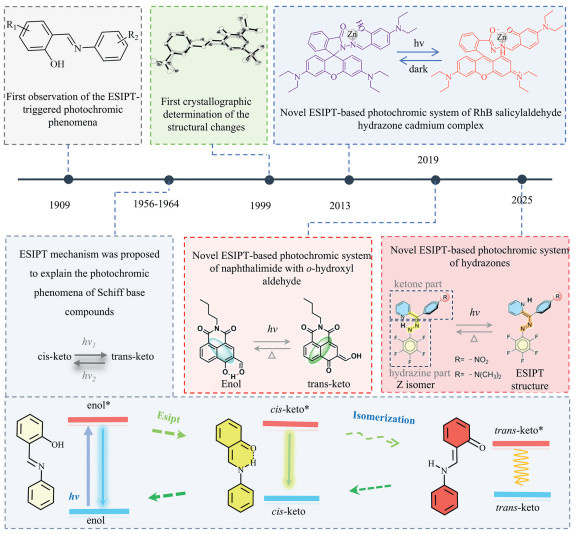
The photochromism of Schiff base compounds was the first example of an ESIPT-based photochromic molecule observed by Senier and Shepheard in 1909 [1,10]. This pioneering work laid the foundation for future studies on these compounds. Half a century later, Cohen and co-workers conducted a more systematic investigation into the photochromic properties of crystalline Schiff base compounds, proposing several significant insights [1,11]. They introduced an intramolecular H-transfer mechanism to explain the photochromic phenomenon, a theory that has since become well-known. This mechanism involves two steps: The transformation from the colorless enol form to the yellow cis-keto form through an excited state intramolecular proton transfer reaction following UV irradiation, and then a photoisomerization process from the cis-keto form to the red trans-keto form, often referred to as the "pedal motion" (Fig. 1) [1,10]. These findings have substantially enhanced the understanding of the photochromic properties exhibited by these compounds. However, for a long time, this hypothesis was not confirmed due to the lack of definitive evidence for the existence of the trans-keto form. The primary challenge was that the photoisomerization reaction was observed only on the surface of single crystals, with the inner molecules of the crystal remaining unchanged after UV irradiation. In 1999, Ohashi and coworkers overcame this challenge using a two-photon excitation technique, confirming that the red-colored species resulted from the trans-keto form through X-ray crystal structure analysis [1,12]. With the elucidation of the underlying mechanisms of ESIPT-based photochromic compounds, the focus of research has gradually shifted towards their photochromic performance. As technology advances in the past decades, innovative approaches such as theoretical calculations and ultrafast laser spectroscopy have been increasingly applied to study their photochromic behavior. Despite the extensive research on these photochromic compounds, it is still a formidable challenge to govern the expression of solid-state photochromism and for more accurate predictions of their photochromic properties. This is mainly attributed to the multiple factors affecting its photochromic properties in solid state, as well as the lack of effective research methods for solid powders. Additionally, achieving photochromism of such materials in solution is also a significant challenge in related research because of the ultrafast dynamics of ESIPT process. These unresolved issues significantly limit the practical applications of ESIPT-based photochromic materials.
Figure 1

Fortunately, recent research in this field has revealed new aspects of material property regulation and application expansion, offering a chance to comprehensively discuss the factors influencing photochromism and to outline their potential applications. The dawn of the 21st century witnessed significant breakthroughs in ESIPT-based photochromic materials, marked by the emergence of novel molecular architectures distinct from conventional Schiff base systems. These innovative material platforms have revitalized research in this field by providing fresh insights into fundamental photochromic mechanisms while enabling the engineering of advanced functional properties. The systematic investigation of these non-Schiff-base ESIPT systems has established new paradigms for manipulating excited-state proton transfer dynamics, thereby creating unprecedented opportunities for developing next-generation photoresponsive materials with enhanced performance characteristics and broader application prospects. This scientific advancement has subsequently stimulated intensified research efforts and resource allocation across multidisciplinary domains, propelling the entire field of ESIPT photochromics into a phase of accelerated innovation with substantial technological potential.
However, previous ESIPT-based photochromic reviews were all focused on the research of Schiff base structure [1,13,14], the topic of which mainly focuses on sorting out its development history, the relationship between crystal structure and photochromic properties, and its mechanistic analysis. So far, a comprehensive review that systematically summarizes the process of ESIPT-based photochromic materials, including the discovery of structural systems, new properties, synthetic methods, and applications, has yet to be reported. This gap in the literature highlights the need for a comprehensive synthesis of the current state of ESIPT-based photochromic materials research to provide a clearer direction for future studies and applications. Therefore, in this review, we conduct a systemical review of the progress of ESIPT-based photochromic compounds and outline several synthetic strategies for ESIPT-based photochromic materials in both solid and solution states. We also emphatically explore the diverse applications of ESIPT-based photochromic materials in erasable memory media, anti-counterfeiting/information encryption, smart security paper, photo-controlled intelligent robots, wearable sensors and so on. Finally, we summarize the recent advancements in ESIPT-based photochromic materials, analyze the current limitations, and suggest potential directions for future research and development. We expect that the knowledge shared in this review may become a beneficial reference for the field of ESIPT-based photochromic materials and photo-responsive intelligent materials. To facilitate readers' access to information about the photochromic compounds discussed in this work, we have systematically summarized their photochromic properties and corresponding applications (Table S1 in Supporting information).
2. ESIPT-based photochromic materials in solid state
Currently, most studies on solid ESIPT-based photochromic materials focus on molecules with Schiff base structures. This concentration is primarily due to their simple synthesis, outstanding photochromic properties and extensive research cases, which provide a wealth of data and theoretical foundations for in-depth understanding and analysis. In contrast, other types of ESIPT-based photochromic compounds have been rarely explored in this field, with only a handful of reports available. Therefore, in this section, we primarily discuss Schiff base molecules due to their extensive research cases. Moreover, to offer a more comprehensive perspective, we also introduce a few examples of ESIPT-based photochromic materials that differ from the Schiff base structure at the end of this section. Although these non-Schiff base materials have been less studied, their unique properties and potential applications should not be overlooked. By comparing these different structural materials, we can better understand the properties of the ESIPT-triggered photochromism, thereby providing more ideas and methods for the development of new photochromic materials.
2.1 ESIPT-triggered photochromic Schiff base
Among the myriads of Schiff base molecules, a mere fraction exhibit photochromism in solid-state forms. Despite over a century of research, the pivotal factors governing the photochromic characteristics of crystalline Schiff base remain partially elusive. While the reason for the photochromic behavior in some Schiff base molecules and not in others continues to be an enigma, uncovering the answers to this riddle could significantly shape future investigative paths. In this section, we will delve into the impact of molecular architecture, crystal arrangement, and additional elements that may influence the photochromic attributes of Schiff base molecules in their solid-state manifestation. We hope that the discussion in this section will provide a systematic reference for the field and inspire future work with more insightful approaches.
2.1.1 Important factor influencing photochromism
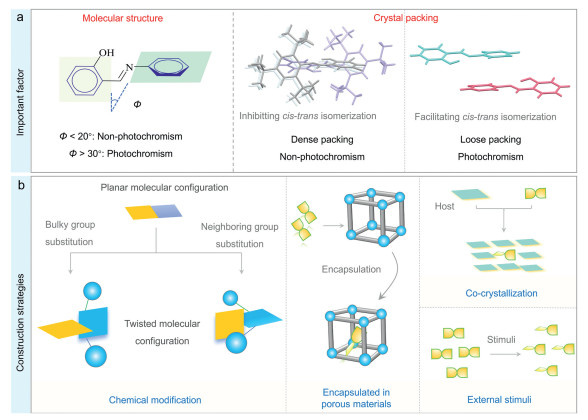
Molecular structure: The early investigation sought to establish a connection between the photochromic properties of Schiff base molecules and their structural characteristics. Cohen and co-workers classified the crystals of anils as thermochromic or photochromic based on their molecular structure [15]. Non-photochromic crystals essentially exhibit planar conformation while photochromic molecules are structurally twisted [1,10]. Such a perspective that non-planar conformations of molecules are important for photochromic properties has been widely accepted for a long time, and the threshold values for planarity have since been examined by several groups. An empirical summary indicates that with dihedral angles greater than 30° exhibited photochromic properties, while those with dihedral angles Φ less than 20° showed non-photochromic behaviors (Fig. 2a). However, the Schiff base planarity rule was not always correct. The non-planar molecular conformation is an important indicator for Schiff base compounds to exhibit photochromism, but it is not the only determining factor.
Figure 2
 Figure 2. (a) The important structural and packing feature for photochromic Schiff base compounds. (b) The schematic diagram of construction strategies for ESIPT-triggered photochromic Schiff base materials.
Crystal packing: Crystal packing is another very important factor that affects the photochromic properties of Schiff base derivatives (Fig. 2a). Generally, Schiff base compounds with close-packed structures in which molecules are in close contact with neighboring molecules in the crystal do not exhibit photochromism, because the cis-trans isomerization can be prevented by the dense crystal environment [1,10,15]. Schiff base derivatives with loose crystal packing arrangements are normally photochromic due to the possible cis-trans pedal motion enabled by the less consolidated crystal structure. For some Schiff base derivatives, the molecular conformation fails to provide a logical explanation for the photochromism or non-photochromism; therefore, such a phenomenon is explained from the viewpoint of crystal packing.
The "crystal packing rule" can also explain the photochromic and non-photochromic behaviors of Schiff base derivates that follow the planarity rule. The planar molecular conformation usually results in close crystal packing, intermolecular π···π interactions can be observed between the adjacent molecules. The photochromic behaviors of these crystals are prohibitive both by the planar molecular structure and dense crystal packing. On the other hand, the distorted molecular structure would block the approach of neighboring molecules, resulting in greater intermolecular distances, therefore, the crystal packing of these Schiff base derivates normally adopts an "open structure". The twisted molecular structure and loose crystal packing are beneficial to the photoinduced pedal motion and the photochromism of these Schiff base derivatives. The combination of non-planar configuration and loose crystal packing can explain the photochromic phenomena of most Schiff base compounds.
2.1.2 Construction strategies
Accurate control of the expression of photochromic properties of Schiff base derivatives is essential for their practical applications and the development of related fields. Although some issues remain unresolved regarding the precise prediction of photochromism, several strategies can be employed to develop photochromic Schiff base materials (Fig. 2b). In this section, the methods for the selective development of photochromic Schiff base derivatives will be introduced.
Chemical modification: As introduced above, the twisted molecular conformation and loose crystal accumulation are significantly important for the photochromic properties of solid Schiff base derivatives. Therefore, the direction of chemical modification is to induce distortions in molecular configurations by introducing specific substituents. These substituent groups can prompt molecules to adopt a twisted conformation and loose crystal packing, providing sufficient room for photoinduced isomerization. Two methods were demonstrated to be effective in developing a photochromic Schiff base in the solid state.
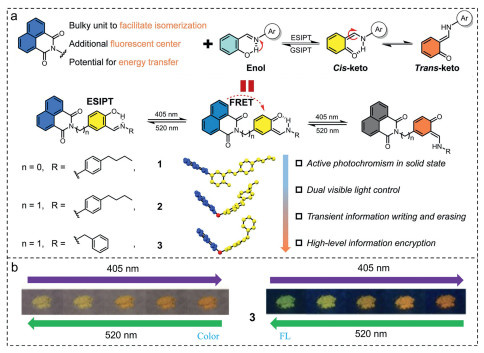
The first method involves introducing bulky group substitutions into the aromatic rings of Schiff base derivatives (Fig. 2b). The bulky group can serve as a space-opener, which twists the aromatic rings out of the plane and provides ample space for the partial framework movement within the crystal. Kawato and co-workers previously developed an effective tert-butyl method for the selective preparation of photochromic Schiff base compounds [10]. They introduced the tert-butyl groups into a series of non-photochromic Schiff base derivatives finding that these non-photochromic molecules transformed into photochromic compounds after modification by tert-butyl groups. The bulky group method is efficient for preparing photochromic Schiff base crystals and the bulky group is not limited to tert-butyl groups. In 2024, Li and coworkers designed a series of novel photochromic molecules (1–3) by employing naphthalimide luminophore as a bulky group (Fig. 3a) [16]. The bulky naphthalimide can provide sufficient volume for photoisomerization and suppress emission quenching in solid state. In addition, it can broaden the photoresponsive wavelengths and creates possibility of energy transfer between naphthalimide and imine parent structure. Therefore, these compounds exhibited visible-light induced dual-mode changes (both in color and fluorescence) in the solid state (Fig. 3b).
Figure 3
 Figure 3. (a) The design strategy, molecular structures and single-crystal structure of the salicylaldimine Schiff bases 1–3, which undergo photochromism enabled by ESIPT and cis-trans isomerization strategy via visible-light irradiation (405 and 520 nm). ESIPT (excited-state intramolecular proton transfer), GSIPT (ground-state intramolecular proton transfer), FRET (fluorescence resonance energy transfer). (b) Time-dependent color and fluorescent photographs changes of compound. Reproduced with permission [16]. Copyright 2024 Wiley-VCH GmbH.
The second method involves introducing alkyl groups at the 2,6-positions of aniline rings to encourage the molecules to adopt a non-planar conformation. Kawato and co-workers developed a series of Schiff base derivatives and investigated the relationship between their structure and photochromism (Fig. 2b) [10]. Most N-salicylidene-2,6-dialkylanilines exhibited photochromism in the crystal state and this method became more effective with increasing the length of alkyl. Especially, when the substituent is an isopropyl group, all 2,6-positions substituted Schiff base derivatives are photochromic. The 2,6-positions substituted Schiff base derivatives always adopt a twisted structural conformation because of steric repulsion, which favors the photochromism of the crystals.
Overall, the main idea of the chemical modification method is to promote the distortions of aromatic rings for achieving a twisted molecular configuration by introducing substituents with steric repulsion. The twisted structural conformation and large steric hindrance can keep the neighboring molecules from getting close, thereby providing enough space for the photoreaction. According to this design idea, some researchers utilized molecules with a twisted spatial conformation as functional units and developed related photochromic derivatives [17-20].
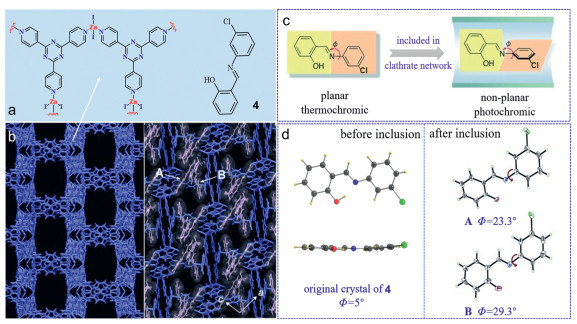
Clathrate crystal: Another effective strategy for constructing photochromic Schiff base in the solid state is the clathrate crystal method which is based on the utilization of crystal lattice cavities (porous coordination network) constructed by hosts for the photo-isomerization of guest species. The clathrate crystal method can alter the crystalline environment of the Schiff base derivatives and transform the non-photochromic molecules into photochromic ones. Fujita and co-workers developed a 3D coordination network by the complexation of tris(4-pyridyl)triazine with ZnI2 (Fig. 4) [21]. The authors obtained the inclusion complexes of compound 4 in this network through the guest-exchange method and determined their single crystal structure (Figs. 4b-d). The original crystal conformation of 4 was almost planar with a very small dihedral angle (Φ = 5°) and it exhibited thermochromism without any photochromism. However, the original planar conformation became twisted (dihedral angle of 4 transformed into 23.3° and 29.3°) and the non-photochromic compound 4 turned into photochromic when included in the 3D coordination network. Therefore, the photochromic properties of Schiff base derivatives can be controlled by inclusion in a coordination network without any chemical modification and the relationship between structural conformation and photochromism can be investigated due to the good crystalline nature.
Figure 4
 Figure 4. (a) The chemical structure of the coordination network [{(ZnI2)3(2)2}n] and compound 4. Crystal structure of the porous network [{(ZnI2)3(2)2}n] including 4 in the pore (b): (left) View in the (101) direction. Molecules of 4 and solvent molecules in the pores are omitted; (right) View along the b axis. The porous network of 4 is shown in blue in stick form. Two crystallographically independent molecules of 4 (A and B), packed in the pore of the network, are shown in pink as a stick and translucent space-filling model. Solvent tBuOH molecules in the pores are omitted for clarity. (c) Thermo-to-photo-switching of compound 4 by inclusion. (d) The Φ changes of compound 4 before and after inclusion. Reproduced with permission [21]. Copyright 2007, Wiley-VCH Verlag GmbH & Co. KGaA, Weinheim.
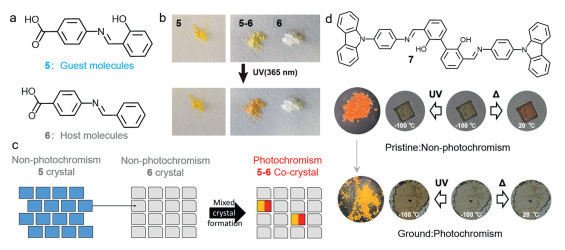
Co-crystallization: Co-crystallization is another method to tune the molecular conformation of photochromic derivatives and modify their photochromic properties without any chemical modifications [22-25]. Co-crystallization can combine two components (Schiff base derivative and another co-former molecule) in the same crystal lattice and obtain various crystals with different molecular conformations. The introduction of different co-former molecules can tune the intermolecular interactions, structural conformation, and available volume, thereby altering the photochromic properties of Schiff base derivatives. Uekusa and co-workers successfully controlled the molecular conformation and photochromic properties of compound 5 by the co-crystallization method (Figs. 5a-c) [26]. Compound 5 was non-photochromic in the crystal state and its dihedral angle was 5o, indicating a planar conformation. After forming co-crystals with host compound 6, the formed co-crystal (5–6) exhibited strongly photochromism under UV light irradiation. Its structural conformation maybe significantly modified by co-crystallization, resulting in significant photochromic behavior change.
Figure 5
 Figure 5. (a) The chemical structure of compounds 5 and 6. (b) Powdered crystalline samples of 5,5–6, and 6 before and after UV irradiation. (c) Precise control of the molecular conformation of 5 via co-crystallization. (d) The chemical structure of compound 7. The photochromic behavior transformation of the pristine crystal and ground sample of 7. (a-c) Reproduced with permission [26]. Copyright 2024, Oxford University Press. (d) Reproduced with permission [29]. Copyright 2025, The Royal Society of Chemistry.
In addition to the above effective strategies for constructing photochromic Schiff base derivatives, the photochromism of some Schiff base derivatives can be produced by external stimuli [27-29]. Houjou and co-workers synthesized a novel Schiff base compound 7, which exhibited exclusive thermochromism in its crystal state (Fig. 5d) [29]. Upon grinding, the crystalline sate transformed to amorphous state and its thermochromism changed into photochromism. Therefore, the authors showed a photochromic behavior regulation by external stimuli to produce photochromic Schiff base derivatives in the solid state. This strategy was promising in developing smart Schiff base derivatives and extending their application fields.
2.2 ESIPT-triggered photochromic hydrazones
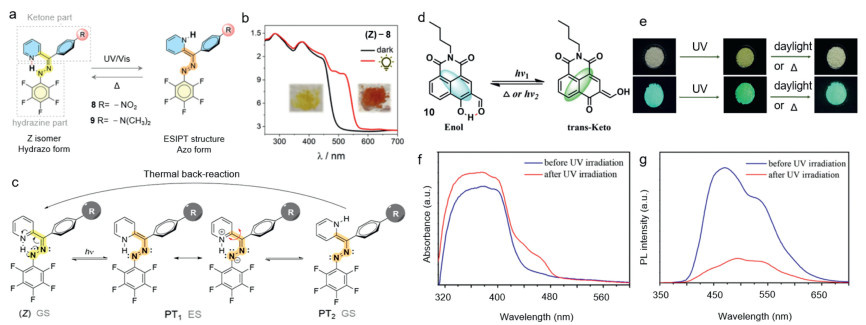
Hydrazones are renowned for their photoresponsive properties, undergoing Z/E isomerization around the hydrazone C=N double bond upon light irradiation [30-33]. However, a recent study has shown that through the optimization of substituent groups, hydrazones can exhibit ESIPT-based photochromic properties. In 2025, Cigán and coworkers designed and synthesized a new class of triaryl-hydrazones by introducing a perfluorinated phenyl ring on the hydrazine side and para-substituents (such as nitro (8) or dimethylamino (9)) on the ketone part (Figs. 6a-c) [33]. Compounds 8 and 9 exhibited new bathochromically shifted absorption bands in the region of 500−600 nm upon UV or visible light irradiation. They showed a dramatic color change from yellow to red in this process. The research team revealed the photochromic mechanism through various theoretical calculations and experimental techniques. Upon light excitation, the Z isomers of compounds 8 and 9 undergo ESIPT, where a proton transfers from the hydrazine moiety to the pyridinic nitrogen, forming a metastable proton transfer structure (ESIPT structure). This structure formation leads to a red-shift in the absorption maximum, consistent with the observed photochromic phenomenon. The red-colored species can convert to its original state when placed in the dark or treated with thermal, demonstrating good reversibility. The novel design strategy reported in this work may provide an effective reference for the development of novel ESIPT-based photochromic materials.
Figure 6
 Figure 6. (a) Novel perfluorinated triaryl-hydrazone solid-state photoswitches of compounds 8 and 9 whose photochromic behavior results from ESIPT. (b) Diffuse reflection spectrum of hydrazone 9 before (black curve) and after (red curve) irradiation by a 405 nm light source. (c) Proposed mechanism of photochromism of studied triaryl hydrazones in the solid state (GS: ground state; ES: excited state), and both resonance structures of PT1 and PT1. (d) Photochromic mechanism of 10 upon UV irradiation. (e) Photographs of 10 before and after photochromism, and photos after long-wavelength illumination or heating. (f) The UV–vis absorption spectra of 10 before and after UV irradiation in solid state. (g) The PL spectra of BHC before and after UV irradiation in solid state. (a-c) Reproduced with permission [33]. Copyright 2025, American Chemical Society. (d-g) Reproduced with permission [35]. Copyright 2019, Published by Elsevier B.V.
2.3 ESIPT-triggered photochromic naphthalimide with o-hydroxyl aldehyde
Compared to the widely studied ESIPT where a proton transfers from a hydroxyl group to N atom, recent reports have shown that ESIPT can also occur in molecules containing an o-hydroxyl aldehyde structure. In 2017, Basarić reported that 2,3-disubstituted anthrols carbaldehydes can undergo efficient barrierless ultrafast ESIPT [34]. In 2019, Ni and colleagues introduced a naphthalimide derivative featuring an o-hydroxyl aldehyde moiety (compound 10), which exhibits ESIPT-induced photochromic behavior (Figs. 6d-g) [35]. They observed that the color of solid compound 10 rapidly shifts from light yellow to deep yellow upon UV light exposure. Concurrently, its fluorescence changes from light blue to deep yellow. These transformations are evident through the significant differences in the absorption and emission spectra before and after UV irradiation. Moreover, thermal treatment can reversibly restore the color and emission of compound 10 to its original state. The authors attributed this reversible photochromism to the ESIPT process. This discovery not only expands the scope of ESIPT-triggered photochromic materials but also opens new avenues for designing molecules with tailored photoresponsive properties.
3. ESIPT-based photochromic materials in solution state
The ESIPT-based photochromic phenomenon is typically observed in solid-state materials where the molecular structure is more constrained, allowing for the formation and stabilization of the tautomeric form. Conversely, in solution, multiple factors render ESIPT-based photochromism scarce [36-38]. Firstly, within a solution environment, molecules possess enhanced freedom of movement and rotation. This augmented mobility has the potential to disrupt the hydrogen-bond network essential for ESIPT. As a result, it becomes arduous for the proton to transfer and for the tautomeric form to reach a stable state. Secondly, solvents can interact with the excited molecule, thereby competing with the intramolecular proton transfer process. Notably, polar solvents can stabilize the ground state of the molecule. They also lower the energy barrier for non-radiative decay, consequently diminishing the efficiency of ESIPT. Thirdly, the conformational flexibility inherent in the solution enables the molecule to assume diverse forms. This variability can impede the establishment of the specific molecular alignment that is necessary for efficient proton transfer. Fortunately, through the unremitting efforts of researchers, there are currently two strategies to achieve ESIPT-based photochromic phenomena in solutions: Forming Rhodamine B (RhB) salicylaldehyde hydrazone metal complex and forming π-conjugated zwitterions.
3.1 RhB salicylaldehyde hydrazone metal complex
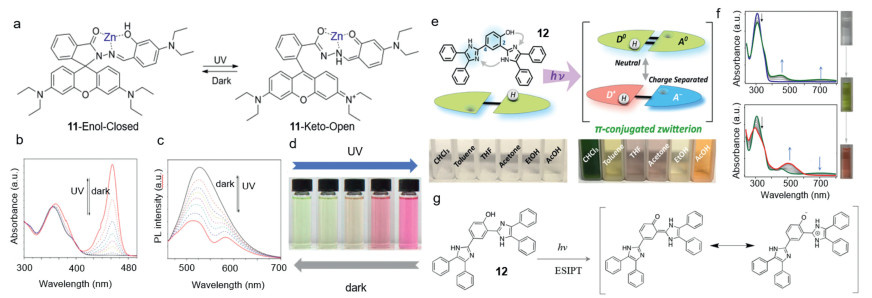
The first strategy that has been widely reported involves employing metal ions like zinc and cadmium to create organometallic complexes with RhB derivatives [39–41]. For instance, Tang et al. devised and synthesized a RhB salicylaldehyde hydrazone zinc complex (11) (Figs. 7a-d) [41]. This complex demonstrates remarkable photochromism in THF solution. Upon exposure to 365 nm UV light, the initially light yellow solution progressively changes to purple. After the UV light is switched off, the solution returns to its original light-yellow state within 10 min. Before UV irradiation, the metal complex 11 shows no absorption band above 500 nm. Nevertheless, upon 365 nm UV irradiation, a strong absorption band centered at 554 nm appears. The intrinsic mechanism can be described as follows: The UV light triggers the isomerization of the salicylaldehyde component in metal complex 11 from its enol form (11-Enol-Closed) to the keto form (11-Keto-Open) upon ESIPT process. This transformation in the excited state causes the ring-opening RhB spirolactam because of charge separation, yielding the purple-colored 11-Keto-Open form. Notably, the lifetime of the ring-open state could be modulated through multiple factors. Metal ions played a role, as different ones influenced the stability of the open-ring configuration. Temperature was another variable; higher or lower temperatures affected the kinetics of the ring-opening and closing processes, thereby altering the lifetime. Solvents also had an impact, with their unique properties either promoting or hindering the maintenance of the open-ring state. For more related research, the readers can refer to the following literature [40].
Figure 7
 Figure 7. (a) Proposed mechanism for color change of 11 upon UV irradiation. (b) Absorption and (c) fluorescence spectra of 11 in THF before and after UV irradiation. (d) Photographic images of 11 in THF upon irradiation, and the recovery in the dark at 25 ℃. (e) Proposed mechanism for color change of 12 upon UV irradiation and the photographs of 12 before and after photochromism in various solvents. (f) 365 nm UV light irradiation-time-dependent absorption spectra of 12 in CHCl3. (g) Hypothesized molecular structural transitions for a series of color changes observed in 12. (a-d) Reproduced with permission [41]. Copyright 2014, American Chemical Society. (d-g) Reproduced with permission [42]. Copyright 2021, American Chemical Society.
3.2 Photoinduced π-conjugated zwitterionic state via ESIPT
In 2021, Akutagawa and colleagues developed a novel ESIPT-based compound 12, which exhibits distinct large Stokes-shifted ESIPT emission (Figs. 7e-g) [42]. However, it exhibits significant photochromism in various solutions. The originally colorless solutions of compound 12 turns to be colored upon exposure to UV light for several minutes, with the color depending on the solvent used. Specifically, the CHCl3 solution quickly changes to a dark green color with a maximum absorption band at about 700 nm. This colored solution can be nearly restored to its original state by alternately adding acid and base. Following extensive experimental investigations and theoretical computations, the authors have put forth a plausible mechanism that can be encapsulated as follows: Initially, compound 12 resides in its enol configuration. Upon exposure to UV light, it undergoes an ESIPT process, transitioning to its keto form. This keto form, characterized by a distinct electronic arrangement, is hypothesized to experience additional structural reorganization in the ground state. Such reorganization culminates in the generation of a π-conjugated zwitterionic form, wherein the positive and negative charges are dispersed across the molecule's conjugated π-network. This zwitterionic form accounts for the observed chromatic shift and the pronounced Stokes shift in the compound's fluorescence properties.
4. Material applications
Considering the easy synthesis/purification, easy crystallization, high sensitivity, fast response, good fatigue resistance, and reversible photochromism of photochromic anils, extensive efforts have been focused on exploring their applications in various fields. The photoisomerization-induced reversible switching between the enol form and trans-keto form of ESIPT-based photochromic materials can result in reversible physical and chemical property changes, which makes them suitable candidates for molecular switches, erasable memory media, anti-counterfeiting materials, and other advanced fields. Based on the anticipated change, researchers have unraveled various cutting-edge applications of ESIPT-based photochromic materials.
4.1 Erasable memory media
Significant color changes can be observed in the reversible photochromic process of Schiff base derivatives. The colorless/yellow enol form transforms into the red-colored trans-keto form upon UV irradiation, which is restored to the original colorless/yellow enol form after subsequent visible light irradiation. Photochromic Schiff base derivatives are characterized by excellent fatigue resistance, about 104–105 cycles can be achieved for the enol-keto transformation. Moreover, these photochromic Schiff bases commonly exhibit high sensitivity to light, allowing color changes to be achieved quickly. The reversible color changes, good fatigue resistance, and fast response make photochromic Schiff base promising materials in erasable memory media.
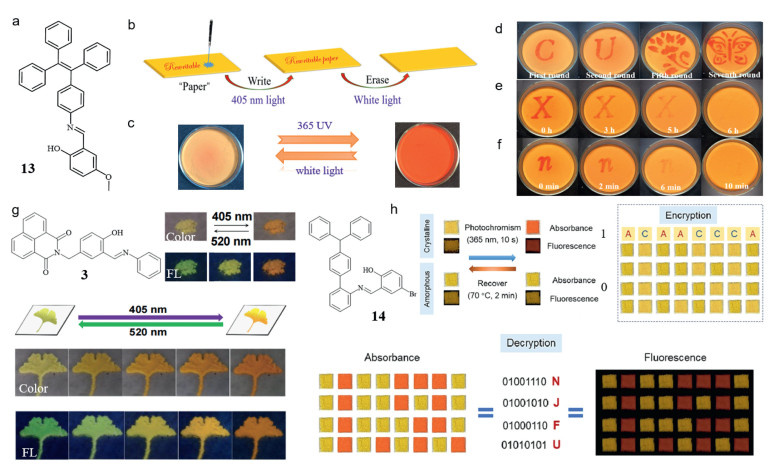
Ni and co-workers developed a tetraphenylethene-based Schiff base derivative (13) and obtained its two different polymorphs (Figs. 8a-f) [43]. The square block-like crystal exhibited reversible photochromic behavior. Its color can be switched reversibly between yellow and deep red after alternating UV and white light irradiation. The authors employed compound 13 as an inkless rewritable paper by using different light sources as the pen and erase. Light with wavelengths ranging from 300 nm to 450 nm was able to promote the photochromism of 13 and thus could serve as the pen for writing, while light with longer wavelengths from 460 nm to 570 nm and white light accelerated the recovery rate and functioned as the erase for erasing information. Therefore, it can serve as a visible light-responsive rewritable paper. As illustrated, different letters and patterns were recorded and erased immediately after alternating 405 nm blue light and white light irradiation. The recorded information was reproduced for many cycles without significant changes indicating good fatigue resistance of the rewritable paper. Moreover, the written information can be self-erased in about 6 hours in the dark and 20 min in daylight at room temperature.
Figure 8
 Figure 8. (a) The chemical structures of compound 13. (b) The color change of compound 13 before and after 365 nm UV and white light irradiation. (c) The writing and erasing process carried out on compound 13. (d) Different numbers, letters, and patterns written on the rewritable paper. Photographic images and self-erasing time of compound 13 in the dark (e) and in daylight (f) at room temperature. (g) The chemical structure of compound 3 and its application in color-fluorescence dual model anti-counterfeiting. (h) The chemical structure of compound 14 and its application in color-fluorescence dual model information encryption-decryption. (a-f) Reproduced with permission [43]. Copyright 2019, The Royal Society of Chemistry. (g) Reproduced with permission [16]. Copyright 2024 Wiley-VCH GmbH. (h) Reproduced with permission [44]. Copyright 2023, Elsevier B.V.
4.2 Anti-counterfeiting/information encryption
Photochromic Schiff base materials have also been applied in anti-counterfeiting and information encryption because of their reversible high-contrast color change controlled by photo stimulus. They offer distinct advantages in the realms of anti-counterfeiting and information encryption, primarily due to their unique optical properties and chemical characteristics. The high security of these materials stems from their ability to undergo color changes exclusively under specific light conditions, which significantly enhances the difficulty of unauthorized replication. Their fast response times allow for rapid verification and encryption processes, ensuring efficiency in various applications. Moreover, the color changes in these materials are fully reversible, enabling multiple uses without any degradation in performance. An additional benefit is the ease of synthesis, which makes the production of these materials more accessible and cost-effective. These features collectively render photochromic Schiff base materials an excellent choice for securing information and protecting against counterfeiting attempts.
In 2024, Li and coworkers designed a novel photochromic molecule (3) by employing naphthalimide luminophore as a bulky group (Fig. 8g) [16]. Compound 3 exhibits distinct color and fluorescence changes upon exposure to 405 nm visible light, which will revert to its initial state after irradiation with 520 nm visible light. Compound 3, when crafted into the form of a maple leaf, undergoes a remarkable color transformation that closely emulates the seasonal changes observed in nature. Under standard ambient lighting conditions, the leaf-like structure presents a delicate pale-yellow hue. However, upon exposure to 405 nm wavelength light, the color of the leaf progressively intensifies, undergoing a gradual metamorphosis from yellow to orange, effectively capturing the essence of a maple leaf's maturation. This chromatic evolution is further enhanced by a concurrent alteration in the fluorescence emission, which sequentially shifts from green to yellow and ultimately to orange, providing a vivid representation of the leaf's developmental stages. The reversibility of this color change is achieved by employing 520 nm green light irradiation, which rapidly resets both the color and fluorescence of the compound 3 leaf to its pristine state. This sophisticated multi-color switching behavior of compound 3 makes it a promising candidate for advanced materials in the field of anti-counterfeiting/information encryption.
Similarly, in 2023, Tang et al. reported a triphenylamine (TPA) group functionalized Schiff base molecule (14) that exhibits unique photochromic properties in its crystal state while demonstrating fluorescent performance in its amorphous state (Fig. 8h) [44]. The authors capitalized on the rapid photochromism of crystalline 14 and the photochromism-inactive characteristics of its amorphous state to develop a dual-mode encryption-decryption technique. This technique integrates photochromism under both absorption and fluorescence conditions, employing binary coding or Morse code for information encryption and decryption. Specifically, the crystalline 14 exhibits photochromic activity in both absorption and fluorescence states, while the amorphous 14 does not show photochromic activity under these conditions. Information can be encrypted and decrypted through UV irradiation and heating processes, demonstrating the material's potential in the field of information security.
4.3 Smart security paper
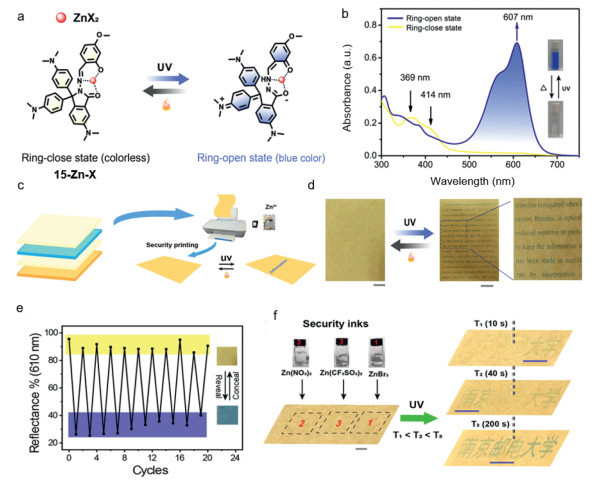
ESIPT-based photochromic molecules can also be employed as the photosensitive layer to fabricate intelligent light-responsive devices. Their ability to change colors or luminescence patterns upon light irradiation allows for the creation of dynamic and interactive information displays. For example, Zhao and colleagues adopted the strategy of changing counterions to successfully design and synthesize a series of ESIPT-based zinc complexes based on crystal violet lactone salicylaldehyde hydrazine (15), where X represents different counterions such as CH3COO-, CF3SO3-, NO3-, Cl-, and Br- (Fig. 9) [45]. This compound exhibits reversible photochromic properties in non-polar solvents such as dichloromethane. Taking the ZnBr2 complex 15 as an example, under 365 nm light irradiation, its colorless solution gradually turns to deep blue, and a maximum absorption peak appears at 607 nm. Meanwhile, the photochromic performance of the compound is significantly influenced by counterions. As the basicity of the counter anions decreases, the photochromic activity increases, and relevant kinetic parameters such as the photochromic rate and thermal relaxation constant also changes accordingly. Moreover, its photochromic behavior can be dynamically regulated based on the reversible coordination bonds between zinc ions and 15. Based on the outstanding photochromic properties of these compounds, they were employed to fabricate smart security paper. The security paper is composed of three layers. The bottom layer is parchment paper, the middle imaging layer is coated with a substance containing 15 as the data recording medium, and the upper and lower layers are both PEG-PPG-PEG, which play the roles of passivation and protection respectively. With a commercial inkjet printer, aqueous solutions of zinc salts are used as inks to record information on the security paper. Initially, the information is invisible under ambient light, but it becomes clearly visible after 1 min of 365 nm UV irradiation. The information can be quickly hidden by heating at 70 ℃ for 1 min or by being left under ambient conditions for 1 h. This process can be repeated at least 15 times without significant loss of contrast. More importantly, using different zinc salts as inks can achieve multi-level security information protection. For example, when aqueous solutions of ZnBr2, Zn(NO3)2, and Zn(CF3SO3)2 are used to record information respectively, different contents will be displayed sequentially under different UV irradiation durations. Only authorized personnel who know the correct encryption algorithm and the exact irradiation time can access the confidential information, which greatly enhances the security of the information.
Figure 9
 Figure 9. (a) Reversible photo-induced ring-opening and ring-closing reaction process for 15-Zn-X. (b) Visible color changes (inset) and the corresponding absorption spectral changes of 15-Zn-X in CH2Cl2 (1 × 10⁻⁵ mol/L). (c) Schematic illustration of four-layer structure used to create the security paper based on 15. (d) Photograph of a paragraph of text printed on security paper using a commercially available inkjet printer with a cartridge filled with ZnBr2 aqueous solution as the ink. The information can be clearly seen after UV irradiation for 1 min. Scale bars: 3 cm. (e) A plot of the reflectivity at 610 nm versus the number of cycles as the security paper is cycled through UV irradiation and heating. (f) Multilevel security information printing was realized by using various zinc salts as the inks, distinct information can be read by exposing the security paper under UV irradiation for different times. Reproduced with permission [45]. Copyright 2020, The Author(s), under terms of the CC-BY license.
4.4 Photo-controlled intelligent robot
The transformation between the cis-keto and trans-keto isomers of Schiff base molecules involves a significant rearrangement of the internal molecular structure [1,46]. In the cis-keto form, the two substituent groups are located on the same side of the double bond, whereas in the trans-keto form, these groups are positioned on opposite sides. This change in geometric configuration is not only a molecular-level alteration but can also trigger macroscopic mechanical movements. When Schiff base molecules transition from one isomer to another under light stimuli, the shape of the molecules may change, leading to macroscopic deformations. This phenomenon holds significant potential for the development of smart materials and mechanical systems, such as photo-controlled intelligent robots. Therefore, the photo-responsive nature of Schiff bases offers broad prospects for the design of new intelligent materials that can make precise mechanical responses to environmental changes, opening up new possibilities for future technological innovations and application development.
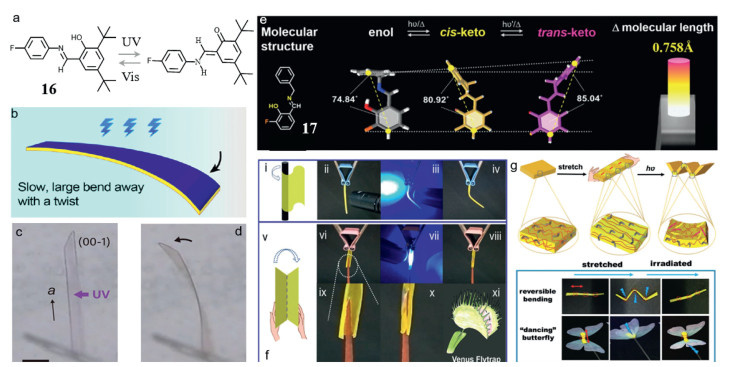
For example, Koshima et al. reported the interesting mechanical behavior of the long, plate-like microcrystals of compound 16 (Figs. 10a-d) [47]. The crystal gradually bent away from the light source, accompanying by some twist behavior upon UV light irradiation. The innternal mechanism was caused by enol–keto photoisomerization. The study also explores the relationship between the bending angle and light intensity and the repeatability of the crystals over multiple cycles. Such photo-respnsive mechanical system enable it be potential photo-controlled intelligent robot. However, the practical application of the crystalline 16 remains distant due to its brittleness, relatively low reproducibility, and monotonous mechanical performance. Interestingly, in 2021, Li et al. developed a new type of photo-responsive material by doping Schiff base molecules (17) into poly(ethylene terephthalate) (PET), which can achieve reversible photo-controlled motions under ultraviolet and visible light irradiation, such as bending, fluttering, and switching (Figs. 10e-g) [48]. The study found that the ESIPT and cis-trans isomerization of the Schiff base molecule is key to achieving photo-induced deformation. The doped films demonstrated up to 70% light-driven contraction and approximately 141° bending angles, along with good fatigue resistance. Researchers demonstrated that a variety of photo-controlled motions can be achieved through different pretreatment methods, such as rolling and folding, mimicking the trapping process of the Venus flytrap. Furthermore, by changing the direction of light exposure, designed morphological changes can be realized, such as the reversible bending of the "W" shape and the dancing butterfly. This work offers potential value for applications in the field of photo-controlled intelligent robots and beyond.
Figure 10
 Figure 10. (a) Photochromic reaction of compound 16. (b) Schematic illustration of the photoinduced mechanical motion of crystal 16. (c, d) The photoinduced mechanical motion of crystal 16. (e) The chemical structure of compound 17 and its calculated molecular lengths in different conditions. The white words denote the dihedral angle between phenolic and benzene rings, and the yellow dots denote both ends of molecular skeletons. (f) Schematics of pretreatments of the films: (i) by wrapping film around capillary (2.7 cm × 1 cm) and (v) by folding film in half (1.5 cm × 0.5 cm). (ii–iv), (vi–x) Photographs of photodeformation process of 17-PET film, (ii–iv) bending process, (vi–viii) wrapping up process, (ix) detailed image of (vi), (x) detailed image of (viii) (LED: 455 nm, 500 mW/cm2). (xi) A picture of a Venus flytrap. (g) Schematic representation of the photoactuated bending process of the stretched 17-PET film and the reversible bending and "dancing" butterflies. (a-d) Reproduced with permission [47]. Copyright 2022, American Chemical Society. (e-g) Reproduced with permission [48]. Copyright 2020, Wiley-VCH GmbH.
4.5 Wearable sensors
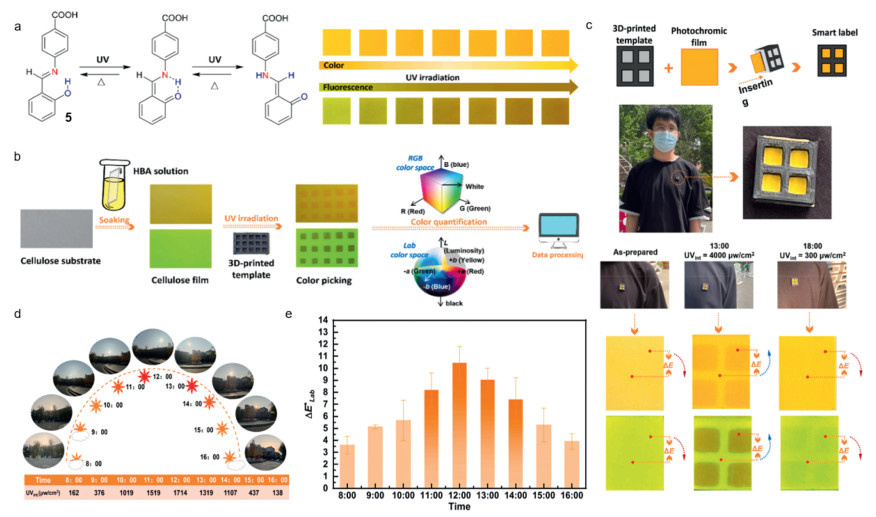
In recent years, photochromic Schiff base compounds have demonstrated significant potential in a variety of innovative applications, which is essential for broadening the scope of these materials and underscores their promising future in various fields of application [49-51]. For example, in 2024, Han and colleagues developed a photochromic Schiff base (5), which undergoes reversible photochromism under ultraviolet radiation, resulting in noticeable alterations in both color and fluorescence (Fig. 11) [51]. Compound 5 was then integrated into affordable wearable sensors and intelligent textiles, capable of delivering visual feedback when exposed to UV radiation. These photochromic transformations were meticulously quantified utilizing RGB and CIEL*a*b* color spaces. This study successfully tackled several pivotal challenges in the realm of photochromic UV sensing: It achieved precise quantification of photochromic fluorescence and color shifts using RGB and CIEL*a*b* color spaces along with ΔE*Lab; it established a straightforward, cost-effective method for fabricating innovative wearable UV sensors and smart UV-responsive textiles, which can alert users to potentially harmful levels of UV exposure; and it presented a practical point-of-care sensing solution that offers visual feedback in response to elevated outdoor UV radiation levels. Overall, this research presents an economical platform for the naked-eye dosimetry of outdoor UV radiation, providing timely warnings against excessive UV exposure.
Figure 11
 Figure 11. (a) Schematic illustration showing the reversible photochromic process of compound 5. (b) Schematic illustration describing the multipoint color-picking and the data processing using RGB and CIEL*a*b* color space (15 repeated trials). (c) Schematic illustration showing the fabrication of the wearable UV sensor with the representative photos. ΔE*Lab indicates the color difference between the window area and the covered area. (d) UV intensity recorded in real environments at different times. (e) Histogram showing the ΔE*Lab of the wearable UV sensor at different times (4 repeated trials). Reproduced with permission [51]. Copyright 2024, Elsevier B.V.
5. Summary and outlook
In summary, this review provides a comprehensive introduction to ESIPT-based photochromic compounds, including factors influencing their properties, synthesis strategies, and various applications in the field of smart materials. The recent advancements in understanding the mechanism and expansion of the molecular system of ESIPT-based photochromic materials, facilitated by endeavors of the researchers, have opened new avenues for research. However, this field still requires ongoing innovation, particularly in the development of new synthetic methods, novel material systems and the exploration of novel applications.
Moving forward, research in this area needs to address the current limitations to fully harness the potential of ESIPT-based photochromic materials. One of the key issues is the precise synthesis and photochromic behavior regulation of these materials, which requires further enhancement to ensure their practical usability in real-world applications. A deeper understanding of the structure-property relationships is essential for designing compounds with tailored photochromic behaviors. Potential solutions include employing advanced computational methods to predict photochromic properties and exploring new synthetic routes to introduce functional groups that can modulate the photo-responsiveness of these materials. The rapid advances in computational chemistry and machine learning will enable the development of highly accurate predictive models. These models will precisely forecast photochemical behavior and molecular configurations, thereby transforming photoswitch design paradigms by reliably predicting performance metrics prior to synthetic investment.
Additionally, expanding the range of responsive wavelengths could enable these compounds to interact with a broader spectrum of light sources [52]. Theoretically, ESIPT-active molecules inherently possess push-pull electronic configurations with intramolecular charge transfer (ICT) characteristics. Such molecular architecture can significantly redshifts their absorption spectra into the visible range (400–600 nm), allowing efficient activation by sunlight or low-energy visible light irradiation. In addition, the photogenerated keto tautomer typically possesses a reduced energy gap in its absorption profile, which facilitates visible-light triggered reversible photochromism. Through rational molecular engineering, these systems can demonstrate promising potential for achieving full visible-light-responsive photochromism across the entire visible spectrum. Moreover, a pioneering study has demonstrated the use of ESIPT to extend the absorption wavelength of other photochromic molecules. For instance, Zhu et al. revealed that the tautomeric equilibrium between the OH-form and NH-form leads to distinct absorption characteristics (with the NH-form exhibiting longer-wavelength absorption) [53]. By incorporating these groups as peripheral pendants on diarylethene frameworks, they successfully achieved visible-light responsiveness. This work provides important insights for developing fully visible-light-responsive photochromic systems.
Furthermore, expanding the application of ESIPT-based photochromic materials into new fields and integrating them into practical devices and systems will be a critical direction for future research. Take biomedical applications as an example, this area still requires significant expansion. Current ESIPT-based photochromic systems are limited to superficial tissue applications due to their short activation wavelengths. Significant biomedical breakthroughs could be achieved by extending their responsive range into the red/near-infrared region, which would enable: deep-tissue photomodulation, in vivo therapeutic interventions or organ-level photomanipulation. The future of ESIPT-based photochromic materials looks promising, with the potential to revolutionize information security, smart textiles, and biomimetic systems, making it a vibrant and growing area of research with significant implications for material science and photonics.
Declaration of competing interest
The authors declare that they have no known competing financial interests or personal relationships that could have appeared to influence the work reported in this paper.
CRediT authorship contribution statement
Hao Sun: Writing – review & editing, Writing – original draft, Funding acquisition. Chenzi Li: Writing – review & editing, Visualization. Wanting Yu: Visualization, Validation. Yang Chen: Validation. Zhe Sun: Validation. Zhuofei Li: Visualization. Wei Huang: Validation. Dayu Wu: Writing – review & editing, Validation. Liangliang Zhu: Writing – review & editing, Visualization.
Acknowledgments
This work is supported by the National Natural Science Foundation of China (No. 22405053) and Changzhou Leading Innovative Talent Introduction and Cultivation Program (Basic Research Innovation Category D, No. CQ20240105).
Supplementary materials
Supplementary material associated with this article can be found, in the online version, at doi:
10.1016/j.cclet.2025.111971 .
-
-
[1]
E. Hadjoudis, I.M. Mavridis, Chem. Soc. Rev. 33 (2004) 579-588.
-
[2]
S. Mollick, J.C. Tan, Nat. Rev. Mater. 10 (2025) 519–535. doi: 10.1038/s41578-024-00760-4
-
[3]
X. Zhang, T. Jin, C. Yang, et al., Chin. Chem. Lett. 36 (2025) 111135. doi: 10.1016/j.cclet.2025.111135
-
[4]
L. Li, Y.T. Yu, N.N. Zhang, et al., Coord. Chem. Rev. 500 (2024) 215526. doi: 10.1016/j.ccr.2023.215526
-
[5]
G.C. Thaggard, B. Kankanamalage, K.C. Park, et al., Adv. Mater. 37 (2025) 2410067. doi: 10.1002/adma.202410067
-
[6]
J. Bargstedt, M. Reinschmidt, L. Tydecks, et al., Angew. Chem. Int. Ed. 63 (2024) e202310797. doi: 10.1002/anie.202310797
-
[7]
Z. Li, X. Gao, H. Zhang, et al., Chin. Chem. Lett. 34 (2023) 107645. doi: 10.1016/j.cclet.2022.06.068
-
[8]
T. Dang, Z.Y. Zhang, T. Li, J. Am. Chem. Soc. 146 (2024) 19609-19620. doi: 10.1021/jacs.4c03135
-
[9]
E. Benchimol, J. Tessarolo, G.H. Clever, Nat. Chem. 16 (2024) 13-21. doi: 10.1038/s41557-023-01387-8
-
[10]
K. Amimoto, T. Kawato, J. Photoch. Photobio. C 6 (2005) 207-226. doi: 10.1016/j.jphotochemrev.2005.12.002
-
[11]
A. Senier, F.G. Shepheard, J. Chem. Soc. Trans. 95 (1909) 1943-1955. doi: 10.1039/CT9099501943
-
[12]
J. Harada, H. Uekusa, Y. Ohashi, J. Am. Chem. Soc. 121 (1999) 5809-5810. doi: 10.1021/ja9842969
-
[13]
K. Johmoto, H. Uekusa, Control of photochromism in N-salicylideneaniline by crystal engineering, in: E. Tiekink, J. Zukerman-Schpector (Eds.), MultiComponent Crystals: Synthesis, Concepts, Function, De Gruyter, 2018, pp. 103–119.
-
[14]
M. Rawat, S. Mal, P. Singh, Open Chem. J. 2 (2015) 7-19. doi: 10.2174/1874842201502010007
-
[15]
E. Hadjoudis, Mol. Eng. 5 (1995) 301-337. doi: 10.1007/BF01004014
-
[16]
Z. Han, M. He, G. Wang, J.M. Lehn, Q. Li, Angew. Chem. Int. Ed. 63 (2024) e202416363. doi: 10.1002/anie.202416363
-
[17]
W. Lei, S. Chen, Y. Zeng, Q. Dou, Q. Luo, Tetrahedron 161 (2024) 134065. doi: 10.1016/j.tet.2024.134065
-
[18]
X. Zhao, J. Hu, Y. Zhang, J. Wei, L. Gao, et al., Dyes Pigm. 217 (2023) 111434. doi: 10.1016/j.dyepig.2023.111434
-
[19]
Y. Li, J. Fu, B. Yao, et al., Chin. J. Chem. 42 (2024) 2987-2992. doi: 10.1002/cjoc.202400541
-
[20]
H. Sun, J.Y. Li, F.F. Han, et al., Dyes Pigm. 167 (2019) 143-150. doi: 10.1504/ijcat.2019.102843
-
[21]
T. Haneda, M. Kawano, T. Kojima, M. Fujita, Angew. Chem. 119 (2007) 6763-6765. doi: 10.1002/ange.200700999
-
[22]
Y. Hua, L. Li, H. Zhang, G.C. Guo, Chem. Commun. 61 (2025) 5422-5434. doi: 10.1039/d4cc06570k
-
[23]
Y. Ye, L. Qi, Y. Sun, et al., Sci. China Mater. 67 (2023) 223-231. doi: 10.1364/ol.478350
-
[24]
X. Xu, I. Sahalianov, H. Sun, et al., Angew. Chem. Int. Ed. 64 (2025) e202422856. doi: 10.1002/anie.202422856
-
[25]
T.H. Borchers, F. Topic, M. Arhangelskis, et al., J. Am. Chem. Soc. 145 (2023) 24636-24647.
-
[26]
H. Sugiyama, I. Yoshida, K. Johmoto, et al., Bull. Chem. Soc. Jpn. 97 (2024) uoad018. doi: 10.1093/bulcsj/uoad018
-
[27]
H. Sugiyama, K. Johmoto, A. Sekine, H. Uekusa, Cryst. Growth Des. 19 (2019) 4324-4331. doi: 10.1021/acs.cgd.9b00039
-
[28]
H. Sugiyama, K. Johmoto, A. Sekine, H. Uekusa, Cryst. Eng. Comm. 21 (2019) 3170-3175. doi: 10.1039/c9ce00442d
-
[29]
K. Omasa, I. Yoshikawa, H. Houjou, Cryst. Eng. Comm. 27 (2025) 468-473. doi: 10.1039/d4ce01027b
-
[30]
M. Zhang, J. Zhang, P. Alam, et al., Adv. Funct. Mater. 33 (2023) 2213927. doi: 10.1002/adfm.202213927
-
[31]
L.D. Thai, J. Fanelli, R. Munaweera, et al., Angew. Chem. Int. Ed. 63 (2024) e202315887. doi: 10.1002/anie.202315887
-
[32]
G.C. Thaggard, G.A. Leith, D. Sosnin, et al., Angew. Chem. Int. Ed. 62 (2023) e202211776. doi: 10.1002/anie.202211776
-
[33]
B. Mravec, S. Budzak, M. Medved, et al., J. Am. Chem. Soc. 147 (2025) 2421-2431. doi: 10.1021/jacs.4c12510
-
[34]
S. Chaiwongwattana, D. Skalamera, N. Doslic, C. Bohne, N. Basaric, Phys. Chem. Chem. Phys. 19 (2017) 28439-28449. doi: 10.1039/C7CP05472F
-
[35]
X. Tang, H. Sun, J. Nie, et al., Spectrochim. Acta A 219 (2019) 154-163. doi: 10.1016/j.saa.2019.04.049
-
[36]
J. Zhao, Q. Li, M. Guo, et al., J. Mol. Liq. 408 (2024) 125265. doi: 10.1016/j.molliq.2024.125265
-
[37]
T. Stoerkler, G. Ulrich, P. Retailleau, et al., Chem. Sci. 15 (2024) 7206-7218. doi: 10.1039/d4sc01937g
-
[38]
H. Ren, Y. Du, X. Yang, et al., Chin. Chem. Lett. 36 (2025) 109867. doi: 10.1016/j.cclet.2024.109867
-
[39]
A. Mandi, N. Bar, D. Biswas, et al., J. Lumin. 271 (2024) 120611. doi: 10.1016/j.jlumin.2024.120611
-
[40]
N. Bar, P. Chowdhury, ACS Appl. Electron. Mater. 4 (2022) 3749-3771. doi: 10.1021/acsaelm.2c00107
-
[41]
K. Li, Y. Xiang, X. Wang, et al., J. Am. Chem. Soc. 136 (2014) 1643-1649. doi: 10.1021/ja411689w
-
[42]
K.I. Sakai, N. Miyamoto, M. Ogawa, J. Phys. Chem. A 125 (2021) 4784-4792. doi: 10.1021/acs.jpca.1c02353
-
[43]
H. Sun, S.S. Sun, F.F. Han, et al., J. Mater. Chem. C 7 (2019) 7053-7060. doi: 10.1039/c9tc01312a
-
[44]
X.M. Cai, W. Zhong, Z. Deng, et al., Chem. Eng. J. 466 (2023) 143353. doi: 10.1016/j.cej.2023.143353
-
[45]
Y. Ma, Y. Yu, P. She, et al., Sci. Adv. 6 (2020) eaaz2386.
-
[46]
W. Zhong, Y. Wu, Y. Lin, et al., J. Mater. Chem. C 12 (2024) 11394-11401. doi: 10.1039/D4TC01287A
-
[47]
S. Hasebe, Y. Hagiwara, K. Takechi, et al., Chem. Mater. 34 (2022) 1315-1324. doi: 10.1021/acs.chemmater.1c04007
-
[48]
A. Huang, J. Hu, M. Han, et al., Adv. Mater. 33 (2021) e2005249. doi: 10.1002/adma.202005249
-
[49]
Z.X. Gu, N. Zhang, Y. Zhang, et al., Nat. Commun. 15 (2024) 4416. doi: 10.1038/s41467-024-48405-y
-
[50]
H.P. Lv, Z.K. Xu, H. Yu, C.R. Huang, Z.X. Wang, Chem. Mater. 34 (2022) 1737-1745. doi: 10.1021/acs.chemmater.1c03906
-
[51]
X. Zhao, Z. Liu, Z. Sun, Y. Zhang, T. Han, Mater. Lett. 364 (2024) 136382.
-
[52]
Z. Zhang, W. Wang, M. O'Hagan, et al., Angew. Chem. Int. Ed. 61 (2022) e202205758.
-
[53]
H. Xi, Z. Zhang, W. Zhang, et al., J. Am. Chem. Soc. 141 (2019) 18467–18474. doi: 10.1021/jacs.9b07357
-
[1]
-
Figure 2 (a) The important structural and packing feature for photochromic Schiff base compounds. (b) The schematic diagram of construction strategies for ESIPT-triggered photochromic Schiff base materials.
Figure 3 (a) The design strategy, molecular structures and single-crystal structure of the salicylaldimine Schiff bases 1–3, which undergo photochromism enabled by ESIPT and cis-trans isomerization strategy via visible-light irradiation (405 and 520 nm). ESIPT (excited-state intramolecular proton transfer), GSIPT (ground-state intramolecular proton transfer), FRET (fluorescence resonance energy transfer). (b) Time-dependent color and fluorescent photographs changes of compound. Reproduced with permission [16]. Copyright 2024 Wiley-VCH GmbH.
Figure 4 (a) The chemical structure of the coordination network [{(ZnI2)3(2)2}n] and compound 4. Crystal structure of the porous network [{(ZnI2)3(2)2}n] including 4 in the pore (b): (left) View in the (101) direction. Molecules of 4 and solvent molecules in the pores are omitted; (right) View along the b axis. The porous network of 4 is shown in blue in stick form. Two crystallographically independent molecules of 4 (A and B), packed in the pore of the network, are shown in pink as a stick and translucent space-filling model. Solvent tBuOH molecules in the pores are omitted for clarity. (c) Thermo-to-photo-switching of compound 4 by inclusion. (d) The Φ changes of compound 4 before and after inclusion. Reproduced with permission [21]. Copyright 2007, Wiley-VCH Verlag GmbH & Co. KGaA, Weinheim.
Figure 5 (a) The chemical structure of compounds 5 and 6. (b) Powdered crystalline samples of 5,5–6, and 6 before and after UV irradiation. (c) Precise control of the molecular conformation of 5 via co-crystallization. (d) The chemical structure of compound 7. The photochromic behavior transformation of the pristine crystal and ground sample of 7. (a-c) Reproduced with permission [26]. Copyright 2024, Oxford University Press. (d) Reproduced with permission [29]. Copyright 2025, The Royal Society of Chemistry.
Figure 6 (a) Novel perfluorinated triaryl-hydrazone solid-state photoswitches of compounds 8 and 9 whose photochromic behavior results from ESIPT. (b) Diffuse reflection spectrum of hydrazone 9 before (black curve) and after (red curve) irradiation by a 405 nm light source. (c) Proposed mechanism of photochromism of studied triaryl hydrazones in the solid state (GS: ground state; ES: excited state), and both resonance structures of PT1 and PT1. (d) Photochromic mechanism of 10 upon UV irradiation. (e) Photographs of 10 before and after photochromism, and photos after long-wavelength illumination or heating. (f) The UV–vis absorption spectra of 10 before and after UV irradiation in solid state. (g) The PL spectra of BHC before and after UV irradiation in solid state. (a-c) Reproduced with permission [33]. Copyright 2025, American Chemical Society. (d-g) Reproduced with permission [35]. Copyright 2019, Published by Elsevier B.V.
Figure 7 (a) Proposed mechanism for color change of 11 upon UV irradiation. (b) Absorption and (c) fluorescence spectra of 11 in THF before and after UV irradiation. (d) Photographic images of 11 in THF upon irradiation, and the recovery in the dark at 25 ℃. (e) Proposed mechanism for color change of 12 upon UV irradiation and the photographs of 12 before and after photochromism in various solvents. (f) 365 nm UV light irradiation-time-dependent absorption spectra of 12 in CHCl3. (g) Hypothesized molecular structural transitions for a series of color changes observed in 12. (a-d) Reproduced with permission [41]. Copyright 2014, American Chemical Society. (d-g) Reproduced with permission [42]. Copyright 2021, American Chemical Society.
Figure 8 (a) The chemical structures of compound 13. (b) The color change of compound 13 before and after 365 nm UV and white light irradiation. (c) The writing and erasing process carried out on compound 13. (d) Different numbers, letters, and patterns written on the rewritable paper. Photographic images and self-erasing time of compound 13 in the dark (e) and in daylight (f) at room temperature. (g) The chemical structure of compound 3 and its application in color-fluorescence dual model anti-counterfeiting. (h) The chemical structure of compound 14 and its application in color-fluorescence dual model information encryption-decryption. (a-f) Reproduced with permission [43]. Copyright 2019, The Royal Society of Chemistry. (g) Reproduced with permission [16]. Copyright 2024 Wiley-VCH GmbH. (h) Reproduced with permission [44]. Copyright 2023, Elsevier B.V.
Figure 9 (a) Reversible photo-induced ring-opening and ring-closing reaction process for 15-Zn-X. (b) Visible color changes (inset) and the corresponding absorption spectral changes of 15-Zn-X in CH2Cl2 (1 × 10⁻⁵ mol/L). (c) Schematic illustration of four-layer structure used to create the security paper based on 15. (d) Photograph of a paragraph of text printed on security paper using a commercially available inkjet printer with a cartridge filled with ZnBr2 aqueous solution as the ink. The information can be clearly seen after UV irradiation for 1 min. Scale bars: 3 cm. (e) A plot of the reflectivity at 610 nm versus the number of cycles as the security paper is cycled through UV irradiation and heating. (f) Multilevel security information printing was realized by using various zinc salts as the inks, distinct information can be read by exposing the security paper under UV irradiation for different times. Reproduced with permission [45]. Copyright 2020, The Author(s), under terms of the CC-BY license.
Figure 10 (a) Photochromic reaction of compound 16. (b) Schematic illustration of the photoinduced mechanical motion of crystal 16. (c, d) The photoinduced mechanical motion of crystal 16. (e) The chemical structure of compound 17 and its calculated molecular lengths in different conditions. The white words denote the dihedral angle between phenolic and benzene rings, and the yellow dots denote both ends of molecular skeletons. (f) Schematics of pretreatments of the films: (i) by wrapping film around capillary (2.7 cm × 1 cm) and (v) by folding film in half (1.5 cm × 0.5 cm). (ii–iv), (vi–x) Photographs of photodeformation process of 17-PET film, (ii–iv) bending process, (vi–viii) wrapping up process, (ix) detailed image of (vi), (x) detailed image of (viii) (LED: 455 nm, 500 mW/cm2). (xi) A picture of a Venus flytrap. (g) Schematic representation of the photoactuated bending process of the stretched 17-PET film and the reversible bending and "dancing" butterflies. (a-d) Reproduced with permission [47]. Copyright 2022, American Chemical Society. (e-g) Reproduced with permission [48]. Copyright 2020, Wiley-VCH GmbH.
Figure 11 (a) Schematic illustration showing the reversible photochromic process of compound 5. (b) Schematic illustration describing the multipoint color-picking and the data processing using RGB and CIEL*a*b* color space (15 repeated trials). (c) Schematic illustration showing the fabrication of the wearable UV sensor with the representative photos. ΔE*Lab indicates the color difference between the window area and the covered area. (d) UV intensity recorded in real environments at different times. (e) Histogram showing the ΔE*Lab of the wearable UV sensor at different times (4 repeated trials). Reproduced with permission [51]. Copyright 2024, Elsevier B.V.
-

 DownLoad:

 下载:
下载:


 扫一扫看文章
计量
- PDF下载量: 0
- 文章访问数: 12
- HTML全文浏览量: 1
 下载:
下载:

