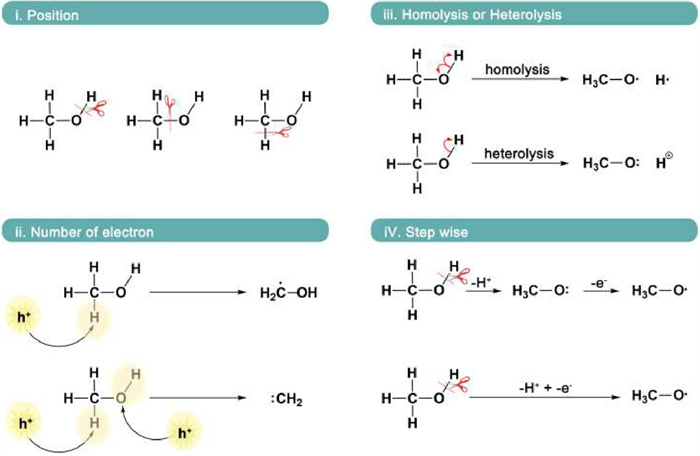
Figure 1.
The different activation modes of methanol.

Uncovering the photocatalytic conversion of methanol for C2+ chemicals
Haochuan Jing , Yunfei Ma , Tianyu Liu , Yanglong Liao , Yinyin Wang , Zirui Zhou , Yulin Wang , Hongli Sun , Chenliang Su , Bin Liu


Semiconductor-based solar-driven photocatalytic energy conversions, such as water splitting [1-5], hydrogen peroxide synthesis [6-9], CO2 reduction [10-14], have garnered significant attention. At the early research stage of these conversions, methanol is mostly utilized as the sacrificial agent [15-19], ignoring the conversion products of methanol and the reaction mechanism behind it, which not only is a huge waste from the perspective of atomic economy, but also casts a veil over the comprehensive understanding of the mechanism. As the research progressed, researchers gradually realize that methanol can be utilized as one of the most important building blocks to produce essences, perfumes, and pharmaceuticals. So, the photocatalytic conversion value of methanol as well as the corresponding mechanism should be highlighted. Simultaneous activation of methanol to provide C1 source and produce valuable chemicals such as C2+ chemicals, and N-alkyl drugs. while producing hydrogen is undoubtedly a more atom-economical approach. In addition, such in-situ photocatalytic activation of methanol for C–C coupling allows radical/intermediate generation and coupling at the same zone, where intermediates can react immediately for value-added C2+ chemicals without separation steps, efficiently suppressing undesired side reactions. Especially, for critical short-lived intermediates involved transformations, in-situ photocatalytic activation-coupling can minimize diffusion losses and ensure rapid in-situ consumption of intermediates toward C–C coupling before decomposition. Therefore, what methanol is converted into and how methanol is converted during the photocatalytic process become key issues that need to be clarified.
Methanol is the simplest aliphatic alcohol and holds three types of chemical bonds, C-H, C-O, and O-H, of which the bond dissociation energies (BDE) are ~401, ~385, and ~436 kJ/mol, respectively. The factors during photocatalytic process such as excited state dynamics, adsorption configuration, and surface interactions, make the activation of chemical bonds not always follow the order of BDE, which complicates the activation of methanol. This is why the photocatalytic activation of C—O bond in methanol has rarely been observed or reported, even though its BDE is the smallest. In theory, the activation of different chemical bonds, the different cleavage ways (homolysis vs. heterolysis), and the number of the involved electrons, etc., would furniture various carbon-containing intermediates like ·CH3O, CH3O-, ·CH2OH, ·CH3, HCHO and :CH2, etc. The subsequent interactions between these carbon-containing intermediates or between intermediates and substrates would lead to the formation of various value-added C2+ products with different formation mechanisms. For example, the single electron-involved homolysis of C-H bond and subsequent radical coupling would induce the formation of ethylene glycol (EG). Therefore, even for simple alcohols like methanol, the activation exhibits diverse characteristics, which makes the selective activation of the C-H, C-O, and O-H bonds and the elegant control over the selectivity quite challenging for photocatalytic methanol conversion.
As for the selectivity control, it requires the master of not only the product formation mechanisms, but also the interface catalytic behaviors. Various characterization techniques have been developed and are relatively mature to capture, trace, and determine the above-mentioned short-lived intermediate radicals for disclosing the product formation pathways. For example, the ·CH3O and ·CH2OH radicals both can be trapped by the DMPO reagent but display obviously different signals with electronic paramagnetic resonance (EPR) techniques. Their distinct features can help distinguish and verify the reactive radicals formed during the photocatalytic process, and thus the formation pathway. However, it is much more complicated when it comes to the interface catalytic behaviors. The adsorption energies and configurations the methanol molecules, the adsorption sites, the electron transfer between photocatalysts and methanol, the competition between bond cleavage and radical desorption, etc., all might pose influences on the catalytic process, resulting in different mechanisms. Although some achievements have been made on the selective activation of methanol into HCHO and EG over photocatalysts like TiO2 [20-25], CdS [26-30], ZnIn2S4 [31-33], etc., there is still huge room remaining unclear in the blueprint of methanol activation.
In this review, with the aim to uncover the details related to the photocatalytic conversion of methanol, the selective activation of three chemical bonds in methanol in different ways is firstly elaborated, accompanying with the formation mechanisms of various intermediated radicals. Then the high-value-added C2+ chemicals derived from the reactions between the intermediates, radicals or substrates are highlighted, with particular emphasis on the in-depth exploration of the reaction mechanism and the structure-activity relationship. Finally, current challenges and future opportunities on photocatalytic methanol reforming are also presented
Methanol holds three types of chemical bonds, C-H, C-O, and O-H, respectively. The different cleavage of these three chemical bonds would furniture different carbon-containing intermediates, ·CH3O, CH3O-, ·CH2OH, -CH2OH, ·CH3, HCHO and :CH2, etc. As shown in Fig. 1, the difference in the activation position, the cleavage ways (homolysis vs. heterolysis), the number of the involved electrons, and the activation steps would result in different radicals (Notes: Since this review highlights the photocatalytic conversion of methanol into value-added C2+ chemicals, the production of H2 and the over oxidation of methanol into CO2 is excluded for discussion. In specific, the activation site can be specifically either on the C-H bond to produce ·CH2OH via homolysis or -CH2OH via heterolysis, or on the O-H bond to furnish ·CH3O or CH3O- radicals. Apart from those frequently observed one-electron activation modes, a two-electron activation mode is also possible to generate active radicals like :CH2. Besides, these radicals can be formed either through a step-by-step process or via a concerted proton-electron transfer (CPET) mechanism. The diversity of ways to transform toward these partially oxidized intermediates provides a wealth of possibilities for synthesizing high-value-added C2+ chemicals.
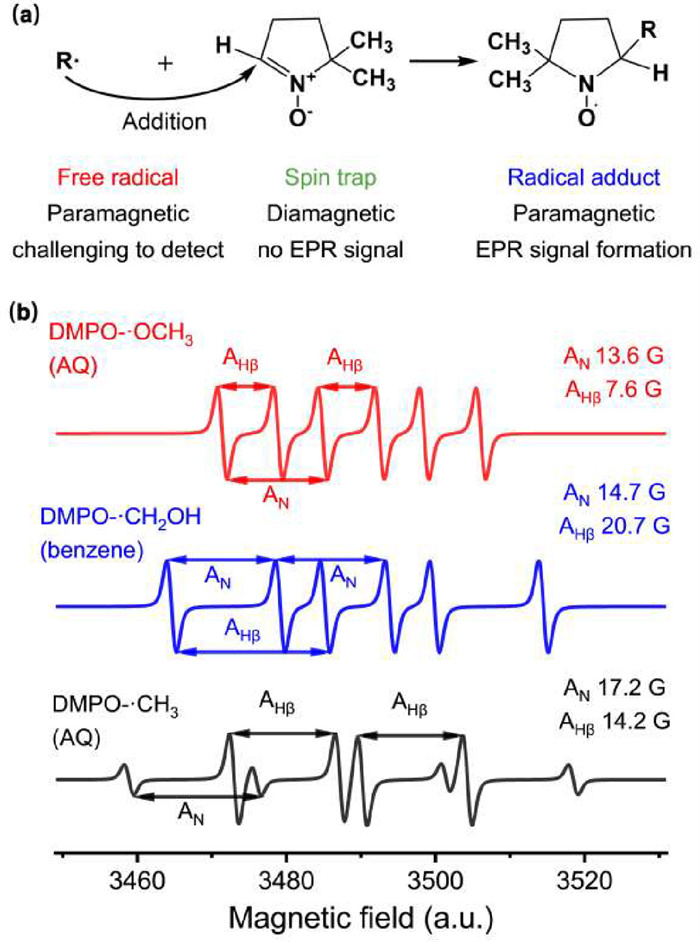
The diverse activation modes of chemical bonds enriched the distribution of C2+ products, but also pose challenges for the determination of mechanism, which demands precise knowledge of the intermediate radicals (·R) generated during the chemical reactions. EPR is a highly specific technique that has been widely adopted to characterize the intermediate radicals (·R). When in the presence of EPR silent diamagnetic spin trap chemicals (DMPO, DMPO, PBN, BMPO, MNP, etc.) [34-37], the short-lived paramagnetic radicals ·R can be trapped and transformed into relatively stable paramagnetic spin adducts, showing specific EPR signals that can be used to distinguish and determine ·R radicals (Fig. 2a). For the radicals generated during the photocatalytic activation of methanol, DMPO has been demonstrated as an efficient spin trap and DMPO−R has been regarded as an efficient indicator in EPR technology for the determination of radicals like ·CH3O, ·CH2OH and ·CH3 (Fig. 2b) [38-40]. As owing to the hyperfine coupling between the unpaired electron and surrounding nuclei, DMPO-R can display characteristic peak structures in the EPR spectrum with quite different spacing (AN, AHβ). For example, in the solvent benzene, the AN and AHβ of DMPO−·CH2OH are 14.7 G and 20.7 G, respectively, quite different from that of DMPO−·OCH3 in aqueous solutions (AQ), of which the AN and AHβ are 13.6 G and 7.6 G, respectively. Therefore, the unique peak structures and the quite variant AN and AHβ values can help distinguish DMPO−R generated in the methanol activation process, thus helping reflect the primary intermediate radicals and determine the methanol activation pathways.
(1) The relationship with photocatalytic water splitting
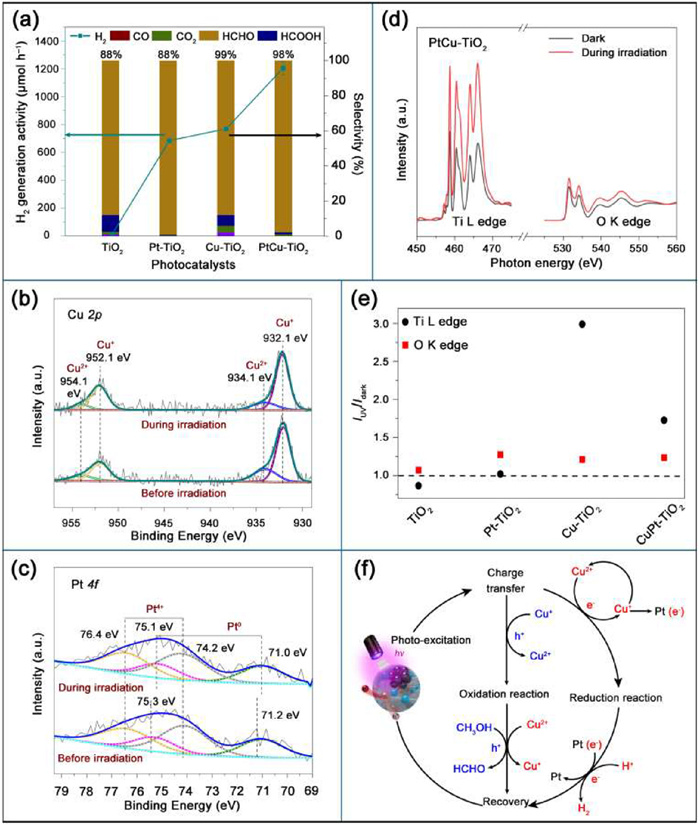
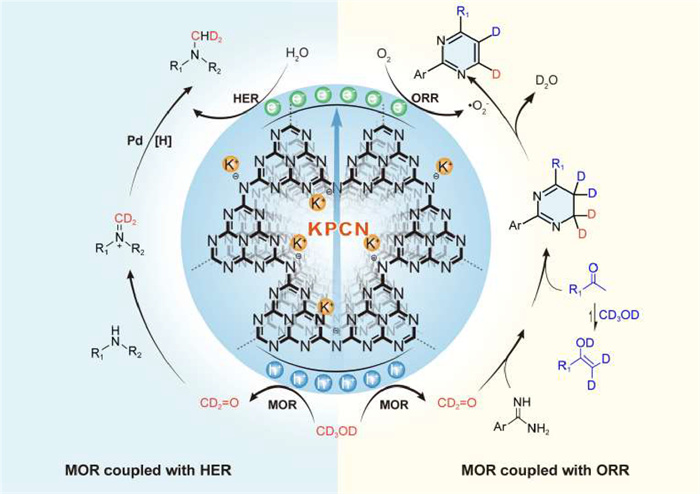
Photocatalytic activation of methanol for HCHO as a new C1 source for valuable organic transformations emerged as a reflection on the use of methanol as a sacrificial agent in the process of photocatalytic water splitting for hydrogen production. On one hand, ignoring the value of oxidation products (formaldehyde, HCHO) derived from methanol as the sacrificial agent is undoubtedly a significant waste and is not aligned with the principles of sustainable carbon cycling. On the other hand, HCHO, although the simplest representative of the aldehyde group of organic compounds, is a fundamental precursor for synthesizing alcohols, ethers, acids, and other compounds. HCHO can even be used as an intermediate to synthesize certain drugs in pharmaceutical chemistry. The widespread applications of HCHO in petrochemical, pharmaceutical, textile, biochemical, energy, transportation and other industries [41-44] prompt us to reconsider the use of methanol as a sacrificial agent in photocatalytic water splitting and indicate a significant potential of further utilizing the partial oxidation product HCHO as a C1 source. In addition, the currently widely used methods for synthesizing HCHO are mainly the selective vapor-phase oxidation of methanol [45], the direct dehydrogenation of methanol [46], the direct hydrogenation of CO or CO2 [47,48], the selective oxidation of methane [49] or higher hydrocarbons (propane, propene, etc.) [50], These pathways face issues such as high energy consumption, harsh reaction conditions, massive O2 input, highlighting the importance of seeking an alternative route for HCHO production with a high atom economy and low cost, as well as the reutilization of photocatalytic methanol reforming. Encouragingly, in recent years, more and more researchers started to critically reevaluate the commercial and industrial value of HCHO that dehydrogenated from methanol, and devoted to realizing the highly selective production of formaldehyde from methanol or methanol aqueous solution [51-54]. For example, by applying an atomic-level catalyst design strategy, Tang et al. designed a sandwich-like PtCu–TiO2 photocatalyst, which not only achieved an efficient H2 generation activity of 1206.5 µmol/h, but also obtained formaldehyde with a high selectivity (98%) and a good synthesis rate of 1166.0 µmol/h at room temperature (Fig. 3a) [55]. The comprehensive analyses of in situ XPS, EPR and EXAFS spectra not only revealed the coexistence of Cu+ and Cu2+ in PtCu–TiO2, but also demonstrated the synergy between Cu single atoms and Pt nanodots by the bond formation Pt-Cu. As shown in Fig. 3b, under light irradiation, Cu2+ was reduced to Cu+, indicating that Cu2+ captured photogenerated electrons. After irradiation, the binding energy of Pt0 decreased by 0.2 eV, while that of Pt4+ remained almost unchanged (Fig. 3c). This suggested that electrons were captured by Pt0 rather than Pt4+, implying that only Pt located on Cu trapped photogenerated electrons. Moreover, the operando XANES analyses in Figs. 3d and e revealed the charge transfer pathway. Cu-TiO2 exhibited the highest IUV/Idark (Ti) ratio, demonstrating Cu’s exceptional efficiency in extracting electrons from TiO2. In Pt-TiO2, the slightly enhanced Ti L-edge intensity as compared to TiO2 was attributed to bidirectional electron flow caused by electron backflow from Pt to TiO2. For PtCu−TiO2, the intermediate IUV/Idark ratio arose from the synergistic interplay of monodirectional Cu+ → Pt0 transfer and Pt→TiO2 reflux. This conclusively validated the electron transfer trajectory: TiO2 → Cu2+ → Cu+ → Pt0, where single-atom Cu2+ species bridge the Pt/TiO2 interface, thereby inhibiting electron-hole recombination and enabling highly efficient and stable catalysis. The reaction mechanism is concluded as follows: upon irradiation, the excited electrons were first trapped by the atomic Cu2+, converting them into Cu+, then transferring to Pt for hydrogen generation. This charge flow efficiently mitigated the electron backflow from Pt to TiO2. In the meantime, holes were trapped by Cu+ at other sites, facilitating the dynamic recovery of Cu2+. Owing to the synergy effect between Cu and Pt, where Cu2+–Pt was in charge of electron trapping and Cu+ for hole trapping, methanol was highly selectively converted to formaldehyde at Cu2+ and protons were efficiently reduced to H2 at electron-rich Pt sites (Fig. 3f). By further utilizing the formed HCHO during photocatalytic methanol reforming process, some value-added C2+ chemicals such as N-methylation compounds, 1,1-dimethoxymethane, can be formed via aldehyde-amine condensation, aldehyde-alcohol esterification reactions, etc. Although still in the early stages, semiconductor-based photocatalytic methanol reforming for HCHO generation and subsequent production of value-added chemicals [56-59] has been demonstrated a feasible route. For example, as shown in Fig. 4, our group designed a polymeric semiconductor photoredox catalytic system, which not only can couple methanol oxidation reaction (MOR) with hydrogen evolution reaction or deuterium evolution reaction, enabling the controlled introduction of –CH3, –CDH2, –CD2H, –CD3, and –13CH3 into pharmaceutical amines using water and methanol as the combined methylating reagent [58], but also can combine MOR with oxygen reduction reaction (ORR) to enable the transformation of methanol to HCHO as an ideal C1 source for constructing bioactive pyrimidines [59].
As compared to photocatalytic water splitting with methanol as the sacrificial agent, the development of photocatalytic activation of methanol for HCHO and subsequent chemicals production lags far behind. But fortunately, given the similarities, we subsequent researchers can draw substantial insights from the massive photocatalytic research where methanol was involved as a sacrificial agent. For example, owing to the Fermi levels of noble metals are usually lower than the conduction band energy of most semiconductors (TiO2, carbon nitride, etc.), which can facilitate the separation of photogenerated charges and act as reactive sites, the incorporation of noble metals as cocatalysts was widely used as a strategy to boost the photocatalytic H2 generation in the water splitting system with methanol as sacrificial agent. This strategy is predictably applicable to photocatalytic methanol reforming for HCHO generation. In a study by Kumar and co-workers, a series of Au nanostructures (nanorods, nanohexagons and nanostars) modified amorphous TiO2 were prepared via a facile and green low-temperature colloidal synthesis route for the photocatalytic oxidation of methanol [60]. After Au was embedded on TiO2, compared with TiO2 alone, the formation rate of HCHO was markedly increased, where the order of improvement was: nanorods < nanohexagons < nanostars. As Au nanostructures, especially Au nanostars, could serve as electron sinks for accepting the e- from CB of amorphous TiO2 due to its lower Fermi energy level. Additionally, the LSPR effect of Au also synergistically facilitated the separation of the photogenerated charges, leading to efficient conversion of methanol to HCHO. Doping is another widely used method to enhance H2 evolution performance and has been shown to be equally effective in photocatalytic HCHO generation. For instance, Goldstein et al. reported that carbon-doped TiO2 (C−TiO2) could facilitate the transformation of methanol into HCHO under UV−vis light irradiation [61]. As the C-doping could explicitly substitute O atoms by forming –Ti–C– and produce new energy states near the valence band, thereby enhancing visible light absorption capabilities and boosting the methanol conversion efficiency. The scavenger studies showed that the formation rates of HCHO were greatly enhanced mainly due to efficient generation of ·OH, which was produced via O2−to−H2O2 reduction by the photogenerated electrons of C−TiO2. And it is found that the oxidation of methanol by surface h+ to form ·CH2OH is thermodynamically feasible, thus leading to the final yield of HCHO via the reaction between ·OH and ·CH2OH. Coupling with another semiconductor, another well-explored strategy in photocatalytic water splitting, was also demonstrated effective in photocatalytic methanol reforming. Mersal et al. fabricated a coupled catalyst, N−doped TiO2 nanoparticles/WO3 microrods (N−TiO2@WO3), and studied its photocatalytic activity towards the oxidation of methanol [62]. Before contact, both N−TiO2 and WO3 could intrinsically absorb more visible light and generate more photoinduced carriers than pure TiO2 due to the narrowed band gap. After contact, the formation of heterojunction between N−TiO2 and WO3 could further provide an alternative channel for the charge transfer, facilitating the effective spatial separation and transfer of the photoexcited charge carriers. Under the same reaction conditions, the optimized N−TiO2@WO3 showed much higher HCHO generation rate than that of pure WO3 and TiO2.
After many years of research, co-catalysts, morphology control, doping, coupling, etc. were well-documented efficient strategies to tailor the geometric or electronic structures of photocatalysts that were applied in the methanol involved photocatalytic water splitting system. Although not all these strategies are enumerated in this section, given the similarities, these successful strategies are expected to achieve success in the photocatalytic conversion of methanol to produce HCHO and subsequent fine chemicals.
(2) Photocatalytic activation of methanol for HCHO as a new C1 source for N-methylation compounds
Direct functionalization of amino groups into N-methylamines molecules is one of the most important procedures in modern organic synthesis, which is widely involved in the synthesis process of detergents, pharmaceuticals, dyes, and synthetic intermediates. For example, in pharmaceutical synthesis, strategic N-methylation of amine functionalities represents a powerful approach to optimize critical drug properties including target engagement, metabolic resistance, and developability. A prime illustration is lidocaine (widely employed in ambulatory surgery): Its N-methylated analog, featuring an N-methyldiethylamino pharmacophore, exhibits superior nerve-blocking potency and extended therapeutic persistence compared to the parent compound. Traditional N-methylation reactions usually require the use of highly toxic, explosive and flammable starting materials and strong reducing reagents [63-65]. Meanwhile, these reaction processes typically result in high costs, safety hazards, and the generation of waste by products. Thus, developing greener, milder and more economic processes for the N-methylation of amines and their derivatives with good functionality tolerance by using cost-effective and low-toxic methanol as the direct methylating agent is meaningful yet challenging.
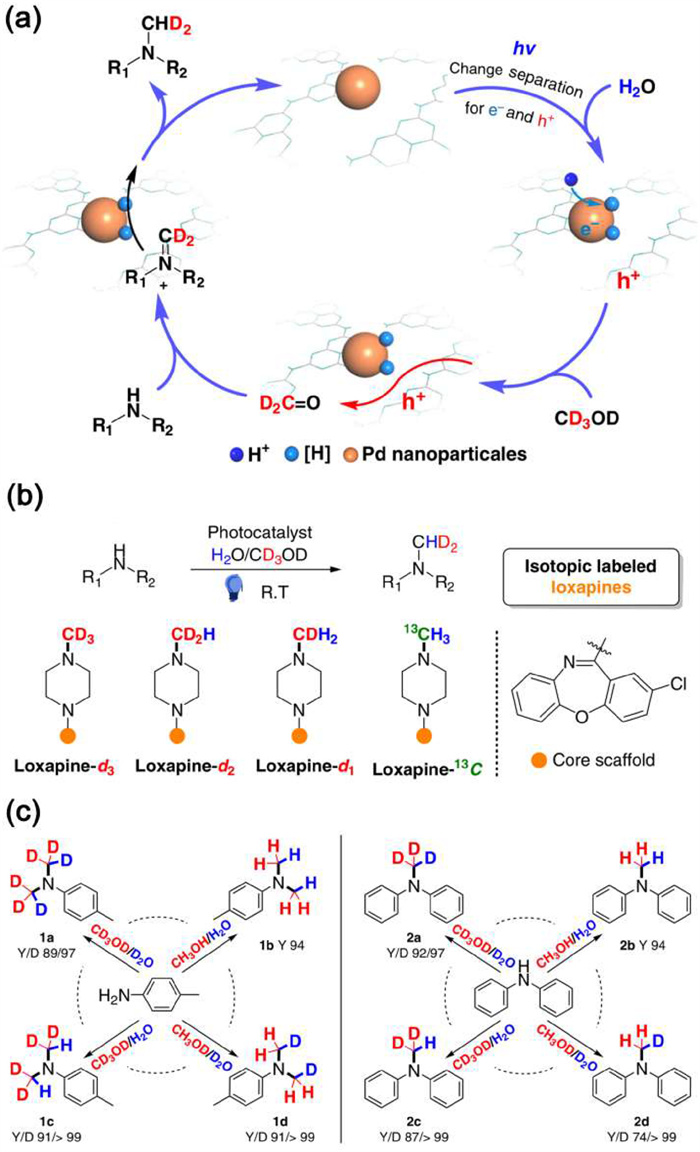
The photocatalytic N-methylation transformation with methanol as the C1 source has been demonstrated feasible early in 1986, when Tsutomo and co-workers reported the successful photocatalytic N-methylation of asymmetric secondary and tertiary amines by platinized anatase titanium dioxide (5 wt% Pt/TiO2) suspensions in a variety of alcohols (MeOH, EtOH, i-PrOH) [66]. Under light irradiation (λex > 300 nm), alcohol was predominantly dehydrogenated to carbonyl via hydrogen abstraction by ·OH and reduction of H+ to H2 at Pt sites, then undergoing a condensation reaction with the primary amines with the aid of Pt and in situ formed H2, realizing the N-alkylation and N,N-dialkylation. The incorporated alkyl chains clearly originated from the solvent alcohols rather than from the substrate amines. This successful trial provided a hint that MeOH can be a green and facile C1 source for photocatalytic N-alkylation processes at room temperature [67-69]. Subsequently, several semiconductors-based photocatalytic systems, such as Au/TiO2 [70], Cu/Mo–TiO2 [71], and Pd/TiO2 [72]. were developed for the N-methylation. For example, with the novel hybrid photocatalyst designed by Zhang et al., TiO2 supported non-noble metal Cu–Mo (Cu/Mo–TiO2), a variety of aromatic and aliphatic amines could be selectively converted into the corresponding alkylation of secondary amines or tertiary amines in moderate to excellent yields (~95%) without adding any bases or organic ligands [72]. Taking the p-chloroaniline as an example, the time-dependent changes in the quantities of p-chloroaniline, methanol and intermediates were monitored using GC−MS to investigate the possible reaction pathways and intermediates. During the photocatalytic N-methylation process, methanol was oxidized on the CuOx sites by the photogenerated h+ to form HCHO and H+, then H+ was predominantly reduced by electrons on the surface of Cu0 to generate the Cu-hydride species (Cu–H), instead of producing H2. Then imine was formed by the condensation of the formed HCHO with p-chloroaniline over the Lewis acid sites on the TiO2 surface, which was subsequently hydrogenated by Cu–H species and transformed into p‑chloro‑N-methylaniline. In 2015, Tsarev et al. found that the photocatalytic N-methylation of amines with methanol could be achieved by using silver-loaded titanium dioxide (Ag/TiO2) photocatalyst at room temperature under anhydrous/aqueous and acidic/neutral/basic conditions [73]. Under UV–vis light irradiation, the Ag/TiO2 allowed facile synthesis and isolation of N-methylamines with various functional groups (N-benzyl, N-allyl, N-Boc, hydroxyl, ether, acetal, carboxamide, formamide, olefin, etc.), while maintaining the tolerance of acid-, base- or redox-sensitive group sites. Benefited from this protocol, isotope-labeled amines (mono-, di-, or tri-deuterated N-methylamines), which are frequently used in medical studies for examining drug metabolism or enzyme mechanisms, could be concisely and simply synthesized by simply applying different deuterated methanol (CH3OD, CD3OH, CD3OD) sources. The enhancement of this photocatalytic system undoubtedly offered a valuable tool for late-stage functionalization of pharmaceutically important compounds, as well as for the rapid synthesis of 11C-labeled pharmaceuticals for positron emission tomography technology. Since then, more and more attentions were paid to improve the photocatalytic N-methylation strategies, where methanol was used as C1 source, for selective synthesis of organic compounds and drugs, particularly N-deuterated methylamine drugs. For example, Saito and Naka employed mixed heterogeneous photosystems composing of Cu/TiO2 and Au/TiO2 for the late-stage N-alkylation of pharmaceutically relevant amines with methanol, realizing the mono- and di-alkylation of primary amines at ambient temperature [74]. Further, they reported an efficient TiO2-supported Pd photocatalyst for the N-methylation of heterocyclic amines for synthesizing important pharmaceutical intermediates and drugs (such as Loxapine, Venlafaxine, Butenafine, and Adiphenine) under mild reaction conditions [75]. Our group members also successfully achieved N-methylation in 2020 under mild conditions by using the Pd-loaded mesoporous carbon nitride (Pd-mpCN) nanoparticles as the visible light-response photocatalysts [76]. Owing to the balanced redox couples presented Pd−mpCN, several N-mono-methylation products were obtained with high yields, revealing the significance of rational design of semiconductors with appropriate redox abilities and surface properties for selective organic synthesis. By further designing the photocatalysts, our group reported another powerful semiconductor-based photocatalytic system (Pd-loaded crystalline PCN, Pd/KPCN) for the sustainable and scalable construction of high value-added deuterated pharmaceuticals and chemicals [77]. As shown in Fig. 5, the photoexcited e- migrated from KPCN to Pd site and was utilized to split H2O/D2O or reduce H+/D+ to furnish reactive [H]/[D] species, and simultaneously methanol was oxidized by the photoexcited h+ on KPCN to generate the key HCHO intermediates for the subsequent condensation reactions. With synergistic utilization of reactive [H]/[D] species and the intermediate imines, the substrate amine could be converted corresponding N-alkyl compounds. For example, various isotope-labeled loxapines were successfully fabricated according to this protocol (Fig. 5b). Significantly, this unique protocol provided the ability to precisely control the number of D atoms at the metabolic position of pharmaceuticals by simply tuning the proportions of isotopic water and methanol (i.e., N—CD3, CD2H and CDH2, Fig. 5c), which was critically important for the research and design of new deuterated drugs [78].
To sum up, photocatalytic activation of methanol for N-methylation compounds not only provides a green and sustainable synthesis route of N-alkyl chemicals and drugs, but also presents a new horizon of photosynthesis for direct pharmaceutical production.
(3) Photocatalytic activation of methanol for HCHO as a new C1 source for acetalization reactions
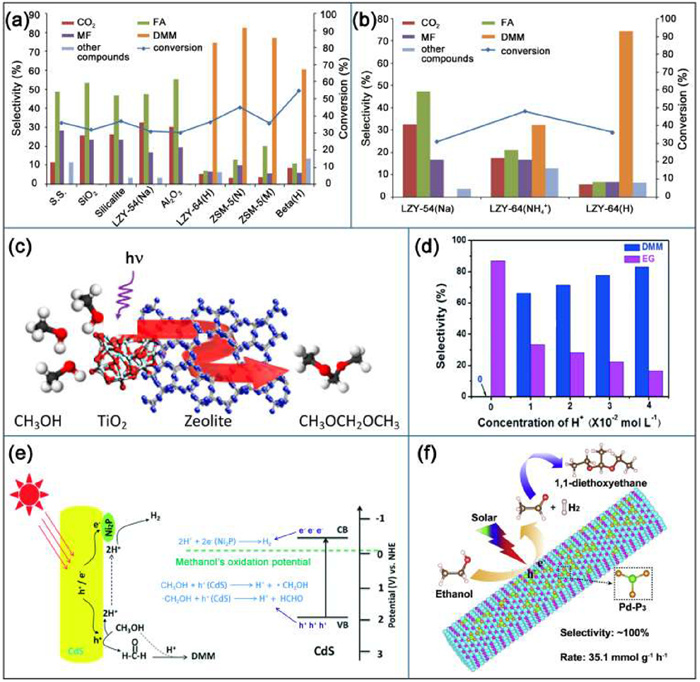
Aldehyde-alcohol esterification is also a key reaction in organic synthesis, as it can be integrated into diverse synthetic pathways, allowing for the creation of large amounts of complex molecules. In the past few years, successful cases on photocatalytic activation of methanol for HCHO as a new C1 source for acetalization reactions has been gradually reported. Photocatalytic formation of 1,1-dimethoxymethane (DMM) represents one such method, producing a pivotal intermediate for manufacturing polyoxymethylene (POM), an engineering plastic anchoring a multi-billion-dollar industry. Actually, the industrial scale production of DMM is produced via the reaction between formaldehyde and MeOH as well, but over acidic catalysts with elevated reaction temperature [79]. Thus, photocatalytic selective oxidation of methanol to DMM is fascinating. In 2017, El-Roz et al. prepared highly dispersed vanadium oxide clusters on nanosized zeolite (P−VOx@Beta) via a plasma-treated method for partial photooxidation of MeOH [80]. They found that with a higher methanol concentration at 100 mW/cm2 of irradiance, P−VOx@Beta could even catalyze the formation toward dimethoxymethane (DMM). And the formation of DMM was speculated by the condensation of two methoxy with a weak adsorbed HCHO. However, the selectivity of DMM formation was still unsatisfied. Later, they reported the one-step selective methanol photooxidation to DMM at room temperature over bifunctional TiO2/zeolite catalyst [81]. As shown in Fig. 6a, the yield and selectivity of the DMM were strongly associated with the type of the support zeolite (SiO2, LZY−54(Na), LZY−64(NH4+), LZY−64(H), ZSM−5 (N), ZSM−5 (M), and beta(H)), where TiO2/LZY−54(Na) catalyst primarily facilitated the formation of HCOOH and CO2, while TiO2/LZY−64(H) and ZSM−5(N) mainly generated DMM with the selectivity higher than 70%. This dissimilarity was mainly ascribed to their different properties related to the acid sites. By comparing the conversion and selectivity performance of LZY−54(Na), LZY−64(NH4+) and LZY−64(H), they further convinced the crucial role of the Brønsted acid sites on DMM formation (Fig. 6b). Based on the comprehensive IR studies, they supposed that TiO2 worked as the photo redox active sites for the conversion of MeOH to HCHO, while zeolites providing Brønsted acid sites to promote the adsorption of MeOH and/or HCHO, facilitating subsequent condensation reaction to yield DMM (Fig. 6c). At the same year, Chao et al. designed a noble metal-free photocatalyst, CdS/Ni2P, which achieved visible light-driven dehydrogenation–acetalization of methanol to facilitate the one-step conversion into DMM [82]. With the addition of sulphuric acid, the as-prepared CdS/Ni2P achieved a high DMM selectivity of 83% and a nearly stoichiometrically H2 formation rate of 188.42 mmol g−1 h−1. In this system, the concentration of H+ played a vital role in determining the selectivity of the liquid products, with a clear increase in the selectivity of DMM and a corresponding decrease in glycol as the H+ concentration rises (Fig. 6d). According to the signal of the hydroxymethyl radical ˙CH2OH witnessed by in situ electron spin resonance spectrum, and the thermodynamic analysis of redox potentials, the authors speculated that methanol was first oxidized to hydroxymethyl radicals, and then into HCHO by the photogenerated h+, then the formed HCHO further reacted with methanol rapidly to obtain DMM under sulfuric acid condition (Fig. 6e).
Such photocatalytic MeOH dehydrogenation–acetalization reaction to high value-added compounds can be further extended to other alcohols. Alcohols like ethanol, isopropanol can also be dehydrogenated in a similar way to form high value-added C-C coupling compounds, such as 1,1-diethoxyethane (DEE) [83-88], 2,3-butanediol (2,3-BD) [89-92], and 2,3-butanediol (pinacol) [93,94], etc. In addition, aromatic benzyl alcohols could also transform into hydrobenzoin, benzoin, and deoxybenzoin via this similar photocatalytic strategy [95-99]. For example, as shown in Fig. 6f, guided by DFT calculations, Guo’s group designed a unique single-atom photocatalyst by introducing the atomically dispersed Pd–P3 species into CdS nanorods (PdPSA−CdS), which achieved a high photocatalytic activity in the dehydrogenation of ethanol into high-value-added DEE (35.1 mmol g-1 h-1), with approximately 100% selectivity under visible light irradiation [100]. Based on the X-ray absorption near-edge structure analysis and theoretical simulations, the synergy between the metal-support interaction effect and Pd–P coordination effect benefited the formation of unoccupied hybrid states of Pd 4d and P 3p on the partially reduced Pd centers in PdPSA−CdS, which could greatly promote the activation of O–H and C–H bonds through an enhanced electron transfer pathway from ethanol to the unoccupied hybrid states of Pd 4d and P 3p.
Photocatalytic MeOH dehydrogenation–acetalization reaction allows for the utilization of methanol or its derivative HCHO as a C1 source for producing acetals, which is advantageous for developing new methodologies in carbon-based chemistry and promoting carbon utilization strategies, making a significant step toward more sustainable and efficient chemical processes.
(1) Photocatalytic activation of methanol for ethylene glycol via ·CH2OH
Ethylene glycol (EG) is a widely used bulk chemical that can be used as a reaction solvent, antifreeze, surfactant, synthetic raw material, etc., and has gained a huge market volume in the field of chemical engineering. In addition, its polymer, polyethylene glycol, also has great applications in the fields of chemical catalysis, biotechnology, etc., owing to the great potentials as a phase transfer catalyst and a promotor for cell fusion [101-103], further highlighting the importance of EG. In recent years, the annual output of EG has reached approximately 28 million tons globally. Currently, industrial production of EG mainly adopts the ethylene epoxidation and hydration process [104,105]. However, the energy costs and water consumption of this route are significant, making it very necessary to develop mild technologies that can prepare EG sustainably. Interestingly, as shown in Table 1, photocatalytic transformation of methanol to EG via C-C coupling under mild conditions represents a promising alternative approach [106-113].

 DownLoad:
CSV
| Catalyst | Raw materials | Target product | Light source | Selectivity efficiency | Ref. |
| ZnS | Methanol | EG: 1.0 mmol g−1 h−1 | Hg lamp (UV) | Sel. (60 h): 75% Yield (60 h): 0.3% |
[107] |
| MoS2/CdS | Methanol | EG: 11 mmol g−1 h−1 | Xe lamp (420–780 nm) | Sel. (100 h): 90% Yield (100 h): 16% |
[108] |
| CoP/Zn2In2S5 | Methanol | EG: 18.9 mmol g−1 h−1 | Xe lamp (AM 1.5) | Sel. (12 h): 90% Yield (12 h): 4.5% |
[109] |
| Pt/TiO2 | Methanol + HCHO | EG: ~2 mmol g−1 h−1 | UV light (320–400 nm) | Sel. (10 h): 80% Yield (10 h): ~0.4% |
[110] |
| In NPs/ZnIn2S4 | Methanol | EG: 3.2 mmol g−1 h−1 | 103 W LEDs (365 ± 10 nm) | Sel. (8 h): 84% | [111] |
| N-Ta2O5 | Methanol | EG: 4.0 mmol g−1 h−1 | Xe lamp (full spectrum) | Sel. (160 h): 70% Yield (160 h): 3.6% |
[112] |
| RhSA-WZ/ZB-Zn1−xCdxS | Methanol | EG: 34 mmol g−1 h−1 | Xe lamp (320–780 nm) | Sel. (60 h): ~85% Yield (60 h): 37% |
[114] |
| TiO2/FeOx | Methanol + H2O2 | EG: 12.6 mmol g−1 h−1 | mercury vapor lamp | Sel. (5 h): 78% | [115] |
Actually, photocatalytic conversion of methanol for EG synthesis has been demonstrated feasible early in 1984 [106]. Although methanol was used as a sacrificial electron donor to enhance the photocatalytic production of H2 on ZnS under UV light irradiation, Yanagida et al. found that the primary oxidation product of methanol was EG. However, the yield was low (1.0 mmol g−1 h−1, Table 1, entry 1), further improvement is required. Recently, Wang’s group developed a composite photocatalyst, MoS2 nanofoam modified CdS nanorods (MoS2/CdS, Fig. 7a), which can efficiently activate methanol to generate EG under visible light irradiation, achieving a EG yield up to 11 mmol g−1 h−1. This brings the synthesis of EG via photocatalytic activation of methanol back into the view of scientific researchers [107]. For the composite MoS2/CdS system, the incorporation of MoS2 with more edge sites not only guaranteed sufficient active sites, but also facilitated efficient charge separation, thus resulting in a high EG selectivity of 90% and a quantum yield of above 5.0%. The radical scavenger experiments and in situ EPR studies demonstrated that, the formation of EG proceed via the coupling of radical intermediates ·CH2OH that obtained by C-H activation during the photocatalytic process. Combined with the DFT calculations, mechanistic studies have revealed a preferential activation of C-H bond in methanol by photoexcited h+ on CdS via a concerted proton–electron transfer (CPET) mechanism, forming a ·CH2OH that can readily desorb from the catalyst surfaces and subsequently coupled into EG. This impressive study presented a promising and mild visible-light-driven EG synthetic route with quite high atom efficiency. Inspired by this work, more and more research work focused on the photocatalytic preparation of ethylene glycol from methanol, as listed in Table 1 [103-112,114]. And various strategies were applied to tune the activity and selectivity, such as the introduction of heterojunctions [108,114], metal cocatalysts [109,110], doping elements [111], single metal atom [112]. For example, Luo et al. found that the decoration of ZnIn2S4 or ZnS by those metals with low functions (In, Cd, Bi) would simultaneously boost the selectivity and rate of methanol C-H bond scission, and thus facilitate the EG generation. As these metals with low work function would donate electrons to ZnIn2S4 or ZnS in the dark, then ZnIn2S4 or ZnS enriched with electrons tends to polarize C-O bond instead of the O-H bond, thereby suppressing O-H bond scission and favoring the preferential C-H bond scission. Besides, introduction of these metals induced the formation of strong built-in field between metals and the support, which promoted the charge separation and accelerating the activation process [110]. By alternately stacking wurtzite (WZ) and zinc (ZB), Wang et al. designed a zinc-cadmium sulfide semiconductor composed of WZ and ZB phases lined alternately in one dimension, and single-atom Rh sites were introduced as active sites which deposited selectively onto the WZ segment [112]. The linearly arranged WZ/ZB heterojunction structure facilitated the formation of built-in electric field, allowing the fast separation of photogenerated charges (Fig. 7b). The electrons would like to gather on the ZB segment, enabling the reduction of H2O to H2, while holes mainly accumulate on the Rh sites, facilitating the oxidative coupling of methanol to EG through the interaction of C-H bond with Rh sites. And DFT calculations showed that the single-atom Rh sites lowered the adsorption energy of methanol, of which the adsorption energy (−1.46 eV) was much negative than that on Cd atom (−0.23 eV) on the (1120) facet of WZ segment, thus energetically more favorable for C–H activation and subsequent C–C bond coupling. Therefore, this specially designed photocatalyst exhibited a record-breaking efficiency under visible light irradiation, with a EG formation rate of 34 mmol gcat−1 h−1 and a simultaneous H2 evolution rate of 41 mmol gcat−1 h−1, and the AQY reached up to 16% at the wavelength of 400 nm.
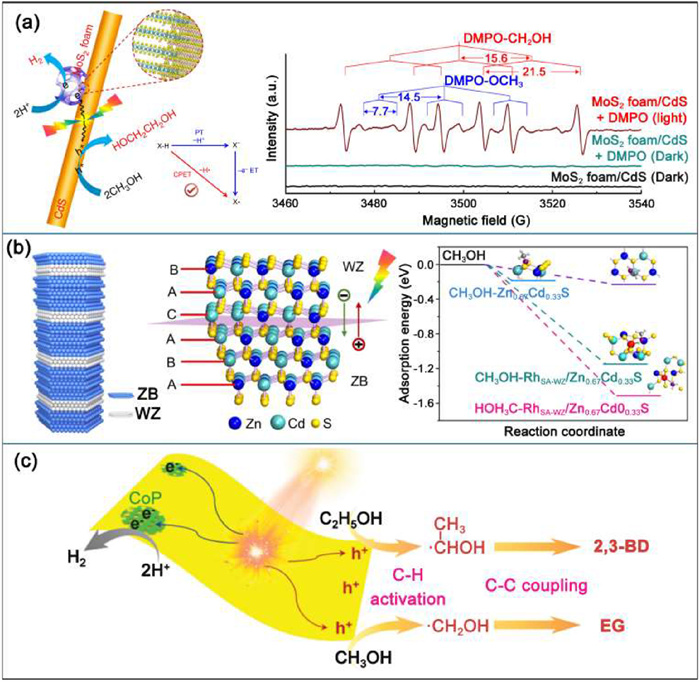
Interestingly, photocatalytic activation of methanol for ethylene glycol via C-C cross-coupling also provides insights into the fabrication of other C2+ chemicals. For example, Zhang et al. reported an environmentally friendly visible-light-driven photocatalyst, CoP/Zn2In2S5, which selectively activated the C–H bond of methanol and synthesized EG with a high selectivity of 90% [108]. And by adopting this strategy and changing methanol to ethanol, they further obtained 2,3-butanediol through dehydrogenative coupling (Fig. 7c). These pioneering works not only demonstrated the feasibility of the photocatalytic synthesis strategy toward EG via methanol activation and C-C coupling, but also implied the potential for extending this strategy by changing methanol accordingly.
(2) Photocatalytic activation of methanol for ethanol via:CH2
As same important as methanol, ethanol is also a critically important fossil fuel, which can be widely used as a building block for the production of various chemicals and polymers. However, as compared with methanol, ethanol is more user friendly and broadly applicable from the perspective of toxicity and environmental hazards. Given the more environmental friendliness, versatility, and less toxic properties of ethanol than methanol, methanol-to-ethanol (MeOH−to−EtOH) conversion chemistry is particularly conspicuous, as it can simultaneously combine the advantages while limiting the disadvantages of methanol. However, achieving such transformation efficiently under mild conditions, particularly through photocatalytic methods, presents significant challenges. Li’s group reported the first trial on the direct photocatalytic transformation of methanol to ethanol catalyzed by a gallium nitride (GaN) semiconductor under ambient conditions (Fig. 8a) [115]. By incorporating trace amounts of dopants, the intrinsic GaN nanowire (i-GaN) can be tailored to form either n-type (n-GaN) or p-type (p-GaN) semiconductors, among which the p-GaN displayed the highest MeOH-to-EtOH conversion activities with an ethanol formation rate of 4.85 mmol/g. By selectively exposing and controlling the lengths of the polar N-terminated c-plane and the non-polar m-plane, the authors found that MeOH-to-EtOH conversion most likely occurred on the polar c-plane of GaN (Fig. 8b). Interestingly, a small singlet signal at 0.23 ascribed to cyclopropane was observed in the 1H NMR high-resolution spectrum, implying the generation of intermediate methyl carbene (:CH2) and that the MeOH-to-EtOH methylation process may proceed via a carbene mechanism. This was further evidenced by the introduction of ethylene into MeOH or MeOH-d4 solutions, generating the singlet signal at 0.23 ppm or a quintet-like signal with a coupling constant of 3JD-H = 1.3 Hz, respectively (Fig. 8c). Simultaneously, almost no EtOH was produced, as the :CH2 was quenched by ethylene. Comprehensive mechanistic studies showed that :CH2 was derived from the elimination of water from methanol and acting as the crucial intermediate involved in ethanol formation process. Upon light irradiation, the photoexcited e- would preferentially accumulate on the GaN surface, resulting in a highly negatively charged N− region at the c-plane surface of GaN (Fig. 8d). Then, the highly charged N− attacked the C–H bond of MeOH to generate the :CH2 radicals via elimination of a water molecule. The :CH2 subsequently either methylated the C–H bond of MeOH to produce EtOH or proceed via dimerization and cyclopropanation.
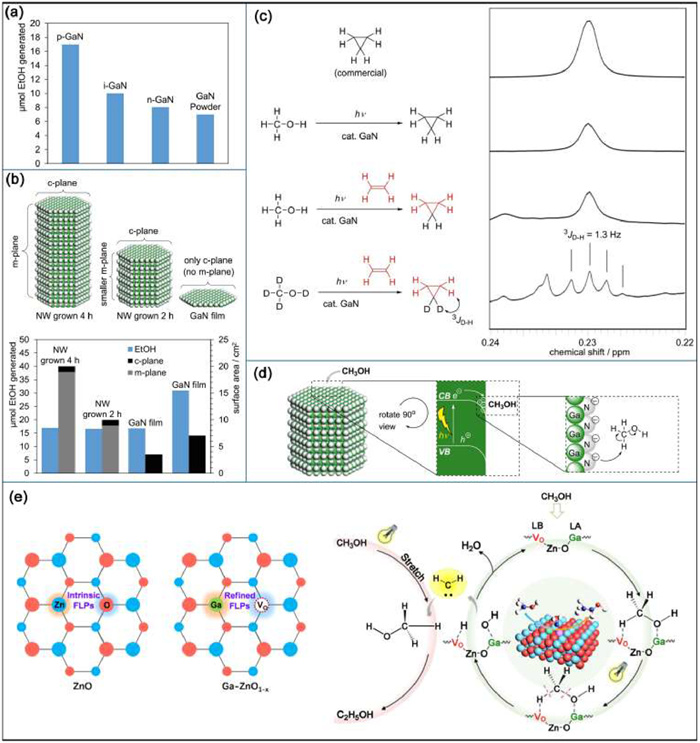
Recently, Li et al. reported a Ga−ZnO1-x semiconductor photocatalyst featuring an abundance of frustrated Lewis acid-base pairs (Fig. 8e) [116]. Similarly, this catalyst enabled the highly selective production of ethanol from methanol via a carbene pathway under visible light irradiation. The Ga sites and oxygen vacancies in the semiconductor photocatalyst acted as the acid and base sites, respectively. Thus, the C–O bond and C–H bond of methanol could be selectively adsorbed on different sites. Under photoexcitation conditions, the Ga sites and oxygen vacancies served as efficient traps for photogenerated holes and electrons, respectively, leading to selective activation of the C–O bond and the C–H bond. As illustrated in Fig. 8e, upon photoexcitation, Ga accumulated photogenerated holes and withdrew electrons from the polarized C–O bond, while simultaneously, oxygen vacancies captured photogenerated electrons and injected them into the C–H bond. This finally resulted in the cleavage of both C–O and C–H bonds, generating water and a carbene intermediate. Subsequently, the carbene inserted into another methanol molecule, leading to the highly selective formation of ethanol.
Although reports on the photocatalytic activation of methanol to generate:CH2 for ethanol are quite rare, further investigation into this intriguing photochemical method is recommended, as it provides unique insights into carbon chain elongation.
In summary, we summarized recent developments of solar energy-driven photocatalytic methanol reforming over semiconductor photocatalyst materials, including the formation and detection of intermediate radicals, the formation of valuable C2+ chemicals via intermediate HCHO as C1 source or via radicals coupling. With different photocatalytic systems and mechanisms, methanol can be selectively activated and converted to different intermediates, ·CH3O, ·CH2OH, :CH2, and –CH3. The subsequent selective coupling of these intermediates would furniture various value-added hydrocarbons, demonstrating that photocatalytic methanol reforming could be an alternative, mild and green resource realignment strategy. However, it should be noted that photocatalytic methanol reforming is still in the proof-of-concept stage. The lack of deep understanding of the catalytic mechanism, low conversion rate, poor stability and selectivity, process immaturity, etc., determine that there is still a long way to go before large-scale application, yet this journey presents numerous opportunities and challenges.
(1) Most studies related to photocatalytic methanol reforming have tried to apply noble or non-noble transition metals to boost either the desired conversion efficiency or the product selectivity. Although generally speaking, noble metals-modified catalytic systems are beneficial for the conversion of methanol to H2 and the synthesis of •CH3O or •CH3 due to their intrinsic low work functions and lower overpotentials, and inexpensive transition metal-based catalytic systems seem to be more conducive to the control of product selectivity, there is no global idea of which metals are suitable for catalyzing the synthesis of what intermediates (•CH3O, •CH2OH, •CH3,
(2) In some cases, methanol can be easily over-oxidized into CO2 and H2O by holes (h+) or reactive radicals, which might result in the failure to synthesize C2+ chemicals. Thus, the core challenge for producing C2+ products lies in suppressing methanol degradation while enhancing C–C coupling capability between intermediates or between intermediates and feedstock. Recently, integrative catalytic pairs (ICPs), a new class of catalysts where binary active centers are spatially adjacent, demonstrate potential in facilitating complex chemical transformations that simultaneously involve multiple intermediates. It was shown that the kinetic barriers and reaction pathways of multi-interactive intermediates on ICPS can be finely tuned to improve the transformation efficiency owing to the atomic-scale site-to-site electronic interactions and the synergistic catalytic effects [117-120]. Therefore, constructing ICPs to spatially coordinate the methanol activation sites with the C–C coupling sites may effectively inhibit the over-oxidation of methanol and facilitate the timely coupling of methanol or its intermediates to form C2+ products. So, it is highly recommended to prioritize catalyst designs that enable spatial cooperation between methanol activation sites and C–C coupling sites.
(3) Photocatalytic activation of methanol for C–C coupling engages diverse intermediates and reactants, whose stability, absorption behaviors, and reaction modes might be substantially modulated by the choice of protic or aprotic solvents within the photocatalytic system. Variations in the methanol/water ratio have been shown to markedly affect the hydrogen yield in methanol-involved photocatalytic hydrogen production studies. For example, with Pt–C/TiO2 as photocatalysts for photochemical oxidation of methanol in aqueous solution, Tang et al. observed the highest hydrogen production rate when methanol concentration was kept at 70%. The simultaneous attenuation of both water and methanol peaks under illumination in-situ FTIR spectra indicated that, both water and methanol participated in the reaction, and their concentration would influence the methanol oxidation efficiency [121]. In addition, by using the platinum/graphitic carbon nitride (Pt/CN) as the model photocatalyst, Wang et al. investigated the role of water in photocatalytic hydrogen production from methanol. Comprehensive studies on in-situ FTIR, EPR, isotope effects and theoretical model calculations revealed that, water hindered the adsorption of methanol molecules on the catalyst surface and the desorption of methanol oxidation products, which significantly reduced hydrogen production rate from methanol and altered the product selectivity [122,123]. Inspiringly, as for photocatalytic methanol conversion for C2+ chemicals, the solvents might also modulate the electronic structure of photocatalysts, affect the adsorption and desorption behaviors of reactants/products, influence the generation and separation of photogenerated charge carriers, etc. Thus, it is necessary to prioritize systematical study on solvent effects and unlock how different solvents interact with photocatalysts and influence the reaction mechanisms, and ultimately advance the practical application of photocatalytic methanol reforming.
(4) While photocatalytic methanol upgrading is green and operates under mild conditions, the quantum efficiency is still far from satisfactory owing to sluggish charge separation kinetics and significant photon energy dissipation such as heat or fluorescence. Seeking catalytic systems that can not only solve these issues but also maintain the merits of photocatalytic methanol upgrading is necessary. Photoelectrochemical systems enable directed spatial separation of photogenerated charge carriers through built-in electric fields, and photothermal catalysis emphasized the localized heating effects to accelerate reaction kinetics. Combining thermal or photochemical pathways with photocatalytic methanol upgrading might be an alternative solution for scalable, high-yield methanol upgrading to value-added C2+ chemicals, yet challenging in terms of the choice and design of corresponding catalysts.
(5) The resistance to large-scale application of photocatalytic methanol reforming is not just caused by the lack of inefficient catalysts and deep understanding of the mechanism, given the diversity of products (EG, ethanol, DMM, etc.), the huge separation cost of the products is also a major issue. Research should not be limited to one-pot reactions, which is not only detrimental to the efficiency improvement but also increases separation costs. Instead, the focus should be emphasized on photocatalytic methanol reforming based on mobile phase reaction.
(6) Photocatalytic methanol reforming and subsequent N-alkyl modification have given us great inspiration. Photocatalytic reforming of the deuterium-labelled methanol will be beneficial to the development of deuterated value-added chemicals. At present, the challenges of high value-added deuterated compounds, such as new deuterated drugs, are mainly technical barriers to high value-added deuterated compounds, expensive deuterium sources, and unclear kinetic modulation mechanism of H/D, etc. Therefore, for photocatalytic methanol/deuterated methanol reforming, the following research focus is suggested to aim at gradually breaking through the above problems.
Haochuan Jing: Writing – original draft, Formal analysis, Data curation, Conceptualization. Yunfei Ma: Writing – original draft, Formal analysis, Data curation, Conceptualization. Tianyu Liu: Writing – original draft, Formal analysis, Data curation, Conceptualization. Yanglong Liao: Formal analysis, Data curation. Yinyin Wang: Formal analysis. Zirui Zhou: Formal analysis. Yulin Wang: Formal analysis, Data curation. Hongli Sun: Writing – review & editing, Project administration, Funding acquisition, Formal analysis, Data curation, Conceptualization. Chenliang Su: Writing – review & editing, Conceptualization. Bin Liu: Writing – review & editing, Formal analysis.
The authors declare that they have no known competing financial interests or personal relationships that could have appeared to influence the work reported in this paper.
This work was supported by the National Key Research and Development Program of China (No. 2021YFA1600800), National Natural Science Foundation of China (Nos. 22102102, 22372102, 22101185, 22402122), Shenzhen Science and Technology Program (Nos. 20231122120657001, RCJC20200714114434086), Research Team Cultivation Program of Shenzhen University (No. 2023QNT013), Scientific Foundation for Youth Scholars of Shenzhen University (No. 868-000001032185), Graduate Student Innovation Incubator Program of Shenzhen University (No. 868–000002020269), Shenzhen Peacock Plan (No. 20210308299C), Science and Technology Innovation Commission of Shenzhen (No. ZDSYS201707271014468), China Postdoctoral Science Foundation (No. 2023M742395), State-sponsored Postdoctoral Researcher program (No. GZC20231718).
A. Fujishima, K. Honda, Nature 238 (1972) 37–38. doi: 10.1038/238037a0
J.R. Bolton, S.J. Strickler, J.S. Connolly, Nature 316 (1985) 495–500. doi: 10.1038/316495a0
S. Nishioka, F.E. Osterloh, X. Wang, T.E. Mallouk, K. Maeda, Nat. Rev. Methods Primers 3 (2023) 1–15. doi: 10.5040/9781509956586.ch-001
K. Maeda, J. Photochem. Photobiol. C 12 (2011) 237–268. doi: 10.1016/j.jphotochemrev.2011.07.001
Q. Xu, L. Zhang, B. Cheng, J. Fan, J. Yu, Chem 6 (2020) 1543–1559. doi: 10.1016/j.chempr.2020.06.010
S. Chen, Z. Chen, S. Siahrostami, et al., ACS Sustain. Chem. Eng. 6 (2018) 311–317. doi: 10.1021/acssuschemeng.7b02517
J.K. Edwards, S.J. Freakley, A.F. Carley, C.J. Kiely, G.J. Hutchings, Acc. Chem. Res. 47 (2014) 845–854. doi: 10.1021/ar400177c
S.C. Perry, D. Pangotra, L. Vieira, et al., Nat. Rev. Chem. 3 (2019) 442–458. doi: 10.1038/s41570-019-0110-6
E. Jennifer K, S. Benjamin, N.N. Edwin, Science 323 (2009) 1037–1041. doi: 10.1126/science.1168980
S. Zhang, Q. Fan, R. Xia, T.J. Meyer, Acc. Chem. Res. 53 (2020) 255–264. doi: 10.1021/acs.accounts.9b00496
N. Dae-Hyun, L. Phil De, R.-H. Alonso, T. Arnaud, Nat. Mater. 19 (2020) 266–276. doi: 10.1038/s41563-020-0610-2
S. Fang, M. Rahaman, J. Bharti, J. Reisner, E. Reisner, Nat. Rev. Methods Primers 3 (2023) 61. doi: 10.1038/s43586-023-00243-w
P. Saha, S. Amanullah, A. Dey, Acc. Chem. Res. 55 (2) (2022) 134–144. doi: 10.1021/acs.accounts.1c00678
X. Li, S. Wang, L. Li, Y. Sun, Y. Xie, J. Am. Chem. Soc. 142 (2020) 9567–9581.
Z. Haider, Y.S. Kang, ACS Appl. Mater. Interfaces 6 (2014) 10342–10352. doi: 10.1021/am501796m
F. Costantino, P.V. Kamat, ACS Energy Lett. 7 (2022) 242–246. doi: 10.1021/acsenergylett.1c02487
F. Guzman, S.S.C. Chuang, C. Yang, Ind. Eng. Chem. Res. 52 (2013) 61–65. doi: 10.1021/ie301177s
W.T. Chen, A. Chan, Z.H.N. Al-Azri, et al., J. Catal. 329 (2015) 499–513. doi: 10.1016/j.jcat.2015.06.014
R. Yadav, A.K. Sinha, ACS Sustain, Chem. Eng. 5 (2017) 6736–6745. doi: 10.1021/acssuschemeng.7b00996
J.J. Velázquez, R. Fernández-González, L. Díaz, et al., J. Alloys Compd. 721 (2017) 405–410. doi: 10.1016/j.jallcom.2017.05.314
C.R. López, E.P. Melián, J.A. Ortega Méndez, et al., J. Photochem. Photobiol. A Chem. 312 (2015) 45–54. doi: 10.1016/j.jphotochem.2015.07.005
Z. Haider, Y.S. Kang, ACS Appl. Mater. Interfaces 6 (2014) 10342–10352. doi: 10.1021/am501796m
F. Sauvage, F. Di Fonzo, A. Li Bassi, et al., Nano Lett. 10 (2010) 2562–2567. doi: 10.1021/nl101198b
A. Galińska, J. Walendziewski, Energy Fuels 19 (2005) 1143–1147. doi: 10.1021/ef0400619
E.P. Melián, C.R. López, D.E. Santiago, et al., Appl. Catal. A: Gen. 518 (2016) 189–197. doi: 10.1016/j.apcata.2015.09.033
M. Wang, S. Shen, L. Li, Z. Tang, C. Yang, J. Mater. Sci. 52 (2017) 5155–5164. doi: 10.1007/s10853-017-0752-z
J. Sabaté, S. Cervera-March, R. Simarro, J. Giménez, Int. J. Hydrogen Energy 15 (1990) 115–124. doi: 10.1016/0360-3199(90)90033-U
N. Bao, L. Shen, T. Takata, K. Domen, Chem. Mater. 20 (2008) 110–117. doi: 10.1021/cm7029344
V.M. Daskalaki, M. Antoniadou, G. Li Puma, D.I. Kondarides, P. Lianos, Environ. Sci. Technol. 44 (2010) 7200–7205. doi: 10.1021/es9038962
M.Y. Xing, B.C. Qiu, M.M. Du, et al., Adv. Funct. Mater. 27 (2017) 1702624. doi: 10.1002/adfm.201702624
L. Su, X. Ye, S. Meng, X. Fu, S. Chen, Appl. Surf. Sci. 384 (2016) 161–174. doi: 10.1016/j.apsusc.2016.04.084
J. Peng, X. Huang, Q. Gu, et al., Chem. Commun. 170 (2024) 113314.
M. Sheng, C. Gan, Y. Li, et al., Appl. Catal. B: Environ. 339 (2023) 123138. doi: 10.1016/j.apcatb.2023.123138
E. Morra, E. Giamello, M. Chiesa, J. Magn. Reson. 280 (2017) 89–102. doi: 10.1016/j.jmr.2017.02.008
J.M. Coronado, A. Javier Maira, A. Martıńez-Arias, J.C. Conesa, J. Soria, J. Photochem. Photobiol. A: Chem. 150 (2002) 213–221. doi: 10.1016/S1010-6030(02)00092-8
J.W. Nichols, Y.H. Bae, J. Control. Release 190 (2014) 451–464. doi: 10.1016/j.jconrel.2014.03.057
Z. Wang, W. Ma, C. Chen, H. Ji, J. Zhao, Chem. Eng. J. 170 (2011) 353–362. doi: 10.1016/j.cej.2010.12.002
L. Wang, Y. Fu, Q. Li, Z. Wang, Environ. Sci. Technol. 56 (2022) 8796–8806. doi: 10.1021/acs.est.2c00459
F.A. Villamena, E.J. Locigno, A. Rockenbauer, C.M. Hadad, J.L. Zweier, J. Phys. Chem. A 110 (2006) 13253–13258. doi: 10.1021/jp064892m
V.V. Khramtsov, V.A. Reznikov, L.J. Berliner, et al., Free Radic. Biol. Med. 30 (2001) 1099–1107. doi: 10.1016/S0891-5849(01)00505-6
V. Kumaravel, J. Bartlett, S.C. Pillai, ACS Energy Lett. 5 (2020) 486–519. doi: 10.1021/acsenergylett.9b02585
M. Siebert, M. Seibicke, A.F. Siegle, S. Kräh, O. Trapp, J. Am. Chem. Soc. 141 (2019) 334–341. doi: 10.1021/jacs.8b10233
J. Tian, J. Tan, Z. Zhang, et al., Nat. Commun. 11 (2020) 5693. doi: 10.1038/s41467-020-19517-y
L.E. Heim, H. Konnerth, M.H.G. Prechtl, Green Chem. 19 (2017) 2347–2355. doi: 10.1039/C6GC03093A
M. Qian, M.A. Liauw, G. Emig, Appl. Catal. A: Gen. 238 (2003) 211–222. doi: 10.1016/S0926-860X(02)00340-X
L. Lefferts, J.G. van Ommen, J.R.H. Ross, Appl. Catal. 23 (1986) 385–402. doi: 10.1016/S0166-9834(00)81306-8
D. Lee, D. Kim, Kim, Appl. Organometal. Chem. 15 (2001) 148–150. doi: 10.1002/1099-0739(200102)15:2<148::AID-AOC104>3.0.CO;2-N
A.M. Bahmanpour, A. Hoadley, A. Tanksale, Green Chem. 17 (2015) 3500–3507. doi: 10.1039/C5GC00599J
J. Ohyama, D. Abe, A. Hirayama, H. Iwai, Y. Tsuchimura, J. Phys. Chem. C 126 (2022) 1785–1792. doi: 10.1021/acs.jpcc.1c08739
S.H. Taylor, G.J. Hutchings, M.L. Palacios, D.F. Lee, Catal. Today 81 (2003) 171–178. doi: 10.1016/S0920-5861(03)00110-X
Z. Gao, T. Montini, J. Mu, et al., J. Am. Chem. Soc. 380 (2019) 15.
Z. Li, A. Ivanenko, X. Meng, Z. Zhang, J. Hazard. Mater. 380 (2019) 120822. doi: 10.1016/j.jhazmat.2019.120822
H. Wang, H. Qi, X. Sun, et al., Nat. Mater. 22 (2023) 619–626. doi: 10.1038/s41563-023-01519-y
M. Xiao, A. Baktash, M. Lyu, et al., Angew. Chem. Int. Ed. 63 (2024) e202402004. doi: 10.1002/anie.202402004
H. Wang, H. Qi, X. Sun, et al., Nat. Mater. 22 (2023) 619–626. doi: 10.1038/s41563-023-01519-y
S. Han, R.A. Ciufo, B.R. Wygant, B.K. Keitz, C.B. Mullins, ACS Catal. 10 (2020) 4997–5007. doi: 10.1021/acscatal.0c00592
Z. Jiang, X. Feng, J. Deng, et al., Adv. Funct. Mater. 29 (2019) 902041.
Z. Zhang, C. Qiu, Y. Xu, et al., Nat. Commun. 11 (2020) 4722. doi: 10.1038/s41467-020-18458-w
H. Wu, J. Wang, H. Sun, et al., Sci. Bull. 30 (2024) 2496–2500.
A. Kumar, K. Kumar, V. Krishnan, Mater. Lett. 245 (2019) 45–48. doi: 10.1016/j.matlet.2019.02.091
S. Goldstein, D. Behar, J. Rabani, J. Phys. Chem. C 112 39 (2008) 15134–15139. doi: 10.1021/jp803974a
M. Mersal, G.G. Mohamed, A.F. Zedan, Opt. Mater. 122 (2021) 111810. doi: 10.1016/j.optmat.2021.111810
P.W. Manley, F. Blasco, J. Mestan, R. Aichholz, Bioorg. Med. Chem. 21 11 (2013) 3231–3239.
Y. Nakai, M. Hayashi, W. Mitsuhashi, US11214545B2, 2022.
W. Ou, C. Qiu, C. Su, Chin. J. Catal. 43 (2022) 956–970. doi: 10.1016/S1872-2067(21)63928-1
B. Ohtani, H. Osaki, S. Nishimoto, T. Kagiya, J. Am. Chem. Soc. 108 (1986) 308–310. doi: 10.1021/ja00262a028
B. Ohtani, H. Osaki, S. Nishimoto, T. Kagiya, Tetrahedron Lett. 27 (1986) 2019–2022. doi: 10.1016/S0040-4039(00)84437-8
C.F. Winans, H. Adkins, J. Am. Chem. Soc. 54 (1932) 306–312. doi: 10.1021/ja01340a046
R. Grigg, T.R.B. Mitchell, S. Sutthivaiyakit, N. Tongpenyai, Tetrahedron Lett. 22 41 (1981) 4107–4110.
D. Stíbal, J. Sá, J.A. van Bokhoven, Catal. Sci. Technol. 3 (2013) 94–98. doi: 10.1039/C2CY20511D
L. Zhang, Y. Zhang, Y. Deng, F. Shi, Catal. Sci. Technol. 5 (2015) 3226–3234. doi: 10.1039/C5CY00316D
L. Zhang, Y. Zhang, Y. Deng, F. Shi, RSC Adv. 5 19 (2015) 14514–14521.
V.N. Tsarev, Y. Morioka, J. Caner, et al., Org. Lett. 17 10 (2015) 2530–2533. doi: 10.1021/acs.orglett.5b01063
L.M. Wang, Y. Morioka, K. Jenkinson, et al., Sci. Rep. 8 (2018) 6931. doi: 10.1038/s41598-018-25293-z
L.M. Wang, K. Jenkinson, A.E.H. Wheatley, et al., ACS Sustain. Chem. Eng. 6 (2018) 15419–15424. doi: 10.1021/acssuschemeng.8b03855
B. Zhang, H. Gao, W. Wang, Green Chem. 22 (2020) 4433–4437. doi: 10.1039/d0gc01385d
Z. Zhang, C. Qiu, Y. Xu, et al., Nat. Commun. 11 (2020) 4722. doi: 10.1038/s41467-020-18458-w
Y. Xu, Z. Zhang, C. Qiu, et al., ChemSusChem 14 (2021) 582–589. doi: 10.1002/cssc.202002459
K. Fuji, S. Nakano, E. Fujita, Synthesis 4 (1975) 276–277.
E.R. Mohamed, L. Lakiss, L. Telegeiev, et al., ACS Appl. Mater. Interfaces 9 21 (2017) 17846–17855.
K. Ftouni, L. Lakiss, S. Thomas, et al., J. Phys. Chem. C 122 (2018) 29359–29367. doi: 10.1021/acs.jpcc.8b10092
Y. Chao, J. Lai, Y. Yang, et al., Catal. Sci. Technol. 8 (2018) 3372–3378. doi: 10.1039/c8cy01030g
P. Zhou, Q. Zhang, Y. Chao, et al., Chem 7 (2021) 1033–1049. doi: 10.1016/j.chempr.2021.01.007
H. Zhang, Y. Wu, L. Li, Z. Zhu, ChemSusChem 8 (2015) 1226–1231. doi: 10.1002/cssc.201403305
B. Weng, Q. Quan, Y.J. Xu, J. Mater. Chem. A 4 (2016) 18366–18377. doi: 10.1039/C6TA07853B
H. Zhang, W. Zhang, M. Zhao, P. Yang, Z. Zhu, Chem. Commun. 53 (2017) 1518–1521. doi: 10.1039/C6CC09050H
J.Y. Li, Y.H. Li, F. Zhang, Z.R. Tang, Y.J. Xu, Appl. Catal. B: Environ. 269 (2020) 118783. doi: 10.1016/j.apcatb.2020.118783
H. Jiang, X. Li, W. Zheng, et al., ACS Appl. Nano Mater. 6 18 (2023) 17161–17170. doi: 10.1021/acsanm.3c03418
B.R. Müller, S. Majoni, D. Meissner, R. Memming, J. Photochem. Photobiol. A Chem. 151 (2002) 253–265. doi: 10.1016/S1010-6030(02)00010-2
H. Lu, J. Zhao, L. Li, et al., Energy Environ. Sci. 4 (2011) 3384–3388. doi: 10.1039/c1ee01476e
P. Yang, J. Zhao, B. Cao, et al., ChemCatChem 7 (2015) 2384–2390. doi: 10.1002/cctc.201500326
N. Li, W. Yan, P. Yang, et al., Green Chem. 18 (2016) 6029–6034. doi: 10.1039/C6GC00883F
H. Lu, B. Zhao, D. Zhang, et al., J. Photochem. Photobiol. A Chem. 272 (2013) 1–5.
B. Cao, Y. Yu, S. Xu, et al., New J. Chem. 43 (2019) 1936–1942. doi: 10.1039/c8nj02348d
N. Li, W. Yan, H. Zhang, et al., New J. Chem. 41 (2017) 2764–2768. doi: 10.1039/C6NJ03848D
G. Han, X. Liu, Z. Cao, Y. Sun, ACS Catal. 10 (2020) 9346–9355. doi: 10.1021/acscatal.0c01715
N. Luo, T. Hou, S. liu, et al., ACS Catal. 10 (2020) 762–769. doi: 10.1021/acscatal.9b03651
K.P. McClelland, E.A. Weiss, ACS Appl. Energy Mater. 21 (2019) 92–96. doi: 10.1021/acsaem.8b01652
M.Y. Qi, Y.H. Li, M. Anpo, Z.R. Tang, Y.J. Xu, ACS Catal. 10 (2020) 14327–14335. doi: 10.1021/acscatal.0c04237
P. Zhou, Q. Zhang, Y. Chao, et al., Chem 7 (2021) 1033–1049. doi: 10.1016/j.chempr.2021.01.007
M. Zheng, J. Pang, R. Sun, A. Wang, T. Zhang, ACS Catal. 7 (2017) 1939–1954. doi: 10.1021/acscatal.6b03469
H. Yue, Y. Zhao, X. Ma, J. Gong, Chem. Soc. Rev. 41 (2012) 4218–4244. doi: 10.1039/c2cs15359a
H. Song, R. Jin, M. Kang, J. Chen, Chin. J. Catal. 34 (2013) 1035–1050. doi: 10.1016/S1872-2067(12)60529-4
Y. Li, S. Yan, L. Qian, et al., J. Catal. 241 (2006) 173–179. doi: 10.1016/j.jcat.2006.04.030
Y. Li, B. Yue, S. Yan, et al., Catal. Lett. 95 (2004) 163–166. doi: 10.1023/B:CATL.0000027290.25879.f2
S. Yanagida, T. Azuma, H. Kawakami, H. Kizumoto, H. Sakurai, J. Chem. Soc. Chem. Commun. (1984) 21–22.
S. Xie, Z. Shen, J. Deng, et al., Nat. Commun. 9 (2018) 1181. doi: 10.1038/s41467-018-03543-y
H. Zhang, S. Xie, J. Hu, et al., Chem. Commun 56 (2020) 1776–1779. doi: 10.1039/C9CC09205F
Y. Fan, J. Bao, L. Shi, et al., Catal. Lett. 148 (2018) 2274–2282. doi: 10.1007/s10562-018-2465-6
L. Wang, Y. Sun, F. Zhang, et al., ACS Catal. 35 5 (2023) 2205782.
L. Wang, D. Du, B. Zhang, et al., Chin. J. Catal. 42 (2021) 1459–1467. doi: 10.3390/antiox10091459
L. Wang, Y. Sun, F. Zhang, et al., Adv. Mater. 35 (2023) 2205782. doi: 10.1002/adma.202205782
J. Liang, Q. Song, H. Zhang, et al., Angew. Chem. Int. Ed. 63 (2024) e202318236. doi: 10.1002/anie.202318236
D.J. MacKay, Am. J. Phys. 78 (2010) 222–223. doi: 10.1119/1.3273852
M. Liu, Y. Wang, X. Kong, et al., Chem 5 (2019) 858–8674. doi: 10.1016/j.chempr.2019.01.005
Y. Qian, Q. Zhan, Z. Li, et al., J. Am. Chem. Soc. 147 (2025) 10349–10356. doi: 10.1021/jacs.4c17227
J. Ni, J. Yan, F. Li, et al., Adv. Energy Mater. 14 (2024) 2400065. doi: 10.1002/aenm.202400065
Q. Zhou, Y. Guo, Y. Zhu, Nat. Catal. 8 (2025) 728–739. doi: 10.1038/s41929-025-01369-8
Z. Teng, Z. Zhang, Y. Tu, et al., Nat. Nanotechnol. 20 (2025) 815–824. doi: 10.1038/s41565-025-01897-1
Q. Wang, Y. Cheng, H.B. Yang, C. Su, B. Liu, Nat. Nanotechnol. 19 (2024) 1442–1451. doi: 10.1038/s41565-024-01716-z
T. Zhou, Z. Luo, J. Zhao, et al., Sci. Adv. 6 (2025) 11–23.
M. Xiao, A. Baktash, M. Lyu, et al., Angew. Chem. Int. Ed. 63 (2024) e202402004. doi: 10.1002/anie.202402004
J. Liang, Q. Song, H. Zhang, et al., Angew. Chem. Int. Ed. 63 (2024) e202318236. doi: 10.1002/anie.202318236

Figure 2 (a) Illustration of determining the radicals via the EPR characterization. (b) EPR peak structures of DMPO−·CH3O, DMPO−·CH2OH and DMPO−·CH3.

Figure 3 (a) The photocatalytic hydrogen generation efficiency and HCHO selectivity by PtCu–TiO2. (b) The in-situ XPS Cu 2p spectra of PtCu–TiO2 before and during irradiation, indicating that Cu2+ is in situ reduced to the active site Cu+. (c) The XPS Pt 4f spectra of PtCu–TiO2 before and during irradiation. (d) Ti L-edge and O K-edge EXAFS spectra of PtCu–TiO2 in the dark andduring irradiation. (e) Ratio of intensity under light irradiation to intensity in the dark at the Ti L-edge and O K-edge in the modified samples. (f) Reaction scheme for methanol conversion by PtCu–TiO2. Reproduced with permission [53]. Copyright 2023, Springer Nature Limited.

Figure 4 Photocatalytic activation of methanol for HCHO as a new C1 source for valuable organic transformations. Reproduced with permission [59]. Copyright 2024, Elsevier.

Figure 5 (a) Schematic illustration of the controllable isotope-labeled N-methylation of amines by the synergistic utilization of electrons and holes on Pd/KPCN. (b) The example of practical synthesis of isotope-labeled lox pines. (c) Controllable D-labeled N-methylation of primary and secondary amines. Reproduced with permission [77]. Copyright 2021, Springer Nature.

Figure 6 (a) The photocatalytic MeOH conversion efficiency and selectivity over the TiO2 mixed with different zeolite. (b) The selectivity of methanol photooxidation on TiO2-P25 mixed with zeolite in different forms: sodium form (LZY-54(Na), ammonium form (LZY-64(NH4+)) and acidic form (LZY-64(H)). (c) Illustration of photocatalytic methanol reforming into DMM. Reproduced with permission [81]. Copyright 2018, ACS Publications. (d) The effect of H+ concentration on DMM and EG selectivity. (e) Proposed mechanism for photocatalytic MeOH conversion into DMM over a CdS/Ni2P photocatalyst. Reproduced with permission [82]. Copyright 2018, Royal Society of Chemistry. (f) Mechanism illustration on photocatalytic ethanol reforming to 1,1-diethoxyethane over Pd-P3 structures. Reproduced with permission [100]. Copyright 2021, Elsevier.

Figure 7 (a) Schematic illustration of photocatalytic synthesis of EG from methanol over MoS2/CdS via a concerted proton–electron transfer mechanism, and the EPR characterization of intermediate radicals. Reproduced with permission [107]. Copyright 2018, Springer Nature. (b) Structural model and illustration of charge separation within the WZ/ZB heterojunction, and DFT calculations on the adsorption energy of CH3OH on the various photocatalysts. Reproduced with permission [112]. Copyright 2023, John Wiley and Sons. (c) Schematic illustration of photocatalytic conversion of methanol and ethanol via C–C coupling over CoP/Zn2In2S5. Reproduced with permission [108]. Copyright 2020, The Royal Society of Chemistry.

Figure 8 (a) Photo-driven direct MeOH-to-EtOH conversion performance of various GaN. (b) Illustration of the selective exposure and length control of the c-plane of GaN and their corresponding MeOH−to−EtOH conversion performance. (c) Mechanistic study related to the intermediate formed during MeOH−to−EtOH conversion process. (d) Proposed mechanism of photocatalytic MeOH conversion on c-plane of p-GaN NW surface. Reproduced with permission [115]. Copyright 2019, Elsevier. (e) Schematic images of FLPs on the (100) surfaces of ZnO and Ga−ZnO1−x and proposed photocatalytic mechanism for methanol-to-ethanol conversion over Ga-ZnO1−x. Reproduced with permission [116]. Copyright 2025, ACS Publications.
Table 1. Photocatalytic activation of methanol for EG via C–C cross-coupling.
| Catalyst | Raw materials | Target product | Light source | Selectivity efficiency | Ref. |
| ZnS | Methanol | EG: 1.0 mmol g−1 h−1 | Hg lamp (UV) | Sel. (60 h): 75% Yield (60 h): 0.3% |
[107] |
| MoS2/CdS | Methanol | EG: 11 mmol g−1 h−1 | Xe lamp (420–780 nm) | Sel. (100 h): 90% Yield (100 h): 16% |
[108] |
| CoP/Zn2In2S5 | Methanol | EG: 18.9 mmol g−1 h−1 | Xe lamp (AM 1.5) | Sel. (12 h): 90% Yield (12 h): 4.5% |
[109] |
| Pt/TiO2 | Methanol + HCHO | EG: ~2 mmol g−1 h−1 | UV light (320–400 nm) | Sel. (10 h): 80% Yield (10 h): ~0.4% |
[110] |
| In NPs/ZnIn2S4 | Methanol | EG: 3.2 mmol g−1 h−1 | 103 W LEDs (365 ± 10 nm) | Sel. (8 h): 84% | [111] |
| N-Ta2O5 | Methanol | EG: 4.0 mmol g−1 h−1 | Xe lamp (full spectrum) | Sel. (160 h): 70% Yield (160 h): 3.6% |
[112] |
| RhSA-WZ/ZB-Zn1−xCdxS | Methanol | EG: 34 mmol g−1 h−1 | Xe lamp (320–780 nm) | Sel. (60 h): ~85% Yield (60 h): 37% |
[114] |
| TiO2/FeOx | Methanol + H2O2 | EG: 12.6 mmol g−1 h−1 | mercury vapor lamp | Sel. (5 h): 78% | [115] |
 下载: 导出CSV

 扫一扫看文章


扫一扫关注我们

 下载: