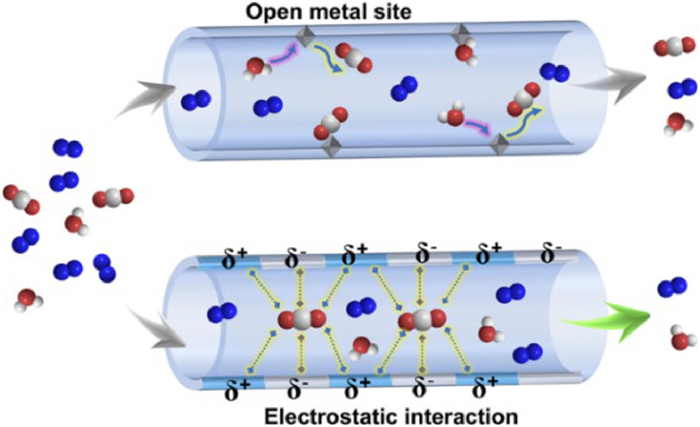
Scheme 1.
Schematic illustration of the synergistic effect of the match of electeostatic potentials for enhanced host-guest interactions between CO2, H2O and N2.

Inherent charge channels in a hydrogen-bonded framework for efficiently capturing CO2 from humid flue gas
Chenglin Shu , Yunzhe Zhou , Shuixiang Zou , Caiping Liu , Maochun Hong , Mingyan Wu


The atmospheric level of CO2 has unprecedentedly approached 419 ppm in recent years, which is about 1.5 times as compared with pre-industrial period. Such serious situation makes limiting CO2 emissions a challenging issue [1-4]. Since CO2 emission is closely related to the fossil fuels combustion, it is critical to develop suitable materials for achieve post-combustion CO2 capture (PCC) under practical flue gas conditions. Alkaline solvent systems can be used to treat CO2 based on chemical adsorption, but harsh and expensive regeneration process restricts their uses [5-9]. Now solid porous materials, especially metal-organic frameworks, are considered as a kind of promising materials, due to the easily recyclability and low energy consumption [10-12]. However, in an actual industrial process, flue gas from fuel combustion usually has a low CO2 partial pressure <0.4 bar as well as temperature up to 70 ℃, accompanied by an amount of N2 and water vapour [13-15]. The wet gas stream can deactivate and disintegrate the frameworks, by competing with CO2 and disrupting coordination bonds. At present, it still lacks efficient capture of CO2 from flue gas with porous materials. Therefore, capturing CO2 under wet conditions is an outstanding challenge. A suitable candidate should have the following characteristics: CO2 gas can be rapidly adsorbed at low partial pressure; high selectivity for CO2 over N2; high performance can be maintained over a wide range of temperatures and humidities [16-18]. Unfortunately, although many frameworks exhibit excellent capacity for CO2 adsorption, most of them do not exhibit stable CO2/N2 selectivity in the presence of steam and high temperature.
In crystal engineering, the design and synthesis of hydrogen bonded frameworks have received wide concerns recently. Such networks are constructed through hydrogen bonding and π···π interactions. In hydrogen bonds, C—H···O bonds are usually considered as weak or auxiliary interactions [19-24]. Contrary to common sense, C—H···O bonds could also play a vital role in crystal construction, such as determining crystal structure and improving stability [25]. Until now, such reports are very few, for most of hydrogen bonds usually consist of more polar atoms. There are not enough examples to illustrate the role for C—H···O hydrogen bonds. Furthermore, introducing active sites into the supramolecular networks can provide opportunity to generate charge-induced interactions between guest molecules and frameworks, then regulate the performance of materials [26,27]. For charge sites, its positive or negative characteristics have been used in photoluminescence, catalysis and detection, etc., which are different from other common neutral materials [28-31]. It has been reported that the N-methylated frameworks exhibit enhanced gas adsorption capacities compared to the original materials [32,33]. Theoretically, the charge sites should have different charge-induced interactions with gases of different polarities. This distinction can be used to develop separation applications. Until now, there have been few comprehensive reports to explore the relationship between charge sites and CO2 adsorption and separation systematically in hydrogen bonding frameworks.
Herein we present a rarely seen hydrogen-bonded metal-organic framework (FJI-W35), where one-dimensional (1D) chains are stabilized by C—H···O hydrogen bonds and π···π interactions. Furthermore, positively charged sites are distributed evenly on the pore wall, which gives FJI-W35 a highly polar pore environment. At room temperature, FJI-W35 exhibits nearly 60% of the CO2 total capacity at 0.01 bar, which indicates strong affinity for CO2. The single-component isotherms and dynamic breakthrough experiments confirm that FJI-W35 can realize high-performance CO2 capture. Additionally, benefitting from the robust framework, FJI-W35 can even capture humid CO2 gas at high temperatures. More importantly, CO2-loaded single-crystal structure shows that the inherent charge channels of FJI-W35 can generate strong interactions with CO2 molecules (Scheme 1).
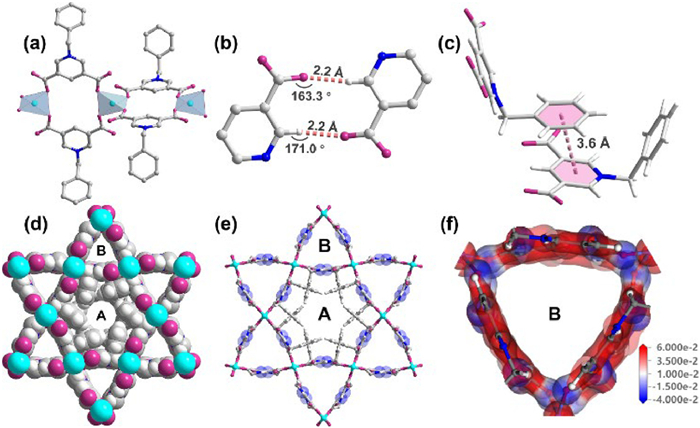
FJI-W35 can be obtained by solvothermal methods. Single-crystal X−ray diffraction analyses reveal that FJI-W35 crystallized in the hexagonal P63/mcc space group. The asymmetric unit consists of one-quarter of Co(II) ion and half ligand (Fig. 1). The Co(II) center is in a tetrahedral O4 coordination environment which is completed by four different carboxylate groups (Fig. 1a and Fig. S2 in Supporting information). At the same time, each ligand links two Co(II) centers as a μ2-bridge through two carboxylate groups, which results in one-dimensional (1D) chains along the crystallographic c-axis. The pyridine rings of ligands are staggered along the chains with the dihedral angles of 75.7° (Fig. S3 in Supporting information). Interestingly, each 1D chain interacts with four adjacent chains through dual C—H···O hydrogen bonds. Usually, a C—H···O hydrogen bond is acknowledged if the separation between the hydrogen atom of the aromatic C–H group and an oxygen atom is <2.9 Å and the C—H···O angle is larger than 110°. In FJI-W35, the H···O separation is 2.18 Å and the angle of C—H···O is 171.80°, which indicates there exists very strong C—H···O interactions (Fig. 1b) [34]. We think the N+ sites in the pyridine rings may enhance the C—H···O interactions. For hydrogen bonds, C—H···O bonds are usually considered as weak or auxiliary interactions. Contrary to common sense, C—H···O bonds could also play a vital role in crystal construction, in this work it determines crystal structure and improving stability. Until now, such reports are very few, for most of hydrogen bonds usually consist of more polar atoms. In addition, as shown in Fig. 1c, the distance between the benzene ring in the chain and the pyridine ring in the adjacent chain is about 3.67 Å, indicating strong π···π interactions. Through these supramolecular interactions, every chain interacts with four neighboring chains to form a three-dimensional (3D) supra-molecular framework (Fig. S4 in Supporting information). There are two kinds of channels (channel A and channel B) running along c axis (Fig. 1d). Channel A is hexagonal with the diameter of ca. 7.33 Å (H···H separation), while channel B is triangular with the diameter of about ca. 9.89 Å (Co···Co separation). Moreover, the N+ sites are located at the triangular channel B (Fig. 1e). Hirshfeld surface analysis demonstrates that a lot of positive charge centers are formed in channel B, which will increase the adsorption affinity of CO2 molecules due to strong intermolecular electrostatic interactions (Fig. 1f). Calculating using PLATON indicates that solvent-accessible volume represents a ∼24.2% void volume [35], which provides probability to accommodate guest molecules.
The phase purity of FJI-W35 was verified by the good consistency of the experimental and the simulated power X-ray diffraction (PXRD) patterns (Fig. S6 in Supporting information). The thermogravimetric analysis (TGA) reveals that FJI-W35 possesses good thermal stability. The activated FJI-W35 framework exhibits remarkable thermal stability, maintaining its structural integrity without significant weight loss up to approximately 300 ℃ under N2 atmosphere (Fig. S7 in Supporting information). Additionally, as presented in Fig. S8 (Supporting information), the in-situ variable temperature powder X-ray diffraction (VT−PXRD) patterns demonstrate that FJI-W35 maintains its structural integrity up to 200 ℃. The above-mentioned results suggest that FJI-W35 has good thermal stability. As is widely known such stable hydrogen-bonded frameworks stabilized by C—H···O interactions are rarely encountered. It is the strong hydrogen bonding and π···π interactions that enhance the stability of the framework. This finding highlights the structural integrity of the activated material under elevated temperatures, which is critical for its potential applications in high-temperature gas adsorption and separation processes.
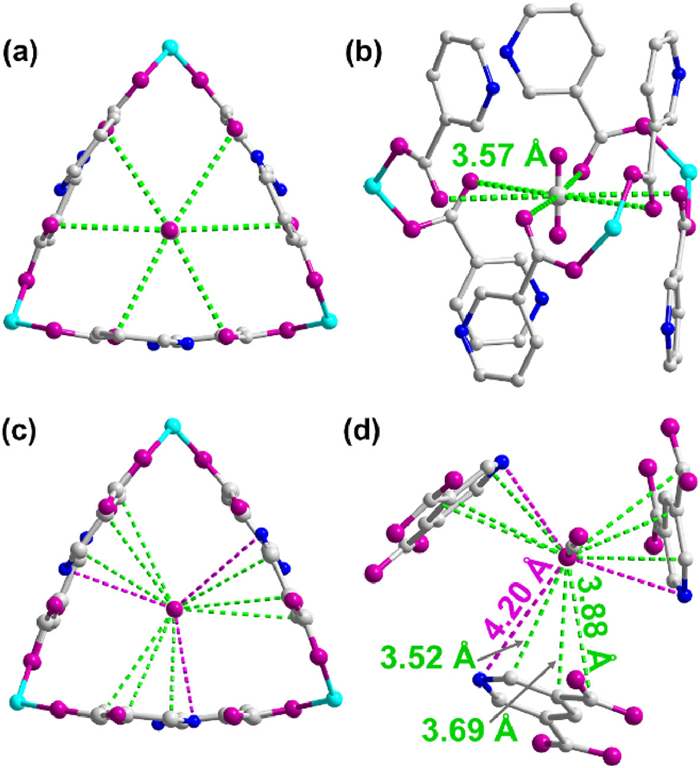
According to the moderate pore size and the particular pore environments of FJI-W35, we next tested its gas adsorption properties. Firstly, we conducted CO2 adsorption experiments at 195 K to evaluate the porosity of FJI-W35. The results revealed that the activated FJI-W35 demonstrates a high CO2 uptake at 195 K (Fig. 2a). The Brunauer-Emmett-Teller (BET) surface area is calculated as 209 m2/g. Motivated by the particular pore environment and high porosity of FJI-W35, we have investigated single component adsorption behavior for CO2 and N2 in the range of 273–373 K. As shown in Fig. 2b, in the range of 273–373 K, FJI-W35 always exhibits high adsorption capacity for CO2. For example, at 273 K, the adsorption isotherm of CO2 increases particularly rapidly in the low-pressure region. As the temperature gradually increases, the adsorption behavior of FJI-W35 towards CO2 shows no obvious decrease. At 298 K, the CO2 adsorption amount at 100 kPa can reach 29.6 cm3/g. To our surprise, at 1 kPa FJI-W35 can absorb 17.8 cm3/g of CO2, accounting for approximately 60% of the total adsorption amount. This value far exceeds those reported CO2 capture materials with topnotch performance, such as MOF-11 (21.6%) [36], NKMOF-9a (∼11.1%) [37] and dptz-CuSiF6 (∼5%) [38]. As the temperature continues to rise, FJI-W35 maintains its high CO2 absorption efficiency. Surprisingly, when the temperature is elevated to 373 K, FJI-W35 still absorbs 19.2 cm3/g CO2 at 100 kPa. The above results indicate that FJI-W35 has an exceptionally excellent CO2 absorption capacity which is very rare in previously reported materials [39-41]. Compared to CO2, theabsorption capacity of N2 is almost negligible. As shown in Fig. 2c, the N2 adsorption curves show almost linear increase, which indicates that FJI-W35 has no obvious interactions with N2 molecules [42,43]. The above adsorption results show that theFJI-W35 shows a great difference between CO2 and N2. Therefore, it can be assumed that the FJI-W35 can achieve high-performance CO2 capture from flue gas. Given the pronounced difference between CO2 and N2 adsorption, we next calculated the heats of adsorption (Qst) for both gases on FJI-W35 using the Virial equation method (Eqs. S1 and S2 in Supporting information). As illustrated in Fig. S9 (Supporting information), the initial Qst for CO2 at zero coverage reaches 64.6 kJ/mol, significantly exceeding the corresponding value for N2 (13.9 kJ/mol-). This substantial difference in adsorption heats clearly demonstrates the stronger affinity for CO2 gas. Remarkably, the adsorption heat of FJI-W35 for CO2 is much higher than those of numerous famous MOFs for CO2 capture, such as MOF-11 (45.6) [44], Zn-dmtrz-mip (26.5) [45], ZJU-620(Al) (11.2) [46], NKU-521a (41.0) [47], and HKUST-1 (35.0) (Table S2 in Supporting information) [48]. The apparent difference in gas adsorption and isosteric heats between CO2 and N2 prompts us to explore the potential of FJI-W35 for capturing CO2 from flue gas. To predict the selectivity of CO2 and N2, the ideal adsorbed solution theory (IAST) was used based on the single-component adsorption isotherms at 298 K. As shown in Fig. 2d, the IAST selectivity for CO2/N2 with the volume ratio of 15/85 can climb up to 558 as the pressure rises to 100 kPa. This performance surpasses most reported materials for PCC, such as NbOFFIOVE-Cu-TPA (471.9) [49], Cu-PSB (60.5) [50], FJUT-3 (178.3) [51], ZnF(daTZ) (120) [52], and Ni(3-ain)2 (26.3) [53], and comparable with IISERP-MOF16 (600) [54], positioning FJI-W35 as a highly promising candidate for flue gas separation. Even when the temperature reaches 373 K, the IAST selectivity remains as high as 84 (Fig. S10 in Supporting information). Furthermore, for 15/85 CO2/N2 mixtures, the separation potential is calculated as 5.8 mol/kg (Fig. S11 in Supporting information). Based on the comprehensive analysis of experimental and computational results, it can be deduced that FJI-W35 can perform well in separating CO2/N2. In consideration of the N+ sites distributed evenly in the channels of FJI-W35, we speculate that the strong interaction is originated from the charge-induced skeleton, which enhances the affinity of FJI-W35 for CO2. By comparison, there is almost no N2 uptake. Such big difference suggests that FJI-W35 can be nominated as a qualified material for CO2 capture. To better understand the nature of adsorption sites in frameworks based on charged ligands, we carried out the in-situ gas molecule loading single-crystal X-ray diffracion experiment to determine the gas binding sites. As depicted in Fig. 3, single-crystal data of activated FJI-W35 with adsorbed CO2 molecule was obtained. Consistent with previous speculation, the primary binding site for CO2 is mainly involved in channel B. In Figs. 3a and b, the C atom of CO2 molecule exhibits close contact with six deprotonated carboxyl oxygen atoms for six ligands and the C···O separation is ca. 3.57 Å. At the meantime, the O atoms of CO2 interact with the pyridine rings of the ligands, with the O···C separations of 3.52–3.88 Å and O···N separations of 4.20 Å.

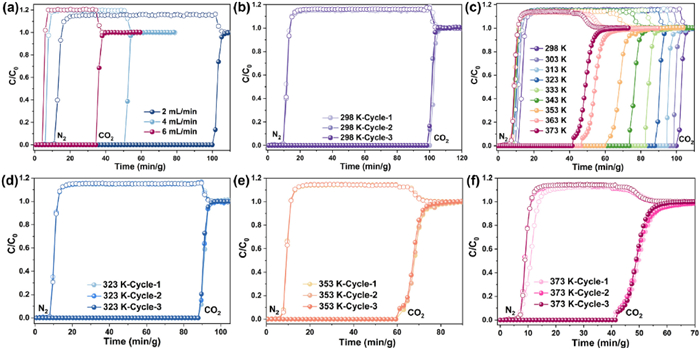
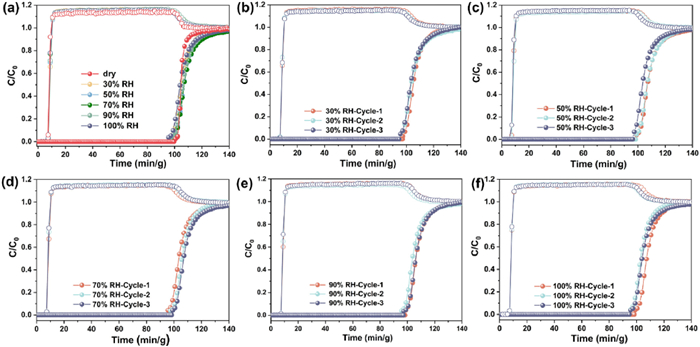
To evaluate the practical separation potential of FJI-W35, the practical separation experiments were also carried out under different conditions. The CO2/N2 (15/85) mixture with a flow of 2 mL/min is selected to be tested. As shown in Figs. 4a and b, high-efficiency separation of CO2/N2 has been achieved from the gas mixture. N2 flows out at 7.0 min/g firstly, while no CO2 signal is detected until 99.9 min/g. The retention time is 92.9 min/g at 298 K, which prompts us to explore the CO2/N2 separation performance under more temperature conditions. The retention times of CO2 at 303, 313, 323, 333, 343, 353, and 363 K are 91.3, 87.4, 80.7, 74.2, 66.5, 52.3, and 39.1 min/g, respectively, with consistent CO2 separation performance retained even under elevated temperature conditions (Figs. 4c-e). Even up to 373 K, FJI-W35 still presents the breakthrough time of 35.1 min/g. Compared with the breakthrough time at 298 K, the separation performance still maintains about 38%. The good reusability of FJI-W35 has been proved by three cycles of breakthrough experiments (Fig. 4f). The above results illustrate the potential applications of FJI-W35 for separation and purification under such high temperature conditions, because of its good thermal stability and strong interactions with CO2 molecules. The good gas separation performance may be originated from the charge-induced interactions between CO2 and framework. The charge-induced interactions catch the CO2 molecules firmly. Meanwhile, the strong hydrogen bonding interactions maintain the structure of the framework. To our knowledge, the materials which have excellent CO2/N2 separation at high temperature are very rare since previous CO2/N2 separations are usually tested at room temperature. Given the ubiquitous presence of water vapor in flue gas streams, the efficiency and recyclability of FJI-W35 under humid conditions were systematically evaluated to address its practical applicability. Fig. 5a presents dynamic breakthrough experiments for a CO2/N2 mixture (15/85, v/v) under humid conditions with relative humidity (RH) ranging from 0 to 100%. FJI-W35 exhibits exceptional CO2/N2 separation stability across the full RH range (0–100%), as revealed by breakthrough curve analysis. Notably, even at 100% RH, the CO2 retention time remains as high as 87.4 min/g, which has only 6% decrease in the CO2 retention time and outperforms most reported PPC materials. Comparative analysis highlights its superiority over benchmark materials. At 65% RH, IRMOF-74-III-CH2NH2 [55] shows 80% reduction in the CO2 retention time. PN@MOF-5 experiences ∼5% reduction breakthrough time. NH2-UiO-66 and MOF-199 experience complete performance degradation under humid conditions [56]. Cyclic breakthrough tests under identical conditions (3 cycles) confirmed its robust recyclability, with no measurable performance degradation after regeneration via 373 K He flow activation (Figs. 5b-f). These findings demonstrate that incorporating ionic ligands into the framework is an effective strategy to enhance hydrothermal stability, enabling practical gas purification under humid industrial conditions. These findings demonstrate that integrating ionic ligands into frameworks represents an effective strategy to design materials for practical gas mixture purification under humid industrial conditions, as validated by their robust CO2/N2 separation performance across the full RH spectrum.
In summary, a novel hydrogen-bonded framework has been successfully synthesized, which is stabilized by charge-assisted C—H···O bonds and π···π interactions. Due to its good stability and strong interactions with CO2, this framework can preferentially adsorb CO2 from CO2/N2 mixture up to 373 K and retain its performance at 100% RH. X-ray diffraction experiments reveal that the charge-induced interactions make CO2 selectively adsorbed in the channel where the inherent charge sites are exposed. FJI-W35, which possesses the inherent charge sites and surface chemistry, can selectively adsorb CO2 even in high temperature and high humidity, overcoming the limitations of conventional materials. This research is significant as it addresses a critical industrial challenge and enabling efficient carbon capture from real-world, moisture-laden flue gases. Optimized MOFs could offer low-energy and scalable solutions to advance global carbon neutrality goals.
Chenglin Shu: Resources, Investigation, Conceptualization. Yunzhe Zhou: Writing – original draft, Software, Formal analysis, Data curation. Shuixiang Zou: Validation, Methodology. Caiping Liu: Visualization, Software. Maochun Hong: Project administration, Formal analysis, Conceptualization. Mingyan Wu: Writing – review & editing, Project administration, Funding acquisition.
The authors declare that they have no known competing financial interests or personal relationships that could have appeared to influence the work reported in this paper.
This work is supported by the National Natural Science Foundation of China (NSFC, No. 22271282) and the Self-deployment Project Research Program of Haixi Institutes, Chinese Academy of Sciences (No. CXZX-2022-JQ04). Additionally, this work is also supported by the Strategic Priority Research Program of the Chinese Academy of Sciences (No. XDB1170000), Fujian Science & Technology Innovation Laboratory for Optoelectronic Information of China (No. 2021ZR120) and NSF of Fujian Province (Nos. 2021J01517 and 2020J06034).
Supplementary material associated with this article can be found, in the online version, at doi:
P. Nugent, Y. Belmabkhout, S.D. Burd, et al., Nature 495 (2013) 80–84. doi: 10.1038/nature11893
O. Shekhah, Y. Belmabkhout, Z. Chen, et al., Nat. Commun. 5 (2014) 4228. doi: 10.1038/ncomms5228
Z. Zhou, T. Ma, H. Zhang, et al., Nature 101 (2024) 96–101. doi: 10.1038/s41586-024-08080-x
C. Wang, X. Song, Y. Wang, et al., Angew. Chem. Int. Ed. 62 (2023) e202311482. doi: 10.1002/anie.202311482
J. Liang, A. Nuhnen, S. Millan, et al., Angew. Chem. Int. Ed. 59 (2020) 6068–6073. doi: 10.1002/anie.201916002
H.M. Wen, C. Liao, L. Li, et al., J. Mater. Chem. A 7 (2019) 3128–3134. doi: 10.1039/c8ta11596f
P.M. Bhatt, Y. Belmabkhout, A. Cadiau, et al., J. Am. Chem. Soc. 138 (2016) 9301–9307. doi: 10.1021/jacs.6b05345
D. Sengupta, S. Bose, X. Wang, et al., J. Am. Chem. Soc. 146 (2024) 27006–27013. doi: 10.1021/jacs.4c08757
Y. Chang, L. Wang, Z. Jiang, et al., Sep. Purif. Technol. 326 (2023) 124828. doi: 10.1016/j.seppur.2023.124828
K. Adil, Y. Belmabkhout, R.S. Pillai, et al., Chem. Soc. Rev. 46 (2017) 3402–3430. doi: 10.1039/C7CS00153C
Y. He, B. Li, M. O’Keeffe, B. Chen, Chem. Soc. Rev. 43 (2014) 5618–5656. doi: 10.1039/C4CS00041B
K. Adil, P.M. Bhatt, Y. Belmabkhout, et al., Adv. Mater. 29 (2017) 1702953. doi: 10.1002/adma.201702953
A. Chaix, G. Mouchaham, A. Shkurenko, et al., J. Am. Chem. Soc. 140 (2018) 14571–14575. doi: 10.1021/jacs.8b08770
L. Gan, E. Andres-Garcia, G. Minguez Espallargas, J.G. Planas, ACS Appl. Mat. Interfaces 15 (2023) 5309–5316. doi: 10.1021/acsami.2c20373
Y. Hu, Y. Jiang, J. Li, et al., Adv. Funct. Mater. 33 (2023) 2213915. doi: 10.1002/adfm.202213915
J. Jia, P.M. Bhatt, S.R. Tavares, et al., Angew. Chem. Int. Ed. 63 (2024) e202318844. doi: 10.1002/anie.202318844
Z. Chen, X. Wang, R. Cao, et al., ACS Mater. Lett. 2 (2020) 1129–1134. doi: 10.1021/acsmaterialslett.0c00264
X.H. Xiong, Z.W. Wei, W. Wang, L.L. Meng, C.Y. Su, J. Am. Chem. Soc. 145 (2023) 14354–14364. doi: 10.1021/jacs.3c03309
R.B. Lin, B. Chen, Chem 8 (2022) 2114–2135. doi: 10.1016/j.chempr.2022.06.015
X. Song, Y. Wang, C. Wang, et al., J. Am. Chem. Soc. 144 (2022) 10663–10687. doi: 10.1021/jacs.2c02598
R.B. Lin, Y. He, P. Li, et al., Chem. Soc. Rev. 48 (2019) 1362–1389. doi: 10.1039/c8cs00155c
C. Ma, L. Qin, T. Zhou, J. Zhang, Energy Environ. Sci. 17 (2024) 8992–9026. doi: 10.1039/d4ee03766a
Z. Ji, Q. Li, Y. Zhou, et al., Angew. Chem. Int. Ed. 63 (2024) e202411175. doi: 10.1002/anie.202411175
Y. Zhou, C. Chen, R. Krishna, et al., Angew. Chem. Int. Ed. 62 (2023) e202305041. doi: 10.1002/anie.202305041
O.T. Qazvini, R. Babarao, S.G. Telfer, Nat. Commun. 12 (2021) 197. doi: 10.1038/s41467-020-20489-2
X. Ding, Z. Liu, Y. Zhang, et al., Angew. Chem. Int. Ed. 61 (2022) e202116483. doi: 10.1002/anie.202116483
Y. Xie, X. Ding, J. Wang, G. Ye, Angew. Chem. Int. Ed. 62 (2023) e202313951. doi: 10.1002/anie.202313951
L.Z. Cai, X.Y. Yu, M.S. Wang, et al., Angew. Chem. Int. Ed. 64 (2025) e202417072. doi: 10.1002/anie.202417072
W.P. Lustig, F. Wang, S.J. Teat, et al., Inorg. Chem. 55 (2016) 7250–7256. doi: 10.1021/acs.inorgchem.6b00897
A.B. Kanj, J. Bürck, N. Vankova, et al., J. Am. Chem. Soc. 143 (2021) 7059–7068. doi: 10.1021/jacs.1c01693
B. Valizadeh, T.N. Nguyen, S. Kampouri, et al., J. Mater. Chem. A 8 (2020) 9629–9637. doi: 10.1039/d0ta01046d
L.Z. Cai, Z.Z. Yao, S.J. Lin, M.S. Wang, G.C. Guo, Angew. Chem. Int. Ed. 60 (2021) 18223–18230. doi: 10.1002/anie.202105491
X.J. Xi, Z. Ji, F. Lang, et al., Chem. Eng. J. 497 (2024) 154420. doi: 10.1016/j.cej.2024.154420
Q. Yin, P. Zhao, R.J. Sa, et al., Angew. Chem. Int. Ed. 57 (2018) 7691–7696. doi: 10.1002/anie.201800354
A.L. Spek, J. Appl. Crystallogr. 36 (2003) 7–13. doi: 10.1107/S0021889802022112
H. Wu, Y. Yuan, Y. Chen, et al., Energy Fuels 35 (2021) 610–617. doi: 10.1021/acs.energyfuels.0c03144
S. Geng, H. Xu, C.S. Cao, et al., Angew. Chem. Int. Ed. 62 (2023) e202305390. doi: 10.1002/anie.202305390
W. Liang, P.M. Bhatt, A. Shkurenko, et al., Chem 5 (2019) 950–963. doi: 10.1016/j.chempr.2019.02.007
K.A. Forrest, T. Pham, P. Nugent, et al., Cryst. Growth Des. 13 (2013) 4542–4548. doi: 10.1021/cg401034s
Y.Z. Li, G.D. Wang, S. Lu, et al., Chem. Eng. J. 484 (2024) 149494. doi: 10.1016/j.cej.2024.149494
Y. Hu, Y. Chen, W. Yang, et al., Sep. Purif. Technol. 343 (2024) 127099. doi: 10.1016/j.seppur.2024.127099
Y. Zhou, C. Chen, Z. Ji, et al., ACS Mater. Lett. 6 (2024) 1388–1395. doi: 10.1021/acsmaterialslett.4c00111
J.J. Pang, Z.Q. Yao, H.L. Huang, et al., Angew. Chem. Int. Ed. 64 (2025) e202421681. doi: 10.1002/anie.202421681
H. Wu, Y. Yuan, Y. Chen, et al., Energy Fuels 35 (2020) 610–617. doi: 10.1109/icma49215.2020.9233607
G. Zhang, K. Zhang, X.Y. Lou, et al., ACS Mater. Lett. 6 (2024) 446–451. doi: 10.1021/acsmaterialslett.3c01250
L. Hu, W. Wu, L. Jiang, et al., ACS Appl. Mater. Interfaces 15 (2023) 43925–43932. doi: 10.1021/acsami.3c10086
N. Li, Z. Chang, H. Huang, et al., Small 15 (2019) e1900426. doi: 10.1002/smll.201900426
X. Yan, S. Komarneni, Z. Zhang, Z. Yan, Micropor. Mesopor. Mat. 183 (2014) 69–73. doi: 10.1016/j.micromeso.2013.09.009
L. Li, S. Zhao, H. Huang, et al., Adv. Sci. 11 (2023) 2303057. doi: 10.1002/advs.202303057
S.C. Pal, R. Krishna, M.C. Das, Chem. Eng. J. 460 (2023) 141795. doi: 10.1016/j.cej.2023.141795
L. Zhang, Z. He, Y. Liu, et al., ACS Appl. Mater. Interfaces 15 (2023) 30394–30401. doi: 10.1021/acsami.3c06530
Z. Shi, Y. Tao, J. Wu, et al., J. Am. Chem. Soc. 142 (2020) 2750–2754. doi: 10.1021/jacs.9b12879
S.M. Wang, H.R. Liu, S. Ni, Q.Y. Yang, Chin. J. Chem. 41 (2023) 763–768. doi: 10.1002/cjoc.202200658
S. Nandi, H.D. Singh, D. Chakraborty, R. Maity, R. Vaidhyanathan, ACS Appl. Mater. Interfaces 13 (2021) 24976–24983. doi: 10.1021/acsami.1c05845
A.M. Fracaroli, H. Furukawa, M. Suzuki, et al., J. Am. Chem. Soc. 136 (2014) 8863–8866. doi: 10.1021/ja503296c
N. Ding, H. Li, X. Feng, et al., J. Am. Chem. Soc. 138 (2016) 10100–10103. doi: 10.1021/jacs.6b06051

Scheme 1 Schematic illustration of the synergistic effect of the match of electeostatic potentials for enhanced host-guest interactions between CO2, H2O and N2.

Figure 1 Single-crystal X-ray structure of FJI-W35. (a) The subunits of FJI-W35. (b) Cage-like structure of FJI-W35. Solvent molecules and hydrogen atoms are omitted for clarity. (c) The structure of tetrahedron cage-A. (d) The structure of octahedron cage-B. (e) The 12-connected Co8 cluster. (f) The electrostatic surface potential ofpore channels for FJI-W35.

Figure 2 CO2 and N2 adsorption performance on FJI-W35. (a) The CO2 adsorption isotherm (195 K) of the activated FJI-W35. (b, c) Single-component adsorption isotherms of CO2 and N2 in the range of 273–373 K. (d) IAST selectivity of CO2/N2 (15/85, v/v) at 298 K.

Figure 3 (a, b) Single crystal structure of CO2 loaded FJI-W35. The interactions between the C atom of CO2 and the framework. (c, d) The interactions between the O atoms of CO2 and the framework. The Cδ+···Oδ− interactions are shown in green dotted lines and the Nδ+···Oδ− interactions are shown in purple dotted lines.

Figure 4 The breakthrough experiments of FJI-W35 for CO2/N2 (15/85, v/v). (a) The separation experiments of FJI-W35 at different gas flow rates at 298 K. (b) The cycling breakthrough tests of FJI-W35 with a flow rate of 2.0 mL/min at 298 K. (c) The separation experiments of FJI-W35 under different temperatures with a gas flow rate of 2.0 mL/min. (d-f) The cycling breakthrough tests of FJI-W35 for CO2/N2 with a flow rate of 2.0 mL/min under different temperatures (323, 353 and 373 K).

 扫一扫看文章


扫一扫关注我们
 DownLoad:
 下载:

 下载: