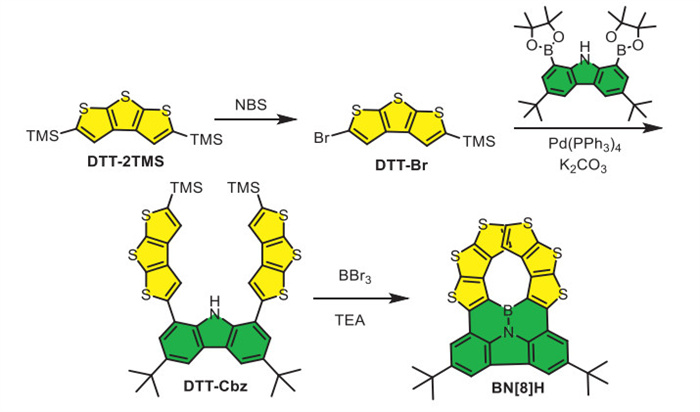
Scheme 1.
Synthetic route to BN[8]H.

Fluoride-induced sign inversion of circularly polarized luminescence of B,N-thia[8]helicene
Shuai Qiu , Jia Tang , Wan Xu , Zhiying Ma , Chao Zhang , Sheng Zhang , Chunli Li , Wei Tian , Hua Wang


Organic molecules with circularly polarized luminescence (CPL) [1-3] have attracted significant research interest due to their potential applications in a variety of fields, including anti-counterfeiting, bioimaging and optical sensing [4-9]. External stimuli such as solvents, temperature, photons, and ions induced sign inversion of CPL in chiral systems can significantly increase the convenience of CPL materials [10-17]. Current strategies to control the sign inversion of CPL commonly focus on supramolecules systems, chiral small molecule species, liquid crystals and metal complexes [18-27]. However, at the molecular level, it is still a great challenge for switching the CPL sign to a given enantiomer without any chemical modification.
Recently, helicenes [28-33], defined as ortho-fused polycyclic aromatic compounds with helical molecular structures and inherent helical chirality, have considered as ideal candidates as CPL handedness switching materials due to their modifiability of the molecular skeleton and tunability of photo-physical and chiro-optical properties. For instance, combine helicenes with rigid twistacenes [34], motor-helicene hybrid system [35], oxidation or enhanced ICT modulation [36], combine helicene with responsive luminophore [37], change in the peripheral substituent of helicene [38], and heterohelicenes [39]. Among them, heteroaromatic helicenes showed impressive CPL response, especially the doping with neighboring boron–nitrogen (BN) units in helicene skeleton. Boron–nitrogen atoms, on the one hand, can endow helicenes with delocalized electronic structures, well-tunable excited-state photophysical properties, enhance their fluorescence quantum yield, and regulate half-maximum [40-46]. On the other hand, incorporating boron–nitrogen atoms into the appropriate positions in helicenes could also adjust the electric (μ) and magnetic (m) transition dipole moments to possibly change the θu,m and improve the luminescence dissymmetry factors (glum) values [47-49]. However, incorporating BN units into the skeleton of helicenes with CPL handedness switching still remains unexplored.
Herein, we report a facile and efficient synthesis of thia[8]helicene (BN[8]H) with BN unit and dithieno[2,3-b:3′,2′-d]thiophene (DTT) moiety [50]. Notably, BN[8]H exhibits moderate photoluminescence quantum yield and strong chiroptical properties. In addition, the novel sign inversion of both ECD and CPL were observed by adding certain amounts of tetra-n-butylammonium fluoride and boron trifluoride diethyl etherate. The theoretical calculation results show that the dipole moments and their angles of the magnetic and electric transitions of BN[8]H are changed by the addition of fluoride ions. This study establishes a new strategy to efficiently and conveniently adjust the handedness and intensity of CPL of helicenes, which may provide a universal platform for future construction of helicenes based CPL-active smart materials and devices with promising application potentials.
The synthetic route to BN[8]H is shown in Scheme 1. The carbazole precursor DTT-Cbz was synthesized via a Suzuki coupling reaction with 3–bromo-dithieno[2,3-b:3′,2′-d]thiophene (DTT-Br) [51] and readily available borylated carbazole derivative in an excellent isolated yield up to 85%. Introduction of boron atoms to the molecular structure by using boron tribromide as the boron source with triethylamine as the additive in o-dichlorobenzene (o-DCB) at 180 ℃ was achieved to produce BN[8]H in 78% yield in gram scale. Standard spectroscopic techniques (proton nuclear magnetic resonance 1H NMR, 13C NMR, and high-resolution mass spectrometry-electrospray ionization mass spectrometry) of above compounds are shown in Supporting information.
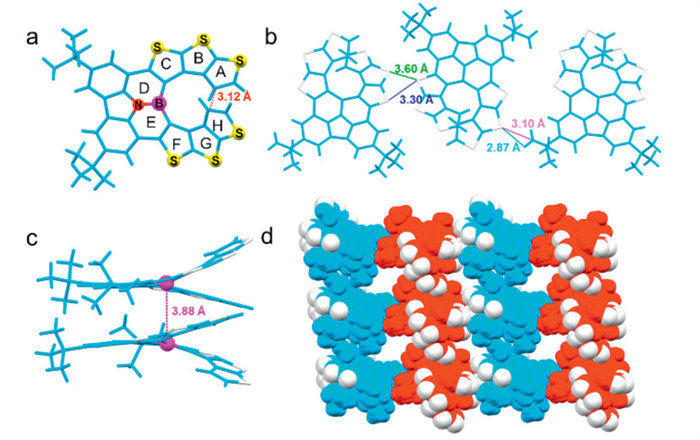
The single crystal of rac-BN[8]H was obtained by slow evaporation in chloroform/methanol (3:1, v/v) solutions and characterized by single crystal X-ray diffraction analysis. Rac-BN[8]H belongs to monoclinic space group C12/C2. As shown in Fig. 1, the crystal structure of BN[8]H shows that two B, N-fused six-membered rings embedded in the center of helicene and displays a helical skeleton due to the steric hindrance from the terminal thiophene rings. The formation of B, N-hexagons results in smaller dihedral angle (40.96°, ring A and ring H) with shorter distance (3.12 Å, C14···C20) of thiophene rings, and the B–N bond lengths is 1.417 Å (Fig. S18 in Supporting information). In the crystal packing of rac-BN[8]H, two homochiral molecules form a dimer with an intermolecular distance of 3.88 Å (B···B) (Fig. 1c). There are multiple intermolecular interactions among the surrounding molecules from the neigh-boring unit cells. These included S1···S2: 3.30 Å, S2···S3: 3.60 Å, S6···H35B: 2.87 Å and S6···C35: 3.10 Å (Fig. 1b), resulting in the rac-BN[8]H crystal composed of P and M configurations with a ratio of 1:1, two kinds of dimers are in-volved and embedded to each other in the assembly columns, forming a two dimensional (2D) supramolecular sheet framework (Fig. 1d). The details of crystal structures and intra-molecular interactions in crystals are shown in Fig. S22 (Supporting information), and the crystal parameters are listed in Tables S7 (Supporting information).
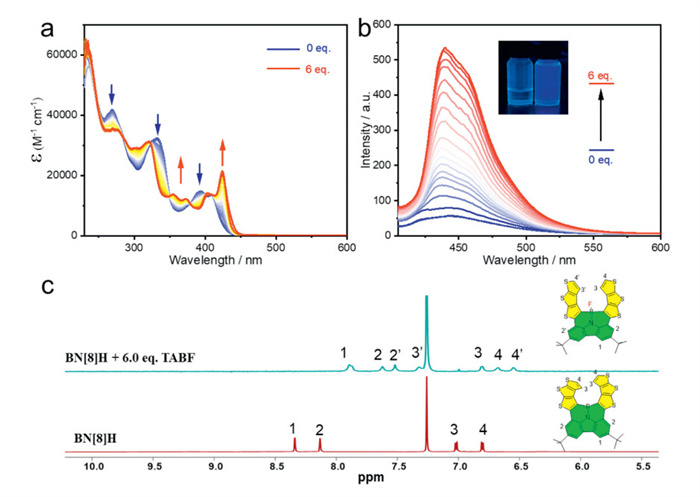
The UV–vis absorption spectra of BN[8]H in CH2Cl2 exhibit lowest energy absorption bands corresponding to S0 → S1 transitions at 410 and 392 nm, followed by two stronger bands at 330 nm and 268 nm, respectively. Time-dependent density functional theory (TD-DFT) calculations at the B3LYP/6–31G (solvent CH2Cl2) level of theory indicate that the lowest-energy absorption band is a superposition of two transitions (oscillator strengths f of 0.26 and 0.32) corresponding primarily to the HOMO to LUMO transition (Table S1 and Fig. S7 in Supporting information), where the HOMO is delocalized over the whole molecule, while the LUMO is predominantly confined to the carbazole moieties and BN-rings (Fig. S8 in Supporting information). The fluorescence maxima are positioned at 465, 461 and 467 nm in CH2Cl2, MeOH and MeCN, respectively (Fig. S9 in Supporting information). And the fluorescence quantum yield of BN[8]H is 1.89% (Fig. S10a in Supporting information). Thus, BN[8]H basically shows a very weak solvatochromic effect.
Due to the empty orbital on the boron atom, BN[8]H is able to bond with Lewis bases and therefore changed its photoelectric properties. However, even by adding 6.0 equiv. tetrabutylammonium salts of Cl-, Br-, I-, ClO4- and PF6- to a THF solution of BN[8]H, their solution UV–vis is and fluorescence spectra were basically unchanged (Fig. S11 in Supporting information). Interestingly, upon the addition of tetra-n-butylammonium fluoride (TBAF), an obvious absorption peak appeared at 424 nm and the fluorescence emission peak gradually shifted to 436 nm and the intensity increased significantly. The color of the solution changed from green to yellow, while the fluorescence quantum yield increased up to 12.31% (Fig. S10b in Supporting information). The complexation constant and detection limit for TABF of BN[8]H calculated to be 1.05 × 10⁴ L/mol and 26 nmol/L (Figs. S12 and 13 in Supporting information), respectively. The experimental results prove that BN[8]H has the potential application in the fields of sensors, smart materials and stimulus-responsive materials. When boron trifluoride diethyl etherate was added to the solution above, the UV–vis and fluorescence spectra reverted back (Fig. S14 in Supporting information), indicating that the coordination between fluorine and boron was reversible and can be cycled several times. The responsiveness of BN[8]H to fluoride ions is attributed to the high electronegativity, small atomic radius, and low energy state of fluoride ions, which enable them to match the energy level of boron's vacant orbital to form a stable complex with a tetrahedral geometry [52,53]. To gain further insight into the reason for the formation of B-F complexes, we performed DFT calculations on the B3LYP/6–31G(d,p) level. As shown in Table S3 (Supporting information), the Mayer bond order of B-F bond is 1.06, which is indicative of a strong interaction between boron and fluoride. However, the Mayer bond order of B-Cl bond only is 0.09, it is proved that chloride ions are difficult to form stable complexes with boron.
To further prove the coordination between fluorine and boron, the 1H NMR titration experiments were performed before and after the addition of TABF in BN[8]H. As shown in Fig. 2c, when an excess of fluoride ion (6.0 equiv.) was added to ensure a complete reaction, the chemical shift of proton changed obviously, indicating that the 3-coordinated boron was converted to a 4-coordinated one.
We also got the single crystals of fluorinated complex with the tetracoordinated boron atom. As shown Fig. S19 (Supporting information), rac-BN[8]H-F belongs to monoclinic space group P-1. The titration of fluoride caused a significant change of the helical skeleton of BN[8]H, the lengths of the B–N bond and B–C bonds increased after coordination with fluoride, from 1.417, 1.544, and 1.561 Å to 1.531, 1.642, and 1.623 Å (Fig. S19), respectively. The dihedral angle (ring A' and ring B') and the distance of C27···C35 increases to 60.77° and 3.37 Å (Fig. S20 in Supporting information), respectively. In the packing diagram, tetrabutylammonium ions are uniformly dispersed in 2D supramolecular sheet framework of BN[8]H-F and broken the intermolecular B···B interactions. The homochiral isomers stack along the a-axis through multiple intermolecular interactions (F···H, F···C, S···H, C···H, and H···H) and the heterochiral molecules are stacked along the c-axis through intermolecular S···S interactions (Fig. S21 in Supporting information). The details of crystal structures are shown in Fig. S23 (Supporting information), and the crystal parameters are listed in Table S8 (Supporting information).
The chiral resolutions of BN[8]H was successfully resolved by chiral HPLC (Fig. S15 in Supporting information). The optical rotations of (+)-BN[8]H,
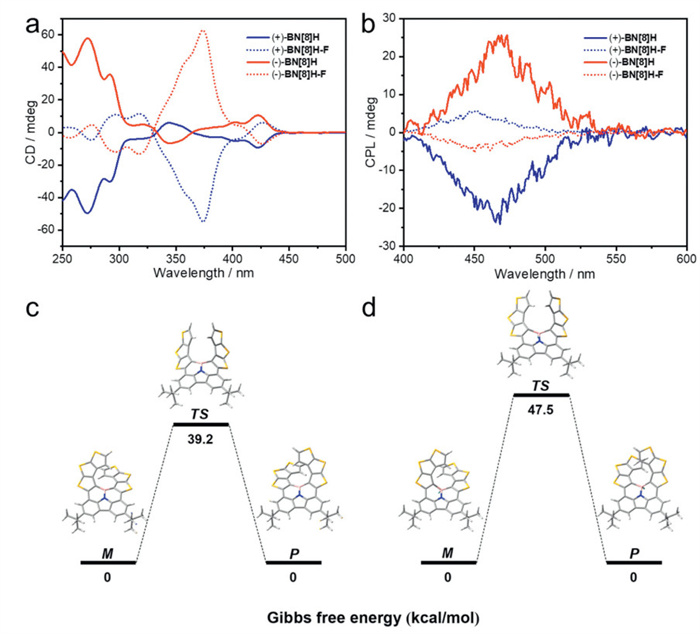
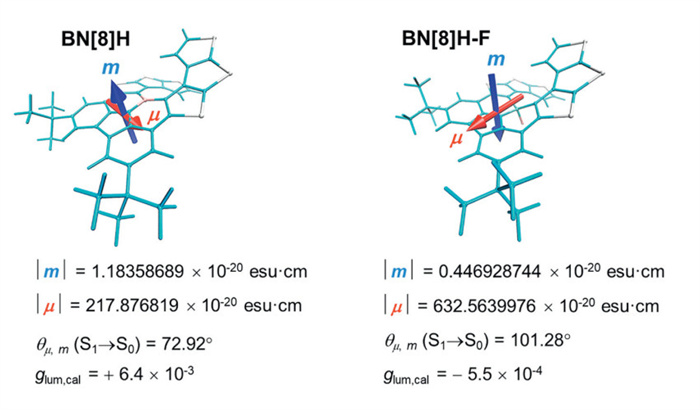
To evaluate the conformational stability, the racemization process of BN[8]H and BN[8]H-F was estimated by DFT calculation at the B3LYP/6–31G(d, p) level. As shown in Fig. 3c, the energy barrier required for the transformation from (M)-BN[8]H to (P)-BN[8]H was 39.2 kcal/mol. After treatment with TABF, the energy barrier was increased to 47.5 kcal/mol. These experimental results suggest that BN[8]H and BN[8]H-F maintain stable chirality that is resistant to flipping.
In summary, we have efficiently synthesized a new boron–nitrogen infused heterohelicene, BN[8]H via Suzuki coupling and intramolecular electrophilic arene borylation reactions. The helical structures of BN[8]H and BN[8]H-F were con-firmed by X-ray single crystal analysis. Enantiomers BN[8]H showed a fluoride-induced sign inversion of both ECD and CPL. TD-DFT calculations revealed that the fluoride ions significant influence the transition dipole moments and θu,m, resulting in CPL reversal. This study establishes a new strategy to efficiently and conveniently adjust the handedness and intensity of CPL of helicenes based on B, N-embedded molecular system. We believe that this finding can help providing a deep insight in regulating the chiroptical behaviors of helicenes and highlighting the potential for integrated chiral electronics and photonics.
The authors declare that they have no known competing financial interests or personal relationships that could have appeared to influence the work reported in this paper.
Shuai Qiu: Writing – original draft, Investigation, Formal analysis, Data curation. Jia Tang: Formal analysis. Wan Xu: Formal analysis. Zhiying Ma: Data curation. Chao Zhang: Formal analysis. Sheng Zhang: Funding acquisition, Formal analysis, Data curation. Chunli Li: Software, Investigation. Wei Tian: Writing – review & editing, Supervision. Hua Wang: Writing – review & editing, Methodology, Funding acquisition.
This work was financially supported by the National Natural Science Foundation of China (Nos. 22471061, U2004213, 22475063), Natural Science Foundation of Henan (Nos. 242300421607, 242300421611, 252300420754), China Postdoctoral Science Foundation (No. 2023M730951) and Open Foundation project of Henan University (No. DCSHENU2420).
Supplementary material associated with this article can be found, in the online version, at doi:
X. Zou, N. Gan, Y. Gao, et al., Angew. Chem. Int. Ed. 64 (2025) e202417906. doi: 10.1002/anie.202417906
J. Liu, X. Zhou, X. Tang, et al., Adv. Funct. Mater. 35 (2025) 2414086. doi: 10.1002/adfm.202414086
Y.J. Long, X.N. Han, Y. Han, et al., Chin. Chem. Lett. 36 (2025) 110600. doi: 10.1016/j.cclet.2024.110600
L.E. MacKenzie, R. Pal, Nat. Chem. Rev. 5 (2021) 109–124.
M. Zhang, Q. Guo, Z. Li, et al., Sci. Adv. 9 (2023) eadi9944. doi: 10.1126/sciadv.adi9944
L. Wan, R. Zhang, E. Cho, et al., Nat. Photonics 17 (2023) 649–655. doi: 10.1038/s41566-023-01230-z
C. Wang, T. Jiang, X. Ma, Chin. Chem. Lett. 31 (2020) 2921–2924. doi: 10.1016/j.cclet.2020.03.021
S. Huo, P. Duan, T. Jiao, Q. Peng, M. Liu, Angew. Chem. Int. Ed. 129 (2017) 12342–12346. doi: 10.1002/ange.201706308
D. Zhang, C.Y. Yu, L. Zheng, et al., Chin. Chem. Lett. 31 (2020) 673–676. doi: 10.1109/icuems50872.2020.00147
K. Takaishi, K. Iwachido, T. Ema, J. Am. Chem. Soc. 142 (2020) 1774–1779. doi: 10.1021/jacs.9b13184
X. Song, X. Zhu, S. Qiu, et al., Angew. Chem. Int. Ed. 61 (2022) 8574–8583.
J. Bao, R. Lan, C. Shen, et al., Adv. Optical Mater. 10 (2022) 2101910. doi: 10.1002/adom.202101910
F. Wang, W. Ji, P. Yang, et al., ACS Nano 13 (2019) 7281–7290. doi: 10.1021/acsnano.9b03255
X. Wang, Q. Song, Z. He, et al., Chin. Chem. Lett. 36 (2025) 110047. doi: 10.1016/j.cclet.2024.110047
K. Yao, Z. Liu, H. Li, et al., Sci. China Chem. 65 (2022) 1945–1952. doi: 10.1007/s11426-022-1319-9
A.H.G. David, R. Casares, J.M. Cuerva, et al., J. Am. Chem. Soc. 141 (2019) 18064–18074. doi: 10.1021/jacs.9b07143
M. Xu, Z. Xu, M.A. Soto, et al., Adv. Mater. 35 (2023) 2301060. doi: 10.1002/adma.202301060
S. Ghorai, S. Show, A. Das, Angew. Chem. Int. Ed. 64 (2025) e202500879. doi: 10.1002/anie.202500879
M.Y. Zhang, X. Liang, D.N. Ni, et al., Org. Lett. 23 (2021) 2–7. doi: 10.1021/acs.orglett.0c02463
K. Yao, Z. Wang, P. Wang, et al., Angew. Chem. Int. Ed. 64 (2025) e202420290. doi: 10.1002/anie.202420290
W. Li, S. Yin, Z. Song, et al., Inorg. Chem. Front. 12 (2025) 1176–1186. doi: 10.1039/d4qi02730b
Y. Zhang, J. Wang, H. Chen, et al., Chin. Chem. Lett. 33 (2022) 2473–2476. doi: 10.1016/j.cclet.2021.11.069
K. Fu, G. Liu, ACS Nano 18 (2024) 2279–2289. doi: 10.1021/acsnano.3c10151
R. Ren, Y. Pan, H.X. Wang, et al., Chin. Chem. Lett. (2025) 111060.
J. Liu, Z.P. Song, L.Y. Sun, et al., Responsive Mater. 1 (2023) e20230005. doi: 10.1002/rpm.20230005
S. Li, J. Wang, M. Tian, et al., Angew. Chem. Int. Ed. 63 (2024) e202405615. doi: 10.1002/anie.202405615
W. Kang, Y. Tang, X. Meng, Angew. Chem. Int. Ed. 62 (2023) e202311486. doi: 10.1002/anie.202311486
Y. Shen and C.F. Chen, Chem. Rev. 112 (2012) 1463–1535. doi: 10.1021/cr200087r
W.L. Zhao, M. Li, H.Y. Lu, et al., Chem. Commun. 55 (2019) 13793–13803. doi: 10.1039/c9cc06861a
J.F. Xing, K. Li, W. Xiang, et al., Chin. Chem. Lett. (2025) 110982.
T. Mori, Chem. Rev. 121 (2021) 2373–2412. doi: 10.1021/acs.chemrev.0c01017
W.B. Lin, M. Li, L. Fang, et al., Chin. Chem. Lett. 29 (2018) 40–46. doi: 10.1117/12.2289207
W.W. Yang, J.J. Shen, Chem. Eur. J. 28 (2022) e202202069. doi: 10.1002/chem.202202069
I. Shioukhi, H. Batchu, G. Schwartz, et al., Angew. Chem. Int. Ed. 63 (2024) e202319318. doi: 10.1002/anie.202319318
Y. Gisbert, M. Ovalle, C.N. Stindt, et al., Angew. Chem. Int. Ed. 64 (2025) e202416097. doi: 10.1002/anie.202416097
W.B. Lin, D.Q. He, H.Y. Lu, et al., Chem. Commun. 56 (2020) 1863–1866. doi: 10.1039/c9cc08573d
S. Miwa, D. Mizutani, K. Kawano, et al., Chem. Eur. J. 31 (2025) e202500335.
H.W. Li, M. Li, Z.H. Zhao, et al., Org. Lett. 23 (2021) 4759–4763. doi: 10.1021/acs.orglett.1c01485
E. Yen-Pon, F. Buttard, L. Frédéric, et al., JACS Au 1 (2021) 807–818. doi: 10.1021/jacsau.1c00084
D. Tan, J. Dong, T. Ma, et al., Angew. Chem. Int. Ed. 62 (2023) e202304711.
D. Volland, J. Niedens, P.T. Geppert, et al., Angew. Chem. Int. Ed. 62 (2023) e202304291. doi: 10.1002/anie.202304291
Y. Appiarius, S. Míguez-Lago, P. Puylaert, et al., Chem. Sci. 15 (2024) 466–476. doi: 10.1039/d3sc02685j
A. Nowak-Król, P.T. Geppert, K.R. Naveen, Chem. Sci. 15 (2024) 7408–7440. doi: 10.1039/d4sc01083c
C. Maeda, K. Nagahata, T. Shirakawa, et al., Angew. Chem. Int. Ed. 59 (2020) 7813–7817. doi: 10.1002/anie.202001186
J. Full, S.P. Panchal, J. Götz, Angew. Chem. Int. Ed. 60 (2021) 4350–4357. doi: 10.1002/anie.202014138
F. Zhang, V. Brancaccio, F. Saal, et al., J. Am. Chem. Soc. 146 (2024) 29782–29791. doi: 10.1021/jacs.4c11404
Y. Yu, C. Wang, F.F. Hung, et al., J. Am. Chem. Soc. 146 (2024) 22600–22611. doi: 10.1021/jacs.4c06997
Y. Yu, C. Wang, F.F. Hung, et al., Angew. Chem. Int. Ed. 64 (2025) e202501645.
Z. Ye, H. Wu, Y. Xu, et al., Adv. Mater. 36 (2024) 2308314.
L. Dang, W. Xu, S. Qiu, et al., Org. Lett. 26 (2024) 10141–10145. doi: 10.1021/acs.orglett.4c03849
W. Xu, J. Wei, K. Tang, et al., Org. Chem. Front. 9 (2022) 5578–5585. doi: 10.1039/d2qo01208a
H.R. Bhat, P.S.S. Gupta, S. Biswal, et al., ACS Omega 4 (2019) 4505–4518. doi: 10.1021/acsomega.8b03237
V.M. Hertz, N. Ando, M. Hirai, et al., Organometallics 36 (2017) 2512–2519. doi: 10.1021/acs.organomet.6b00800
W. Yuan, L. Chen, C. Yuan, et al., Nat. Commun. 14 (2023) 8022.
K. Fu, D.H. Qu, G. Liu, J. Am. Chem. Soc. 146 (2024) 33832–33844. doi: 10.1021/jacs.4c12211

Figure 1 (a) Molecular structures of BN[8]H. Solvent molecules were omitted for clarity for rac-BN[8]H. (b) showing S⋅⋅⋅S and S⋅⋅⋅H interactions, (c) a dimer of (P)-BN[8]H with one complementary B···B interaction (d) crystal packings.

Figure 2 Titration experiments of BN[8]H in THF solution with TBAF, measured by (a) UV–vis and (b) fluorescence spectra. Inset: photos showing fluorescence of BN[8]H and BN[8]H-F. (c) Partial 1H NMR spectra of BN[8]H, with different equivalents of TABF (CDCl3, 400 MHz, 298 K).

Figure 3 Chiroptical properties. CD (a) and CPL (b) spectra of enantiomers BN[8]H in DCM. A pathway for the isomerization of (c) BN[8]H and (d) BN[8]H-F with relative Gibbs free energy as calculated at the B3LYP/6–31G(d,p) level.

 扫一扫看文章


扫一扫关注我们
 DownLoad:

 下载:
下载:

 下载:
下载: