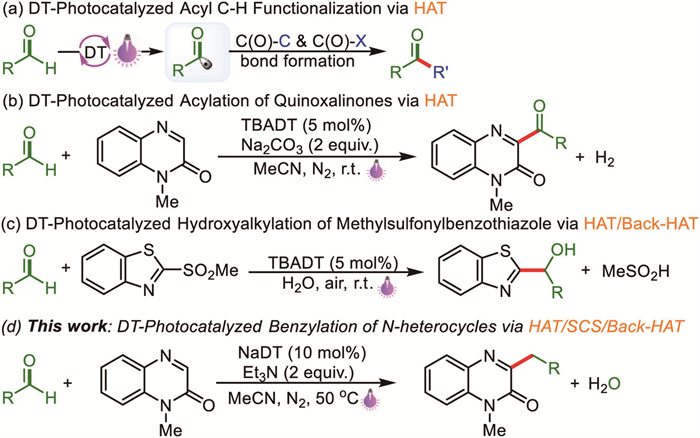
Scheme 1.
DT-photocatalyzed aldehydic C(O)-H functionalization.

Decatungstate-photocatalyzed heterogeneous direct benzylation of N-heterocycles with benzaldehydes
Yan-Yan Zeng , Jun Jiang , Yan-Cui Wen , Chun-Lin Zhuang , Li-Juan Ou , Zi Yang , Hai-Tao Zhu , Zu-Li Wang , Wei-Min He


The direct functionalization of C—H bonds in organic molecules is an ideal methodology to produce value-added compounds from easily available feedstocks [1]. Along these lines, hydrogen atom transfer (HAT) as an elementary process in chemical reactions and biological systems, has attracted much attention as an atom- and step-economical strategy to realize catalytic C—H radical functionalization reactions [2], [3]. Visible-light photocatalysis [4-13], which harnesses renewable light energy to drive bond-forming reaction under mild reaction conditions, is a versatile synthetic tool in organic synthesis [14-21]. The photocatalytic HAT strategy [22], [23], which combines main advantages of the HAT catalysis and visible-light photocatalysis, has emerged as an energy-efficient and eco-friendly platform to achieve C—H functionalization for diverse organic transformations.
Decatungstate anion (DT, [W10O32]4−), a type of low cost and readily available metal-oxygen cluster, has been demonstrated to be one of the most efficient and environmentally friendly heterogeneous HAT photocatalyst for promoting the homolytic cleavage of aldehydic C(O)-H bond to realize C(O)-H activation [24], [25]. Since the seminal work of Fagnoni in 2007 [26], considerable progress has been made in the conversion of aldehydes into various value-added products via DT-photocatalyzed C(O)-C [27-32] and C(O)-X [33-39] bond formations with acyl radical as the key intermediate (Scheme 1a). For example, Yu and co-workers reported the DT-photocatalyzed direct acylation of quinoxalin-2(1H)-ones with aldehydes for the synthesis of 3-acylated quinoxalin-2(1H)-ones (Scheme 1b) [40]. Despite these achievements, all these reactions are limited to the production of carbonylation products. In 2023, Xu and Deng have made a significant breakthrough in the field of aldehyde conversion (Scheme 1c). They described the construction of 2-hydroxyalkyl benzothiazoles through DT-photocatalyzed direct hydroxyalkylation of 2-methylsulfonyl benzothiazoles with aldehydes, which involves the HAT and back-HAT processes [41].
Benzyl N-heterocycles, such as 3-benzyl quinoxalin-2(1H)-ones [42-46] and 2-benzylquinoxalines [47], are found in numerous natural products and synthetic pharmaceuticals possessing valuable biological activities [48,49]. In comparison with the DT-photocatalyzed direct acylation and hydroxyalkylation, the DT-photocatalyzed direct benzylation with aromatic aldehydes is scarce and remains a challenge. On the other hand, the spin-center shift (SCS) [50], in which a 1,2-radical shift proceeds with the elimination of an oxygen-containing leaving group, has emerged as a powerful strategy for the scission of C—O bond [51-53]. The remarkable breakthrough in such fields was made by MacMillan in 2015, they pioneered the photocatalyzed dehydroxylative alkylation of alcohols via a SCS process [54]. We envisioned that if the HAT and the back-HAT could be combined, a tandem aldehydic C(O)-H activation/reduction/dehydroxylation strategy could be realized for the direct benzylation of N-heterocycles with benzaldehydes. In continuation of our research on green chemistry [55-64], we herein report the DT-photocatalyzed direct benzylation of N-heterocycles with aromatic aldehydes via a combination of HAT and SCS. The present strategy not only provides an efficient and sustainable route to benzylated N-heterocycles but also offers a complement of classical DT-photocatalyzed acylation, hydroxyalkylation and expands the scope of DT catalysis.
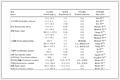
We began our investigations by selecting the benzylation of quinoxalin-2(1H)-one (1a) with benzaldehyde (2a) as a model reaction for optimization (Table 1). After optimizing the reaction parameters, we found that, when 1a was treated with 2a (2 equiv.) and NaDT (10 mol%) in MeCN under 10 W LEDs (390 nm) at 50 ℃, the benzylation proceeded effectively, thus affording the corresponding product 3aa in 84% GC yield (Table 1, entry 1). Only a trace amount of 3aa was detected when the reaction was carried out in the absence of the NaDT (entry 2). Unsurprisingly, no reaction occurred in the absence of light irradiation (entry 3). Decreasing the loading of Et3N led to a lower yield of 3aa (entry 4). Without Et3N but under otherwise optimal conditions, only a trace amount of 3aa was detected, whereas 3-benzoyl-1-methylquinoxalin-2(1H)-one (4aa) was formed (entry 5). Conducting the reaction with other DT salt, such as TBADT and TMADT, gave 3aa in a lower yield (entry 6). Replacing Et3N with Me3N, DIPEA or nPr3N diminished the reaction yield (entry 7). When inorganic bases were used instead of Et3N, only a trace amount of 3aa was observed, indicating that alkylamie might play a key role in this reaction (entry 8). A series of solvents were next investigated, and the replacement of MeCN with DCE gave a decreased yield (entry 9), while only a trace amount of 3aa was detected when employing acetone, THF or DMF as the solvent (entry 10). Reducing the temperature from 50 ℃ to room temperature decreased the reaction yield (entry 11), suggesting the reaction temperature had an influence on the reaction. No benzylation reaction was observed when the reaction was performed in air atmosphere, revealing that atmospheric oxygen was not beneficial to this reaction (entry 12). Further efforts in varying the power of LED light did not improve the yield of 3aa (entry 13).
 DownLoad:
CSV
DownLoad:
CSV
 |
||
| Entry | Variation from the standard conditions | Yield (%)b |
| 1 | None | 84 |
| 2 | Without NaDT | trace |
| 3 | Without light irradiation | N.R. |
| 4 | 1.5 equiv. of Et3N was used | 73 |
| 5 | Without Et3N | trace |
| 6 | TBADT, TMADT was used | 51, 42 |
| 7 | Me3N, DIPEA, nPr3N was used | 72, 19, trace |
| 8 | KH2PO3, Na2CO3 was used | trace |
| 9 | DCE was used | 59 |
| 10 | Acetone, THF, DMF was used | all trace |
| 11 | room temperature | 38 |
| 12 | Under open-air atmosphere | N.D. |
| 13 | 8 W or 12 W LED was used | 75, 83 |
| a Conditions: 1a (0.2 mmol), 2a (0.4 mmol), NaDT (10 mol%), Et3N (2 equiv.), MeCN (2.5 mL), LED (390 nm, 10 W), N2, 50 ℃, 36 h. b Yield estimated by GC with dodecane as the internal reference. |
||
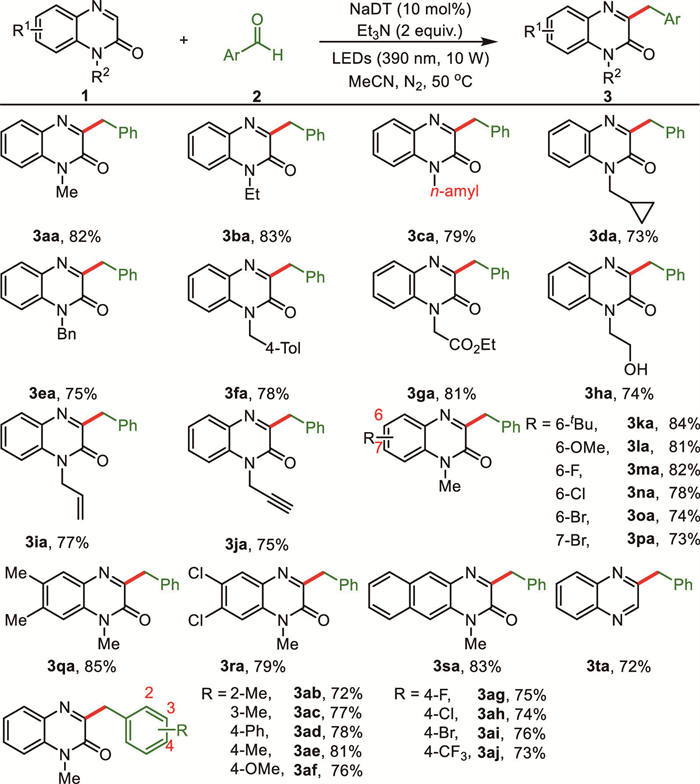
Following the acquisition of optimized conditions (Table 1, entry 1), we then investigated the scope generality of these photoinduced reactions of N-heterocycles 1 with benzaldehydes 2 (Scheme 2). The quinoxalin-2(1H)-ones, comprising a range of N-substituted methyl, ethyl, n-amyl, cyclopropylmethyl, benzyl, 4-methylbenzyl, ester and hydroxyethyl groups, were all compatible to deliver the target products (3aa-3ha) in good to excellent yields. Substrates containing a C=C double bond or C≡C triple bond, which could capture free radical, participated in this reaction efficiently (3ia and 3ja). In addition, N-methylquinoxalin-2(1H)-one substrates bearing either an electron-rich groups (-tBu and -OMe) or electron-deficient substituents (-F, -Cl and -Br) on phenyl ring ran smoothly to deliver the target products (3ka-3pa) in good yields. 6,7-Disubstituted quinoxalin-2(1H)-ones and benzo[g]quinoxalin-2(1H)-one reacted well with 2a to afford the corresponding products (3qa-3sa) in high yields. Furthermore, our protocol was successfully applied to quinoxaline (3ta). Next, a series of benzaldehydes were investigated. To our delight, no matter whether the phenyl ring of benzaldehyde was modified with either a sterically hindered, electron-rich or electron-deficient group, all of them gave the desired products (3ab-3aj) in good yields. However, when heteroaromatic aldehydes (4-pyridinecarboxaldehyde or 3-thiophenecarboxaldehyde) were used as the substrates, only a trace amount of the desired product was observed.
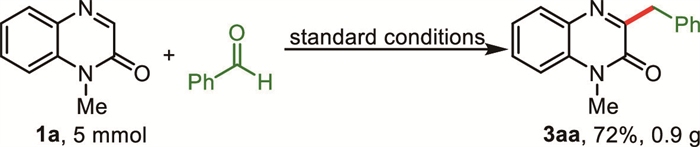
To further depict the practicability of the DT-photocatalyzed aldehyde conversion, both gram-scale synthesis and NaDT recycling tests were presented. With the amplification of 1a from 0.2 mmol to 5.0 mmol, the benzylation reaction of 1a produced 0.90 g of 3aa in 72% yield without further optimization (Scheme 3). The reusability of NaDT was also investigated using the reaction between 1a and 2a. As illustrated in Fig. 1a, the photocatalytic efficiency of NaDT was found to be constantly excellent even after 5 consecutive recycles. Taken together, these results highlighted the synthetic practicability of this DT-photocatalyzed strategy. Considering that this type of deoxygenation processes may involve the H2O as the by-product, but all efforts failed to detect H2O.
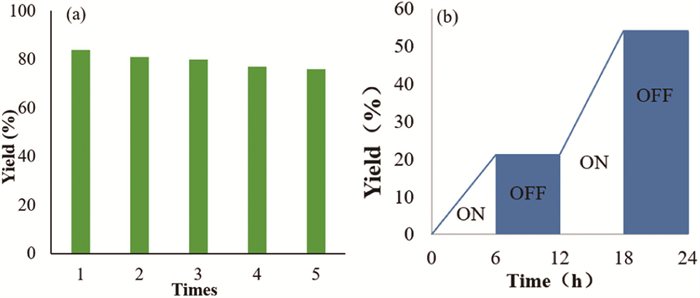
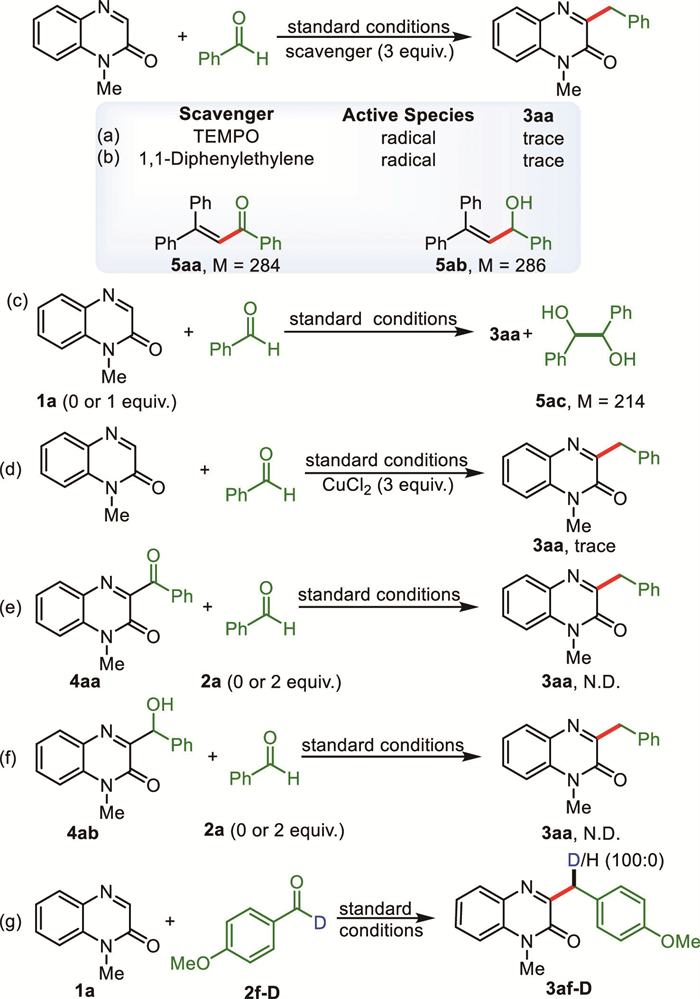
First, performing the reaction with 2,2,6,6-tetramethyl-1-piperidinyloxy (TEMPO) and 1,1-diphenylethene as a radical scavenger under standard conditions, the formation of 3aa was suppressed (Schemes 4a and b), and both benzoyl-diphenylethylene adduct 5aa and ketyl-diphenylethylene adduct 5ab were detected by MS. When 2a or the mixture of 1a and 2a was subjected to the standard conditions, 1,2-diphenylethane-1,2-diol (5ac) was observed (Scheme 4c) [65]. Taken together, these results indicated the involvement of benzoyl and ketyl radical intermediates in this process. The addition of single electron transfer (SET) scavenger CuCl2 to the reaction mixture led to no reaction, revealing a SET process might be involved in this transformation (Scheme 4d). Both 4aa and 3-(hydroxy(phenyl)methyl)-N-methylquinoxalin-2(1H)-one (4ab) could not be transformed into 3aa under the standard conditions (Schemes 4e and f), ruling out that they were the key intermediates in this transformation. When deuterated benzaldehyde (2f-D) was used as a substrate, the deuterated product 3af-D was formed (Scheme 4g), suggesting that the benzylic hydrogen atom in product 3 originated from aldehyde, which supported the HAT and back-HAT mechanism. Furthermore, the results of visible light on/off experiments showed that continuous light irradiation was necessary for this reaction (Fig. 1b). Considering that this type of deoxygenation processes may involve the H2O as the by-product, but all efforts failed to detect H2O.
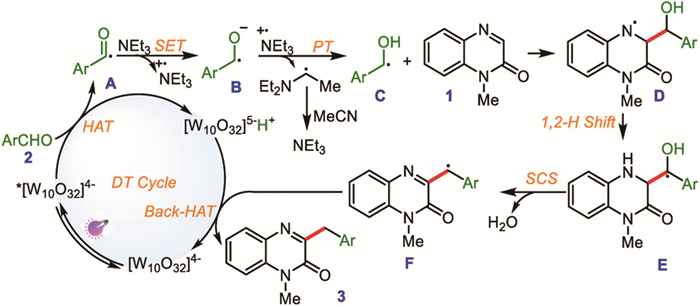
Based on the aforementioned experimental results and literature precedents [41,65-68], a tentative mechanism was proposed in Scheme 5. First, the excited-state DT catalyst *[W10O32]4− would abstract a hydrogen atom (HAT) from the aldehyde 2 to produce an acyl radical A and [W10O32]5−H+. Next, the produced radical A underwent a sequential SET and proton transfer (PT) processes with Et3N to afford the ketyl radical B. The ketyl radical B selectively attacked the C=N double bond of quinoxalin-2(1H)-one 1 to form a nitrogen-centered radical D, which underwent a 1,2-hydrogen shift process to generate a carbon-centered E, followed by a SCS process to eliminate H2O and yield the open-shell benzylic radical F. Finally, a back-HAT process between radical F and [W10O32]5−H+ delivered the target product 3 and ground-state DT catalyst.
In conclusion, we have developed the first DT-photocatalyzed direct benzylation of N-heterocycles (quinoxalin-2(1H)-ones and quinoxalines) with benzaldehydes. This novel strategy shows good reaction substrate tolerance, providing efficient and sustainable access to a broad range of benzylated products in a highly concise fashion. In addition, this reaction can be performed on a gram-scale with good efficiency and allowed the NaDT catalyst to be easily recycled. The overall reaction involved a sequence of DT-photocatalyzed production of acyl radical via HAT, the reduction of acyl radical into ketyl radical via SET and concomitant PT, the radical addition, the elimination of hydroxyl group via SCS and the back-HAT. The deuterium-labeling experimental result manifested that the benzylic hydrogen atom in the product originated from aldehyde, which supported the HAT and back-HAT mechanism. The mild and concise conditions, readily available reactants, wide substrate scope, large-scale synthesis and reusable NaDT catalyst make the present strategy highly attractive in organic and pharmaceutical chemistry. Furthermore, this DT-photocatalyzed direct benzylation would be a useful complement to classical DT-photocatalyzed acylation and hydroxyalkylation, expanding the scope of DT catalysis.
The authors declare that they have no known competing financial interests or personal relationships that could have appeared to influence the work reported in this paper.
Yan-Yan Zeng: Methodology. Jun Jiang: Supervision. Yan-Cui Wen: Methodology. Chun-Lin Zhuang: Supervision. Li-Juan Ou: Writing – review & editing. Zi Yang: Investigation. Hai-Tao Zhu: Conceptualization, Formal analysis. Zu-Li Wang: Investigation. Wei-Min He: Writing – review & editing, Project administration.
We are grateful for financial support from Science and Technology Innovation Program of Hunan Province (No. 2022RC4044), the Scientific Research Fund of Hunan Provincial Education Department (No. 22B0435) and Science and Technology Innovation Program of Hunan Province (No. 2022RC4044).
Supplementary material associated with this article can be found, in the online version, at doi:
N. Holmberg-Douglas, D.A. Nicewicz, Chem. Rev. 122 (2022) 1925–2016. doi: 10.1021/acs.chemrev.1c00311
Z. Ye, Y.M. Lin, L. Gong, Eur. J. Org. Chem. 2021 (2021) 5545–5556. doi: 10.1002/ejoc.202101036
J.L. Tu, B. Huang, Chem. Commun. 60 (2024) 11450–11465. doi: 10.1039/d4cc03383c
P. Bellotti, H.M. Huang, T. Faber, F. Glorius, Chem. Rev. 123 (2023) 4237–4352. doi: 10.1021/acs.chemrev.2c00478
L. Dai, G. Zhong, Chin. J. Org. Chem. 43 (2023) 2589–2590. doi: 10.6023/cjoc202300042
Y. Zhao, X. Jiang, Chin. J. Org. Chem. 43 (2023) 786–788. doi: 10.6023/cjoc202300009
K. Liu, X. Long, Y. Huang, S. Zhu, Acta Chim. Sin. 82 (2024) 658–676. doi: 10.6023/A24030090
Z. Tang, C. Pi, Y. Wu, X. Cui, Green Synth. Catal. 5 (2024) 31–34.
X. Li, H. Yao, Chin. J. Org. Chem. 44 (2024) 660–662. doi: 10.6023/cjoc202400007
J. Yi, M. Chen, Acta Chim. Sin. 82 (2024) 126–131. doi: 10.6023/a23080387
L. Qin, X. Zhang, H. Sun, et al., Green Synth. Catal. 5 (2024) 20–24.
J.C. Hou, W. Cai, H.T. Ji, L.J. Ou, W.M. He, Chin. Chem. Lett. 36 (2025) 110469. doi: 10.1016/j.cclet.2024.110469
X. He, F. Liu, T. Tu, Chin. Chem. Lett. 36 (2025) 110621. doi: 10.1016/j.cclet.2024.110621
C. Yang, J. Chen, X. Li, et al., Acta Chim. Sin. 81 (2023) 1–5.
X.M. Chen, L. Song, J. Pan, et al., Chin. Chem. Lett. 35 (2024) 110112. doi: 10.1016/j.cclet.2024.110112
H. Cheng, T. He, D. Chen, et al., Org. Lett. 26 (2024) 3581–3585. doi: 10.1021/acs.orglett.4c01024
Y. Lv, H. Ding, J. You, W. Wei, D. Yi, Chin. Chem. Lett. 35 (2024) 109107. doi: 10.1016/j.cclet.2023.109107
G. Guo, X. Li, J. Ma, et al., Chin. Chem. Lett. 35 (2024) 110024. doi: 10.1016/j.cclet.2024.110024
W.T. Ouyang, J. Jiang, Y.F. Jiang, et al., Chin. Chem. Lett. 35 (2024) 110038. doi: 10.1016/j.cclet.2024.110038
Y. Wang, J. Wang, C. Chen, et al., Chem. Commun. 61 (2025) 10812–10815. doi: 10.1039/d5cc02744f
Y. Wang, S. Wang, J. Liu, et al., Green Synth. Catal. 3 (2022) 102–109.
J. Zhang, M. Rueping, Chem. Soc. Rev. 52 (2023) 4099–4120. doi: 10.1039/d3cs00023k
X.Y. Yuan, C.C. Wang, B. Yu, Chin. Chem. Lett. 35 (2024) 109517. doi: 10.1016/j.cclet.2024.109517
D. Ravelli, M. Fagnoni, T. Fukuyama, T. Nishikawa, I. Ryu, ACS Catal. 8 (2018) 701–713. doi: 10.1021/acscatal.7b03354
P.P. Singh, S. Sinha, P. Gahtori, S. Tivari, V. Srivastava, Org. Biomol. Chem. 22 (2024) 2523–2538. doi: 10.1039/d4ob00213j
S. Esposti, D. Dondi, M. Fagnoni, A. Albini, Angew. Chem. Int. Ed. 46 (2007) 2531–2534. doi: 10.1002/anie.200604820
S.A. Paveliev, O.O. Segida, O.M. Mulina, I.B. Krylov, A.O. Terent’ev, Org. Lett. 24 (2022) 8942–8947. doi: 10.1021/acs.orglett.2c03364
S. Le, J. Li, J. Feng, et al., Nat. Commun. 13 (2022) 4734. doi: 10.1038/s41467-022-32467-x
L. Qiao, X. Fu, Y. Si, et al., Green Chem. 24 (2022) 5614–5619. doi: 10.1039/d2gc01381a
P. Fan, Y. Mao, C. Wang, Org. Chem. Front. 9 (2022) 4649–4653. doi: 10.1039/d2qo00935h
D. Wang, L. Ackermann, Chem. Sci. 13 (2022) 7256–7263. doi: 10.1039/d2sc02277j
X. Li, H. Wang, T. Xu, Org. Chem. Front. 10 (2023) 3061–3066. doi: 10.1039/D3QO00543G
J. Dong, X. Wang, Z. Wang, et al., Chem. Sci. 11 (2020) 1026–1031. doi: 10.1039/c9sc05132e
X. Wang, J. Dong, Y. Liu, H. Song, Q. Wang, Chin. Chem. Lett. 32 (2021) 3027–3030. doi: 10.1016/j.cclet.2021.03.070
Z. Ye, Z. Lei, X. Ye, et al., J. Org. Chem. 87 (2022) 765–775. doi: 10.1021/acs.joc.1c02244
J.W. Sang, Q. Li, C. Zhang, et al., Org. Lett. 25 (2023) 4592–4597. doi: 10.1021/acs.orglett.3c01694
P.S. Gowda, D.S. Sharada, G. Satyanarayana, Chem. Commun. 59 (2023) 9094–9097. doi: 10.1039/d3cc02340k
H. Tan, C. Zhang, Y. Deng, et al., Org. Lett. 25 (2023) 2883–2888. doi: 10.1021/acs.orglett.3c00868
H. Tang, M. Zhang, Y. Zhang, et al., J. Am. Chem. Soc. 145 (2023) 5846–5854. doi: 10.1021/jacs.2c13157
Z. Zhang, F. Cheng, X. Ma, et al., Green Chem. 26 (2024) 7331–7336. doi: 10.1039/d4gc00534a
J. Xu, L. Liu, Z.C. Yan, et al., Green Chem. 25 (2023) 2268–2273. doi: 10.1039/d3gc00162h
L. Hu, J. Yuan, J. Fu, et al., Eur. J. Org. Chem. 2018 (2018) 4113–4120. doi: 10.1002/ejoc.201800697
Y. Shi, J. Hou, K. Wang, et al., ChemistrySelect 7 (2022) e202203468. doi: 10.1002/slct.202203468
P. Xiang, K. Sun, S. Wang, et al., Chin. Chem. Lett. 33 (2022) 5074–5079. doi: 10.1016/j.cclet.2022.03.096
Q. Yan, W. Cui, J. Li, et al., Org. Chem. Front. 9 (2022) 2653–2658. doi: 10.1039/d1qo01910d
J.C. Hou, J. Jiang, H. Dai, et al., Sci. China Chem. 68 (2025) 1945–1951. doi: 10.1007/s11426-024-2496-5
X. Zhu, M. Jiang, X. Li, et al., Org. Chem. Front. 9 (2022) 347–355. doi: 10.1039/d1qo01570b
X. Qin, X. Hao, H. Han, et al., J. Med. Chem. 58 (2015) 1254–1267. doi: 10.1021/jm501484b
S.N. Khattab, S.A.H. Abdel Moneim, A.A. Bekhit, et al., Eur. J. Med. Chem. 93 (2015) 308–320. doi: 10.1016/j.ejmech.2015.02.020
F.L. Zhang, B. Li, K.N. Houk, Y.F. Wang, JACS Au 2 (2022) 1032–1042. doi: 10.1021/jacsau.2c00051
T.Y. Peng, Z.Y. Xu, F.L. Zhang, et al., Angew. Chem. Int. Ed. 61 (2022) e202201329. doi: 10.1002/anie.202201329
X. Liu, M. Lu, X. Guo, H. Xu, J. Xu, Chem. Eur. J. 29 (2023) e202302041. doi: 10.1002/chem.202302041
Z.S. Wang, Y.B. Chen, H.W. Zhang, et al., J. Am. Chem. Soc. 142 (2020) 3636–3644. doi: 10.1021/jacs.9b13975
J. Jin, D.W.C. MacMillan, Nature 525 (2015) 87–90. doi: 10.1038/nature14885
Z. Yang, Y. Zhou, H. Li, et al., Asian J. Org. Chem. 11 (2022) e202100656. doi: 10.1002/ajoc.202100656
Z. Yang, C. Liu, J. Lei, et al., Chem. Commun. 58 (2022) 13483–13486. doi: 10.1039/d2cc05899e
C. Liu, Q. Dai, Y. Li, et al., J. Org. Chem. 88 (2023) 7281–7289. doi: 10.1021/acs.joc.3c00517
X. Chen, W.T. Ouyang, X. Li, W.M. He, Chin. J. Org. Chem. 43 (2023) 4213–4219. doi: 10.6023/cjoc202307026
Y.H. Lu, Z.T. Zhang, H.Y. Wu, et al., Chin. Chem. Lett. 34 (2023) 108036. doi: 10.1016/j.cclet.2022.108036
C. Xin, J. Jiang, Z.W. Deng, L.J. Ou, W.M. He, Acta Chim. Sinica 82 (2024) 1109–1113. doi: 10.6023/a24100329
H.T. Ji, Y.H. Lu, Y.T. Liu, et al., Chin. Chem. Lett. 36 (2025) 110568. doi: 10.1016/j.cclet.2024.110568
C.H. Liu, Z.W. Zhang, Z.J. Zhao, et al., J. Org. Chem. 90 (2025) 11982–11989. doi: 10.1021/acs.joc.5c01659
Z. Yang, J. Luo, W. Zhang, et al., Org. Biomol. Chem. 23 (2025) 323–327. doi: 10.1039/d4ob01655f
W. He, Wang Jingyu, R. Yi, et al., Chin. J. Org. Chem. 45 (2025) 3534–3545, doi: 10.6023/cjoc202506034.
Y. Yan, G. Li, J. Ma, et al., Green Chem. 25 (2023) 4129–4136. doi: 10.1039/d3gc00054k
Z. Wang, Q. Liu, X. Ji, G.J. Deng, H. Huang, ACS Catal. 10 (2020) 154–159. doi: 10.1021/acscatal.9b04411
J. Dong, Z. Wang, X. Wang, et al., Sci. Adv. 5 (2019) eaax9955. doi: 10.1126/sciadv.aax9955
Y. Sun, Y. Wang, Z. Zuo, Org. Chem. Front. 11 (2024) 6510–6517. doi: 10.1039/d4qo01517g

Scheme 2 Substrate scope. 1 (0.2 mmol), 2 (0.4 mmol), NaDT (10 mol%), Et3N (2 equiv.), MeCN (2.5 mL), LED (390 nm, 10 W), N2, 50 ℃.
Table 1. Optimization of reaction conditions.a
|
||
| Entry | Variation from the standard conditions | Yield (%)b |
| 1 | None | 84 |
| 2 | Without NaDT | trace |
| 3 | Without light irradiation | N.R. |
| 4 | 1.5 equiv. of Et3N was used | 73 |
| 5 | Without Et3N | trace |
| 6 | TBADT, TMADT was used | 51, 42 |
| 7 | Me3N, DIPEA, nPr3N was used | 72, 19, trace |
| 8 | KH2PO3, Na2CO3 was used | trace |
| 9 | DCE was used | 59 |
| 10 | Acetone, THF, DMF was used | all trace |
| 11 | room temperature | 38 |
| 12 | Under open-air atmosphere | N.D. |
| 13 | 8 W or 12 W LED was used | 75, 83 |
| a Conditions: 1a (0.2 mmol), 2a (0.4 mmol), NaDT (10 mol%), Et3N (2 equiv.), MeCN (2.5 mL), LED (390 nm, 10 W), N2, 50 ℃, 36 h. b Yield estimated by GC with dodecane as the internal reference. |
||
 下载: 导出CSV

 扫一扫看文章


扫一扫关注我们


 下载:
下载: