
Figure 1.
The synthesis of P(DBT-Melmx-OxI1 - x) polymers.

Poly(dibenzothiophene methylimidazole oxindole) copolymer membranes with multiple hydrogen-bonding sites for high temperature polymer electrolyte membrane fuel cells
Meichen Zhang , Yao Lu , Lele Wang , Peiru Lv , Jingshuai Yang


The combustion of fossil fuels depletes finite resources and worsens environmental problems, highlighting the need for clean energy alternatives. High-temperature proton exchange membrane fuel cells (HT-PEMFCs), operating above 100 ℃, offer advantages such as faster electrode kinetics, reduced CO poisoning, and simplified water and thermal management [1,2]. A key component of HT-PEMFC is the high temperature polymer electrolyte membrane (HT-PEM), which must combine high proton conductivity with excellent mechanical, thermal, and chemical stability [3-5]. Currently, phosphoric acid (PA)-doped polybenzimidazole (PBI) membranes are widely studied for their outstanding thermal and mechanical performance [6-11]. However, their widespread application is limited by issues such as the toxicity of 3,3′,4,4′-tetraaminobiphenyl and poor solubility of high molecular weight PBI in organic solvents [6].
To overcome these drawbacks, recent research has explored alternative membranes incorporating basic functional groups onto robust polymer backbones. Imidazole-containing polymers, especially those synthesized via Friedel-Crafts hydroxyalkylation, have shown considerable potential for HT-PEMFCs [12-15]. For instance, Yang et al. developed a series of aromatic, ether-free imidazole polymers by polymerizing terphenyl with five distinct imidazole aldehyde-substituted ketones, revealing how monomer structure influences polymerization and membrane performance [16]. Li et al. reported imidazole-functionalized polymers with enhanced chemical and mechanical stability over their aliphatic counterparts [17]. Zhang et al. synthesized alkaline membranes from biphenyl and imidazole-2-formaldehyde, achieving peak power densities of up to 850 mW/cm2 at 200 ℃ [18].
Although extensive research has focused on polymers with simple aromatic backbones like terphenyl or biphenyl, copolymerization strategies offer greater structural flexibility and tunable performance [19,20]. As a planar conjugation structure, dibenzothiophene (DBT) can facilitate intermolecular interactions by electron-rich sulfur atoms [21]. Recently, Sun et al. [22] and Yang et al. [23] separately synthesized poly(aryl piperidinium) copolymers with DBT units as anion exchange membranes. Results showed that DBT’s sulfur atoms support the formation of extensive hydrogen bond networks, facilitating ion conduction via the Grotthuss mechanism. Nevertheless, DBT has not yet been explored for HT-PEM applications. In this study, we synthesized a series of novel ether-free poly(dibenzothiophene methylimidazole oxindole) (P(DBT-Melmx-OxI1 - x) polymers as HT-PEMs through a one-step, superacid-catalyzed Friedel-Crafts hydroxyalkylation reaction (Fig. 1).
Incorporating the π-conjugated DBT structural unit diminished rotational mobility and restricted polymer chain packing, thereby forming a twisted backbone with greater free volume [21]. The DBT groups additionally provided supplementary hydrogen- bonding sites, aiding efficient proton conduction. Another advantage was that both 1-methyl-1H-imidazole-2-carboxaldehyde and isatin were highly reactive monomers, resulting a straightforward polymerization route. Taking P(DBT-Melm0.5OxI0.5) as a representative example, the polymerization was efficiently completed within 1 h at room temperature without the need for an inert atmosphere. Meanwhile the copolymerization of isatin intended to improve mechanical strength and dimensional stability.
As depicted in Fig. S1a (Supporting information), the peaks appearing between 7.3 ppm and 8.3 ppm (H1,2) correspond to the aromatic protons in the dibenzothiophene groups of the pure P(DBT-Melm), whereas peaks at 6.74 and 7.01 ppm (H4,5) correspond to the imidazole units. Additionally, prominent peaks at 6.05 ppm (H3) and 3.42 ppm (H6) are assigned to main-chain methine protons and methyl groups, respectively [16,24]. For the pure P(DBT-OxI) polymer, the characteristic signal at 10.86 ppm (Hd) corresponds to the –NH proton in the oxindole units [17], accompanied by multiple aromatic protons resonating between 6.94 ppm and 8.00 ppm. After copolymerization, the copolymer P(DBT-Melm0.5OxI0.5) exhibits all characteristic peaks originating from both P(DBT-Melm) and P(DBT-OxI). Furthermore, the integral area ratio of peaks H3 and Hd in the spectrum of P(DBT-Melm0.5OxI0.5) matches the monomer feed ratio, confirming accurate control over polymer composition and high polymerization efficiency. FT-IR spectroscopy (Fig. S1b in Supporting information) provided additional evidence for the successful synthesis of the P(DBT-Melmx-OxI1 - x) polymers. All membranes displayed characteristic absorption peaks at 3055 and 2922 cm-1, corresponding to aromatic and aliphatic C–H stretching vibrations, respectively. Compared to the P(DBT-Melm) membrane, new absorption peaks at 1717 cm-1, characteristic of the C = O stretching vibration in oxindole groups, appeared in membranes containing isatin [25]. Additionally, the imidazole-containing membranes exhibited a distinct peak at 1677 cm-1 associated with the C = N stretching vibration in the imidazole ring [19]. The absorption band observed at 1465 cm-1 corresponds to C–N stretching vibrations from methylimidazole and oxindole groups, while the band at 1228 cm-1 arises from C–S stretching vibrations from dibenzothiophene units. The 1H NMR and FT-IR results conclusively verify the successful preparation of P(DBT-Melmx-OxI1 - x), P(DBT-Melm), and P(DBT-OxI) membranes.
As shown in Table S1 (Supporting information), both homopolymers and copolymers exhibited suitable inherent viscosities ranging from 0.64 dL/g to 1.20 dL/g. Meanwhile, the P(DBT-Melmx-OxI1 - x) polymers exhibited excellent solubility in DMAc, likely due to their twisted molecular architecture. Various membranes were successfully prepared using a straightforward solution-casting method. As shown in Fig. S2 (Supporting information), all resultant membranes were uniform, transparent, and varied in color from light yellow to golden yellow. SEM analysis further confirmed their dense, nonporous microstructures. Such a dense morphology effectively prevents fuel crossover between the anode and cathode, significantly reducing gas permeability and enhancing the open-circuit voltage (OCV) [26]. Consequently, these membranes facilitate efficient and stable fuel cell operation.
The thermal stability of the synthesized P(DBT-Melmx-OxI1 - x) polymers was evaluated by TGA and derivative thermogravimetry (DTG). As shown in Figs. S3a and b (Supporting information), polymer decomposition occurs in three distinct stages. The initial slight mass loss (<2%) observed between 200 ℃ and 230 ℃ might be associated with crystallized water or unreacted terminal groups. Subsequently, a second stage from approximately 230 ℃ to 330 ℃ corresponds primarily to thermal decomposition of the imidazole functionalities. Finally, a third mass loss above 410 ℃ is attributed to polymer backbone degradation. These observations indicate that all membranes exhibit sufficient thermal robustness for the typical operating temperature range (120–180 ℃) employed in HT-PEMFCs. On the other hand, the oxidative stability of the prepared membranes was evaluated by immersing them in Fenton’s reagent (3 wt% H2O2 containing 4 ppm Fe2+) at 68 ℃ for approximately 350 h. Fig. S3c (Supporting information) illustrates that all membranes exhibit rapid initial degradation during the first 90 h, followed by a relatively gradual weight reduction. Notably, the P(DBT-Melm0.25OxI0.75) membrane maintains approximately 84.2% of its initial weight after 348 h. In contrast, membranes with increased methylimidazole content display significantly greater degradation; for example, the P(DBT-Melm0.75OxI0.25) membrane retains merely 69.2% of its initial mass, eventually fragmenting into small pieces (inset of Fig. S3c). Previous research suggests that electron-rich side-chain imidazole groups are especially vulnerable to radical attack [8]. Another likely source of degradation is the –CH– linkage in the polymer backbone, which is susceptible to radical-induced cleavage. Thus, replacing such groups with more chemically stable alternatives (e.g., –CH3 or –CF3) could offer an effective route for enhancing membrane oxidative stability.
To clarify the correlation between polymer molecular structure and antioxidant properties, density functional theory (DFT) calculations were conducted on representative model molecules. Fig. S3d (Supporting information) summarizes the lowest unoccupied molecular orbital (LUMO) energy levels of P(DBT-Melm) and P(DBT-OxI) model units, and the highest occupied molecular orbital (HOMO) of ·OH. Radical-induced oxidation involves electron transfer from the HOMO of the ·OH radical to the LUMO of the polymer unit; thus, a larger HOMO-LUMO energy gap indicates greater resistance to radical attack [16]. This effect arises because the polymer backbone influences the electron density distribution of the frontier orbitals in these molecules. As depicted in Fig. S3d (Supporting information), the calculated LUMO energy levels for P(DBT-Melm) and P(DBT-OxI) units are −1.407 and −1.351 eV, respectively, whereas the ·OH radical’s HOMO level is −9.546 eV. Hence, P(DBT-OxI) exhibits a larger energy barrier to radical attack, implying superior oxidative stability compared to P(DBT-Melm).
PA uptake and swelling behavior significantly influence the proton conductivity and mechanical stability of HT-PEMs [8]. Imidazole-containing polymers are known for their strong PA-binding capabilities, primarily due to acid-base interactions and hydrogen-bonding formation. As shown in Fig. 2a and Table S1, the ADC% of P(DBT-Melmx-OxI1 - x) membranes increases proportionally with the methylimidazole content in the polymer backbone, while water contact angle decreased accordingly. For instance, ADC% increases dramatically from 89% to 383% as the methylimidazole proportion rises from 25% to 75%. Remarkably, the P(DBT-Melm) homopolymer membrane becomes gel-like upon doping in 85 wt% PA, exhibiting an ADC% value exceeding 1000% due to extensive PA binding by methylimidazole groups. Consequently, isatin units were copolymerized to enhance membrane mechanical and dimensional stability. Earlier studies have shown that isatin does not readily absorb PA [25,27], as also demonstrated by the reference poly(isatin p-terphenyl) membrane (PIT) with ADC% of only 16% (Fig. 2a). However, the P(DBT-OxI) membrane without imidazole still achieved moderate ADC% (72%), indicating that thiophene units should effectively contribute to PA uptake via hydrogen bonding between the sulfur atoms and PA molecules. To quantitatively investigate polymer-PA interactions, binding energies were computed for P(DBT-Melm) and P(DBT-OxI) repeat units complexed with a single PA molecule (Fig. 2b). Binding of PA with the methylimidazole group in P(DBT-Melm) reaches 20.5 kcal/mol, confirming strong interactions. Meanwhile, binding energies of 8.8 and 8.1 kcal/mol observed for PA complexation with the dibenzothiophene unit in P(DBT-Melm) and P(DBT-OxI), respectively, indicate moderate yet significant interactions. The hydrogen bonding interactions between PA molecules and DBT/imidazole groups were further confirmed by simulation calculations [28] shown in Fig. S4 (Supporting information). Furthermore, we synthesized two reference membranes, i.e., poly(fluorene methylimidazole) (P(Flu-Melm)) and poly(fluorene oxindole) (P(Flu-OxI)), which do not contain dibenzothiophene (DBT) units. Compared to P(Flu-Melm) and P(Flu-OxI), the P(DBT-Melm) and P(DBT-OxI) membranes exhibited significantly higher ADC% across all PA concentrations (Table S2 in Supporting information). These findings confirm the crucial role of DBT units in enhancing PA uptake through additional hydrogen bonding sites.
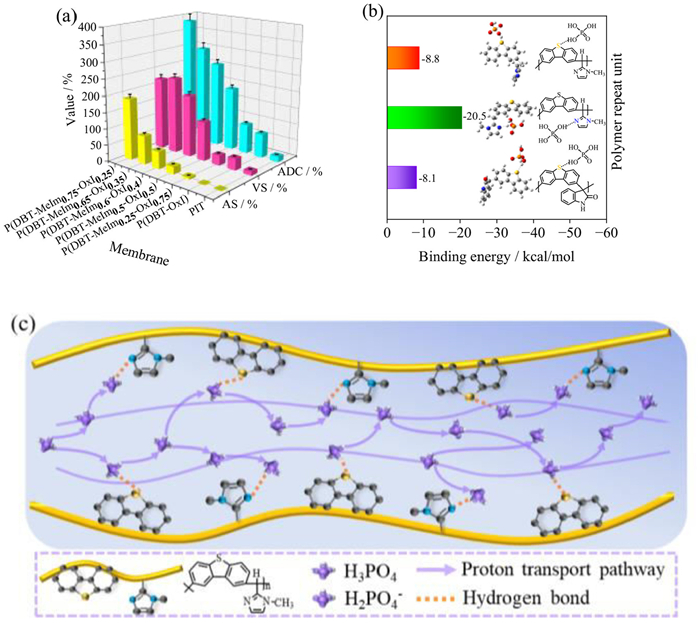
Proton conductivity is a key indicator of membrane performance in HT-PEMFC applications [17]. Fig. S5a (Supporting information) shows the proton conductivity of various PA-doped membranes under anhydrous conditions between 100 ℃ and 180 ℃. Conductivity increases with temperature due to enhanced proton mobility. For instance, the conductivity of P(DBT-Melm0.5OxI0.5)/190%PA rises from 35.9 mS/cm (100 ℃) to 64.6 mS/cm (180 ℃). Generally, membranes exhibiting higher PA uptake display greater conductivity due to enhanced hydrogen-bond networks facilitating proton conduction via the Grotthuss mechanism [10,26]. As shown in Fig. S5b (Supporting information), the Ea values of various PA doped membranes ranged from 8.1 kJ/mol to 14.6 kJ/mol. The P(DBT-Melm0.75OxI0.25)/383%PA membrane thus achieves the highest proton conductivity (182.9 mS/cm at 180 ℃), nearly three times greater than that of the P(DBT-Melm0.5OxI0.5)/190%PA membrane. By contrast, the P(DBT-Melm0.25OxI0.75)/89%PA membrane exhibits lower conductivities, attributed to the smaller number of methylimidazole groups (and thus lower PA uptake) as well as the large fraction of hydrophobic oxindole moieties, which restrict the formation of a continuous proton-conduction network. Interestingly, the P(DBT-OxI)/72%PA membrane, despite lacking methylimidazole groups, still exhibits proton conductivity comparable to P(DBT-Melm0.25OxI0.75)/89%PA, underscoring the significant proton conduction contribution from thiophene units (Fig. 2c).
However, increased PA uptake often leads to greater membrane swelling, compromising mechanical and dimensional stability [3]. As indicated in Fig. 2a, membranes with higher ADC% display increased area and volume swelling. Stress-strain measurements (Fig. S5c in Supporting information) illustrate that membrane with lower ADC% possess higher tensile strength but lower elongation. For example, the P(DBT-OxI)/72%PA membrane has a tensile strength of 14.9 MPa and elongation at break of 8.3%, whereas the highly doped P(DBT-Melm0.5OxI0.5)/190%PA and P(DBT-Melm0.75OxI0.25)/383%PA membranes exhibit lower tensile strengths (5.4 and 3.9 MPa) but significantly higher elongations (153% and 215%). This “plasticizing effect” can be explained by the binding of PA molecules to the imidazole –N= sites, which weakens the intermolecular forces between polymer chains [12]. Thus, controlled copolymerization proves effective for balancing proton conductivity with mechanical stability. In addition, as shown in Fig. S5d (Supporting information), the P(DBT-Melmx-OxI1 - x)/PA membranes exhibit proton conductivity and tensile strength comparable to those of high-performance HT-PEMs reported in the literature.
Due to its relatively high proton conductivity and excellent mechanical robustness, the P(DBT-Melm0.5OxI0.5)/190%PA membrane with a thickness of around 110 μm was selected to evaluate H2O2 fuel cell performance without external humidification and backpressure. The corresponding polarization and power density curves are presented in Fig. 3a. Throughout the tested temperature range (120–180 ℃), the OCVs remained consistently above 0.9 V, indicating minimal gas permeability [13,24]. Furthermore, the power density increased significantly with elevated temperatures. Specifically, under conditions without humidification or backpressure, the maximum power density of the cell reached 556.6 mW/cm2 at 120 ℃, increased to 824.7 mW/cm2 at 160 ℃, and further rose to 893.2 mW/cm2 at 180 ℃. This notable improvement can be attributed to enhanced proton conductivity and improved electrode kinetics at elevated operating temperatures [18]. In contrast, it is previously reported OPBI/162%PA membrane achieved a considerably lower peak power density of 437 mW/cm2 under similar conditions at 180 ℃ [29]. Fuel crossover is a critical parameter for membrane performance in fuel cells. Therefore, we measured the H2 crossover current densities of the P(DBT-Melm0.5OxI0.5)/190%PA membrane by linear sweep voltammetry (LSV). As shown in Table S3 (Supporting information), the crossover current slightly increased with temperature. However, the values (1.62–2.84 mA/cm2) are comparable to those reported in the literature [30,31], indicating excellent gas barrier properties and correlating well with the high OCVs observed. In addition, Fig. S6 (Supporting information) shows the startup-shutdown cycling performance of the H2O2 fuel cell using the P(DBT-Melm0.5OxI0.5)/190%PA membrane at 160 ℃ under a constant current density of 200 mA/cm2. The test was carried out over one week, with 10 h of operation per day (totaling 60 h). The cell voltage remained stable over time, demonstrating good long-term durability.
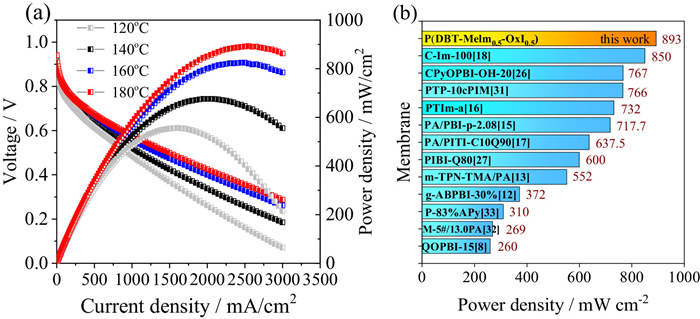
As illustrated in Fig. 3b, the P(DBT-Melm0.5OxI0.5)/190%PA membrane achieved a peak power density of 893.2 mW/cm2 at 180 ℃, clearly surpassing many previously reported PA-doped HT-PEMs. For comparison, the M-5#/13.0PA and P-83%APy membrane previously reported exhibited peak power densities of 269 mW/cm2 [32] and 310 mW/cm2 at 160 ℃ [33], whereas the QOPBI-15 membrane delivered only 260 mW/cm2 at the same temperature [8]. Zhao et al. reported that the PTP-10cPIM membrane achieved a peak power density of 766 mW/cm2 at 180 ℃ without backpressure [31]. Li et al. introduced aliphatic side chains into the PITI-C10Q90 membrane, achieving a peak power density of 637.5 mW/cm2 under H2O2 at 160 ℃ [17]. Gong et al. developed a chemically crosslinked CPyOPBI-OH-20 membrane, reaching a maximum power density of 767 mW/cm2 at 180 ℃ [26]. It should be emphasized that the performance of HT-PEM fuel cells also depends on various operational and structural factors, such as MEA preparation techniques, gas purity, catalyst composition, and optimization of the three-phase interface [34,35]. Nevertheless, these findings underscore the significant potential of the P(DBT-Melm0.5OxI0.5)-based membranes as promising materials for advanced HT-PEMFC applications.
In summary, we designed a series of methylimidazole-containing copolymers with π-conjugated structures for application in HT-PEMFCs. By incorporating rigid, non-rotatable dibenzothiophene units into the polymer main chains, we significantly enhanced the performance of P(DBT-Melmx-OxI1 - x) membranes, since the combined thiophene backbones were capable of forming additional hydrogen-bonding sites, with methylimidazole segments that effectively absorb phosphoric acid. This dual design strategy substantially boosts proton conductivity while preserving desirable mechanical properties. Furthermore, copolymerization with oxindole units helps control excessive dimensional swelling caused by high acid doping. As a result, the P(DBT-Melm0.5OxI0.5)/190%PA membrane demonstrates outstanding power output in HT-PEMFC. Overall, these findings highlight the importance of precisely tuning polymer backbone structures to achieve a balance between high proton conductivity and robust mechanical performance. Additionally, this works also provides high-performance membrane materials for other energy conversion and storage devices [36,37].
Meichen Zhang: Writing – original draft, Methodology, Investigation, Conceptualization. Yao Lu: Methodology, Investigation, Formal analysis, Conceptualization. Lele Wang: Methodology, Investigation. Peiru Lv: Software, Formal analysis, Data curation. Jingshuai Yang: Writing – review & editing, Writing – original draft, Supervision, Resources, Project administration, Funding acquisition, Conceptualization.
The authors declare that they have no known competing financial interests or personal relationships that could have appeared to influence the work reported in this paper.
We gratefully acknowledge the Science and Technology Major Project of Liaoning Province (No. 2024JH1/11700015), and Zhejiang TUNA Environmental Science & Technology Limited Company (No. 2024020600001) for financially supporting this work. We would like to express our gratitude to Prof. J.-G. Liu from Institute of Metal Research, Chinese Academy of Sciences for the assistance with the theoretical calculations.
Supplementary material associated with this article can be found, in the online version, at doi:
Z. Guo, M. Perez-Page, J. Chen, Z. Ji, S.M. Holmes, J. Energy Chem. 63 (2021) 393–429. doi: 10.1016/j.jechem.2021.06.024
M. Li, L. Feng, J. Electrochem. 28 (2022) 2106211. doi: 10.13208/j.electrochem.2106211
D. Aili1, D. Henkensmeier, S. Martin, et al., Energy Rev. 3 (2020) 793–845. doi: 10.1007/s41918-020-00080-5
Y. Gao, T. Mu, X. Hu, Y. Pang, C. Zhao, Chin. Chem. Lett. 36 (2025) 110763. doi: 10.1016/j.cclet.2024.110763
G. Wang, J. Li, H. Li, et al., Chin. Chem. Lett. 34 (2023) 107497. doi: 10.1016/j.cclet.2022.05.011
D. Aili, J. Yang, K. Jankova, D. Henkensmeier, Q. Li, J. Mater. Chem. A 8 (2020) 12854–12886. doi: 10.1039/d0ta01788d
H. Sun, S. Wang, X. Wang, et al., Int. J. Hydrogen Energy 61 (2024) 883–892. doi: 10.1016/j.ijhydene.2023.07.223
M. Hu, T. Li, S. Neelakandan, L. Wang, Y. Chen, J. Membr. Sci. 593 (2020) 117435. doi: 10.1016/j.memsci.2019.117435
J. Huang, G. Wei, A. Wu, et al., ACS Appl. Mater. Interfaces 16 (2024) 25994–26003. doi: 10.1021/acsami.4c00052
N.N. Krishnan, N.M.H. Duong, A. Konovalova, et al., J. Membr. Sci. 614 (2020) 118494. doi: 10.1016/j.memsci.2020.118494
Y. Dong, S. Zhong, Y. He, et al., Chin. Chem. Lett. 35 (2024) 109261. doi: 10.1016/j.cclet.2023.109261
B. Wang, Z. Ling, Y. Liu, et al., Int. J. Hydrogen Energy 84 (2024) 959–967. doi: 10.1016/j.ijhydene.2024.08.308
X. You, Q. Ju, Y. Ma, et al., Chem. Eng. J. 487 (2024) 150535. doi: 10.1016/j.cej.2024.150535
H. Cho, J. Seiler, P. Atanasova, V. Atanasov, Application. ACS Appl. Energy Mater. 7 (2024) 1864–1872. doi: 10.1021/acsaem.3c02854
J. Lin, P. Wang, A. Gao, et al., Chem. Eng. J. 475 (2023) 146146. doi: 10.1016/j.cej.2023.146146
T. Mu, L. Wang, Q. Wang, et al., J. Energy Chem. 98 (2024) 512–523. doi: 10.1016/j.jechem.2024.07.017
Z. Lv, N. Zhao, M. He, et al., J. Membr. Sci. 687 (2023) 122075. doi: 10.1016/j.memsci.2023.122075
L. Huang, Q. Wang, Z. Wang, et al., J. Mater. Chem. A 12 (2024) 13364–13373. doi: 10.1039/d4ta00243a
M. Ju, Q. Ren, J. Xu, et al., Chem. Eng. J. 466 (2023) 143023. doi: 10.1016/j.cej.2023.143023
Q. Wang, L. Sang, L. Huang, et al., Adv. Funct. Mater. 34 (2024) 2316506. doi: 10.1002/adfm.202316506
J. Gao, J. Zhao, J. Wu, et al., J. Power Sources 602 (2024) 234314. doi: 10.1016/j.jpowsour.2024.234314
W. Zheng, L. He, T. Tang, et al., Angew. Chem. Int. Ed. 63 (2024) e202405738. doi: 10.1002/anie.202405738
Z. Peng, T. Wei, Q. Wang, et al., J. Power Sources 642 (2025) 236918. doi: 10.1016/j.jpowsour.2025.236918
Y. Han, Y. Xu, K. Huang, et al., Int. J. Hydrogen Energy 65 (2024) 319–325. doi: 10.1016/j.ijhydene.2024.04.027
G. Chao, H. Tang, R. Li, et al., J. Membr. Sci. 692 (2024) 122297. doi: 10.1016/j.memsci.2023.122297
J. Ji, H. Li, W. Wang, et al., J. Membr. Sci. 694 (2024) 122423. doi: 10.1016/j.memsci.2024.122423
Q. Ju, H. Tang, G. Chao, et al., J. Mater. Chem. A 10 (2022) 25295–25306. doi: 10.1039/d2ta07129k
Q. Wang, S. Zhao, Y. Guo, et al., Sci. China Chem. 68 (2025) 1078–1090. doi: 10.1007/s11426-024-2269-0
Q. Wang, L. Wang, M. Zhang, et al., Chem. Commun. 60 (2024) 5318–5321. doi: 10.1039/d4cc01089b
H. Bai, J. Zhang, H. Wang, et al., J. Membr. Sci. 645 (2022) 120194. doi: 10.1016/j.memsci.2021.120194
B. Liu, Y. Duan, T. Li, et al., J. Membr. Sci. 692 (2024) 122273. doi: 10.1016/j.memsci.2023.122273
J. Yang, J. Wang, C. Liu, et al., J. Membr. Sci. 493 (2015) 80–87. doi: 10.1016/j.memsci.2015.06.010
R. Liu, J. Wang, X. Che, et al., J. Membr. Sci. 636 (2021) 119584. doi: 10.1016/j.memsci.2021.119584
J. Lin, P. Yang, Y. Jiang, et al., Chin. Chem. Lett. 35 (2024) 109435. doi: 10.1016/j.cclet.2023.109435
Chinese Society of Electrochemistry, J. Electrochem. 30 (2024) 2024121. doi: 10.61558/2993-074X.3444
G. Yang, Z. Hao, C. Fang, et al., Chin. Chem. Lett. 36 (2025) 111185. doi: 10.1016/j.cclet.2025.111185
S. Xin, X. Zhang, L. Wang, et al., Sci. China Chem. 67 (2024) 13–42. doi: 10.1007/s11426-023-1908-9

Figure 2 (a) Acid doping content and swellings of various membranes after soaking in 85 wt% PA solutions at 30 ℃. (b) Binding energies between P(DBT-Melm)/P(DBT-OxI) repeat unit and one PA molecule. (c) Schematic illustration of possible proton transfer mechanism in P(DBT-Melm)/PA membranes.

 扫一扫看文章


扫一扫关注我们
 DownLoad:

 下载:

 下载: