Received Date:
15 June 2025 Accepted Date:
09 August 2025 Revised Date:
04 August 2025 Available Online:
15 November 2026
Abstract:
Solar-driven hydrogen peroxide (H2O2) production offers a sustainable alternative to the energy-intensive anthraquinone process, yet conventional photocatalysts suffer from poor selectivity and uncontrollable reaction pathways. Inspired by catechol oxidase enzymes, we design dopamine-grafted lipoic acid-protected gold nanoclusters (DA-LA-Au NCs) that shift photocatalytic active sites from the metal core to redox-active ligands. This ligand-centric architecture leverages dopamine’s reversible catechol/quinone interconversion to gate a biomimetic proton-coupled electron transfer (PCET) pathway, enabling exclusive 2e- oxygen reduction with near-100% H2O2 selectivity while completely suppressing superoxide radical (·O2-) generation. Transient absorption spectroscopy and molecular dynamics confirm enhanced electron transfer kinetics and O2 enrichment at ligand sites. Encapsulation in ZIF-8 stabilizes the system, achieving a record H2O2 yield of 1198 µmol/L under visible light without sacrificial agents and a 0.39% solar-to-chemical conversion efficiency, surpassing most reported photocatalysts. This "ligand-as-catalyst" strategy merges enzymatic precision with nanocluster functionality for sustainable oxidant synthesis.
Hydrogen peroxide (H2O2), an environmentally benign oxidant with burgeoning applications in chemical synthesis, energy storage, and water purification, is predominantly produced via the energy-intensive anthraquinone process [1,2]. Solar-driven H2O2 synthesis from O2 and H2O offers a promising alternative [1,3-5], yet conventional photocatalysts (e.g., metal oxides, plasmonic nanoparticles) suffer from critical limitations: (1) Uncontrollable reaction pathways where competing one-electron oxygen reduction (generating detrimental ·O2- radicals) compromises H2O2 selectivity; (2) Metal-centric active sites with intrinsically limited orbital tunability, hindering precise regulation of O2 activation thermodynamics [4]. Therefore, developing novel photocatalysts with both exclusive H2O2 selectivity and superior H2O2 producibility is urgently demanded [3].
In recent years, ultrasmall metal nanoclusters (NCs), atomically precise aggregates of several to hundreds of metal atoms (typically < 2 nm) protected by an organic ligand shell, emerge as a novel class of functional nanomaterials [6-8]. Benefiting from their interesting molecule-like properties (e.g., photoluminescence (PL) [9,10], chirality, and discrete electronic transitions) and atomic-level metal core-surface ligand control over functionality [11-13], metal NCs are widely applied in sensing [14], imaging [15-18], biomedicine [6,19,20], energy conversion [21], environmental protection [22], optoelectronics [23,24], and catalysis [25-28]. Among these applications, metal NCs harvest intensive research attentions in catalysis because they provide an ideal platform to precisely manipulate structure/surface chemistry-dependent application performance based on atomic-level metal core-surface ligand regulation. However, conventional NC designs predominantly exploit the metal core for catalysis, while ligands serve merely as stabilizers, a significant underutilization of their chemical potential [29]. This paradigm constrains both reaction selectivity (e.g., inability to suppress ·O2- formation) and activity (e.g., poor reactant accessibility to metal sites).
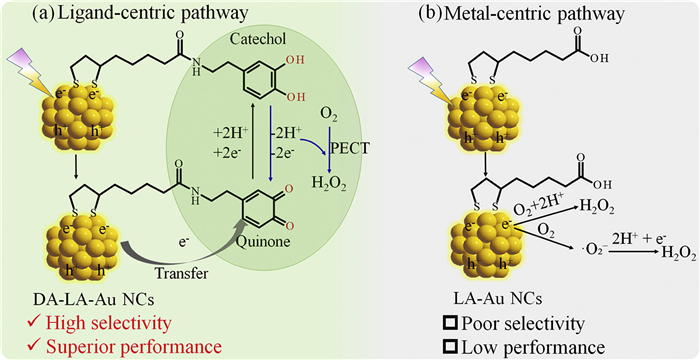
Herein, we transcend this limitation through bioinspired ligand engineering. Inspired by catechol oxidase enzymes that utilize organic cofactors (e.g., tyrosine-quinone motifs) for selective O2 activation, we design dopamine-grafted lipoic acid-protected Au NCs (DA-LA-Au NCs for short) as a ligand-centric photocatalytic nanozyme for H2O2 production via photocatalytic O2 reduction (Fig. 1a), demonstrating a distinct photocatalytic mechanism compared to that of the LA-Au NCs where metal-centric photocatalysis dominates (Fig. 1b). This architecture uniquely integrates three innovations: (1) Active site translocation from the Au core to redox-active DA ligands, repurposing the metal as an electron reservoir while DA serves as the catalytic center; (2) Biomimetic pathway gating via DA’s catechol/quinone interconversion (Fig. 1a), mirroring enzymatic proton-coupled electron transfer (PCET). This molecular switch selectively channels photogenerated electrons toward exclusive 2e- O2 reduction (H2O2 selectivity: Nearly 100%), completely bypassing ·O2- generation via metal-centric pathway (Fig. 1b); (3) Ligand-engineered nanoenvironments where the dense DA layer acts as an “O2 funnel”, increasing O2 reactant-catalyst collision probability (validated by molecular dynamics). By fusing the ultrasmall size of NCs with enzyme-like mechanistic control, this work establishes a paradigm-shifting “ligand-as-catalyst” strategy, achieving record H2 producibility (1198 µmol/L) and a high solar-to-chemical conversion (SCC) efficiency of 0.39% (which is 3.9 times higher than that of natural plants), while demonstrating how bioinspired design principles can unlock new frontiers in selective photocatalysis.
Figure 1
Figure 1.
Schematic comparison of H2O2 photocatalytic production mechanisms: (a) Ligand-centric pathway of DA-LA-Au NCs versus (b) metal-centric pathway of LA-Au NCs (Note: Surface ligands are partially omitted for visual clarity).
Materials: Ultrapure water (18.2 MΩ cm) was used in the whole experiment. Gold chloride trihydrate (HAuCl4·3H2O, ≥ 99.9%), and 5,5-dimethyl-1-pyrroline N-oxide (DMPO) from Sima-Aldrich; 1-(3-dimethylaminopropyl)-3-ethylcarbodiimide hydrochloride (EDC), 2-(N-morpholino) ethane sulfonic hydrochloride (MES, ≥ 99%) and N-hydroxysuccinimide (NHS, ≥ 98%) and from Aladdin Reagent Inc.; Sodium bicarbonate (NaHCO3, ≥ 98%), dopamine (DA) hydrochloride, lipoic acid (LA), sodium hydroxide (NaOH, ≥ 99%), sodium sulfate (Na2SO4), sodium borohydride (NaBH4, ≥98%), zinc nitrate hexahydrate (Zn(NO3)2·6H2O, ≥ 98%), 2-methylimidazole (2-Melm), methanol, hydrochloric acid (HCl) and perchloric acid (HClO4) from Sinopharm Chemical Reagent Co., Ltd.; Sodium 3-[1-[(phenylamino)-carbony]3,4-tetrazolium]-bis(4-methoxy-6-nitro)benzene-sulfonic acid hydrate (XTT) from Kulaibo Technology Co., Ltd.; All reagents were all received without further refinement.
Instruments: Transmission electron microscope (TEM) images and energy dispersive X-ray (EDX) element mapping were acquired on a JEOL JEM 2100F microscope. The UV-visible absorption was recorded on a Shimadzu UV-1800 photospectrometer. Fourier transforms infrared (FTIR) spectra were gained from a VERTEX 70 spectrometer. The in-situ FTIR spectra were obtained on the in-situ diffuse reflectance infrared Fourier transform spectrometer (INVENIO S, Bruker) equipped with a liquid N2 cooled MCT detector and a high temperature reaction chamber (Praying Mantis, Harrick).The steady-state photoluminescence (PL) spectra were collected on a PerkinElmer FL-8500 fluorescence spectrometer with an excitation wavelength of 567 nm. The PL decay results were collected on a photoluminescence spectrometer (FLS-1000, Edinburgh Instruments Ltd.). Transient absorption spectroscopy (TAS) was performed on a commercial Ti:Sapphire laser system (Spitfire, Spectra-Physics; 100 fs, 3.5 mJ, 1 kHz). Solution samples in 1 mm path length cuvettes were excited by the tunable output of the optical parametric amplifier (OPA) serving as the pump source. The X-ray photoelectron spectroscopy (XPS) analysis was carried out on an AXIS SUPRA spectrometer using a standard Al Kα X-ray source. Electron spin resonance (ESR) measurements were carried out on a Bruker EMX PLUS spectrometer. The electrochemical behaviors of the sample were tested by cyclic voltammetry on an electrochemical workstation (Chenhua, CHI760E), with 0.5 mol/L Na2SO4 as the electrolyte.
Density functional theory (DFT) and molecular dynamics (MD) simulation method and model: Theoretical calculations were performed by using spin-polarized DFT calculations package. The exchange–correlation energy was calculated using Perdew-Burke-Ernzerhof (PBE) functional [30]. Moreover, the DFT-D3 method was employed to calculate the van der Waals (vdW) interaction. The semi-core pseudopotential based on density functional theory and the double numerical plus polarization basis set were chosen to represent the metal ion cores and the valence electron functions, respectively [31]. The geometry optimization cannot be stopped until the energy convergence tolerance is 1 × 10⁻⁵ Ha, the maximum force is 2 × 10⁻³ Ha/Å, and the maximum displacement is 5 × 10⁻³ Å. Subsequently, to account for thermodynamic contributions at finite temperature, the Gibbs free energy (G) was calculated for the optimized structures using the harmonic approximation based on vibrational frequency analysis, employing the formula: G = EDFT + ZPE − T × S, where EDFT is the total electronic energy obtained from the DFT calculation, ZPE is the zero-point energy correction, S is the entropy, and T is the temperature.
The MD simulation box with an edge length of roughly 4.4 nm was first build, followed by adding 2000 H2O, 100 ligands and O2. The COMPASSII force field was selected to describe the nonbond interactions. Before the MD simulation, the energy of all models was minimized using the steep descent + ABNR + Quasi-Newton algorithm. Subsequently, the isothermal-isobaric (NPT) ensemble was used for MD simulation at 298 K to reach equilibrium for 100 ps with a time step of 1 fs, using an Andersen thermostat. The time step was set to 1 fs. Then, the MD with a further 100 ps using an NPT ensemble was carried out for radial distribution function analysis. In this stage, the system temperature was controlled with a Nose thermostat.
Synthesis of DA-LA ligand: DA-LA was synthesized by a simple EDC/NHS crosslinking strategy. In brief, 48.31 mg EDC and 14.5 mg NHS were added into the 504 µL of methanol containing 5.2 mg LA, followed by introducing 504 µL of MES buffer (prepared by dissolving 9.8 mg MES in 504 µL of 0.2 mol/L NaOH solution) and 1.5 mL of methanol. After stirring for 30 min, the pH of the solution was adjusted to 7-8 by introducing 100 µL of saturated NaHCO3 solution. Subsequently, 1.26 mL of DA solution (20 mmol/L) was introduced into the solution, followed by stirring at room temperature for 6 h. Finally, DA-LA was obtained by the organic rotary evaporation of the solution.
Synthesis of DA-LA-protected Au NCs (DA-LA-Au NCs): 0.025 mmol/L DA-LA (8.6 mg) was added to 15.6 mL aqueous solution containing 80 µL NaOH (1 mol/L), followed by stirring until all DA-LA was completely dissolved. Subsequently, 160 µL HAuCl4 (51.82 mmol/L) was added to the solution and stirred until the solution turned colorless. After that, 320 µL NaBH4 (50 mmol/L) was added slowly into the solution under vigorous stirring. Finally, the reaction solution was kept stirring overnight to obtain LA-Au NCs.
Synthesis of LA-Au NCs: LA-Au NCs were prepared by the same preparation procedure as for DA-LA-Au NCs except for the replacement of the DA-LA with LA.
Synthesis of ZIF-8: The ZIF-8 was synthesized according to the previously reported procedure. In brief, 1.17 g of Zn(NO3)2 was dissolved in 8 mL of water to serve as solution A. 22.7 g of 2-Melm was dissolved in 80 mL of water to serve as solution B. Subsequently, solution A was dropped into solution B under stirring. After stirring for 10 min at room temperature, the reaction solution was transferred into a refrigerator overnight. Finally, the ZIF-8 was collected through centrifugation, followed by washing five times with water, and vacuum dried at 30 ℃ overnight.
Synthesis of ZIF-8 encapsuled DA-LA-Au NCs (DA-LA-Au NCs@ZIF-8): 162.80 µL of Zn(NO3)2 was added into 40 mL DA-LA-Au NCs (0.5 mmol/L) solution, followed by stirring for 1 h. Afterwards, 1.62 mL of 2-Melm (276.50 mmol/L) was added into the solution under stirring. After stirring for 10 min at room temperature, the reaction solution was transferred into a refrigerator overnight. Finally, the DA-LA-Au NCs@ZIF-8 was collected through centrifugation, followed by washing five times with water and vacuum dried at 30 ℃ overnight.
Photocatalytic H2O2 production over the photocatalysts: 5 mL of DA-LA-Au NCs (0.4 mmol/L) was added in a quartz glass reactor, followed by bubbling O2 into the solution in the dark for 30 min to achieve the adsorption/desorption equilibrium of O2. After that, the solution was exposed to a 300 W Xe lamp (λ ≥ 400 nm) with a power density of 100 mW/cm2. 100 µL of the reaction solution was pipetted at given irradiation time intervals (0, 15, 30, 45, and 60 min) to determine the concentration of H2O2, which was quantified using the Quantitative Peroxide Assay Kit (aqueous). In addition, XTT was added to the reaction solution as a superoxide radical trapping agent to investigate the H2O2 formation pathway. The pH of the reaction system was adjusted with HClO4 or NaOH. The solar-to-H2O2 conversion efficiency was calculated as following:
where the free energy for H2O2 generation (ΔG) is 117 kJ/mol. The photocatalytic H2O2 production over LA-Au NCs (0.4 mmol/L), ZIF-8 (1 mg/mL), and DA-LA-Au NCs@ZIF-8 (1 mg/mL) was tested by the same procedure as for LA-Au NCs.
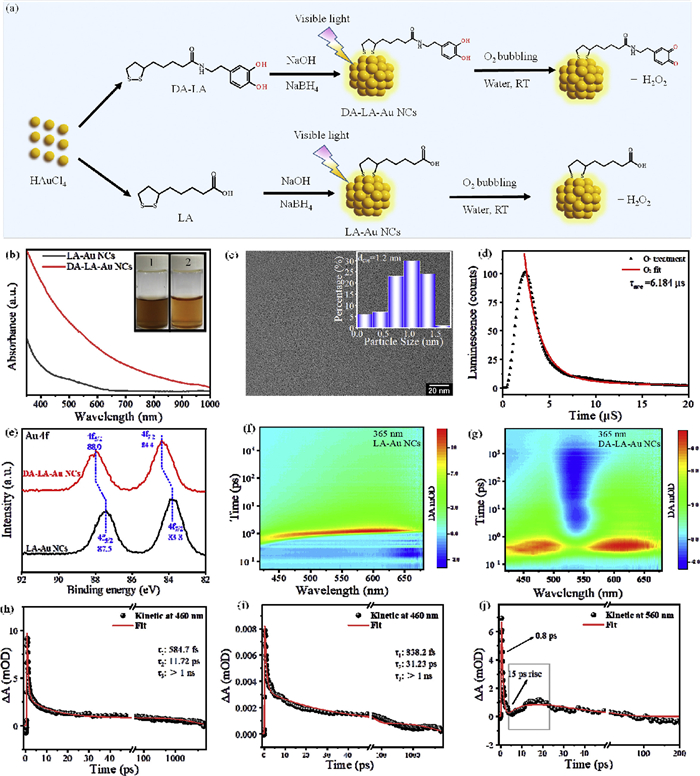
In this study, DA-LA-Au NCs were directly synthesized using DA-LA molecules as ligands, necessitating prior preparation of the DA-LA molecules. DA was grafted to LA via EDC/NHS coupling chemistry. Successful formation of DA-LA was confirmed by electrospray ionization mass spectrometry (Fig. S1 in Supporting information). Subsequently, DA-LA-Au NCs were prepared through a modified "NaOH-mediated NaBH4 reduction" method [32]. Briefly, an aqueous mixture of HAuCl4 and DA-LA ligands was sequentially treated with NaOH and reductant NaBH4, followed by 12-h reaction to yield the NCs (Fig. 2a). For comparison, LA-Au NCs without DA on the surface were synthesized identically using LA ligands.
Figure 2
Figure 2.
(a) Schematic illustration of the synthesis of DA-LA-Au NCs and LA-Au NCs for photoctalytic H2O2 production via O2 reduction. (b) UV–vis absorption spectra of DA-LA-Au NCs and LA-Au NCs. Inset shows digital images of the DA-LA-Au NCs (left) and LA-Au NCs (right) under room light illumination. (c) TEM image and the size distribution histogram (inset) of DA-LA-Au NCs. (d) PL decay profile and corresponding fit curve of DA-LA-Au NCs after O2 treatment. Inset: The calculated average PL lifetime (τave). (e) XPS spectra of Au4f of DA-LA-Au NCs and LA-Au NCs. TAS spectra of (f) LA-Au NCs and (g) DA-LA-Au NCs under 365 nm pump light excitation. The kinetics of (h) LA-Au NCs and (i) DA-LA-Au NCs at 460 nm. (j) The kinetics of DA-LA-Au NCs at 560 nm.
As shown in Fig. 2b, both DA-LA-Au NCs and LA-Au NCs exhibit brown coloration and similar UV-vis spectral features, lacking the characteristic surface plasmon resonance (SPR) peak at ∼520 nm. This confirms their NCs nature rather than larger plasmonic Au nanoparticles [33]. Notably, DA-LA-Au NCs display significantly stronger absorbance than LA-Au NCs, attributable to the intense absorption peak of oxidized DA derivatives at 480 nm [34]. This enhanced light-harvesting capability suggests superior photocatalytic potential of DA-LA-Au NCs relative to their DA-free counterparts.
TEM was employed to assess the core dimensions of both Au NCs. TEM images (Fig. 2c and Fig. S2 in Supporting information) reveal that DA-LA-Au NCs and LA-Au NCs exhibit sub-2 nm diameters with comparable average sizes of ∼1.2 nm. This size uniformity confirms that the ligand chemistry (DA-LA vs. LA) negligibly influences Au NC dimensions under identical synthesis conditions, attributable to the potent size-confinement effect of thiol groups through strong Au-S bonding. Complementary FTIR spectroscopy characterized the interfacial chemistry (Fig. S3 in Supporting information), revealing: (1) Preservation of amide bond signatures in DA-LA-Au NCs at 1645 cm-1 (amide I, C═O stretch) and 1550 cm-1 (amide II, N-H bend), which verifies DA-LA ligand retention on Au cores; and (2) disappearance of the S-H stretching vibration at 2361 cm-1 alongside the disulfide bond signal at 519 cm-1, supporting the Au-S bond formation.
Comprehensive characterization via zeta potential, PL spectroscopy, PL lifetime, XPS, and TAS delineates fundamental distinctions between DA-LA-Au and LA-Au NCs. Initial zeta potential analysis reveals DA-LA-Au NCs exhibit near-neutral surface charge (-11.1 mV), contrasting sharply with the pronounced electronegativity of LA-Au NCs (-45.9 mV, Fig. S4 in Supporting information). This divergence originates from hydroxyl-terminated surface versus deprotonated carboxylates on respective NCs. Critically, the anionic character of LA-Au NCs impedes O2 adsorption through electrostatic repulsion of O2's π-electron cloud and Pauli repulsion from filled σ-orbital overlap, whereas the near-neutral DA-LA-Au NCs circumvent these barriers to facilitate photocatalytic oxidation.
PL emission spectra demonstrate a 2.8-fold quenching in DA-LA-Au NCs relative to LA-Au NCs (Fig. S5 in Supporting information), indicative of DA-mediated electron transfer from Au core to DA-LA ligands, instead of the conventional ligand-to-metal charge transfer (LMCT) or ligand-to-metal-metal charge transfer (LMMCT) observed in previous luminescent metal NCs including LA-Au NCs. Concomitantly, O2-treated DA-LA-Au NCs display prolonged average PL lifetime (τave = 6.184 µs, Fig. 2d) when comparing to LA-Au NCs with the τave = 0.349 µs (Fig. S6 in Supporting information), attributable to catechol-to-quinone conversion that stabilizes charge carriers. XPS analysis further corroborates interfacial electron redistribution, where 0.5 and 0.3 eV positive shifts in Au 4f and S 2p binding energies, respectively, confirm reduced electron density at metallic centers (Fig. 2e and Fig. S7 in Supporting information).
The TAS results of LA-Au NCs and DA-LA-Au NCs are presented in Figs. 2f and g, respectively. Under 365 nm excitation, the kinetics at 460 nm for both LA-Au NCs (Fig. 2f) and DA-LA-Au NCs (Fig. 2g) were analyzed. Three decay lifetimes were resolved for each system. For LA-Au NCs, the lifetimes were τ1 = 584.7 fs, τ2 = 11.72 ps, and τ3 > 1 ns (Fig. 2h). Correspondingly, for DA-LA-Au NCs, the lifetimes were τ1 = 838.2 fs, τ2 = 31.23 ps, and τ3 > 1 ns (Fig. 2i). These components were assigned to internal conversion (IC), vibrational relaxation, and electron-hole recombination processes within the NCs [35]. The observed differences in decay lifetimes are attributed to energy level modifications induced by the DA ligand. At 560 nm, a distinct rising component with a time constant <15 ps was observed (Fig. 2j), attributed to electron transfer from the Au core to the DA ligand.
Under 570 nm pump light excitation (Figs. S8a and c in Supporting information), only the NC's absorption behavior was observed. At 650 nm, the kinetics of LA-Au NCs (Fig. S8b in Supporting information) were fitted with a single exponential decay corresponding to electron-hole recombination, while DA-LA-Au NCs (Fig. S8d in Supporting information) exhibited a bi-exponential decay with a 3 ps component linked to electron transfer to DA. This component differed from that at 560 nm due to variations in the energy level structure during electron transfer. Collectively, these results clearly suggest a paradigm shift from metal-centric to ligand-centric photocatalysis in DA-LA-Au NCs, driven by DA-enabled electron transfer and optimized O2 adsorption kinetics.
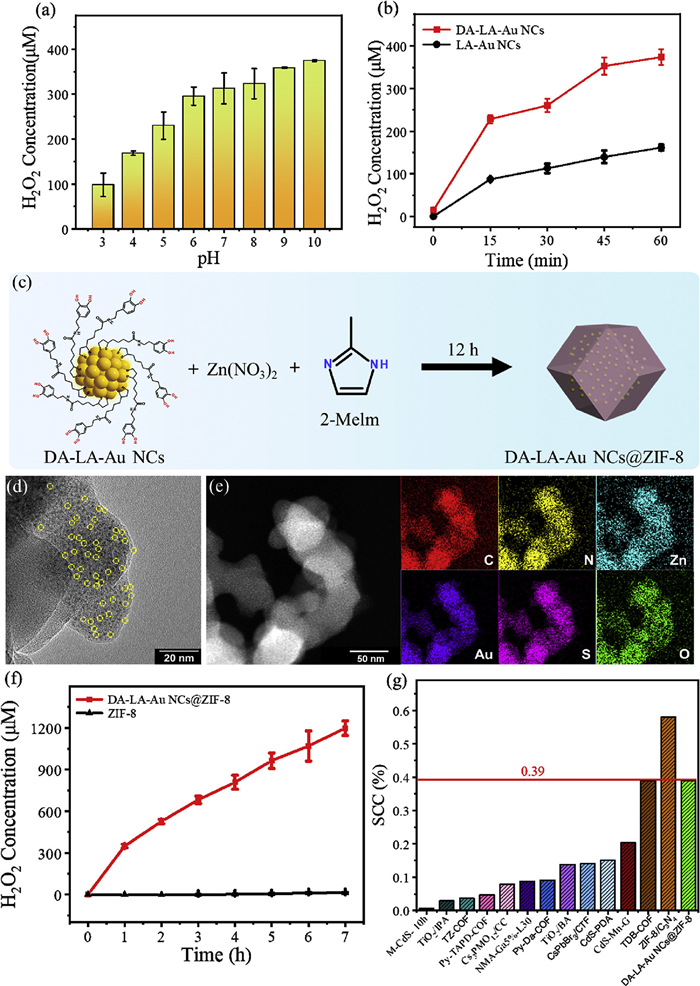
The photocatalytic H2O2 production performance of DA-LA-Au NCs was evaluated against LA-Au NCs under visible light irradiation (λ ≥ 400 nm; 100 mW/cm2) in aqueous solution without sacrificial agents. H2O2 quantification employed a commercial peroxide assay kit (Fig. S9 in Supporting information). Pre-optimization of reaction pH revealed a distinctive trend: H2O2 yield over DA-LA-Au NCs increases significantly with pH elevation (Fig. 3a), contrasting sharply with conventional photocatalysts exhibiting pH-inversed activity. This anomalous enhancement correlates with pH-dependent quinone formation (Fig. S10 in Supporting information), which provides efficient electron-accepting sites on the NC’s ligand shell. Subsequent experiments were conducted at pH 8.6-the native pH of DA-LA-Au NCs solutions. Critically, DA-LA-Au NCs achieved 373.99 µmol/L H2O2 within 60 min, outperforming LA-Au NCs (161.58 µmol/L) by a factor of 2.31 (Fig. 3b). This 131% enhancement unequivocally demonstrates DA's pivotal role in intensifying photocatalytic H2O2 generation.
Figure 3
Figure 3.
Catalytic activity for H2O2 production: (a) pH-dependent yield over DA-LA-Au NCs (60 min reaction). (b) Time-dependent profiles comparing DA-LA-Au NCs versus LA-Au NCs under visible light irradiation. (c) Schematic illustration on the synthesis of the DA-LA-Au NCs@ZIF-8. (d) TEM and (e) EDX elemental mapping results of DA-LA-Au NCs@ZIF-8. (f) Photocatalytic H2O2 production over DA-LA-Au NCs@ZIF-8 and ZIF-8 within 7 h. (g) Comparison of SSC efficiency of DA-LA-Au NCs@ZIF-8 to other previously reported photocatalysts. µM = µmol/L.
Building upon the achievement of high catalytic activity, enhancing catalyst durability became our subsequent objective. This focus stems from the recognition that while high activity enables greater H2O2 production, the resulting elevated concentrations of H2O2 may potentially compromise catalyst stability. Consequently, we conducted a long-term photocatalytic H2O2 production test over DA-LA-Au NCs to evaluate their photostability and durability. As depicted in Fig. S11 (Supporting information), the H2O2 production rate over DA-LA-Au NCs increased gradually within the first 3 h but reached a plateau thereafter. This suggests unsatisfied photocatalytic durability, potentially linked to structural changes in the DA-LA-Au NCs during the reaction. This structural evolution was corroborated by observed changes in their optical absorption (Fig. S12 in Supporting information).
To mitigate structural degradation and enhance photostability, DA-LA-Au NCs were protectively encapsulated within a porous zeolitic imidazolate framework (ZIF-8), forming DA-LA-Au NCs@ZIF-8 (Fig. 3c). TEM (Fig. 3d) and EDX elemental mapping (Fig. 3e) confirmed the uniform confinement of the DA-LA-Au NCs within the porous ZIF-8 matrix. The photocatalytic H2O2 production performance of DA-LA-Au NCs@ZIF-8 was then assessed, with the results shown in Fig. 3f. Notably, the H2O2 concentration increased progressively with illumination time, reaching 1198 µmol/L within 7 h. This H2O2 yield significantly surpasses those reported for other metal NCs-based catalysts in photocatalytic H2O2 production (Table S1 in Supporting information), demonstrating the superior efficacy of our design strategy for such catalysts. This approach also offers valuable insights for developing other nanomaterial photocatalysts. Moreover, the calculated solar-to-chemical conversion (SCC) efficiency was 0.39% , exceeding that of most previously reported photocatalysts (Fig. 3g) [36-51]. This highlights the significant potential of metal NCs for photocatalytic H2O2 generation. Furthermore, control experiments confirmed that ZIF-8 itself contributed negligibly to H2O2 production (yielding only 12.33 µmol/L). This result unequivocally establishes DA-LA-Au NCs as the dominant active component within the composite.
To elucidate the underlying mechanism for the superior photocatalytic H2O2 production of DA-LA-Au NCs, we systematically probed the roles of DA-LA ligands. As known, photocatalytic processes fundamentally involve three critical stages: Light harvesting, charge carrier separation/transfer, and surface reactions [52]. The strategic incorporation of DA-LA ligands in Au NC design concurrently optimizes all three aspects: Enhanced visible-light absorption via DA-derived chromophores; regulated electron transfer through catechol/quinone redox mediation; and accelerated surface reactions by O2 enrichment at ligand sites. This tripartite enhancement establishes DA-LA-Au NCs as a paradigm-shifting photocatalyst architecture.
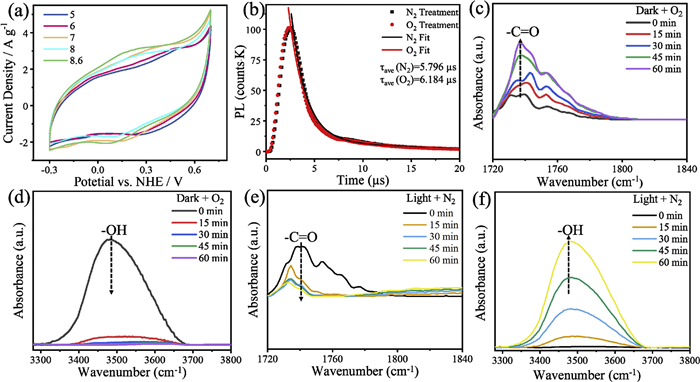
Specifically, the aforementioned analyses have confirmed their dual function in enhancing light-harvesting capability (Fig. 2b) and modulating electron transfer dynamics (Figs. 2d-j and Figs. S5-S8 in Supporting information). To definitively establish whether DA-LA-Au NCs retain the electrochemical characteristics of free DA, cyclic voltammetry was performed across pH 5–8.6. As shown in Fig. 4a, both anodic and cathodic peaks shift cathodically with increasing pH, mirroring the behavior of unbound DA molecules. Critically, the formal potential (Ef = (Epa + Epc)/2) exhibits a linear dependence on pH with a slope of −59 mV/pH (Fig. S13). This aligns with the theoretical Nernst value (−59 mV/pH per electron) for a two-proton-coupled two-electron redox process [53], unambiguously demonstrating that DA-LA-Au NCs inherit DA’s redox behavior. Moreover, the progressive enhancement of PL quenching in DA-LA-Au NCs with increasing pH (Fig. S14 in Supporting information) directly correlates with accelerated electron transfer from the Au core to DA-LA ligands. This pH-dependent charge redistribution rationalizes the concomitant improvement in photocatalytic H2O2 production efficiency. Concurrently, DA-LA-Au NCs exhibit reduced average PL lifetime (τave) under N2 atmosphere relative to O2-treated counterparts (Fig. 4b). This phenomenon directly correlates with O2-driven oxidation of catechol moieties to quinone forms, which enhances interfacial electron transfer and consequently prolongs charge carrier lifetimes. Consequently, DA-LA ligands likely function as surface reaction centers to enable photocatalytic O2 reduction via efficient electron-proton transfer.
Figure 4
Figure 4.
(a) Cyclic voltammograms of DA-LA-Au NCs collected in different pH buffers. (b) PL decay profiles and corresponding fit curves of DA-LA-Au NCs after N2 and O2 treatment. Inset: The calculated average PL lifetimes (τave). In-situ FTIR spectra of DA-LA-Au NCs with (c, d) an O2 atmosphere in the dark and (e, f) an N2 atmosphere under light illumination.
To further validate DA's role in O2 reduction, in situ FTIR spectra were acquired under contrasting conditions: (1) O2 atmosphere in darkness and (2) N2 atmosphere during illumination. Under dark/O2 exposure, progressive intensification of the C═O stretch (1737 cm-1, Fig. 4c) concomitant with attenuation of the -OH vibration (3484 cm-1, Fig. 4d) confirms direct oxidation of catechol moieties to quinone by molecular O2. Conversely, illumination under N2 induces inverse spectral trends -C═O diminution (Fig. 4e) and -OH recovery (Fig. 4f), evidencing quinone reduction to catechol by photoinduced electrons. This reversible quinone-catechol interconversion directly demonstrates DA-LA ligands functioning as photocatalytic reaction centers for H2O2 synthesis.
To further verify whether the photocatalytic reaction center shifts from metal core to the ligands and whether DA modification alters the H2O2 production pathway, we employed electron spin resonance (ESR) to probe intermediate species during photocatalysis using DA-LA-Au NCs versus LA-Au NCs. As established, H2O2 generation via O2 reduction by photoinduced electrons proceeds through two routes:
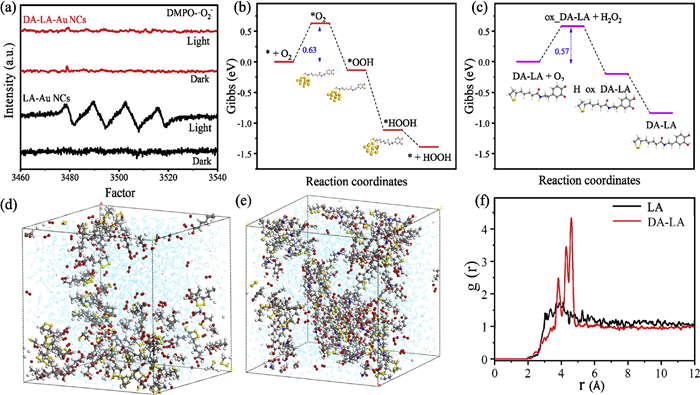
Given that ·O2- are critical intermediates in the sequential pathway, we detected ·O2- using DMPO as a spin-trapping agent. As shown in Fig. 5a, distinct signals for DMPO-·O2- adducts were observed in LA-Au NC systems. Conversely, these signals were negligible in DA-LA-Au NC solutions (Fig. 5a). This demonstrates that surface-bound DA suppresses the one-electron reduction pathway, enabling selective ( > 99%) two-electron O2 reduction to H2O2. This alignment with DA’s inherent two-electron/two-proton redox behavior confirms our design strategy: Engineering ligand-anchored reaction centers to enhance photocatalytic activity.
Figure 5
Figure 5.
(a) ESR signals for DMPO-·O2- adduct over LA-Au NCs and DA-LA-Au NCs under light irradiation and dark condition. Free energy diagrams for H2O2 production pathways at the catalytic sites of (b) the Au core and (c) the DA ligand moiety in DA-LA-Au NCs. MD Simulation boxes of O2 molecules in water at 298 K over (d) LA ligands and (e) DA-LA ligands, atomic color code: red-O, yellow-S, grey-C, and white-H. (f) The RDF plots of the H atom in LA ligands and DA-LA ligands to the O2 molecules.
Two fundamental questions arise regarding the mechanistic shift in H2O2 photocatalysis: (1) Why does simple DA functionalization redirect the catalytic active site from the metal core to the ligand surface? (2) How does surface-bound DA dramatically enhance H2O2 production efficiency? To address these questions, we conducted DFT calculations to analyze the photocatalytic pathways on both DA-LA-Au NCs and LA-Au NCs. First, we computed the O2 binding energies and O2 reduction reaction (ORR) energy barriers over DA-LA-Au NCs at two potential active sites: Metal core vs. DA ligands (Figs. 5b and c). As shown in Figs. 5b and c, O2 adsorption is the rate-determining step for H2O2 production via ORR. The energy barrier for O2 adsorption on the DA-LA ligand (ΔE = 0.57 eV) is lower than that on the Au core (ΔE = 0.63 eV). This indicates that O2 adsorption and subsequent reaction are more favorable on the DA-LA ligand than on the Au core in DA-LA-Au NCs. These computational results demonstrate that surface-anchored DA functions as a molecular switch, redirecting photocatalytic activity from the metal core to the ligand interface.
Beyond enhancing O2 adsorption, DA ligands facilitate O2 accessibility at reactive sites. To quantify ligand-O2 contact probability—a critical factor governing surface reactivity—we computed radial distribution functions (RDFs) via MD simulations. RDF analysis provides the normalized probability of locating a molecule at a given radial distance, enabling quantitative assessment of ligand-O2 interactions. Figs. 5d and e display MD simulation snapshots of LA and DA-LA ligand systems at 298 K in O2/H2O environments. Corresponding RDFs for O2 surrounding terminal hydrogen atoms in –COOH (LA) and DA moieties (DA-LA) are presented in Fig. 5f. Notably, the RDF for DA-bound H atoms exhibits pronounced peaks at 3.6 Å and 4.9 Å, contrasting with the weaker features observed for LA. This demonstrates significantly enhanced O2 accessibility at DA sites, thereby promoting photocatalytic O2 reduction for H2O2 generation. Taken together, employing DA-LA ligands as the protective layer for Au NCs confers several key advantages in photocatalytic H2O2 production: (1) Enhanced visible light absorption; (2) shifting the photocatalytic active sites from the Au core to the ligand shell; (3) facilitated transfer of excited electrons from the Au core to the ligands; and (4) enhanced O2 adsorption and increased reaction probability at the ligand-centered active sites. Collectively, these advantageous properties of DA-LA-Au NCs account for the significant enhancement in H2O2 production.
Based on the preceding analysis, a plausible mechanism and potential pathway for H2O2 generation over DA-LA-Au NCs are proposed in Fig. 1a. Specifically, the quinone moieties act as electron acceptors, capturing electrons from the photoexcited NCs. This electron transfer facilitates the reduction of quinone to catechol via a coupled two-electron, two-proton process. Subsequently, the catechol species can be oxidized back to quinone by molecular O2, simultaneously generating H2O2 through another two-electron, two-proton pathway. This reversible catechol/quinone redox cycle enables the DA ligands on the NC surface to function as continuous reaction centers for photocatalytic H2O2 production. Thus, this shift from metal-centric to ligand-centric photocatalysis circumvents the one-electron O2 reduction pathway typically involved in the two-step formation of H2O2.
This work unveiled a bioinspired "ligand-as-catalyst" strategy using DA-LA-Au NCs for solar-driven H2O2 synthesis. By relocating catalytic sites from the Au core to redox-active DA ligands, we achieved exclusive 2e- oxygen reduction with near-100% selectivity, completely suppressing ·O2- generation, as verified by ESR. The DA ligands serve as molecular switches, enabling PCET via reversible catechol/quinone interconversion, while simultaneously enhancing visible-light absorption and electron transfer kinetics. Ligand-engineered nanoenvironments boosted reactant-catalyst collision frequency (validated by MD simulations). Encapsulation within ZIF-8 (DA-LA-Au NCs@ZIF-8) stabilizes the system, delivering a record H2O2 production of 1198 µmol/L under visible light without sacrificial agents and a SCC efficiency of 0.39% , surpassing most reported photocatalysts. This ligand-centric paradigm, merging enzyme-like precision with NCs functionality, establishes a versatile platform for sustainable oxidant production and selective photocatalysis.
The authors declare that they have no known competing financial interests or personal relationships that could have appeared to influence the work reported in this paper.
Acknowledgments
This work is supported by the National Natural Science Foundation of China (Nos. 22371153, 22071127), Shandong Province Natural Science Foundation (Nos. ZR2024JQ002, ZR2024QE020), Taishan Scholars Project Special Funds (No. tsqn202312200), and the Youth Innovation Team Development Program of Shandong Higher Education Institutions (No. 2022KJ155). We gratefully acknowledge Prof. Zhennan Wu (Jilin University) for providing transient absorption spectroscopy (TAS) measurements.
Supplementary materials
Supplementary material associated with this article can be found, in the online version, at doi:10.1016/j.cclet.2025.111701.
Figure 1
Schematic comparison of H2O2 photocatalytic production mechanisms: (a) Ligand-centric pathway of DA-LA-Au NCs versus (b) metal-centric pathway of LA-Au NCs (Note: Surface ligands are partially omitted for visual clarity).
Figure 2
(a) Schematic illustration of the synthesis of DA-LA-Au NCs and LA-Au NCs for photoctalytic H2O2 production via O2 reduction. (b) UV–vis absorption spectra of DA-LA-Au NCs and LA-Au NCs. Inset shows digital images of the DA-LA-Au NCs (left) and LA-Au NCs (right) under room light illumination. (c) TEM image and the size distribution histogram (inset) of DA-LA-Au NCs. (d) PL decay profile and corresponding fit curve of DA-LA-Au NCs after O2 treatment. Inset: The calculated average PL lifetime (τave). (e) XPS spectra of Au4f of DA-LA-Au NCs and LA-Au NCs. TAS spectra of (f) LA-Au NCs and (g) DA-LA-Au NCs under 365 nm pump light excitation. The kinetics of (h) LA-Au NCs and (i) DA-LA-Au NCs at 460 nm. (j) The kinetics of DA-LA-Au NCs at 560 nm.
Figure 3
Catalytic activity for H2O2 production: (a) pH-dependent yield over DA-LA-Au NCs (60 min reaction). (b) Time-dependent profiles comparing DA-LA-Au NCs versus LA-Au NCs under visible light irradiation. (c) Schematic illustration on the synthesis of the DA-LA-Au NCs@ZIF-8. (d) TEM and (e) EDX elemental mapping results of DA-LA-Au NCs@ZIF-8. (f) Photocatalytic H2O2 production over DA-LA-Au NCs@ZIF-8 and ZIF-8 within 7 h. (g) Comparison of SSC efficiency of DA-LA-Au NCs@ZIF-8 to other previously reported photocatalysts. µM = µmol/L.
Figure 4
(a) Cyclic voltammograms of DA-LA-Au NCs collected in different pH buffers. (b) PL decay profiles and corresponding fit curves of DA-LA-Au NCs after N2 and O2 treatment. Inset: The calculated average PL lifetimes (τave). In-situ FTIR spectra of DA-LA-Au NCs with (c, d) an O2 atmosphere in the dark and (e, f) an N2 atmosphere under light illumination.
Figure 5
(a) ESR signals for DMPO-·O2- adduct over LA-Au NCs and DA-LA-Au NCs under light irradiation and dark condition. Free energy diagrams for H2O2 production pathways at the catalytic sites of (b) the Au core and (c) the DA ligand moiety in DA-LA-Au NCs. MD Simulation boxes of O2 molecules in water at 298 K over (d) LA ligands and (e) DA-LA ligands, atomic color code: red-O, yellow-S, grey-C, and white-H. (f) The RDF plots of the H atom in LA ligands and DA-LA ligands to the O2 molecules.


 DownLoad:

 下载:


 下载:

