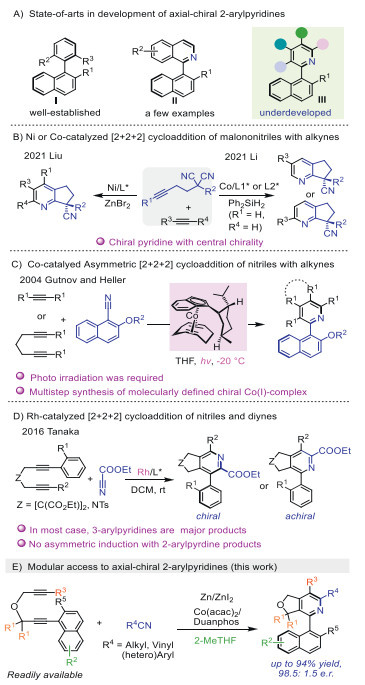
Scheme 1.
Asymmetric [2 + 2 + 2] cycloaddition of alkynes and nitriles.

Modular synthesis of polyfunctionalized axial-chiral 2-arylpyridines via cobalt-catalyzed asymmetric [2 + 2 + 2] cycloaddition of diynes and nitriles
Zhen-Qi Wang , Lin-Wen Wei , Zhao-Qing Wang , Yan-Jie Yang , Yu Zhao , Song Liu , Yuan Huang


Atropisomerism represents one of the most important chirality elements in nature [1-5]. Atropisomers with different configurations could vary drastically in their biological activities and functions [6-12]. In particular, axial-chiral 2-arylpyridine derivatives are important structural motifs that are not only widely available in bioactive molecules [13], but also frequently used as ligands or catalysts such as Quinazolinap, Quinap, and Quinox (Scheme 1A) [14-17]. Contrary to the development of protocols accessing to axially chiral biaryls [18-20] as depicted as Ⅰ, much less attention has been paid to the methods producing densely functionalized axial-chiral 2-arylpyridines Ⅲ. Hence, the development of the efficient methods for accessing to diverse polyfunctionalized axial-chiral 2-arylpyridine derivatives could potentially extend the chemical and biological space of this privileged scaffolds, as well as provide new opportunities in asymmetric catalysis.
Transition metal-catalyzed [2 + 2 + 2] cycloaddition of alkynes and nitriles has emerged as an atom economic process and allows the formation of multisubstituted pyridines using readily available starting materials in a single step [21-24]. The great progress has recently been made in the construction of chiral pyridines with central chirality by the groups of Liu [25] and Li [26] independently (Scheme 1B), however, the methods for highly enantioselective construction of axial-chiral 2-arylpyridines yet remains underdeveloped. In this context, the groups of Gutnov, Heller, and Hapke developed methods for the synthesis of enantioenriched atropisomers of 2-arylpyridines (Scheme 1C) [27-30]. However, multi-step synthesis of the molecularly defined chiral indenyl-based cobalt(Ⅰ) complex involving resolution was required, and the external photo irradiation was necessary for the reactions to take place. In the related area of the research, Tanaka et al. have demonstrated that Rh(Ⅰ)/H8-Binap-catalyzed asymmetric [2 + 2 + 2] cycloaddition has enabled access to axial-chiral pyridines (Scheme 1D) [31], however, in most cases, the axially chiral 3-arylpyridines were obtained in their system. Subsequently, Song et al. disclosed an asymmetric [2 + 2 + 2] cycloaddition reaction of B, N-diynes and nitriles for the synthesis of C-B axial chirality using rhodium catalysis system, the reactions favorably delivered axial-chiral 3-arylpyridines compounds [32]. Very recently, Liu et al. developed a nickel-catalyzed asymmetric [2 + 2 + 2] cycloaddition reactions for the efficient construction of axially chiral 4-arylpyridine products [33]. Therefore, a modular and practical catalytic system that utilizes commercially available catalysts, and works for the asymmetric [2 + 2 + 2] cycloaddition for accessing densely functionalized axialchiral 2-arylpyridines Ⅲ (Scheme 1A) is still highly desirable, which remains a challenge in organic synthesis. Herein, we report our discovery and development of cobalt-catalyzed highly enantioselective [2 + 2 + 2] cycloaddition reactions of readily available diynes and nitriles by using commercially available cobalt salt and chiral bisphosphine as the catalyst system (Scheme 1E) [34-62]. A broad range of axial-chiral 2-pyridine derivatives with diverse substitutions were achieved in good yields and excellent enantioselectivities. DFT calculation profiles have identified the mechanism of this cobalt-catalyzed asymmetric [2 + 2 + 2] cycloaddition reaction for further clarifying the origin of regioselectivity.
The reaction conditions were optimized using readily available diyne 1a and commercially available acetonitrile 2a (Table 1). Initially, a variety of metal salts which have been demonstrated to be effective in previous [2 + 2 + 2] cycloaddition reactions were chosen to tested for validation of our hypothesis, however, no desired product was observed (Table 1, entries 1–4). Interestingly, the desired product was achieved by using Co(OAc)2 as the catalyst, albeit with 50% yield (Table 1, entry 5). Subsequently, a variety of commercially available chiral nitrogen-based ligands (Table 1, entries 6 and 7) and chiral phosphine ligands (Table 1, entries 8–13) were tested for this cycloaddition reaction. To our delight, it was found that duanphos L5 offered the best reaction efficiency and selectivity, yielding the desired product 3a with 85% yield, 95:5 e.r. (Table 1, entry 10). Since different anions in the cobalt salts may lead to different electronic properties, we evaluated various cobalt salts. However, the yields of 3a were dramatically decreased in the presence of CoF2, CoCl2, CoBr2, or CoI2 as the cobalt source (Table 1, entries 14–17) compared to Co(acac)2 (Table 1, entry 18). Additionally, Co(OTf)2 also showed a slight decrease both in yield and stereoselectivity (75% yield, 87:13 e.r.) (Table 1, entry 19). Different solvents, including acetonitrile, toluene, dioxane, chlorobenzene, cyclopentyl methyl ether, and 2-methyl tetrahydrofuran, were tested to optimize the stereoselectivity (Table 1, entries 20–25). The results revealed that excellent efficiency and stereoselectivity (87% yield, 97:3 e.r.) could be achieved by using 2-methyl tetrahydrofuran (Table 1, entry 25). It is worth noting that the reaction failed to engage without the addition of either Zn or ZnI2. In addition, we have identified that temperature has a great impact on enantioselectivity of desired product, 50 ℃ was found to be the best reaction temperature, the enantioselectivity of desired product decreased dramatically with higher temperature.
 DownLoad:
CSV
DownLoad:
CSV
 | |||||
| Entry | Ligand | [M] | Solvent | Yield (%)b | e.r. c |
| 1d | DPPP | Ni(cod)2 | THF | < 2 | – |
| 2 | DPPP | NiCl2 | THF | < 2 | – |
| 3 | DPPP | FeBr2 | THF | < 2 | – |
| 4d | DPPP | [Rh(cod)2]BF4 | THF | < 2 | – |
| 5 | DPPP | Co(OAc)2 | THF | 50 | – |
| 6 | L1 | Co(OAc)2 | THF | 65 | 75:25 |
| 7 | L2 | Co(OAc)2 | THF | 51 | 50:50 |
| 8 | L3 | Co(OAc)2 | THF | 24 | 60:40 |
| 9 | L4 | Co(OAc)2 | THF | 24 | 52:48 |
| 10 | L5 | Co(OAc)2 | THF | 85 | 95:5 |
| 11 | L6 | Co(OAc)2 | THF | 12 | 67:33 |
| 12 | L7 | Co(OAc)2 | THF | 64 | 56:44 |
| 13 | L8 | Co(OAc)2 | THF | < 2 | – |
| 14 | L5 | CoF2 | THF | 57 | 95:5 |
| 15 | L5 | CoCl2 | THF | 57 | 94:6 |
| 16 | L5 | CoBr2 | THF | 48 | 96:4 |
| 17 | L5 | CoI2 | THF | 48 | 95:5 |
| 18 | L5 | Co(acac)2 | THF | 85 | 97:3 |
| 19 | L5 | Co(OTf)2 | THF | 75 | 87:13 |
| 20 | L5 | Co(acac)2 | MeCN | 57 | 90:10 |
| 21 | L5 | Co(acac)2 | Toluene | 59 | 92.5:7.5 |
| 22 | L5 | Co(acac)2 | Dioxane | 59 | 95:5 |
| 23 | L5 | Co(acac)2 | Chlorobenzene | 44 | 94:6 |
| 24 | L5 | Co(acac)2 | CPME | 35 | 92.5:7.5 |
| 25 | L5 | Co(acac)2 | 2-Me-THF | 87 | 97:3 |
| 26d | L5 | Co(acac)2 | 2-Me-THF | 0 | – |
| 27e | L5 | Co(acac)2 | 2-Me-THF | 0 | – |
| 28f | L5 | Co(acac)2 | 2-Me-THF | 85 | 94:6 |
| 29g | L5 | Co(acac)2 | 2-Me-THF | 85 | 57:43 |
| a 1a (0.1 mmol, 1.0 equiv.), 2a (0.2 mmol, 2.0 equiv.), [M] (0.010 mmol, 10 mol%), ligand (0.015 mmol, 15 mol%), Zn (0.05 mmol, 0.5 equiv.), ZnI 2 (0.05 mmol, 0.5 equiv.) in solvent (0.5 mL, 0.2 mol/L) at 50 ℃ for 20 h under N 2 atmosphere. DPPP: 1,3-Bis(diphenylphosphino)propane. b Yield was determined by GC and n-dodecane was used as the internal standard. c Determined by chiral HPLC. d Reaction without Zn. e Reaction without ZnI 2. f Reaction temperature is 60 ℃. g Reaction temperature is 100 ℃. | |||||
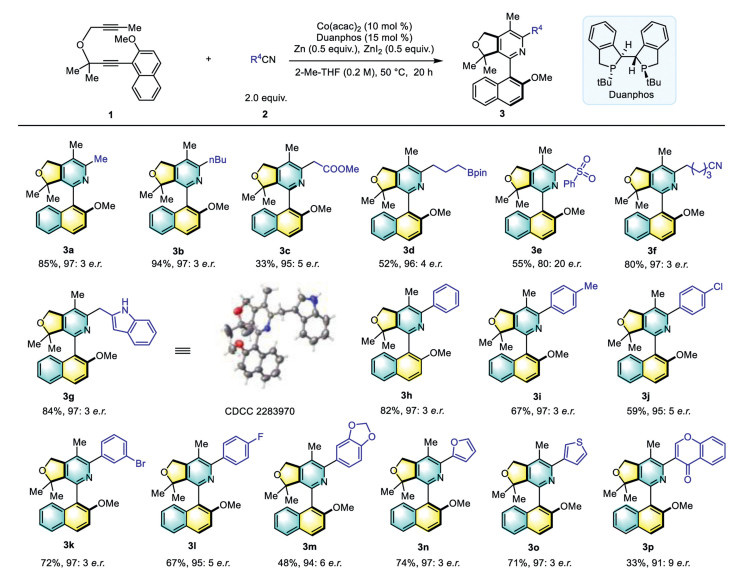
With the optimal reaction conditions in hand, the generality of this procedure for the stereoselective synthesis of axial-chiral 2-arylpyridines was investigated. Both alkyl nitriles and aryl nitriles were successfully worked in this reaction, forming the desired products in good yields and enantioselectivities under standard conditions with the same procedure (Scheme 2). In addition to simple acetonitrile, the nitriles with different functional groups such as ester, boronic ester, sulfone, cyano, and indole moieties could all produce chiral 2-arylpyridines 3c-3g in good yields and enantioselectivities. Furthermore, arylnitriles bearing electron-donating and electron-withdrawing groups on the para- or meta-positions of the phenyl ring also participated in this reaction smoothly, producing species 3h-3m in 48%−82% yields with 95:5–97:3 e.r. More importantly, nitriles with heterocycles such as furan or thiophene successfully achieved the corresponding cycloaddition products 3n, 3o with 74%, 71% yields in 97:3 e.r. In addition, 3-cyano flavone was also involved in this reaction with good enantioselectivity, albeit with a lower yield. The absolute configuration of 3g was unambiguously assigned by single-crystal X-ray diffraction analysis.
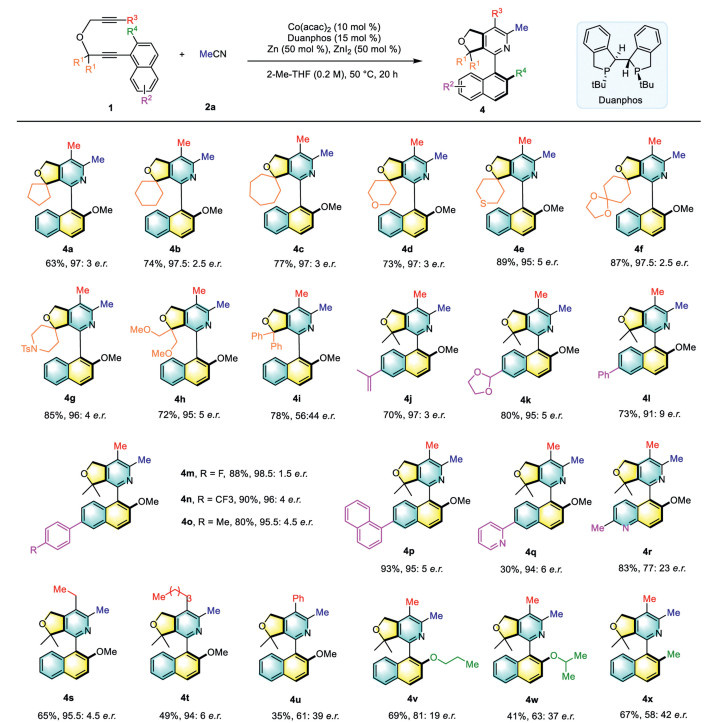
The substrate scope of diynes 1 is shown in Scheme 3. The diynes containing (hetero)cyclic or open-chain structure (R1) delivered the desired products 4a-4h in high yields and enantioselectivities. However, when R1 was replaced with benzene rings, the yield of product 4i remained well, however the enantioselectivity decreased dramatically. Chiral 2-arylpyridine products 4j, 4k bearing alkene, and 3-acetal group on 6-position of naphthalene ring were achieved in 70%, 80% yield and 97:3, 95:5 e.r., respectively. The diynes attached with an aryl group on the 6-position of naphthalene could proceed reactions efficiently, yielding the products 4l-4p in good efficiency. The diyne with a pyridinyl group also proceeded this [2 + 2 + 2] cycloaddition reaction smoothly, affording the desired product 4q with good enantioselectivity, albeit with a lower yield. Furthermore, the diyne installing a methylquinoline moiety could produce product 4r with good yields and moderate enantioselectivity. Additionally, substrates containing longer alkyl chains at R3 produced good yields and stereoselectivities with the axial chiral 2-arylpyridine products 4s, 4t. When R3 is a phenyl group on the diyne, both the reactivity and enantioselectivity were largely affected, only affording the product 4u in 35% yield, 61:39 e.r. Variation of substituents on 2-position of naphthalene ring led to the desired products 4v-4x with poor enantioselectivity.
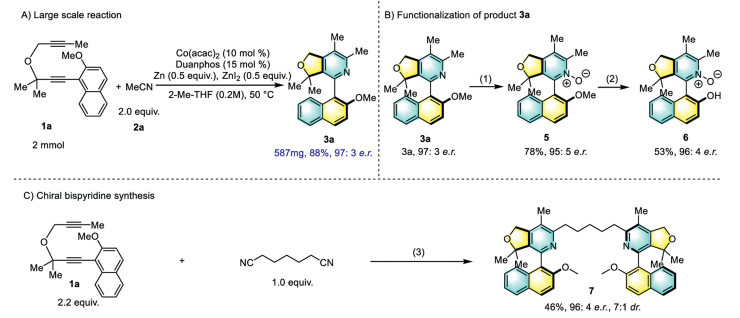
To further showcase the practicability of the protocol, a large-scale reaction was demonstrated by using 2.0 mmol dienyne 1a and 4.0 mmol acetonitrile 2a to give 587 mg of the corresponding axial-chiral 2-arylpyridines 3a (Scheme 4A, left). To demonstrate the utility of this strategy, several transformations of 3a were conducted (Scheme 4B). Firstly, the pyridine moiety of 3a could be readily oxidized using m-CPBA, generating N-oxide containing product 5 in high yield and good stereoselectivity (78% yield, 95:5 e.r.), which was subsequently demethylated using HPPh2 and tBuOK to produce the naphthol product 6 in a moderate yield with excellent stereoselectivity (53% yield, 96:4 e.r.). It should be noted that using 3a as the starting material to do demethylation reaction, a complete racemization issue occured, yielding racemic naphthol product. Considering the importance of chiral bispyridines in organic synthesis [63], we also adopted this simple protocol to synthesize the bisaxial-chiral 2-arylpyridines skeleton 7 using 1,5-dicyanopentane as the nitrile source (Scheme 4C).
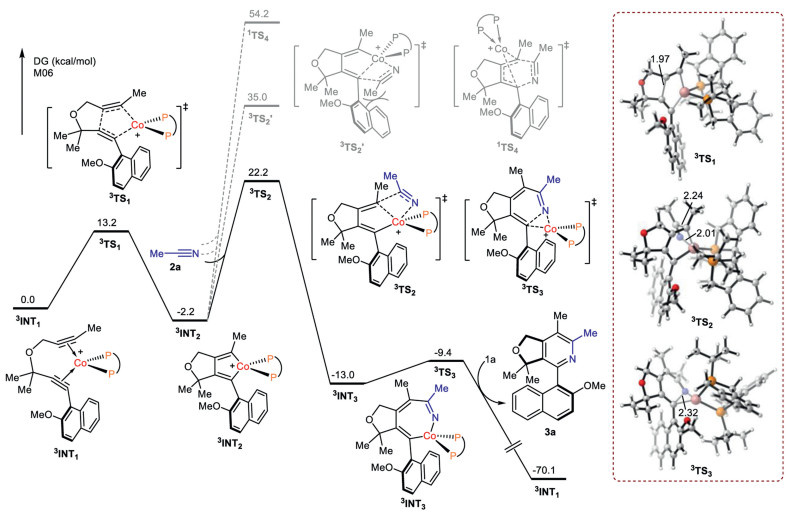
We performed DFT calculations to reveal the mechanism of this Co-catalyzed asymmetric [2 + 2 + 2] cycloaddition to clarify the origin of regioselectivity. Importantly, all the transition states and intermediates calculated in the catalytic cycle are triplet states. The unfavorable singlet free-energy profiles are depicted in Scheme S1 (Supporting information). As shown in Scheme 5, The diyne coordinated triplet cationic Co(Ⅰ) species 3INT1 was used as the active catalytic complex for the catalytic cycle. The oxidative cyclization occurred via transition state 3TS1 with a free energy barrier of 13.2 kcal/mol to give the cyclometallic triplet intermediate 3INT2. The length of the forming C—C bond in 3TS1 is 1.97 Å. The formation of 3INT2 is exergonic by 2.2 kcal/mol, where the oxidative state of cobalt center is increased to +3. The following cyano migratory insertion would occur via transition state 3TS2 or 3TS2′, respectively, with a free energy barrier of 24.4 or 37.5 kcal/mol. The calculated results indicated that cyano insertion into methyl alkenyl cobalt site is favorable, compared to the naphthylalkenyl part, which dominates the origin of regioselectivity. The steric repulsion of nitrile with naphthyl contributed to the high free energy barrier of 3TS2′. After this step, a seven-membered cobaltacycle 3INT3 was formed. The axial-chiral 2-arylpyridines product 3a was generated by C—N reductive elimination via transition state 3TS3 with energetic span of 3.6 kcal/mol. The length of the forming C—N bond is 2.32 Å. The atroposelective product 3a was predicted as the major product in our DFT calculation, which is coincident with experimental observations. Furthermore, the [4 + 2] cycloaddition pathway has also been considered. As shown in Scheme 5, the [4 + 2] cycloaddition transition state 1TS4 entailed a free energy barrier of 56.4 kcal/mol, which is 32.0 kcal/mol higher than that of 3TS2. The calculation results showed that the [4 + 2] cycloaddition pathway was unfavorable.
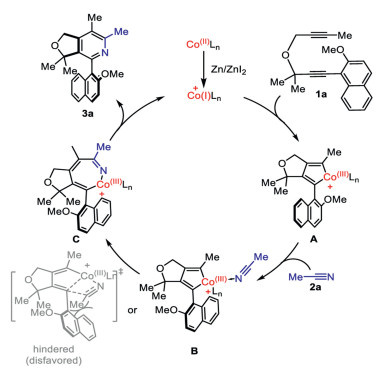
From the above results and previous transition metal- catalyzed [2 + 2 + 2] cycloaddition reports [64-67], the proposed mechanisms for this cobalt-catalyzed [2 + 2 + 2] cycloaddition of the diynes 1 with nitriles 2 are depicted in Scheme 6. Initially, the cationic Co(Ⅰ) species is generated in-situ from the reduction of Co(Ⅱ) with zinc powder and ZnI2 before it was coordinated with the diyne 1a, followed by cyclization to form the cationic Co(Ⅲ) intermediate A [68-73]. Subsequently, acetonitrile 2a coordinated with A to give the cationic Co(Ⅲ) complex B. Complex B undergoes migratory insertion to generate the Co(Ⅲ) intermediate C, followed by reductive elimination to give the final product 3a while the reactive cationic Co(Ⅰ) species was released for the next catalytic cycle. Due to the steric hindered interaction between the aryl group in A and the methyl group in acetonitrile 2a, cyano insertion into naphthyl alkenyl part is unfavourable.
In summary, we have developed an efficient approach to synthesis of polyfunctionalized axial-chiral 2-arylpyridines through asymmetric [2 + 2 + 2] cycloaddition of diynes with nitriles using commercially available cobalt catalyst system. A wide range of axial-chiral 2-arylpyridines products with highly diverse substitution patterns have been achieved in high efficiency by using 2-methyl tetrahydrofuran as a green solvent. This reaction exhibits high modularity, excellent stereoselectivity and regioselectivity, good functional tolerance. The gram-scale synthesis also demonstrated its practicability. Furthermore, the efficient accessing axial-chiral 2-pyridine N-oxide and chiral bispyridine skeletons were also accomplished. The DFT calculation profiles have elucidated the mechanism of this cobalt-catalyzed asymmetric cycloaddition reaction and clarified the origin of regioselectivity. Further applications of this simple cobalt catalysis system to other [2 + 2 + 2] cycloaddition for synthesis of novel nitrogen containing chiral molecules are currently underway in our laboratories.
The authors declare that they have no known competing financial interests or personal relationships that could have appeared to influence the work reported in this paper.
Zhen-Qi Wang: Investigation, Conceptualization. Lin-Wen Wei: Writing – original draft, Methodology, Investigation, Formal analysis. Zhao-Qing Wang: Methodology, Investigation, Formal analysis. Yan-Jie Yang: Investigation. Yu Zhao: Writing – review & editing. Song Liu: Software, Investigation. Yuan Huang: Writing – review & editing, Project administration, Investigation, Funding acquisition, Conceptualization.
The authors are grateful for the financial support was provided by the National Natural Science Foundation of China (Nos. 22001203, 22471209, 22303010), the Key R&D Plan of Shaanxi Province (No. 2023-YBSF-186), the Youth Project of Basic Science Research Institute of Shaanxi Province (No. 22JHQ013), the Fundamental Research Funds for the Central Universities (No. xtr052024013).
Supplementary material associated with this article can be found, in the online version, at doi:
C.X. Liu, W.W. Zhang, S.Y. Yin, Q. Gu, S.L. You, J. Am. Chem. Soc. 143 (2021) 14025–14040. doi: 10.1021/jacs.1c07635
T.Z. Li, S.J. Liu, W. Tan, F. Shi, Chem. Eur. J. 26 (2020) 15779–15792. doi: 10.1002/chem.202001397
G. Liao, T. Zhou, Q.J. Yao, B.F. Shi, Chem. Commun. 55 (2019) 8514–8523. doi: 10.1039/c9cc03967h
J.E. Smyth, N.M. Butler, P.A. Keller, Nat. Prod. Rep. 32 (2015) 1562–1583. doi: 10.1039/C4NP00121D
G.J. Mei, W.L. Koay, C.Y. Guan, Y. Lu, Chem. 8 (2022) 1855–1893. doi: 10.1016/j.chempr.2022.04.011
S.R. LaPlante, P.J. Edwards, L.D. Fader, A. Jakalian, O. Hucke, ChemMedChem 6 (2011) 505–513. doi: 10.1002/cmdc.201000485
S.R. LaPlante, L.D. Fader, K.R. Fandrick, et al., J. Med. Chem. 54 (2011) 7005–7022. doi: 10.1021/jm200584g
G. Bringmann, T. Gulder, T.A.M. Gulder, M. Breuning, Chem. Rev. 111 (2011) 563–639. doi: 10.1021/cr100155e
C.C. Hughes, C.A. Kauffman, P.R. Jensen, W. Fenical, J. Org. Chem. 75 (2010) 3240–3250. doi: 10.1021/jo1002054
W. Meng, R.P. Brigance, H.J. Chao, et al., J. Med. Chem. 53 (2010) 5620–5628. doi: 10.1021/jm100634a
J. Clayden, W.J. Moran, P.J. Edwards, S.R. LaPlante, Angew. Chem. Int. Ed. 48 (2009) 6398–6401. doi: 10.1002/anie.200901719
Y.F. Hallock, K.P. Manfredi, J.W. Blunt, et al., J. Org. Chem. 59 (1994) 6349–6355. doi: 10.1021/jo00100a042
G. Bringmann, M. Reichert, Y. Hemberger, Tetrahedron. 64 (2008) 515–521. doi: 10.1016/j.tet.2007.11.015
B.V. Rokade, P.J. Guiry, ACS Catal. 8 (2018) 624–643. doi: 10.1021/acscatal.7b03759
E. Fernández, P.J. Guiry, K.P.T. Connole, J.M. Brown, J. Org. Chem. 79 (2014) 5391–5400. doi: 10.1021/jo500512s
B. V. Rokade, J. Barker, P. J. Guiry, Chem. Soc. Rev. 48 (2019) 4766-4790. doi: 10.1039/c9cs00253g
A.V. Malkov, L. Dufková, L. Farrugia, P. Kočovský, Angew. Chem. Int. Ed. 42 (2003) 3674–3677. doi: 10.1002/anie.200351737
J.K. Cheng, S.H. Xiang, S. Li, L. Ye, B. Tan, Chem. Rev. 121 (2021) 4805–4902. doi: 10.1021/acs.chemrev.0c01306
J.A. Carmona, C. Rodríguez-Franco, R. Fernández, V. Hornillos, J.M. Lassaletta, Chem. Soc. Rev. 50 (2021) 2968–2983. doi: 10.1039/d0cs00870b
Z.X. Zhang, T.Y. Zhai, L.W. Ye, Chem Catal. 1 (2021) 1378–1412.
J. Cai, K. Cen, W. Shen, L.G. Bai, W.B. Liu, Chem Catal. 2 (2022) 2889–2897.
M. Amatore, C. Aubert, Eur. J. Org. Chem. 2015 (2015) 265–286. doi: 10.1002/ejoc.201403012
A. Pla-Quintana, A. Roglans, Asian J. Org. Chem. 7 (2018) 1706–1718. doi: 10.1002/ajoc.201800291
K. Cen, M. Usman, W. Shen, et al., Org. Biomol. Chem. 20 (2022) 7391–7404. doi: 10.1039/d2ob01344d
J. Cai, L.G. Bai, Y. Zhang, et al., Chem. 7 (2021) 799–811. doi: 10.1016/j.chempr.2021.02.013
K. Li, L. Wei, M. Sun, et al., Angew. Chem. Int. Ed. 60 (2021) 20204–20209. doi: 10.1002/anie.202105452
A. Gutnov, B. Heller, C. Fischer, et al., Angew. Chem. Int. Ed. 43 (2004) 3795–3797. doi: 10.1002/anie.200454164
B. Heller, A. Gutnov, C. Fischer, et al., Chem. Eur. J. 13 (2007) 1117–1128. doi: 10.1002/chem.200600826
F. Fischer, P. Jungk, N. Weding, et al., Eur. J. Org. Chem. 2012 (2012) 5828–5838. doi: 10.1002/ejoc.201200402
M. Hapke, K. Kral, C. Fischer, et al., J. Org. Chem. 75 (2010) 3993–4003. doi: 10.1021/jo100122d
K. Kashima, K. Teraoka, H. Uekusa, Y. Shibata, K. Tanaka, Org. Lett. 18 (2016) 2170–2173. doi: 10.1021/acs.orglett.6b00791
H. Wang, B. Qiao, J. Zhu, et al., Chem 10 (2024) 317–329. doi: 10.1016/j.chempr.2023.09.017
J.H. Peng, Y.Q. Zheng, L.G. Bai, W.B. Liu, Sci. China Chem. 66 (2023) 3148–3153. doi: 10.1007/s11426-023-1749-x
Y. Huang, R.Z. Huang, Y. Zhao, J. Am. Chem. Soc. 138 (2016) 6571–6576. doi: 10.1021/jacs.6b02372
Y. Huang, C. Ma, Y.X. Lee, R. Huang, Y. Zhao, Angew. Chem. Int. Ed. 54 (2015) 13696–13700. doi: 10.1002/anie.201506003
R.Z. Huang, Z.C. Ma, Y. Huang, Y. Zhao, J. Org. Chem. 88 (2023) 7755–7763. doi: 10.1021/acs.joc.2c01369
L.W. Wei, Z.C. Ma, Z.Q. Wang, Y. Zhao, Y. Huang, Synthesis (Mass) 55 (2023) 3954–3960. doi: 10.1055/a-2152-0355
L.J. Li, Y. He, Y. Yang, et al., CCS Chem. 6 (2024) 537–584. doi: 10.31635/ccschem.023.202303412
J.V. Obligacion, P.J. Chirik, Nat. Rev. Chem. 2(2018) 15–34. doi: 10.1038/s41570-018-0001-2
N. Yoshikai, Synthesis 51 (2019) 135–145. doi: 10.1055/s-0037-1610397
P. Gandeepan, C.H. Cheng, Acc. Chem. Res. 48 (2015) 1194–1206. doi: 10.1021/ar500463r
G. Zhang, Q. Zhang, Chem Catal. 3 (2023) 100526.
J. Chen, Z. Lu, Org. Chem. Front. 5 (2018) 260–272. doi: 10.1039/c7qo00613f
T. Du, B. Wang, C. Wang, J. Xiao, W. Tang, Chin. Chem. Lett. 32 (2021) 1241–1244. doi: 10.1016/j.cclet.2020.09.011
A. Luc, J. Oliveira, P. Boos, et al., Chem Catal. 3 (2023) 100765.
H. Pellissier, Coordin. Chem. Rev. 360 (2018) 122–168. doi: 10.1016/j.ccr.2018.01.013
Y. Hu, Y. Zou, H. Yang, et al., Angew. Chem. Int. Ed. 62 (2023) e202217871. doi: 10.1002/anie.202217871
Y. Zheng, C. Zheng, Q. Gu, S. -L. You, J. Am. Chem. Soc. 14 (2023) 6944–6952.
Z. Liang, L. Wang, Y. Wang, et al., J. Am. Chem. Soc. 145 (2023) 3588–3598. doi: 10.1021/jacs.2c12475
M. Zhang, N. Zhang, Q. Zhao, et al., Chin. Chem. Lett. 36 (2025) 110081. doi: 10.1016/j.cclet.2024.110081
H. Chen, C. Zhu, H. Yue, M. Rueping, ACS Catal. 13 (2023) 6773–6780. doi: 10.1021/acscatal.3c01244
Y.D. Zhang, X.Y. Li, Q. KM, et al., Angew. Chem. Int. Ed. 61 (2022) e202208473. doi: 10.1002/anie.202208473
X. Du, Y. Zhang, T. Yang, et al., Chem Catal. 4 (2024) 100999.
Y. Hu, Z. Zhang, Y. Liu, W. Zhang, Angew. Chem. Int. Ed. 60 (2021) 16989–16993. doi: 10.1002/anie.202106566
W. Huang, F. Meng, Angew. Chem. Int. Ed. 60 (2021) 2694–2698. doi: 10.1002/anie.202012122
A. Whyte, J. Bajohr, A. Torelli, M. Lautens, Angew. Chem. Int. Ed. 59 (2020) 16409–16413. doi: 10.1002/anie.202006716
S. Ghorai, S.S. Chirke, W.B. Xu, J.F. Chen, C. Li, J. Am. Chem. Soc. 141 (2019) 11430–11434. doi: 10.1021/jacs.9b06035
A. Whyte, A. Torelli, B. Mirabi, et al., J. Am. Chem. Soc. 142 (2020) 9510–9517. doi: 10.1021/jacs.0c03246
C. Wu, J. Liao, S. Ge, Angew. Chem. Int. Ed. 58 (2019) 8882–8886. doi: 10.1002/anie.201903377
J. Xiao, Y. Zheng, Y. Zhao, Z. Shi, M. Wang. Chin. Chem. Lett. 36 (2025) 110243. doi: 10.1016/j.cclet.2024.110243
Z. Cheng, M. Li, X.Y. Zhang, et al., Angew. Chem. Int. Ed. 62 (2023) e202215029. doi: 10.1002/anie.202215029
Z.L. Zhang, Z. Li, Y.T. Xu, et al., Angew. Chem. Int. Ed. 62 (2023) e202306381. doi: 10.1002/anie.202306381
S. Zhang, Y. Ouyang, Y. Gao, P. Li, Acc. Chem. Res. 57 (2024) 957–970. doi: 10.1021/acs.accounts.3c00808
G. Dazinger, M. Torres-Rodrigues, K. Kirchner, M.J. Calhorda, P.J. Costa, J. Organomet. Chem. 691 (2006) 4434–4445. doi: 10.1016/j.jorganchem.2006.03.004
A.A. Dahy, K. Yamada, N. Koga, Organometallics. 28 (2009) 3636–3649. doi: 10.1021/om900025m
A.A. Dahy, N. Koga, J. Organomet. Chem. 695 (2010) 2240–2250. doi: 10.1016/j.jorganchem.2010.06.015
A.M. Rodriguez, C. Cebrián, P. Prieto, et al., Chem. Eur. J. 18 (2012) 6217–6224. doi: 10.1002/chem.201103560
C.H. Wei, S. Mannathan, C.H. Cheng, J. Am. Chem. Soc. 133 (2011) 6942–6944. doi: 10.1021/ja201827j
J. Treutwein, G. Hilt, Angew. Chem. Int. Ed. 47 (2008) 6811–6813. doi: 10.1002/anie.200801778
S. Mannathan, C. -H. Cheng, Chem. Commun. 46 (2010) 1923–1925. doi: 10.1039/b920071a
W. Ding, N. Yoshikai, Angew. Chem. Int. Ed. 58 (2019) 2500–2504. doi: 10.1002/anie.201813283
A. Goswami, T. Ito, S. Okamoto, Adv. Synth. Catal. 349 (2007) 2368–2374. doi: 10.1002/adsc.200700188
L. Fiebig, J. Kuttner, G. Hilt, et al., J. Org. Chem. 78 (2013) 10485–10493. doi: 10.1021/jo402001g

Scheme 2 Substrate scope of Co-catalyzed [2 + 2 + 2] cycloaddition reaction. Reaction conditions: 1 (0.2 mmol, 1.0 equiv.), 2 (0.4 mmol, 2.0 equiv.), Co(acac)2 (0.020 mmol, 10 mol%), duanphos (0.030 mmol, 15 mol%), Zn (0.1 mmol, 0.5 equiv.), ZnI2 (0.1 mmol, 0.5 equiv.) in 2-Me-THF (1.0 mL, 0.2 mol/L) at 50 ℃ for 20 h under N2 atmosphere. Isolated yields; er values were determined by HPLC using chiral columns. The absolute configuration of 3g was confirmed by X-ray.

Scheme 3 Substrate scope of Co-catalyzed [2 + 2 + 2] cycloaddition reaction. Reaction conditions: 1 (0.2 mmol, 1.0 equiv.), 2 (0.4 mmol, 2.0 equiv.), Co(acac)2 (0.020 mmol, 10 mol%), duanphos (0.030 mmol, 15 mol%), Zn (0.1 mmol, 0.5 equiv.), ZnI2 (0.1 mmol, 0.5 equiv.) in 2-Me-THF (1.0 mL, 0.2 mol/L) at 50 ℃ for 20 h under N2 atmosphere. Isolated yields; er values were determined by HPLC using chiral columns.

Scheme 4 Large scale reaction and applications of products. (1) m-CPBA, CH2Cl2, 0 ℃ to r.t., 1 h; (2) HPPh2, tBuOK, DMF, 50 ℃, 12 h; (3) Co(acac)2, (1S, 1′S, 2R, 2′R)-duanphos, Zn, ZnI2, 2-Me-THF, 50 ℃, 72 h.

Scheme 5 Free-energy profiles and structure information for the Co-catalyzed asymmetric [2 + 2 + 2] cycloaddition. Bond lengths are labeled with angstroms (Å).
Table 1. Optimization of reaction conditions.a
| |||||
| Entry | Ligand | [M] | Solvent | Yield (%)b | e.r. c |
| 1d | DPPP | Ni(cod)2 | THF | < 2 | – |
| 2 | DPPP | NiCl2 | THF | < 2 | – |
| 3 | DPPP | FeBr2 | THF | < 2 | – |
| 4d | DPPP | [Rh(cod)2]BF4 | THF | < 2 | – |
| 5 | DPPP | Co(OAc)2 | THF | 50 | – |
| 6 | L1 | Co(OAc)2 | THF | 65 | 75:25 |
| 7 | L2 | Co(OAc)2 | THF | 51 | 50:50 |
| 8 | L3 | Co(OAc)2 | THF | 24 | 60:40 |
| 9 | L4 | Co(OAc)2 | THF | 24 | 52:48 |
| 10 | L5 | Co(OAc)2 | THF | 85 | 95:5 |
| 11 | L6 | Co(OAc)2 | THF | 12 | 67:33 |
| 12 | L7 | Co(OAc)2 | THF | 64 | 56:44 |
| 13 | L8 | Co(OAc)2 | THF | < 2 | – |
| 14 | L5 | CoF2 | THF | 57 | 95:5 |
| 15 | L5 | CoCl2 | THF | 57 | 94:6 |
| 16 | L5 | CoBr2 | THF | 48 | 96:4 |
| 17 | L5 | CoI2 | THF | 48 | 95:5 |
| 18 | L5 | Co(acac)2 | THF | 85 | 97:3 |
| 19 | L5 | Co(OTf)2 | THF | 75 | 87:13 |
| 20 | L5 | Co(acac)2 | MeCN | 57 | 90:10 |
| 21 | L5 | Co(acac)2 | Toluene | 59 | 92.5:7.5 |
| 22 | L5 | Co(acac)2 | Dioxane | 59 | 95:5 |
| 23 | L5 | Co(acac)2 | Chlorobenzene | 44 | 94:6 |
| 24 | L5 | Co(acac)2 | CPME | 35 | 92.5:7.5 |
| 25 | L5 | Co(acac)2 | 2-Me-THF | 87 | 97:3 |
| 26d | L5 | Co(acac)2 | 2-Me-THF | 0 | – |
| 27e | L5 | Co(acac)2 | 2-Me-THF | 0 | – |
| 28f | L5 | Co(acac)2 | 2-Me-THF | 85 | 94:6 |
| 29g | L5 | Co(acac)2 | 2-Me-THF | 85 | 57:43 |
| a 1a (0.1 mmol, 1.0 equiv.), 2a (0.2 mmol, 2.0 equiv.), [M] (0.010 mmol, 10 mol%), ligand (0.015 mmol, 15 mol%), Zn (0.05 mmol, 0.5 equiv.), ZnI 2 (0.05 mmol, 0.5 equiv.) in solvent (0.5 mL, 0.2 mol/L) at 50 ℃ for 20 h under N 2 atmosphere. DPPP: 1,3-Bis(diphenylphosphino)propane. b Yield was determined by GC and n-dodecane was used as the internal standard. c Determined by chiral HPLC. d Reaction without Zn. e Reaction without ZnI 2. f Reaction temperature is 60 ℃. g Reaction temperature is 100 ℃. | |||||
 下载: 导出CSV

 扫一扫看文章


扫一扫关注我们


 下载:
下载: