State Key Laboratory of Supramolecular Structure and Materials, Institute of Theoretical Chemistry, College of Chemistry, Jilin University, Changchun 130021, China
b.
Key Laboratory of Polyoxometalate and Reticular Material Chemistry of Ministry of Education, Faculty of Chemistry, Northeast Normal University, Changchun 130024, China
c.
School of Chemistry and Environmental Engineering, Changchun University of Science and Technology, Changchun 130022, China
* Corresponding author. ** Corresponding author at: State Key Laboratory of Supramolecular Structure and Materials
zanghy100@nenu.edu.cn (H.-Y. Zang).
1 These authors contributed equally to this work.
Received Date:
30 March 2025 Accepted Date:
27 April 2025 Revised Date:
22 April 2025 Available Online:
15 August 2026
Abstract:
In this study, we employed sodium hydroxide and 2,6-pyridinedimethanol as modulators to tailor the structure of metal-organic crystals via “coordination modulation strategy”. Based on this strategy, two copper-based crystalline materials were synthesized via hydrothermal synthesis and structurally characterized. Single-crystal X-ray diffraction analysis elucidates that [Cu2(μ2–OH)(μ3–OH)(H2dcppa)(H2O)]·H2O (dcppa = 3-(3′,5′-dicarboxyphenoxy)phthalic acid, CP-1) exist a kind of [Cu4(μ2–OH)2(μ3–OH)2(H2O)2]4+ cluster. Each [Cu4(μ2–OH)2(μ3–OH)2(H2O)2]4+ is interconnected in-plane with H2dcppa ligands, forming a four-directional extended coordination network that ultimately generates a periodically arranged layered architecture. In [Cu4(Hdcppa)2(H2dcppa)(H2O)3] (MOF-1), there are two types of binuclear copper building blocks, [Cu2(H2O)]4+ and [Cu2(H2O)2]4+, respectively. The adjacent [Cu2(H2O)]4+ units are interconnected via Hdcppa ligands, forming a 1D metal-organic chain. These 1D chains are connected by [Cu2(H2O)2]4+ to establish a 2D layer, which is further extended by H2dcppa ligands to a 3D framework. The successful implementation of this synthetic route further validates the feasibility and effectiveness of combining hydrothermal methods with coordination modulation strategies for the targeted construction of functionalized metal-organic crystals. The proton conductivities (σ) of CP-1 and MOF-1 were measured under conditions of 85 ℃ and 98% relative humidity (RH), resulting in values of 2.14 × 10⁻³ and 2.55 × 10⁻² S/cm, respectively. This study presents a novel approach to fabricating MOFs as proton conductors through coordination modulation strategy.
Metal-organic frameworks (MOFs) are a class of crystalline porous materials constructed from inorganic nodes (metal cations/clusters) and multidentate organic ligands, which self-assemble into periodic framework structures [1–3]. MOFs exhibit remarkable chemical diversity, characterized by exceptionally high porosity, large specific surface area, tunable pore structure and designable functionality. Such unique properties make them great candidates in energy, environment, and other fields [4,5]. Many properties of MOFs, such as proton [6,7], electro- [8] conductivity and gas permeability [9] show dependence on pore size and the chemical environment. However, conventional modulator (e.g., NaOH) often drive the assembly of low-dimensional coordination polymers (CPs) rather than porous MOFs, limiting access to advanced functionalities [10,11]. Consequently, precise engineering of anisotropic MOF crystalline architectures has emerged as a critical research focus throughout the past decade.
Multiple synthetic approaches, including microwave-assisted thermal processing, ultrasonication techniques, surfactant-mediated crystallization, and coordination modulation strategies, have been developed for precise regulation of MOF formation processes [12]. Among the prevailing strategies for controlling MOF morphology, the coordination modulation approach has emerged as the most widely adopted methodology. In this process, the competitive interactions between modulators and either organic linkers or inorganic metal clusters serve as critical determinants governing framework assembly. These dynamic competitions ultimately dictate the resultant morphological features, including specific morphologies, crystal sizes and porosity features [13,14]. Furthermore, when employing modulators with acidic/basic functionalities, additional pH-mediated effects may occur within the reaction medium. Such modulation can facilitate precise regulation of protonation/deprotonation equilibria during crystal nucleation and growth stages [15]. Thus, selecting suitable modulators is essential for achieving targeted structural control in MOFs.
After extensive screening and optimization experiments, two modulators (NaOH and 2,6-pyridinedimethanol) were selected as critical synthetic parameters. Using a hydrothermal approach with copper salts as metal nodes and polycarboxylic ligand H4dcppa as linkers under identical conditions, systematic comparative studies revealed distinct structural outcomes: the introduction of modulator NaOH yielded a two-dimensional layered coordination polymer [Cu2(μ2—OH)(μ3—OH)(H2dcppa)(H2O)]·H2O (CP-1), whereas modulator 2,6-pyridinedimethanol directed the formation of a three-dimensional framework [Cu4(Hdcppa)2(H2dcppa)(H2O)3] (MOF-1) with ordered channel structures. The test results show that significantly enhanced proton conductivity in the MOF-1, with conductivity increasing from 2.14 × 10⁻³ S/cm (CP-1) to 2.55 × 10⁻² S/cm (MOF-1) at 85 ℃ and 98% relative humidity (RH). This finding validates the feasibility of employing novel modulators to control the structural dimensionality and pore characteristics of MOFs, providing an effective methodology for the design of high-performance proton-conductive materials.
Synthesis: CP-1 and MOF-1 were prepared at 120 ℃ under hydrothermal conditions. Among them, the modulator shows an effect on the formation of title materials: For CP-1, the pH was adjusted to 3.51 with NaOH. For MOF-1, 2,6-pyridinedimethanol was used as the modulator with different deprotonation effects compared to NaOH. It is noteworthy that the competitive binding between modulator 2,6-pyridinedimethanol and primary ligand H4dcppa induces modifications in the coordination geometry of the latter, thereby resulting in the formation of distinct structural architectures [15]. Therefore, the modulator has a significant impact on the synthesis of title crystals. It is noteworthy that this study is the first to employ 2,6-pyridinedimethanol as the modulator, thereby successfully controlling the structure of the MOFs.
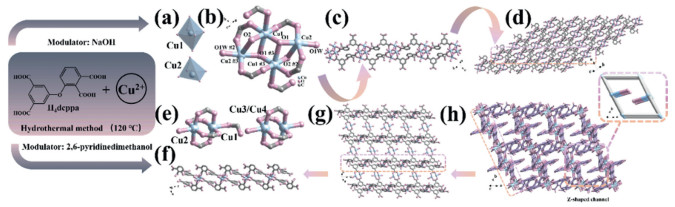
Single-crystal X-ray diffractometry reveals that CP-1 crystallizes in P-1 space group and incorporates tetranuclear copper-oxygen clusters linked with H4dcppa ligands. Based on the bond valence sum (BVS) calculations and structural characterization, the platelike CP-1 consists of two CuⅡ atoms, one μ2—OH, one μ3—OH, one coordinated H2O molecule, one H2dcppa ligand and one crystallization water molecule. Additionally, one hydrogen proton was introduced into the formula to balance charge. As demonstrated in Fig. 1a, the Cu1 atoms adopt an octahedral geometry, which coordinated with one μ2—OH, one μ3—OH, one coordinated H2O molecule and three carboxylate groups from three H2dcppa ligands. The five-coordinated Cu2 atoms defined by one μ2—OH, one μ3—OH, one coordinated H2O molecule and two carboxylate groups from two H2dcppa ligands. It is observed that a type of [Cu4(μ2—OH)2(μ3—OH)2(H2O)2]4+ cluster is assembled (Fig. 1b). The carboxylate groups from H2dcppa ligands are decorated on the clusters forming a 1D tetranuclear copper-based chain (Fig. 1c). The H2dcppa ligands serve as connectors in the 2D network linking with these 1D chains to continue the structure of CP-1 (Fig. 1d). Notably, CP-1 exhibits a 2D layered architecture featuring surface-exposed uncoordinated carboxyl groups.
Figure 1
Figure 1.
(a) The coordination mode of Cu1 and Cu2. (b) The structure of [Cu4(μ2—OH)2(μ3—OH)2(H2O)2]4+ units (The coordinated carboxylic acid groups are added to the structure for clarity). (c) 1D metal-organic chain. (d) metal-organic 2D layer of CP-1. (e) The coordination mode of Cu1–4 (The coordinated carboxylic acid groups are added to the structure for clarity). (f) The 1D chain, (g) 2D layer, (h) 3D framework of MOF-1.
MOF-1 crystallizes in the P-1 space group. On the basis of BVS analysis and structural evaluation, MOF-1 assembled from four CuⅡ atoms, two Hdcppa ligands, one H2dcppa ligand and three coordinated H2O molecules. To achieve charge balance, a proton was incorporated into the formula. As presented in Fig. 1e, Cu1~4 display five-coordinated geometry. Among them, the Cu1 atoms coordinate with five carboxylate groups from four Hdcppa ligands and one H2dcppa ligand. The Cu2 atoms are bonded to one H2O molecule and four carboxylate groups derived from four Hdcppa ligands. The Cu3 and Cu4 adopt a similar coordination configuration, which exhibit coordination with two H2O molecules and four carboxylate groups from two Hdcppa ligands and two H2dcppa ligands.
In MOF-1, there are two types of binuclear copper building blocks, [Cu2(H2O)]4+ and [Cu2(H2O)2]4+, respectively. The adjacent [Cu2(H2O)]4+ units are interconnected via Hdcppa ligands, forming a 1D metal-organic chain (Fig. 1f). The [Cu2(H2O)2]4+ architectural units act as bridging linkers, connecting these chains to generate a 2D metal-organic layer (Fig. 1g). Ultimately, coordination interactions between H2dcppa ligands and [Cu2(H2O)2]4+ architectural units from the 2D layers lead to the formation of a sTable 3D framework (Fig. 1h). Remarkably, the 3D framework of MOF-1 contains Z-shaped channels featuring ordered uncoordinated carboxyl groups.
The IR spectra, PXRD patterns, and TG curves for CP-1 and MOF-1 are presented in Figs. S1-S3 (Supporting information), with detailed descriptions included in Supporting information, confirming their composition and purity.
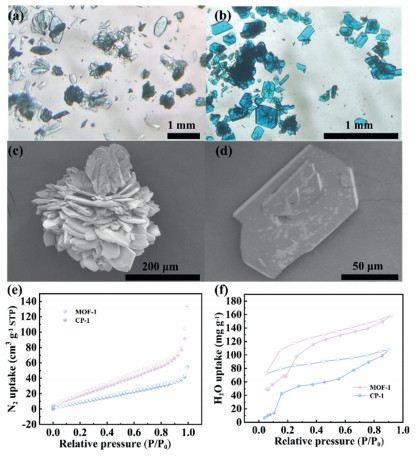
Microscopic and scanning electron microscope (SEM) observations reveal that crystals synthesized using different modulators exhibit distinctly different morphologies. As shown in Fig. 2a, CP-1 displays a light blue, cluster-like structure with an individual crystal plate having a longitudinal dimension of approximately 117 μm (Fig. 2c), whereas MOF-1 exhibits a dark blue, rectangular block-like morphology (Fig. 2b) with a longitudinal dimension of about 100 μm (Fig. 2d).
Figure 2
Figure 2.
Optical images of (a) CP-1 and (b) MOF-1. SEM images of (c) CP-1 and (d) MOF-1. (e) BET surface analysis of CP-1 and MOF-1. (f) Water uptake isotherms of CP-1 and MOF-1 (measured at 30 ℃).
The surface area and porosity of CP-1 and MOF-1 were assessed via nitrogen adsorption measurements at 77 K. As shown in Fig. 2e, the Brunauer–Emmett–Teller (BET) surface areas of CP-1 and MOF-1 were determined to be 54.44 and 132.35 m2/g, respectively. This indicates that MOF-1 exhibits a marked advantage in terms of pore structure and specific surface area, further confirming its potential application as a proton conductor [16].
Investigating water uptake in materials is essential for probing proton transport mechanisms, as H2O molecules serve as key mediators in enhancing conductivity [17,18]. These molecules facilitate the formation of H-bond networks, and the high water uptake enables CP-1 and MOF-1 to establish extended H-bond pathways under elevated humidity conditions. As revealed in Fig. 2f (P/P0 = 0.95), MOF-1 exhibits superior moisture absorption capacity (158.8 mg/g) relative to CP-1 (107.5 mg/g). Under varying humidity conditions, CP-1 exhibits enhanced water retention capacity due to hydrogen bonds formed between uncoordinated carboxyl groups on its 2D layered surface and adsorbed water molecules. Compared to CP-1, MOF-1 not only contains abundant ordered carboxyl groups but also features unique Z-shaped hydrophilic water transport channels, thus leading to superior water retention capability [19,20].
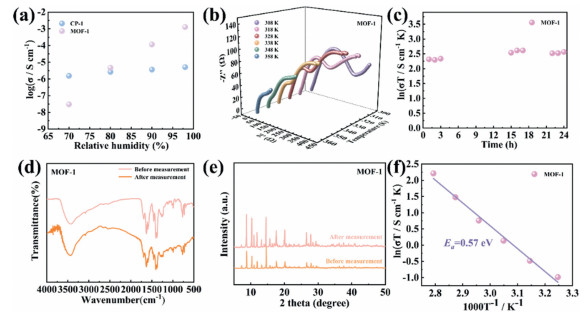
Considering the multiple proton hopping sites in CP-1 and MOF-1, combined with the WVA test results, we evaluated their proton conductivity. The proton conductivity of CP-1 and MOF-1 were investigated at 25 ℃ via alternating current impedance spectroscopy. As the relative humidity (RH) increased from 70% to 98%, the proton conductivity of CP-1 increased from 1.53 × 10⁻⁶ S/cm to 5.13 × 10⁻⁶ S/cm, while that of MOF-1 increased from 3.02 × 10⁻⁸ S/cm to 1.16 × 10⁻³ S/cm (Fig. 3a). These results demonstrate that CP-1 and MOF-1 exhibit high humidity dependence. At 25 ℃ under varying humidity conditions, MOF-1 shows a more pronounced variation in proton conductivity. Furthermore, as the relative humidity gradually increases, MOF-1 displays significantly superior proton-conductive performance compared to CP-1. This enhancement is primarily attributed to the abundance of water molecules under high-humidity conditions, which facilitates the formation of efficient proton transport pathways through proton carriers within the hydrophilic channels of MOF-1, thereby improving proton conduction efficiency [21–25].
Figure 3
Figure 3.
(a) RH-dependent proton conductivity of CP-1 and MOF-1 at 25 ℃. (b) Nyquist plots of MOF-1 from 35 ℃ to 85 ℃. (c) Proton conductivity stability of MOF-1 at 85 ℃ and 98% RH. (d) IR spectrum and (e) PXRD patterns of MOF-1. (f) Arrhenius plots and linear fitting of MOF-1.
In addition to variations in relative humidity, temperature significantly influences the migration rate of proton carriers, thereby impacting the proton conductivity of the crystalline framework. Variable-temperature tests were performed on CP-1 and MOF-1 under 98% RH, covering a temperature range of 35–85 ℃ with 10 ℃ intervals and 1-h equilibration at each step. For CP-1, the proton conductivity increased from 7.06 × 10⁻⁵ S/cm to 2.14 × 10⁻³ S/cm (Figs. S4 and S5 in Supporting information). MOF-1 similarly exhibited an increasing trend (Fig. 3b), with values of 1.21 × 10⁻³ S/cm to 2.55 × 10⁻² S/cm. Notably, elevated temperatures enhance the proton conductivity of CP-1 and MOF-1, attributed to faster proton movement within the structures. MOF-1 exhibits a proton conductivity of 2.55 × 10⁻² S/cm under 98% RH and 85 ℃. This superior performance is attributed to its unique Z-shaped hydrophilic channels, which facilitate directional and rapid proton transport. Remarkably, its conductivity rivals that of many reported crystalline proton conductor (Table S5 in Supporting information). The stability of proton conductivity in CP-1 and MOF-1 was investigated. To assess this critical property, CP-1 and MOF-1 were exposed to 85 ℃, 98% RH. Over a 24-h continuous operation period, their proton conductivity exhibited negligible variation (Fig. 3c and Fig. S6 in Supporting information), demonstrating exceptional operational durability. Importantly, comparative analysis of pre- and post-test IR spectra and PXRD patterns (Figs. 3d and e, Figs. S7 and S8 in Supporting information) revealed preserved structural integrity with no detectable framework degradation, indicating their structural stability under conditions of elevated temperature and humidity. The time-dependent current profiles for CP-1 and MOF-1 were measured using the Hebb-Wagner direct current polarization method [26,27]. As depicted in Fig. S9 (Supporting information), a constant voltage of 0.1 V was applied, and the resulting current curves revealed values of about 0.17 and 0.73 nA for CP-1 and MOF-1, respectively, with corresponding resistances of 5.9 × 10⁸ and 1.3 × 10⁸ Ω. These results confirm their dominant proton conduction behavior over electronic conduction.
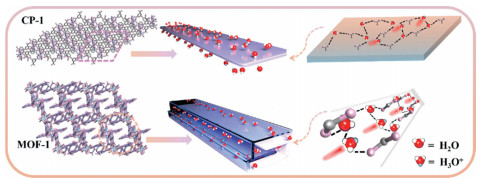
The conduction mechanisms of CP-1 and MOF-1 were analyzed via Arrhenius plots. As depicted in Fig. 3f and Fig. S10 (Supporting information), the derived activation energy (Ea) values (0.57 eV for MOF-1 and 0.67 eV for CP-1) surpass the 0.4 eV threshold, unambiguously indicating adherence to the Vehicle mechanism [28–30]. Fig. 4 illustrates the proton transport pathways under this mechanism, where protons migrate through H3O+ complexes formed with mobile water molecules. In such systems, freely diffusing lattice water molecules serve as dynamic proton carriers, enabling rapid directional transport [31,32]. The enhanced proton mobility in CP-1 arises from carboxyl-containing ligands and water species (coordinated or lattice) within its 2D layered structure, which form a hydrogen-bonding network. Within this network, adsorbed water molecules promote adjacent proton migration, thereby providing continuous pathways for efficient proton conduction. MOF-1 achieves exceptional proton conduction through its 3D framework featuring Z-shaped channels enriched with water molecules and uncoordinated carboxyl groups. These components collectively establish a hydrogen-bonding network that directs protons along ordered pathways, resulting in rapid proton transport.
Figure 4
Figure 4.
Schematic illustrations of proton-conducting pathways in CP-1 and MOF-1.
In summary, we have effectively synthesized two copper-based crystalline materials. The transformation of coordination polymer (CP-1) into metal-organic framework (MOF-1) was successfully achieved through a coordination modulation strategy. The proton conductivity of CP-1 and MOF-1 was evaluated at 85 ℃ and 98% RH, yielding values of 2.14 × 10⁻³ and 2.55 × 10⁻² S/cm, respectively. The exceptional proton conductivity of MOF-1 originates from two synergistic factors: (1) The 3D framework incorporates Z-shaped proton-conducting channels, which facilitate directional proton migration along ordered pathways; (2) These channels, densely populated by water molecules and uncoordinated carboxyl groups, collectively establish a continuous hydrogen-bonding network to enable efficient proton hopping. Further study on using this strategy to design other types of MOFs with special pore channels is currently underway.
Declaration of competing interest
The authors declare that they have no known competing financial interests or personal relationships that could have appeared to influence the work reported in this paper.
CRediT authorship contribution statement
Yongzhen Chen: Writing – original draft, Validation, Supervision, Software, Formal analysis, Data curation, Conceptualization. Jianxin Ma: Formal analysis, Data curation, Conceptualization. Yuyang Wang: Data curation, Conceptualization. Qianqian Liu: Conceptualization. Yunzuo Cui: Data curation. Weibo Ren: Software. Chen Wang: Data curation. Zhong-Min Su: Writing – review & editing. Hong-Ying Zang: Writing – review & editing.
Acknowledgments
This work was supported by the National Natural Science Foundation of China (Nos. 22322102, 21471028, 21673098, 21671036, 22271023), the Fundamental Research Funds for the Central Universities Excellent Youth Team Program (No. 2412023YQ001), Natural Science Foundation of Jilin Province (No. 20200201083JC), Jilin Provincial Education Department (No. JJKH20201169KJ), the Fundamental Research Funds for the Central Universities (Nos. 2412015KJ012, 2412017BJ004), and the support of the Jilin Provincial Department of Education.
Supplementary materials
Supplementary material associated with this article can be found, in the online version, at doi:10.1016/j.cclet.2025.111266.
[1]
I.E. Khalil, J. Fonseca, M.R. Reithofer, et al., Coord. Chem. Rev. 481 (2023) 215043. doi: 10.1016/j.ccr.2023.215043
[2]
H.R. Tian, Z, Zhang, S.M. Liu, et al., Green Chem. 22 (2022) 7513–7520.
[3]
B. Mohanty, S. Kumari, P. Yadav, et al., Coord. Chem. Rev. 519 (2024) 216102. doi: 10.1016/j.ccr.2024.216102
[4]
L.X. Shi, Y.H. Shi, Y.Q. Xu, et al., J. Environ. Chem. Eng. 11 (2023) 111468. doi: 10.1016/j.jece.2023.111468
[5]
Y.X. Wang, Y. Lu, W.S. Zhang, et al., Polyoxometalates 1 (2022) 9140005. doi: 10.26599/pom.2022.9140005
[6]
S. Srivastava, S.P. Shet, S.S. Priya, et al., Int. J. Hydrog. Energy. 47 (2022) 15820–15831. doi: 10.1016/j.ijhydene.2022.03.089
[7]
Y.F. Dong, S.J. Zhong, Y.H. He, et al., Chin. Chem. Lett. 35 (2024) 109261. doi: 10.1016/j.cclet.2023.109261
L. Zhang, Z. Liu, C.X. Yang, et al., ACS Nano 16 (2022) 13771–13782. doi: 10.1021/acsnano.2c00686
[31]
H.Y. Sun, S.H. Sun, B. Hu, et al., Inorg. Chem. Front. 7 (2020) 1699–1703. doi: 10.1039/d0qi00040j
[32]
B.J. Kim, S.H. Park, M.L. Díaz-Ramírez et al., Chem. Commun. 61 (2025) 3582–3600. doi: 10.1039/d4cc06378c
Figure 1
(a) The coordination mode of Cu1 and Cu2. (b) The structure of [Cu4(μ2—OH)2(μ3—OH)2(H2O)2]4+ units (The coordinated carboxylic acid groups are added to the structure for clarity). (c) 1D metal-organic chain. (d) metal-organic 2D layer of CP-1. (e) The coordination mode of Cu1–4 (The coordinated carboxylic acid groups are added to the structure for clarity). (f) The 1D chain, (g) 2D layer, (h) 3D framework of MOF-1.
Figure 2
Optical images of (a) CP-1 and (b) MOF-1. SEM images of (c) CP-1 and (d) MOF-1. (e) BET surface analysis of CP-1 and MOF-1. (f) Water uptake isotherms of CP-1 and MOF-1 (measured at 30 ℃).
Figure 3
(a) RH-dependent proton conductivity of CP-1 and MOF-1 at 25 ℃. (b) Nyquist plots of MOF-1 from 35 ℃ to 85 ℃. (c) Proton conductivity stability of MOF-1 at 85 ℃ and 98% RH. (d) IR spectrum and (e) PXRD patterns of MOF-1. (f) Arrhenius plots and linear fitting of MOF-1.


 DownLoad:

 下载:
下载:


 下载:
下载:

