
Scheme 1.
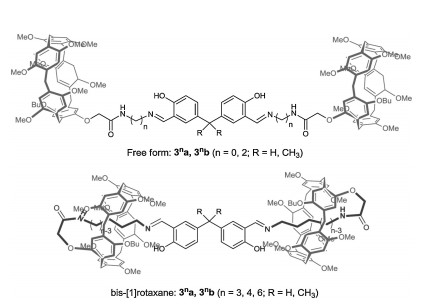
Synthesis of salen-bridged bis-pillar[5]arenes 3na-3nb.

Synthesis and characterization of bis-[1]rotaxanes via salen-bridged bis-pillar[5]arenes
Ying Han , Cui-Yun Nie , Shuo Jiang , Jing Sun , Chao-Guo Yan


In recent years, pillararenes have become the most attractive supramolecular hosts after crown ethers, cyclodextrins, calixarenes, and cucurbiturils [1, 2]. Pillararene have a longer unique tubular cavity with the substituents on ring point to two opposite directions [3, 4]. The unique tubular structure of pillararene has been demonstrated to be novel useful supramolecular hosts and applied in the construction of new supramolecular polymers, molecular devices, artificial transmembrane channels, as well as chemical and physical responsive materials [5-9]. Therefore, the most easily preparedpillar[5]arene has been widely used as wheel componentin constructing interlocked assemblies including various pillararenebased pseudorotaxanes with diverse functions [10-17]. In this respect, the mono-functionalized pillar[5]arenes showed to be the one of the most versatile candidates for assembly of pseudo[1]rotaxanes and pseudo[1]rotaxanes [18-23].Forthispurpose, various longer chain axels and larger functionalized stoppers have been introduced into pillar[5]arenes [24-29]. Our group also prepared various functionalized mono-functionalized pillar[5]arene Schiff base, thiourea, pyridylimine and polyamide derivatives and found that these functionalized pillar[5]arene derivatives with longer side chains tending to form stable pesudo[1]rotaxane and [1]rotaxane both in solution and in solid state [30-36]. In order to further exploit the potential applications of functionalized pillar[5]arene on the construction of [1]rotaxanes and catananes, we initialized the project on assembly of functionalized bis-[1]rotaxanes and tris-[1]rotaxanes. We have successfully developed efficient synthetic protocols for construction of unique bis-[1]rotaxanes by employing dithiourea or diamide as the bridging linker [37, 38]. Very recently, Wang and Meguellati also synthesized self-included pillar[5]arenebased bis-[1]rotaxanes by using longer alkylene bis-triazole bridge [39]. Herein, we wish to report the convenient synthesis of salenbridged bispillar[5]arene derivatives by the condensation reaction of mono-amido-functionalized pillar[5]arenes with 5, 50-methylenebis (2-hydroxybenzaldehyde) or 5, 50-(propane-2, 2-diyl)bis(2-hydroxybenzaldehyde) and construction of the fascinating bis[1]rotaxanes.
The synthetic route for the desired salen-bridged bis-pillar[5]arenes was illustrated in Scheme 1. The amido-functionalized pillar[5]arenes 2n (n = 0, 2, 3, 4, 6) were prepared from ammonolysis reaction of ethyl pillar[5]arene-oxyacetate with diaminoalkanes according to our previously reported synthetic method [30]. The condensation of 5, 50-methylenebis(2-hydroxybenzaldehyde) 1 and amido-functionalized pillar[5]arenes 2n (n = 0, 2, 3, 4, 6) was carried out in refluxing ethanol for 12 h. The desired salen-bridged bis-pillar[5]arenes 3na (n = 0, 2, 3, 4, 6; R = H) were easily obtained in moderate yields (Scheme 1). Under same reaction conditions, when 5, 50-(propane-2, 2-diyl)bis(2-hydroxybenzaldehyde) was used in the reaction, the corresponding salenbridged bis-pillar[5]arenes 3nb (n = 0, 2, 3, 4, 6; R = CH3) were also prepared in moderate yields. The structures of the obtained ten salen-bridged bis-pillar[5]arenes 3na-3nb were fully characterized by IR, HRMS, 1H and 13C NMR spectroscopes.
1H NMR spectra is the convenient evidence for elucidation the chemical structures for the interlocked molecules. 1H NMR spectra of the bis-pillar[5]arenes 30a and 32a showed that there are no signals at very high magnetic field (Fig. 1), which suggested that the bridged hydrazinyl and ethylenediamino chain did not insert in the cavity of two pillar[5]arene. Therefore, the two scaffolds of pillar[5]arenes were connected by the shorter bridged diimido chain from outside bis-pillar[5]arenes 30a and 32a (Scheme 2). 1H NMR spectra of bis-pillar[5]arene 33a clearly showed one broad peak at -0.10 ppm and two mixed peaks at (-1.69) – (-1.87) ppm. The characteristic signals of bridged Schiff base were stilly observed in normal magnetic field, which strongly indicated the two propylenediamino linker threading into the cavity of the pillar [5]arene to form the novel bis-[1]rotaxanes (Scheme 2). The 1H NMR spectra of bis-pillar[5]arene 34a also displayed a mixed peak at 0.52–0.44 ppm, a broad peak at -0.97 ppm and a mixed peak at (-1.86) – (-1.93) ppm. Similarly, the 1H NMR spectra of the bispillar[5]arene 36a displayed four peaks at 0.04 ppm, (-0.79) – (-0.87) ppm, -1.80 ppm and -2.30 ppm, respectively. Therefore, the butylenediamino and hexylenediamino linker actually existed in the cavity of pillar[5]arene to form the bis-[1]rotaxanes. The 1H NMR spectra of the bis-pillar[5]arenes 3nb (n = 0, 2, 3, 4, 6) also showed similar absorption patterns. That is, there are no signals at high magnetic field in the compounds 30b and 32b, while several signals at high magnetic field were observed in compounds 33b- 36b with propylenediamino, butylenediamino and hexylenediamino linkers. It should be pointed out that the salen scaffold could not inserted into the cavity of the pillar[5]arene due to its larger volume of the disubstituted benzenes. On the basis of these results, we could get a conclusion that bis-pillar[5]arenes with short hydrazine and ethylenediamino linkers exist in the free form due to stronger repulsion of two molecular pillar[5]arene, and bispillar[5]arenes with longer alkylenediamino linkers predominately form the unique bis-[1]rotaxanes (Scheme 2). It should be pointed out that this conclusion is agreed with our previously prepared pillar[5]arene mono-Schiff bases, in which longer than propylenediamino linker could form [1]rotaxanes [30].

In order to confirm the formation of unique bis-[1]rotaxanes, NOESY spectra of the compounds 34a (Fig. 2), 36a (Fig. 3), 34b and 36b (Figs. S1 and S2 in Supporting information) were recorded. From the Fig. 2, the correlations between the protons of Ha4, Hb4, Hc4 in bridged butylene group to the protons of Hd4, He4, Hf4, Hg4 in methoxy and phenyl group were clearly observed. In the Fig. 3, The protons of Ha3, Hb3, Hc3, Hd3 in hexylene group were similarly correlated with protons He3, Hf3, Hg3, Hh3 in ring of pillar[5]arene. The similar correlation pattern were also observed in the NOESY spectra of 34b and 36b (Figs. S1 and S2). These results unambiguously indicated that the bis-[1]rotaxanes were formed in these salen-bridged bis-pillar[5]arenes. It has been known that the v-aminoalkylamido chain was inserted into the cavity to form a pseudo[1]rotaxanes in starting amido-functionalized pillar[5] arenes 2n (n = 2, 3, 4, 6). In the formation of salen-bridged bispillarenes, the shorter ethylenediamino chainwas forced to thread out of the cavity because the repulsion of two scaffolds of pillar[5]arenes. The longer than propylenediamino chains retained in the cavity of form the bis-[1]rotaxanes. Therefore, the length of the alkyleneadiamino chains controlled the formation of bis-[1]rotaxanes.


The single crystal structure of the compound 33b was successfully determined by X-ray diffraction method (Fig. 4). Single crystal data for compounds 33b (CCDC 1940468) has been deposited at the Cambridge Crystallographic Data Center. The suitable single crystal of the compound 33b was obtained from the slow crystallization of the compound 33b in a mixture of chloroform and ethanol for more than one week. From the Fig. 4, it can be seen that the two propylenediamino units actually threaded into both cavities of the two pillar[5]arenes and were connected by the salen-bridge. Thus, the unique bis-[1]rotaxanes were really formed. It is also seen that the middle bis-phenol bridge exist in jagged arrangement, which made two scaffolds of pillar[5]arenes in very close manner. Therefore, the propylenediamino units is obviously the most short linker for the formation of bis-[1]rotaxanes.

In summary, we have successfully synthesized series of salenbridged bis-pillar[1]arenes by condensation reaction of 5, 50- methylenebis(2-hydroxybenzaldehyde) or 5, 50-(propane-2, 2-diyl) bis(2-hydroxybenzaldehyde) with mono-amido-functionalized pillar[5]arenes containing different terminal aminoalkyl groups. The analysis of 1H NMR, 2D-NOESY spectra and determination of single crystal structure clearly indicated that the salen-bridgedbis-pillar[5]arenes with longeralkylene linker (n = 3, 4, 6) formed the fascinating bis-[1]rotaxanes, while the salen-bridged bispillar[5]arenes with shorthydrazine and ethylenediamino linker (n = 0, 2)predominately existed in free form. Therefore, the present work not only provided new novel bis-[1]rotaxane systems based on excellent performance of pillar[5]arenes, but also gave efficient methodology for construction more complicated supramolecular architectures.
We are grateful to the financial support by the National Natural Science Foundation of China (Nos. 21372192, 21871227) and the Priority Academic Program Development of Jiangsu Higher Education Institutions.
Supplementary material related to this article can be found, in the online version, at doi:https://doi.org/10.1016/j.cclet.2019.09.014.
T. Ogoshi, S. Kanai, S. Fujinami, et al., J. Am. Chem. Soc. 130 (2008) 5022-5023. doi: 10.1021/ja711260m
D. Cao, Y. Kou, J. Liang, et al., Angew. Chem., Int. Ed. 48 (2009) 9721-9723. doi: 10.1002/anie.200904765
S.H. Li, H.Y. Zhang, X.F. Xu, et al., Nat. Commun. 6 (2015) 7590-7596. doi: 10.1038/ncomms8590
Y.W. Yang, D. Cao, et al., Chin. J. Chem. 33 (2015) 303-304. doi: 10.1002/cjoc.201590007
J.F. Xu, Y.Z. Chen, L.Z. Wu, et al., Org. Lett. 15 (2013) 6148-6151. doi: 10.1021/ol403015s
X.Y. Hu, X. Wu, Q. Duan, et al., Org. Lett. 14 (2012) 4826-4829. doi: 10.1021/ol302149t
H. Chen, J. Fan, X. Hu, et al., Chem. Sci. 6 (2015) 197-202. doi: 10.1039/C4SC02422B
W. Si, P. Xin, Z. Li, et al., Acc. Chem. Res. 48 (2015) 1612-1619. doi: 10.1021/acs.accounts.5b00143
Y. Cao, X.Y. Hu, Y. Li, et al., J. Am. Chem. Soc. 136 (2014) 10762-10769. doi: 10.1021/ja505344t
M. Xue, Y. Yang, X. Chi, et al., Acc. Chem. Res. 45 (2012) 1294-1308. doi: 10.1021/ar2003418
Z.C. Liu, S.K.M. Nalluri, J.F. Stoddart, Chem. Soc. Rev. 46 (2017) 2459-2478. doi: 10.1039/C7CS00185A
Y.L. Wang, C.H. Ping, C.J. Li, Chem. Commun. (Camb.) 52 (2016) 9858-9872. doi: 10.1039/C6CC03999E
S.Y. Sun, M. Geng, L. Huang, et al., Chem. Commun. (Camb.) 54 (2018) 13006-13009. doi: 10.1039/C8CC07658H
Y. Sun, W.X. Fu, C.Y. Chen, et al., Chem. Commun. (Camb.) 53 (2017) 3725-3728. doi: 10.1039/C7CC00291B
B. Li, Z. Meng, Q.Q. Li, et al., Chem. Sci. 8 (2017) 4458-4464. doi: 10.1039/C7SC01438D
Y. Yao, X.J. Wei, Y. Cai, et al., J. Colloid Interf. Sci. 525 (2018) 48-53. doi: 10.1016/j.jcis.2018.04.034
S.Y. Sun, D. Lu, Q. Huang, et al., J. Colloid Interf. Sci. 533 (2019) 42-46. doi: 10.1016/j.jcis.2018.08.051
T. Ogoshi, K. Demachi, K. Kitajima, et al., Chem. Commun. (Camb.) 47 (2011) 7164-7166. doi: 10.1039/c1cc12333e
Y. Chen, D. Cao, L. Wang, et al., Chem. -Eur. J. 19 (2013) 7064-7070. doi: 10.1002/chem.201204628
B.Y. Xia, M. Xue, Chem. Commun. (Camb.) 50 (2014) 1021-1023. doi: 10.1039/C3CC48014C
M.F. Ni, X.Y. Hu, J.L. Jiang, et al., Chem. Commun. (Camb.) 50 (2014) 1317-1319. doi: 10.1039/C3CC47823H
Y.F. Guan, P.Y. Liu, C. Deng, et al., Org. Biomol. Chem. 12 (2014) 1079-1089. doi: 10.1039/c3ob42044b
X. Wu, M.F. Ni, W. Xia, et al., Org. Chem. Front. 2 (2015) 1013-1017. doi: 10.1039/C5QO00159E
X. Wu, L. Gao, J.Z. Sun, et al., Chin. Chem. Lett. 27 (2016) 1655-1660. doi: 10.1016/j.cclet.2016.05.004
C.L. Sun, J.F. Xu, Y.Z. Chen, et al., Chin. Chem. Lett. 26 (2015) 843-846. doi: 10.1016/j.cclet.2015.05.030
M. Cheng, Q. Wang, Y.H. Cao, et al., Tetrahedron Lett. 57 (2016) 4133-4137. doi: 10.1016/j.tetlet.2016.07.038
X.S. Du, C.Y. Wang, Q. Jia, et al., Chem. Commun. (Camb.) 53 (2017) 5326-5329. doi: 10.1039/C7CC02364B
T.X. Xiao, L. Zhou, L.X. Xu, et al., Chin. Chem. Lett. 30 (2019) 271-276. doi: 10.1016/j.cclet.2018.05.039
M.J. Wang, X.S. Du, H.S. Tian, et al., Chin. Chem. Lett. 30 (2019) 345-348. doi: 10.1016/j.cclet.2018.10.014
Y. Han, G.F. Huo, J. Sun, et al., Sci. Rep. 6 (2016) 28748. doi: 10.1038/srep28748
G.F. Huo, Y. Han, J. Sun, et al., J. Incl. Phenom. Macrocycl. Chem. 86 (2016) 231-240. doi: 10.1007/s10847-016-0652-x
Y. Han, G.F. Huo, J. Sun, et al., Supramol. Chem. 29 (2017) 547-552. doi: 10.1080/10610278.2017.1287367
S. Jiang, Y. Han, J. Sun, et al., Tetrahedron 73 (2017) 5107-5114. doi: 10.1016/j.tet.2017.07.001
C.B. Yin, Y. Han, G.F. Huo, et al., Chin. Chem. Lett. 28 (2017) 431-436. doi: 10.1016/j.cclet.2016.09.008
S. Jiang, Y. Han, M. Cheng, et al., New J. Chem. 42 (2018) 7603-7606. doi: 10.1039/C7NJ05192A
L.L. Zhao, Y. Han, C.G. Yan, Chin. Chem. Lett. 31 (2020) 81-83. doi: 10.1016/j.cclet.2019.04.024
Y. Han, L.M. Xu, C.Y. Nie, et al., Beilstein J. Org. Chem. 14 (2018) 1660-1667. doi: 10.3762/bjoc.14.142
S. Jiang, Y. Han, L.L. Zhao, et al., Supramol. Chem. 30 (2018) 642-647. doi: 10.1080/10610278.2018.1427238
M.J. Wang, X.S. Du, H.S. Tian, et al., Chin. Chem. Lett. 30 (2019) 345-348. doi: 10.1016/j.cclet.2018.10.014

 扫一扫看文章


扫一扫关注我们
 DownLoad:

 下载:
下载:


 下载:
下载: