
Scheme 1.
Selective C—N bond formation tuning by non-coordinating anions through dual catalysis.

The synthesis and structure of pyridine-oxadiazole iridium complexes and catalytic applications: Non-coordinating-anion-tuned selective C-N bond formation
Wei Yao , Yilin Zhang , Haiyan Zhu , Chenyang Ge , Dawei Wang


Gem-bisamides, which are bearing aminal functional groups, are found in a wide variety of synthetic intermediates and natural products. Many pharmaceutical compounds based upon the gem-bisamides have exhibited characteristic bioactivities, for instance, hypertension in peptidomimetic structure [1]. Methylidene bisamide is another typical example and could be served as CB2 receptor inverse agonist. These compounds served as inverse agonists with a significant CB1/CB2 selectivity (Ki(CB1)/Ki(CB2)) up to 235 folds. Similar molecule could show the osteoclast formation with the IC72 of 0.1 μmol/L [2]. Despite that gem-bisamides have important therapeutic use, to date, methods achieving efficient synthesis of gem-bisamides are limited, which are usually conducted employing various aldehydes in the presence of strong Lewis acids or bases (sulphuric acid, SnCl4, etc.) under harsh conditions. Development of efficient method for gem-bisamides synthesis utilizing green reagents under mild conditions has, therefore, remained an important challenge [3].
During the past several years, borrowing hydrogen and dehydrogenation reactions have been recognized as mild tool to achieve high atom efficiency in organic chemistry [4, 5]. It has been well known that catalysts play an important role during these processes [6, 7]. Several groups have made great efforts and achieved significant progress in borrowing hydrogen area during the past [8, 9]. However, borrowing hydrogen and dehydrogenation reactions with traditional catalysts remain infeasible for the synthesis of gem-bisamides bearing aminal functional groups [10].
Our interest in developing new ligands to adjust catalytic activity in borrowing hydrogen and dehydrogenation reactions has led to the recent discoveries of copper, gold, ruthenium, iridium catalysts [11]. However, when these triazole-based metal complexes were employed as catalyst in the synthesis of gem-bisamide derivatives from benzamide, it was disappointing that no desired product was obtained, which might be caused by strong electron withdrawing and coordinating properties of these triazoles. Since it was known that benzamide is less reactive in borrowing hydrogen strategy than conventional amine, the development of novel and new catalysts for the preparation of gem-bisamide derivatives are apparently highly necessary and desirable (Scheme 1). Herein, we reported the synthesis and characterizations of several new pyridine-oxadiazole iridium complexes, which revealed excellent catalytic activity in C-N bond formation of benzamides with benzyl alcohols. The structures of these complexes have been confirmed by X-ray crystallography. The mechanism explorations proved that the reactivity of iridium catalyst was varied by non-coordinating anions.
Firstly, 2-picolinyl hydrazide was mixed with CS2 and KOH and refluxed in EtOH for 11 h to achieve 5-(pyridin-2-yl)-1, 3, 4-oxadiazole-2-thiol L1. After arylation of L1, Ir complexes were successfully prepared in high yields by mixing [Cp*IrCl2]2 and corresponding ligands L2 in a 1:2.1 molar ratio in MeOH at room temperature under N2 atmosphere for 2 h. The exact structure of iridium complex was confirmed by single-crystal X-ray diffraction (Scheme 2).

With these iridium(Ⅲ) complexes (1a-1c) in hand, their catalytic activities in the borrowing hydrogen reaction of benzamide with benzyl alcohol were subsequently examined. Preliminary results showed that the reaction could proceed smoothly and the desired product could be successfully isolated. After a series of reaction conditions screening (Supporting information for details), toluene and cesium carbonate were proven to be the most efficient medium and base respectively. As shown in Scheme 3, a wide range of functional groups or substituents including methyl, methoxy, chloro, bromine, and heterocycle at different positions of benzyl alcoholwere tolerated, affording the target products in moderate to good yields. Similarly, a variety of benzamides have shown good activity in this reaction.

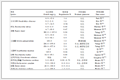
N, N'-(Phenylmethylene)dibenzamides were another ubiquitous class of heterocyclic derivatives and widely distributed in alkaloids and natural products. They have demonstrated excellent biological and pharmaceutical properties during the past decade. Due to their significant applications, we next dedicated to achieve the synthesis of N, N'-(phenylmethylene)dibenzamides utilizing this catalytic system. A series of initial attempts were unable to produce the desired dibenzamide (5a) with satisfied yields (Table 1, entries 1–4). To our delight, when 1 equiv. of AgOTf was employed as additive to this catalytic system, the dibenzamide was obtained in 23% yield (entry 5). Further investigations revealed that several silver salts could effectively promote this transformation. Notably, silver hexafluoroantimonate produced the highest yield even with catalytic amount (2 mol%) loaded (entry 10). However, the control experiment revealed that product 5a couldn't be obtained when only silver additive was employed (entries 11 and 12). It should be noted the reaction could not take place in water (entry 14).
Next, the reaction was applied in the synthesis of various N, N'-(phenylmethylene)dibenzamides by the use of bimolecular benzamide under oxygen conditions (Scheme 4). Obviously, relatively high yields were obtained when benzyl alcohol with para-substituted groups was employed, mainly because less steric hindrance exists. Among those, substrate with electron donating group gave higher yield. Interestingly, the reaction scope was also successfully expanded to different substituted benzamide and thienyl group, producing good yields.

To gain insights into the possible mechanism, several control experiments were conducted. Initial studydisclosed that electronrich benzamide was preferentially consumed, which revealedthatbenzamidewith electron-donating group was much more reactive than that with electron-withdrawing group (Scheme 5A). Subsequent efforts were made on trapping of key intermediate, one of commonly used method to learn reaction pathway. Surprisingly, benzaldehyde intermediate (3a') was detected during this transformation, which was also detected by Massspectrometry. Further exploration revealed that gem-bisamide (5a) could be synthesized frombenzaldehyde (Scheme 5B), which could explain the proposed mechanism. Additionally, we found that the gem-bisamide could be converted to N-benzylbenzamide product (Scheme 5C), which was consistent with previous result [10e].

Meanwhile, the Hammett plot equation was carried out to further understand this transformation. Several substrates were selected to build the equation and the plot was shown in Fig. 1. The results revealed that the electronic effect had significant impact on this reaction and a positive charge at the reaction center was favorable in the transition state.

In addition, we carried out an intermolecular competition reaction on the kinetically relevant elementary steps. The kinetic isotope effect (KIE) value (2.26) was achieved through the first order reaction plot between ln[3a] and ln[3a-d2], providing a clear evidence that dehydrogenation of benzylic alcohol was the rate determining step during this transformation (Fig. 1).
To further elucidate the reaction mechanism, kinetic investigations was conducted, which revealed that benzaldehyde is the most convincing reaction intermediate (Fig. 2). Further research proved that N, N'-(phenylmethylene)dibenzamide can be converted to N-benzylbenzamide with this iridium catalytic system.

In the past several years, "silver effect" was found in silverinvolved transformations, which was a long-overlooked phenomenon [12]. It was disclosed that reactions involving silver are in fact accompanied with silver-assisted metal or bimetallic catalysis. Recently, several studies on "silver effect" were conducted by our group and some preliminary results were acquired [13]. Here, "silver effect" was also investigated for its impact on this reaction system.
As shown in Table 2, experiments for silver salts effect was conducted accordingly. Catalytic system (1a/AgSbF6) with silver chloride salt removed by celite can also afford the gem-bisamide only with slightly lower yield. Similar results were obtained with other silver additives (Table 2). These experiments disclosed that non-coordinating anions promoted the synthesis of N, N'-(phenylmethylene)dibenzamides from benzamides with benzyl alcohols, while silver salts did not play any role during this process. This was another typical example for the effect of noncoordinating anions and highlighted the application of noncoordinating anions.
In summary, we have accomplished the synthesis of pyridineoxadiazole iridium complexes and characterized the compounds with X-ray crystallography. The obtained Ir catalyst was successfully applied to C—N bond formation of amides with benzyl alcohols. We found that gem-bisamide products were achieved under non-coordinating anions conditions, where as N-benzylbenzamide products were achieved in the absence of non-coordinating anions.
We gratefully acknowledge the financial support from the National Natural Science Foundation of China (Nos. 21776111, 21861039), the Fundamental Research Funds for the Central Universities (No. JUSRP 51627B), and the Ministry of Education and the State Administration of Foreign Experts Affairs for the 111 Project (No. B13025).
Supplementary material related to this article can be found, in the online version, at doi:https://doi.org/10.1016/j.cclet.2019.08.049.
(a) H.R. Shaterian, A. Hosseinian, M. Ghashang, Can. J. Chem. 86 (2008) 376-383;
(b) P. Yang, K.Z. Myint, Q. Tong, et al., J. Med. Chem. 55 (2012) 9973-9987;
(c) C. Ma, L. Wang, P. Yang, K.Z. Myint, X.Q. Xie, J. Chem. Inf. Model. 53 (2013) 11-26.
(a) H.R.Shaterian, M.Ghashang, M.Feyzi, Appl.Catal.AGen.345 (2008)128-133;
(b) J.W. Bode, Curr. Opin. Drug Discov. Devel. 9 (2006) 765-775;
(c) M. Rodriguez, P. Dubreuil, J.P. Bali, J. Martinez, J. Med. Chem. 30 (1987) 758-763;
(d) M.G. Liu, N. Liu, W.H. Xu, L. Wang, Tetrahedron 75 (2019) 2748-2754.
(a) G. Kour, M. Gupta, Dalton Trans. 46 (2017) 7039-7050;
(b) M. Kour, S. Paul, New J. Chem. 39 (2015) 6338-6350;
(c) B. Maleki, M. Baghayeri, RSC Adv. 5 (2015) 79746-79758;
(d) R. Tayebee, B. Maleki, F.M. Zonoz, R.M. Kakhki, T. Kunani, RSC Adv. 6 (2016) 20687-20694;
(e) L. Wang, Y.B. Xie, N.Y. Huang, et al., ACS Catal. 6 (2016) 4010-4016;
(f) L. Wang, Y.B. Xie, N.Y. Huang, et al., Adv. Synth. Catal. 359 (2017) 779-785;
(g) N. Liu, F. Chao, M.G. Liu, et al., J. Org. Chem. 84 (2019) 2366-2371.
(a) A. Corma, J. Navas, M.J. Sabater, Chem. Rev. 118 (2018) 1410-1459;
(b) G. Chelucci, Coord. Chem. Rev. 331 (2017) 1-36;
(c) F. Huang, Z. Liu, Z. Yu, Angew. Chem. Int. Ed. 55 (2016) 862-875;
(d) Q. Yang, Q. Wang, Z. Yu, Chem. Soc. Rev. 44 (2015) 2305-2329;
(e) A. Nandakumar, S.P. Midya, V.G. Landge, E. Balaraman, Angew. Chem. Int. Ed. 54 (2015) 11022-11034;
(f) B. Chen, L. Wang, S. Gao, ACS Catal. 5 (2015) 5851-5876;
(g) K.I. Shimizu, Catal. Sci. Technol. 5 (2015) 1412-1427;
(h) Y. Obora, ACS Catal. 4 (2014) 3972-3981;
(i) D. Hollmann, ChemSusChem 7 (2014) 2411-2413.
(a) A.J.A. Watson, J.M.J. Williams, Science 329 (2010) 635-636;
(b) C. Gunanathan, D. Milstein, Science 341 (2013) 249;
(c) P. Hu, Y. Ben-David, D. Milstein, Angew. Chem. Int. Ed. 55 (2016) 1061-1064;
(d) P. Daw, S. Chakraborty, J.A. Garg, Y. Ben-David, D. Milstein, Angew. Chem. Int. Ed. 55 (2016) 14373-14377;
(e) S. Gowrisankar, H. Neumann, M. Beller, Angew. Chem. Int. Ed. 50 (2011) 5139-5143;
(f) L. Neubert, D. Michalik, S. Bähn, et al., J. Am. Chem. Soc. 134 (2012) 12239-12244;
(g) M. Zhang, X. Fang, H. Neumann, M. Beller, J. Am. Chem. Soc. 135 (2013) 11384-11388;
(h) J. Schranck, A. Tlili, M. Beller, Angew. Chem. Int. Ed. 52 (2013) 7642-7644;
(i) M. Zhang, H. Neumann, M. Beller, Angew. Chem. Int. Ed. 52 (2013) 597-601;
(j) C.S. Lim, T.T. Quach, Y. Zhao, Angew. Chem. Int. Ed. 56 (2017) 7176-7180.
(a) F.G. Mutti, T. Knaus, N.S. Scrutton, M. Breuer, N.J. Turner, Science 349 (2015) 1525-1529;
(b) J.R. Frost, C.B. Cheong, W.M. Akhtar, et al., J. Am. Chem. Soc. 137 (2015) 15664-15667;
(c) N. Deibl, R. Kempe, J. Am. Chem. Soc. 138 (2016) 10786-10789;
(d) T. Yan, B.L. Feringa, K. Barta, ACS Catal. 6 (2016) 381-388;
(e) C. Schlepphorst, B. Maji, F. Glorius, ACS Catal. 6 (2016) 4184-4188;
(f) B. Emayavaramban, M. Roy, B. Sundararaju, Chem. -Eur. J. 22 (2016) 3952-3955;
(g) D. Shen, D.L. Poole, C.C. Shotton, et al., Angew. Chem. Int. Ed. 54 (2015) 1642-1645;
(h) F. Jiang, M. Achard, C. Bruneau, Chem. -Eur. J. 21 (2015) 14319-14323;
(i) M.V. Jimenez, J. Fernandez-Tornos, F.J. Modrego, J.J. Perez-Torrente, L.A. Oro, Chem. -Eur. J. 21 (2015) 17877-17889;
(j) A.J. Rawlings, L.J. Diorazio, M. Wills, Org. Lett. 17 (2015) 1086-1089;
(k) T.T. Dang, B. Ramalingam, A.M. Seayad, ACS Catal. 5 (2015) 4082-4088;
(l) X. Xie, H.V. Huynh, ACS Catal. 5 (2015) 4143-4151;
(m) H. Hikawa, T. Koike, K. Izumi, S. Kikkawa, I. Azumaya, Adv. Synth. Catal. 358 (2016) 784-791;
(n) H. Hikawa, R. Ichinose, S. Kikkawa, I. Azumaya, Green Chem. 20 (2018) 1297-1305.
(a) B. Xiong, S. Zhang, H. Jiang, M. Zhang, Org. Lett. 18 (2016) 724-727;
(b) Z. Tan, H. Jiang, M. Zhang, Org. Lett. 18 (2016) 3174-3177;
(c) B. Xiong, S.D. Zhang, L. Chen, et al., Chem. Commun. 52 (2016) 10636-10639;
(d) Z. Tan, H. Jiang, M. Zhang, Chem. Commun. 52 (2016) 9359-9362;
(e) F. Xie, R. Xie, J.X. Zhang, et al., ACS Catal. 7 (2017) 4780-4785;
(f) H.J. Pan, T.W. Ng, Y. Zhao, Chem. Commun. 51 (2015) 11907-11910;
(g) Z.Q. Rong, Y. Zhang, R.H.B. Chua, H.J. Pan, Y. Zhao, J. Am. Chem. Soc.137 (2015)4944-4947;
(h) Y. Zhang, C.S. Lim, D.S.B. Sim, H.J. Pan, Y. Zhao, Angew. Chem. Int. Ed. 53 (2014) 1399-1403;
(i) C.S. Lim, T.T. Quach, Y. Zhao, Angew. Chem. Int. Ed. 56 (2017) 7176-7180;
(j) X. Chen, H. Zhao, C. Chen, H. Jiang, M. Zhang, Angew. Chem. Int. Ed. 56 (2017) 14232-14326.
(a) F. Li, L. Lu, P. Liu, Org. Lett. 18 (2016) 2580-2583;
(b) R. Wang, H. Fan, W. Zhao, F. Li, Org. Lett. 18 (2016) 3558-3561;
(c) S.Y. Li, X.H. Li, Q. Li, et al., Green Chem. 17 (2015) 3260-3265;
(d) Q. Xu, J. Chen, H. Tian, et al., Angew. Chem. Int. Ed. 53 (2014) 225-229;
(e) X. Cui, X. Dai, Y. Deng, F. Shi, Chem. -Eur. J. 19 (2013) 3665-3675;
(f) Q. Wang, K. Wu, Z. Yu, Organometallics 35 (2016) 1251-1256;
(g) T. Liu, L. Wang, K. Wu, Z. Yu, ACS Catal. 8 (2018) 7201-7207.
(a) C. Gunanathan, D. Milstein, Angew. Chem. Int. Ed. 47 (2008) 8661-8664;
(b) F. Shi, M.K. Tse, X.J. Cui, et al., Angew. Chem. Int. Ed. 48 (2009) 5912-5915;
(c) B. Gnanaprakasam, J. Zhang, D. Milstein, Angew. Chem. Int. Ed. 49 (2010) 1468-1471;
(d) Y. Zhao, S.W. Foo, S. Saito, Angew. Chem. Int. Ed. 50 (2011) 3006-3009;
(e) S. Gowrisankar, H. Neumann, M. Beller, Angew. Chem. Int. Ed. 50 (2011) 5139-5143;
(f)L.Neubert, D.Michalik, S.Bähn, etal., J.Am.Chem.Soc.134 (2012)12239-12244;
(g) T. Yan, B.L.T. Feringa, K. Barta, Nat. Commun. 5 (2014) 5602-560;
(h) T. Yan, B.L. Feringa, K. Barta, ACS Catal. 6 (2016) 381-388;
(i) P. Hu, Y. Ben-David, D. Milstein, Angew. Chem. Int. Ed. 55 (2016) 1061-1064;
(j) N. Deibl, R. Kempe, J. Am. Chem. Soc. 138 (2016) 10786-10789.
(a) X. Cui, Y. Zhang, F. Shi, Y. Deng, Chem. -Eur. J. 17 (2011) 1021-1028;
(b) Q. Xu, H.M. Xie, E.L. Zhang, et al., Green Chem. 18 (2016) 3940-3944;
(c) S. Kerdphon, X. Quan, V.S. Parihar, P.G. Andersson, J. Org. Chem. 80 (2015) 11529-11537;
(d) J. Das, D. Banerjee, J. Org. Chem. 83 (2018) 3378-3384;
(e) G.C.Y. Choo, H. Miyamura, S. Kobayashi, Chem. Sci. 6 (2015) 1719-1727.
(a) D. Wang, K. Zhao, C. Xu, H. Miao, Y. Ding, ACS Catal. 4 (2014) 3910-3918;
(b) Y. Yang, A. Qin, K. Zhao, D. Wang, X. Shi, Adv. Synth. Catal. 358 (2016) 1433-1439;
(c) Z. Xu, D.S. Wang, X. Yu, Y. Yang, D. Wang, Adv. Synth. Catal. 359 (2017) 3332-3340;
(d) Q. Wu, L. Pan, G. Du, C. Zhang, D. Wang, Org. Chem. Front. 5 (2018) 2668-2675;
(e) R. Huang, Y. Yang, D.S. Wang, L. Zhang, D. Wang, Org. Chem. Front. 5 (2018) 203-209;
(f) C. Ge, X. Sang, W. Yao, L. Zhang, D. Wang, Green Chem. 20 (2018) 1805-1812;
(g) Z. Xu, X. Yu, X. Sang, D. Wang, Green Chem. 20 (2018) 2571-2577;
(h) X. Hu, H. Zhu, X. Sang, D. Wang, Adv. Synth. Catal. 360 (2018) 4293-4300;
(j) D. Ye, R. Huang, H. Zhu, L.H. Zou, D. Wang, Org. Chem. Front. 6 (2019) 62-69;
(j.) D. Ye, L. Pan, H. Zhu, et al., Mater.Chem. Front. 3 (2019) 216-223.
D. Wang, R. Cai, S. Sharma, et al., J. Am. Chem. Soc. 134 (2012) 9012-9019. doi: 10.1021/ja303862z
(a) D. Wang, X. Yu, X. Xu, et al., Chem. -Eur. J. 22 (2016) 8663-8668;
(b) X. Yu, D.S. Wang, Z. Xu, B. Yang, D. Wang, Org. Chem. Front. 4 (2017) 1011-1018;
(c) X. Yu, W. Yao, H. Wan, Z. Xu, D. Wang, J. Organomet. Chem. 822 (2016) 100-103.

Scheme 1 Selective C—N bond formation tuning by non-coordinating anions through dual catalysis.

Scheme 3 Reaction of benzamides with benzyl alcohols. Conditions: 2 (1.0 μmol), 3 (1.1 μmol), catalyst (1.0 mol%), Cs2CO3 (1.0 equiv.), toluene (1.5 mL), 12 h. Isolated product.

Scheme 4 The reaction of benzamides with benzyl alcohols. Conditions: 2 (2.5 μmol), 3 (1.0 μmol), 1a (1.0 mol%), AgSbF6 (2.0 mol%), toluene (2.5 mL). Isolated product.

 扫一扫看文章


扫一扫关注我们
 DownLoad:


 下载:
下载:


 下载:
下载: