

 图 1
活性炭N2吸附脱附等温线
Figure 1.
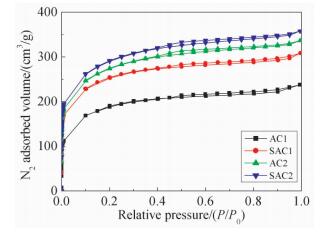
N2 adsorption and desorption isotherms of ACs
图 1
活性炭N2吸附脱附等温线
Figure 1.
N2 adsorption and desorption isotherms of ACs
Citation:
Dai Qiwen, Wang Feng, Wang Jide, Wang Lu. Steam Activation to Activated Carbon and Its Supported Bi-Based Catalyst for Acetylene Hydrochlorination[J]. Chemistry,
2017, 80(8): 751-759.

水蒸汽活化活性炭及其负载乙炔氢氯化铋基催化剂
摘要:
以水蒸汽活化的两种活性炭为载体,采用等体积浸渍法制备了一系列Bi/AC催化剂,考察了其对乙炔氢氯化反应的催化性能。分别通过氮气吸附脱附实验(BET)、扫描电镜(SEM)、傅立叶变换红外光谱(FTIR)、透射电镜(TEM)、X射线粉末衍射(XRD)、X射线光电子能谱(XPS)和热重分析(TGA)对活性炭和催化剂进行表征。结果表明,水蒸汽活化重整了活性炭的孔径和孔道,尤其是介孔材质活性炭,增加了其比表面积,形成了新的微孔结构;积碳是Bi/AC催化剂失活的主要原因,水蒸汽活化抑制了积碳,并增加了BiOCl的结晶度和分散性,提高了对乙炔氢氯化反应的催化性能。
English
Steam Activation to Activated Carbon and Its Supported Bi-Based Catalyst for Acetylene Hydrochlorination
Abstract:
Two kinds of activated carbons (ACs) were activated by steam, and a series of Bi/AC catalysts supported on steam-activated ACs were prepared by incipient-wetness impregnation method. Their catalytic performance for acetylene hydrochlorination was investigated. The characterizations of ACs and catalysts were conducted by N2 adsorption-desorption experiments (BET), scanning electron microscopy (SEM), Fourier transform-infrared spectroscopy (FTIR), transmission electron microscopy (TEM), powder X-ray diffraction (XRD), X-ray photoelectron spectroscopy (XPS) and thermogravimetric analysis (TGA) methods, respectively. The results revealed that: (1) Steam activation reorganized the pore size and channel structure of ACs, especially for the mesoporous AC, whose specific surface area was increased and new micropore structure was formed; (2) Steam activation decreased the amount of coke deposition, which was the decisive factors affecting the catalytic activity, and generated a higher degree of crystallinity and a better dispersity of BiOCl, thus improving the catalytic performance for acetylene hydrochlorination.
-
Key words:
- Activated carbon
- / Steam activation
- / Bi based catalyst
- / Acetylene hydrochlorination
- / Pore structure
-
Acetylene hydrochlorination catalyzed by mercury catalyst has been a main industrial process in China for producting vinyl chloride monomer (VCM), which is the irreplaceable raw material for polyvinylchloride (PVC)[1~2]. Currently, the reaction of mercury-free catalyst arouses much concern because mercury catalysts used in the reaction have a detrim-ental effect on the environment. In the past decade, mercury-free metal catalysts supported on activated carbon (AC) have been extensively studied. Du et al[3] studied CuCl2 promoted low-gold-content Au/C catalyst for acetylene hydrochlorination prepared by ultrasonic-assisted impregnation. Hou et al[4] examined the effects of nitrogen-dopants on Ru-supported catalysts for acetylene hydrochlorination. A series of N-doped spherical active carbons were synthesized via the pyrolysis of melamine in activated carbon, and used as a support to prepare Ru-based catalysts for an acetylene hydrochlorination reaction. It is illustrated that N-dopants can increase the dispersion of Ru species, enhance the adsorption of reactants and the desorption of the product, and reduce significantly the coke deposition. Dong et al[5] prepared bimetallic Au-Sn/AC catalyst by an incipient wetness impregnation, and it showed better activity and stability for acetylene hydrochlorination compared with Au/AC. The addition of Sn enhanced the dispersion of Au species and decreased the coke deposition.
AC was used as the support in catalysts for the acetylene hydrochlorination because of its advantages such as high developed porous structure, large surface area, excellent adsorption capacity, high mechanical intensity, suitable acidity, renewability and low prices[6~9]. In order to meet the requirements of some reactions, chemical methods[10~11]or physical methods[12~13] were generally used to activate AC. For example, by chemical activation with KOH and ZnCl2, AC was provided with large pore volumes and high specific surface areas[14~15], and thus its adsor-ption performance was improved. Compared with chemical activation, physical activation using steam is effective and alternative because of its environment friendliness, relative simplicity and lower costs. Fu et al[16] prepared lignin-based AC by physical activ-ation with steam. The pore structures of the lignin-based AC were significantly influenced by different preparation conditions, such as the carbonization temperature, activation temperature and activation time. In Heo et al's study[17], physical activation using steam was observed to have an influence on the development of new pores and the expansion of pore sizes, and to be effective in developing optimal micropores for CO2 adsorption on the carbon surface.
In this work, two kinds of ACs were activated by steam, and Bi-based catalysts supported on ACs for acetylene hydrochlorination were prepared. Effects of steam activation on the structure and catalytic performance of Bi-based catalysts were investigated.
1 Experimental
1.1 Steam activation of ACs
Two kinds of commercial ACs (labeled as AC1 and AC2 purchased from Xinghua Chemical Plant, Shanxi, China) were activated by steam in a fixed bed reactor. At first, ACs were washed thoroughly with distilled water to remove volatile and impurities and subsequently dried at 120 ℃ for 12 h in drying oven. Then the resultant ACs were placed into the fix bed reactor and activated by steam, which were traversed the reactor at 600 ℃ for 3 h under a steam volume rate of 30 cm3/min, subsequently dried at 120 ℃ for 12 h. Corresponding to AC1 and AC2, ACs after steam activation were named as SAC1 and SAC2, respectively.
1.2 Preparation of the catalysts
The Bi-based catalysts with Bi loading level of 25 (wt)% were prepared by incipient-wetness impregnation method, applying steam-activated ACs as catalyst supports and bismuth chloride (BiCl3) as precursor. BiCl3 was dissolved in 2 mol/L aqueous hydrochloric acid (HCl). The solution was added dropwise into ACs activated by steam with continuous stirring in order to obtain a well-dispersed catalyst, then treated under microwave for 1 h and kept at ambient temperature for 12 h, finally dried at 120 ℃ for 12 h. As-prepared catalysts were desi-gnated as Bi/SAC1 and Bi/SAC2, separately. For comparison, original ACs supported Bi-based catalysts were prepared by the same process and labeled as Bi/AC1 and Bi/AC2, respectively.
1.3 Characterization of ACs and catalysts
The surface morphology of ACs and catalysts was obtained by scanning electron microscopy (SEM, Model LEO1450VP, LEO Co., Ltd, DE) at an acceleration voltage of 15 kV.X-ray diffraction (XRD) patterns of catalysts were measured in the scan range of 2θ between 10°to 80°using a Bruker D8 advance instrument (Bruker Co., Ltd, DE) operated at 40 kV, 40 mA with Cu-Kα irradiation. Transmission electron microscopy (TEM) was carried out by using a H-600-Ⅱ electron microscope (Hitachi Co., Ltd, JP) with an accelerating voltage of 200 kV. X-ray photoelectron spectroscopy (XPS) was used by AXIS ULTRA X-ray diffractometer (Kratos Analytical Ltd.) equipped with an Al X-ray source (hv=1486.6 eV). Thermogravimetric analysis (TGA) was performed by a NETZSCH SAT 449F3 multifunctional thermal analyzer ranged from 25 to 800 ℃ at a heating rate of 10 ℃/min in the atmosphere of air at a flow rate of 200 mL/min. The functional groups on the surface of ACs were determined by Fourier transform-infrared spectroscopy (FTIR) using a VERTEX 70 FTIR spectrometer (Bruker Co., Ltd, DE), recorded in the region from 500 to 4000 cm-1. The textural properties and pore structure parameters of ACs and catalysts were analyzed with N2 adsorption-desorption isotherms by using an Autosorb iQ2 ASIQM0002-6 (Quantachrome instruments Co., Ltd, USA) at 77 K. Before analysis, all the samples were degassed under vacuum at 120 ℃ for 8 h. The surface area (SBET) was calculated using the Brunauer-Emmet-Teller (BET) equation with relative pressures (P/P0) ranged from 0.05 to 0.35. The total pore volume (Vtot) was determined at a relative pressure of 0.99. The micropore volume (Vmic) was measured employing to the Dubinin-Radushkevich (DR) equation with relative pressures (P/P0) in the range of 10-4 to 10-1. The average pore diameter (DA) was also obtained from N2 adsorption-desorption isotherm data. And the pore-size distributions of micropore and mesopore were derived utilizing the Horvath-Kawazoe (HK) and Barrett-Joyner-Halenda (BJH) methods, separately.
1.4 Catalytic performance tests
The catalytic performance for acetylene hydrochlorination was tested in a fixed bed reactor with a 10 mm diameter quartz-tube microreactor at 160 ℃ and atmospheric pressure. Before testing, N2 flow as sweeping gas was used to remove air and water in the reactor controlled with mass flow controllers (Sevenstar Huachuang electronics Co. ltd, Beijing, China) at a flow rate of 20 cm3/min, and subsequently passing hydrochloride (HCl) through the heated reactor to activate catalysts. When reactor temperature reached to 160 ℃, hydrochloride (gas, 99.99%) and acetylene (C2H2, gas, 99.99%) were mixed in a commingler contained catalyst (about 5g) via calibrated mass flow contr-ollers at a total gas hourly space velocity (GHSV) of 120 h-1. The exhaust gas mixture from the reactor was fed through an absorption bottle including sodium hydroxide (NaOH) solution. And catalytic activities, which were evaluated by conversion of acetylene (XA) and selectivity of VCM (SVCM) were analyzed immediately using a gas chromatograph (GC 2010, Shimadzu). In the case of catalytic performance testing at a GHSV of 120 h-1, the internal and external diffusion of catalyst were eliminated.
2 Results and Discussion
2.1 The effect of steam on the pore structure of ACs
The N2 adsorption-desorption experiments and SEM characterization were performed to investigate the effects of steam on pore structure and morphology of ACs. As shown in Fig. 1, according to the International Union of Pure and Applied Chemistry (IUPAC) classification[18~19], the N2adsorption-desorption isotherms of all ACs are similar to the typeⅠshape. This indicats that both original ACs (AC1 and AC2) and steam-activated ACs (SAC1 and SAC2) have the characteristic of micro-mesoporous structure. Fig. 2 shows the pore size distribution, including mesopore (between 2 nm and 50 nm) and micropore (less than 2 nm)[20~21], characterized by using the BJH and HK methods, respectively. As shown in Fig. 2(a), the average mesopore size is 3.8 nm, whereas the micropore size distributions of all the ACs in Fig. 2(b) exhibit double-peak structures located at 0.52 nm and 1.57 nm, respectively. It is clearly observed that the pore distributions are different between two kinds of ACs, AC2 and SAC2 have more abundant pores than AC1 and SAC1. Compared with AC1 and AC2, after steam activation, N2 adsorption capacities of the SAC1 and SAC2 have increased, indicating that the pore structure becomes abundant in the SAC1 and SAC2, and the pore size and channel are reorganized during steam activation.
图 1
活性炭N2吸附脱附等温线
Figure 1.
N2 adsorption and desorption isotherms of ACs
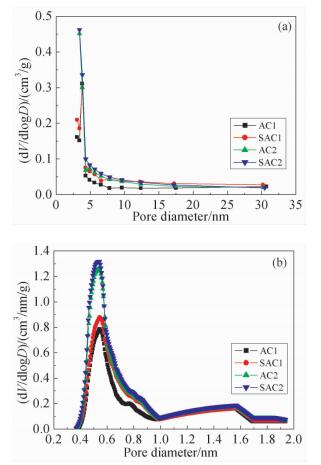 图 2
(a) BJH法和(b) HK法测得的活性炭孔径分布图
Figure 2.
(a) BJH and (b) HK pore size distribution profiles of ACs
图 2
(a) BJH法和(b) HK法测得的活性炭孔径分布图
Figure 2.
(a) BJH and (b) HK pore size distribution profiles of ACs
In order to further interpret pore size distribution and the ratio of micropore and mesopore volume of two kinds of ACs, the Dubinin-Radushkevich (DR) equation was used to calculate the micropore volume as follows[22~24]:
Tab. 1 summarized the detailed results of pore structure parameters of ACs, it can be seen that all the ACs have the framework of micro-mesoporous structure corresponded with the N2 adsorption-desorption experiments in Fig. 2. AC1 is mainly mesoporous structure, but for AC2, microporous structure is in the majority. The data also show that effects of steam on the surface area and pore structures are different between AC1 and AC2. After steam activation, SBET of SCA1 increases from 598 m2/g to 786 m2/g (about 31%), and the proportion of micropores increased, while that of mesopores decreased. The results indicate that the mesoporous structure is destroyed, and at the same time more micropores are produced. While for AC2, the pore structure and surface area have no obvious change after steam activation.
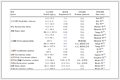 表 1
活性炭的孔结构参数
Table 1.
Pore structure parameters of ACs
表 1
活性炭的孔结构参数
Table 1.
Pore structure parameters of ACs
Specimens SBET /(m2/g) Vtot/(cm3/g) Vmic /(cm3/g) Vmes/(cm3/g) Pore volume fraction/% DA/nm Micropore Mesopore AC1 598 0.828 0.201 0.627 24.3 75.7 2.77 SAC1 786 0.477 0.304 0.173 63.7 36.3 1.21 AC2 818 0.520 0.333 0.187 64.0 36.0 1.27 SAC2 869 0.553 0.353 0.200 63.8 36.2 1.27 Note:SBET: Specific surface area; Vtot: Total pore volume; Vmic: Micropore volume; Vmes: Mesopore volume; DA: Average pore diameter Fig. 3 is the SEM images of ACs. It is observed that original ACs exhibit smooth surfaces and poor pore structure both in AC1 and AC2. However, after activation by steam, clear pore structure appears and surface becomes relatively rough in SAC1 and SAC2. It is also observed that the pore size and channel of SAC1 are bigger than those of the SAC2, attributing to the difference of pore structure between AC1 and AC2. The results of N2 adsorption-desorption and SEM images suggest that the steam had a remarkable impact on the structure of pores and channels due to the collision of steam molecules with the AC during the activation. However, the effect of steam activation is more pronounced for the mesoporous carbon than that for the microporous carbon. Because pore size of mesopore is larger than that of micropore, the steam molecules are easy to enter the mesoporous channel and thus affect the structure of AC under same conditions.
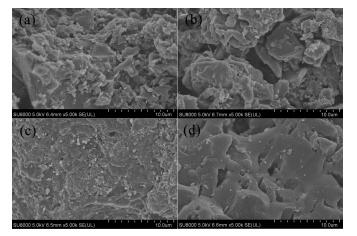 图 3
(a) AC1、(b) SAC1、(c) AC2、(d) SAC2的SEM图
Figure 3.
SEM images of (a) AC1, (b) SAC1, (c) AC2 and (d) SAC2
图 3
(a) AC1、(b) SAC1、(c) AC2、(d) SAC2的SEM图
Figure 3.
SEM images of (a) AC1, (b) SAC1, (c) AC2 and (d) SAC2
2.2 The effect of steam on surface chemistry of ACs
Fig. 4 is the FTIR characterization, contributing to analyze the surface functional groups of ACs. The FTIR spectra were measured within the range of 4000~500 cm-1. The intense bands at approximately 3437cm-1 in all ACs are related to stretching vibrations of the hydrogen-bonded O-H group[25]. And the ACs also show weak bands, assigned to stretching vibrations of aromatic rings at about 1573 cm-1[26]. According to Hidayus report[27], the absorption bands at 1234 cm-1are associated with C-O stretching vibrations in AC1 and SAC1, and for AC2 and SAC2, the absorption bands corresponding to C-O and C-H vibration are located at 1103 cm-1 and 806 cm-1[28], respectively. It is obvious that the groups of steam-activated ACs have not substantially change compared with original ACs, demonstrating that steam activation is a physical activation to ACs without changing the surface chemistry.
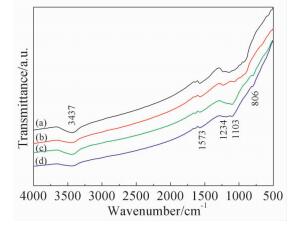 图 4
(a) AC1、(b) SAC1、(c) AC2、(d) SAC2的FTIR谱图
Figure 4.
FTIR spectra of (a) AC1, (b) SAC1, (c) AC2 and (d) SAC2
图 4
(a) AC1、(b) SAC1、(c) AC2、(d) SAC2的FTIR谱图
Figure 4.
FTIR spectra of (a) AC1, (b) SAC1, (c) AC2 and (d) SAC2
2.3 The catalytic performance of Bi/AC catalysts
Fig. 5 illustrates catalytic performance of Bi/AC catalysts for the acetylene hydrochlorination reaction. The selectivity to VCM for all ACs is above 80%. Fig. 5(a) shows that C2H2 conversion rate over the Bi/AC2 is higher than that over the Bi/AC1 because AC2 possesses larger surface area and more pores, providing more sites to load active species. And after steam activation, the catalytic activities of Bi/SAC1 and Bi/SAC2 are improved. For Bi/SAC1, the highest conversion of C2H2 increases from 64% to 86%, and the increase in conversion rate is greater than Bi/SAC2 (increased from 71% to 82%). The reason is that the effect of steam activation for the mesoporous carbon (AC1) is more efficient than that for microporous carbon (AC2) as the above discussions, and this has a great impact on the adsorption and load of active species in catalyst. However, it also can be clearly seen that Bi/AC1 and Bi/SAC1 display fairly unstable activities and have an obvious decline after 20 h compared with Bi/AC2 and Bi/SAC2.
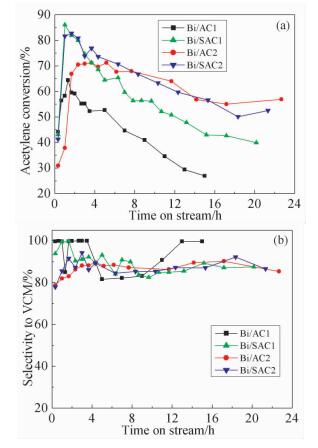 图 5
Bi/AC催化剂的催化性能
Figure 5.
The catalytic performance of Bi/AC catalysts
图 5
Bi/AC催化剂的催化性能
Figure 5.
The catalytic performance of Bi/AC catalysts
Fig. 6 shows the XRD patterns of Bi/AC1 and Bi/SAC1 catalysts. It can be seen that both catalysts exhibit the diffraction peaks of tetragonal structures of BiOCl, which is the active species of catalysts. The major XRD diffraction peaks are located at 2θ =11.98°, 25.86°, 32.50°, 33.44°, 40.89°, 46.64° and 58.60°, corresponding to the (001), (101), (110), (102), (112), (200) and (212) planes of BiOCl, respectively. The diffraction peak intensities of Bi/SAC1 increase remarkably at (101), (110), (102) planes after steam activation. Steam activation increases the specific surface area and pores of SAC1, which are beneficial for the loading and dispersion of BiOCl, leading to superior crystal structure and better catalytic performance.
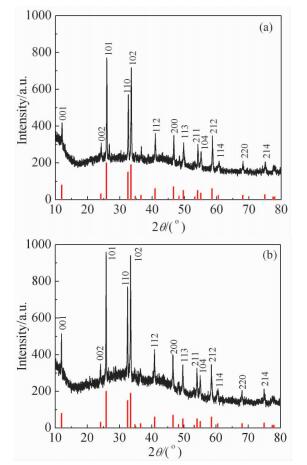 图 6
Bi/AC1、(b) Bi/SAC1催化剂的XRD图
Figure 6.
XRD patterns of (a) Bi/AC1 and (b) Bi/SAC1 catalysts
图 6
Bi/AC1、(b) Bi/SAC1催化剂的XRD图
Figure 6.
XRD patterns of (a) Bi/AC1 and (b) Bi/SAC1 catalysts
Fig. 7 shows the TEM images of fresh and used Bi/AC1 and Bi/SAC1 catalysts. Compared with Fresh-Bi/AC1 catalyst (Fig. 7(a)), there is no significant aggregation on Fresh-Bi/SAC1 catalyst (Fig. 7(b)), and the BiOCl as active component is evenly distributed on the surface of SAC1. It is well demonstrated that steam activation promotes the dispersion of active component via reforming pore size and channel of ACs, thereby improving the catalytic activity. Nevertheless, we cannot observe the black blob of active species in both Used-Bi/AC1(Fig. 7(c)) and Used-Bi/SAC1 (Fig. 7(d)). And combined with the following XPS and TGA, it can be ascribed to the coke deposition covered on active species that leading to the rapid deactivation of catalysts.
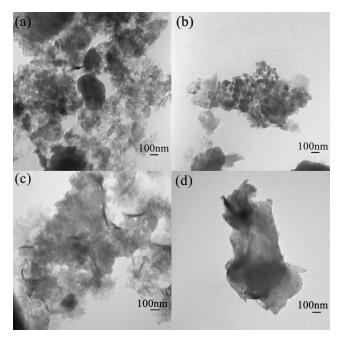 图 7
(a) Fresh-Bi/AC1、(b) Fresh-Bi/SAC1、(c) Used-Bi/AC1、(d) Used-Bi/AC1催化剂的TEM图
Figure 7.
TEM profiles of (a) Fresh-Bi/AC1, (b) Fresh-Bi/SAC1, (c) Used-Bi/AC1, (d) Used-Bi/AC1 catalysts
图 7
(a) Fresh-Bi/AC1、(b) Fresh-Bi/SAC1、(c) Used-Bi/AC1、(d) Used-Bi/AC1催化剂的TEM图
Figure 7.
TEM profiles of (a) Fresh-Bi/AC1, (b) Fresh-Bi/SAC1, (c) Used-Bi/AC1, (d) Used-Bi/AC1 catalysts
XPS spectra were further used to describe the forms of Bi species and relative content of each element. Fig. 8 is the XPS survey spectra of Bi/AC catalysts. It can be seen clearly that fresh and used catalysts consisted of four elements, C, Bi, O and Cl. Fig. 9 is the Bi 4f XPS spectra of Bi/AC catalysts. All the catalysts show two spin-orbit doublet bismuth species peaking (Bi 4f7/2 and Bi 4f5/2) located at binding energies about 159.7 eV and 164.9 eV, which are the characteristic peaks for Bi3+[29]. It is also suggested that Bi3+ species may be the active species for Bi/AC catalysts, and there is no change of valence state during the reaction. But compared with the data of fresh catalysts in Tab. 2, the relative contents of Bi3+ species decrease in the used catalysts. The diminution of Bi is 24% in Bi/AC1 catalyst and 9.6% in Bi/SAC1 catalyst after the reaction, which is due to the loss of active species. And it can also be seen that the relative contents of C species increase in various degrees, which may be caused by the coke deposition. And the addition of C species in Bi/AC1 catalyst is higher than that in Bi/SAC1 catalyst during the reaction. The loss of Bi species may be a reason of the deactivation in Bi-based catalysts, but the decisive factor is the happen of coke deposition covered on active species. And after steam activation to AC1, the activity of Bi/SAC1 catalyst is improved significantly, ascribed to the inhibitory effect of the happen of coke deposition.
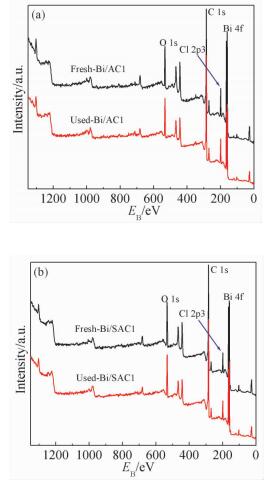 图 8
Bi/AC催化剂的XPS全谱图
Figure 8.
XPS survey spectra of BI/AC catalysts
图 8
Bi/AC催化剂的XPS全谱图
Figure 8.
XPS survey spectra of BI/AC catalysts
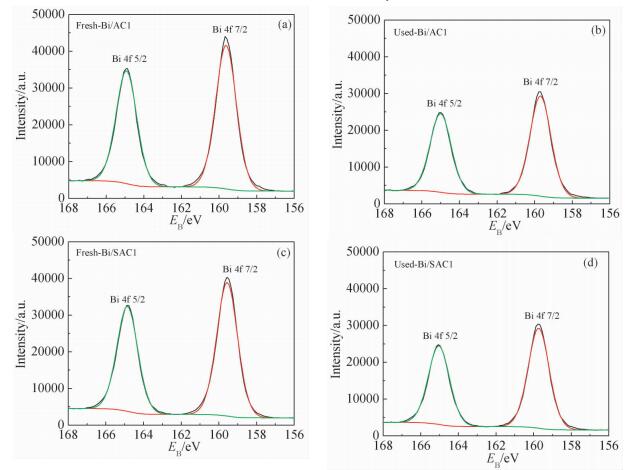 图 9
Bi/AC催化剂的Bi 4f XPS分谱图
Figure 9.
Bi 4f XPS spectrum of Bi/AC catalysts
表 2
Bi/AC催化剂XPS数据
Table 2.
XPS data of Bi/AC catalysts
图 9
Bi/AC催化剂的Bi 4f XPS分谱图
Figure 9.
Bi 4f XPS spectrum of Bi/AC catalysts
表 2
Bi/AC催化剂XPS数据
Table 2.
XPS data of Bi/AC catalysts
Sample Relative contents of elements (Mass fraction %) C Bi O Cl Fresh-Bi/AC1 75.22 1.85 11.74 11.18 Used-Bi/AC1 80.24 1.40 11.70 6.66 Fresh-Bi/SAC1 77.41 1.56 12.93 8.09 Used-Bi/SAC1 79.71 1.41 13.36 5.52 According to the above discussion, Bi/SAC1 exhibits a good catalytic performance than that of Bi/AC1 after steam activation, but its catalytic activity was significantly reduced after 20 hours. Coke deposition is a suggesting reason[30]. The ther-mogravimetric analysis (TGA) is a standard way to obtain more direct and detailed evidences about the coke deposition. As shown in Fig. 10, the mass loss in the range of 100~450 ℃ is observed. The difference in mass losses between the fresh and used catalysts reflects the amount of coke deposition. After steam activation, the amount of coke deposition of the fresh and used Bi/SAC1 catalysts significantly deceases from 17.2% to 3.2%. Tab. 3 listed the pore structure parameters of fresh and used Bi/AC1 and Bi/SAC1. Compared with the fresh ones, the SBET and Vtot of used catalyst decrease, and DA increases to some extent. It is regarded that the coke deposition covered on the surface of the catalyst leads to the decrease of SBETand the change of pore structure in catalysts. It is also shown that the decrease of SBET in the used Bi/SAC1 is more serious compared with Bi/AC1. However, the amount of coke deposition of Bi/SAC1 catalyst is less and its catalytic performance is better than that of Bi/AC1 catalyst during the reaction. This could be attributed to the generation of new micropores in SAC after steam activation, which improves the pore and channel structures, so that more active centers are exposed on the surface of SAC1, thus reducing the coke deposition.
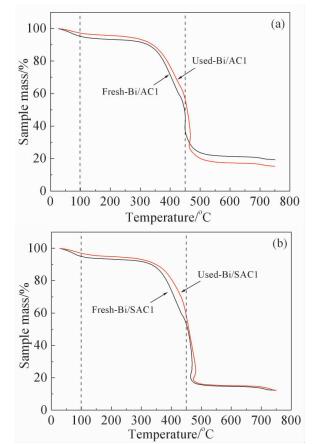 图 10
Bi/AC催化剂的TGA图
Figure 10.
TGA curves of Bi/AC catalysts
表 3
Bi/AC催化剂孔结构参数
Table 3.
Pore structure parameters of Bi/AC catalysts
图 10
Bi/AC催化剂的TGA图
Figure 10.
TGA curves of Bi/AC catalysts
表 3
Bi/AC催化剂孔结构参数
Table 3.
Pore structure parameters of Bi/AC catalysts
Specimens SBET/(m2/g) Vtot/(cm3/g) DA/nm Fresh-Bi/AC1 40 0.06 3.17 Fresh-Bi/SAC1 88 0.07 1.55 Used-Bi/AC1 18 0.04 4.74 Used-Bi/SAC1 17 0.02 3.01 3 Conclusions
Steam activation can change the pore size and channel structure and increase the amount of new micropores and specific surface area, especially for the mesoporous ACs, which are beneficial for the adsorption and load of active species in catalysts. The Bi-based catalysts supported on the steam-activated ACs express a better catalytic performance for acetylene hydrochlorination owing to the less amount of coke deposition, the higher degree of crystallinity and better dispersity of BiOCl.
-
-
[1]
X Liu, M Conte, D Elias et al. Catal. Sci. Technol. , 2016, 6: 5144~5153. https: //www. researchgate. net/publication/298734691_Investigation_of_the_active_species_in_the_carbon-supported_gold_catalyst_for_acetylene_hydrochlorination?ev=prf_high
-
[2]
J Zhao, S Gu, X Xu et al. Catal. Sci. Technol. , 2015, 6: 3263~3270.
-
[3]
Y Du, R Hu, Y Jia et al. J. Ind. Eng. Chem. , 2016, 37: 32~41.
-
[4]
L Hou, J Zhang, Y Pu et al. RSC Adv. , 2016, 6: 18026~18032. https: //www. researchgate. net/publication/293190491_Effects_of_nitrogen-dopants_on_Ru-supported_catalysts_for_acetylene_hydrochlorination
-
[5]
Y Dong, W Li, Z Yan et al. Catal. Sci. Technol. , 2016, 6: 7946~7955.
-
[6]
Y J Zhang, Z J Xing, Z K Duan et al. Appl. Surf. Sci. , 2014, 315: 279~286. https: //www. researchgate. net/publication/264791079_Effects_of_steam_activation_on_the_pore_structure_and_surface_chemistry_of_activated_carbon_derived_from_bamboo_waste
-
[7]
P G González, Y B Pliego Cuervo. J. Anal. Appl. Pyrol. , 2013, 99: 32~39. https: //www. researchgate. net/publication/256797662_Physicochemical_and_microtextural_characterization_of_activated_carbons_produced_from_water_steam_activation_of_three_bamboo_species?ev=prf_cit
-
[8]
O Olorundare, T Msagati, R Krause et al. Chem. Ecol. , 2014, 30: 473~490. http: //www. researchgate. net/publication/271414798_Steam_activation_characterisation_and_adsorption_studies_of_activated_carbon_from_maize_tassels?ev=auth_pub
-
[9]
J Y Cao, J L Tang, L Z Song et al. Acta Phys. Chim. Sin. , 2013, 29: 144~150.
-
[10]
J Kong, Q Yue, L Huang et al. Chem. Eng. J. , 2013, 221: 62~71. https: //www. researchgate. net/publication/257567145_Preparation_characterization_and_evaluation_of_adsorptive_properties_of_leather_waste_based_activated_carbon_via_physical_and_chemical_activation
-
[11]
L Tong, W Q Xu, H Qi et al. Acta Phys. Chim. Sin. , 2012, 31: 512~518. https: //www. researchgate. net/publication/274142498_Enhanced_Effect_of_ON_Groups_on_the_Hg0_Removal_Efficiency_over_the_HNO3-Modified_Activated_Carbon
-
[12]
S Román, J F González, C M González-García et al. Fuel Proc. Technol. , 2008, 89: 715~720. https: //www. researchgate. net/publication/257210141_Control_of_pore_development_during_CO2_and_steam_activation_of_olive_stones?ev=auth_pub
-
[13]
T Maneerung, J Liew, Y J Dai et al. Bioresource Technol. , 2015, 200: 350~359. https: //www. researchgate. net/publication/283326246_Activated_carbon_derived_from_carbon_residue_from_biomass_gasification_and_its_application_for_dye_adsorption_Kinetics_isotherms_and_thermodynamic_studies
-
[14]
B Belhamdi, Z Merzougui, M Trari et al. J. Appl. Res. Technol. , 2016, 14.
-
[15]
M Wei, Q Yu, T Mu et al. Adsorption, 2016, 22: 1~12.
-
[16]
K Fu, Q Yue, B Gao et al. Chem. Eng. J. , 2013, 228: 1074~1082. https: //www. researchgate. net/publication/257567414_Preparation_characterization_and_application_of_lignin-based_activated_carbon_from_black_liquor_lignin_by_steam_activation
-
[17]
Y J Heo, S J Park. Energy, 2015, 91: 142~150. https: //www. researchgate. net/publication/283905687_A_role_of_steam_activation_on_CO2_capture_and_separation_of_narrow_microporous_carbons_produced_from_cellulose_fibers
-
[18]
S J Zhang, H Q Yu, H M Feng. Carbon, 2006, 44: 2059~2068. https: //www. researchgate. net/publication/233810230_PVA-based_activated_carbon_fibers_with_lotus_root-like_axially_porous_structure
-
[19]
X Ma, H Yang, L Yu et al. Materials, 2014, 7: 4431~4441. https: //www. researchgate. net/publication/276039725_Preparation_Surface_and_Pore_Structure_of_High_Surface_Area_Activated_Carbon_Fibers_from_Bamboo_by_Steam_Activation
-
[20]
U Kuila, M Prasad. Geophys. Prospect. , 2013, 61: 341~362. https: //www. researchgate. net/publication/256456724_Specific_surface_area_and_pore-size_distribution_in_clays_and_shales
-
[21]
S H Jung, J S Kim. J. Anal. Appl. Pyrol. , 2014, 107: 116~122. https: //www. researchgate. net/profile/Su-Hwa_Jung/publication/260313311_Production_of_biochars_by_intermediate_pyrolysis_and_activated_carbons_from_oak_by_three_activation_methods_using_CO2/links/00b49532f7c0774c30000000
-
[22]
M J Lashaki, M Fayaz, S Niknaddaf et al. J. Hazard. Mater. , 2012, 241~242: 154~163. https: //www. researchgate. net/publication/232222436_Effect_of_the_adsorbate_kinetic_diameter_on_the_accuracy_of_the_Dubinin-Radushkevich_equation_for_modeling_adsorption_of_organic_vapors_on_activated_carbon?ev=auth_pub
-
[23]
C Nguyen, D D Do. Carbon, 2001, 39: 1327~1336. https: //www. researchgate. net/publication/223076652_The_DubininRadushkevich_equation_and_the_underlying_microscopic_adsorption_description
-
[24]
C Long, Y Li, W Yu et al. J. Hazard. Mater. , 2012, 203~204: 251~256. https: //www. researchgate. net/publication/51977060_Removal_of_benzene_and_methyl_ethyl_ketone_vapor_comparison_of_hypercrosslinked_polymeric_adsorbent_with_activated_carbon
-
[25]
D Chen, D Liu, H Zhang et al. Fuel, 2015, 148: 79~86. https: //www. researchgate. net/publication/272373121_Bamboo_pyrolysis_using_TGFTIR_and_a_lab-scale_reactor_Analysis_of_pyrolysis_behavior_product_properties_and_carbon_and_energy_yields
-
[26]
P Burg, P Fydrych, D Cagniant et al. Carbon, 2002, 40: 1521~1531. https: //www. researchgate. net/publication/229311315_The_characterization_of_nitrogen-enriched_activated_carbons_by_IR_XPS_and_LSER_methods
-
[27]
A R Hidayu, N F Mohamad, S Matali et al. Procedia Eng. , 2013, 68: 379~384. https: //www. researchgate. net/publication/264461487_Characterization_of_activated_carbon_prepared_from_oil_palm_empty_fruit_bunch_using_BET_and_FT-IR_techniques
-
[28]
J Yang, K Qiu. Environ. Sci. Technol. , 2009, 43: 3385~3390. https: //www. researchgate. net/publication/26299220_Preparation_of_activated_carbon_by_chemical_activation_under_vacuum
-
[29]
N Myung, S Ham, S Choi et al. J. Phys. Chem. , 2011, 115: 7793~7800.
-
[30]
B Dai, K Chen, Y Wang et al. ACS Catal. , 2015, 5: 2541~2547.
-
[1]
-

Figure 5 The catalytic performance of Bi/AC catalysts
Reaction conditions: temperature=160℃, GHSV=120 h-1 and VHCl:VC2H2=1.25:1

Figure 7 TEM profiles of (a) Fresh-Bi/AC1, (b) Fresh-Bi/SAC1, (c) Used-Bi/AC1, (d) Used-Bi/AC1 catalysts
Table 1. Pore structure parameters of ACs
Specimens SBET /(m2/g) Vtot/(cm3/g) Vmic /(cm3/g) Vmes/(cm3/g) Pore volume fraction/% DA/nm Micropore Mesopore AC1 598 0.828 0.201 0.627 24.3 75.7 2.77 SAC1 786 0.477 0.304 0.173 63.7 36.3 1.21 AC2 818 0.520 0.333 0.187 64.0 36.0 1.27 SAC2 869 0.553 0.353 0.200 63.8 36.2 1.27 Note:SBET: Specific surface area; Vtot: Total pore volume; Vmic: Micropore volume; Vmes: Mesopore volume; DA: Average pore diameter  下载: 导出CSV
Table 2. XPS data of Bi/AC catalysts
Sample Relative contents of elements (Mass fraction %) C Bi O Cl Fresh-Bi/AC1 75.22 1.85 11.74 11.18 Used-Bi/AC1 80.24 1.40 11.70 6.66 Fresh-Bi/SAC1 77.41 1.56 12.93 8.09 Used-Bi/SAC1 79.71 1.41 13.36 5.52
下载: 导出CSV
Table 3. Pore structure parameters of Bi/AC catalysts
Specimens SBET/(m2/g) Vtot/(cm3/g) DA/nm Fresh-Bi/AC1 40 0.06 3.17 Fresh-Bi/SAC1 88 0.07 1.55 Used-Bi/AC1 18 0.04 4.74 Used-Bi/SAC1 17 0.02 3.01
下载: 导出CSV
-


 扫一扫看文章
计量
- PDF下载量: 0
- 文章访问数: 0
- HTML全文浏览量: 0
 下载:
下载:

