Login In
Application of Propargylic Radicals in Organic Synthesis
- Corresponding author: Lu Liang-Qiu, luliangqiu@mail.ccnu.edu.cn Xiao Wen-Jing, wxiao@mail.ccnu.edu.cn
Figures(20)
Citation:
Lu Fu-Dong, Jiang Xuan, Lu Liang-Qiu, Xiao Wen-Jing. Application of Propargylic Radicals in Organic Synthesis[J]. Acta Chimica Sinica,
;2019, 77(9): 803-813.
doi:
10.6023/A19060201

Figures(20)


(a) Trost, B. M.; Li, C.-J. Modern Alkyne Chemistry: Catalytic and Atom-Economic Transformations, Wiley-VCH, New York, 2014. (b) Trotuş, I. T.; Zimmermann, T.; Schüth, F. Chem. Rev. 2014, 114, 1761. (c) Tiwari, V. K.; Mishra, B. B.; Mishra, K. B.; Mishra, N.; Singh, A. S.; Chen, X. Chem. Rev. 2016, 116, 3086. (d) Huang, D.; Liu, Y.; Qin, A.-J.; Tang, B.-Z. Polym. Chem. 2018, 9, 2853.
Ding, C.-H.; Hou, X.-L. Chem. Rev. 2011, 111, 1914.
doi: 10.1021/cr100284m
(a) Nicholas, K. M.; Pettit, R. Tetrahedron Lett. 1971, 37, 3475. (b) Nicholas, K. M.; Pettit, R. J. Organomet. Chem. 1972, 44, 21.
Melikyan, G. G. Acc. Chem. Res. 2015, 48, 1065.
doi: 10.1021/ar500365v
Geri, R.; Oilizzi, C.; Lardicci, L.; Caporusso, A. M. Gazz. Chim. Ital. 1994, 124, 241.
Bruneau, C.; Dixneuf, P. H. Metal Vinylidenes and Allenylidenes in Catalysis, Wiley-VCH, Weinheim, 2008.
(a) Kropf, H.; SchrÖder, R.; FÖlsing, R. Synthesis 1977, 894. (b) Alvarez, L. X.; Christ, M. L.; Sorokin, A. B. Appl. Catal. A: Gen. 2007, 325, 303.
Smith, S. W.; Fu, G. C. J. Am. Chem. Soc. 2008, 130, 12645.
doi: 10.1021/ja805165y
Oelke, A. J.; Sun, J.-W.; Fu, G. C. J. Am. Chem. Soc. 2012, 134, 2966.
doi: 10.1021/ja300031w
Pelphrey, P. M.; Popov, V. M.; Joska, T. M.; Beierlein, J. M.; Bolstad, E. S. D.; Fillingham, Y. A.; Wright, D. L.; Anderson, A. C. J. Med. Chem. 2007, 50, 940.
doi: 10.1021/jm061027h
Schley, N. D.; Fu, G. C. J. Am. Chem. Soc. 2014, 136, 16588.
doi: 10.1021/ja508718m
Domingo-Legarda, P.; Soler-Yanes, R.; Quirós-López, M. T.; Buñuel, E.; Cárdenas, D. J. Eur. J. Org. Chem. 2018, 35, 4900.
An, L.; Tong, F.-F.; Zhang, X.-G. Acta Chim. Sinica 2018, 76, 977(in Chinese).
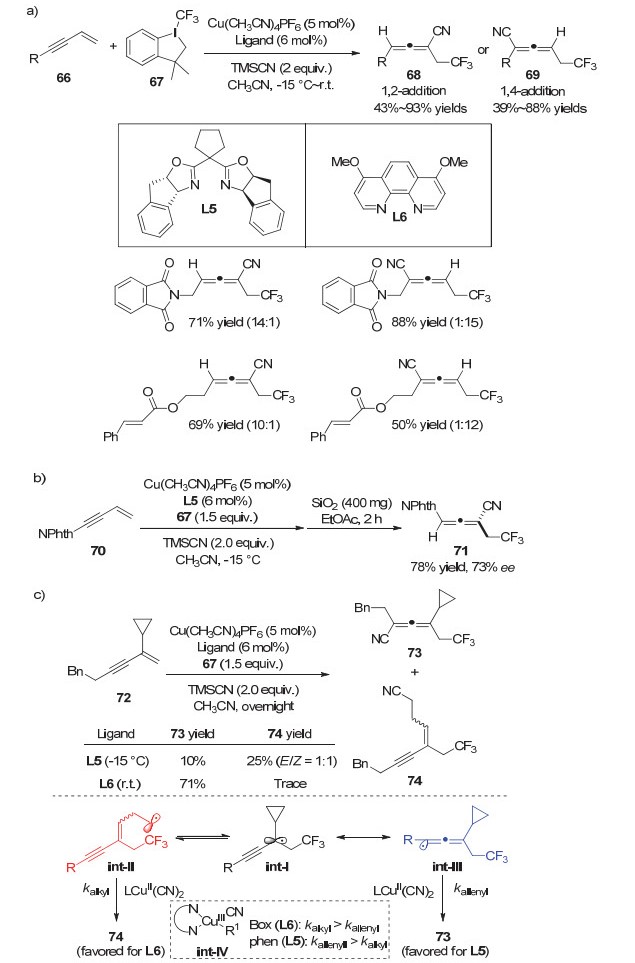
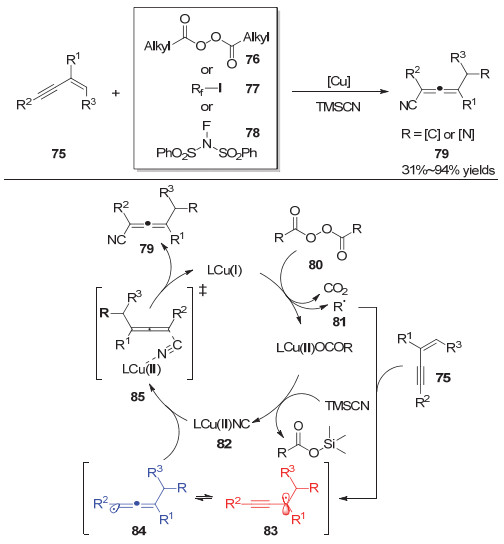
Lu, F.-D.; Liu, D.; Zhu, L.; Lu, L.-Q.; Yang, Q.; Zhou, Q.-Q.; Wei, Y.; Lan, Y.; Xiao, W.-J. J. Am. Chem. Soc. 2019, 141, 6167.
doi: 10.1021/jacs.9b02338
Cheng, J.-K.; Loh, T.-P. J. Am. Chem. Soc. 2015, 137, 42.
doi: 10.1021/ja510635k
Andia, A. A.; Miner, M. R.; Woerpel, K. A. Org. Lett. 2015, 17, 2704.
doi: 10.1021/acs.orglett.5b01120
Miner, M. R.; Woerpel, K. A. Eur. J. Org. Chem. 2016, 1860.
Cheng, J.-K.; Shen, L.; Wu, L.-H.; Hu, X.-H.; Loh, T.-P. Chem. Commun. 2017, 53, 12830.
doi: 10.1039/C7CC08074C
(a) Wartenberg, F.-H.; Junga, H.; Blechert, S. Tetrahedron Lett. 1993, 34, 5251. (b) Alameda-Angulo, C.; Quiclet-Sire, B.; Zard, S. Z. Tetrahedron Lett. 2006, 47, 913.
Soler-Yanes, R.; Arribas-Álvarez, I.; Guisán-Ceinos, M.; Buñuel, E.; Cárdenas, D. J. Chem. Eur. J. 2017, 23, 1584.
doi: 10.1002/chem.201603758
Wang, F.; Wang, D.-H.; Zhou, Y.; Liang, L.; Lu, R.-H.; Chen, P.-H.; Lin, Z.-Y.; Liu, G.-S. Angew. Chem., Int. Ed. 2018, 57, 7140.
doi: 10.1002/anie.201803668
Zhu, X.; Deng, W.; Chiou, M.-F.; Ye, C.; Jian, W.; Zeng, Y.; Jiao, Y.; Ge, L.; Li, Y.; Zhang, X.; Bao, H. J. Am. Chem. Soc. 2019, 141, 548.
doi: 10.1021/jacs.8b11499
Ye, C.-Q.; Li, Y.-J.; Zhu, X.-T.; Hu, S.-M.; Yuan, D.-Q.; Bao, H.-L. Chem. Sci. 2019, 10, 3632.
doi: 10.1039/C8SC05689G
Zhang, K.-F.; Bian, K.-J.; Li, C.; Sheng, J.; Li, Y.; Wang, X.-S. Angew. Chem. Int. Ed. 2019, 58, 5069.
doi: 10.1002/anie.201813184
Ye, C.-Q.; Qian, B.; Li, Y.-J.; Su, M.; Li, D.-L.; Bao, H.-L. Org. Lett. 2018, 20, 3202.
doi: 10.1021/acs.orglett.8b01043
Kang, Y.-W.; Choi, Y.-J.; Jang, H.-Y. Org. Lett. 2014, 16, 4842.
doi: 10.1021/ol502341f
Horn, E. J.; Rosen, B. R.; Chen, Y.; Tang, J.; Chen, K.; Eastgate, M. D.; Baran, P. S. Nature 2016, 533, 77.
doi: 10.1038/nature17431
Geyang Song , Dong Xue , Gang Li . Recent Advances in Transition Metal-Catalyzed Synthesis of Anilines from Aryl Halides. University Chemistry, 2024, 39(2): 321-329. doi: 10.3866/PKU.DXHX202308030
Yan Li , Xinze Wang , Xue Yao , Shouyun Yu . 基于激发态手性铜催化的烯烃E→Z异构的动力学拆分——推荐一个本科生综合化学实验. University Chemistry, 2024, 39(5): 1-10. doi: 10.3866/PKU.DXHX202309053
Yanhui Guo , Li Wei , Zhonglin Wen , Chaorong Qi , Huanfeng Jiang . Recent Progress on Conversion of Carbon Dioxide into Carbamates. Acta Physico-Chimica Sinica, 2024, 40(4): 2307004-0. doi: 10.3866/PKU.WHXB202307004
Yajun Hou , Jinxin Liu , Tao Chen , Yi Zhang , Lei Zhou . Sonogashira coupling reaction in ionic liquids: a detailed exploration of experiment 4.4D in the “101 Plan” synthetic chemistry curriculum. University Chemistry, 2026, 41(6): 136-144. doi: 10.12461/PKU.DXHX202510101
Zhengyu Zhou , Huiqin Yao , Youlin Wu , Teng Li , Noritatsu Tsubaki , Zhiliang Jin . Synergistic Effect of Cu-Graphdiyne/Transition Bimetallic Tungstate Formed S-Scheme Heterojunction for Enhanced Photocatalytic Hydrogen Evolution. Acta Physico-Chimica Sinica, 2024, 40(10): 2312010-0. doi: 10.3866/PKU.WHXB202312010
Jie ZHAO , Sen LIU , Qikang YIN , Xiaoqing LU , Zhaojie WANG . Theoretical calculation of selective adsorption and separation of CO2 by alkali metal modified naphthalene/naphthalenediyne. Chinese Journal of Inorganic Chemistry, 2024, 40(3): 515-522. doi: 10.11862/CJIC.20230385
Xuqiang Hao , Yuanjin He , Xue Wang , Yuqiang Hao , Zhiliang Jin . Co掺杂诱导S型CoCdS/石墨炔异质结不对称电荷分布及其宽光谱光催化析氢. Acta Physico-Chimica Sinica, 2026, 42(11): 100376-. doi: 10.1016/j.actphy.2026.100376
Yujie WANG , Laobang WANG , Zheng ZHANG , Qi LIU , Jianping LANG . Construction of W/Cu/S cluster-based supramolecular compounds via alkynyl/sulfur cycloaddition and their third-order nonlinear optical properties. Chinese Journal of Inorganic Chemistry, 2025, 41(10): 2069-2077. doi: 10.11862/CJIC.20250129
Dongheng WANG , Si LI , Shuangquan ZANG . Construction of chiral alkynyl silver chains and modulation of chiral optical properties. Chinese Journal of Inorganic Chemistry, 2025, 41(1): 131-140. doi: 10.11862/CJIC.20240379
Tongyan Yu , Pan Xu . Visible-Light Photocatalyzed Radical Rearrangement Reaction. University Chemistry, 2025, 40(7): 169-176. doi: 10.12461/PKU.DXHX202409070
Baitong Wei , Jinxin Guo , Xigong Liu , Rongxiu Zhu , Lei Liu . Theoretical Study on the Structure, Stability of Hydrocarbon Free Radicals and Selectivity of Alkane Chlorination Reaction. University Chemistry, 2025, 40(3): 402-407. doi: 10.12461/PKU.DXHX202406003
Danqing Wu , Jiajun Liu , Tianyu Li , Dazhen Xu , Zhiwei Miao . Research Progress on the Simultaneous Construction of C—O and C—X Bonds via 1,2-Difunctionalization of Olefins through Radical Pathways. University Chemistry, 2024, 39(11): 146-157. doi: 10.12461/PKU.DXHX202403087
.
CCS Chemistry | 超分子活化底物为自由基促进高效选择性光催化氧化
. CCS Chemistry, 2025, 7(10.31635/ccschem.025.202405229): -.Yinjie Xu , Suiqin Li , Lihao Liu , Jiahui He , Kai Li , Mengxin Wang , Shuying Zhao , Chun Li , Zhengbin Zhang , Xing Zhong , Jianguo Wang . Enhanced Electrocatalytic Oxidation of Sterols using the Synergistic Effect of NiFe-MOF and Aminoxyl Radicals. Acta Physico-Chimica Sinica, 2024, 40(3): 2305012-0. doi: 10.3866/PKU.WHXB202305012
Ju Wang , Jie Xu , Shuangshuang Li , Chunhua Du , Xianli Wu , Lihua Lu , Xinxin Zhang . Rational design and synthesis of deep eutectic solvent-derived carbon-supported transition metal electrocatalysts for nitrate reduction to ammonia. University Chemistry, 2026, 41(7): 309-318. doi: 10.12461/PKU.DXHX202505099
Dan Liu . 可见光-有机小分子协同催化的不对称自由基反应研究进展. University Chemistry, 2025, 40(6): 118-128. doi: 10.12461/PKU.DXHX202408101
Wenliang Wang , Weina Wang , Tian Sheng , Nan Wei , Sufan Wang , Tao Zhou . 过渡金属/氧化物催化CO2加H2还原生成甲醇的甲酸盐与甲酰基路径的前线轨道对称性分析. University Chemistry, 2026, 41(9): 405-411. doi: 10.12461/PKU.DXHX202508059
Lei Shi . Nucleophilicity and Electrophilicity of Radicals. University Chemistry, 2024, 39(11): 131-135. doi: 10.3866/PKU.DXHX202402018
Min LIU , Huapeng RUAN , Zhongtao FENG , Xue DONG , Haiyan CUI , Xinping WANG . Neutral boron-containing radical dimers. Chinese Journal of Inorganic Chemistry, 2025, 41(1): 123-130. doi: 10.11862/CJIC.20240362
Huilin ZHENG , Tao WANG , Ruilin GAO , Mengke ZHOU , Xinyue LI , Hui WANG , Xiaoxia GU . Antitumor and antibacterial activities of transition metal complexes incorporating pyridyl salicylaldehyde Schiff base. Chinese Journal of Inorganic Chemistry, 2026, 42(5): 897-905. doi: 10.11862/CJIC.20250358
 DownLoad: