Login In
Preparation and Chromatographic Evaluation of a L-Isoleucine-Bonded Chromatographic Stationary Phase
- Corresponding author: CHENG Xiaodong, shapaozi1995@163.com
Figures(6)
Citation:
CHENG Xiaodong, ZHANG Zheng. Preparation and Chromatographic Evaluation of a L-Isoleucine-Bonded Chromatographic Stationary Phase[J]. Chinese Journal of Applied Chemistry,
;2019, 36(6): 726-732.
doi:
10.11944/j.issn.1000-0518.2019.06.180356

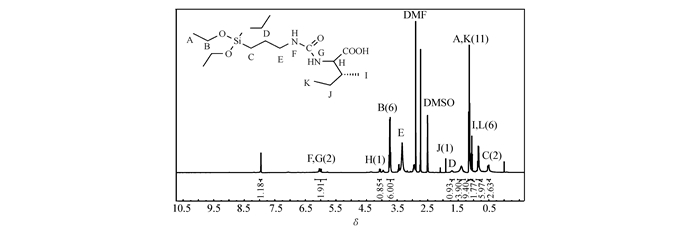
Figures(6)


DONG Xuefang, CAI Xiaoming, SHEN Aijin. Development and Application of Separation Materials for Mixed-Mode Chromatography[J]. Chinese J Chromatogr, 2013,31(4):297-302.
PU Jianghua, ZHAO Xia, HAN Wenwei. Application of Hydrophilic Interaction Chromatography in Analysis of Carbohydrates[J]. J Instrum Anal, 2017,36(1):145-150.
Alpert A J. Hydrophilic-Interaction Chromatography for the Separation of Peptides, Nucleic Acids and Other Polar Compounds[J]. J Chromatogr, 1990,499(2):177-196.
Regnier F E, Noel R. Glycerolpropylsilane Bonded Phases in the Steric Exclusion Chromatography of Biological Macromolecules[J]. J Chromatogr Sci, 1976,14(7):316-320. doi: 10.1093/chromsci/14.7.316
Wu J, Bicker W, Lindner W. Separation Properties of Novel and Commercial Polar Stationary Phases in Hydrophilic Interaction and Reversed-Phase Liquid Chromatography Mode[J]. J Sep Sci, 2008,31(9):1492-1503. doi: 10.1002/(ISSN)1615-9314
Risley D S, Strege M A. Chiral Separations of Polar Compounds by Hydrophilic Interaction Chromatography with Evaporative Light Scattering Detection[J]. Anal Chem, 2000,72(8):1736-1739. doi: 10.1021/ac9911490
Nguyen H P, Schug K A. The Advantages of ESI-MS Detection in Conjunction with HILIC Mode Separations:Fundamentals and Applications[J]. J Sep Sci, 2008,31(9):1465-1480. doi: 10.1002/(ISSN)1615-9314
JIN Gaowa, DING Junjie, CHEN Xue. Separation of Glucoside Compounds by Reversed-Phase and Hydrophilic Interaction Liquid Chromatography[J]. J Instrum Anal, 2014,33(2):133-137. doi: 10.3969/j.issn.1004-4957.2014.02.003
Qiu H, Loukotkov L, Sun P. Cyclofructan 6 Based Stationary Phases for Hydrophilic Interaction Liquid Chromatography[J]. J Chromatogr A, 2011,1218(2):270-279. doi: 10.1016/j.chroma.2010.11.027
Guo Y, Gaiki S. Retention Behavior of Small Polar Compounds on Polar Stationary Phases in Hydrophilic Interaction Chromatography[J]. J Chromatogr A, 2005,1074(1/2):71-80.
Greco G, Letzel T. Main Interactions and Influences of the Chromatographic Parameters in HILIC Separations[J]. J Sep Sci, 2013,51(7):684-693.
SHEN Aijin, GUO Zhimou, LIANG Xinmiao. Development and Application of Hydrophilic Interaction Liquid Chromatographic Stationary Phases[J]. Prog Chem, 2014,26(1):10-18.
Buszewski B, Noga S. Hydrophilic Interaction Liquid Chromatography(HILIC)—A Powerful Separation Technique[J]. Anal Bioanal Chem, 2012,402(1):231-247. doi: 10.1007/s00216-011-5308-5
Jandera P. Stationary and Mobile Phases in Hydrophilic Interaction Chromatography:A Review[J]. Anal Chim Acta, 2011,692(1/2):1-25.
García-Gómez D, Rodríguez-Gonzalo E, Carabias-Martínez R. Stationary Phases for Separation of Nucleosides and Nucleotides by Hydrophilic Interaction Liquid Chromatography[J]. Trend Anal Chem, 2013,47:111-128. doi: 10.1016/j.trac.2013.02.011
CHENG Xiaodong, FENG Yuqi. Preparation and Evaluation of N-Acryloyltris(hydroxymethyl) aminomethane-bonded Chromatographic Stationary Phase[J]. Chinese J Chromatogr, 2015,33(9):917-921.
GUO Zhimou, ZHANG Xiuli, XU Qing. Stationary Phases for Hydrophilic Interaction Liquid Chromatography and Their Applications in Separation of Traditional Chinese Medicines[J]. Chinese J Chromatogr, 2009,27(5):675-681. doi: 10.3321/j.issn:1000-8713.2009.05.020
Olsen B A. Hydrophilic Interaction Chromatography Using Amino and Silica Columns for the Determination of Polar Pharmaceuticals and Impurities[J]. J Chromatogr A, 2001,913(1/2):113-122.
HAN Xiaoqian, LIN Yunyun, LI Zhen. Preparation and Application of Novel Bonded L-Valine and L-Alanine Derived Chiral Stationary Phases[J]. Chinese J Appl Chem, 2018,35(1):68-74.
Hayriye A, Çelik K S, Altındaǧ R. Synthesis, Characterization, and Application of a Novel Multifunctional Stationary Phase for Hydrophilic Interaction/Reversed Phase Mixed-Mode Chromatography[J]. Talanta, 2017,174(1):703-714.
Hemstrom P, Irgum K. Hydrophilic Interaction Chromatography[J]. J Sep Sci, 2006,29(12):1784-1821. doi: 10.1002/(ISSN)1615-9314
Qiuting Zhang , Fan Wu , Jin Liu , Zian Lin . Chromatographic Stationary Phase and Chiral Separation Using Frame Materials. University Chemistry, 2025, 40(4): 291-298. doi: 10.12461/PKU.DXHX202405174
Fan Wu , Wenchang Tian , Jin Liu , Qiuting Zhang , YanHui Zhong , Zian Lin . Core-Shell Structured Covalent Organic Framework-Coated Silica Microspheres as Mixed-Mode Stationary Phase for High Performance Liquid Chromatography. University Chemistry, 2024, 39(11): 319-326. doi: 10.12461/PKU.DXHX202403031
Siming Bian , Sijie Luo , Junjie Ou . Application of van Deemter Equation in Instrumental Analysis Teaching: A New Type of Core-Shell Stationary Phase. University Chemistry, 2025, 40(3): 381-386. doi: 10.12461/PKU.DXHX202406087
Weina Wang , Lixia Feng , Fengyi Liu , Wenliang Wang . Computational Chemistry Experiments in Facilitating the Study of Organic Reaction Mechanism: A Case Study of Electrophilic Addition of HCl to Asymmetric Alkenes. University Chemistry, 2025, 40(3): 206-214. doi: 10.12461/PKU.DXHX202407022
Xudong Liu , Huili Fan , Junping Xiao , Min Yang , Yan Li . Teaching Approaches to the AE + AN Mechanism of Electrophilic Addition Reactions between Olefins and Inorganic Acids in Organic Chemistry. University Chemistry, 2025, 40(7): 367-372. doi: 10.12461/PKU.DXHX202409041
Li'na ZHONG , Jingling CHEN , Qinghua ZHAO . Synthesis of multi-responsive carbon quantum dots from green carbon sources for detection of iron ions and L-ascorbic acid. Chinese Journal of Inorganic Chemistry, 2025, 41(4): 709-718. doi: 10.11862/CJIC.20240280
Kexin Yan , Zhaoqi Ye , Lingtao Kong , He Li , Xue Yang , Yahong Zhang , Hongbin Zhang , Yi Tang . Seed-Induced Synthesis of Disc-Cluster Zeolite L Mesocrystals with Ultrashort c-Axis: Morphology Control, Decoupled Mechanism, and Enhanced Adsorption. Acta Physico-Chimica Sinica, 2024, 40(9): 2308019-0. doi: 10.3866/PKU.WHXB202308019
Weilai Yu , Chuanbiao Bie . Unveiling S-Scheme Charge Transfer Mechanism. Acta Physico-Chimica Sinica, 2024, 40(4): 2307022-0. doi: 10.3866/PKU.WHXB202307022
Hongpeng He , Mengmeng Zhang , Mengjiao Hao , Wei Du , Haibing Xia . Synthesis of Different Aspect-Ratios of Fixed Width Gold Nanorods. Acta Physico-Chimica Sinica, 2024, 40(5): 2304043-0. doi: 10.3866/PKU.WHXB202304043
Chi Zhang , Yi Xu , Xiaopeng Guo , Zian Jie , Ling Li . 五彩斑斓的秘密——物质显色机理. University Chemistry, 2025, 40(6): 266-275. doi: 10.12461/PKU.DXHX202407061
Feiyang Liu , Liuhong Song , Miaoyu Fu , Zhi Zheng , Gang Xie , Junlong Zhao . Tryptophan’s Employment Journey. University Chemistry, 2024, 39(9): 16-21. doi: 10.12461/PKU.DXHX202404037
Zihan Cheng , Kai Jiang , Jun Jiang , Henggang Wang , Hengwei Lin . Achieving thermal-stimulus-responsive dynamic afterglow from carbon dots by singlet-triplet energy gap engineering through covalent fixation. Acta Physico-Chimica Sinica, 2026, 42(2): 100169-0. doi: 10.1016/j.actphy.2025.100169
Xiaosong PU , Hangkai WU , Taohong LI , Huijuan LI , Shouqing LIU , Yuanbo HUANG , Xuemei LI . Adsorption performance and removal mechanism of Cd(Ⅱ) in water by magnesium modified carbon foam. Chinese Journal of Inorganic Chemistry, 2024, 40(8): 1537-1548. doi: 10.11862/CJIC.20240030
Heng Zhang . Determination of All Rate Constants in the Enzyme Catalyzed Reactions Based on Michaelis-Menten Mechanism. University Chemistry, 2024, 39(4): 395-400. doi: 10.3866/PKU.DXHX202310047
Jiajie Li , Xiaocong Ma , Jufang Zheng , Qiang Wan , Xiaoshun Zhou , Yahao Wang . Recent Advances in In-Situ Raman Spectroscopy for Investigating Electrocatalytic Organic Reaction Mechanisms. University Chemistry, 2025, 40(4): 261-276. doi: 10.12461/PKU.DXHX202406117
Rohit Kumar , Anita Sudhaik , Aftab Asalam Pawaz Khan , Van Huy Neguyen , Archana Singh , Pardeep Singh , Sourbh Thakur , Pankaj Raizada . Designing tandem S-scheme photo-catalytic systems: Mechanistic insights, characterization techniques, and applications. Acta Physico-Chimica Sinica, 2025, 41(11): 100150-0. doi: 10.1016/j.actphy.2025.100150
Wei HE , Jing XI , Tianpei HE , Na CHEN , Quan YUAN . Application of solar-driven inorganic semiconductor-microbe hybrids in carbon dioxide fixation and biomanufacturing. Chinese Journal of Inorganic Chemistry, 2025, 41(1): 35-44. doi: 10.11862/CJIC.20240364
Changsheng An , Tao Liu . Decoding SEI chemistry at the lithium-metal potential. Acta Physico-Chimica Sinica, 2025, 41(9): 100101-0. doi: 10.1016/j.actphy.2025.100101
Yuejiao An , Wenxuan Liu , Yanfeng Zhang , Jianjun Zhang , Zhansheng Lu . Revealing Photoinduced Charge Transfer Mechanism of SnO2/BiOBr S-Scheme Heterostructure for CO2 Photoreduction. Acta Physico-Chimica Sinica, 2024, 40(12): 2407021-0. doi: 10.3866/PKU.WHXB202407021
Mian Wei , Chang Cheng , Bowen He , Bei Cheng , Kezhen Qi , Chuanbiao Bie . Inorganic-organic CdS/YBTPy S-scheme photocatalyst for efficient hydrogen production and its mechanism. Acta Physico-Chimica Sinica, 2025, 41(12): 100158-0. doi: 10.1016/j.actphy.2025.100158
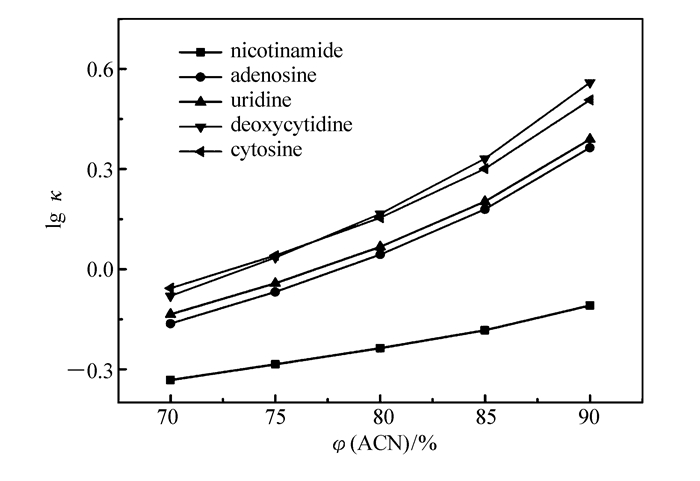
Mobile phase:consisting of ACN and H2O with corresponding volume fractions containing ammonium acetate with a constant concentration of 50 mmol/L(pH=6.5)
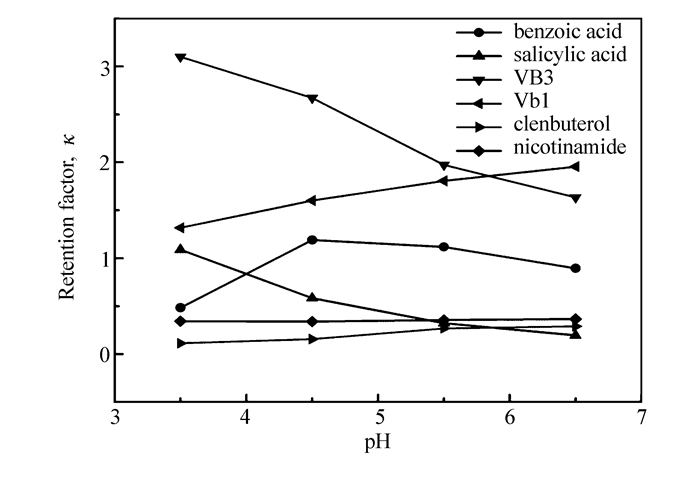
Mobile phase:ACN/ammonium acetate, pH=6.5, 80/20(volume ratio)
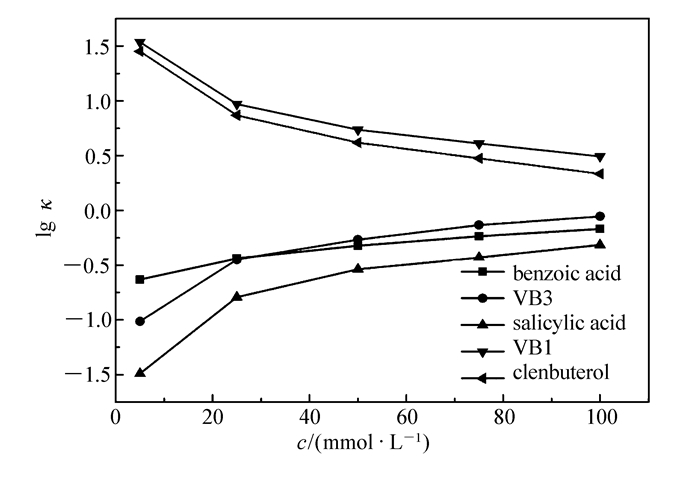
Mobile phase:ACN/100 mmol/L ammonium acetate, 80/20(volume ratio)
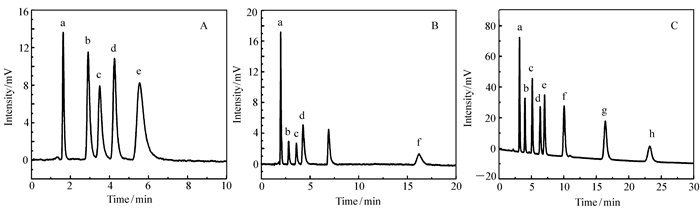
A.Mobile phase:ACN/50 mmol/L ammonium acetate, pH=4.0, 70/30(volume ratio); Solutes:a.theophylline; b. berberine; c.jateorhizine; d. procaine; e. clenbuterol. B.Mobile phase:ACN/50 mmol/L ammonium acetate, pH=6.5, 80/20(volume ratio); Elutes:a. nicotinamide; b.VB3; c.VB2; d.VB6; e.VB1; f VB12. C.Mobile phase:ACN/50 mmol/L ammonium acetate, pH=6.5, 85/15(volume ratio); Elutes:a.2′-deoxyadenosine; b.adenosine; d.2′-deoxycytidine; d.uridine; e.cytidine; f.2′-deoxyguanosine; g.guanosine; h.inosine
 DownLoad: