Login In
Preparation of New Photoluminescent Carbon Dots and Its Application in Hg2+ Detection
- Corresponding author: HUANG Xiaomei, dxw8066031@163.com
Figures(5)
Citation:
HUANG Xiaomei, DENG Xiang. Preparation of New Photoluminescent Carbon Dots and Its Application in Hg2+ Detection[J]. Chinese Journal of Applied Chemistry,
;2019, 36(5): 603-610.
doi:
10.11944/j.issn.1000-0518.2019.05.180259


Figures(5)


Cui L, Wu J, Ju H. Nitrogen-Doped Porous Carbon Derived from Metal-Organic Gel for Electrochemical Analysis of Heavy-Metal Ion[J]. ACS Appl Mater Interfaces, 2014,6(18):16210-16216. doi: 10.1021/am504367t
Tan J Z, Nursam N M, Xia F. High-Performance Coral Reef-like Carbon Nitrides:Synthesis and Application in Photocatalysis and Heavy Metal Ion Adsorption[J]. ACS Appl Mater Interfaces, 2017,9(5):4540-4547. doi: 10.1021/acsami.6b11427
Chen L Y, Ou C M, Chen W Y. Synthesis of Photoluminescent Au ND-PNIPAM Hybrid Microgel for the Detection of Hg2+[J]. ACS Appl Mater Interfaces, 2013,5(10):4383-4388. doi: 10.1021/am400628p
Huang P J, Wang F, Liu J. Cleavable Molecular Beacon for Hg2+ Detection Based on Phosphorothioate RNA Modifications[J]. Anal Chem, 2015,87(13):6890-6895. doi: 10.1021/acs.analchem.5b01362
Cui X, Zhu L, Wu J. A Fluorescent Biosensor Based on Carbon Dots-Labeled Oligodeoxyribonucleotide and Graphene Oxide for Mercury(Ⅱ) Detection[J]. Biosens Bioelectron, 2015,63(6):506-512.
Chen L, Lu L, Wang S. Valence States Modulation Strategy for Picomole Level Assay of Hg2+ in Drinking and Environmental Water by Directional Self-assembly of Gold Nanorods[J]. ACS Sens, 2017,2(6):781-788. doi: 10.1021/acssensors.7b00149
Hsu I H, Hsu T C, Sun Y C. Gold-Nanoparticle-Based Graphite Furnace Atomic Absorption Spectrometry Amplification and Magnetic Separation Method for Sensitive Detection of Mercuric Ions[J]. Biosens Bioelectron, 2011,26(11):4605-4609. doi: 10.1016/j.bios.2011.04.048
Da S M, Paim A P, Pimentel M F. Determination of Mercury in Rice by Cold Vapor Atomic Fluorescence Spectrometry After Microwave-Assisted Digestion[J]. Anal Chim Acta, 2010,667(1):43-48.
Khatua S, Schmittel M. A Single Molecular Light-up Sensor for Quantification of Hg2+ and Ag+ in Aqueous Medium:High Selectivity Toward Hg2+ over Ag+ in a Mixture[J]. Org Lett, 2013,15(17):4422-4425. doi: 10.1021/ol401970n
Hussain M M, Rahman M M, Arshad M N. Hg2+ Sensor Development Based on (E)-N'-Nitrobenzylidene-Benzenesulfonohydrazide(NBBSH) Derivatives Fabricated on a Glassy Carbon Electrode with a Nafion Matrix[J]. ACS Omega, 2017,2(2):420-431. doi: 10.1021/acsomega.6b00359
Chen F Y, Jiang S J. Slurry Sampling Flow Injection Chemical Vapor Generation Inductively Coupled Plasma Mass Spectrometry for the Determination of As, Cd, and Hg in Cereals[J]. J Agric Food Chem, 2009,57(15):6564-6569. doi: 10.1021/jf9013857
Zhao T, Goodwin E D, Guo J. An Advanced Architecture for Colloidal PbS Quantum Dot Solar Cells Exploiting a CdSe Quantum Dot Buffer Layer[J]. ACS Nano, 2016,10(10):9267-9273. doi: 10.1021/acsnano.6b03175
Roelofs K E, Herron S M, Bent S F. Increased Quantum Dot Loading by pH Control Reduces Interfacial Recombination in Quantum-Dot-Sensitized Solar Cells[J]. ACS Nano, 2015,9(8):8321-8334. doi: 10.1021/acsnano.5b02853
Agarwalla H, Mahajan P S, Sahu D. A Switch-on NIR Probe for Specific Detection of Hg2+ Ion in Aqueous Medium and in Mitochondria[J]. Inorg Chem, 2016,55(22):12052-12060. doi: 10.1021/acs.inorgchem.6b02233
Zheng M, Li Y, Liu S. One-Pot to Synthesize Multifunctional Carbon Dots for Near Infrared Fluorescence Imaging and Photothermal Cancer Therapy[J]. ACS Appl Mater Interfaces, 2016,8(36):23533-23541. doi: 10.1021/acsami.6b07453
Xu X, Kai Z, Liang Z. Aspirin-Based Carbon Dots, a Good Biocompatibility of Material Applied for Bioimaging and Anti-inflammation[J]. ACS Appl Mater Interfaces, 1944,8(48):32706-32716.
Liu H, Ye T, Mao C. Fluorescent Carbon Nanoparticles Derived from Candle Soot[J]. Angew Chem Int Ed Engl, 2007,46(34):6473-6475. doi: 10.1002/(ISSN)1521-3773
Bourlinos A B, Stassinopoulos A, Anglos D. Photoluminescent Carbogenic Dots[J]. Chem Mater, 2008,20(14):4539-4541. doi: 10.1021/cm800506r
Tian L, Ghosh D, Chen W. Nanosized Carbon Particles from Natural Gas Soot[J]. Chem Mater, 2009,21(13):2803-2809. doi: 10.1021/cm900709w
Ray S C, Saha A, Jana N R. Fluorescent Carbon Nanoparticles:Synthesis, Characterization, and Bioimaging Application[J]. J Phys Chem C, 2009,113(43):18546-18551. doi: 10.1021/jp905912n
Liu H, Ye T, Mao C. Fluorescent Carbon Nanoparticles Derived from Candle Soot[J]. Angew Chem Int Ed Engl, 2007,46(34):6473-6475. doi: 10.1002/(ISSN)1521-3773
Huang H, Lv J J, Zhou D L. One-Pot Green Synthesis of Nitrogen-Doped Carbon Nanoparticles as Fluorescent Probes for Mercury Ions[J]. RSC Adv, 2013,3(44):21691-21696. doi: 10.1039/c3ra43452d
Liu L Q, Li Y F, Zhan L. One-Step Synthesis of Fluorescent Hydroxyls-Coated Carbon Dots with Hydrothermal Reaction and Its Application to Optical Sensing of Metal Ions[J]. Sci China Chem, 2011,54(8):1342-1347. doi: 10.1007/s11426-011-4351-6
Shen J, Zhu Y, Yang X. Graphene Quantum Dots:Emergent Nanolights for Bioimaging, Sensors, Catalysis and Photovoltaic Devices[J]. Chem Commun, 2012,43(29):3686-3699.
Li L, Ji J, Fei R. A Facile Microwave Avenue to Electrochemiluminescent Two-Color Graphene Quantum Dots[J]. Adv Funct Mater, 2012,22(14):2971-2979. doi: 10.1002/adfm.v22.14
Chakraborti H, Sinha S, Ghosh S. Interfacing Water Soluble Nanomaterials with Fluorescence Chemosensing:Graphene Quantum Dot to Detect Hg2+, in 100% Aqueous Solution[J]. Mater Lett, 2013,97(2):78-80.
Qin X, Lu W, Asiri A M. Microwave-assisted Rapid Green Synthesis of Photoluminescent Carbon Nanodots from Flour and Their Applications for Sensitive and Selective Detection of Mercury(Ⅱ) Ions[J]. Sens Actuators B, 2013,184(8):156-162.
Zhang Y L, Wang L, Zhang H C. Graphitic Carbon Quantum Dots as a Fluorescent Sensing Platform for Highly Efficient Detection of Fe3+ Ions[J]. RSC Adv, 2013,3(11):3733-3738. doi: 10.1039/c3ra23410j
Udhayakumari D, Velmathi S. Azo Linked Polycyclic Aromatic Hydrocarbons-Based Dual Chemosensor for Cu2+ and Hg2+ Ions[J]. Ind Eng Chem Res, 2015,54(14):3541-3547. doi: 10.1021/acs.iecr.5b00775
Lin W C, Wu C Y, Liu Z H. A New Selective Colorimetric and Fluorescent Sensor for Hg2+ and Cu2+.Based on a Thiourea Featuring a Pyrene Unit[J]. Talanta, 2010,81(4/5):1209-1215.
Martí nez R, Zapata F, Caballero A. 2-Aza-1, 3-butadiene Derivatives Featuring an Anthracene or Pyrene Unit:Highly Selective Colorimetric and Fluorescent Signaling of Cu2+ Cation[J]. Org Lett, 2006,8(15):3235-3238. doi: 10.1021/ol0610791
Ye H, Ge F, Chen X C. A New Probe for Fluorescent Recognition of Hg2+, in Living Cells and Colorimetric Detection of Cu2+, in Aqueous Solution[J]. Sens Actuators B, 2013,182(3):273-279.
Jun S K, Myung G C, Ki C S. Ratiometric Determination of Hg2+ Ions Based on Simple Molecular Motifs of Pyrene and Dioxaoctanediamide[J]. Org Lett, 2007,9(6):1129-1132.
Liu Y, Ouyang Q, Li H. Turn-On Fluoresence Sensor for Hg2+ in Food Based on FRET Between Aptamers-Functionalized Upconversion Nanoparticles and Gold Nanoparticles[J]. J Agric Food Chem, 2018,66(24):6188-6195. doi: 10.1021/acs.jafc.8b00546
Zhang Y M, Shi B B, Peng Z. A Highly Selective Dual-Channel Hg2+, Chemosensor Based on an Easy to Prepare Double Naphthalene Schiff Base[J]. Sci China Chem, 2013,56(5):612-618. doi: 10.1007/s11426-012-4798-0
Moon S Y, Cha N R, Kim Y H. New Hg2+-Selective Chromo-and Fluoroionophore Based upon 8-Hydroxyquinoline[J]. J Org Chem, 2004,69(1):181-183.
Dai B N, Cao Q Y, Wang L. A New Naphthalene-Containing Triazolophane for Fluorescence Sensing of Mercury(Ⅱ) Ion[J]. Inorg Chim Acta, 2014,423:163-167. doi: 10.1016/j.ica.2014.08.015
Xiaoyong ZHAI , Yao KOU , Pingru SU , Yu TANG . Lanthanide metal-organic framework with msw topology: Synthesis and the application in 2, 4, 6-trinitrophenol detection. Chinese Journal of Inorganic Chemistry, 2025, 41(10): 2087-2094. doi: 10.11862/CJIC.20250182
Yingpeng ZHANG , Xingxing LI , Yunshang YANG , Zhidong TENG . A pyrazole-based turn-off fluorescent probe for visual detection of hydrazine. Chinese Journal of Inorganic Chemistry, 2025, 41(7): 1301-1308. doi: 10.11862/CJIC.20250064
Siyi ZHONG , Xiaowen LIN , Jiaxin LIU , Ruyi WANG , Tao LIANG , Zhengfeng DENG , Ao ZHONG , Cuiping HAN . Targeting imaging and detection of ovarian cancer cells based on fluorescent magnetic carbon dots. Chinese Journal of Inorganic Chemistry, 2024, 40(8): 1483-1490. doi: 10.11862/CJIC.20240093
Lin LI , Le CHEN , Lingjie HOU , Jiaqi JING , Jiayu DING , Tao ZHOU , Ruiping ZHANG . Smartphone-assisted fluorescent silver nanoclusters as ratiometric sensor for visual colorimetric detection of sulfide. Chinese Journal of Inorganic Chemistry, 2025, 41(11): 2261-2271. doi: 10.11862/CJIC.20250130
Lulu DONG , Jie LIU , Hua YANG , Yupei FU , Hongli LIU , Xiaoli CHEN , Huali CUI , Lin LIU , Jijiang WANG . Synthesis, crystal structure, and fluorescence properties of Cd-based complex with pcu topology. Chinese Journal of Inorganic Chemistry, 2025, 41(4): 809-820. doi: 10.11862/CJIC.20240171
Jianjun Liu , Xue Yang , Chi Zhang , Xueyu Zhao , Zhiwei Zhang , Yongmei Chen , Qinghong Xu , Shao Jin . Preparation and Fluorescence Characterization of CdTe Semiconductor Quantum Dots. University Chemistry, 2024, 39(7): 307-315. doi: 10.3866/PKU.DXHX202311031
Li'na ZHONG , Jingling CHEN , Qinghua ZHAO . Synthesis of multi-responsive carbon quantum dots from green carbon sources for detection of iron ions and L-ascorbic acid. Chinese Journal of Inorganic Chemistry, 2025, 41(4): 709-718. doi: 10.11862/CJIC.20240280
Peiran ZHAO , Yuqian LIU , Cheng HE , Chunying DUAN . A functionalized Eu3+ metal-organic framework for selective fluorescent detection of pyrene. Chinese Journal of Inorganic Chemistry, 2024, 40(4): 713-724. doi: 10.11862/CJIC.20230355
Qianli Ma , Tianbing Song , Tianle He , Xirong Zhang , Huanming Xiong . Sulfur-doped carbon dots: a novel bifunctional electrolyte additive for high-performance aqueous zinc-ion batteries. Acta Physico-Chimica Sinica, 2025, 41(9): 100106-0. doi: 10.1016/j.actphy.2025.100106
Yanxi LIU , Mengjia XU , Haonan CHEN , Quan LIU , Yuming ZHANG . A fluorescent-colorimetric probe for peroxynitrite-anion-imaging in living cells. Chinese Journal of Inorganic Chemistry, 2025, 41(6): 1112-1122. doi: 10.11862/CJIC.20240423
Benhua Wang , Chaoyi Yao , Yiming Li , Qing Liu , Minhuan Lan , Guipeng Yu , Yiming Luo , Xiangzhi Song . 一种基于香豆素氟离子荧光探针的合成、表征及性能测试——“科研反哺教学”在有机化学综合实验教学中的探索与实践. University Chemistry, 2025, 40(6): 201-209. doi: 10.12461/PKU.DXHX202408070
Yan ZHAO , Xiaokang JIANG , Zhonghui LI , Jiaxu WANG , Hengwei ZHOU , Hai GUO . Preparation and fluorescence properties of Eu3+-doped CaLaGaO4 red-emitting phosphors. Chinese Journal of Inorganic Chemistry, 2024, 40(10): 1861-1868. doi: 10.11862/CJIC.20240242
Xinyu Liu , Weiran Hu , Zhengkai Li , Wei Ji , Xiao Ni . Algin Lab: Surging Luminescent Sea. University Chemistry, 2024, 39(5): 396-404. doi: 10.3866/PKU.DXHX202312021
Wenli FENG , Lu ZHAO , Yunfeng BAI , Feng FENG . Research progress on ultralong room temperature phosphorescent carbon dots. Chinese Journal of Inorganic Chemistry, 2025, 41(5): 833-846. doi: 10.11862/CJIC.20240308
Chun-Lin Sun , Yaole Jiang , Yu Chen , Rongjing Guo , Yongwen Shen , Xinping Hui , Baoxin Zhang , Xiaobo Pan . Construction, Performance Testing, and Practical Applications of a Home-Made Open Fluorescence Spectrometer. University Chemistry, 2024, 39(5): 287-295. doi: 10.3866/PKU.DXHX202311096
Zishuo Yi , Peng Liu , Yan Xu . Fluorescent “Chameleon”: A Popular Science Experiment Based on Dynamic Luminescence. University Chemistry, 2024, 39(9): 304-310. doi: 10.12461/PKU.DXHX202311079
Zhongxin YU , Wei SONG , Yang LIU , Yuxue DING , Fanhao MENG , Shuju WANG , Lixin YOU . Fluorescence sensing on chlortetracycline of a Zn-coordination polymer based on mixed ligands. Chinese Journal of Inorganic Chemistry, 2024, 40(12): 2415-2421. doi: 10.11862/CJIC.20240304
Zijuan LI , Xuan LÜ , Jiaojiao CHEN , Haiyang ZHAO , Shuo SUN , Zhiwu ZHANG , Jianlong ZHANG , Yanling MA , Jie LI , Zixian FENG , Jiahui LIU . Synthesis of visual fluorescence emission CdSe nanocrystals based on ligand regulation. Chinese Journal of Inorganic Chemistry, 2025, 41(2): 308-320. doi: 10.11862/CJIC.20240138
Yuting DU , Jing YUAN , Peiyao DENG . Synthesis and application of a fluorescent probe for the detection of reduced glutathione. Chinese Journal of Inorganic Chemistry, 2025, 41(7): 1331-1337. doi: 10.11862/CJIC.20240461
Kuaibing Wang , Feifei Mao , Weihua Zhang , Bo Lv . Design and Practice of a Comprehensive Teaching Experiment for Preparing Biomass Carbon Dots from Rice Husk. University Chemistry, 2025, 40(5): 342-350. doi: 10.12461/PKU.DXHX202407042
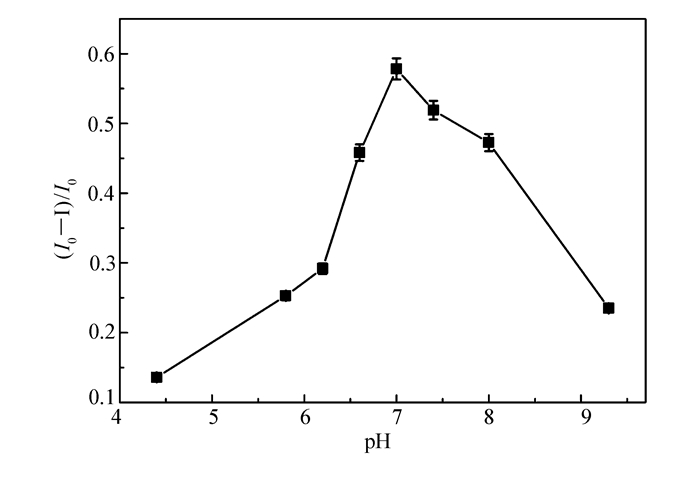
pH:4.4, 5.8, 6.2, 6.6, 7.0, 7.4, 8.0, 9.3; ρ(C-dots)=25.0 mg/L, c(Hg2+)=40 μmol/L; λex=285 nm
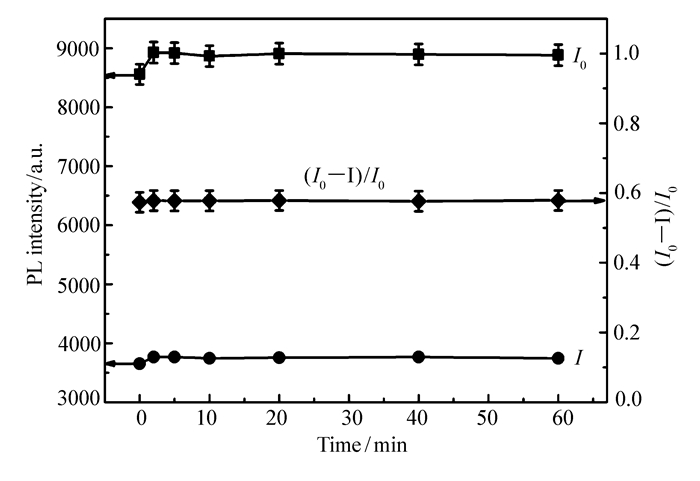
Time/min:0, 2, 5, 10, 20, 40, 60; ρ(C-dots)=25.0 mg/L; c(Hg2+)=40 μmol/L; λex=285 nm
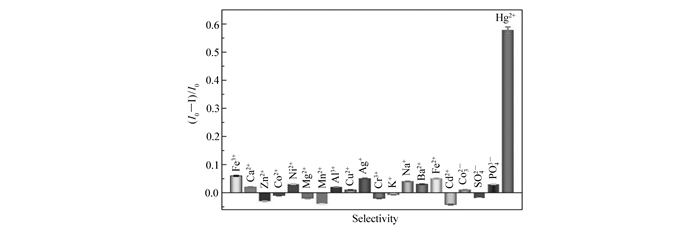
ρ(C-dots)=25.0 mg/L, c(sample)=40 μmol/L; λex=285 nm
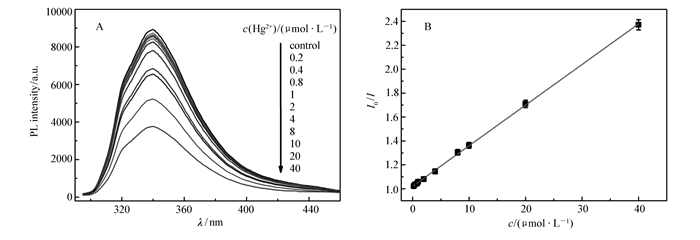
c(Hg2+)/(μmol·L-1):0, 0.2, 0.4, 0.8, 1, 2, 4, 8, 10, 20, 40; ρ(C-dots)=25.0 mg/L; λex=285 nm
 DownLoad: