Login In
Structure and catalytic performance of [Pd(1, 5-cyclooctadiene)X2] (X=Cl, Br) modulated by organophosphine ligands
- Corresponding author: Qaiowen CHANG, changqiaowen@126.com Juan YU, yujuan@ipm.com.cn
Figures(9)
Citation:
Xuhu GUO, Chuntao ZHANG, Jinshu LI, Yuanyuan TAN, Qaiowen CHANG, Juan YU. Structure and catalytic performance of [Pd(1, 5-cyclooctadiene)X2] (X=Cl, Br) modulated by organophosphine ligands[J]. Chinese Journal of Inorganic Chemistry,
;2026, 42(6): 1247-1260.
doi:
10.11862/CJIC.20250299

Figures(9)


ZHANG L X, ZHOU F B, CHENG G Y, YANG X, XIAO D D, JIANG D H, CHENG H C, YUAN B X, SHI J C. Synthesis and characterization of terphenyl phosphine ligands and their palladium catalyst precursors[J]. Organometallics, 2025, 44(15): 1653-1659
doi: 10.1021/acs.organomet.5c00129
WANG Z, ZHANG Z G, LU X Y. Effect of halide ligands on the reactivity of carbon-palladium bonds: Implications for designing catalytic reactions[J]. Organometallics, 2000, 19(5): 775-780
doi: 10.1021/om990670h
XIE H J, FAN T, LEI Q F, FANG W J. New progress in theoretical studies on palladium-catalyzed C—C bond-forming reaction mechanisms[J]. Sci. China Chem., 2016, 59(11): 1432-1447
doi: 10.1007/s11426-016-0018-2
ZHAN B B, JIN L, SHI B F. Palladium-catalyzed enantioselective C—H functionalization via C—H palladation[J]. Trends Chem., 2022, 4(3): 220-235
doi: 10.1016/j.trechm.2021.12.005
RAGO A J, DONG G. Synthesis of indoles, indolines, and carbazoles via palladium-catalyzed C—H activation[J]. Green Synth. Catal., 2021, 2(2): 216-227
TRZECIAK A M, WOJTKÓW W, ZIÓŁKOWSKI J J. Catalytic activity of palladium complexes, PdCl2(COD) and PdCl2(P(OPh)3)2, in methoxy-carbonylation of iodobenzene[J]. Inorg. Chem. Commun., 2003, 6(7): 823-826
doi: 10.1016/S1387-7003(03)00105-9
MOHANTY S, PUNJI B, BALAKRISHNA M S. Synthesis and reaction kinetics of Pd(1, 5-cyclooctadiene)Cl2 with N, N′-methylene-bis (2-aminopyridyl): An efficient catalyst for Suzuki-cross-coupling reactions[J]. Polyhedron, 2006, 25(3): 815-820
doi: 10.1016/j.poly.2005.08.013
FU G C. The development of versatile methods for palladium-catalyzed coupling reactions of aryl electrophiles through the use of P(t-Bu)3 and PCy3 as ligands[J]. Accounts Chem. Res., 2008, 41(11): 1555-1564
doi: 10.1021/ar800148f
FLECKENSTEIN C A, PLENIO H. Sterically demanding trialkylphosphines for palladium-catalyzed cross coupling reactions-alternatives to P(t-Bu)3[J]. Chem. Soc. Rev., 2010, 39(2): 694-711
doi: 10.1039/B903646F
WANG J R, XU B, WANG Y B, XIA G Z, ZHANG Z M, ZHANG J L. Pd-catalyzed enantioselective three-component carboamination of 1, 3-cyclohexadiene[J]. J. Am. Chem. Soc., 2024, 146(31): 21231-21238
doi: 10.1021/jacs.4c07382
SEECHURN C C C J, SPERGER T, SCRASE T G, SCHOENEBECK F, COLACOT T J. Understanding the unusual reduction mechanism of Pd(Ⅱ) to Pd(Ⅰ): Uncovering hidden species and implications in catalytic cross-coupling reactions[J]. J. Am. Chem. Soc., 2017, 139(14): 5194-5200
doi: 10.1021/jacs.7b01110
HUPPERICH D, PONCE-DE-LEÓN J, FUNES-ARDOIZ I, SPERGER T, SCHOENEBECKET F. Sterically induced acceleration of aryl halide activation by Pd(0): A radical alternative to 2-electron oxidative addition[J]. J. Am. Chem. Soc., 2025, 147(23): 19941-19948
doi: 10.1021/jacs.5c04407
SOLIN N, SZABÓ K J. Mechanism of the η3-η1-η3 isomerization in allylpalladium complexes: Solvent coordination, ligand, and substituent effects[J]. Organometallics, 2001, 20(25): 5464-5471
doi: 10.1021/om010793d
DEANGELIS A J, GILDNER P G, CHOW R, COLACOT T J. Generating active "L-Pd (0)" via neutral or cationic π-allylpalladium complexes featuring biaryl/bipyrazolylphosphines: Synthetic, mechanistic, and structure-activity studies in challenging cross-coupling reactions[J]. J. Org. Chem., 2015, 80(13): 6794-6813.
doi: 10.1021/acs.joc.5b01005
Shaughnessy K H. Development of palladium precatalysts that efficiently generate LPd(0) active species[J]. Isr. J. Chem., 2020, 60(3/4): 180-194
RETTIG M F, WING R M, WIGER G R. X-ray crystallographic, chemical, and spectroscopic studies of the palladium dichloride complexes of cyclonona-1, 5-diene, cycloocta-1, 5-diene, cycloocta-1, 4-diene, and cyclohepta-1, 4-diene[J]. J. Am. Chem. Soc., 1981, 103(11): 2980-2986
doi: 10.1021/ja00401a012
KLEIN A, DOGAN A, FETH M, BERTAGNOLLI H. Cyclooctadi-enemethylpalladium complexes: Synthesis, structures and reactivity[J]. Inorg. Chim. Acta, 2003, 343: 189-201
doi: 10.1016/S0020-1693(02)01231-8
STOCKLAND JR R A, ANDERSON G K, RATH N P, BRADDOCK W J, ELLEGOOD J C. Synthesis of the complexes [PdClR (cod)](R=benzyl, ethyl; cod=1, 5-cyclooctadiene). β-Elimination from [PdClEt(cod)] to give the η1, η2 and η3 isomers of [Pd2(μ-Cl)2(C8H13)2][J]. Can. J. Chem., 1996, 74(11): 1990-1997
doi: 10.1139/v96-226
POWELL D B, LEEDHAM T J. Infrared and Raman spectra of 1, 5-cyclooctadiene complexes of rhodium, palladium and platinum[J]. Spectroc. Acta Pt. A‒Molec. Biomolec. Spectr., 1972, 28(2): 337-341
KUNKELY H, VOGLER A. Electronic spectrum and photoreactivity of dichloro (1, 5-cyclooctadiene)-palladium(Ⅱ)[J]. J. Organomet. Chem., 1998, 559(1/2): 223-225
NEESE F. Software update: The ORCA program system, version 4.0[J]. Wiley Interdiscip. Rev. ‒Comput. Mol. Sci., 2018, 8(1): e1327
doi: 10.1002/wcms.1327
BECKE A D. Density-functional thermochemistry. Ⅲ. The role of exact exchange[J]. J. Chem. Phys., 1993, 98(7): 5648-5652
doi: 10.1063/1.464913
ARAVENA D, NEESE F, PANTAZIS D A. Improved segmented all-electron relativistically contracted basis sets for the lanthanides[J]. J. Chem. Theory Comput., 2016, 12(3): 1148-1156
doi: 10.1021/acs.jctc.5b01048
ŠTĚPNIČKA P, CÍSAŘOVÁ I. Crystal structure of dibromo (η4-1, 5-cyclooctadiene) palladium(Ⅱ)[J]. Collect. Czech. Chem. Commun., 1996, 61(9): 1335-1341
doi: 10.1135/cccc19961335
MOHANTY S, PUNJI B, BALAKRISHNA M S. Synthesis and reaction kinetics of Pd(1, 5-cyclooctadiene)Cl2 with N, N′-methylene-bis (2-aminopyridyl): An efficient catalyst for Suzuki-cross-coupling reactions[J]. Polyhedron, 2006, 25(3): 815-820
doi: 10.1016/j.poly.2005.08.013
STEPHENSON M D, HARDIE M J. Extended structures of transition metal complexes of 6, 7-dicyanodipyridoquinoxaline: π-Stacking, weak hydrogen bonding, and CN-π interactions[J]. Cryst. Growth Des., 2006, 6(2): 423-432
doi: 10.1021/cg050366t
MAGISTRATO A, PREGOSIN P S, ALBINATI A, ROTHLISBERGER U. The role of π-π stacking interactions in square planar palladium complexes. combined quantum mechanics/molecular mechanics QM/MM studies[J]. Organometallics, 2001, 20(20): 4178-4184
doi: 10.1021/om010485f
DATSENKO V P, NELYUBINA Y V, SMOL′YAKOV A F, LOGINOV D A. Cyclooctadiene iridium complexes [Cp*Ir(COD)X]+ (X=Cl, Br, I): Synthesis and application for oxidative coupling of benzoic acid with alkynes[J]. J. Organomet. Chem., 2018, 874: 7-12
doi: 10.1016/j.jorganchem.2018.08.014
HARTLEY F R. The cis- and trans-effects of ligands[J]. Chem. Soc. Rev., 1973, 2(2): 163-179
doi: 10.1039/cs9730200163
D′ALTERIO M C, CASALS-CRUAÑAS È, TZOURAS N V, TALARICO G, NOLAN S P, POATER A. Mechanistic aspects of the palladium-catalyzed Suzuki-Miyaura cross-coupling reaction[J]. Chem. ‒Eur. J., 2021, 27(54): 13481-13493
JEDDI N, SCOTT N W J, FAIRLAMB I J S. Well-defined Pdn clusters for cross-coupling and hydrogenation catalysis: New opportunities for catalyst design[J]. ACS Catal., 2022, 12(19): 11615-11638
doi: 10.1021/acscatal.2c03345
SIVENDRAN N, PIRKL N, HU Z Y, DOPPIU A, GOOSSEN L J. Halogen-bridged methylnaphthyl palladium dimers as versatile catalyst precursors in coupling reactions[J]. Angew. Chem. ‒Int. Edit., 2021, 60(47): 25151-25160
doi: 10.1002/anie.202110450
CASADO A L, ESPINET P. On the configuration resulting from oxidative addition of RX to Pd(PPh3)4 and the mechanism of the cis-to-trans isomerization of [PdRX(PPh3)2] complexes (R=aryl, X=halide)[J]. Organometallics, 1998, 17(5): 954-959
doi: 10.1021/om9709502
PORTNOY M, MILSTEIN D. Chelate effect on the structure and reactivity of electron-rich palladium complexes and its relevance to catalysis[J]. Organometallics, 1993, 12(5): 1655-1664
doi: 10.1021/om00029a025
TOLMAN C A. Steric effects of phosphorus ligands in organometallic chemistry and homogeneous catalysis[J]. Chem. Rev., 1977, 77(3): 313-348
TATSUMI K, HOFFMANN R, YAMAMOTO A, STILLE J K. Reductive elimination of d8-organotransition metal complexes[J]. Bull. Chem. Soc. Jpn., 1981, 54(6): 1857-1867
doi: 10.1246/bcsj.54.1857
Yahui HAN , Jinjin ZHAO , Ning REN , Jianjun ZHANG . Synthesis, crystal structure, thermal decomposition mechanism, and fluorescence properties of benzoic acid and 4-hydroxy-2, 2′: 6′, 2″-terpyridine lanthanide complexes. Chinese Journal of Inorganic Chemistry, 2025, 41(5): 969-982. doi: 10.11862/CJIC.20240395
Xiaomei Ai , Muran Lin , Jinlan Zeng , Jiwei Ren . 可见光催化绿色合成二肽化合物. University Chemistry, 2026, 41(5): 358-367. doi: 10.12461/PKU.DXHX202510007
Changqing MIAO , Fengjiao CHEN , Wenyu LI , Shujie WEI , Yuqing YAO , Keyi WANG , Ni WANG , Xiaoyan XIN , Ming FANG . Crystal structures, DNA action, and antibacterial activities of three tetranuclear lanthanide-based complexes. Chinese Journal of Inorganic Chemistry, 2024, 40(12): 2455-2465. doi: 10.11862/CJIC.20240192
Xinting XIONG , Zhiqiang XIONG , Panlei XIAO , Xuliang NIE , Xiuying SONG , Xiuguang YI . Synthesis, crystal structures, Hirshfeld surface analysis, and antifungal activity of two complexes Na(Ⅰ)/Cd(Ⅱ) assembled by 5-bromo-2-hydroxybenzoic acid ligands. Chinese Journal of Inorganic Chemistry, 2024, 40(9): 1661-1670. doi: 10.11862/CJIC.20240145
Longfei MA , Fang SI , Congjie PAN , Xinhua WANG . Synthesis and crystal structure of extended tetrathiafulvalene derivatives and cupric bromide charge transfer complexes. Chinese Journal of Inorganic Chemistry, 2026, 42(6): 1229-1236. doi: 10.11862/CJIC.20250355
Jingjing QING , Fan HE , Zhihui LIU , Shuaipeng HOU , Ya LIU , Yifan JIANG , Mengting TAN , Lifang HE , Fuxing ZHANG , Xiaoming ZHU . Synthesis, structure, and anticancer activity of two complexes of dimethylglyoxime organotin. Chinese Journal of Inorganic Chemistry, 2024, 40(7): 1301-1308. doi: 10.11862/CJIC.20240003
Lifang HE , Wenjie TANG , Yaoze LUO , Mingsheng LIANG , Jianxin TANG , Yuxuan WU , Fuxing ZHANG , Xiaoming ZHU . Synthesis, structure, and anticancer activity of two dialkyltin complexes constructed based on 2, 2′-bipyridin-6, 6′-dicarboxylic acid. Chinese Journal of Inorganic Chemistry, 2025, 41(8): 1601-1609. doi: 10.11862/CJIC.20250012
Linjie ZHU , Xufeng LIU . Synthesis, characterization and electrocatalytic hydrogen evolution of two di-iron complexes containing a phosphine ligand with a pendant amine. Chinese Journal of Inorganic Chemistry, 2025, 41(5): 939-947. doi: 10.11862/CJIC.20240416
Haitang WANG , Yanni LING , Xiaqing MA , Yuxin CHEN , Rui ZHANG , Keyi WANG , Ying ZHANG , Wenmin WANG . Construction, crystal structures, and biological activities of two LnⅢ3 complexes. Chinese Journal of Inorganic Chemistry, 2024, 40(8): 1474-1482. doi: 10.11862/CJIC.20240188
Jing WU , Puzhen HUI , Huilin ZHENG , Pingchuan YUAN , Chunfei WANG , Hui WANG , Xiaoxia GU . Synthesis, crystal structures, and antitumor activities of transition metal complexes incorporating a naphthol-aldehyde Schiff base ligand. Chinese Journal of Inorganic Chemistry, 2024, 40(12): 2422-2428. doi: 10.11862/CJIC.20240278
Hongjie SHEN , Haozhe MIAO , Yuhe YANG , Yinghua LI , Deguang HUANG , Xiaofeng ZHANG . Synthesis, crystal structure, and fluorescence properties of two Cu(Ⅰ) complexes based on pyridyl ligand. Chinese Journal of Inorganic Chemistry, 2025, 41(5): 855-863. doi: 10.11862/CJIC.20250009
Yuxin CHEN , Yanni LING , Yuqing YAO , Keyi WANG , Linna LI , Xin ZHANG , Qin WANG , Hongdao LI , Wenmin WANG . Construction, structures, and interaction with DNA of two SmⅢ4 complexes. Chinese Journal of Inorganic Chemistry, 2025, 41(6): 1141-1150. doi: 10.11862/CJIC.20240258
Chengyan XU , Jiangnan YU , Yu LI , Xizhen PAN , Yinlin HOU , Wenmin WANG . Synthesis, structure, and bioactivity of a Ho4 complex bridged by azide group. Chinese Journal of Inorganic Chemistry, 2026, 42(7): 1453-1462. doi: 10.11862/CJIC.20260033
Wenjuan SHI , Yuxuan LEI , Lei HOU , Yaoyu WANG . Synthesis, structure, and luminescence properties of trinucluear Cu(Ⅰ)-pyrazole complexes containing different substituent groups. Chinese Journal of Inorganic Chemistry, 2026, 42(3): 543-550. doi: 10.11862/CJIC.20250270
Yingchun ZHANG , Yiwei SHI , Ruijie YANG , Xin WANG , Zhiguo SONG , Min WANG . Dual ligands manganese complexes based on benzene sulfonic acid and 2, 2′-bipyridine: Structure and catalytic properties and mechanism in Mannich reaction. Chinese Journal of Inorganic Chemistry, 2024, 40(8): 1501-1510. doi: 10.11862/CJIC.20240078
Hexing SONG , Zan SUN . Synthesis, crystal structure, Hirshfeld surface analysis, and fluorescent sensing for Fe3+ of an Mn(Ⅱ) complex based on 1-naphthalic acid. Chinese Journal of Inorganic Chemistry, 2025, 41(5): 885-892. doi: 10.11862/CJIC.20240402
Linjie ZHU , Xufeng LIU . Electrocatalytic hydrogen evolution performance of tetra-iron complexes with bridging diphosphine ligands. Chinese Journal of Inorganic Chemistry, 2025, 41(2): 321-328. doi: 10.11862/CJIC.20240207
Xiaoling LUO , Pintian ZOU , Xiaoyan WANG , Zheng LIU , Xiangfei KONG , Qun TANG , Sheng WANG . Synthesis, crystal structures, and properties of lanthanide metal-organic frameworks based on 2, 5-dibromoterephthalic acid ligand. Chinese Journal of Inorganic Chemistry, 2024, 40(6): 1143-1150. doi: 10.11862/CJIC.20230271
Jia JI , Tengqi YAO , Wenqian DENG , Wenjing SHI , Xuan LÜ , Lin TIAN , Xiaoyan XIN , Yinling HOU . Structures, antibacterial activities, and interactions with DNA of two nickel complexes. Chinese Journal of Inorganic Chemistry, 2026, 42(1): 78-86. doi: 10.11862/CJIC.20250141
Xin MA , Ya SUN , Na SUN , Qian KANG , Jiajia ZHANG , Ruitao ZHU , Xiaoli GAO . A Tb2 complex based on polydentate Schiff base: Crystal structure, fluorescence properties, and biological activity. Chinese Journal of Inorganic Chemistry, 2024, 40(7): 1347-1356. doi: 10.11862/CJIC.20230357
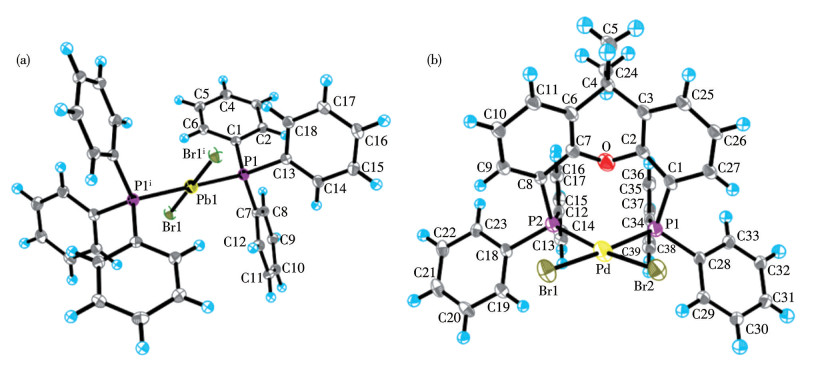
Symmetry code: ⅰ 1-x, 1-y, 1-z.
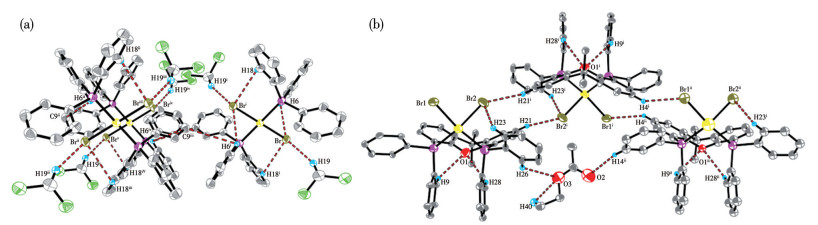
Symmetry codes: ⅰ 1-x, 1-y, 1-z; ⅱ 1/2-x, 1/2+y, z; ⅲ-1/2+x, 3/2-y, 1-z; ⅳ-1/2+x, 1/2-y, 1-z; ⅴ 1/2-x, -1/2+y, z for trans-[Pd(PPh3)2Br2]; ⅰ 1-x, 2-y, 1-z; ⅱ x, y, -1+z for cis-[Pd(Xantphos)Br2].
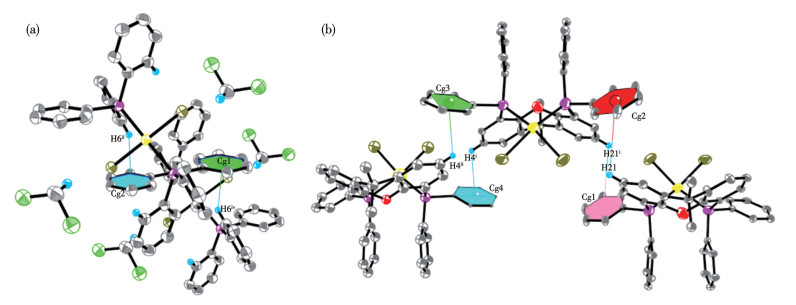
Symmetry codes: ⅱ 1/2-x, 1/2+y, z; ⅳ-1/2+x, 1/2-y, 1-z for trans-[Pd(PPh3)2Br2]; ⅰ 1-x, 2-y, 1-z; ⅱ x, y, -1+z for cis-[Pd(Xantphos)Br2].
 DownLoad: