Login In
Amphiphilic surface modification of magnetic adsorbents and its adsorption properties of two microplastics
- Corresponding author: Jianjun LI, lijj3@aust.edu.cn
Figures(20)
Citation:
Qin′ai FENG, Jianjun LI, Lili ZHANG, Linxin WU, Huiling WANG, Wenjing HOU, Lei WANG, Mingjie REN. Amphiphilic surface modification of magnetic adsorbents and its adsorption properties of two microplastics[J]. Chinese Journal of Inorganic Chemistry,
;2026, 42(4): 789-807.
doi:
10.11862/CJIC.20250208

Figures(20)


HU D F, SHEN M C, ZHANG Y X, ZENG G M. Micro(nano)plastics: An un-ignorable carbon source?[J]. Sci. Total Environ., 2019, 657: 108-110
doi: 10.1016/j.scitotenv.2018.12.046
REAL L E P. Recycled materials for construction applications: Plastic products and composites[M]. Lisbon: Springer Nature, 2022: 103-113
JOHNSTONE I. 10. Organisation for economic Co-operation and development (OECD)[J]. Yearbook of International Environmental Law, 2022, 33(1): 271-276
VETHAAK A D, LEGLER J. Microplastics and human health[J]. Science, 2021, 371(6530): 672-674
doi: 10.1126/science.abe5041
KHALID N, AQEEL M, NOMAN A. Microplastics could be a threat to plants in terrestrial systems directly or indirectly[J]. Environ. Pollut., 2020, 267: 115653
doi: 10.1016/j.envpol.2020.115653
REBELEIN A, INT-VEEN I, KAMMANN U, SCHARSACK J P. Microplastic fibers—Underestimated threat to aquatic organisms?[J]. Sci. Total Environ., 2021, 777: 146045
doi: 10.1016/j.scitotenv.2021.146045
LESLIE H A, VAN VELZEN M J, BRANDSMA S H, VETHAAK A D, GARCIA-VALLEJO J J, LAMOREE M H. Discovery and quantification of plastic particle pollution in human blood[J]. Environ. int., 2022, 163: 107199
doi: 10.1016/j.envint.2022.107199
KUTRALAM-MUNIASAMY G, SHRUTI V C, PEREZ-GUEVARA F, ROY P D. Microplastic diagnostics in humans: “The 3Ps” progress, problems, and prospects[J]. Sci. Total Environ., 2023, 856: 159164
doi: 10.1016/j.scitotenv.2022.159164
WU D, FENG Y D, WANG R, JIANG J, GUAN Q Q, YANG X, WEI H C, XIA Y K, LUO Y M. Pigment microparticles and microplastics found in human thrombi based on Raman spectral evidence[J]. J. Adv. Res., 2023, 49: 141-150
doi: 10.1016/j.jare.2022.09.004
ANDRADY A L. Microplastics in the marine environment[J]. Mar. Pollut. Bull., 2011, 62(8): 1596-1605
doi: 10.1016/j.marpolbul.2011.05.030
THOMPSON R C, OLSEN Y, MITCHELL R P, DAVIS A, ROWLAND S J, JOHN A W G, MCGONIGLE D, RUSSELL A E. Lost at sea: Where is all the plastic?[J]. Science, 2004, 304(5672): 838
doi: 10.1126/science.1094559
DING G G, WANG J S, WANG Y Z, WANG X, ZHAO K, LI R Z, GENG X F, WEN J, CHEN B, ZHAO X, WU X D. An innovative miniaturized cell imaging system based on integrated coaxial dual optical path structure and microfluidic fixed frequency sample loading strategy[J]. IEEE Trans. Instrum. Meas., 2023, 72: 1-17
HANIF M A, IBRAHIM N, DAHALAN F A, ALI U F M, HASAN M, JALIL A A. Microplastics and nanoplastics: Recent literature studies and patents on their removal from aqueous environment[J]. Sci. Total Environ., 2022, 810: 152115
doi: 10.1016/j.scitotenv.2021.152115
ASENSIO-MONTESINOS F, RAMÍREZ M O, GONZÁLEZ-LEAL J M, CARRIZO D, ANFUSO G. Characterization of plastic beach litter by Raman spectroscopy in south‑western Spain[J]. Sci. Total Environ., 2020, 744: 140890
doi: 10.1016/j.scitotenv.2020.140890
DÜMICHEN E, EISENTRAUT P, BANNICK C G, BARTHEL A K, SENZ R, BRAUN U. Fast identification of microplastics in complex environmental samples by a thermal degradation method[J]. Chemosphere, 2017, 174: 572-584
doi: 10.1016/j.chemosphere.2017.02.010
SIMON-SÁNCHEZ L, GRELAUD M, GARCIA-ORELLANA J, ZIVERI P. River deltas as hotspots of microplastic accumulation[J]. Sci. Total Environ., 2019, 687: 1186-1196
doi: 10.1016/j.scitotenv.2019.06.168
KUMAR R, VERMA A, RAKIB M R J, GUPTA P K, SHARMA P, GARG A, GIRARD P, AMINABHAVI T M. Adsorptive behavior of micro (nano) plastics through biochar: Co-existence, consequences, and challenges in contaminated ecosystems[J]. Sci. Total Environ., 2023, 856: 159097
doi: 10.1016/j.scitotenv.2022.159097
SUN C Z, WANG Z G, ZHENG H, CHEN L Y, LI F M. Biodegradable and re-usable sponge materials made from chitin for efficient removal of microplastics[J]. J. Hazard. Mater., 2021, 420: 126599
doi: 10.1016/j.jhazmat.2021.126599
GUO X, WANG J L. The chemical behaviors of microplastics in marine environment: A review[J]. Mar. Pollut. Bull., 2019, 142: 1-14
CAO Y T, SATHISH C, GUAN X W, WANG S B, PALANISAMI T, VINU A, YI J B. Advances in magnetic materials for microplastic separation and degradation[J]. J. Hazard. Mater., 2024, 461: 132537
doi: 10.1016/j.jhazmat.2023.132537
LI J, CHEN X H, YU S G, CUI M. Removal of pristine and aged microplastics from water by magnetic biochar: Adsorption and magnetization[J]. Sci. Total Environ., 2023, 875: 162647
doi: 10.1016/j.scitotenv.2023.162647
HE D F, ZHANG X T, HU J N. Methods for separating microplastics from complex solid matrices: Comparative analysis[J]. J. Hazard. Mater., 2021, 409: 124640
doi: 10.1016/j.jhazmat.2020.124640
GRBIC J, NGUYEN B, GUO E, YOU J B, SINTON D, ROCHMAN C M. Magnetic extraction of microplastics from environmental samples[J]. Environ. Sci. Technol. Lett., 2019, 6(2): 68-72
doi: 10.1021/acs.estlett.8b00671
ELMACI G. Microwave-assisted rapid synthesis of C@Fe3O4 composite for removal of microplastics from drinking water[J]. ADYU. J. Sci., 2020, 10(1): 207-217
MULLAIMALAR A, JEYALAKSHMI R. Fabrication of superhydrophobic copper slag-based inorganic polymer adsorbents by silane grafting using response surface methodology for the removal of microplastics from aqueous solutions[J]. J. Water Process Eng., 2025, 69: 106620
doi: 10.1016/j.jwpe.2024.106620
LI Y Y, ZHANG S J, LIU S H, CHEN Y H, LUO M Q, LI J H, XU S, HOU X H. Eco-friendly hydrophobic ZIF-8/sodium alginate monolithic adsorbent: An efficient trap for microplastics in the aqueous environment[J]. J. Colloid Interface Sci., 2024, 661: 259-270
doi: 10.1016/j.jcis.2024.01.182
LI X C, XU X Y, XIA F L, BU L X, QIU H X, CHEN M X, ZHANG L, GAO J P. Electrochemically active MnO2/RGO nanocomposites using Mn powder as the reducing agent of GO and the MnO2 precursor[J]. Electrochim. Acta, 2014, 130: 305-313
doi: 10.1016/j.electacta.2014.03.040
SHI C L, GENG J J, QU X X, NIU F L, YANG J J, WANG J. Experimental study on enhanced magnetic removal of microplastics in water using modified maifanite[J]. J. Environ. Chem. Eng, 2025, 13(2): 116014
doi: 10.1016/j.jece.2025.116014
LI W H, LIU S H, HUANG K, QIN S B, LIANG B, WANG J. Preparation of magnetic Janus microparticles for the rapid removal of microplastics from water[J]. Sci. Total Environ., 2023, 903: 166627
doi: 10.1016/j.scitotenv.2023.166627
PEREZ-GARNES M, MORALES V, SANZ R, GARCIA-MUNOZ R A. Cytostatic and cytotoxic effects of hollow-shell mesoporous silica nanoparticles containing magnetic iron oxide[J]. Nanomaterials, 2021, 11(9): 2455
doi: 10.3390/nano11092455
KOO H Y, LEE H J, NOH Y Y, LEE E S, KIM Y H, CHOI W S. Gold nanoparticle-doped graphene nanosheets: Sub-nanosized gold clusters nucleate and grow at the nitrogen-induced defects on graphene surfaces[J]. J. Mater. Chem., 2012, 22(15): 7130-7135
doi: 10.1039/c2jm16195h
LEE Y S, BAE J Y, KOO H Y, LEE Y B, CHOI W S. A remote- controlled generation of gold@polydopamine (core@shell) nanoparticles via physical-chemical stimuli of polydopamine/gold composites[J]. Sci. Rep., 2016, 6(1): 22650
doi: 10.1038/srep22650
OLATUNJI M A, KHANDAKER M U, MAHMUD H N M E. Adsorption kinetics, equilibrium and radiation effect studies of radioactive cesium by polymer-based adsorbent[J]. J. Vinyl Addit. Technol., 2018, 24(4): 347-357
doi: 10.1002/vnl.21620
WANG H P, HUANG X H, CHEN J N, DONG M, NIE C Z, QIN L. Modified superhydrophobic magnetic Fe3O4 nanoparticles for removal of microplastics in liquid foods[J]. Chem. Eng. J., 2023, 476: 146562
doi: 10.1016/j.cej.2023.146562
PARASHAR N, HAIT S. Cetyl trimethyl ammonium bromide-modified magnetic biochar-integrated sand filter for microplastics removal from secondary-treated sewage effluents: Performance evaluation and mechanistic insights[J]. J. Water Process. Eng., 2024, 59: 105035
doi: 10.1016/j.jwpe.2024.105035
SING K S W. Reporting physisorption data for gas/solid systems with special reference to the determination of surface area and porosity[J]. Pure Appl. Chem., 1982, 54(11): 2201-2218
doi: 10.1351/pac198254112201
ELMOBARAK W F, ALMOMANI F. A new insight into the separation of oil from oil/water emulsion by Fe3O4-SiO2 nanoparticles[J]. Environ. Res., 2021, 202: 111645
doi: 10.1016/j.envres.2021.111645
ZHANG Y F, DUAN J J, LIU R Q, PETROPOULO E, FENG Y F, XUE L H, YANG L Z, HE S Y. Efficient magnetic capture of PE microplastic from water by PEG modified Fe3O4 nanoparticles: Performance, kinetics, isotherms and influence factors[J]. J. Environ. Sci., 2025, 147: 677-687
doi: 10.1016/j.jes.2023.07.025
SEIDENSTICKER S, GRATHWOHL P, LAAMPRECHT J, ZZARFL C. A combined experimental and modeling study to evaluate pH-dependent sorption of polar and non-polar compounds to polyethylene and polystyrene microplastics[J]. Environ. Sci Eur., 2018, 30: 30
doi: 10.1186/s12302-018-0155-z
RIZWAN M, LIN Q M, CHEN X J, LI Y Y, LI G T, ZHAO X R, TIAN Y F. Synthesis, characterization and application of magnetic and acid modified biochars following alkaline pretreatment of rice and cotton straws[J]. Sci. Total Environ., 2020, 714: 136532
doi: 10.1016/j.scitotenv.2020.136532
TANG Y, ZHANG S H, SU Y L, WU D, ZHAO Y P, XIE B. Removal of microplastics from aqueous solutions by magnetic carbon nanotubes[J]. Chem. Eng. J., 2021, 406: 126804
doi: 10.1016/j.cej.2020.126804
DUAN X T, CHEN X, SHI L L, CAO Y R, LIANG Y C, HUANG C, CAO Y X. Functionality-dependent removal efficiency and mechanisms of polystyrene microplastics by a robust magnetic biochar[J]. J. Environ. Chem. Eng., 2025, 13(2): 115509
doi: 10.1016/j.jece.2025.115509
GANIE Z A, KHANDELWAL N, TIWARI E, SINGH N, DARBHA G K. Biochar-facilitated remediation of nanoplastic contaminated water: Effect of pyrolysis temperature induced surface modifications[J]. J. Hazard. Mater., 2021, 417: 126096
doi: 10.1016/j.jhazmat.2021.126096
ULLAH H, ALOMAR T S, TARIQ M, ALMASOUD N, BHATTI M H, AJMAL M, NAZAR Z, NADEEM M, ASIF H M, SOHAIL M. Nanoarchitectonics of molybdenum rich crown shaped polyoxometalates based ionic liquids reinforced on magnetic nanoparticles for the removal of microplastics and heavy metals from water[J]. J. Environ. Chem. Eng., 2024, 12(6): 114257
doi: 10.1016/j.jece.2024.114257
ZHANG L, SUN M Y, LI X Y, LIU M Y, CHU H Y, WANG C C, WANG P, YI X Y, WANG Y, DENG J. Uranium extraction from radioactive wastewater by NH2-MIL-125 immobilized in a double-network aerogel microsphere[J]. ACS Sustainable Chem. Eng., 2025, 13(14): 5345-5354
doi: 10.1021/acssuschemeng.5c00543
JIN R T, ZHAO C L, SONG Y X, QIU X J, LI C X, ZHAO Y X. Competitive adsorption of sulfamethoxazole and bisphenol A on magnetic biochar: Mechanism and site energy distribution[J]. Environ. Pollut., 2023, 329: 121662
doi: 10.1016/j.envpol.2023.121662
ZHAO H H, CUI W Q, YANG S Q, ZHENG K, SONG F M, LIU Z F, JI P H. Potential of a novel magnetic gangue material for remediating wastewater and field co-polluted by microplastics and heavy metals[J]. Sep. Purif. Technol., 2025, 368: 133030
doi: 10.1016/j.seppur.2025.133030
YI X H, WANG C C. Metal-organic frameworks on 3D interconnected macroporous sponge foams for large-scale water decontamination: A mini review[J]. Chin. Chem. Lett., 2024, 35(5): 109094
doi: 10.1016/j.cclet.2023.109094
ARAGÓN D, GARCÍA-MERINO B, BARQUÍN C, BRINGAS E, RIVERO M J, ORTIZ I. Advanced green capture of microplastics from different water matrices by surface-modified magnetic nanoparticles[J]. Sep. Purif. Technol., 2025, 354: 128813
doi: 10.1016/j.seppur.2024.128813
YU Y, MO W Y, LUUKKONEN T. Adsorption behaviour and interaction of organic micropollutants with nano and microplastics—A review[J]. Sci. Total Environ., 2021, 797: 149140
doi: 10.1016/j.scitotenv.2021.149140
SUN Y Z, JI J H, TAO J G, YANG Y Y, WU D, HAN L F, LI S, WANG J. Current advances in interactions between microplastics and dissolved organic matters in aquatic and terrestrial ecosystems[J]. Trac-Trends Anal. Chem., 2023, 158: 116882
doi: 10.1016/j.trac.2022.116882
Peipei DING , Jingying DUAN , Haoran XU , Xinru FANG , Xingyu LIU , Juntao YAN , Chunlei WANG . Preparation and adsorption properties of poplar catkin-derived porous carbon by ethanol solvothermal method. Chinese Journal of Inorganic Chemistry, 2026, 42(6): 1203-1214. doi: 10.11862/CJIC.20250370
Jingke LIU , Jia CHEN , Yingchao HAN . Nano hydroxyapatite stable suspension system: Preparation and cobalt adsorption performance. Chinese Journal of Inorganic Chemistry, 2024, 40(9): 1763-1774. doi: 10.11862/CJIC.20240060
Cong JI , Hao WANG , Willie Forkpah DELEAU , Xinxin JING , Dapeng LI , Zhengying WU , Linbing SUN . Magnetic calcium-rich CaFe2O4: Synthesis and adsorption performance for phosphates in water bodies. Chinese Journal of Inorganic Chemistry, 2026, 42(6): 1131-1145. doi: 10.11862/CJIC.20260063
Hui Wang , Abdelkader Labidi , Menghan Ren , Feroz Shaik , Chuanyi Wang . Recent Progress of Microstructure-Regulated g-C3N4 in Photocatalytic NO Conversion: The Pivotal Roles of Adsorption/Activation Sites. Acta Physico-Chimica Sinica, 2025, 41(5): 100039-0. doi: 10.1016/j.actphy.2024.100039
Peng XU , Shasha WANG , Nannan CHEN , Ao WANG , Dongmei YU . Preparation of three-layer magnetic composite Fe3O4@polyacrylic acid@ZiF-8 for efficient removal of malachite green in water. Chinese Journal of Inorganic Chemistry, 2024, 40(3): 544-554. doi: 10.11862/CJIC.20230239
Guangyue He , Hanxiao Liu , Chi Zhang , Yunsheng Li , Guanfeng Ji , Dawei Fan . “蟹”逅荧光特工队:废壳“逮捕”微塑料. University Chemistry, 2026, 41(5): 398-411. doi: 10.12461/PKU.DXHX202511058
Yadan Luo , Hao Zheng , Xin Li , Fengmin Li , Hua Tang , Xilin She . Modulating reactive oxygen species in O, S co-doped C3N4 to enhance photocatalytic degradation of microplastics. Acta Physico-Chimica Sinica, 2025, 41(6): 100052-0. doi: 10.1016/j.actphy.2025.100052
Shuting Zhuang , Lida Zhao . Teaching through Research: A Comprehensive Experiment on Carbon Quantum Dots from Microplastic Waste. University Chemistry, 2025, 40(10): 217-224. doi: 10.12461/PKU.DXHX202412010
Guang Huang , Lei Li , Dingyi Zhang , Xingze Wang , Yugai Huang , Wenhui Liang , Zhifen Guo , Wenmei Jiao . Cobalt’s Valor, Nickel’s Foe: A Comprehensive Chemical Experiment Utilizing a Cobalt-based Imidazolate Framework for Nickel Ion Removal. University Chemistry, 2024, 39(8): 174-183. doi: 10.3866/PKU.DXHX202311051
Fugui XI , Du LI , Zhourui YAN , Hui WANG , Junyu XIANG , Zhiyun DONG . Functionalized zirconium metal-organic frameworks for the removal of tetracycline from water. Chinese Journal of Inorganic Chemistry, 2025, 41(4): 683-694. doi: 10.11862/CJIC.20240291
Wei Li , Jinfan Xu , Yongjun Zhang , Ying Guan . 共价有机框架整体材料的制备及食品安全非靶向筛查应用——推荐一个仪器分析综合化学实验. University Chemistry, 2025, 40(6): 276-285. doi: 10.12461/PKU.DXHX202406013
Shiyi Chen , Jialong Fu , Jianping Qiu , Guoju Chang , Shiyou Hao . Waste medical mask-derived carbon quantum dots enhance the photocatalytic degradation of polyethylene terephthalate (PET) over BiOBr/g-C3N4 S-scheme heterojunction. Acta Physico-Chimica Sinica, 2026, 42(1): 100135-0. doi: 10.1016/j.actphy.2025.100135
Zeyu XU , Anlei DANG , Bihua DENG , Xiaoxin ZUO , Yu LU , Ping YANG , Wenzhu YIN . Evaluation of the efficacy of graphene oxide quantum dots as an ovalbumin delivery platform and adjuvant for immune enhancement. Chinese Journal of Inorganic Chemistry, 2024, 40(6): 1065-1078. doi: 10.11862/CJIC.20240099
Jing Wang , Pingping Li , Yuehui Wang , Yifan Xiu , Bingqian Zhang , Shuwen Wang , Hongtao Gao . Treatment and Discharge Evaluation of Phosphorus-Containing Wastewater. University Chemistry, 2024, 39(5): 52-62. doi: 10.3866/PKU.DXHX202309097
Ting YANG , Jia AN , Jinyu ZHANG , Ruonan FAN , Rong YAN , Xiaoxia JING , Panpan CHANG , Wei YAN . Synergistic enhancement of ion migration and sulfur conversion kinetics in lithium-sulfur batteries by CeO2/g-C3N4. Chinese Journal of Inorganic Chemistry, 2026, 42(3): 519-530. doi: 10.11862/CJIC.20250274
Ningyuan Chen , Qingyi Zeng , Zhiqiang Kuang , Peicong Tian , Dazhi Yan , Weiliang Jin , Deming Kong . Digital-Assisted Experimental Study on Dye Adsorption by Porous Materials. University Chemistry, 2026, 41(1): 321-331. doi: 10.12461/PKU.DXHX202504072
Yueyue DU , Yuwei ZHENG , Xuanhe WEI , Yifan LU , Yingchao HAN . Sodium alginate/nano lanthanum hydroxide composite microspheres: Electrospraying preparation and phosphorus adsorption performance. Chinese Journal of Inorganic Chemistry, 2026, 42(8): 1669-1684. doi: 10.11862/CJIC.20260002
Qianqian Zhong , Yucui Hao , Guotao Yu , Lijuan Zhao , Jingfu Wang , Jian Liu , Xiaohua Ren . Comprehensive Experimental Design for the Preparation of the Magnetic Adsorbent Based on Enteromorpha Prolifera and Its Utilization in the Purification of Heavy Metal Ions Wastewater. University Chemistry, 2024, 39(8): 184-190. doi: 10.3866/PKU.DXHX202312013
Jianan Zhang , Mengzhen Xu , Jiamin Liu , Yufei He . 面向“双碳”目标的脱氯吸附剂开发研究型综合实验设计. University Chemistry, 2025, 40(6): 248-255. doi: 10.12461/PKU.DXHX202408068
Jie ZHAO , Sen LIU , Qikang YIN , Xiaoqing LU , Zhaojie WANG . Theoretical calculation of selective adsorption and separation of CO2 by alkali metal modified naphthalene/naphthalenediyne. Chinese Journal of Inorganic Chemistry, 2024, 40(3): 515-522. doi: 10.11862/CJIC.20230385
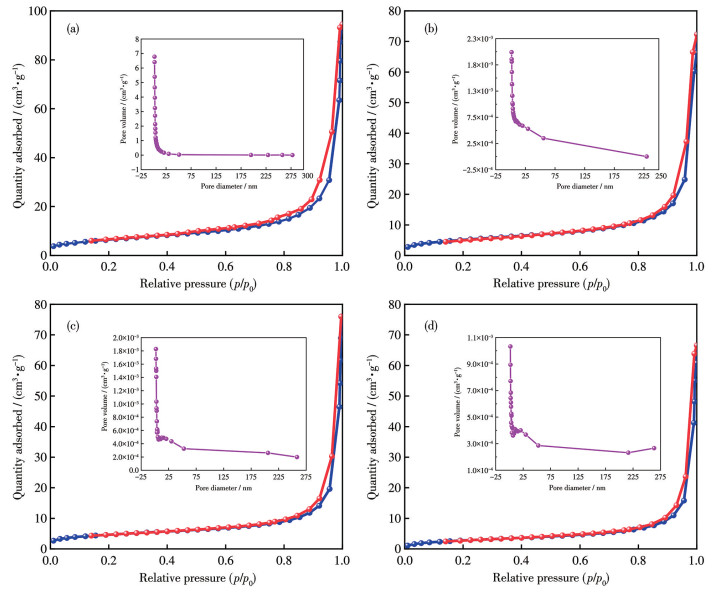
Inset: the corresponding pore size distributions.
 DownLoad: