Login In
Advances in electrocatalytic and photocatalytic CO2 conversion to value-added chemicals using copper-based covalent organic frameworks
- Corresponding author: Haiying WANG, wanghaiying@nju.edu.cn
Figures(18)
Citation:
Yue LI, Ziqi LIU, Ke FENG, Yingdan LI, Yue NING, Li SHEN, Jitao LU, Qingguo MENG, Min WANG, Haiying WANG. Advances in electrocatalytic and photocatalytic CO2 conversion to value-added chemicals using copper-based covalent organic frameworks[J]. Chinese Journal of Inorganic Chemistry,
;2026, 42(1): 1-22.
doi:
10.11862/CJIC.20250197

Figures(18)


FAN L, XIA C, YANG F Q, WANG J, WANG H T, LU Y Y. Strategies in catalysts and electrolyzer design for electrochemical CO2 reduction toward C2+ products[J]. Sci. Adv., 2020, 6: eaay3111
doi: 10.1126/sciadv.aay3111
HAN N, DING P, HE L, LI Y Y, LI Y G. Promises of main group metal-based nanostructured materials for electrochemical CO2 reduction to formate[J]. Adv. Energy Mater., 2019, 10: 1902338
YAN Y L, BORHANI T N, SUBRAVETI S G, PAI K N, PRASAD V, RAJENDRAN A, NKULIKIYINKA P, ASIBOR J O, ZHANG Z N, SHAO D, WANG L J, ZHANG W B, YAN Y, AMPOMAH W, YOU J Y, WANG M H, ANTHONY E J, MANOVIC V, CLOUGH P T. Harnessing the power of machine learning for carbon capture, utilisation, and storage (CCUS)—A state-of-the-art review[J]. Energy Environ. Sci., 2021, 14: 6122-6157
doi: 10.1039/D1EE02395K
HE C H, DUAN D L, LOW J X, BAI Y, JIANG Y W, WANG X Y, CHEN S M, LONG R, SONG L, XIONG Y J. Cu2-xS derived copper nanoparticles: A platform for unraveling the role of surface reconstruction in efficient electrocatalytic CO2-to-C2H4 conversion[J]. Nano Res., 2023, 16: 4494-4498
doi: 10.1007/s12274-021-3532-7
KIBRIA M G, EDWARDS J P, GABARDO C M, DINH C T, SEIFITOKALDANI A, SINTON D, SARGENT E H. Electrochemical CO2 reduction into chemical feedstocks: From mechanistic electrocatalysis models to system design[J]. Adv. Mater., 2019, 31: 1807166
doi: 10.1002/adma.201807166
LIM J W, DONG W J, PARK J Y, HONG D M, LEE J L. Spontaneously formed CuSx catalysts for selective and stable electrochemical reduction of industrial CO2 gas to formate[J]. ACS Appl. Mater. Interfaces, 2020, 12: 22891-22900
doi: 10.1021/acsami.0c03606
KURISINGAL J F, KIM H, CHOE H J, CHANG S H. Covalent organic framework-based catalysts for efficient CO2 utilization reactions[J]. Coord. Chem. Rev., 2022, 473: 214835
doi: 10.1016/j.ccr.2022.214835
WANG H Y, SU J, ZUO J L. Porous crystalline materials based on tetrathiafulvalene and its analogues: Assembly, charge transfer, and applications[J]. Acc. Chem. Res., 2024, 57: 1851-1869
doi: 10.1021/acs.accounts.4c00228
ZHU X L, ZHOU E L, TAI X S, ZONG H B, YI J J, YUAN Z M, ZHAO X L, HUANG P, XU H, JIANG Z Y. g-C3N4 S-scheme homojunction through van der Waals interface regulation by intrinsic polymerization tailoring for enhanced photocatalytic H2 evolution and CO2 reduction[J]. Angew. Chem.‒Int. Edit., 2025, 64: e202425439
doi: 10.1002/anie.202425439
ZHU X L, ZONG H B, CAMILO J V P, MIAO H H, SUN W, YUAN Z M, WANG S H, ZENG G X, XU H, JIANG Z Y, OZIN G A. Supercharged CO2 photothermal catalytic methanation: High conversion, rate, and selectivity[J]. Angew. Chem.‒Int. Edit., 2023, 135: e202218694
doi: 10.1002/ange.202218694
ZUO C, SU Q, JIANG Z Y. Advances in the application of Bi-based compounds in photocatalytic reduction of CO2[J]. Molecules, 2023, 28: 3982
doi: 10.3390/molecules28103982
ZUO C, SU Q, YAN X Y. Research progress of Co-catalysts in photocatalytic CO2 reduction: A review of developments, opportunities, and directions[J]. Processes, 2023, 11: 867
doi: 10.3390/pr11030867
WANG L H, TAI X S. Synthesis, structural characterization, Hirschfeld surface analysis and photocatalytic CO2 reduction activity of a new dinuclear Gd(Ⅲ) complex with 6-phenylpyridine-2-carboxylic acid and 1, 10-phenanthroline ligands[J]. Molecules, 2023, 28: 7595
doi: 10.3390/molecules28227595
TAI X S, YAN X H, WANG L H. Synthesis, structural characterization, Hirschfeld surface analysis, density functional theory, and photocatalytic CO2 reduction activity of a new Ca(Ⅱ) complex with a bis-Schiff base ligand[J]. Molecules, 2024, 29: 047
DONG H, CHE H T, BAI L W, ZHANG N N, TIAN Y Q, LI B Z, WANG Y, ZHANG X, ZHANG F M. Benzotrithiophene-based covalent organic frameworks with rhenium modified for artificial photosynthetic CO2 reduction[J]. Inorg. Chem., 2024, 63: 24421-24428
doi: 10.1021/acs.inorgchem.4c04599
MANDAL A, KARGUPTA K. Cu-doped 2D-Bi2MoO6 nanoribbon/rGO photocatalysts for selective ethanol production by photocatalytic CO2 reduction[J]. ACS Appl. Nano Mater., 2025, 8: 3471-3486
doi: 10.1021/acsanm.4c06608
WANG J X, GUO S E, XU C, JIANG Y Q, WU X M, YU P, XIAO Y T, SONG R J. Zinc-porphyrin conjugated polymer nanosheets with accelerated charge transfer dynamics for selective photocatalytic CO2 reduction to CH4[J]. ACS Appl. Nano Mater., 2025, 8: 2022-2032
doi: 10.1021/acsanm.4c06800
XIE K L, WU L P, LIAO Y Q, HU J J, LU K Q, WEN H R, HUO J R. Highly stable lanthanide-organic frameworks based on {Ln6O8} clusters with photocatalytic reduction of CO2 to CO[J]. Inorg. Chem., 2025, 64: 638-645
doi: 10.1021/acs.inorgchem.4c03799
YAN Y K, WANG Y, PENG C X, WANG J, WANG X S, SHI L. Single-atom Ni sites with asymmetric coordination structures for efficient photocatalytic CO2 reduction[J]. ACS Sustain. Chem. Eng., 2025, 13: 1628-1636
doi: 10.1021/acssuschemeng.4c08332
YANG J L, CHEN Z H, ZHANG L, ZHANG Q C. Covalent organic frameworks for photocatalytic reduction of carbon dioxide: A review[J]. ACS Nano, 2024, 18: 21804-21835
doi: 10.1021/acsnano.4c06783
ZHANG J J, ZHENG M, WU Y, XIONG J, LI S Z, JIANG W, LIU Z, DI J. Strongly coupled interface in electrostatic self-assembly covalent triazine framework/Bi19S27Br3 for high-efficiency CO2 photoreduction[J]. ACS Nano, 2025, 19: 2759-2768
doi: 10.1021/acsnano.4c15225
ZHANG H Y, SU Q. Recent advances of indium-based sulfides in photocatalytic CO2 reduction[J]. ACS Omega, 2025, 10: 8793-8815
doi: 10.1021/acsomega.4c09487
ZHU Y R, XUE Y L, WANG Z, CHAO D B. Robust noble metal-free photoconversion of CO2 to CO with a molecule/MOF hybrid catalyst for straightforward two-chamber organic carbonylation[J]. ACS Catal., 2025, 15: 3546-3557
doi: 10.1021/acscatal.4c07343
LIU H, GUO R T, YAN J S, GUO S H, YU L Q, PAN W G. Progress and prospect of application of two-dimensional materials in electrochemical CO2 reduction: A review[J]. Energy Fuels, 2024, 38: 16010-16025
doi: 10.1021/acs.energyfuels.4c03022
LIU J W, PENG D, LIU S J, WEN H R, ZHU Z H, ZHAO J, CHEN J L. New insight into the conjugation effect of tetranuclear copper(Ⅰ) cluster catalysts for efficient electrocatalytic reduction of CO2 into CH4[J]. ACS Sustain. Chem. Eng., 2025, 13: 2564-2573
doi: 10.1021/acssuschemeng.4c09723
MEI B B, MAO J N, LIANG Z F, SUN F F, YANG S, LI J; MA J Y, SONG F, ZHENG J. Reversible angle distortion-dependent electrochemical CO2 reduction on cobalt phthalocyanine[J]. J. Am. Chem. Soc., 2025, 147: 5819-5827
doi: 10.1021/jacs.4c14409
MENG F F, DONG M, HE J T, GU J X, YAO X H, SUN C Y, WANG X L, SU Z M. Metal cluster-based crystalline materials for the electrocatalytic reduction of carbon dioxide[J]. ACS Materials Lett., 2025, 7: 229-249
doi: 10.1021/acsmaterialslett.4c02064
SHAO W W, FAN W Y, GUAN H M, ZU X L, JIAO X C. Fundamentals and perspectives of positively charged single-metal site catalysts for CO2 electroreduction[J]. ACS Appl. Mater. Interfaces, 2025, 17: 10276-10291
doi: 10.1021/acsami.4c21988
XU H S, DING S Y, AN W K, WU H, WANG W. Constructing crystalline covalent organic frameworks from chiral building blocks[J]. J. Am. Chem. Soc., 2016, 138: 11489-11492
doi: 10.1021/jacs.6b07516
ZHANG J, HAN X, WU X W, LIU Y, CUI Y. Chiral DHIP- and pyrrolidine-based covalent organic frameworks for asymmetric catalysis[J]. ACS Sustain. Chem. Eng., 2019, 7: 5065-5071
doi: 10.1021/acssuschemeng.8b05887
ZHANG J, HAN X, WU X W, LIU Y, CUI Y. Multivariate chiral covalent organic frameworks with controlled crystallinity and stability for asymmetric catalysis[J]. J. Am. Chem. Soc., 2017, 139: 8277-8285
doi: 10.1021/jacs.7b03352
DONG B, WANG L Y, ZHAO S, GE R L, SONG X D, WANG Y, GAO Y A. Immobilization of ionic liquids to covalent organic frameworks for catalyzing the formylation of amines with CO2 and phenylsilane[J]. Chem. Commun., 2016, 52: 7082-7085
doi: 10.1039/C6CC03058K
TAN K T, GHOSH S, WANG Z Y, WEN F X, RODRÍGUEZ-SAN-MIGUEL D, FENG J, HUANG N, WANG W, ZAMORA F, FENG X L, THOMAS A, JIANG D L. Covalent organic frameworks[J]. Nat. Rev. Methods Primers, 2023, 3: 1
doi: 10.1038/s43586-022-00181-z
HUANG N, WANG P, JIANG D. Covalent organic frameworks: A materials platform for structural and functional designs[J]. Nat. Rev. Mater., 2016, 1: 16068
doi: 10.1038/natrevmats.2016.68
GUAN X, CHEN F, FANG Q, QIU S. Design and applications of three dimensional covalent organic frameworks[J]. Chem. Soc. Rev., 2020, 49: 1357-1384
doi: 10.1039/C9CS00911F
CÔTÉ A P, BENIN A I, OCKWIG N W, O′KEEFFE M, MATZGER A J, YAGHI O M. Porous, crystalline, covalent organic frameworks[J]. Science, 2005, 310: 1166-1170
doi: 10.1126/science.1120411
FENG X, DING X S, JIANG D L. Covalent organic frameworks[J]. Chem. Soc. Rev., 2012, 41: 6010-6022
doi: 10.1039/c2cs35157a
JIN F Y, NGUYEN H, ZHONG Z Y, HAN X, ZHU C H, PEI X K, MA Y H, YAGHI O M. Entanglement of square nets in covalent organic frameworks[J]. J. Am. Chem. Soc., 2022, 144: 1539-1544
doi: 10.1021/jacs.1c13468
FENG J, ZHANG Y J, MA S H, YANG C, WANG Z P, DING S Y, LI Y, WANG W. Fused-ring-linked covalent organic frameworks[J]. J. Am. Chem. Soc., 2022, 144: 6594-6603
doi: 10.1021/jacs.2c02173
MASCHITA J, BANERJEE T, SAVASCI G, HAASE F, OCHSENFELD C, LOTSCH B V. Ionothermal synthesis of imide-linked covalent organic frameworks[J]. Angew. Chem.‒Int. Edit., 2020, 59: 15750-15758
doi: 10.1002/anie.202007372
ZHAO Y B, GUO L, GÁNDARA F, MA Y H, LIU Z, ZHU C H, LYU H, TRICKETT C A, KAPUSTIN E A, TERASAKI O, YAGHI O M. A synthetic route for crystals of woven structures, uniform nanocrystals, and thin films of imine covalent organic frameworks[J]. J. Am. Chem. Soc., 2017, 139: 13166-13172
doi: 10.1021/jacs.7b07457
XIONG Z S, SUN B B, ZOU H B, WANG R W, FANG Q R, ZHANG Z T, QIU S L. Amorphous-to-crystalline transformation: General synthesis of hollow structured covalent organic frameworks with high crystallinity[J]. J. Am. Chem. Soc., 2022, 144: 6583-6593
doi: 10.1021/jacs.2c02089
ZHAO W, YAN P Y, YANG H F, BAHRI M, JAMES A M, CHEN H M, LIU L J, LI B Y, PANG Z F, CLOWES R, BROWNING N D, WARD J W, WU Y, COOPER A I. Using sound to synthesize covalent organic frameworks in water[J]. Nat. Synth., 2022, 1: 87-95
doi: 10.1038/s44160-021-00005-0
WANG L L, XU C W, ZHANG W Q, ZHANG Q L, ZHAO M L, ZENG C, JIANG Q L, GU C, MA Y G. Electrocleavage synthesis of solution-processed, imine-linked, and crystalline covalent organic framework thin films[J]. J. Am. Chem. Soc., 2022, 144: 8961-8968
doi: 10.1021/jacs.1c13072
ZHAO Y F, YAO K X, TENG B Y, ZHANG T, HAN Y. A perfluorinated covalent triazine-based framework for highly selective and water-tolerant CO2 capture[J]. Energy Environ. Sci., 2013, 6: 3684-3692
doi: 10.1039/c3ee42548g
WANG Z F, ZHANG Y S, LIU J J, CHEN Y, CHENG P, ZHANG Z J. Flux synthesis of two-dimensional covalent organic frameworks[J]. Nat. Protoc., 2024, 19: 3489-3519
doi: 10.1038/s41596-024-01028-5
WU C, XIA L, XIA S J, VAN DER BRUGGEN B, ZHAO Y. Advanced covalent organic framework-based membranes for recovery of ionic resources[J]. Small, 2023, 19: 2206041
doi: 10.1002/smll.202206041
LI B Y, ZHANG Y M, KRISHNA R, YAO K X, HAN Y, WU Z L, MA D X, SHI Z, PHAM T, SPACE B, LIU J, THALLAPALLY P K, LIU J, CHRZANOWSKI M, MA S Q. Introduction of π-complexation into porous aromatic framework for highly selective adsorption of ethylene over ethane[J]. J. Am. Chem. Soc., 2014, 136: 8654-8660
doi: 10.1021/ja502119z
HASELL T, MIKLITZ M, STEPHENSON A, LITTLE M A, CHONG S Y, CLOWES R, CHEN L J, HOLDEN D, TRIBELLO G A, JELFS K E, COOPER A I. Porous organic cages for sulfur hexafluoride separation[J]. J. Am. Chem. Soc., 2016, 138: 1653-1659
doi: 10.1021/jacs.5b11797
WANG Z F, ZHANG S N, CHEN Y, ZHANG Z J, MA S Q. Covalent organic frameworks for separation applications[J]. Chem. Soc. Rev., 2020, 49: 708-735
doi: 10.1039/C9CS00827F
YUAN S S, LI X, ZHU J Y, ZHANG G, VAN PUYVELDE P, VAN DER BRUGGEN B. Covalent organic frameworks for membrane separation[J]. Chem. Soc. Rev., 2019, 48: 2665-2681
doi: 10.1039/C8CS00919H
LI J, ZHOU X, WANG J, LI X F. Two-dimensional covalent organic frameworks (COFs) for membrane separation: A mini review[J]. Ind. Eng. Chem. Res., 2019, 58: 15394-15406
doi: 10.1021/acs.iecr.9b02708
SONG Q L, JIANG S, HASELL T, LIU M, SUN S J, CHEETHAM A K, SIVANIAH E, COOPER A I. Porous organic cage thin films and molecular-sieving membranes[J]. Adv. Mater., 2016, 28: 2629-2637
doi: 10.1002/adma.201505688
DING S Y, GAO J, WANG Q, ZHANG Y, SONG W G, SU C Y, WANG W. Construction of covalent organic framework for catalysis: Pd/COF-LZU1 in Suzuki-Miyaura coupling reaction[J]. J. Am. Chem. Soc., 2011, 133: 19816-19822
doi: 10.1021/ja206846p
FANG Q R, GU S, ZHENG J, ZHUANG Z B, QIU S L, YAN Y S. 3D microporous base-functionalized covalent organic frameworks for size-selective catalysis[J]. Angew. Chem.‒Int. Edit., 2014, 53, 2878-2882
doi: 10.1002/anie.201310500
XU H, GAO J, JIANG D L. Stable, crystalline, porous, covalent organic frameworks as a platform for chiral organocatalysts[J]. Nat. Chem., 2015, 7: 905-912
doi: 10.1038/nchem.2352
KAMIYA K, KAMAI R, HASHIMOTO K, NAKANISHI S. Platinum-modified covalent triazine frameworks hybridized with carbon nanoparticles as methanol-tolerant oxygen reduction electrocatalysts[J]. Nat. Commun., 2014, 5: 5040
doi: 10.1038/ncomms6040
SHARMA R K, YADAV P, YADAV M, GUPTA R, RANA P, SRIVASTAVA A, ZBORIL R, VARMA R S, ANTONIETTI M, GAWANDE M B. Recent development of covalent organic frameworks (COFs): Synthesis and catalytic (organic-electro-photo) applications[J]. Mater. Horizons, 2020, 7: 411-454
doi: 10.1039/C9MH00856J
ZHI Y F, WANG Z R, ZHANG H L, ZHANG Q C. Recent progress in metal-free covalent organic frameworks as heterogeneous catalysts[J]. Small, 2020, 16: 2001070
doi: 10.1002/smll.202001070
CAO S, LI B, ZHU R M, PANG H. Design and synthesis of covalent organic frameworks towards energy and environment fields[J]. Chem. Eng. J., 2019, 355: 602-623
doi: 10.1016/j.cej.2018.08.184
WANG J L, ZHUANG S T. Covalent organic frameworks (COFs) for environmental applications[J]. Coord. Chem. Rev., 2019, 400: 213046
doi: 10.1016/j.ccr.2019.213046
ZHENG W R, TSANG C S, LEE L Y S, WONG K Y. Two-dimensional metal-organic framework and covalent-organic framework: Synthesis and their energy-related applications[J]. Mater. Today Chem., 2019, 12: 34-60
doi: 10.1016/j.mtchem.2018.12.002
FERNANDES S P S, ROMERO V, ESPIÑA B, SALONEN L M. Tailoring covalent organic frameworks to capture water contaminants[J]. Chem.‒Eur. J., 2019, 25: 6461-6473
doi: 10.1002/chem.201806025
HE T, GENG K Y, JIANG D L. Engineering covalent organic frameworks for light-driven hydrogen production from water[J]. ACS Mater. Lett., 2019, 1: 203-208
doi: 10.1021/acsmaterialslett.9b00153
LIN J M, ZHONG Y R, TANG L Y, WANG L Q, YANG M, XIA H. Covalent organic frameworks: From materials design to electrochemical energy storage applications[J]. Nano Select, 2022, 3: 320-347
doi: 10.1002/nano.202100153
XU J Y, XU Y F, LAI C L, XIA T T, ZHANG B N, ZHOU X S. Challenges and perspectives of covalent organic frameworks for advanced alkali-metal ion batteries[J]. Sci. China Chem., 2021, 64: 1267-1282
LI J, JING X C, LI Q Q, LI S W, GAO X, FENG X, WANG B. Bulk COFs and COF nanosheets for electrochemical energy storage and conversion[J]. Chem. Soc. Rev., 2020, 49: 3565-3604
doi: 10.1039/D0CS00017E
WANG Z Y, WANG C J, CHEN Y, WEI L. Covalent organic frameworks for capacitive energy storage: Recent progress and technological challenges[J]. Adv. Mater. Technol., 2023, 8: 2201828
doi: 10.1002/admt.202201828
TAO R, YANG T F, WANG Y, ZHANG J M, WU Z Y, QIU L. Design strategies of covalent organic framework-based electrodes for supercapacitor application[J]. Chem. Commun., 2023, 59: 3175-3192
doi: 10.1039/D2CC06573H
SCICLUNA M C, VELLA-ZARB L. Evolution of nanocarrier drug-delivery systems and recent advancements in covalent organic framework-drug systems[J]. ACS Appl. Nano Mater., 2020, 3: 3097-3115
doi: 10.1021/acsanm.9b02603
BHUNIA S, DEO K A, GAHARWAR A K. 2D covalent organic frameworks for biomedical applications[J]. Adv. Funct. Mater., 2020, 30: 2002046
doi: 10.1002/adfm.202002046
SINGH N, KIM J, KIM J, LEE K Y W, ZUNBUL Z, LEE I J, KIM E, CHI S G, KIM J S. Covalent organic framework nanomedicines: Biocompatibility for advanced nanocarriers and cancer theranostics applications[J]. Bioact. Mater., 2023, 21: 358-380
SHI Y Q, GAO F, ZHANG Q C, YANG J L. Covalent organic frameworks: Recent progress in biomedical applications[J]. ACS Nano, 2023, 17: 1879-1905
doi: 10.1021/acsnano.2c11346
ESRAFILI A, WAGNER A, INAMDAR S, ACHARYA A P. Covalent organic frameworks for biomedical applications[J]. Adv. Healthc. Mater., 2021, 10: 2002090
doi: 10.1002/adhm.202002090
LIAO C Y, LIU S J. Tuning the physicochemical properties of reticular covalent organic frameworks (COFs) for biomedical applications[J]. J. Mater. Chem. B, 2021, 9: 6116-6128
doi: 10.1039/D1TB01124C
YAO S C, LIU Z R, LI L L. Recent progress in nanoscale covalent organic frameworks for cancer diagnosis and therapy[J]. Nano-Micro Lett., 2021, 13: 176
doi: 10.1007/s40820-021-00696-2
GUAN Q, ZHOU L L, LI W Y, LI Y A, DONG Y B. Covalent organic frameworks (COFs) for cancer therapeutics[J]. Chem. Eur. J., 2020, 26: 5583-5591
doi: 10.1002/chem.201905150
FENG L L, QIAN C, ZHAO Y L. Recent advances in covalent organic framework-based nanosystems for bioimaging and therapeutic applications[J]. ACS Mater. Lett., 2020, 2: 1074-1092
doi: 10.1021/acsmaterialslett.0c00260
ZHAO Y, DAS S, SEKINE T, MABUCHI H, IRIE T, SAKAI J, WEN D, ZHU W D, BEN T, NEGISHI Y. Record ultralarge-pores, low density three-dimensional covalent organic framework for controlled drug delivery[J]. Angew. Chem.‒Int. Edit., 2023, 62: e202300172
doi: 10.1002/anie.202300172
LV J Q, TAN Y X, XIE J F, YANG R, YU M X, SUN S S, LI M D, YUAN D Q, WANG Y B. Direct solar-to-electrochemical energy storage in a functionalized covalent organic framework[J]. Angew. Chem.‒Int. Edit., 2018, 57: 12716-12720
doi: 10.1002/anie.201806596
LI Z P, ZHANG Z W, NIE R M, LI C Z, SUN Q K, SHI W, CHU W C, LONG Y Y, LI H, LIU X M. Construction of stable donor-acceptor type covalent organic frameworks as functional platform for effective perovskite solar cell enhancement[J]. Adv. Funct. Mater., 2022, 32: 2112553
doi: 10.1002/adfm.202112553
STEGBAUER L, SCHWINGHAMMER K, LOTSCH B V. A hydrazone-based covalent organic framework for photocatalytic hydrogen production[J]. Chem. Sci., 2014, 5: 2789-2793
doi: 10.1039/C4SC00016A
KRISHNARAJ C, JENA H S, BOURDA L, LAEMONT A, PACHFULE P, ROESER J, CHANDRAN C V, BORGMANS S, ROGGE S M J, LEUS K, STEVENS C V, MARTENS J A, VAN SPEYBROECK V, BREYNAERT E, THOMAS A, VAN DER VOORT P. Strongly reducing (diarylamino) benzene-based covalent organic framework for metal-free visible light photocatalytic H2O2 generation[J]. J. Am. Chem. Soc., 2020, 142: 20107-20116
doi: 10.1021/jacs.0c09684
CHEN W B, WANG L, MO D Z, HE F, WEN Z L, WU X J, XU H X, CHEN L. Modulating benzothiadiazole-based covalent organic frameworks via halogenation for enhanced photocatalytic water splitting[J]. Angew. Chem.‒Int. Edit., 2020, 59: 16902-16909
doi: 10.1002/anie.202006925
HAO L Q, JIA S P, QIAO X L, LIN E, YANG Y, CHEN Y, CHENG P, ZHANG Z J. Pore geometry and surface engineering of covalent organic frameworks for anhydrous proton conduction[J]. Angew. Chem.‒Int. Edit., 2022, 62: e202217240
LIU S J, LIN Z, WANG C C, GUO J. Dual-sided symmetric crystalline orientation of covalent organic framework membranes for unidirectional anhydrous proton conduction[J]. Sci. China Chem., 2022, 65: 2548-2557
doi: 10.1007/s11426-022-1379-y
JIANG G X, ZOU W W, OU Z Y, ZHANG L H, ZHANG W F, WANG X J, SONG H Y, CUI Z M, LIANG Z X, DU L. Tuning the interlayer interactions of 2D covalent organic frameworks enables an ultrastable platform for anhydrous proton transport[J]. Angew. Chem.‒Int. Edit., 2022, 61: e202208086
doi: 10.1002/anie.202208086
ZHANG J, KONG Y R, LIU Y Y, LUO H B, ZOU Y, ZANG S Q, REN X M. Superprotonic conduction of acidified benzimidazole-linked covalent organic framework[J]. ACS Mater. Lett., 2022, 4: 2597-2603
doi: 10.1021/acsmaterialslett.2c00432
HE C Y, TAO S S, LIU R Y, ZHI Y F, JIANG D L. Covalent organic frameworks: Linkage chemistry and its critical role in the evolution of π electronic structures and functions[J]. Angew. Chem.‒Int. Edit., 2024, 63: e202403472
doi: 10.1002/anie.202403472
MA H P, LIU B L, LI B, ZHANG L M, LI Y G, TAN H Q, ZANG H Y, ZHU G S. Cationic covalent organic frameworks: A simple platform of anionic exchange for porosity tuning and proton conduction[J]. J. Am. Chem. Soc., 2016, 138: 5897-5903
doi: 10.1021/jacs.5b13490
XU S, ZHANG Q. Recent progress in covalent organic frameworks as light-emitting materials[J]. Mater. Today Energy, 2021, 20: 100635
doi: 10.1016/j.mtener.2020.100635
VYAS V S, HAASE F, STEGBAUER L, SAVASCI G, PODJASKI F, OCHSENFELD C, LOTSCH B V. A tunable azine covalent organic framework platform for visible light-induced hydrogen generation[J]. Nat. Commun., 2015, 6: 8508
doi: 10.1038/ncomms9508
DALAPATI S, JIN E Q, ADDICOAT M, HEINE T, JIANG D L. Highly emissive covalent organic frameworks[J]. J. Am. Chem. Soc., 2016, 138: 5797-5800
doi: 10.1021/jacs.6b02700
YUAN C, WANG Z, XIONG W Q, HUANG Z F, LAI Y L, FU S G, DONG J Q, DUAN A H, HOU X D, YUAN L M, CUI Y. Cyclodextrin incorporation into covalent organic frameworks enables extensive liquid and gas chromatographic enantioseparations[J]. J. Am. Chem. Soc., 2023, 145: 18956-18967
doi: 10.1021/jacs.3c05973
HOU B, LI Z P, KANG X, JIANG H, CUI Y. Recent advances of chiral covalent organic frameworks for enantiomer separation[J]. Chem. Res. Chin. Univ., 2022, 38: 350-355
doi: 10.1007/s40242-022-1490-6
ZHANG S Y, ZHOU J, LI H B. Chiral covalent organic framework packed nanochannel membrane for enantioseparation[J]. Angew. Chem.‒Int. Edit., 2022, 61: e202204012
doi: 10.1002/anie.202204012
MANORANJAN N, FANG W X, ZHU Y Z, JIN J. A chiral COFs membrane for enantioselective amino acid separation[J]. Angew. Chem.‒Int. Edit., 2025, 64: e202417088
doi: 10.1002/anie.202417088
ZHANG Z C, WANG P L, SUN Y F, YANG T, DING S Y, WANG W. Rational synthesis of functionalized covalent organic frameworks via four-component reaction[J]. J. Am. Chem. Soc., 2024, 146: 4822-4829
doi: 10.1021/jacs.3c13172
YANG J, HUANG L J, YOU J M, YAMAUCHI Y. Magnetic covalent organic framework composites for wastewater remediation[J]. Small, 2023, 19: 2301044
doi: 10.1002/smll.202301044
LIU X L, PANG H W, LIU X W, LI Q, ZHANG N, MAO L, QIU M Q, HU B W, YANG H, WANG X K. Orderly porous covalent organic frameworks-based materials: Superior adsorbents for pollutants removal from aqueous solutions[J]. Innovation, 2021, 2: 100076
LI Y, DONG Y, KAN J L, WU X W, DONG Y B. Synthesis and catalytic properties of metal-N-heterocyclic-carbene-decorated covalent organic framework[J]. Org. Lett., 2020, 22: 7363-7368
doi: 10.1021/acs.orglett.0c02721
LI Y, WANG J M, KAN J L, LI F, DONG Y, DONG Y B. Combination of a metal-N-heterocyclic-carbene catalyst and a chiral aminocatalyst within a covalent organic framework: A powerful cooperative approach for relay asymmetric catalysis[J]. Inorg. Chem., 2022, 61: 2455-2462
doi: 10.1021/acs.inorgchem.1c03268
LI J, WANG Z Y, MCCALLUM C, XU Y, LI F W, WANG Y H, GABARDO C M, DINH C T, ZHUANG T T, WANG L, HOWE J Y, REN Y, SARGENT E H, SINTON D. Constraining CO coverage on copper promotes high-efficiency ethylene electroproduction[J]. Nat. Catal., 2019, 2: 1124-1131
doi: 10.1038/s41929-019-0380-x
WEI P F, GAO D F, LIU T F, LI H F, SANG J Q, WANG C, CAI R, WANG G X, BAO X H. Coverage-driven selectivity switch from ethylene to acetate in high-rate CO2/CO electrolysis[J]. Nat. Nanotechnol., 2023, 18: 299-306
doi: 10.1038/s41565-022-01286-y
WANG L C, FU R Y, LI C, YANG X T, ZHANG C, OUYANG M J, WANG K B, ZHANG Q C. Metal-covalent organic frameworks: Design strategy, structure feature, and applications in energy storage[J]. Angew. Chem.‒Int. Edit., 2025, 64: e202513165
doi: 10.1002/anie.202513165
GUAN Q, ZHOU L L, DONG Y B. Metalated covalent organic frameworks: From synthetic strategies to diverse applications[J]. Chem. Soc. Rev., 2022, 51: 6307-6416
doi: 10.1039/D1CS00983D
WANG C L, LU Z H, YANG W X, FENG X, WANG B. A rational design of functional porous frameworks for electrocatalytic CO2 reduction reaction[J]. Chem. Soc. Rev., 2023, 52: 1382-1427
doi: 10.1039/D2CS00843B
CHEN Q, SI D H, WU Q J, CAO R, HUANG Y B. Engineering copper-based covalent organic framework microenvironments to enable efficient CO2 electroreduction with tunable ethylene/methane switch[J]. Adv. Funct. Mater., 2024, 34: 2315368
doi: 10.1002/adfm.202315368
QIU X F, HUANG J R, YU C, ZHAO Z H, ZHU H L, KE Z F, LIAO P Q, CHEN X M. A stable and conductive covalent organic framework with isolated active sites for highly selective electroreduction of carbon dioxide to acetate[J]. Angew. Chem.‒Int. Edit., 2022, 61: e202206470
doi: 10.1002/anie.202206470
ZHAO Q L, WANG Y A, LI M, ZHU S Q, LI T H, YANG J X, LIN T, DELMO E P, WANG Y N, JANG J H, GU M, SHAO M H. Organic frameworks confined Cu single atoms and nanoclusters for tandem electrocatalytic CO2 reduction to methane[J]. SmartMat, 2022, 3: 183-193
doi: 10.1002/smm2.1098
ZHANG M, LU M, YANG M Y, LIAO J P, LIU Y F, YAN H J, CHANG J N, YU T Y, LI S L, LAN Y Q. Ultrafine Cu nanoclusters confined within covalent organic frameworks for efficient electroreduction of CO2 to CH4 by synergistic strategy[J]. eScience, 2023, 3: 100116
doi: 10.1016/j.esci.2023.100116
ZHU Z J J, ZHU Y H, REN Z X, LIU D, YUE F Y, SHENG D F, SHAO P P, HUANG X Y, FENG X, YIN A X, XIE J, WANG B. Covalent organic framework ionomer steering the CO2 electroreduction pathway on Cu at industrial-grade current density[J]. J. Am. Chem. Soc., 2024, 146: 1572-1579
doi: 10.1021/jacs.3c11709
LIU M, WANG Y R, DING H M, LU M, GAO G K, DONG L Z, LI Q, CHEN Y F, LI S L, LAN Y Q. Self-assembly of anthraquinone covalent organic frameworks as 1D superstructures for highly efficient CO2 electroreduction to CH4[J]. Sci. Bull., 2021, 66: 1659-1668
doi: 10.1016/j.scib.2021.05.001
WANG Y R, DING H M, MA X Y, LIU M, YANG Y L, CHEN Y F, LI S L, LAN Y Q. Imparting CO2 electroreduction auxiliary for integrated morphology tuning and performance boosting in a porphyrin-based covalent organic framework[J]. Angew. Chem.‒Int. Edit., 2022, 61: e202114648
doi: 10.1002/anie.202114648
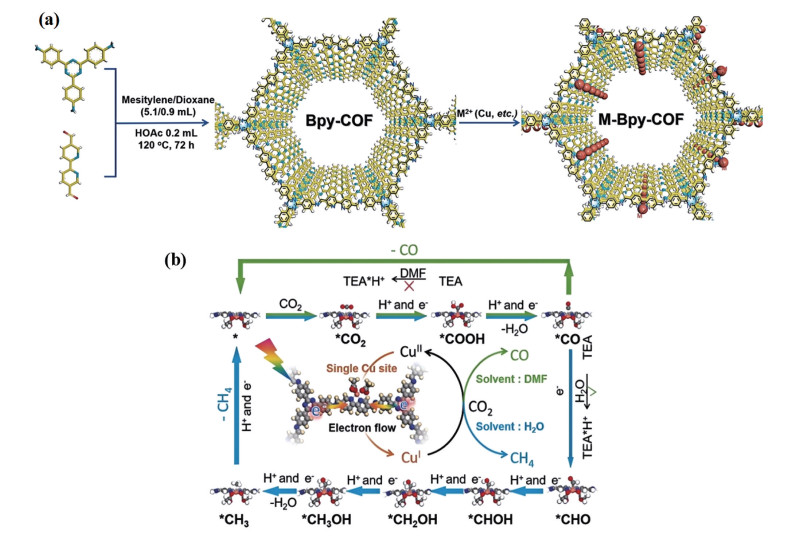
ZHANG Y Z, CAO L L, BAI G Y, LAN X W. Engineering single Cu sites into covalent organic framework for selective photocatalytic CO2 reduction[J]. Small, 2023, 19: 2300035
doi: 10.1002/smll.202300035
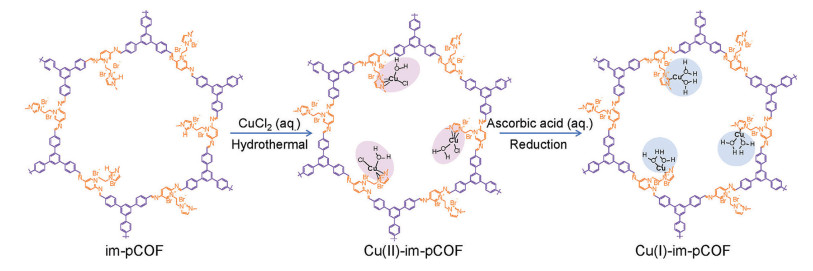
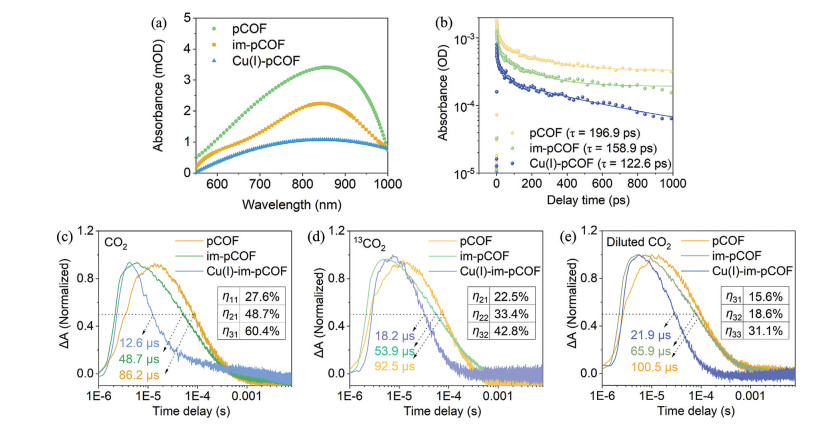
LIU Z Y, YIN H C, SUN J H, BAI L L, LI Z, ZHAO X M, YAN X D, ZHAO M, JING L Q. Engineering single Cu atoms anchored via N-heterocyclic carbene in COF mesopores for modulating electron kinetics of CO2 photoconversion[J]. Adv. Energy Mater., 2024, 14: 2401713
doi: 10.1002/aenm.202401713
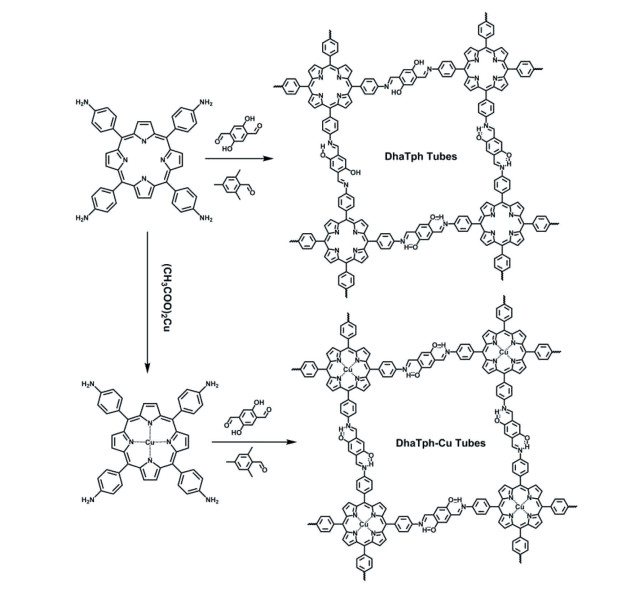
ZHANG Z H, LU J, YANG K, CAO J Y, ZHAO Y, GE K, WANG S, YANG Y, ZHANG Y, YANG Y F. DhaTph tubes and DhaTph-Cu tubes with hollow tubular structure and their photocatalytic reduction of CO2[J]. ChemistrySelect, 2022, 7: e202201203
doi: 10.1002/slct.202201203
TU W G, YANG Y Q, CHEN C P, ZHOU T H, LI T H, WANG H J, WU S Y, ZHOU Y, O′HARE D, ZOU Z G, XU R. Cu-O/N single sites incorporated 2D covalent organic framework ultrathin nanobelts for highly selective visible-light-driven CO2 reduction to CO[J]. Small Struct., 2023, 4: 2200233
doi: 10.1002/sstr.202200233
WANG J M, LEE J H, WOO T G, ZHANG Y X, JANG W D, KIM T K. Regulating Cu atom orbital state on self-built photogate catalyst for improving HCOOH selectivity of CO2 reduction[J]. Appl. Catal. B‒Environ., 2023, 324: 122287
doi: 10.1016/j.apcatb.2022.122287
Xiang-Da Zhang , Jian-Mei Huang , Xiaorong Zhu , Chang Liu , Yue Yin , Jia-Yi Huang , Yafei Li , Zhi-Yuan Gu . Auto-tandem CO2 reduction by reconstructed Cu imidazole framework isomers: Unveiling pristine MOF-mediated CO2 activation. Chinese Chemical Letters, 2025, 36(5): 109937-. doi: 10.1016/j.cclet.2024.109937
Hong Dong , Feng-Ming Zhang . Covalent organic frameworks for artificial photosynthetic diluted CO2 reduction. Chinese Journal of Structural Chemistry, 2024, 43(7): 100307-100307. doi: 10.1016/j.cjsc.2024.100307
Jiaqi Ma , Lan Li , Yiming Zhang , Jinjie Qian , Xusheng Wang . Covalent organic frameworks: Synthesis, structures, characterizations and progress of photocatalytic reduction of CO2. Chinese Journal of Structural Chemistry, 2024, 43(12): 100466-100466. doi: 10.1016/j.cjsc.2024.100466
Zixuan Zhu , Xianjin Shi , Yongfang Rao , Yu Huang . Recent progress of MgO-based materials in CO2 adsorption and conversion: Modification methods, reaction condition, and CO2 hydrogenation. Chinese Chemical Letters, 2024, 35(5): 108954-. doi: 10.1016/j.cclet.2023.108954
Fangzhou Yang , Yangmin Ma , Siyue Ma , Linli Xu . Single-atom based graphdiyne catalysts support for CO2 photo/electro-conversion. Chinese Chemical Letters, 2026, 37(10): 112516-. doi: 10.1016/j.cclet.2026.112516
Yingjin Li , Jiaming Li , Hongjun Dong , Wenli Zhang , Liqiu Zhang , Xiulian Yin , Yun Wang , Zuoyi Liu , Chunmei Li . Recent research progress on metal-organic frameworks and their derivatives heterostructure for photocatalytic CO2 reduction. Chinese Chemical Letters, 2026, 37(6): 112101-. doi: 10.1016/j.cclet.2025.112101
Yanping Qiu , Lei Ge . Low-coordination Cu3 motif for selective photocatalytic conversion of CO2 to ethanol. Chinese Journal of Structural Chemistry, 2025, 44(11): 100716-100716. doi: 10.1016/j.cjsc.2025.100716
Yidan Mao , Bingyu Li , Shuailing Ma , Siwen Cui , Zihan Zhang , Pinwen Zhu , Kongsheng Qi , Xiaodong Li , Weiwei Dong , Wei Luo , Rajeev Ahuja , Dexin Yang , Tian Cui . Metal diborides as robust and highly stable electrodes for efficient electrocatalytic reduction of CO2 to CO in ionic liquid-based electrolytes. Chinese Chemical Letters, 2026, 37(4): 111675-. doi: 10.1016/j.cclet.2025.111675
Mingming Zhang , Ting Xu , Ruonan Yin , Xueqiu Chen , Zheng-Jun Wang , Jun Li , Xin Wang , Huile Jin , Haibo Ke , Shun Wang , Jing-Jing Lv . Anode engineering for electrocatalytic CO2 reduction reaction. Chinese Chemical Letters, 2026, 37(3): 110665-. doi: 10.1016/j.cclet.2024.110665
Ruolin CHENG , Yue WANG , Fei YANG , Huagen LIANG , Shijian LU . Application of metal-organic frameworks (MOFs) in photocatalytic CO2 cycloaddition reaction: A mini review. Chinese Journal of Inorganic Chemistry, 2025, 41(12): 2429-2440. doi: 10.11862/CJIC.20250242
Xia Jiang , Yan-Xin Chen , Rui Chen , Hao-Yan Shi , Ke-Xian Li , Wen-Ya Zhong , Jian-Feng Li , Can-Zhong Lu . Thermo-photocatalytic CO2 conversion with H2O to C2 products in a continuous process by ZIF-67/biochar composites. Chinese Chemical Letters, 2026, 37(4): 111781-. doi: 10.1016/j.cclet.2025.111781
Yuxiang Zhang , Jia Zhao , Sen Lin . Nitrogen doping retrofits the coordination environment of copper single-atom catalysts for deep CO2 reduction. Chinese Journal of Structural Chemistry, 2024, 43(11): 100415-100415. doi: 10.1016/j.cjsc.2024.100415
Pu ZHANG , Youzhu YU , Yuhua GUO , Zhongyuan ZHOU . Syntheses and photocatalytic CO2 reduction properties of heterometallic Ni/Sn and Co/Sn oxo clusters. Chinese Journal of Inorganic Chemistry, 2026, 42(5): 1039-1047. doi: 10.11862/CJIC.20250353
Shu-Ran Xu , Fang-Xing Xiao . Metal halide perovskites quantum dots: Synthesis, and modification strategies for solar CO2 conversion. Chinese Journal of Structural Chemistry, 2023, 42(12): 100173-100173. doi: 10.1016/j.cjsc.2023.100173
Li Li , Fanpeng Chen , Bohang Zhao , Yifu Yu . Understanding of the structural evolution of catalysts and identification of active species during CO2 conversion. Chinese Chemical Letters, 2024, 35(4): 109240-. doi: 10.1016/j.cclet.2023.109240
Yufei Jia , Fei Li , Ke Fan . Surface reconstruction of Cu-based bimetallic catalysts for electrochemical CO2 reduction. Chinese Journal of Structural Chemistry, 2024, 43(3): 100255-100255. doi: 10.1016/j.cjsc.2024.100255
Qin Cheng , Ming Huang , Qingqing Ye , Bangwei Deng , Fan Dong . Indium-based electrocatalysts for CO2 reduction to C1 products. Chinese Chemical Letters, 2024, 35(6): 109112-. doi: 10.1016/j.cclet.2023.109112
Di Wang , Qing-Song Chen , Yi-Ran Lin , Yun-Xin Hou , Wei Han , Juan Yang , Xin Li , Zhen-Hai Wen . Tuning strategies and electrolyzer design for Bi-based nanomaterials towards efficient CO2 reduction to formic acid. Chinese Journal of Structural Chemistry, 2024, 43(8): 100346-100346. doi: 10.1016/j.cjsc.2024.100346
Xiangyu Chen , Aihao Xu , Dong Wei , Fang Huang , Junjie Ma , Huibing He , Jing Xu . Atomic cerium-doped CuOx catalysts for efficient electrocatalytic CO2 reduction to CH4. Chinese Chemical Letters, 2025, 36(1): 110175-. doi: 10.1016/j.cclet.2024.110175
Maomao Liu , Guizeng Liang , Ningce Zhang , Tao Li , Lipeng Diao , Ping Lu , Xiaoliang Zhao , Daohao Li , Dongjiang Yang . Electron-rich Ni2+ in Ni3S2 boosting electrocatalytic CO2 reduction to formate and syngas. Chinese Journal of Structural Chemistry, 2024, 43(8): 100359-100359. doi: 10.1016/j.cjsc.2024.100359
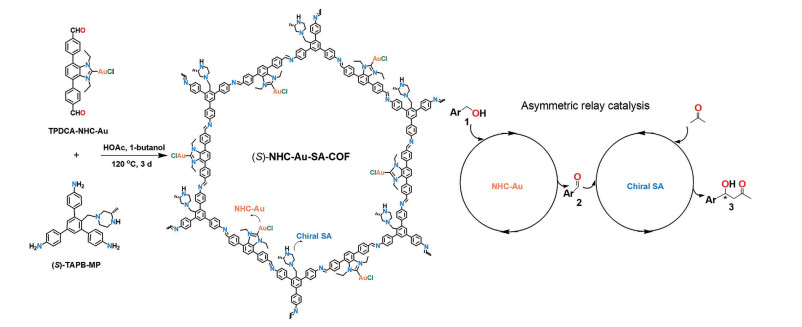
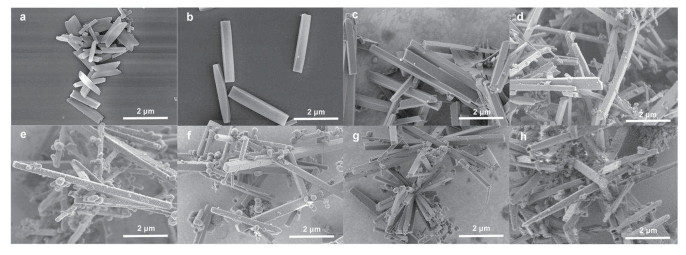
Reaction conditions: dimethylacetamide, 1,3,5-trimethylbenzene, 150 ℃, 3 d, 85% yield.
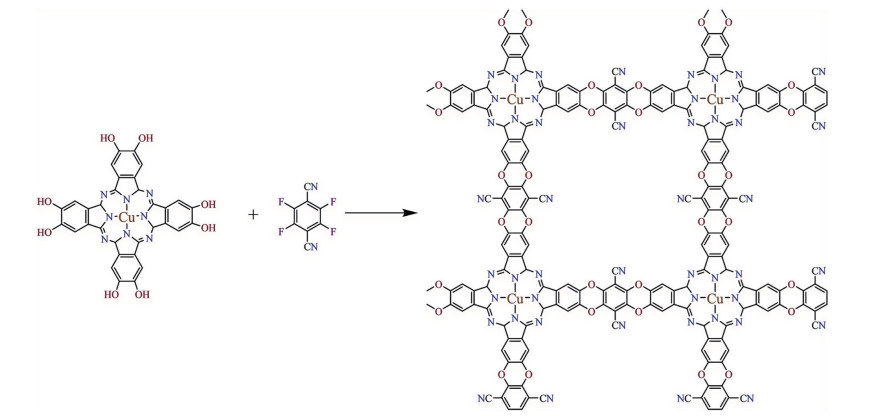
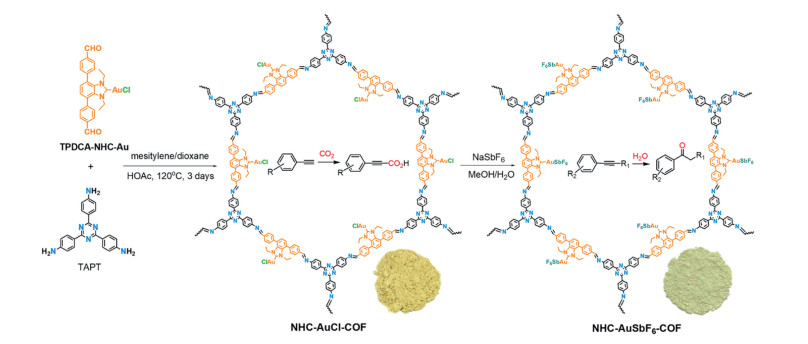
Reaction conditions: 1,4-dioxane, triethylamine, 90 ℃, 6 h.
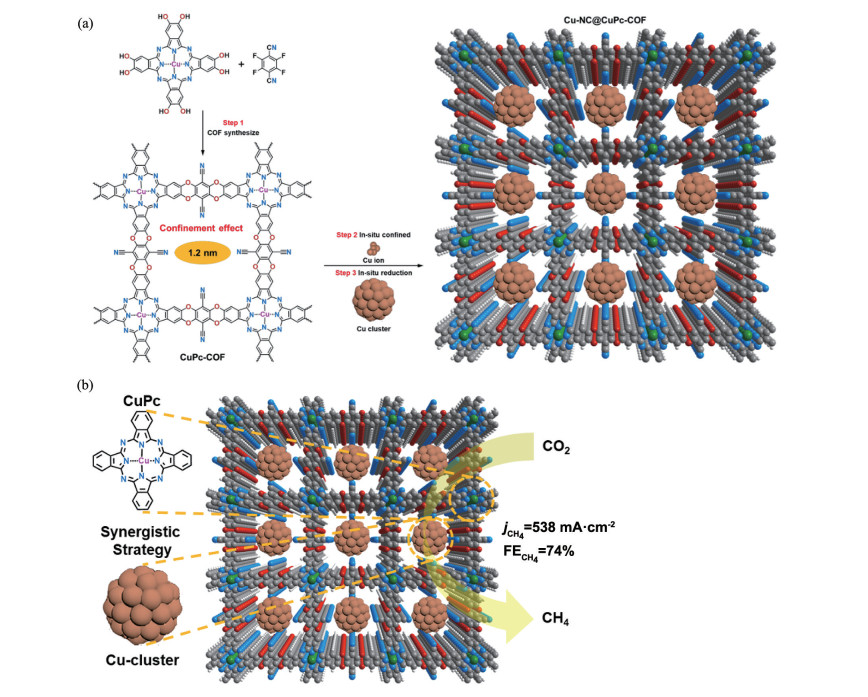
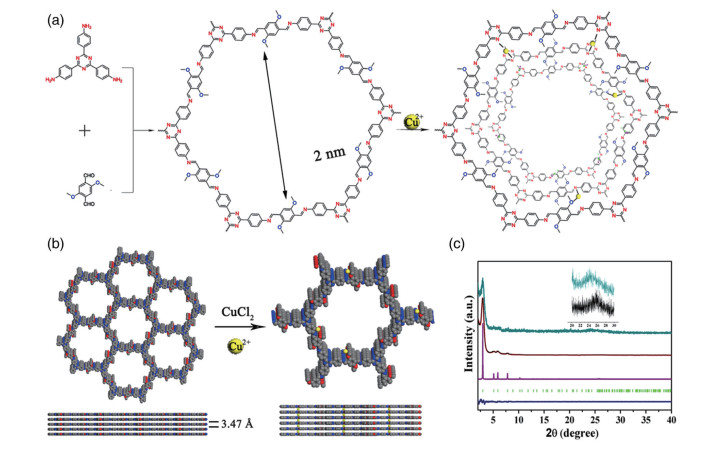
Reaction conditions: 1,2-dichlorobenzene, 1-butanol, 120 ℃, 36 h, CuCl2; In c: comparison between the experimental (black) and Pawley refined (red) profiles, the simulated pattern for AA stacking mode (purple), the refinement differences (blue), and experimental PXRD patterns for Cu-COF (dark cyan).
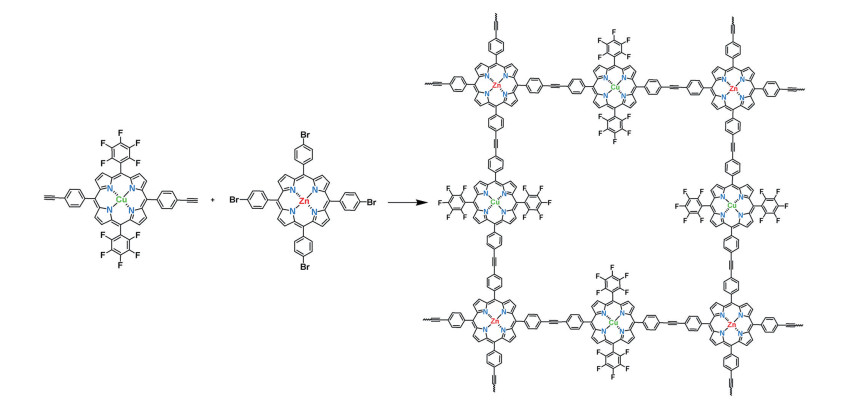
Reaction conditions: triethylamine, tetrahydrofuran, triphenylphosphine, Pd(Ⅱ) acetate, cuprous iodide, 130 ℃, 120 h.
 DownLoad: