Citation: Qiaowen CHANG, Ke ZHANG, Guangying HUANG, Nuonan LI, Weiping LIU, Fuquan BAI, Caixian YAN, Yangyang FENG, Chuan ZUO. Syntheses, structures, and photo-physical properties of iridium phosphorescent complexes with phenylpyridine derivatives bearing different substituting groups[J]. Chinese Journal of Inorganic Chemistry, ;2025, 41(2): 235-244. doi: 10.11862/CJIC.20240311 shu

Syntheses, structures, and photo-physical properties of iridium phosphorescent complexes with phenylpyridine derivatives bearing different substituting groups

Figures(6)

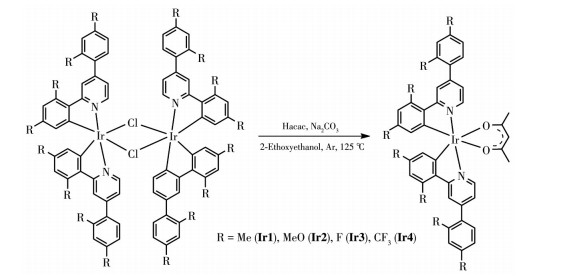
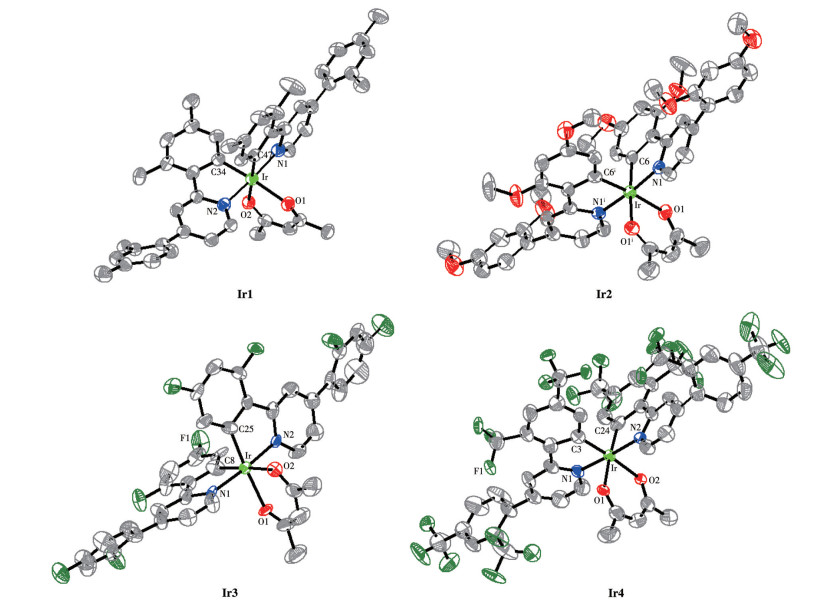
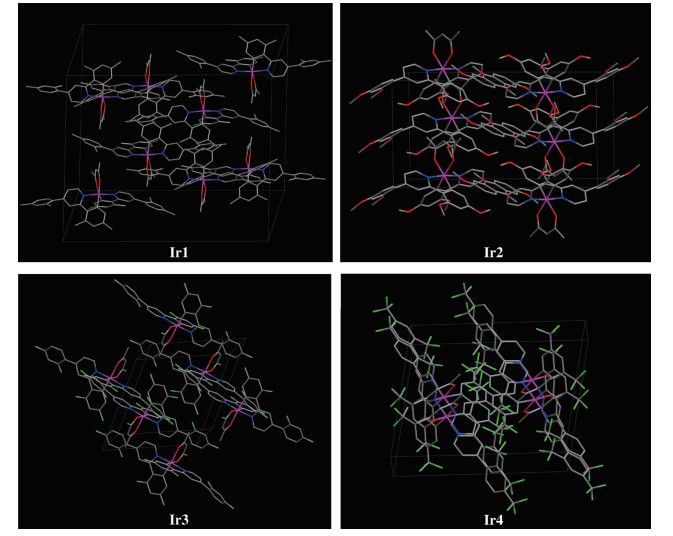
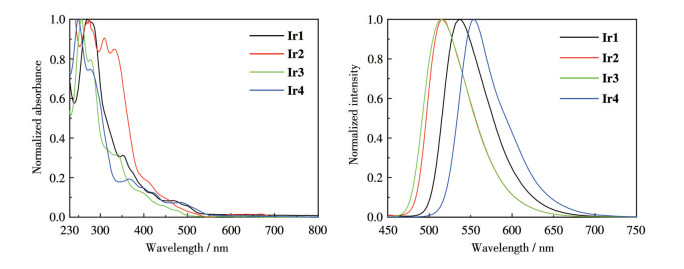
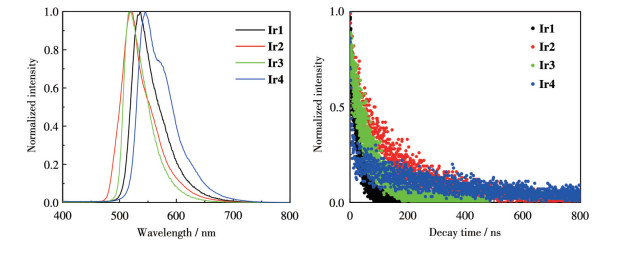
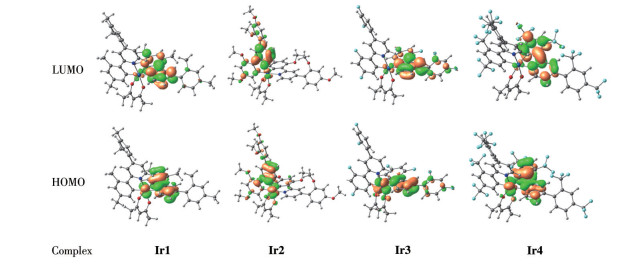
  • To study the effect of substituents on the photo-physical properties of iridium phosphorescent complexes, four identical methyl (Me), methoxy (MeO), fluorine (F), or trifluoromethyl (CF3) groups were introduced into the 2and 4-positions of the two phenyl groups onto the 2, 4-bis(2, 4-disubstituted phenyl) pyridine [2, 4-(2, 4-2R-phenyl)2py, R=Me (HL1), MeO (HL2), F (HL3), CF3 (HL4)] main ligands at the same time. Four iridium phosphorescent complexes (Ln)2Ir(acac) [n=1 (Ir1), 2 (Ir2), 3 (Ir3), 4(Ir4)] were synthesized by using HL1, HL2, HL3, or HL4 as the main ligand and acetylacetone (Hacac) as the auxiliary ligand. The composition, spatial structure, and molecular stacking of all iridium phosphorescent complexes were characterized by elemental analysis, nuclear magnetic resonance spectroscopy (1H NMR and 13C NMR), and single-crystal X-ray diffraction. The results indicated that all four iridium phosphorescent complexes exhibit slightly distorted octahedral configurations. The central iridium(Ⅲ) coordinates with the C and N atoms of the two main ligands to form a five-membered chelating ring while coordinating with the two oxygen atoms of the acetylacetone auxiliary ligand to form a stable six-membered chelating ring. The results are consistent with the chemical structure of the target compound. A comprehensive and systematic study was conducted on the photophysical properties of iridium phosphorescent complexes through solution and solid photoluminescence spectroscopy, UV Vis absorption spectroscopy, fluorescence lifetime, and theoretical calculations. The complexes Ir1, Ir2, Ir3, and Ir4 in solution with the photoluminescence quantum yields of 68%, 83%, 88%, and 81% exhibited maximum emission peaks at 537, 515, 514, and 553 nm, fluorescence lifetime of 26.75, 163.93, 64.50, and 330.39 ns, and in solid with maximum emission peaks at 536, 520, 520, and 546 nm, respectively. Four iridium phosphorescent complexes have different electron cloud distribution characteristics, and substituents can regulate the distribution of electron clouds on the benzene ring, further achieving the control of photophysical properties and chemical structure, such as emission wavelength in solution and solid-state, emission color, fluorescence lifetime, and molecular stacking.
  • 加载中
    1. [1]

      TSUJIMURA T. OLED displays fundamentals and application[M]. Hoboken: John Wiley & Sons, Inc., 2012: 5-30

    2. [2]

      REINEKE S, LINDER F, SCHWARTZ G, SEIDLER N, WALZER K, LÜSSEM B, LEO K. White organic light-emitting diodes with fluorescent tube efficiency[J]. Nature, 2009,459(7244):234-238. doi: 10.1038/nature08003

    3. [3]

      HELANDER M G, WANG Z B, QIU J, GREINER M T, PUZZO D P, LIU Z W, LU Z H. Chlorinated indium tin oxide electrodes with high work function for organic device compatibility[J]. Science, 2011,332(6032):944-947. doi: 10.1126/science.1202992

    4. [4]

      TANG C W, VANSLYKE S A. Organic electroluminescent diodes[J]. Appl. Phys. Lett., 1987,51(12):913-915. doi: 10.1063/1.98799

    5. [5]

      LIU Z W, BIAN Z Q, HUANG C H. The electroluminescence of metal complexes[M]. Beijing: Science Press, 2019: 78-96

    6. [6]

      ZHOU Y H, XU Q L, LIU C L, XU J J. Synthesis and opto-electronic property of three green iridium(Ⅲ) complexes[J]. Chinese J. Inorg. Chem., 2020,36(7):1267-1274.  

    7. [7]

      DILUZIO S, CONNELL T U, MDLULI V, KOWALEWSKI J F, BERNHARD S. Understanding Ir(Ⅲ) photocatalyst structure-activity relationships: A highly parallelized study of light-driven metal reduction processes[J]. J. Am. Chem. Soc., 2022,144(3):1431-1444. doi: 10.1021/jacs.1c12059

    8. [8]

      CHEUNG K P S, SARKAR S, GEVORGYAN V. Visible light‑ induced transition metal catalysis[J]. Chem. Rev., 2022,122(2):1543-1625. doi: 10.1021/acs.chemrev.1c00403

    9. [9]

      DONG Z, MACMILLAN D W C. Metallaphotoredox-enabled deoxygenative arylation of alcohols[J]. Nature, 2021,598(7881):451-456. doi: 10.1038/s41586-021-03920-6

    10. [10]

      CHANG Q W, CUI H, YAN C X, JIANG J, ZHAO J, YE Q S, YU J, LIU W P, CHEN J L. The effect of structure of β-diketonate ligand on the luminous performance of platinum group metals phosphorescent complex[J]. Precious Metals, 2014,35(3):88-93. doi: 10.3969/j.issn.1004-0676.2014.03.021

    11. [11]

      KING K A, SPELLANE P J, WATTS R J. Excited-state properties of a triply ortho-metalated iridium(Ⅲ) complex[J]. J. Am. Chem. Soc., 1985,107(5):1431-1432. doi: 10.1021/ja00291a064

    12. [12]

      BALDO M A, LAMANSKY S, BURROWS P E, THOMPSON M E, FORREST S R. Very high-efficiency green organic light-emitting devices based on electro-phosphorescence[J]. App. Phys. Lett., 1999,75(1):4-6. doi: 10.1063/1.124258

    13. [13]

      TAMAYO A B, ALLEYNE B D, DJUROVICH P I, LAMANSKY S, TSYBA I. Synthesis and characterization of facial and meridional tris-cyclometalated iridium(Ⅲ) complexes[J]. J. Am. Chem. Soc., 2003,125(24):7377-7387. doi: 10.1021/ja034537z

    14. [14]

      YANG X L, ZHOU G J, WONG W Y. Functionalization of phosphorescent emitters and their host material by main-group elements for phosphorescent organic light-emitting devices[J]. Chem. Soc. Rev., 2015,44(23):8484-8575. doi: 10.1039/C5CS00424A

    15. [15]

      HWANG J, JI S B, CHEON H, YOOK K S, KWON S K, KIM Y H. Orange electrophosphorescence based on bis(3, 5-dimethylphenyl)pyridine iridium(Ⅲ) complexes for non-halogenated solution processable phosphorescent organic light-emitting diode[J]. Dyes Pigment., 2018,149:719-727. doi: 10.1016/j.dyepig.2017.11.029

    16. [16]

      CHEON H J, JOO C W, LEE D Y, HUSEYNOVA G, LEE J H, LEE J, KIM Y H. Highly efficient orange phosphorescent organic light-emitting diodes with (4-(3, 5-dimethylphenyl)-2-(m-tolyl)pyridine-based iridium complex[J]. Dyes Pigment., 2021,186109006. doi: 10.1016/j.dyepig.2020.109006

    17. [17]

      CHANG Q W, CHEN Z A, FENG L, JIANG W, YAN C X, LIU W P, BAI F Q. Synthesis and photophysical properties of phenylquinoline iridium complexes controlled by electron-withdrawing groups[J]. Chinese J. Inorg. Chem., 2023,39(2):255-262.

    18. [18]

      CHANG Q W, CHEN Z A, WANG Z A, JIANG J, YU J, LIU W P, YAN C X, CHEN L. Iridium phosphorescent complexes based on the modified phenylquinoline ligand and their high-efficiency pure red organic electroluminescent device[J]. Chinese Journal of Luminescence, 2022,43(10):1583-1591. doi: 10.37188/CJL.20220134

    19. [19]

      CHANG Q W, CHEN Z A, YAN C X, LIU W P, FENG Y Y. The effect of substituent position on photophysical properties of iridium phosphorescent complexes based on substituted 2, 4-diphenylpyridine[J]. Spectrosc. Spectr. Anal., 2024,44(2):504-509.

    20. [20]

      FANG K H, WU L L, HUANG Y T, YANG C H, SUN I W. Color tuning of iridium complexes—part Ⅰ: Substituted phenylisoquinoline-based iridium complexes as the triplet emitter[J]. Inorg. Chim. Acta, 2006,359(2):441-450. doi: 10.1016/j.ica.2005.10.003

    21. [21]

      TAO P. Design, synthesis, and excited states tuning of highly efficient iridium(Ⅲ) complexes for applications in optoelectronics[D]. Taiyuan: Taiyuan University of Technology, 2017: 41-79

    22. [22]

      WANG J, BAI F Q, XIA B H, SUN L, ZHANG H X. Theoretical understanding of ruthenium􀃭 based fluoride sensor derived from 4, 5-bis(benzimidazol-2-yl) imidazole (H3ImBzim) and bipyridine: Electronic structure and binding nature[J]. J. Phys. Chem. A, 2011,115(10):1985-1991. doi: 10.1021/jp1088383

    23. [23]

      XIE M, CHEN J, BAI F Q, WEI W, ZHANG H X. Theoretical studies on the interaction of ruthenium sensitizers and redox couple in different deprotonation situations[J]. J. Phys. Chem. A, 2014,118(12):2244-2252. doi: 10.1021/jp410220q

    24. [24]

      LEE C, YANG W, PARR R G. Development of the colle-salvetti correlation-energy formula into a functional of the electron density[J]. Phys. Rev. B, 1988,37(2):785-789. doi: 10.1103/PhysRevB.37.785

  • 加载中
    1. [1]

      Cong Liu ,  Yuling Huang ,  Peng Zhen ,  Hualiu Li ,  Bingjia Xu ,  Suilian Luo ,  Guang Shi . A Comprehensive Design Experiment: Preparation and Property Characterization of Polymer Room-Temperature Phosphorescence Materials. University Chemistry, 2026, 41(4): 409-416. doi: 10.12461/PKU.DXHX202503092

    2. [2]

      Yi DING , Peiyu LIAO , Jianhua JIA , Mingliang TONG . Structure and photoluminescence modulation of silver(Ⅰ)-tetra(pyridin-4-yl)ethene metal-organic frameworks by substituted benzoates. Chinese Journal of Inorganic Chemistry, 2025, 41(1): 141-148. doi: 10.11862/CJIC.20240393

    3. [3]

      Wenjuan SHI , Yuxuan LEI , Lei HOU , Yaoyu WANG . Synthesis, structure, and luminescence properties of trinucluear Cu(Ⅰ)-pyrazole complexes containing different substituent groups. Chinese Journal of Inorganic Chemistry, 2026, 42(3): 543-550. doi: 10.11862/CJIC.20250270

    4. [4]

      Hongjie SHEN , Haozhe MIAO , Yuhe YANG , Yinghua LI , Deguang HUANG , Xiaofeng ZHANG . Synthesis, crystal structure, and fluorescence properties of two Cu(Ⅰ) complexes based on pyridyl ligand. Chinese Journal of Inorganic Chemistry, 2025, 41(5): 855-863. doi: 10.11862/CJIC.20250009

    5. [5]

      Xiaotong LU , Pan ZHANG , Zijie ZHAO , Lei HUANG , Hongwei ZUO , Lili LIANG . Antitumor and antibacterial activities of pyridyl Schiff base indium and dysprosium complexes. Chinese Journal of Inorganic Chemistry, 2025, 41(8): 1523-1532. doi: 10.11862/CJIC.20250073

    6. [6]

      Huilin ZHENG , Tao WANG , Ruilin GAO , Mengke ZHOU , Xinyue LI , Hui WANG , Xiaoxia GU . Antitumor and antibacterial activities of transition metal complexes incorporating pyridyl salicylaldehyde Schiff base. Chinese Journal of Inorganic Chemistry, 2026, 42(5): 897-905. doi: 10.11862/CJIC.20250358

    7. [7]

      Zhaoyang WANG , Chun YANG , Yaoyao Song , Na HAN , Xiaomeng LIU , Qinglun WANG . Lanthanide(Ⅲ) complexes derived from 4′-(2-pyridyl)-2, 2′∶6′, 2″-terpyridine: Crystal structures, fluorescent and magnetic properties. Chinese Journal of Inorganic Chemistry, 2024, 40(8): 1442-1451. doi: 10.11862/CJIC.20240114

    8. [8]

      Zhengkun QIN , Zicong PAN , Hui TIAN , Wanyi ZHANG , Mingxing SONG . A series of iridium(Ⅲ) complexes with fluorophenyl isoquinoline ligand and low-efficiency roll-off properties: A density functional theory study. Chinese Journal of Inorganic Chemistry, 2025, 41(6): 1235-1244. doi: 10.11862/CJIC.20240429

    9. [9]

      Zhengkun QIN , Lixin BAO , Yunkai ZHANG , Lin CUI , Jinyu WANG , Yuhao WANG , Mingxing SONG . Theoretical study on the thermally activated delayed fluorescence, and efficiency roll-off characteristics of a series of blue and blue-green Ir(Ⅲ) complexes. Chinese Journal of Inorganic Chemistry, 2026, 42(2): 365-374. doi: 10.11862/CJIC.20250222

    10. [10]

      Yingchun ZHANG , Yiwei SHI , Ruijie YANG , Xin WANG , Zhiguo SONG , Min WANG . Dual ligands manganese complexes based on benzene sulfonic acid and 2, 2′-bipyridine: Structure and catalytic properties and mechanism in Mannich reaction. Chinese Journal of Inorganic Chemistry, 2024, 40(8): 1501-1510. doi: 10.11862/CJIC.20240078

    11. [11]

      Liyang ZHANG , Dongdong YANG , Ning LI , Yuanyu YANG , Qi MA . Crystal structures, luminescent properties and Hirshfeld surface analyses of three cadmium(Ⅱ) complexes based on 2-(3-(pyridin-2-yl)-1H-pyrazol-1-yl)benzoate. Chinese Journal of Inorganic Chemistry, 2024, 40(10): 1943-1952. doi: 10.11862/CJIC.20240079

    12. [12]

      Lifang HE , Wenjie TANG , Yaoze LUO , Mingsheng LIANG , Jianxin TANG , Yuxuan WU , Fuxing ZHANG , Xiaoming ZHU . Synthesis, structure, and anticancer activity of two dialkyltin complexes constructed based on 2, 2′-bipyridin-6, 6′-dicarboxylic acid. Chinese Journal of Inorganic Chemistry, 2025, 41(8): 1601-1609. doi: 10.11862/CJIC.20250012

    13. [13]

      Qilu DU , Li ZHAO , Peng NIE , Bo XU . Synthesis and characterization of osmium-germyl complexes stabilized by triphenyl ligands. Chinese Journal of Inorganic Chemistry, 2024, 40(6): 1088-1094. doi: 10.11862/CJIC.20240006

    14. [14]

      Yahui HAN , Jinjin ZHAO , Ning REN , Jianjun ZHANG . Synthesis, crystal structure, thermal decomposition mechanism, and fluorescence properties of benzoic acid and 4-hydroxy-2, 2′: 6′, 2″-terpyridine lanthanide complexes. Chinese Journal of Inorganic Chemistry, 2025, 41(5): 969-982. doi: 10.11862/CJIC.20240395

    15. [15]

      Xiao SANG , Qi LIU , Jianping LANG . Synthesis, structure, and fluorescence properties of Zn(Ⅱ) coordination polymers containing tetra-alkenylpyridine ligands. Chinese Journal of Inorganic Chemistry, 2024, 40(11): 2124-2132. doi: 10.11862/CJIC.20240158

    16. [16]

      Hanxue LIU , Shijie LI , Meng REN , Xuling XUE , Hongke LIU . Design and antitumor properties of dehydroabietic acid functionalized cyclometalated iridium(Ⅲ) complex. Chinese Journal of Inorganic Chemistry, 2025, 41(8): 1483-1494. doi: 10.11862/CJIC.20250031

    17. [17]

      Ke QIAO , Yanlin LI , Shengli HUANG , Guoyu YANG . Advancements in asymmetric catalysis employing chiral iridium (ruthenium) complexes. Chinese Journal of Inorganic Chemistry, 2024, 40(11): 2091-2104. doi: 10.11862/CJIC.20240265

    18. [18]

      Wenjing ZHANG , Xiaoqing WANG , Zhipeng LIU . Recent developments of inorganic metal complex-based photothermal materials and their applications in photothermal therapy. Chinese Journal of Inorganic Chemistry, 2024, 40(12): 2356-2372. doi: 10.11862/CJIC.20240254

    19. [19]

      Mengyu LI , Kewei TONG , Li ZHANG , Minghua LU , Abudula , Luwen ZHU , Yi LIU , Luying WANG , Baiqiao SONG , Zunqi LIU , Peng YANG , Yanhu WANG . Functionalizing the cavities of imidazolyl polyoxovanadate‒organic polyhedra with embedded pyridine to modulate iodine adsorption. Chinese Journal of Inorganic Chemistry, 2026, 42(9): 1974-1983. doi: 10.11862/CJIC.20260154

    20. [20]

      Xuyu WANG , Xinran XIE , Dengke CAO . Photoreaction characteristics and luminescence modulation in phosphine-anthracene-based Au(Ⅰ) and Ir(Ⅲ) complexes. Chinese Journal of Inorganic Chemistry, 2025, 41(8): 1513-1522. doi: 10.11862/CJIC.20250113

Metrics
  • PDF Downloads(23)
  • Abstract views(4001)
  • HTML views(771)

通讯作者: 陈斌, bchen63@163.com
  • 1. 

    沈阳化工大学材料科学与工程学院 沈阳 110142

  1. 本站搜索
  2. 百度学术搜索
  3. 万方数据库搜索
  4. CNKI搜索
Address:Zhongguancun North First Street 2,100190 Beijing, PR China Tel: +86-010-82449177-888
Powered By info@rhhz.net

/

DownLoad:  Full-Size Img  PowerPoint
Return