Citation: Cao Shanshan, Liu Zhaohong, Yuan Haiyan, Yang Liu, Zhang Jingping, Bi Xihe. Computational Studies on Reaction Mechanism of the Catalyst-Controlled Selective Insertion of Metal Carbenoids into C-C and C-H Bonds of 1, 3-Dicarbonyl Compounds[J]. Chinese Journal of Organic Chemistry, ;2020, 40(8): 2468-2475. doi: 10.6023/cjoc202003003 shu

Computational Studies on Reaction Mechanism of the Catalyst-Controlled Selective Insertion of Metal Carbenoids into C-C and C-H Bonds of 1, 3-Dicarbonyl Compounds

  • Corresponding author: Liu Zhaohong, liuzh944@nenu.edu Zhang Jingping, zhangjp162@nenu.edu.cn Bi Xihe, bixh507@nenu.edu.cn
  • Received Date: 2 March 2020
    Revised Date: 13 May 2020
    Available Online: 19 May 2020

    Fund Project: the National Natural Science Foundation of China 21871043Project supported by the National Natural Science Foundation of China (Nos. 21871043, 21961130376)the National Natural Science Foundation of China 21961130376

Figures(8)

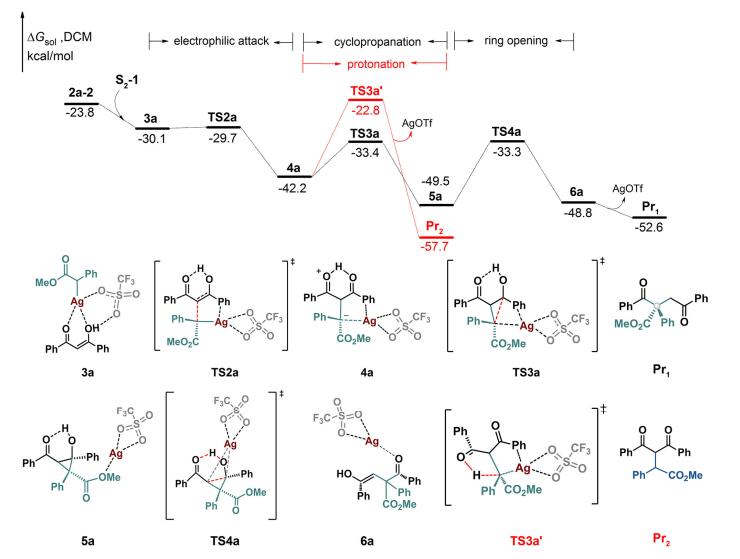
  • Density functional theory (DFT) calculations were carried out to investigate the mechanism and chemoselectivity of silver-or scandium-catalyzed insertion of diazo compounds into C-C or C-H bonds of 1, 3-dicarbonyl compounds. The results show that silver and scandium carbenes are readily generated by metal-induced extrusion of nitrogen from diazo compounds. When low-coordinated silver(I) is used as the catalyst, carbene insertion into the C-C bond of 1, 3-dicarbonyls leads to 1, 4-dicarbonyl product containing an all-carbon α-quaternary center, through a cascade sequence of electrophilic addition, intramolecular cyclization, selective ring-opening and enol isomerization. When highly coordinated scandium(III) is used, carbene insertion into C-H bond of 1, 3-dicarbonyls leads to 1, 3-dicarbonyl product containing α-tertiary center, through a cascade sequence of electrophilic addition and protonation. Computational studies show that the chemoselectivity results from the cooperative effect of ring tension and the difference in coordination number of metal centers, which provides useful insight into the development of transition metal-catalyzed carbene transfer reactions.
  • 加载中
    1. [1]

      (a) Quasdorf, K. W.; Overman, L. E. Nature 2014, 516, 181.
      (b) Long, R.; Huang, J.; Gong, J. X.; Yang, Z. Nat. Prod. Rep. 2015, 32, 1584.
      (c) Zeng, X.; Cao, Z.; Wang, Y.; Zhou, F.; Zhou, J. Chem. Rev. 2016, 116, 7330.
      (d) Ling, T.; Rivas, F. Tetrahedron 2016, 72, 6729.
      (e) Shimizu, M. Angew. Chem., Int. Ed. 2011, 50, 5998.
      (f) Wang, B.; Tu, Y. Acc. Chem. Res. 2011, 44, 1207.

    2. [2]

      Christoffers, J.; Baro, A. Quaternary Stereocenters: Challenges and Solutions for Organic Synthesis, Wiley-VCH, Weinheim, 2005.

    3. [3]

      (a) Fumagalli, G.; Stanton, S.; Bower, J. F. Chem. Rev. 2017, 117, 9404.
      (b) Chen, F.; Wang, T.; Jiao, N. Chem. Rev. 2014, 114, 8613.

    4. [4]

      (a) Candeias, N. R.; Paterna, R.; Gois, M. P. Chem. Rev. 2016, 116, 2937.
      (b) Guttenberger, N.; Breinbauer, R. Tetrahedron 2017, 73, 6815.
      (c) Li, W.; Liu, X.; Tan, F.; Hao, X.; Zheng, J.; Lin, L.; Feng, X. Angew. Chem., Int. Ed. 2013, 52, 10883.
      (d) Li, W.; Liu, X.; Hao, Y.; Cai, Y.; Lin, L.; Feng, X. Angew. Chem., Int. Ed. 2012, 51, 8644.
      (e) Moebius, D. C.; Kingsbury, J. S. J. Am. Chem. Soc. 2009, 131, 878.
      (f) Hashimoto, T.; Naganawa, Y.; Maruoka, K. J. Am. Chem. Soc. 2008, 130, 2434.

    5. [5]

      (a) Xia, Y.; Liu, Z. X.; Liu, Z.; Ge, R.; Ye, F.; Hossain, M.; Zhang, Y.; Wang, J. J. Am. Chem. Soc. 2014, 136, 3013.
      (b) Wang, Y.; Wang, Y.; Zhang, W. J.; Zhu, Y.; Wei, D.; Tang, M. Org. Biomol. Chem. 2015, 13, 6587.

    6. [6]

      (a) Liu, Z.; Sivaguru, P.; Zanoni, G.; Anderson, E. A.; Bi, X. Angew. Chem., Int. Ed. 2018, 57, 8927.
      (b) Liu, Z.; Zhang, X.; Virelli, M.; Zanoni, G.; Anderson, E. A.; Bi, X. iScience 2018, 8, 54.

    7. [7]

    8. [8]

      (a) Zhan, G.; Du, W.; Chen, Y. Chem. Soc. Rev. 2017, 46, 1675.
      (b) Mahatthananchai, J.; Dumas, A. M.; Bode, J. W. Angew. Chem., Int. Ed. 2012, 51, 10954.
      (c) Schreiber, S. L. Science 2000, 287, 1964.

    9. [9]

      Liu, F.; Zhu, L.; Zhang, T.; Zhong, K.; Xiong, Q.; Shen, B.; Liu, S.; Lan, Y.; Bai, R. ACS Catal. 2020, 10, 1256.  doi: 10.1021/acscatal.9b02040

    10. [10]

      Frisch, M. J.; Trucks, G. W.; Schlegel, H. B.; Scuseria, G. E.; Robb, M. A.; Cheeseman, J. R.; Scalmani, G.; Barone, V.; Mennucci, B.; Petersson, G. A.; Nakatsuji, H.; Caricato, M.; Li, X.; Hratchian, H. P.; Izmaylov, A. F.; Bloino, J.; Zheng, G.; Sonnenberg, J. L.; Hada, M.; Ehara, M.; Toyota, K.; Fukuda, R.; Hasegawa, J.; Ishida, M.; Nakajima, T.; Honda, Y.; Kitao, O.; Nakai, H.; Vreven, T.; Montgomery, Jr., J. A.; Peralta, J. E.; Ogliaro, F.; Bearpark, M.; Heyd, J. J.; Brothers, E.; Kudin, K. N.; Staroverov, V. N.; Kobayashi, R.; Normand, J.; Raghavachari, K.; Rendell, A.; Burant, J. C.; Iyengar, S. S.; Tomasi, J.; Cossi, M.; Rega, N.; Millam, N. J.; Klene, M.; Knox, J. E.; Cross, J. B.; Bakken, V.; Adamo, C.; Jaramillo, J.; Gomperts, R.; Stratmann, R. E.; Yazyev, O.; Austin, A. J.; Cammi, R.; Pomelli, C.; Ochterski, J. W.; Martin, R. L.; Morokuma, K.; Zakrzewski, V. G.; Voth, G. A.; Salvador, P.; Dannenberg, J. J.; Dapprich, S.; Daniels, A. D.; Farkas, Ö.; Foresman, J. B.; Ortiz, J. V.; Cioslowski, J.; Fox, D. J. Gaussian 09, Revision A.02, Gaussian Inc., Wallingford, CT, 2009.

    11. [11]

      (a) Becke, A. D. Phys. Rev. A 1988, 38, 3098.
      (b) Becke, A. D. J. Chem. Phys. 1993, 98, 5648.
      (c) Lee, C.; Yang, W.; Parr, R. G. Phys. Rev. B 1988, 37, 785.
      (d) Qi, X.; Zhang, H.; Shao, A.; Zhu, L.; Xu, T.; Gao, M.; Liu, C.; Lan, Y. ACS Catal. 2015, 5, 6640.
      (e) Xiao, P.; Yuan, H.; Liu, J.; Zheng, Y.; Bi, X.; Zhang, J. ACS Catal. 2015, 5, 6177.

    12. [12]

      (a) Schwerdtfeger, P.; Dolg, M.; Schwarz, W. H. E.; Bowmaker, G. A.; Boyd, P. D. W. J. Chem. Phys. 1989, 91, 1762.
      (b) Dolg, M.; Wedig, U.; Stoll, H.; Preuss, H. J. Chem. Phys. 1987, 86, 866.

    13. [13]

      (a) Fukui, K. J. Phys. Chem. 1970, 74, 4161.
      (b) Fukui, K. Acc. Chem. Res. 1981, 14, 363.

    14. [14]

      Peverati, R.; Truhlar, D. G. Phys. Chem. Chem. Phys. 2012, 14, 16187.  doi: 10.1039/c2cp42576a

    15. [15]

      (a) Ji, C. L.; Hong, X. J. Am. Chem. Soc. 2017, 139, 15522.
      (b) Yang, Y. F.; Cheng, G. J.; Liu, P.; Leow, D.; Sun, T. Y.; Chen, P.; Zhang, X.; Yu, J. Q.; Wu, Y. D.; Houk, K. N. J. Am. Chem. Soc. 2014, 136, 344.
      (c) Xu, X.; Liu, P.; Shu, X. Z.; Tang, W.; Houk, K. N. J. Am. Chem. Soc. 2013, 135, 9271.
      (d) Komagawa, S.; Wang, C.; Morokuma, K.; Saito, S.; Uchiyama, M. J. Am. Chem. Soc. 2013, 135, 14508.
      (e) Liu, P.; Xu, X.; Dong, X.; Keitz, B. K.; Herbert, M. B.; Grubbs, R. H.; Houk, K. N. J. Am. Chem. Soc. 2012, 134, 1464.

    16. [16]

      (a) Liu, F.; Zhu, L.; Zhang, T.; Zhong, K.; Xiong, Q.; Shen, B.; Liu, S.; Lan, Y.; Bai, R. ACS Catal. 2020, 10, 1256.
      (b) Xiao, P.; Yuan, H.; Liu, J.; Zheng, Y.; Bi, X.; Zhang, J. ACS Catal. 2015, 5, 6177.
      (c) Qi, X.; Zhang, H.; Shao, A.; Zhu, L.; Xu, T.; Gao, M.; Liu, C.; Lan, Y. ACS Catal. 2015, 5, 6640.
      (d) Daru, J.; Benda, Z.; Póti, Á.; Novák, Z.; Stirling, A. Chem.-Eur. J. 2014, 20, 15395.
      (e) Zhou, B.; Yan, T.; Xue, X.-S.; Cheng, J.-P. Org. Lett. 2016, 18, 6128.

    17. [17]

      Marenich, A. V.; Cramer, C. J.; Truhlar, D. G. J. Phys. Chem. B 2009, 113, 6378.  doi: 10.1021/jp810292n

    18. [18]

      Legault, C. Y. CYLview, version 1.0b, 2009 http://www.cylview.org/.

    19. [19]

      (a) Hu, X.; Tang, Y.; Gantzel, P.; Meyer, K. Organometallics 2003, 22, 612.
      (b) Liu, Q.-X.; Yao, Z.-Q.; Zhao, X.-J.; Chen, A.-H.; Yang, X.-Q.; Liu, S.-W.; Wang, X.-G. Organometallics 2011, 30, 3732.

    20. [20]

      Zhang, J.; Shan, C.; Zhang, T.; Song, J.; Liu, T.; Lan, Y. Coord. Chem. Rev. 2019, 382, 69.  doi: 10.1016/j.ccr.2018.12.009

  • 加载中
    1. [1]

      Jie ZHAOSen LIUQikang YINXiaoqing LUZhaojie WANG . Theoretical calculation of selective adsorption and separation of CO2 by alkali metal modified naphthalene/naphthalenediyne. Chinese Journal of Inorganic Chemistry, 2024, 40(3): 515-522. doi: 10.11862/CJIC.20230385

    2. [2]

      Hao XURuopeng LIPeixia YANGAnmin LIUJie BAI . Regulation mechanism of halogen axial coordination atoms on the oxygen reduction activity of Fe-N4 site: A density functional theory study. Chinese Journal of Inorganic Chemistry, 2025, 41(4): 695-701. doi: 10.11862/CJIC.20240302

    3. [3]

      Tongqi Ye Yanqing Wang Qi Wang Huaiping Cong Xianghua Kong Yuewen Ye . Reform of Classical Thermodynamics Curriculum from the Perspective of Computational Chemistry. University Chemistry, 2025, 40(7): 387-392. doi: 10.12461/PKU.DXHX202409128

    4. [4]

      Weina Wang Lixia Feng Fengyi Liu Wenliang Wang . Computational Chemistry Experiments in Facilitating the Study of Organic Reaction Mechanism: A Case Study of Electrophilic Addition of HCl to Asymmetric Alkenes. University Chemistry, 2025, 40(3): 206-214. doi: 10.12461/PKU.DXHX202407022

    5. [5]

      Chenxu Gong Weizhen Wang Ruiying Zhang Wenfeng Wang Yuanming Li Yaofeng Yuan Keyin Ye . Computational Chemistry-Assisted Organic Structure Analysis (CCAOSA): A Case Study of Propeller-Shaped Hexabenzotriphenylene. University Chemistry, 2026, 41(4): 438-446. doi: 10.12461/PKU.DXHX202503076

    6. [6]

      Kaifu Zhang Shan Gao Bin Yang . Application of Theoretical Calculation with Fun Practice in Raman Spectroscopy Experimental Teaching. University Chemistry, 2025, 40(3): 62-67. doi: 10.12461/PKU.DXHX202404045

    7. [7]

      Jie ZHAOHuili ZHANGXiaoqing LUZhaojie WANG . Theoretical calculations of CO2 capture and separation by functional groups modified 2D covalent organic framework. Chinese Journal of Inorganic Chemistry, 2025, 41(2): 275-283. doi: 10.11862/CJIC.20240213

    8. [8]

      Zhiming Feng Lili Wu Chengming Wang . Doubly Oxidized Carbene. University Chemistry, 2025, 40(9): 326-331. doi: 10.12461/PKU.DXHX202411008

    9. [9]

      Jiaqi ANYunle LIUJianxuan SHANGYan GUOCe LIUFanlong ZENGAnyang LIWenyuan WANG . Reactivity of extremely bulky silylaminogermylene chloride and bonding analysis of a cubic tetragermylene. Chinese Journal of Inorganic Chemistry, 2024, 40(8): 1511-1518. doi: 10.11862/CJIC.20240072

    10. [10]

      Meifeng Zhu Jin Cheng Kai Huang Cheng Lian Shouhong Xu Honglai Liu . Classical Density Functional Theory for Understanding Electrochemical Interface. University Chemistry, 2025, 40(3): 148-152. doi: 10.12461/PKU.DXHX202405166

    11. [11]

      Wei SunYongjing WangKun XiangSaishuai BaiHaitao WangJing ZouArramelJizhou Jiang . CoP Decorated on Ti3C2Tx MXene Nanocomposites as Robust Electrocatalyst for Hydrogen Evolution Reaction. Acta Physico-Chimica Sinica, 2024, 40(8): 2308015-0. doi: 10.3866/PKU.WHXB202308015

    12. [12]

      Xiaochen ZhangFei YuJie Ma . Cutting-Edge Applications of Multi-Angle Numerical Simulations for Capacitive Deionization. Acta Physico-Chimica Sinica, 2024, 40(11): 2311026-0. doi: 10.3866/PKU.WHXB202311026

    13. [13]

      Xinwan ZhaoYue CaoMinjun LeiZhiliang JinTsubaki Noritatsu . Constructing S-scheme heterojunctions by integrating covalent organic frameworks with transition metal sulfides for efficient noble-metal-free photocatalytic hydrogen evolution. Acta Physico-Chimica Sinica, 2025, 41(12): 100152-0. doi: 10.1016/j.actphy.2025.100152

    14. [14]

      Yuai Duan Xuanyu Gan Yao Fu Yingjie Cao Hongliang Han Zhanfang Ma . Application and Innovative Design of Digital Technology in the Preparation Experiment of Cis(Trans)-Diglycine Copper Complexes. University Chemistry, 2026, 41(1): 373-381. doi: 10.12461/PKU.DXHX202504048

    15. [15]

      Shuangshuang Mao Juhua Luo Bingjie Han Jiahuan Shi Yujia Gu . Covalent organic framework-derived Fe3C/NC/TiO2 heterostructures for high-performance electromagnetic wave absorption. Acta Physico-Chimica Sinica, 2026, 42(7): 100290-. doi: 10.1016/j.actphy.2026.100290

    16. [16]

      Hong RAOYang HUYicong MAChunxin LÜWei ZHONGLihua DU . Synthesis and in vitro anticancer activity of phenanthroline-functionalized nitrogen heterocyclic carbene homo- and heterobimetallic silver/gold complexes. Chinese Journal of Inorganic Chemistry, 2024, 40(12): 2429-2437. doi: 10.11862/CJIC.20240275

    17. [17]

      Chi Li Jichao Wan Qiyu Long Hui Lv Ying XiongN-Heterocyclic Carbene (NHC)-Catalyzed Amidation of Aldehydes with Nitroso Compounds. University Chemistry, 2024, 39(5): 388-395. doi: 10.3866/PKU.DXHX202312016

    18. [18]

      Yupeng TANGHaiying YANGFan JINNan LI . Hydrogen storage properties of C6S6Li6: A density functional theory study. Chinese Journal of Inorganic Chemistry, 2025, 41(9): 1827-1839. doi: 10.11862/CJIC.20240460

    19. [19]

      Ming Chen Zhenbo Mo . Research Progress on the Synthesis, Structure, and Chemical Reactivity of Borylenes. University Chemistry, 2026, 41(4): 250-263. doi: 10.12461/PKU.DXHX202502123

    20. [20]

      Baitong Wei Jinxin Guo Xigong Liu Rongxiu Zhu Lei Liu . Theoretical Study on the Structure, Stability of Hydrocarbon Free Radicals and Selectivity of Alkane Chlorination Reaction. University Chemistry, 2025, 40(3): 402-407. doi: 10.12461/PKU.DXHX202406003

Metrics
  • PDF Downloads(31)
  • Abstract views(3456)
  • HTML views(696)

通讯作者: 陈斌, bchen63@163.com
  • 1. 

    沈阳化工大学材料科学与工程学院 沈阳 110142

  1. 本站搜索
  2. 百度学术搜索
  3. 万方数据库搜索
  4. CNKI搜索
Address:Zhongguancun North First Street 2,100190 Beijing, PR China Tel: +86-010-82449177-888
Powered By info@rhhz.net

/

DownLoad:  Full-Size Img  PowerPoint
Return