Login In
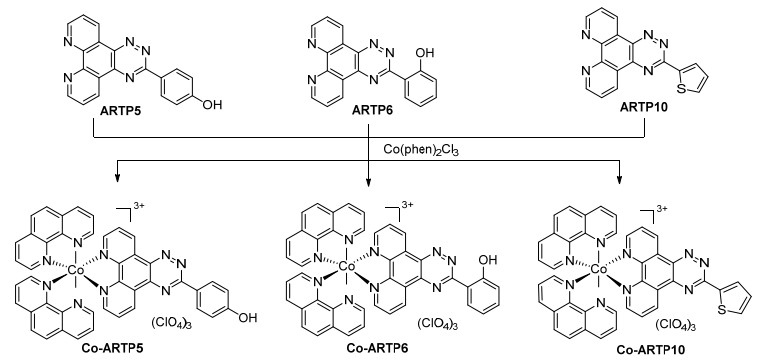
Synthesis and Bioactivities of Novel 1, 2, 4-Triazine Scheleton Phenanthroline Derivatives and the Fluorescent Recognition on DNA Using Three Novel Co (Ⅲ) Complexes
- Corresponding author: Zhang Chenglu, zhangchenglu@lnnu.edu.cn
Figures(9)
Citation:
Zhang Chenglu, Li Yizheng, Li Jingyi, Li Yilin, Gong Rongqing, Wang Huayu. Synthesis and Bioactivities of Novel 1, 2, 4-Triazine Scheleton Phenanthroline Derivatives and the Fluorescent Recognition on DNA Using Three Novel Co (Ⅲ) Complexes[J]. Chinese Journal of Organic Chemistry,
;2018, 38(10): 2720-2730.
doi:
10.6023/cjoc201803048

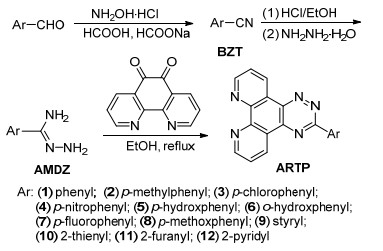
Figures(9)


Mak, L. H.; Knott, J.; Scott, K. A.; Scott, C.; Whyte, G. F.; Ye, Y.; Mann, D. J.; Ces, O.; Stivers, J.; Woscholski, R. Bioorg. Med. Chem. 2012, 20, 4371.
doi: 10.1016/j.bmc.2012.05.040
He, X. P.; Deng, Q.; Gao, L. X.; Li, C.; Zhang, W.; Zhou, Y. B.; Tang, Y.; Shi, X. X.; Xie J.; Li J.; Chen, G. R.; Chen, K. X. Bioorg. Med. Chem. 2011, 19, 3892.
doi: 10.1016/j.bmc.2011.05.049
Sarkis, M.; Tran, D. N.; Kolb, S.; Miteva, M. A.; Villoutreix, B. O.; Garbay, C.; Braud, E. Bioorg. Med. Chem. Lett. 2012, 22, 7345.
doi: 10.1016/j.bmcl.2012.10.072
B urle, S.; Blume, T.; Günther, J.; Henschel, D.; Hillig, R. C.; Husemann, M.; Mengel, A.; Parchmann, C.; Schmid, E.; Skuballa, W. Bioorg. Med. Chem. Lett. 2004, 14, 1673.
doi: 10.1016/j.bmcl.2004.01.052
Barton, J. K.; Danishefsky, A.; Goldberg, J. J. Am. Chem. Soc. 1984, 106, 2172.
doi: 10.1021/ja00319a043
Demeunynck, M.; Bailly, C.; Wilson, W. D. DNA and RNA Binders, From Small Molecules to Drugs, Vol. 1, Wiley-VCH, Weinheim, 2003.
Masood, M. A.; Hodgson, D. J. Inorg. Chem. 1993, 32, 4839.
doi: 10.1021/ic00074a031
Kalyanasundaram, K.; Gratzel, M. Coord. Chem. Rev. 1998, 77, 347.
Barton, J. K.; Danishefsky, A. T.; Goldberg, J. M. J. Am. Chem. Soc. 1984, 106, 2172.
doi: 10.1021/ja00319a043
Juris, A.; Balzani, V.; Barigelletti, F.; Campagna, S.; Belser, P.; Von Zelewsky, A. Coord. Chem. Rev. 1988, 84, 85.
doi: 10.1016/0010-8545(88)80032-8
Balzani, V.; Juris, A.; Venturi, M.; Campagna, S.; Serroni, S. Chem. Rev. 1996, 96, 759.
doi: 10.1021/cr941154y
Cola, L. D.; Belser, P. Coord. Chem. Rev. 1998, 177, 301.
doi: 10.1016/S0010-8545(98)00198-2
Kaes, C.; Katz, A.; Hosseini, M. W. Chem. Rev. 2000, 100, 3553.
doi: 10.1021/cr990376z
Chao, H.; Ji, L. N. Bioinorg. Chem. Appl. 2005, 3, 15.
doi: 10.1155/BCA.2005.15
Vos, J. G.; Kelly, J. M. J. Chem. Soc., Dalton Trans. 2006, 41, 4869.
Tan, L. F.; Liu, J. H.; Wang, F.; Zhang, S. Chem. Biodiversity 2007, 4, 2863.
doi: 10.1002/(ISSN)1612-1880
Liu, Y. J.; Wang, N.; Mei, W. J.; Chen, F.; He, L. X.; Jian, L. Q.; Wang, R. J. Transition. Met. Chem. 2007, 32, 332.
doi: 10.1007/s11243-006-0172-4
Xu, H.; Deng, H.; Zhang, Q. L.; Huang, Y.; Liu, J. Z.; Li, L. L. Inorg. Chem. Commun. 2003, 6, 766.
doi: 10.1016/S1387-7003(03)00079-0
Tan, L. F.; Chao, H.; Liu, Y. J.; Li, H.; Sun, B.; Ji, L. N. Inorg. Chim. Acta 2005, 358, 2191.
doi: 10.1016/j.ica.2004.10.030
Cédric, M. R.; Eddy, D.; Francis, S. Chem. Commun. 2005, 345.
Mahajan, S. S.; Scian, M.; Sripathy, S.; Posakony, J.; Lao, U.; Loe, T. K.; Leko, V.; Thalhofer, A.; Schuler, A. D.; Bedalov, A.; Simon, J. A. J. Med. Chem. 2014, 57, 3283.
doi: 10.1021/jm4018064
Wang, Z. N.; Xue, S. J. Chin. J. Org. Chem. 2002, 22, 174(in Chinese).
doi: 10.3321/j.issn:0253-2786.2002.03.004
Paul, K.; Sharma, A.; Luxami, V. Bioorg. Med. Chem. Lett. 2014, 24, 624.
doi: 10.1016/j.bmcl.2013.12.005
Khoshneviszadeh, M.; Ghahremani, M. H.; Foroumadi, A.; Miri, R.; Firuzi, O.; Madadkar-Sobhani, A.; Edraki, N.; Parsa, M.; Shafiee, A. Bioorg. Med. Chem. 2013, 21, 6708.
doi: 10.1016/j.bmc.2013.08.009
El-Sayed Ali, T. S. Eur. J. Med. Chem. 2009, 44, 4385.
doi: 10.1016/j.ejmech.2009.05.031
Stefek, M.; Soltesova Prnova, M.; Majekova, M.; Rechlin, C.; Heine, A.; Klebe, G. J. Med. Chem. 2015, 58, 2649.
doi: 10.1021/jm5015814
Luo, R.; Liu, L.; Si, Y.; Fang, J. J.; Xu, H. R.; Zhao, L. L.; An, D. M.; Mu, J. Mod. Prev. Med. 2011, 38, 4550(in Chinese).
Guo, X. X.; Du, X. X.; Xue, S. S. Chin. J. Pharmacovigilance 2011, 8, 212(in Chinese).
doi: 10.3969/j.issn.1672-8629.2011.04.007
Li, J.; Li, X. M.; Wang, H. Y. Int. J. Intern. Med. 1999, 26, 107(in Chinese).
Cui, X. Y.; Cao, M. F.; Sun, H.; Yu, B. L. Med. Lab. Sci. Clin. 2008, 16, 71(in Chinese).
Sangshetti, J. N.; Shinde, D. B. Bioorg. Med. Chem. Lett. 2010, 20, 742.
doi: 10.1016/j.bmcl.2009.11.048
Misra, U.; Hitkari, A.; Saxena, A. K.; Gurtu, S.; Shanker, K. Eur. J. Med. Chem. 1996, 31, 629.
doi: 10.1016/0223-5234(96)89559-6
Lindsley, C. W.; Wisnoski, D. D.; Wang, Y.; Leister, W. H.; Zhao, Z. J. Tetrahedron Lett. 2003, 44, 4495.
doi: 10.1016/S0040-4039(03)01019-0
Thirumurugan, P.; Perumal, P. T. Dyes Pigm. 2011, 88, 403.
doi: 10.1016/j.dyepig.2010.07.013
Ghazvini Zadeh, E. H.; El-Gendy, B. E. M.; Popa, A. G.; Katritzky, A. R. Med. Chem. Commun. 2012, 3, 52.
doi: 10.1039/C1MD00177A
Chai, J. H.; Wang, Y.; Xu, D. Q.; Wang, X.; Zhu, C. A.; Guo, Y.; Zhang, C. L. Chem. J. Chin. Univ. 2014, 35, 750(in Chinese).
doi: 10.7503/cjcu20130759
Zhang, C. L.; Wang, X.; Guo, Y.; Wu, Y. F.; Gao, L. N.; Sun, L. J. Chin. J. Org. Chem. 2014, 34, 2331(in Chinese).
Zhu, C. A.; Wu, F. Y.; Wang, X.; Gao, L. N.; Weng, Q. F.; Shi, L.; Zhang, C. L. Chin. J. Appl. Chem. 2014, 31, 455(in Chinese).
Zhang, C. L.; Guo, Y.; Chen, Y.; Sun, L. J.; Cheng, A. Q.; Zhao, N.; Zhao, B. C.; Tang, J.; Xi, H. Chin. J. Org. Chem. 2015, 35, 1665(in Chinese).
Shui, Y. H. J. Chengdu Text. Coll. 2000, 17, 61(in Chinese).
Wang, G. Z.; Wang, Q. X. Stud. Trace Elem. Health 2004, 21, 54(in Chinese).
Park, H.; Bahn, Y. H.; Jung, S. K.; Jeong, D. G.; Lee, S. H.; Seo, I.; Yoon, T. S.; Kim, S. J.; Ryu, S. E. J. Med. Chem. 2008, 51, 5533.
doi: 10.1021/jm701157g
Vlček, A. A. Inorg. Chem. 1967, 6, 1425.
doi: 10.1021/ic50053a028
Heinrich W, Milena T. Collect. Czech. Chem. Commun. 2003, 68, 965.
doi: 10.1135/cccc20030965
Akritopoulou-Zanze, I.; Wang, Y.; Zhao, H.; Djuric, S. W. Tetrahedron Lett. 2009, 50, 5773.
doi: 10.1016/j.tetlet.2009.07.036
Zou, X. H.; Ye, B. H.; Li, H.; Liu, J. G.; Xiong, Y.; Ji, L. N. J. Chem. Soc., Dalton Trans. 1999, 9, 1423.
Pabst, G. R.; Pfüller, O. C.; Sauer, J. Tetrahedron Lett. 1998, 39, 8825.
doi: 10.1016/S0040-4039(98)02044-9
Chao, H.; Qiu, Z. R.; Cai, L. R.; Zhang, H.; Li, X. Y.; Wong, K. S.; Ji, L. N. Inorg. Chem. 2003, 42, 8823.
doi: 10.1021/ic034769z
Jun LUO , Baoshu LIU , Yunchang ZHANG , Bingkai WANG , Beibei GUO , Lan SHE , Tianheng CHEN . Europium(Ⅲ) metal-organic framework as a fluorescent probe for selectively and sensitively sensing Pb2+ in aqueous solution. Chinese Journal of Inorganic Chemistry, 2024, 40(12): 2438-2444. doi: 10.11862/CJIC.20240240
Pengli GUAN , Renhu BAI , Xiuling SUN , Bin LIU . Trianiline-derived aggregation-induced emission luminogen probe for lipase detection and cell imaging. Chinese Journal of Inorganic Chemistry, 2025, 41(9): 1817-1826. doi: 10.11862/CJIC.20250058
Yingpeng ZHANG , Xingxing LI , Yunshang YANG , Zhidong TENG . A pyrazole-based turn-off fluorescent probe for visual detection of hydrazine. Chinese Journal of Inorganic Chemistry, 2025, 41(7): 1301-1308. doi: 10.11862/CJIC.20250064
Yuting DU , Jing YUAN , Peiyao DENG . Synthesis and application of a fluorescent probe for the detection of reduced glutathione. Chinese Journal of Inorganic Chemistry, 2025, 41(7): 1331-1337. doi: 10.11862/CJIC.20240461
Qiang HU , Zhiqi CHEN , Zhong CHEN , Xu WANG , Weina WU . Pyridinium-chalcone-based ClO- fluorescent probe: Preparation and biological imaging applications. Chinese Journal of Inorganic Chemistry, 2025, 41(9): 1789-1795. doi: 10.11862/CJIC.20250086
Jinlong YAN , Weina WU , Yuan WANG . A simple Schiff base probe for the fluorescent turn-on detection of hypochlorite and its biological imaging application. Chinese Journal of Inorganic Chemistry, 2024, 40(9): 1653-1660. doi: 10.11862/CJIC.20240154
Yubin Su , Chenyu Yao , Shuyan Chen , Lisha Xu , Min Peng , Yawen Wang , Yu Peng , Jianfeng Zheng . 一种聚集诱导发光荧光探针的合成及其在指纹显影中的应用——本科生综合性化学实验探索. University Chemistry, 2026, 41(5): 70-78. doi: 10.12461/PKU.DXHX202511031
Yanxi LIU , Mengjia XU , Haonan CHEN , Quan LIU , Yuming ZHANG . A fluorescent-colorimetric probe for peroxynitrite-anion-imaging in living cells. Chinese Journal of Inorganic Chemistry, 2025, 41(6): 1112-1122. doi: 10.11862/CJIC.20240423
Shunping WANG , Chuandong GE , Shuguang QU , Tianduo LI , Shaomin WANG , Qingyuan YANG . Synthesis of a fluorescent probe based on urea-based coordination and Si—O bond cleavage for F- and Cr(Ⅵ) detection. Chinese Journal of Inorganic Chemistry, 2026, 42(2): 297-308. doi: 10.11862/CJIC.20250214
Xinrong Wu , Yingying Ren , Jianxue Wang , Lijin Yang , Jia Jia , Nan Li , Na Zhao . 聚光捕胺——高灵敏胺响应型聚集诱导发光探针的合成及传感应用. University Chemistry, 2026, 41(5): 180-189. doi: 10.12461/PKU.DXHX202509129
Yu SU , Xinlian FAN , Yao YIN , Lin WANG . From synthesis to application: Development and prospects of InP quantum dots. Chinese Journal of Inorganic Chemistry, 2024, 40(11): 2105-2123. doi: 10.11862/CJIC.20240126
Xiaohong Li , Huanjiang Wang , Fang Tan , Xiaohua Cai , Yingchun Luo , Yanli Leng , Guoyong Zhou , Zhu Wen . Research on the Project-Driven Teaching Model in the Context of New Engineering: A Case Study of the Development of a “Portable Metal ions and Pesticide Residues Intelligent Detection System”. University Chemistry, 2026, 41(1): 204-212. doi: 10.12461/PKU.DXHX202510037
Yuan ZHU , Xiaoda ZHANG , Shasha WANG , Peng WEI , Tao YI . Conditionally restricted fluorescent probe for Fe3+ and Cu2+ based on the naphthalimide structure. Chinese Journal of Inorganic Chemistry, 2025, 41(1): 183-192. doi: 10.11862/CJIC.20240232
Liyang ZHANG , Dongdong YANG , Ning LI , Yuanyu YANG , Qi MA . Crystal structures, luminescent properties and Hirshfeld surface analyses of three cadmium(Ⅱ) complexes based on 2-(3-(pyridin-2-yl)-1H-pyrazol-1-yl)benzoate. Chinese Journal of Inorganic Chemistry, 2024, 40(10): 1943-1952. doi: 10.11862/CJIC.20240079
Yahui HAN , Jinjin ZHAO , Ning REN , Jianjun ZHANG . Synthesis, crystal structure, thermal decomposition mechanism, and fluorescence properties of benzoic acid and 4-hydroxy-2, 2′: 6′, 2″-terpyridine lanthanide complexes. Chinese Journal of Inorganic Chemistry, 2025, 41(5): 969-982. doi: 10.11862/CJIC.20240395
Shuwen SUN , Gaofeng WANG . Design and synthesis of a Zn(Ⅱ)-based coordination polymer as a fluorescent probe for trace monitoring 2, 4, 6-trinitrophenol. Chinese Journal of Inorganic Chemistry, 2025, 41(4): 753-760. doi: 10.11862/CJIC.20240399
Hexing SONG , Zan SUN . Synthesis, crystal structure, Hirshfeld surface analysis, and fluorescent sensing for Fe3+ of an Mn(Ⅱ) complex based on 1-naphthalic acid. Chinese Journal of Inorganic Chemistry, 2025, 41(5): 885-892. doi: 10.11862/CJIC.20240402
Meirong HAN , Xiaoyang WEI , Sisi FENG , Yuting BAI . A zinc-based metal-organic framework for fluorescence detection of trace Cu2+. Chinese Journal of Inorganic Chemistry, 2024, 40(8): 1603-1614. doi: 10.11862/CJIC.20240150
Tianlong Zhang , Rongling Zhang , Hongsheng Tang , Yan Li , Hua Li . Online Monitoring and Mechanistic Analysis of 3,5-diamino-1,2,4-triazole (DAT) Synthesis via Raman Spectroscopy: A Recommendation for a Comprehensive Instrumental Analysis Experiment. University Chemistry, 2024, 39(6): 303-311. doi: 10.3866/PKU.DXHX202312006
Zhaoyang WANG , Chun YANG , Yaoyao Song , Na HAN , Xiaomeng LIU , Qinglun WANG . Lanthanide(Ⅲ) complexes derived from 4′-(2-pyridyl)-2, 2′∶6′, 2″-terpyridine: Crystal structures, fluorescent and magnetic properties. Chinese Journal of Inorganic Chemistry, 2024, 40(8): 1442-1451. doi: 10.11862/CJIC.20240114
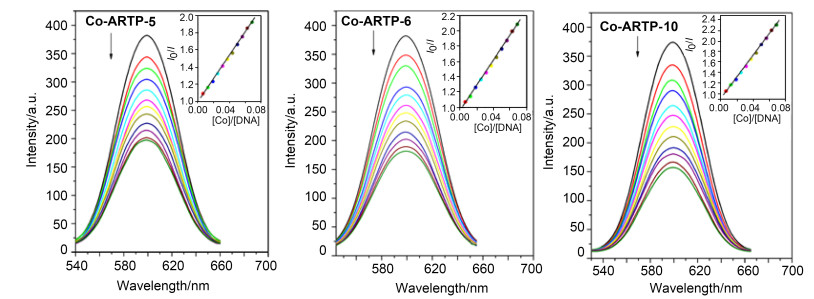
Linear relationship between I0/I and [Co]/[DNA] at the maximum emission wavelength in EB-bound DNA systems
 DownLoad: