Citation: Haoquan Huang, Haiting Chen, Xinran Dong, Yanbin Xu, Anlian Huang, Qiaoyi Cen, Huairou Zhu, Guosheng Chen, Wei Yi, Siming Huang, Gangfeng Ouyang. Site-specific surface amination strategy facilitates biomimetic encapsulation of enzymes within hydrogen-bonded organic framework[J]. Chinese Chemical Letters, ;2025, 36(9): 111223. doi: 10.1016/j.cclet.2025.111223 shu

Site-specific surface amination strategy facilitates biomimetic encapsulation of enzymes within hydrogen-bonded organic framework

    * Corresponding authors.
    E-mail addresses: chengsh39@mail.sysu.edu.cn (G. Chen), huangsm@gzhmu.edu.cn (S. Huang).
    1 These authors contributed equally to this work.
  • Received Date: 16 December 2024
    Revised Date: 14 April 2025
    Accepted Date: 16 April 2025
    Available Online: 16 April 2025

Figures(5)

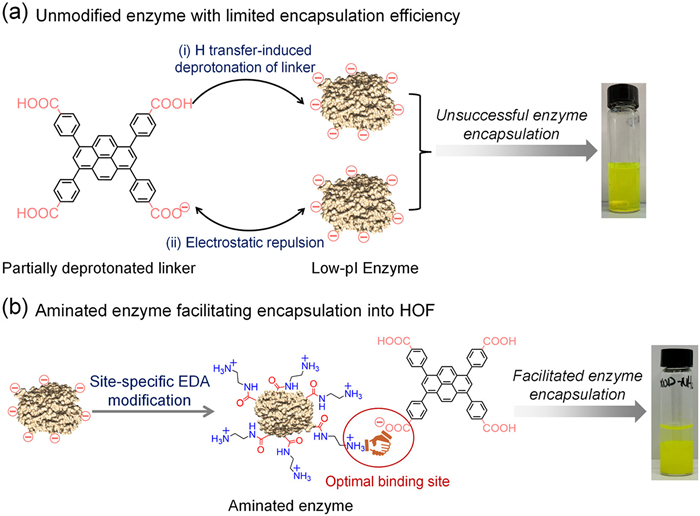
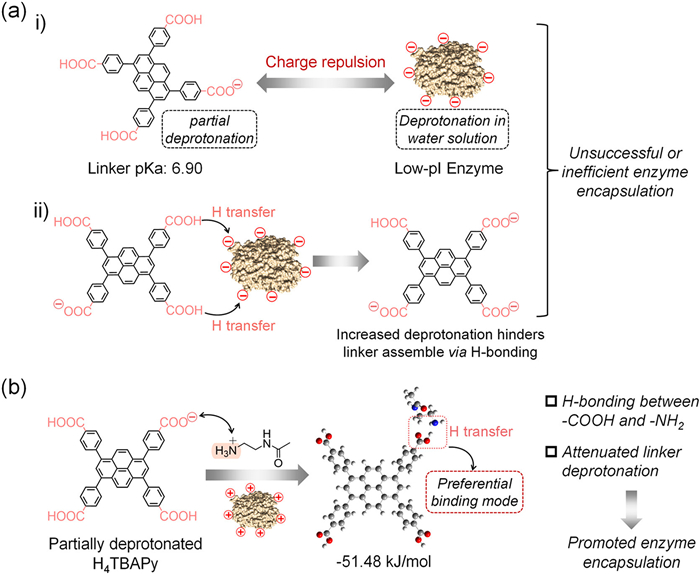
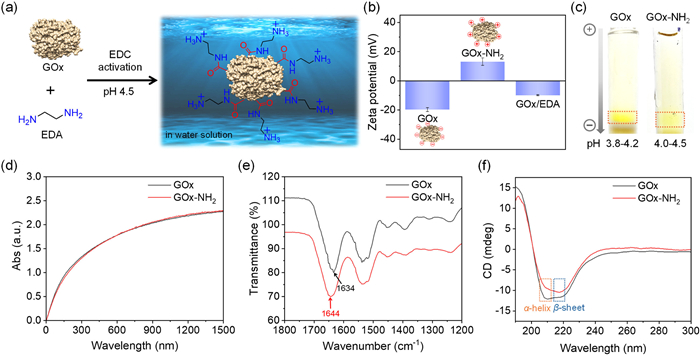
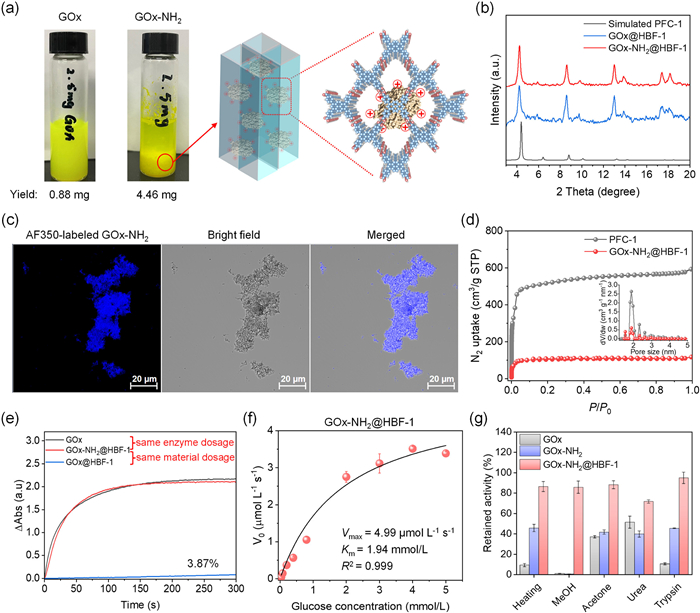
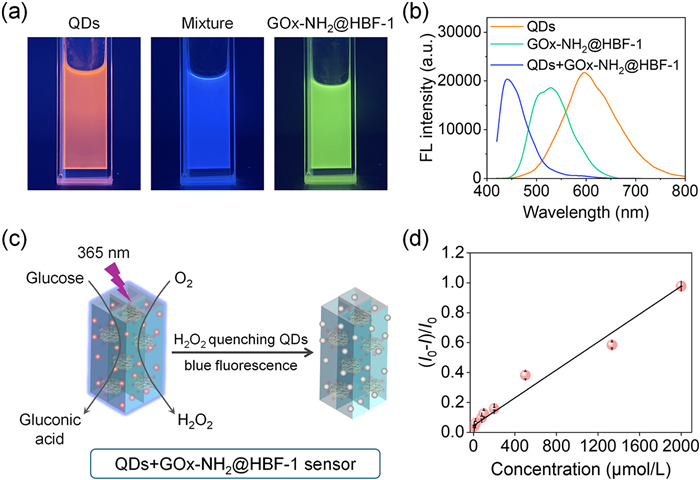
  • Hydrogen-bonded framework (HOF) offers an attractive platform to encapsulate enzymes and stabilize their conformation, due to the advantages of mild synthesis conditions, tailorable pore structure, and backbone biocompatibility. However, the efficiency of this HOF approach relies on the interfacial interactions between enzyme guest and the ligand precursors, limiting its adaptability to enzymes with varying surface chemistry property. In this study, we report a site-specific surface modification strategy to positively tailor the enzyme surface charge, facilitating the biomimetic encapsulation of enzymes within HOF in situ. Both experimental results and computational simulation reveal that site-specific amination of enzyme surface's acidic residues contributes to the interfacial accumulation of carboxylic ligand precursors in aqueous solutions via synergistic electrostatic and hydrogen bonding interactions. This substantially facilitates the in situ growth of porous HOF surrounding the aminated enzyme biotemplates, with up to 100% enzyme loading efficiency. The resultant hydrogen-bonded biohybrid framework (HBF) retains high biocatalytic functions while exhibiting exceptional stability under harsh conditions. By leveraging the marked catalytic activity of GOx-NH2@HBF-1 and a H2O2-sensitive QD, a highly sensitive glucose fluorescence sensor is fabricated with a wide linear range (5–2000 µmol/L) and a low quantification limit of 5 µmol/L. This work presents a simple yet effective enzyme surface engineering approach for integrating enzyme into HOF, opening new avenues for the construction of multifunctional HOF biocomposites.
  • 加载中
    1. [1]

      H.E. Schoemaker, D. Mink, M.G. Wubbolts, Science 299 (2003) 1694–1697.  doi: 10.1126/science.1079237

    2. [2]

      U.T. Bornscheuer, G.W. Huisman, R.J. Kazlauskas, et al., Nature 485 (2012) 185–194.  doi: 10.1038/nature11117

    3. [3]

      M. Pfefferkorn, S. Böhm, T. Schott, et al., Gut 67 (2018) 2045–2053.  doi: 10.1136/gutjnl-2017-313811

    4. [4]

      R. Jiang, G. Luo, G. Chen, et al., Sci. Adv. 10 (2024) eadp1796.  doi: 10.1126/sciadv.adp1796

    5. [5]

      S. Singh, P.K. Sharma, S. Chaturvedi, et al., Food Chem. 435 (2024) 137217.  doi: 10.1016/j.foodchem.2023.137217

    6. [6]

      M.M. Kristjánsson, J.E. Kinsella, Adv. Food Nutri. Res. 35 (1991) 237–316.

    7. [7]

      C. Selvaraj, O. Rudhra, A.S. Alothaim, M. Alkhanani, S.K. Singh, Adv. Protein Chem. Str. 130 (2022) 59–83.

    8. [8]

      M. Bilal, S.A. Qamar, D. Carballares, Á. Berenguer-Murcia, R. Fernandez-Lafuente, Biotechnol. Adv. 70 (2024) 108304.  doi: 10.1016/j.biotechadv.2023.108304

    9. [9]

      W. Liang, P. Wied, F. Carraro, et al., Chem. Rev. 121 (2021) 1077–1129.  doi: 10.1021/acs.chemrev.0c01029

    10. [10]

      Q. Zhu, Y. Zheng, Z. Zhang, Y. Chen, Nat. Protoc. 18 (2023) 3080–3125.  doi: 10.1038/s41596-023-00868-x

    11. [11]

      R.B. Lin, B. Chen, Chem 8 (2022) 2114–2135.  doi: 10.1016/j.chempr.2022.06.015

    12. [12]

      S. Huang, G. Chen, G. Ouyang, Chem. Soc. Rev. 51 (2022) 6824–6863.  doi: 10.1039/D1CS01011E

    13. [13]

      Z. Chen, K.O. Kirlikovali, P. Li, O.K. Farha, Acc. Chem. Res. 55 (2022) 579–591.  doi: 10.1021/acs.accounts.1c00707

    14. [14]

      K. Liang, R. Ricco, C.M. Doherty, et al., Nat. Commun. 6 (2015) 7240.  doi: 10.1038/ncomms8240

    15. [15]

      W. Liang, H. Xu, F. Carraro, et al., J. Am. Chem. Soc. 141 (2019) 2348–2355.  doi: 10.1021/jacs.8b10302

    16. [16]

      W. Liang, K. Flint, Y. Yao, et al., J. Am. Chem. Soc. 145 (2023) 20365–20374.  doi: 10.1021/jacs.3c05488

    17. [17]

      J.C. Díaz, B. Lozano-Torres, M. Giménez-Marqués, Chem. Mater. 34 (2022) 7817–7827.  doi: 10.1021/acs.chemmater.2c01338

    18. [18]

      I. Akpinar, X. Wang, K. Fahy, et al., J. Am. Chem. Soc. 146 (2024) 5108–5117.  doi: 10.1021/jacs.3c07785

    19. [19]

      T.H. Wei, S.H. Wu, Y.D. Huang, et al., Nat. Commun. 10 (2019) 5002.

    20. [20]

      H.Y. Guan, R.J. LeBlanc, S.Y. Xie, Y. Yue, Coordin. Chem. Rev. 369 (2018) 76–90.

    21. [21]

      Q. Liu, Y. Song, Y. Ma, et al., J. Am. Chem. Soc. 141 (2019) 488–496.  doi: 10.1021/jacs.8b11230

    22. [22]

      Z. Zhang, Y. Ye, S. Xiang, B. Chen, Acc. Chem. Res. 55 (2022) 3752–3766.  doi: 10.1021/acs.accounts.2c00686

    23. [23]

      Z.J. Lin, S.A.R. Mahammed, T.F. Liu, R. Cao, ACS Cent. Sci. 8 (2022) 1589–1608.

    24. [24]

      I. Hisaki, C. Xin, K. Takahashi, T. Nakamura, Angew. Chem. Int. Ed. 58 (2019) 11160–11170.

    25. [25]

      C. Huang, C. Zhao, Q. Deng, et al., Nat. Catal. 6 (2023) 729–739.

    26. [26]

      S. Huang, J. Li, Y. Lin, et al., J. Am. Chem. Soc. 146 (2024) 1967–1976.

    27. [27]

      G. Chen, S. Huang, X. Ma, R. He, G. Ouyang, Nat. Protoc. 18 (2023) 2032–2050.

    28. [28]

      A. Huang, H. Yang, S. Huang, G. Chen, G. Ouyang, Matter 6 (2023) 2635–2646.

    29. [29]

      W. Huang, H. Yuan, H. Yang, et al., Nat. Commun. 14 (2023) 3644.

    30. [30]

      G. Chen, L. Tong, S. Huang, et al., Nat. Commun. 13 (2023) 4816.

    31. [31]

      W. Huang, H. Yuan, H. Yang, et al., JACS Au 2 (2022) 2048–2058.

    32. [32]

      G. Chen, S. Huang, Y. Shen, et al., Chem 7 (2021) 2722–2742.

    33. [33]

      Z. Tang, X. Li, L. Tong, et al., Angew. Chem. Int. Ed. 60 (2021) 23608– 23613.

    34. [34]

      H. Yang, J. Fu, W. Huang, et al., Small Struct. 4 (2023) 2200346.

    35. [35]

      S. Hayashi, S. Nakamura, BBA–Enzymology 657 (1981) 40–51.

    36. [36]

      N.K. Maddigan, A. Tarzia, D.M. Huang, et al., Chem. Sci. 9 (2018) 4217–4223.

    37. [37]

      F.C. Church, D.H. Porter, G.L. Catignani, H.E. Swaisgood, Anal. Biochem. 146 (1985) 343–348.

    38. [38]

      B.B. Pinheiro, N.S. Rios, G. Zanatta, B.C. Pessela, L.R.B. Gonçalves, Process Biochem. 133 (2023) 292–302.

    39. [39]

      W.H. Chen, M. Vázquez-González, A. Zoabi, R. Abu-Reziq, I. Willner, Nat. Catal. 1 (2018) 689–695.

    40. [40]

      Z. Xu, Y.K. Cen, S.P. Zou, Y.P. Xue, Y.G. Zheng, Crit. Rev. Biotechnol. 40 (2019) 83–98.

    41. [41]

      N.G. Nezhad, R.N.Z.R.A. Rahman, Y.M. Normi, et al., Int. J. Biol. Macromol. 232 (2023) 123440.

    42. [42]

      N. Özer, M. Müftüoglu, D. Ataman, A. Ercan, I.H. Ögüs, J. Biochem. Bioph. Meth. 39 (1999) 153–159.

    43. [43]

      S. O'Connell, G. Walsh, Appl. Microbiol. Biotechnol. 86 (2010) 517–524.

    44. [44]

      Z. Li, J.R. Askim, K.S. Suslick, Chem. Rev. 119 (2019) 231–292.

    45. [45]

      H. Chen, H. Huang, H. Xu, et al., Small 20 (2024) 2308716.

    46. [46]

      L.A. Pérez-Márquez, M.D. Perretti, R. García-Rodríguez, F. Lahoz, R. Carrillo, Angew. Chem. Int. Ed. 61 (2022) e202205403.

    47. [47]

      Y. Wang, B. Li, T. Tian, et al., TrAC-Trends Anal. Chem. 149 (2022) 116565.

    48. [48]

      N.E. Azmi, N.I. Ramli, J. Abdullah, et al., Biosens. Bioelectron. 67 (2015) 129–133.

    49. [49]

      L. Lin, Y. Wen, Y. Liang, N. Zhang, D. Xiao, Anal. Methods 5 (2013) 457–464.

    50. [50]

      A. Singh, A.S.K. Sinha, Appl. Surface Sci. 430 (2018) 184–197.

    51. [51]

      X. Li, C. Li, L. Chen, New J. Chem. 39 (2015) 9976–9982.

  • 加载中
    1. [1]

      Yuxin Wang Xueqiang Guo Chao Zhi Lifei Yin Meng Wang Jinping Li Libo Li Jia Yao . Hydrogen-bonded organic framework with ammonia recognition “pocket” for exhaled ammonia fluorescence sensing. Chinese Journal of Structural Chemistry, 2025, 44(12): 100729-100729. doi: 10.1016/j.cjsc.2025.100729

    2. [2]

      Shuai Liu Wen Wu Peili Zhang Yunxuan Ding Chang Liu Yu Shan Ke Fan Fusheng Li . Mechanistic insights into acidic water oxidation by Mn(2,2′-bipyridine-6,6′-dicarboxylate)-based hydrogen-bonded organic frameworks. Chinese Journal of Structural Chemistry, 2025, 44(3): 100535-100535. doi: 10.1016/j.cjsc.2025.100535

    3. [3]

      Xiangshuai LiJian ZhaoLi LuoZhuohao JiaoYing ShiShengli HouBin Zhao . Visual and portable detection of metronidazole realized by metal-organic framework flexible sensor and smartphone scanning. Chinese Chemical Letters, 2024, 35(10): 109407-. doi: 10.1016/j.cclet.2023.109407

    4. [4]

      Liangji ChenZhen YuanFudong FengXin ZhouZhile XiongWuji WeiHao ZhangBanglin ChenShengchang XiangZhangjing Zhang . A hydrogen-bonded organic framework containing fluorescent carbazole and responsive pyridyl units for sensing organic acids. Chinese Chemical Letters, 2024, 35(9): 109344-. doi: 10.1016/j.cclet.2023.109344

    5. [5]

      Guang-Xu DuanQueting ChenRui-Rui ShaoHui-Huang SunTong YuanDong-Hao Zhang . Encapsulating lipase on the surface of magnetic ZIF-8 nanosphers with mesoporous SiO2 nano-membrane for enhancing catalytic performance. Chinese Chemical Letters, 2025, 36(2): 109751-. doi: 10.1016/j.cclet.2024.109751

    6. [6]

      Pan HuXiaofan WuYi AnXianjing ZhengLiang GaoYuan TaoYajiao ZhangZedu HuangFener Chen . Batch and continuous-flow asymmetric synthesis of D-pantothenic acid precursor enabled by immobilized ketoreductase mutant. Chinese Chemical Letters, 2026, 37(2): 111945-. doi: 10.1016/j.cclet.2025.111945

    7. [7]

      Erzhuo ChengYunyi LiWei YuanWei GongYanjun CaiYuan GuYong JiangYu ChenJingxi ZhangGuangquan MoBin Yang . Galvanostatic method assembled ZIFs nanostructure as novel nanozyme for the glucose oxidation and biosensing. Chinese Chemical Letters, 2024, 35(9): 109386-. doi: 10.1016/j.cclet.2023.109386

    8. [8]

      Guangying WangQinglong QiaoWenhao JiaYiyan RuanKai AnWenchao JiangXuelian ZhouZhaochao Xu . Adaptive emission profile of transformable fluorescent probes as fingerprints: A typical application in distinguishing different surfactants. Chinese Chemical Letters, 2025, 36(5): 110130-. doi: 10.1016/j.cclet.2024.110130

    9. [9]

      Tianle CaoNi YanYawen LiXinyi ZhangYue ZhuNaiyao LiZengrong WangGang He . D-A-D-A-D conjugated pyrenoviologens for electrochromism, electrofluorochromism, and detection of picric acid. Chinese Chemical Letters, 2025, 36(10): 111021-. doi: 10.1016/j.cclet.2025.111021

    10. [10]

      Xueling YuLixing FuTong WangZhixin LiuNa NiuLigang Chen . Multivariate chemical analysis: From sensors to sensor arrays. Chinese Chemical Letters, 2024, 35(7): 109167-. doi: 10.1016/j.cclet.2023.109167

    11. [11]

      Wenlei Yang Lingyao Wang Yuanbin Zhang . A shape-memory hydrogen-bonded organic framework for flue gas desulfurization. Chinese Journal of Structural Chemistry, 2025, 44(6): 100574-100574. doi: 10.1016/j.cjsc.2025.100574

    12. [12]

      Longhao Hu Lingshan Gong Wenlong Ye Hao Chen Xiao-Li Lai Yingxiang Ye . Luminescent hydrogen-bonded organic frameworks: From design to applications. Chinese Journal of Structural Chemistry, 2025, 44(11): 100703-100703. doi: 10.1016/j.cjsc.2025.100703

    13. [13]

      Ling ZhouLong LiLiwen HuangYan Wu . Enhanced H2O2 production performance via indirect two-electron reduction of HOF/BiVO4 (010) S-scheme photocatalyst. Acta Physico-Chimica Sinica, 2026, 42(3): 100172-0. doi: 10.1016/j.actphy.2025.100172

    14. [14]

      He ZhaoBaiyang FanSiwen HuXingliang LiuBo TangPengchong Xue . Guest-triggered gate-opening of flexible hydrogen-bonded framework for separation of styrene and ethylbenzene. Chinese Chemical Letters, 2025, 36(10): 111005-. doi: 10.1016/j.cclet.2025.111005

    15. [15]

      Runtan GaoYang ZongTingting LiNa LiuZongquan Wu . Three-dimensional supramolecular polymer frameworks with precisely tunable and large apertures for enzyme encapsulation. Chinese Chemical Letters, 2026, 37(1): 111582-. doi: 10.1016/j.cclet.2025.111582

    16. [16]

      Wei GUOZhuoyi GUOXiaoxin LIWei ZHANGJuanzhi YANTingting GUO . Electrochemical sensor based on a Co(Ⅱ)-based metal-organic framework for the detection of Cd2+ and Pb2+. Chinese Journal of Inorganic Chemistry, 2025, 41(9): 1889-1902. doi: 10.11862/CJIC.20250097

    17. [17]

      Rongxin ZhuShengsheng YuXuanzong YangRuyu ZhuHui LiuKaikai NiuLingbao Xing . Construction of pyrene-based hydrogen-bonded organic frameworks as photocatalysts for photooxidation of styrene in water. Chinese Chemical Letters, 2024, 35(10): 109539-. doi: 10.1016/j.cclet.2024.109539

    18. [18]

      Yi ZhangYong ChenQian WangJian-Qiu LiSong-En LiuYu Liu . Slide ring polymer in situ cross-linked conductive ionogel for self-powered sensor. Chinese Chemical Letters, 2026, 37(2): 111676-. doi: 10.1016/j.cclet.2025.111676

    19. [19]

      Pengcheng YanPeng WangJing HuangZhao MoLi XuYun ChenYu ZhangZhichong QiHui XuHenan Li . Engineering Multiple Optimization Strategy on Bismuth Oxyhalide Photoactive Materials for Efficient Photoelectrochemical Applications. Acta Physico-Chimica Sinica, 2025, 41(2): 100014-0. doi: 10.3866/PKU.WHXB202309047

    20. [20]

      Songmei Ma Ying Zhang Gang Liu Wenlong Xu . Comprehensive Experiment Teaching Exploration and Practice in Polymeric Materials Integrating Research-Driven Learning, Creativity-Enhanced Competency, and Science-Education Synergy: A Case Study of Machine Learning-Assisted Intelligent Handwriting Recognition System. University Chemistry, 2026, 41(1): 289-297. doi: 10.12461/PKU.DXHX202509083

Metrics
  • PDF Downloads(0)
  • Abstract views(1704)
  • HTML views(38)

通讯作者: 陈斌, bchen63@163.com
  • 1. 

    沈阳化工大学材料科学与工程学院 沈阳 110142

  1. 本站搜索
  2. 百度学术搜索
  3. 万方数据库搜索
  4. CNKI搜索
Address:Zhongguancun North First Street 2,100190 Beijing, PR China Tel: +86-010-82449177-888
Powered By info@rhhz.net

/

DownLoad:  Full-Size Img  PowerPoint
Return