Citation: Li-Ying Wang, Jun-Jie Yu, Shuai Wang, Yang Liu, Ke-Xian Song, Ji-Pan Yu, Li-Yong Yuan, Zhi-Rong Liu, Wei-Qun Shi. Pyridine-based ionic sp2 carbon-conjugated covalent organic frameworks for selective extraction of Pu(Ⅳ) from high-level liquid waste[J]. Chinese Chemical Letters, ;2025, 36(8): 110706. doi: 10.1016/j.cclet.2024.110706 shu

Pyridine-based ionic sp2 carbon-conjugated covalent organic frameworks for selective extraction of Pu(Ⅳ) from high-level liquid waste

Figures(5)

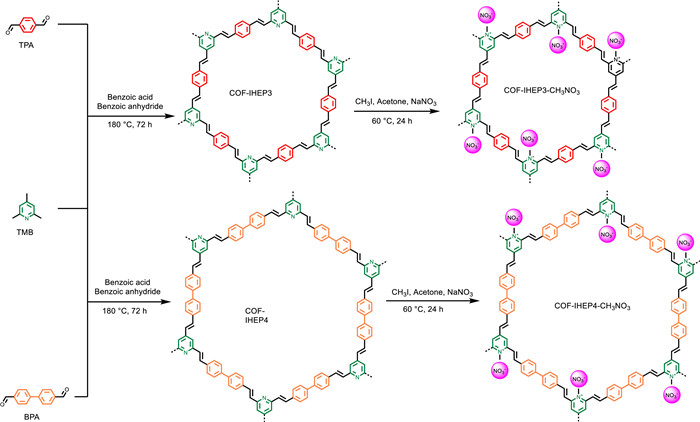
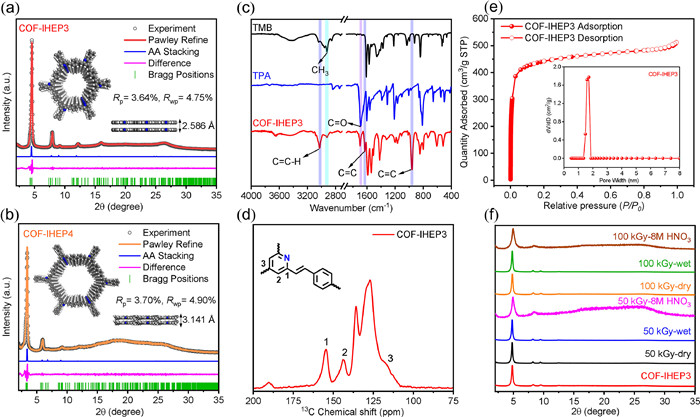
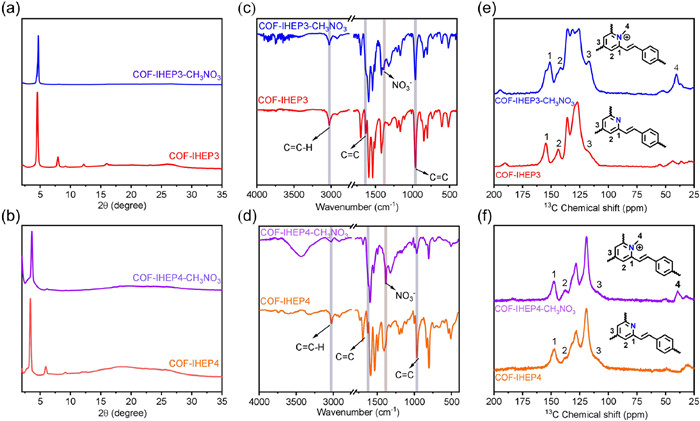
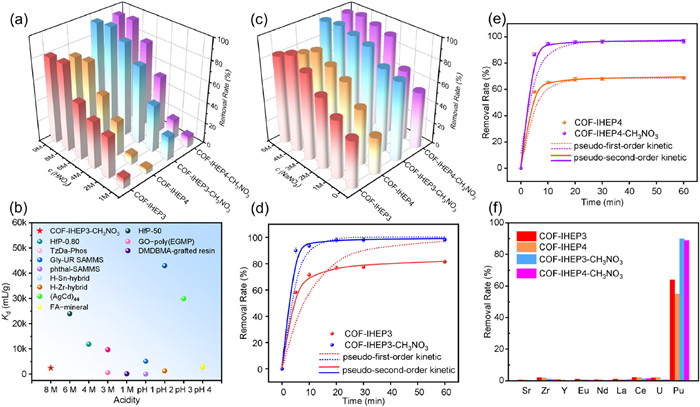
  • In the current era marked by energy shortages, the advancement of nuclear energy stands as an inevitable progression. The reprocessing of spent nuclear fuel plays a crucial role in determining the sustainability of nuclear energy as a viable energy source. Among these processes, the separation and recovery of Pu(Ⅳ) from high-level liquid waste (HLLW) hold paramount significance in terms of safety and strategic implications. Herein, this work focused on the synthesis of two acid- and radiation-resistant pyridine-based sp2c-COFs (COF-IHEP3 and COF-IHEP4), followed by the creation of two pyridine-based ionized sp2c-COFs named COF-IHEP3-CH3NO3 and COF-IHEP4-CH3NO3 through post-modification. These materials have potential anion exchange capacity for the selective separation of Pu(Ⅳ) in highly acidic conditions. Notably, in 8 mol/L nitric acid solution, COF-IHEP3-CH3NO3 demonstrated the capability to eliminate plutonium within 20 min in 98% removal efficiency with a Kd value of 2450 mL/g. Experimental and theoretical analysis suggest that the ionized sp2c-COFs exhibit exceptional stability, selectivity, and prevention of secondary contamination towards Pu(Ⅳ) in the presence of multiple ions environments. In short, this work provides an appropriate anion exchange strategy to design ionic sp2c-COFs as a promising platform for Pu(Ⅳ) recovery from HLLW.
  • 加载中
    1. [1]

      O. Usman, O. Ozkan, G.N. Ike, J. Clean. Prod. 451 (2024) 142070.

    2. [2]

      M.F. Bashir, B.L. Ma, A. Sharif, et al., Technol. Soc. 75 (2023) 102385.  doi: 10.1016/j.techsoc.2023.102385

    3. [3]

      J. Veliscek-Carolan, J. Hazard. Mater. 318 (2016) 266–281.  doi: 10.1016/j.jhazmat.2016.07.027

    4. [4]

      M. Salvatores, Nucl. Eng. Des. 235 (2005) 805–816.  doi: 10.1016/j.nucengdes.2004.10.009

    5. [5]

      D. von Hippel, P. Hayes, J. Kang, et al., Energy Policy 39 (2011) 6867–6881.

    6. [6]

      A. Paulillo, J.M. Dodds, S.J. Palethorpe, et al., Sustain. Mater. Technol. 28 (2021) e00278.

    7. [7]

      C.Y. Liu, J.H. Lan, Q.B. Yan, et al., Chin. Chem. Lett. 33 (2022) 3561–3564.  doi: 10.3390/ma15103561

    8. [8]

      V. Gilinsky, Foreign Aff. 57 (1978) 374.  doi: 10.2307/20040120

    9. [9]

      D.X. Feng, M.C. Ji, H.Q. Liao, et al., Environ. Res. 216 (2023) 114677.

    10. [10]

      N. Vigier, S. Grandjean, B. Arab-Chapelet, et al., J. Alloys Compd. 444–445 (2007) 594–597.  doi: 10.1016/j.jallcom.2007.01.057

    11. [11]

      X.B. Li, Q.Y. Wu, C.Z. Wang, et al., Chin. Chem. Lett. 35 (2024) 109359.

    12. [12]

      C. Berger, C. Marie, D. Guillaumont, et al., Inorg. Chem. 59 (2020) 1823–1834.  doi: 10.1021/acs.inorgchem.9b03024

    13. [13]

      A. Rout, K. Chatterjee, K.A. Venkatesan, et al., Sep. Purif. Technol. 159 (2016) 43–49.

    14. [14]

      S. Sharma, S. Panja, A. Bhattacharyya, et al., Dalton Trans. 45 (2016) 7737–7747.

    15. [15]

      B. Sreenivasulu, C.V.S. Brahmananda Rao, A. Suresh, et al., J. Radioanal. Nucl. Chem. 331 (2022) 3623–3632.  doi: 10.1007/s10967-022-08451-6

    16. [16]

      Y.M. Chen, C.Z. Wang, L. Zhang, et al., J. Mol. Liq. 386 (2023) 122404.

    17. [17]

      A. Kaya, J. Shirahashi, et al., J. Nucl. Sci. Technol. 4 (1967) 289–292.

    18. [18]

      J.G. Pribyl, K.M.L. Taylor-Pashow, T.C. Shehee, et al., ACS Omega 3 (2018) 8181–8189.  doi: 10.1021/acsomega.8b01057

    19. [19]

      P. Zhao, J.D. Begg, M. Zavarin, et al., Environ. Sci. Technol. 50 (2016) 6948–6956.  doi: 10.1021/acs.est.6b00605

    20. [20]

      B. Rao, X.Y. Ma, K. Q, et al., Chem. Eng. J. 431 (2022) 134169.

    21. [21]

      Z. Wang, M.C. Liu, L. Wang, et al., Molecules 27 (2022) 3110.  doi: 10.3390/molecules27103110

    22. [22]

      H.D. Zhang, S. Wang, J.P. Yu, et al., Chem. Eng. J. 463 (2023) 142408.

    23. [23]

      S.C. Zhong, Y. Wang, T. Bo, et al., Chem. Eng. J. 455 (2023) 140523.

    24. [24]

      Y. Wang, J.H. Lan, X.F. Yang, et al., Adv. Funct. Mater. 32 (2022) 2205222.

    25. [25]

      X.W. Liu, A.R. Zhang, R. Ma, et al., Chin. Chem. Lett. 33 (2022) 3549–3555.

    26. [26]

      B.Y. Zhang, L.L. Chen, Z.N. Zhang, et al., Adv. Sci. 9 (2022) 2105912.

    27. [27]

      L.Y. Xiao, Z.L. Wang, J.Q. Guan, Adv. Funct. Mater. 34 (2024) 2310195.

    28. [28]

      W.R. Cui, C.R. Zhang, R.H. Xu, et al., ACS EST Water 1 (2021) 440–448.  doi: 10.1021/acsestwater.0c00176

    29. [29]

      P.F. Dong, X.Y. Xu, R.G. Luo, et al., J. Am. Chem. Soc. 145 (2023) 15473–15481.  doi: 10.1021/jacs.3c03897

    30. [30]

      H. Hu, C.L. Song, D. Wang, et al., Chin. Chem. Lett. 34 (2023) 107770.

    31. [31]

      C. Liu, C. Jia, S.X. Gan, et al., Chin. Chem. Lett. 35 (2024) 109750.

    32. [32]

      E.B. Zhou, X. Zhang, L. Zhu, et al., Adv. Funct. Mater. 33 (2023) 2213667.

    33. [33]

      J. Li, X.C. Jing, Q.Q. Li, et al., Chem. Soc. Rev. 49 (2020) 3565–3604.  doi: 10.1039/d0cs00017e

    34. [34]

      F. Liu, C.J. Wang, C. Liu, et al., Appl. Phys. Lett. 119 (2021) 211905.

    35. [35]

      M.X. Wu, Y.W. Yang, Chin. Chem. Lett. 28 (2017) 1135–1143.

    36. [36]

      L.Y. Ou, Z.L. Xue, B. Li, et al., Chin. Chem. Lett. (2024) 110294.

    37. [37]

      H.M. Wang, H.M. Ding, X.S. Meng, et al., Chin. Chem. Lett. 27 (2016) 1376–1382.

    38. [38]

      H.M. El-Kaderi, J.R. Hunt, J.L. Mendoza-Cortés, et al., Science 316 (2007) 268–272.  doi: 10.1126/science.1139915

    39. [39]

      A.P. Côté, A.I. Benin, N.W. Ockwig, et al., Science 310 (2005) 1166–1170.  doi: 10.1126/science.1120411

    40. [40]

      T. Li, Y. Pan, B.B. Shao, et al., Adv. Funct. Mater. 33 (2023) 2304990.

    41. [41]

      F.J. Uribe-Romo, J.R. Hunt, H. Furukawa, et al., J. Am. Chem. Soc. 131 (2009) 4570–4571.  doi: 10.1021/ja8096256

    42. [42]

      E.Q. Jin, J. Li, K.Y. Geng, et al., Nat. Commun. 9 (2018) 4143.

    43. [43]

      P.H. Zhang, Z.F. Wang, S. Wang, et al., Angew. Chem. Int. Ed. 61 (2022) e202213247.

    44. [44]

      S.C. Wei, F. Zhang, W.B. Zhang, et al., J. Am. Chem. Soc. 141 (2019) 14272–14279.  doi: 10.1021/jacs.9b06219

    45. [45]

      E.Q. Jin, M. Asada, Q. Xu, et al., Science 357 (2017) 673–676.  doi: 10.1126/science.aan0202

    46. [46]

      A. Acharjya, P. Pachfule, J. Roeser, et al., Chem. Int. Ed. 58 (2019) 14865–14870.  doi: 10.1002/anie.201905886

    47. [47]

      S.C. Zhong, Y. Wang, M.S. Xie, et al., Chin. Chem. Lett. 36 (2025) 110312.

    48. [48]

      F.L. Zhang, H.M. Hao, X.Y. Dong, et al., Appl. Catal. B: Environ. 305 (2022) 121027.

    49. [49]

      F.L. Zhang, X.Y. Ma, X.Y. Dong, et al., Chem. Eng. J. 451 (2023) 138802.

    50. [50]

      F.L. Zhang, Y.X. Wang, H.X. Zhao, et al., ACS Appl. Mater. Interfaces 16 (2024) 8772–8782.  doi: 10.1021/acsami.3c16838

    51. [51]

      Z.L. Li, H. Li, X.Y. Guan, et al., J. Am. Chem. Soc. 139 (2017) 17771–17774.  doi: 10.1021/jacs.7b11283

    52. [52]

      K.C. Sole, M.B. Mooiman, E. Hardwick, Sep. Purif. Rev. 47 (2018) 159–178.

    53. [53]

      J. van Deventer, Solvent Extr. Ion Exch. 29 (2011) 695–718.  doi: 10.1080/07366299.2011.595626

    54. [54]

      M.V. Ryzhinsky, A.V. Stepanov, J. Radioanal. Nucl. Chem. 147 (1991) 27–32.

    55. [55]

      S.A. Ansari, P.K. Mohapatra, V.K. Manchanda, J. Hazard. Mater. 161 (2009) 1323–1329.

    56. [56]

      G.E. Fryxell, Y.H. Lin, S. Fiskum, et al., Environ. Sci. Technol. 39 (2005) 1324–1331.  doi: 10.1021/es049201j

    57. [57]

      S. Chappa, A.K. Singha Deb, Sk.M. Ali, et al., J. Phys. Chem. B 120 (2016) 2942–2950.  doi: 10.1021/acs.jpcb.5b11293

    58. [58]

      M. Kaur, H.J. Zhang, L. Martin, et al., Environ. Sci. Technol. 47 (2013) 11942–11959.  doi: 10.1021/es402205q

    59. [59]

      R.M. Tinnacher, J.D. Begg, H. Mason, et al., Environ. Sci. Technol. 49 (2015) 2776–2785.  doi: 10.1021/es505120s

    60. [60]

      L.P. Xiong, K. Lv, M. Gu, et al., Chem. Eng. J. 355 (2019) 159–169.

    61. [61]

      S.Q. Xu, Z.Q. Liao, A. Dianat, et al., Angew. Chem. 134 (2022) e202202492.

    62. [62]

      Q.Y. Guo, H.Y. Ji, L. Yang, et al., Chin. Chem. Lett. 33 (2022) 2621–2624.

    63. [63]

      D.L. Pastoetter, S.Q. Xu, M. Borrelli, et al., Angew. Chem. Int. Ed. 59 (2020) 23620–23625.  doi: 10.1002/anie.202010398

    64. [64]

      X.Y. Wang, J.Y. Yang, X.S. Shi, et al., Small 18 (2022) 2107108.

    65. [65]

      Y. Liang, M. Xia, Q.H. Yu, et al., Adv. Compos. Hybrid Mater. 5 (2022) 184–194.  doi: 10.1007/s42114-021-00311-3

    66. [66]

      M.H. Liu, Q. Xu, G.F. Zeng, Angew. Chem. Int. Ed. 63 (2024) e202404886.

    67. [67]

      S. Chatterjee, J.M. Peterson, A.J. Casella, et al., Inorg. Chem. 59 (2020) 6826–6838.  doi: 10.1021/acs.inorgchem.0c00199

    68. [68]

      H.B. Li, G.A. Ye, X.R. Wang, et al., J. Nucl. Radiochem. 32 (2010) 65–69.

    69. [69]

      R. Bu, L. Zhang, X.Y. Liu, et al., ACS Appl. Mater. Interfaces 13 (2021) 26431–26440.  doi: 10.1021/acsami.1c01791

    70. [70]

      X.D. Gong, Q. Tian, J.B. Li, et al., Appl. Surf. Sci. 615 (2023) 156307.

    71. [71]

      G. Schreckenbach, T. Ziegler, J. Phys. Chem. 99 (1995) 606–611.  doi: 10.1021/j100002a024

    72. [72]

      A. Schäfer, A. Klamt, D. Sattel, et al., Phys. Chem. Chem. Phys. 2 (2000) 2187–2193.

  • 加载中
    1. [1]

      Xiaojuan Sun Ke Kong Jun Liang Dan Wang Beibei Dong Ruihu Wang . Periodic Janus structure based on ionic covalent organic framework for selective removal of perfluoroalkyl substances. Chinese Journal of Structural Chemistry, 2025, 44(9): 100652-100652. doi: 10.1016/j.cjsc.2025.100652

    2. [2]

      Peng GaoYuanyuan ChenQianlin HeXue LiuEchuan TanZhiqiang YuHui Wang . Highly efficient adoptive cell therapy of metastatic triple negative breast cancer with bioactive covalent organic framework-engineered macrophages. Chinese Chemical Letters, 2025, 36(8): 110585-. doi: 10.1016/j.cclet.2024.110585

    3. [3]

      Jiangqi Ning Junhan Huang Yuhang Liu Yanlei Chen Qing Niu Qingqing Lin Yajun He Zheyuan Liu Yan Yu Liuyi Li . Alkyl-linked TiO2@COF heterostructure facilitating photocatalytic CO2 reduction by targeted electron transport. Chinese Journal of Structural Chemistry, 2024, 43(12): 100453-100453. doi: 10.1016/j.cjsc.2024.100453

    4. [4]

      Ting WangXin YuYaqiang Xie . Unlocking stability: Preserving activity of biomimetic catalysts with covalent organic framework cladding. Chinese Chemical Letters, 2024, 35(6): 109320-. doi: 10.1016/j.cclet.2023.109320

    5. [5]

      Yinyin XuYuanyuan LiJingbo FengChen WangYan ZhangYukun WangXiuwen Cheng . Covalent organic frameworks doped with manganese-metal organic framework for peroxymonosulfate activation. Chinese Chemical Letters, 2024, 35(4): 108838-. doi: 10.1016/j.cclet.2023.108838

    6. [6]

      Chao LiuChao JiaShi-Xian GanQiao-Yan QiGuo-Fang JiangXin Zhao . A luminescent one-dimensional covalent organic framework for organic arsenic sensing in water. Chinese Chemical Letters, 2024, 35(11): 109750-. doi: 10.1016/j.cclet.2024.109750

    7. [7]

      Lulu HeLe WangZhen HeYiqian YangCheng Heng PangAiguo WuBencan TangJuan Li . An imine-linked covalent organic framework with intrinsic photo-induced mitochondrial regulation for breast cancer therapy. Chinese Chemical Letters, 2025, 36(9): 110717-. doi: 10.1016/j.cclet.2024.110717

    8. [8]

      Chu ZengHan YangMing XuZhi-Yuan Gu . Optimizing COF crystallinity for high-resolution GC separation. Chinese Chemical Letters, 2026, 37(1): 110064-. doi: 10.1016/j.cclet.2024.110064

    9. [9]

      Yunyu ZhaoChuntao YangYingjian Yu . A review on covalent organic frameworks for rechargeable zinc-ion batteries. Chinese Chemical Letters, 2024, 35(7): 108865-. doi: 10.1016/j.cclet.2023.108865

    10. [10]

      Xinyi CaoYucheng JinHailong WangXu DingXiaolin LiuBaoqiu YuXiaoning ZhanJianzhuang Jiang . A tetraaldehyde-derived porous organic cage and covalent organic frameworks: Syntheses, structures, and iodine vapor capture. Chinese Chemical Letters, 2024, 35(9): 109201-. doi: 10.1016/j.cclet.2023.109201

    11. [11]

      Qi ZhangBin HanYucheng JinMingrun LiEnhui ZhangJianzhuang Jiang . 2D and 3D phthalocyanine covalent organic frameworks for electrocatalytic carbon dioxide reduction. Chinese Chemical Letters, 2025, 36(9): 110330-. doi: 10.1016/j.cclet.2024.110330

    12. [12]

      Shouchao ZhongYue WangMingshu XieYiqian WuJiuqiang LiJing PengLiyong YuanMaolin ZhaiWeiqun Shi . Radiation reduction modification of sp2 carbon-conjugated covalent organic frameworks for enhanced photocatalytic chromium(VI) removal. Chinese Chemical Letters, 2025, 36(5): 110312-. doi: 10.1016/j.cclet.2024.110312

    13. [13]

      Chong WangHao XieRulan XiaXuewei LiaoJin WangHuajun YangChen Wang . Nanofluidic ion rectification sensor for enantioselective recognition and detection. Chinese Chemical Letters, 2025, 36(8): 110642-. doi: 10.1016/j.cclet.2024.110642

    14. [14]

      Yuanfei LiuWanjiao WeiXu LiuRui HuaYanjuan LiuYuefei ZhangWei ChenSheng Tang . Green and mild synthesis of Ca-MOF/COF functionalized silica microspheres in an acid-base tunable deep eutectic solvent for multi-mode chromatography. Chinese Chemical Letters, 2026, 37(1): 111186-. doi: 10.1016/j.cclet.2025.111186

    15. [15]

      Mingrun LiBin HanLei GongYucheng JinMingyue WangXu DingDongdong QiJianzhuang Jiang . 1D COFs with phthalocyanine functional building blocks and imide linkage for superior electrocatalytic nitrate reduction. Chinese Chemical Letters, 2026, 37(2): 110590-. doi: 10.1016/j.cclet.2024.110590

    16. [16]

      Zijie LinQing Li . Covalent organic framework ionomers enable synergistic efficient transport of protons and oxygen in medium-temperature proton exchange membrane fuel cells. Chinese Chemical Letters, 2026, 37(1): 111784-. doi: 10.1016/j.cclet.2025.111784

    17. [17]

      Jiachen Gao Hailong Zhang Xue Zhao Yafu Wang Houen Zhu Xiangyi Kong Yan Liang Ting Ou Rui Ren Yulan Gu Yanyong Su Jiangwei Zhang . Recent advances in anion exchange membranes. Chinese Journal of Structural Chemistry, 2025, 44(5): 100563-100563. doi: 10.1016/j.cjsc.2025.100563

    18. [18]

      Yuanlong Zhong Hancheng Shi Zhijie Chen . Rational synthesis of highly porous covalent organic frameworks for high-performance methane storage. Chinese Journal of Structural Chemistry, 2025, 44(5): 100514-100514. doi: 10.1016/j.cjsc.2025.100514

    19. [19]

      Qiuting ZhangFan WuJin LiuHang SuYanhui ZhongZian Lin . Facile synthesis of single-crystal 3D covalent organic frameworks as stationary phases for high-performance liquid chromatographic separation. Chinese Chemical Letters, 2025, 36(8): 110649-. doi: 10.1016/j.cclet.2024.110649

    20. [20]

      Xiaobo LiQunyan WuCongzhi WangJianhui LanMeng ZhangWeiqun Shi . Theoretical perspectives on the reduction of Pu(Ⅳ) and Np(Ⅵ) by methylhydrazine in HNO3 solution: Implications for Np/Pu separation. Chinese Chemical Letters, 2024, 35(7): 109359-. doi: 10.1016/j.cclet.2023.109359

Metrics
  • PDF Downloads(0)
  • Abstract views(767)
  • HTML views(32)

通讯作者: 陈斌, bchen63@163.com
  • 1. 

    沈阳化工大学材料科学与工程学院 沈阳 110142

  1. 本站搜索
  2. 百度学术搜索
  3. 万方数据库搜索
  4. CNKI搜索
Address:Zhongguancun North First Street 2,100190 Beijing, PR China Tel: +86-010-82449177-888
Powered By info@rhhz.net

/

DownLoad:  Full-Size Img  PowerPoint
Return