Login In
Triarylborane π-electron systems with intramolecular charge-transfer transitions
- Corresponding author: Cui-Hua Zhao, chemistry.chzhao@sdu.edu.cn
Figures(13)
Citation:
Zuo-Bang Sun, Sheng-Yong Li, Zhi-Qiang Liu, Cui-Hua Zhao. Triarylborane π-electron systems with intramolecular charge-transfer transitions[J]. Chinese Chemical Letters,
;2016, 27(8): 1131-1138.
doi:
10.1016/j.cclet.2016.06.007

Figures(13)


(a) P.J. Grisdale, J.L.R. Williams, M.E. Glogowski, B.E. Babb, Boron photochemistry. Possible role of bridged intermediates in the photolysis of borate complexes, J. Org. Chem. 36(1971) 544-549; (b) J.C. Doty, B. Babb, P.J. Grisdale, M. Glogowski, J.L.R. Williams, Boron photochemistry: IX. Synthesis and fluorescent properties of dimesityl-phenylboranes, J. Organomet. Chem. 38(1972) 229-236.
(a) W. Kaim, A. Schulz, p-Phenylenediboranes: mirror images of p-phenylenediamines, Angew. Chem. Int. Ed. 23(1984) 615-616; (b) J. Fiedler, S. Zališ, A. Klein, F.M. Hornung, W. Kaim, Electronic structure of π-conjugated redox systems with borane/borataalkene end groups, Inorg. Chem. 35(1996) 3039-3043.
(a) C.D. Entwistle, T.B. Marder, Boron chemistry lights the way: optical properties of molecular and polymeric systems, Angew. Chem. Int. Ed. 41(2002) 2927-2931; (b) C.D. Entwistle, T.B. Marder, Applications of three-coordinate organoboron compounds andpolymers in optoelectronics, Chem. Mater. 16(2004) 4574-4585; (c) F. Jäkle, Lewis acidic organoboron polymers, Coord. Chem. Rev. 250(2006) 1107-1121; (d) S. Yamaguchi, A. Wakamiya, Boron as a key component for new π-electron materials, Pure. Appl. Chem. 78(2006) 1413-1424; (e) F. Jäkle, Advances in the synthesis of organoborane polymers for optical, electronic, and sensory applications, Chem. Rev. 110(2010) 3985-4022; (f) C.R. Wade, A.E.J. Broomsgrove, S. Aldridge, F.P. Gabbaï, Fluoride ion complexation and sensing using organoboron compounds, Chem. Rev. 110(2010) 3958-3984; (g) Z.M. Hudson, S.N. Wang, Metal-containing triarylboron compounds for optoelectronic applications, Dalton Trans. 40(2011) 7805-7816; (h) C.H. Zhao, Y.H. Zhao, J.M. Lin, Optoelectronic materials of organoboron π-conjugated systems, Prog. Chem. 21(2009) 2605-2612.
(a) Z.Yuan,J.C. Collings, N.J.Taylor, et al., Linearandnonlinear optical properties of three-coordinate organoboron compounds, J. Solid State Chem. 154(2000) 5-12; (b) Z. Yuan, C.D. Entwistle, J.C. Collings, et al., Synthesis, crystal structures, linear and nonlinear optical properties, and theoretical studies of (p-R-phenyl)-,(p-Rphenylethynyl)-, and (E)-[2-(p-R-Phenyl) ethenyl] dimesitylboranes and related compounds, Chem. Eur. J. 12(2006) 2758-2771; (c) Z. Yuan, N.J. Taylor, T.B. Marder, et al., Three coordinate phosphorus and boron as π-donor and p-acceptor moieties respectively, in conjugated organic molecules fornonlinearoptics:crystalandmolecular structures ofE-Ph-CH=CH-B(mes)2, E-4-MeO-C6H4-CH=CH-B(mes)2, and E-Ph2P-CH=CH-B(mes)2[mes=2,4,6-Me3C6H2], J. Chem. Soc. Chem. Commun. (1990) 1489-1492; (d) Z. Yuan, N.J. Taylor, R. Ramachandran, T.B. Marder, Third-order nonlinear optical properties of organoboron compounds: molecular structures and second hyperpolarizabilities, Appl. Organomet. Chem. 10(1996) 305-316; (e) Z. Yuan, N.J. Taylor, Y. Sun, et al., Synthesis and second-order nonlinear optical properties of three-coordinate organoboranes with diphenylphosphino and ferrocenyl groups as electron donors: crystal and molecular structures of (E)-D-CH=CHB(mes)2 and D-C=C-B(mes)2(D=P(C6H52, (η-C5H5) Fe(η-C5H4); mes=2, 4, 6-(CH3)3C6H2], J. Organomet. Chem. 449(1993) 27-37.
(a) M. Lequan, R.M. Lequan, K.C. Ching. Trivalent boron as acceptor chromophore in asymmetrically substituted 4,40-biphenyl and azobenzene for non-linear optics, J. Mater. Chem., 1991,1: 997-999; (b) C. Branger, M. Lequan, R.M. Lequan, M. Barzoukas, A. Fort, Boron derivatives containing a bithiophene bridge as new materials for non-linear optics, J. Mater. Chem., 1996,6: 555-558; (c) C. Branger, M. Lequan, R.M. Lequan, M. Large, F. Kajzar, Polyurethanes containing boron chromophores as sidechains for nonlinear optics[J]. Chem. Phys. Lett., 1997,272:265-270. doi: 10.1016/S0009-2614(97)88019-0
(a) D.X. Cao, Z.Q. Liu, Q. Fang, et al., Blue two-photon excited fluorescence of several D-π-D, A-π-A, and D-π-A compounds featuring dimesitylboryl acceptor, J. Organomet. Chem. 689(2004) 2201-2206; (b) Z.Q. Liu, Q. Fang, D. Wang, et al., Trivalent boron as acceptor in D-π-A chromophores: synthesis, structure and fluorescence following single-and twophoton excitation, Chem. Commun. (2002) 2900-2901.
J.C. Collings, S.Y. Poon, C. Le Droumaguet. The Synthesis and one-and two-Photon optical properties of dipolar, quadrupolar and octupolar donor-acceptor molecules containing dimesitylboryl groups[J]. Chem. Eur. J., 2009,15:198-208. doi: 10.1002/chem.v15:1
(a) W.L. Jia, X.D. Feng, D.R. Bai, et al., Mes2B (p-4, 4'-biphenyl-NPh(1-naphthyl)): a multifunctional molecule for electroluminescent devices, Chem. Mater. 17(2005) 164-170; (b) W.L. Jia, M.J. Moran, Y.Y. Yuan, Z.H. Lu, S.N. Wang, (1-Naphthyl) phenylamino functionalized three-coordinate organoboron compounds: syntheses, structures, and applications in OLEDs, J. Mater. Chem. 15(2005) 3326-3333; (c) W.L. Jia, D.R. Bai, T. McCormick, et al., Three-coordinate organoboron compounds BAr2R (Ar=Mesityl, R=7-Azaindolyl-or 2, 2'-Dipyridylamino-functionalized aryl or thienyl) for electroluminescent devices and supramolecular assembly, Chem. Eur. J. 10(2004) 994-1006; (d) W.L. Jia, D.T. Song, S.N. Wang, Blue luminescent three-coordinate organoboron compounds with a 2, 2'-dipyridylamino functional group, J. Org. Chem. 68(2003) 701-705; (e) F.H. Li, W.L. Jia, S.N. Wang, Y.Q. Zhao, Z.H. Lu, Blue organic light-emitting diodes based on Mes2B[p-4, 4'-biphenyl-NPh (1-naphthyl)], J. Appl. Phys. 103(2008) 034509.
S.L. Lin, L.H. Chan, R.H. Lee. Highly efficient carbazole-π-dimesitylborane bipolar fluorophores for nondoped blue organic light-emitting diodes[J]. Adv. Mater., 2008,20:3947-3952. doi: 10.1002/adma.v20:20
Y. Shirota, M. Kinoshita, T. Noda, K. Okumoto, T. Ohara. A novel class of emitting amorphous molecular materials as bipolar radical formants: 2-{4-[Bis(4-methylphenyl)amino]phenyl}-5-(dimesitylboryl)thiophene and 2-{4-[Bis(9,9-dimethylfluorenyl)amino]phenyl}-5-(dimesitylboryl)thiophene[J]. J. Am. Chem. Soc., 2000,122:11021-11022. doi: 10.1021/ja0023332
K. Suzuki, S. Kubo, K. Shizu. Triarylboron-based fluorescent organic lightemitting diodes with external quantum efficiencies exceeding 20%[J]. Angew. Chem. Int. Ed., 2015,54:15231-15235. doi: 10.1002/anie.201508270
(a) S. Yamaguchi, T. Shirasaka, S. Akiyama, K. Tamao, Dibenzoborole-containing, π-Electron systems: remarkable fluorescence change based on the "on/off" control of the pπ-π* conjugation, J. Am. Chem. Soc. 124(2002) 8816-8817; (b) Y. Kubo, M. Yamamoto, M. Ikeda, et al., A colorimetric and ratiometric fluorescent chemosensor with three emission changes: fluoride ion sensing by a triarylborane-porphyrin conjugate, Angew. Chem. Int. Ed. 42(2003) 2036-2040.
(a) S. Sole, F.P. Gabbai, A bidentate borane as colorimetric fluoride ion sensor, Chem. Commun. 35(2004) 1284-1285; (b) M. Melaimi, F.P. Gabbaï, A heteronuclear bidentate lewis acid as a phosphorescent fluoride sensor, J. Am. Chem. Soc. 127(2005) 9680-9681; (c) C.W. Chiu, F.P. Gabbaï, Fluoride ion capture from water with a cationic borane, J. Am. Chem. Soc. 128(2006) 14248-14249; (d) M.H. Lee, T. Agou, J. Kobayashi, T. Kawashima, F.P. Gabbaï, Fluoride ion complexation by a cationic borane in aqueous solution, Chem. Commun. (2007) 1133-1135.
(a) A. Sundararaman, M. Victor, R. Varughese, F. Jäkle, A family of main-chain polymeric Lewis acids: synthesis and fluorescent sensing properties of boronmodified polythiophenes, J. Am. Chem. Soc. 127(2005) 13748-13749; (b) K. Parab, K. Venkatasubbaiah, F. Jäkle, Luminescent triarylborane-functionalized polystyrene: synthesis, photophysical characterization, and anion-binding studies, J. Am. Chem. Soc. 128(2006) 12879-12885; (c) H.Y. Li, A. Sundararaman, K. Venkatasubbaiah, F. Jäkle, Organoborane acceptor-substituted polythiophene via side-group borylation, J. Am. Chem. Soc. 129(2007) 5792-5793.
(a) G.L. Fu, H. Pan, Y.H. Zhao, C.H. Zhao, Solid-state emissive triarylborane-based BODIPY dyes: photophysical properties and fluorescent sensing for fluoride and cyanide ions, Org. Biomol. Chem. 9(2011) 8141-8146; (b) Y.H. Zhao, H. Pan, G.L. Fu, J.M. Lin, C.H. Zhao, A highly emissive cruciform triarylborane as a ratiometric and solid state fluorescence sensor for fluoride ions, Tetrahedron Lett. 52(2011) 3832-3835.
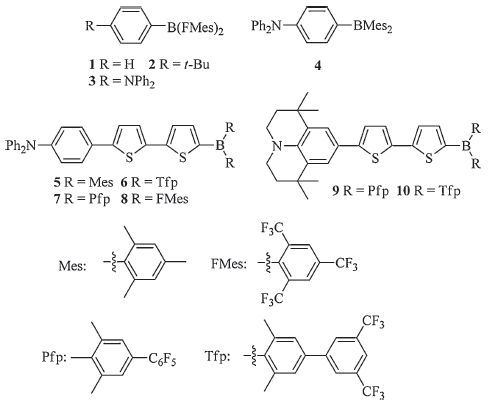
(a) Z.L. Zhang, R.M. Edkins, J. Nitsch, et al., Optical and electronic properties of airstable organoboron compounds with strongly electron-accepting bis (fluoromesityl) boryl groups, Chem. Sci. 6(2015) 308-321; (b) Z.L. Zhang, R.M. Edkins, J. Nitsch, et al., D-π-A triarylboron compounds with tunable push-pull character achieved by modification of both the donor and acceptor moieties, Chem. Eur. J. 21(2015) 177-190.
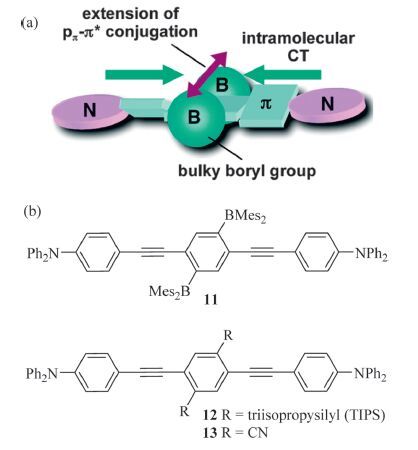
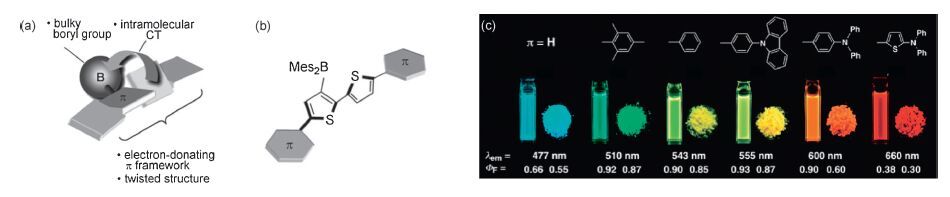
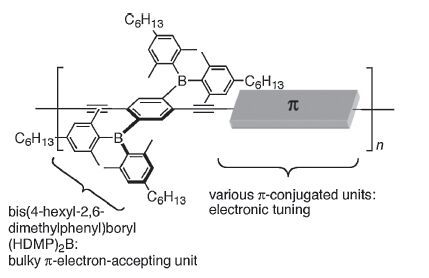
(a) C.H. Zhao, A. Wakamiya, Y. Inukai, S. Yamaguchi, Highly emissive organic solids containing 2, 5-diboryl-1,4-phenylene unit, J. Am. Chem. Soc. 128(2006) 15934-15935; (b) C.H. Zhao, A. Wakamiya, S. Yamaguchi, Highly emissive poly(aryleneethynylene)s containing 2, 5-diboryl-1, 4-phenylene as a building unit, Macromolecules 40(2007) 3898-3900; (c) C.H. Zhao, E. Sakuda, A. Wakamiya, S. Yamaguchi, Highly emissive diborylphenylene-containing bis (phenylethynyl) benzenes: structure-photophysical property correlations and fluoride ion sensing, Chem. Eur. J. 15(2009) 10603- 10612; (d) A. Wakamiya, K. Mori, S. Yamaguchi, 3-Boryl-2, 2'-bithiophene as a versatile core skeleton for full-color highly emissive organic solids, Angew. Chem. Int. Ed. 46(2007) 4273-4276.
G.L.Fu , H.Y. Zhang, Y.Q. Yan, C.H. Zhao. p-Quaterphenyls laterally substituted with a dimesitylboryl group: a promising class of solid-state blue emitters[J]. J. Org. Chem., 2012,77:1983-1990. doi: 10.1021/jo202574n
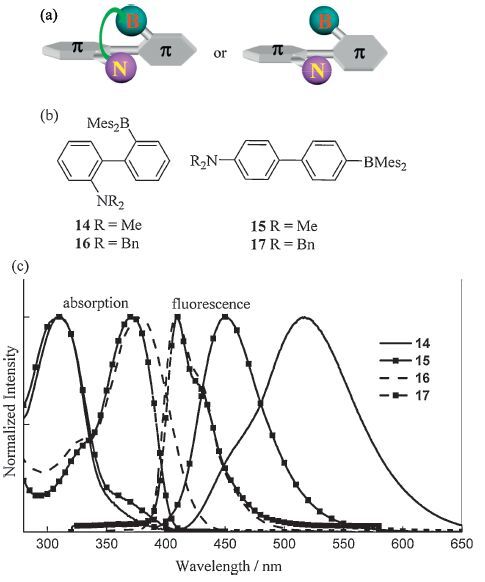
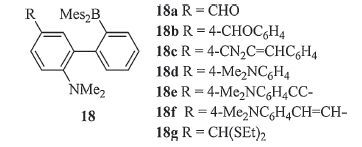
(a) H. Pan, G.L. Fu, Y.H. Zhao, C.H. Zhao, Through-space charge-transfer emitting biphenyls containing a boryl and an amino group at the o,o'-positions, Org. Lett. 13(2011) 4830-4833; (b) C. Wang, Q.W. Xu, W.N. Zhang, Q. Peng, C.H. Zhao, Charge-transfer emission in organoboron-based biphenyls: effect of substitution position and conformation, J. Org. Chem. 80(2015) 10914-10924; (c) Y.Q. Yan, Y.B. Li, J.W. Wang, C.H. Zhao, Effect of the substitution pattern on the intramolecular charge-transfer emissions in organoboron-based biphenyls, diphenylacetylenes, and stilbenes, Chem. Asian. J. 8(2013) 3164-3176; (d) C. Wang, J. Jia, W.N. Zhang, H.Y. Zhang, C.H. Zhao, Triarylboranes with a 2-dimesitylboryl-2'-(N,N-dimethylamino) biphenyl core unit: structure-property correlations and sensing abilities to discriminate between F- and CN- ions, Chem. Eur. J. 20(2014) 16590-16601; (e) Q.W. Xu, C. Wang, Z.B. Sun, C.H. Zhao, A highly selective ratiometric bifunctional fluorescence probe for Hg2+ and F- ions, Org. Biomol. Chem. 13(2015) 3032-3039.
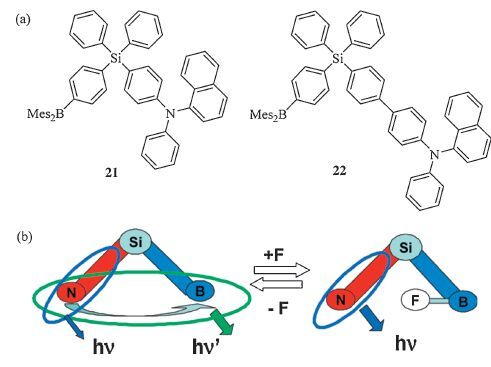
(a) X.Y. Liu, D.R. Bai, S.N. Wang, Charge-transfer emission in nonplanar threecoordinate organoboron compounds for fluorescent sensing of fluoride, Angew. Chem. Int. Ed. 45(2006) 5475-5478; (b) Z.M. Hudson, X.Y. Liu, S.N. Wang, Switchable three-state fluorescence of a nonconjugated donor-acceptor triarylborane, Org. Lett. 13(2011) 300-303; (c) D.R. Bai, X.Y. Liu, S. Wang, Charge-transfer emission involving three-coordinate organoboron: V-shape versus U-shape and impact of the spacer on dual emission and fluorescent sensing, Chem. Eur. J. 13(2007) 5713-5723.
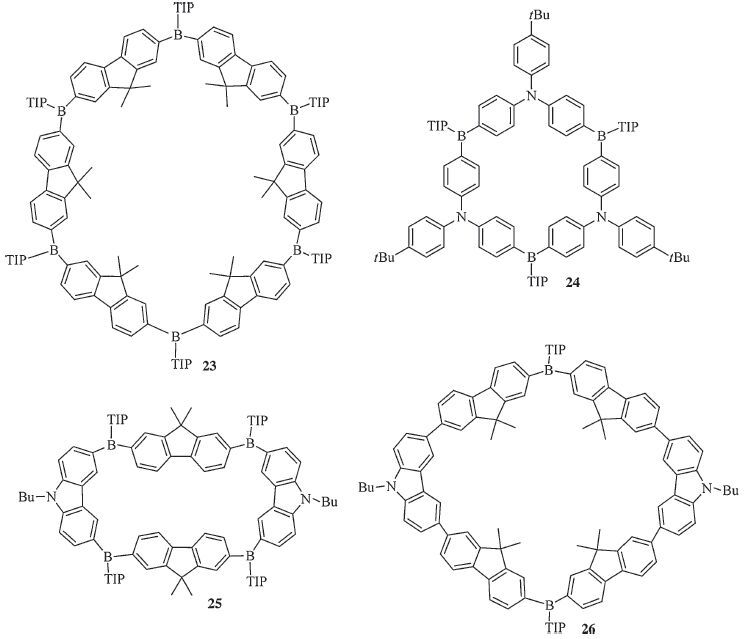
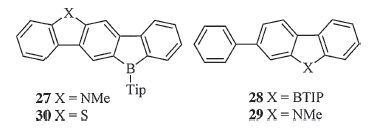
(a) P.K. Chen, F. Jäkle, Highly luminescent, electron-deficient bora-cyclophanes, J. Am. Chem. Soc. 133(2011) 20142-20145; (b) P.K. Chen, R.A. Lalancette, F. Jäkle, p-Expanded borazine: an ambipolar conjugated B-π-N macrocycle, Angew. Chem. Int. Ed. 51(2012) 7994-7998; (c) P.K. Chen, X.D. Yin, N. Baser-Kirazli, F. Jäkle, Versatile design principles for facile access to unstrained conjugated organoborane macrocycles, Angew. Chem. Int. Ed. 54(2015) 10768-10772.
(a) D.M. Chen, Q. Qin, Z.B. Sun, Q. Peng, C.H. Zhao, Synthesis and properties of B,Nbridged p-terphenyls, Chem. Commun. 50(2014) 782-784; (b) D.M. Chen, S. Wang, H.X. Li, X.Z. Zhu, C.H. Zhao, Solid-state emissive B,Sbridged p-terphenyls: synthesis, properties, and utility as bifunctional fluorescent sensor for Hg2+ and F- ions, Inorg. Chem 53(2014) 12532-12539.
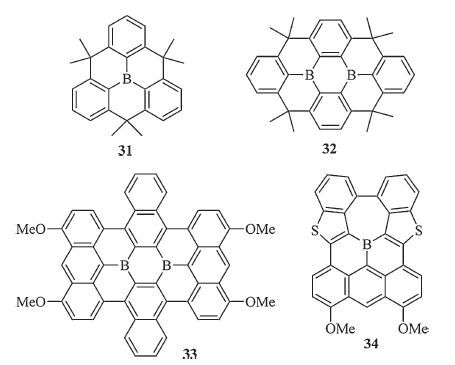
(a) Z.G. Zhou, A. Wakamiya, T. Kushida, S. Yamaguchi, Planarized triarylboranes: stabilization by structural constraint and their plane-to-bowl conversion, J. Am. Chem. Soc. 134(2012) 4529-4532; (b) C.D. Dou, S. Saito, K. Matsuo, I. Hisaki, S. Yamaguchi, A boron-containing PAH as a substructure of boron-doped graphene, Angew. Chem. Int. Ed. 51(2012) 12206-12210; (c) S. Saito, K. Matsuo, S. Yamaguchi, Polycyclic, π-Electron system with boron at its center, J. Am. Chem. Soc. 134(2012) 9130-9133.
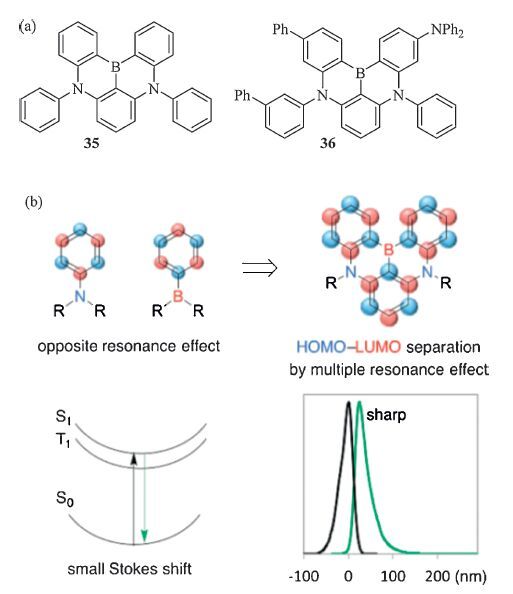
T. Hatakeyama, K. Shiren, K. Nakajima. Ultrapure blue thermally activated delayed fluorescence molecules: efficient HOMO-LUMO separation by the multiple resonance effect[J]. Adv. Mater., 2016,28:2777-2781. doi: 10.1002/adma.v28.14
(a) Y.N. Hong, J.W.Y. Lam, B.Z. Tang, Aggregation-induced emission, Chem. Soc. Rev. 40(2011) 5361-5388; (b) M. Shimizu, T. Hiyama, Organic fluorophores exhibiting highly efficient photoluminescence in the solid state, Chem. Asian. J. 5(2010) 1516-1531; (c) S.P.Anthony,Organicsolid-statefluorescence:strategiesforgeneratingswitchable and tunable fluorescent materials, ChemPlusChem 77(2012) 518-531.
(a) B. Gong, Hollow Crescents, Helices, and Macrocycles from enforced folding and folding-assisted macrocyclization, Acc. Chem. Res. 41(2008) 1376-1386; (b) D. Ramaiah, P.P. Neelakandan, A.K. Nair, R.R. Avirah, Functional cyclophanes: promising hosts for optical biomolecular recognition, Chem. Soc. Rev. 39(2010) 4158-4168.
A. Fukazawa, S. Yamaguchi. Ladder π-conjugated materials containing maingroup elements[J]. Chem. Asian. J., 2009,4:1386-1400. doi: 10.1002/asia.v4:9
(a) H. Uoyama, K. Goushi, K. Shizu, H. Nomura, C. Adachi, Highly efficient organic light-emitting diodes from delayed fluorescence, Nature 492(2012) 234-238; (b) Y. Tao, K. Yuan, T. Chen, et al., Thermally activated delayed fluorescence materials towards the breakthrough of organoelectronics, Adv. Mater. 26(2014) 7931-7958.
Rong-Nan Yi , Wei-Min He . Electron donor-acceptor complex enabled arylation of dithiocarbamate anions with thianthrenium salts under aqueous micellar conditions. Chinese Chemical Letters, 2024, 35(11): 110194-. doi: 10.1016/j.cclet.2024.110194
Hongping Zhao , Weiming Yuan . Merging catalytic electron donor-acceptor complex and copper catalysis: Enantioselective radical carbocyanation of alkenes. Chinese Chemical Letters, 2025, 36(10): 110894-. doi: 10.1016/j.cclet.2025.110894
Guixu Pan , Zhiling Xia , Ning Wang , Hejia Sun , Zhaoqi Guo , Yunfeng Li , Xin Li . Preparation of high-efficient donor-π-acceptor system with crystalline g-C3N4 as charge transfer module for enhanced photocatalytic hydrogen evolution. Chinese Journal of Structural Chemistry, 2024, 43(12): 100463-100463. doi: 10.1016/j.cjsc.2024.100463
Manlin Lu , Sheng Liao , Jiayu Li , Zidong Yu , Ningjiu Zhao , Zuoti Xie , Shunli Chen , Li Dang , Ming-De Li . Face-to-face π-π interactions and electron communication boosting efficient reverse intersystem crossing in through-space charge transfer molecules. Chinese Chemical Letters, 2025, 36(6): 110066-. doi: 10.1016/j.cclet.2024.110066
Jieqiong Xu , Wenbin Chen , Shengkai Li , Qian Chen , Tao Wang , Yadong Shi , Shengyong Deng , Mingde Li , Peifa Wei , Zhuo Chen . Organic stoichiometric cocrystals with a subtle balance of charge-transfer degree and molecular stacking towards high-efficiency NIR photothermal conversion. Chinese Chemical Letters, 2024, 35(10): 109808-. doi: 10.1016/j.cclet.2024.109808
Longjian Li , Ping Zhang , Yongchong Yu , Reyila Tuerhong , Xiaoping Su , Lijuan Han , Enzhou Liu , Jizhou Jiang . Electron trap-induced charge accumulation and surface reaction kinetics synergistically enhance overall nitrogen photofixation. Chinese Chemical Letters, 2025, 36(8): 111118-. doi: 10.1016/j.cclet.2025.111118
Chunxiu Yu , Zelin Wu , Hongle Shi , Lingyun Gu , Kexin Chen , Chuan-Shu He , Yang Liu , Heng Zhang , Peng Zhou , Zhaokun Xiong , Bo Lai . Insights into the electron transfer mechanisms of peroxydisulfate activation by modified metal-free acetylene black for degradation of sulfisoxazole. Chinese Chemical Letters, 2024, 35(8): 109334-. doi: 10.1016/j.cclet.2023.109334
Yiqian Jiang , Zihan Yang , Xiuru Bi , Nan Yao , Peiqing Zhao , Xu Meng . Mediated electron transfer process in α-MnO2 catalyzed Fenton-like reaction for oxytetracycline degradation. Chinese Chemical Letters, 2024, 35(8): 109331-. doi: 10.1016/j.cclet.2023.109331
Huifang Ma , Tao Xu , Saifei Yuan , Shujuan Li , Jiayao Wang , Yuping Zhang , Hao Ren , Shulai Lei . Interlayer interactions and electron transfer effects on sodium adsorption on 2D heterostructures surfaces. Chinese Chemical Letters, 2025, 36(8): 110219-. doi: 10.1016/j.cclet.2024.110219
Yi Liu , Zhe-Hao Wang , Guan-Hua Xue , Lin Chen , Li-Hua Yuan , Yi-Wen Li , Da-Gang Yu , Jian-Heng Ye . Photocatalytic dicarboxylation of strained C–C bonds with CO2 via consecutive visible-light-induced electron transfer. Chinese Chemical Letters, 2024, 35(6): 109138-. doi: 10.1016/j.cclet.2023.109138
Yun-Xin Huang , Lin-Qian Yu , Ke-Yu Chen , Hao Wang , Shou-Yan Zhao , Bao-Cheng Huang , Ren-Cun Jin . Biochar with self-doped N to activate peroxymonosulfate for bisphenol-A degradation via electron transfer mechanism: The active edge graphitic N site. Chinese Chemical Letters, 2024, 35(9): 109437-. doi: 10.1016/j.cclet.2023.109437
Quanyou Guo , Yue Yang , Tingting Hu , Hongqi Chu , Lijun Liao , Xuepeng Wang , Zhenzi Li , Liping Guo , Wei Zhou . Regulating local electron transfer environment of covalent triazine frameworks through F, N co-modification towards optimized oxygen reduction reaction. Chinese Chemical Letters, 2025, 36(1): 110235-. doi: 10.1016/j.cclet.2024.110235
Yan Fan , Jiao Tan , Cuijuan Zou , Xuliang Hu , Xing Feng , Xin-Long Ni . Unprecedented stepwise electron transfer and photocatalysis in supramolecular assembly derived hybrid single-layer two-dimensional nanosheets in water. Chinese Chemical Letters, 2025, 36(4): 110101-. doi: 10.1016/j.cclet.2024.110101
Siyang Xue , Chen Cheng , Jieqiong Kang , Kaixuan Zheng , Adela Jing Li , Renli Yin . Oxygen vacancies-rich BiOBr bridged direct electron transfer with peroxymonosulfate for integrating superoxide radical and singlet oxygen on selective pollutants degradation. Chinese Chemical Letters, 2025, 36(10): 110776-. doi: 10.1016/j.cclet.2024.110776
Wenrui Jia , Chenghuan Qiao , Dongfang Zhao , Juanshan Du , Yaohua Wu , Yongqi Liang , Qinglian Wu , Xiaochi Feng , Huazhe Wang , Wanqian Guo . Insight into nitrogen-doped biochar prepared from Chinese medicine compound residue for peracetic acid activation in sulfamethoxazole degradation: Electron transfer mechanism. Chinese Chemical Letters, 2025, 36(11): 110886-. doi: 10.1016/j.cclet.2025.110886
Shuqi Chen , Cankun Zhang , Xiaonuo Dong , Hui-Jun Zhang , Jianbin Lin . Synthesis and photophysical properties of alternating donor-acceptor conjugated nanorings. Chinese Chemical Letters, 2025, 36(6): 110354-. doi: 10.1016/j.cclet.2024.110354
Xiuzheng Deng , Yi Ke , Jiawen Ding , Yingtang Zhou , Hui Huang , Qian Liang , Zhenhui Kang . Construction of ZnO@CDs@Co3O4 sandwich heterostructure with multi-interfacial electron-transfer toward enhanced photocatalytic CO2 reduction. Chinese Chemical Letters, 2024, 35(4): 109064-. doi: 10.1016/j.cclet.2023.109064
Qinghong Zhang , Qiao Zhao , Xiaodi Wu , Li Wang , Kairui Shen , Yuchen Hua , Cheng Gao , Yu Zhang , Mei Peng , Kai Zhao . Visible-light-induced ring-opening cross-coupling of cycloalcohols with vinylazaarenes and enones via β-C-C scission enabled by proton-coupled electron transfer. Chinese Chemical Letters, 2025, 36(2): 110167-. doi: 10.1016/j.cclet.2024.110167
Yuwei Liu , Yihui Zhu , Weijian Duan , Yizhuo Yang , Haorui Tuo , Chunhua Feng . Electrocatalytic nitrate reduction on Fe, Fe3O4, and Fe@Fe3O4 cathodes: Elucidating structure-sensitive mechanisms of direct electron versus hydrogen atom transfer. Chinese Chemical Letters, 2025, 36(6): 110347-. doi: 10.1016/j.cclet.2024.110347
Zhaoyue Lü , Tiantian Chai , Yichao Jin , Xiao Wang , Ye Zou , Lijiang Zhang , Jiankang Feng , Mengtong Zhang , Shuo Wang , Chichong Lu , Guofan Jin . Asymmetrical carbazole-benzonitrile-based TADF emitters designed by alternate donor-acceptor strategy. Chinese Chemical Letters, 2025, 36(6): 110817-. doi: 10.1016/j.cclet.2025.110817
 DownLoad: