Login In
2026 Volume 42 Issue 9
2026, 42(9): 100303
doi: 10.1016/j.actphy.2026.100303
Abstract:
2026, 42(9): 100341
doi: 10.1016/j.actphy.2026.100341
Abstract:
2026, 42(9): 100258
doi: 10.1016/j.actphy.2026.100258
Abstract:
Toluene to high-value benzaldehyde conversion remains a great challenge due to the reactive inertness of sp3 C–H bonds. Herein, MA3Bi2Br9/g-C3N4 heterojunction was precisely fabricated by employing an in situ growth approach, and O2 molecule was used as the green oxidant. Band structure analysis and advanced characterizations demonstrate the S-scheme mechanism working on the MA3Bi2Br9/g-C3N4 heterojunction, thus enabling the powerful photogenerated electron/holes pairs and large driven force for generating ·O2– species, a critical reactive oxygen species in selective oxidation of toluene. The optimized 20%MA3Bi2Br9/g-C3N4 displays enhanced toluene conversion and product selectivity, reaching 27.4% conversion and 94.2% benzaldehyde selectivity within 4 h. This study provides a universal strategy for future exploration of novel heterojunctions capable of high photocatalytic performance in converting hydrocarbons to high-value chemicals.
Toluene to high-value benzaldehyde conversion remains a great challenge due to the reactive inertness of sp3 C–H bonds. Herein, MA3Bi2Br9/g-C3N4 heterojunction was precisely fabricated by employing an in situ growth approach, and O2 molecule was used as the green oxidant. Band structure analysis and advanced characterizations demonstrate the S-scheme mechanism working on the MA3Bi2Br9/g-C3N4 heterojunction, thus enabling the powerful photogenerated electron/holes pairs and large driven force for generating ·O2– species, a critical reactive oxygen species in selective oxidation of toluene. The optimized 20%MA3Bi2Br9/g-C3N4 displays enhanced toluene conversion and product selectivity, reaching 27.4% conversion and 94.2% benzaldehyde selectivity within 4 h. This study provides a universal strategy for future exploration of novel heterojunctions capable of high photocatalytic performance in converting hydrocarbons to high-value chemicals.
2026, 42(9): 100270
doi: 10.1016/j.actphy.2026.100270
Abstract:
The rapid proliferation of electromagnetic (EM) pollution necessitates the urgent development of high-performance microwave absorption (MA) materials with ultra-broadband capabilities. However, conventional trial-and-error design paradigms are constrained by the path-dependent nature of the fabrication process, where the specific impregnation history strictly governs the final gradient distribution and impedance matching. To address this, this study proposes a sequence-aware inverse design framework that integrates a Long Short-Term Memory (LSTM) neural network with a Genetic Algorithm (GA). Leveraging a process-property database derived from multi-step impregnated polyurethane/carbon nanotube (PU/CNT) foams, a high-fidelity LSTM surrogate model is developed to decode the complex temporal dependencies within the impregnation history and accurately predict frequency-dependent complex permittivity. Subsequently, the GA utilizes this predictive model to navigate the design space, identifying an optimal impregnation pathway that yields a precise three-layer gradient configuration. The resulting optimized foam, characterized by a rational stepwise increase in dielectric loss, achieves an exceptional average reflection loss (RL) of −24.2 dB and an ultra-wide effective absorption bandwidth (EAB) covering the full 2–18 GHz range. This work demonstrates the efficacy of history-based data-driven strategies in accelerating material discovery, offering a scalable paradigm for the intelligent design of advanced functional composites.
The rapid proliferation of electromagnetic (EM) pollution necessitates the urgent development of high-performance microwave absorption (MA) materials with ultra-broadband capabilities. However, conventional trial-and-error design paradigms are constrained by the path-dependent nature of the fabrication process, where the specific impregnation history strictly governs the final gradient distribution and impedance matching. To address this, this study proposes a sequence-aware inverse design framework that integrates a Long Short-Term Memory (LSTM) neural network with a Genetic Algorithm (GA). Leveraging a process-property database derived from multi-step impregnated polyurethane/carbon nanotube (PU/CNT) foams, a high-fidelity LSTM surrogate model is developed to decode the complex temporal dependencies within the impregnation history and accurately predict frequency-dependent complex permittivity. Subsequently, the GA utilizes this predictive model to navigate the design space, identifying an optimal impregnation pathway that yields a precise three-layer gradient configuration. The resulting optimized foam, characterized by a rational stepwise increase in dielectric loss, achieves an exceptional average reflection loss (RL) of −24.2 dB and an ultra-wide effective absorption bandwidth (EAB) covering the full 2–18 GHz range. This work demonstrates the efficacy of history-based data-driven strategies in accelerating material discovery, offering a scalable paradigm for the intelligent design of advanced functional composites.
2026, 42(9): 100273
doi: 10.1016/j.actphy.2026.100273
Abstract:
Rational construction of heterointerfaces represents an effective strategy for exploring high-performance electromagnetic wave absorption. This study employs a simple two-step hydrothermal method to synthesize petal-clustered WS2/MnFe2O4/GNs (where GNs denotes graphene) hybrid materials. WS2 uniformly coats the polyhedral MnFe2O4 particles attached to the GNs surface, forming a multi-layer three-dimensional hetero-structure. By adjusting the MnFe2O4/GNs loading, the electromagnetic wave absorption properties of the ternary hybrid material can be effectively tuned. At a MnFe2O4/GNs loading of 20%, the minimum reflection loss reaches −44.50 dB, with a maximum effective absorption bandwidth of 4.08 GHz. This is attributed to the multilevel microstructure formed by flower-like WS2, polyhedral MnFe2O4, and GNs.
Rational construction of heterointerfaces represents an effective strategy for exploring high-performance electromagnetic wave absorption. This study employs a simple two-step hydrothermal method to synthesize petal-clustered WS2/MnFe2O4/GNs (where GNs denotes graphene) hybrid materials. WS2 uniformly coats the polyhedral MnFe2O4 particles attached to the GNs surface, forming a multi-layer three-dimensional hetero-structure. By adjusting the MnFe2O4/GNs loading, the electromagnetic wave absorption properties of the ternary hybrid material can be effectively tuned. At a MnFe2O4/GNs loading of 20%, the minimum reflection loss reaches −44.50 dB, with a maximum effective absorption bandwidth of 4.08 GHz. This is attributed to the multilevel microstructure formed by flower-like WS2, polyhedral MnFe2O4, and GNs.
2026, 42(9): 100311
doi: 10.1016/j.actphy.2026.100311
Abstract:
Precise molecular-level control strategies implemented within carbon nitride structures can effectively achieve directional transfer of photogenerated electrons, enhancing photocatalytic conversion efficiency. Herein, a carbon nitride system featuring pyridine rings as electron traps is designed. It introduces specific adsorption sites (–C=O, –OH/–NH2) at the structure edges of the carbon nitride, which effectively promotes the activation of O2 molecules. Under visible light irradiation with sacrificial agents, the optimal sample achieves a photocatalytic H2O2 production rate of 2798 μmol g-1 h-1 at a catalyst dosage of 1 mg mL-1. The apparent quantum yield for H2O2 evolution reaches 14.5% at 400 nm, outperforming most of the previously reported carbon nitride-based photocatalysts. Femtosecond transient absorption spectroscopy (fs-TA) reveals electron trap induced charge transfer that accelerates electron migration to surface active sites. Experimental characterization and density functional theory (DFT) calculations reveal that the edge functionalization of carbon nitride changes its electronic structure, leading to charge redistribution, reducing the energy barrier for O2 adsorption and activation, and confirming a rapid electron delocalization channel dependent on the pyridine ring. This work provides new insights into modifying carbon nitride materials with biocompatible conjugated N-heterocyclic compounds for developing high-efficiency photocatalytic systems.
Precise molecular-level control strategies implemented within carbon nitride structures can effectively achieve directional transfer of photogenerated electrons, enhancing photocatalytic conversion efficiency. Herein, a carbon nitride system featuring pyridine rings as electron traps is designed. It introduces specific adsorption sites (–C=O, –OH/–NH2) at the structure edges of the carbon nitride, which effectively promotes the activation of O2 molecules. Under visible light irradiation with sacrificial agents, the optimal sample achieves a photocatalytic H2O2 production rate of 2798 μmol g-1 h-1 at a catalyst dosage of 1 mg mL-1. The apparent quantum yield for H2O2 evolution reaches 14.5% at 400 nm, outperforming most of the previously reported carbon nitride-based photocatalysts. Femtosecond transient absorption spectroscopy (fs-TA) reveals electron trap induced charge transfer that accelerates electron migration to surface active sites. Experimental characterization and density functional theory (DFT) calculations reveal that the edge functionalization of carbon nitride changes its electronic structure, leading to charge redistribution, reducing the energy barrier for O2 adsorption and activation, and confirming a rapid electron delocalization channel dependent on the pyridine ring. This work provides new insights into modifying carbon nitride materials with biocompatible conjugated N-heterocyclic compounds for developing high-efficiency photocatalytic systems.
2026, 42(9): 100320
doi: 10.1016/j.actphy.2026.100320
Abstract:
The proliferation of wireless communication and electronic devices has intensified the dual challenges of electromagnetic (EM) wave pollution and the demand for high-performance energy storage. To address these issues, we develop a facile strategy to fabricate metal (Cu or Co)-decorated soft carbon porous nanosheet composites, which exhibit a hierarchical porous nanosheet structure with in situ dispersed metallic nanoparticles. Systematic characterization confirms the successful integration of crystalline Cu and Co phases within the carbon matrix. The SC-N/Co composite exhibits exceptional multifunctional performance. As an electromagnetic wave absorber, it achieves a strong reflection loss of -39.10 dB and a broad bandwidth of 6.16 GHz at a thin matching thickness of 1.5 mm. Concurrently, as a lithium-ion battery anode, it delivers high reversible capacity, rate capability, and outstanding long-term cycling stability of ~325 mA h g-1 after 1000 cycles at 1.0 A g-1. The superior performance is attributed to synergistic effects, including enhanced interfacial polarization, optimized impedance matching, and improved charge transport kinetics. This study provides a promising pathway for designing carbon-metal composites for dual-functional applications in EM wave management and efficient energy storage.
The proliferation of wireless communication and electronic devices has intensified the dual challenges of electromagnetic (EM) wave pollution and the demand for high-performance energy storage. To address these issues, we develop a facile strategy to fabricate metal (Cu or Co)-decorated soft carbon porous nanosheet composites, which exhibit a hierarchical porous nanosheet structure with in situ dispersed metallic nanoparticles. Systematic characterization confirms the successful integration of crystalline Cu and Co phases within the carbon matrix. The SC-N/Co composite exhibits exceptional multifunctional performance. As an electromagnetic wave absorber, it achieves a strong reflection loss of -39.10 dB and a broad bandwidth of 6.16 GHz at a thin matching thickness of 1.5 mm. Concurrently, as a lithium-ion battery anode, it delivers high reversible capacity, rate capability, and outstanding long-term cycling stability of ~325 mA h g-1 after 1000 cycles at 1.0 A g-1. The superior performance is attributed to synergistic effects, including enhanced interfacial polarization, optimized impedance matching, and improved charge transport kinetics. This study provides a promising pathway for designing carbon-metal composites for dual-functional applications in EM wave management and efficient energy storage.
2026, 42(9): 100326
doi: 10.1016/j.actphy.2026.100326
Abstract:
Metacomposites' high dependence on components and percolation structures leads to an overly large regulation amplitude of negative electromagnetic (EM) parameters. This work designed a FeCo@C functional phase synthesized by electrospinning process based on a biomimetic structure similar to peanuts, and combined it with conductive polyaniline (PANI) to form a set of content gradient metacomposites. These metacomposites have successfully achieved an extremely weak epsilon-negative response (-100 < ε' < 0) in the whole 10 kHz–50 MHz frequency band. Thanks to this peanut-like derived structure of carbon-coated metal, the high plasmonic oscillation intensity of the metal is effectively limited. The filling insensitivity of these metacomposites is manifested as the epsilon-negative spectra remaining basically unchanged throughout the entire frequency band with adjusting FeCo@C content from 2 wt% to 12 wt%. The metacomposites' multi-level interfaces also connect the electron-hole double carrier conductance and the intra-chain electron jumps and inter-chain carrier transitions of the conjugated PANI to jointly construct a three-dimensional conductive network. Correspondingly, their loss tangent angles (tanδ < 0.2) are also significantly reduced compared to metal-matrix metacomposites. Further impedance analysis revealed the intrinsic inductance of the epsilon-negative FeCo@C/PANI metacomposites. Finally, we conducted EM simulation on the scattering ability of EM waves of this magnetic metacomposites and explored its applications in stealth devices, anti-EM interference, and sensitive antennas.
Metacomposites' high dependence on components and percolation structures leads to an overly large regulation amplitude of negative electromagnetic (EM) parameters. This work designed a FeCo@C functional phase synthesized by electrospinning process based on a biomimetic structure similar to peanuts, and combined it with conductive polyaniline (PANI) to form a set of content gradient metacomposites. These metacomposites have successfully achieved an extremely weak epsilon-negative response (-100 < ε' < 0) in the whole 10 kHz–50 MHz frequency band. Thanks to this peanut-like derived structure of carbon-coated metal, the high plasmonic oscillation intensity of the metal is effectively limited. The filling insensitivity of these metacomposites is manifested as the epsilon-negative spectra remaining basically unchanged throughout the entire frequency band with adjusting FeCo@C content from 2 wt% to 12 wt%. The metacomposites' multi-level interfaces also connect the electron-hole double carrier conductance and the intra-chain electron jumps and inter-chain carrier transitions of the conjugated PANI to jointly construct a three-dimensional conductive network. Correspondingly, their loss tangent angles (tanδ < 0.2) are also significantly reduced compared to metal-matrix metacomposites. Further impedance analysis revealed the intrinsic inductance of the epsilon-negative FeCo@C/PANI metacomposites. Finally, we conducted EM simulation on the scattering ability of EM waves of this magnetic metacomposites and explored its applications in stealth devices, anti-EM interference, and sensitive antennas.
2026, 42(9): 100328
doi: 10.1016/j.actphy.2026.100328
Abstract:
The growing demand for superior electromagnetic wave absorbing (EWA) materials with broad bandwidth, lightweight, as well as corrosion resistance has driven interest in molybdenum carbide-based composites. However, single-phase molybdenum carbides typically exhibit unsatisfactory impedance matching and restricted tunability of dielectric loss. Herein, we report a melamine-assisted topotactic transformation of metal-organic frameworks (MOFs) into needle-like α-MoC/β-Mo2C composites for high-performance EWA and corrosion resistance. In this strategy, melamine serves as an additional carbon/nitrogen source and structure-directing agent. During pyrolysis, the gases released from melamine decomposition induce an in situ morphological reconstruction of the bimetallic MOF (MoZn-BIFs) precursor, significantly improving specific surface area and pore architecture, which promotes attenuation of electromagnetic waves and multiple reflections. By systematically optimizing the precursor-to-melamine mass ratio and pyrolysis temperature, we obtain the optimized α-MoC/β-Mo2C composite (denoted MoC/Mo2C-M11T700) at a mass ratio of 1 : 1 and a pyrolysis temperature of 700 ℃. This material exhibits a unique needle-like three-dimensional conductive network with abundant multiphase interfaces, effectively promoting interfacial polarization and dielectric loss. Remarkably, at a filler loading of only 30 wt% and a matching thickness of 2.025 mm, the MoC/Mo2C-M11T700 achieves a minimum reflection loss (RLmin) of -63.61 dB. Its total effective absorption bandwidth over the thickness range of 1– 4 mm (EABtotal) is 12.61 GHz (covering 5.39–18 GHz), demonstrating excellent broadband EWA performance. Furthermore, the material shows good corrosion resistance. This work clarifies the mechanism behind the formation of the dual-phase heterostructure and its influence on electromagnetic parameters, providing a facile and controllable route for developing high-performance, multifunctional molybdenum carbide-based absorbers.
The growing demand for superior electromagnetic wave absorbing (EWA) materials with broad bandwidth, lightweight, as well as corrosion resistance has driven interest in molybdenum carbide-based composites. However, single-phase molybdenum carbides typically exhibit unsatisfactory impedance matching and restricted tunability of dielectric loss. Herein, we report a melamine-assisted topotactic transformation of metal-organic frameworks (MOFs) into needle-like α-MoC/β-Mo2C composites for high-performance EWA and corrosion resistance. In this strategy, melamine serves as an additional carbon/nitrogen source and structure-directing agent. During pyrolysis, the gases released from melamine decomposition induce an in situ morphological reconstruction of the bimetallic MOF (MoZn-BIFs) precursor, significantly improving specific surface area and pore architecture, which promotes attenuation of electromagnetic waves and multiple reflections. By systematically optimizing the precursor-to-melamine mass ratio and pyrolysis temperature, we obtain the optimized α-MoC/β-Mo2C composite (denoted MoC/Mo2C-M11T700) at a mass ratio of 1 : 1 and a pyrolysis temperature of 700 ℃. This material exhibits a unique needle-like three-dimensional conductive network with abundant multiphase interfaces, effectively promoting interfacial polarization and dielectric loss. Remarkably, at a filler loading of only 30 wt% and a matching thickness of 2.025 mm, the MoC/Mo2C-M11T700 achieves a minimum reflection loss (RLmin) of -63.61 dB. Its total effective absorption bandwidth over the thickness range of 1– 4 mm (EABtotal) is 12.61 GHz (covering 5.39–18 GHz), demonstrating excellent broadband EWA performance. Furthermore, the material shows good corrosion resistance. This work clarifies the mechanism behind the formation of the dual-phase heterostructure and its influence on electromagnetic parameters, providing a facile and controllable route for developing high-performance, multifunctional molybdenum carbide-based absorbers.
2026, 42(9): 100331
doi: 10.1016/j.actphy.2026.100331
Abstract:
Balancing impedance matching and loss capability in amorphous materials remains a huge challenge for obtaining excellent microwave absorption performance. In this work, FeNi and α-Fe dual nanocrystalline phases have been constructed in FeSiBCr flakes to enhance loss capability and optimize impedance matching. Dual ultrafine nanocrystalline phases and amorphous flakes not only provide multiple magnetic loss abilities accompanied by natural resonance, exchange resonance and eddy current loss but also facilitates improved permeability, while introducing rich heterointerfaces between amorphous and nanocrystalline phases brings a large number of defects and dipoles, enhancing multi-polarization losses. Additionally, the amorphous FeSiBCr matrix ensures high resistance and low permittivity. Moreover, ~15 nm amorphous hybrid oxides layer is formed on the surface of FeSiBCr flakes to introduce interfacial polarization. Dual nanocrystalline phases, amorphous FeSiBCr flakes and core-shell structure ensure good impedance matching and enhanced loss capability, leading to remarkable absorption toward microwave. The optimized composites deliver the minimal reflection loss of −40.62 dB at 12.4 GHz under 2.20 mm and the optimal effective absorption bandwidth of 6.40 GHz with 1.90 mm, covering 11.44–17.84 GHz. Furthermore, periodic multilayer structure design can extend absorption bandwidth to 12.68 GHz, with an increase of 198.1%. Radar cross section simulation further supports its good stealth performance in real-world scenarios.
Balancing impedance matching and loss capability in amorphous materials remains a huge challenge for obtaining excellent microwave absorption performance. In this work, FeNi and α-Fe dual nanocrystalline phases have been constructed in FeSiBCr flakes to enhance loss capability and optimize impedance matching. Dual ultrafine nanocrystalline phases and amorphous flakes not only provide multiple magnetic loss abilities accompanied by natural resonance, exchange resonance and eddy current loss but also facilitates improved permeability, while introducing rich heterointerfaces between amorphous and nanocrystalline phases brings a large number of defects and dipoles, enhancing multi-polarization losses. Additionally, the amorphous FeSiBCr matrix ensures high resistance and low permittivity. Moreover, ~15 nm amorphous hybrid oxides layer is formed on the surface of FeSiBCr flakes to introduce interfacial polarization. Dual nanocrystalline phases, amorphous FeSiBCr flakes and core-shell structure ensure good impedance matching and enhanced loss capability, leading to remarkable absorption toward microwave. The optimized composites deliver the minimal reflection loss of −40.62 dB at 12.4 GHz under 2.20 mm and the optimal effective absorption bandwidth of 6.40 GHz with 1.90 mm, covering 11.44–17.84 GHz. Furthermore, periodic multilayer structure design can extend absorption bandwidth to 12.68 GHz, with an increase of 198.1%. Radar cross section simulation further supports its good stealth performance in real-world scenarios.
2026, 42(9): 100332
doi: 10.1016/j.actphy.2026.100332
Abstract:
The efficient reduction of CO2 through photocatalysis to produce value-added chemicals faces considerable difficulties, particularly in relation to the charge separation and transfer kinetics of photocatalysts, along with the thermodynamics of the CO2 reduction process. Herein, we present a rational design of oxygen vacancy-mediated 2D/2D Bi2MoO6/Bi2O2S S-scheme heterojunctions via an in situ hydrothermal sulfidation strategy, where partial S2− substitution for [MoO4]2− forms a tightly bonded heterointerface and induces oxygen vacancies, as evidenced by X-ray photoelectron spectroscopy (XPS) and electron paramagnetic resonance (EPR) tests. Density functional theory (DFT) calculations reveal that the oxygen vacancy-mediated Bi2MoO6/Bi2O2S S-scheme heterojunction significantly lowers the energy barrier of *COOH formation rate-determining step, which in turn enhances the thermodynamics of CO2 photoreduction. Consequently, the Bi2MoO6/Bi2O2S heterojunctions, especially BMOS5, possessed the highest CO yield of 11.01 μmol g−1 h−1, corresponding to 2.82 and 3.40 times the yields of bare BMO and BOS. Based on in situ XPS, band edge determination, and DFT calculations, the S-scheme charge transfer pathway was verified. The findings provide a viable pathway toward developing high-performance S-scheme heterojunctions with tailored defects for solar-driven CO2 reduction.
The efficient reduction of CO2 through photocatalysis to produce value-added chemicals faces considerable difficulties, particularly in relation to the charge separation and transfer kinetics of photocatalysts, along with the thermodynamics of the CO2 reduction process. Herein, we present a rational design of oxygen vacancy-mediated 2D/2D Bi2MoO6/Bi2O2S S-scheme heterojunctions via an in situ hydrothermal sulfidation strategy, where partial S2− substitution for [MoO4]2− forms a tightly bonded heterointerface and induces oxygen vacancies, as evidenced by X-ray photoelectron spectroscopy (XPS) and electron paramagnetic resonance (EPR) tests. Density functional theory (DFT) calculations reveal that the oxygen vacancy-mediated Bi2MoO6/Bi2O2S S-scheme heterojunction significantly lowers the energy barrier of *COOH formation rate-determining step, which in turn enhances the thermodynamics of CO2 photoreduction. Consequently, the Bi2MoO6/Bi2O2S heterojunctions, especially BMOS5, possessed the highest CO yield of 11.01 μmol g−1 h−1, corresponding to 2.82 and 3.40 times the yields of bare BMO and BOS. Based on in situ XPS, band edge determination, and DFT calculations, the S-scheme charge transfer pathway was verified. The findings provide a viable pathway toward developing high-performance S-scheme heterojunctions with tailored defects for solar-driven CO2 reduction.
2026, 42(9): 100336
doi: 10.1016/j.actphy.2026.100336
Abstract:
Electromagnetic pollution mitigation and radar stealth have driven sustained demand for high-performance broadband microwave absorbing materials. Existing transition-metal-based systems, however, suffer from severe impedance mismatch due to the skin effect, while conventional exogenous oxide-coating strategies improve impedance only at the cost of sacrificing intrinsic magnetic response. To address these limitations, a gradient-controlled thermal oxidation strategy was applied to gas-atomized equiatomic FeCo alloy powder, fabricating FeCo@(Fe,Co)xO4 multiphase core-shell heterostructures with continuously tunable oxidation degree. The oxidation degree simultaneously governs core-shell ratio, multiphase shell composition, and interfacial defect states. This in situ topochemical approach preserves the strongly magnetic metallic core for sustained high-frequency magnetic loss, while the derived multiphase semiconducting shell optimizes impedance matching to ensure efficient electromagnetic wave penetration. The incident energy is subsequently dissipated through a synergistic magnetic–dielectric multi-loss mechanism. On one hand, work-function-gradient-induced Mott–Schottky built-in electric fields, combined with oxygen vacancy dipoles and mixed-valence (Fe2+/Fe3+, Co2+/Co3+) electron hopping networks, precisely modulate the polarization relaxation time, activating broadband multi-level polarization dissipation across the X-to-Ku band. On the other hand, a high-density interfacial spin-pinning array formed at the rough core-shell heterointerface triggers intense exchange resonance and spin-friction thermal dissipation via the magnetic exchange-spring effect–constituting the dominant attenuation mechanism. Consequently, FeCo-450 achieves RLmin = −60.11 dB and EAB = 7.12 GHz at 1.9 mm, offering important guidance for designing next-generation magnetic metal-based broadband microwave absorbers.
Electromagnetic pollution mitigation and radar stealth have driven sustained demand for high-performance broadband microwave absorbing materials. Existing transition-metal-based systems, however, suffer from severe impedance mismatch due to the skin effect, while conventional exogenous oxide-coating strategies improve impedance only at the cost of sacrificing intrinsic magnetic response. To address these limitations, a gradient-controlled thermal oxidation strategy was applied to gas-atomized equiatomic FeCo alloy powder, fabricating FeCo@(Fe,Co)xO4 multiphase core-shell heterostructures with continuously tunable oxidation degree. The oxidation degree simultaneously governs core-shell ratio, multiphase shell composition, and interfacial defect states. This in situ topochemical approach preserves the strongly magnetic metallic core for sustained high-frequency magnetic loss, while the derived multiphase semiconducting shell optimizes impedance matching to ensure efficient electromagnetic wave penetration. The incident energy is subsequently dissipated through a synergistic magnetic–dielectric multi-loss mechanism. On one hand, work-function-gradient-induced Mott–Schottky built-in electric fields, combined with oxygen vacancy dipoles and mixed-valence (Fe2+/Fe3+, Co2+/Co3+) electron hopping networks, precisely modulate the polarization relaxation time, activating broadband multi-level polarization dissipation across the X-to-Ku band. On the other hand, a high-density interfacial spin-pinning array formed at the rough core-shell heterointerface triggers intense exchange resonance and spin-friction thermal dissipation via the magnetic exchange-spring effect–constituting the dominant attenuation mechanism. Consequently, FeCo-450 achieves RLmin = −60.11 dB and EAB = 7.12 GHz at 1.9 mm, offering important guidance for designing next-generation magnetic metal-based broadband microwave absorbers.
2026, 42(9): 100348
doi: 10.1016/j.actphy.2026.100348
Abstract:
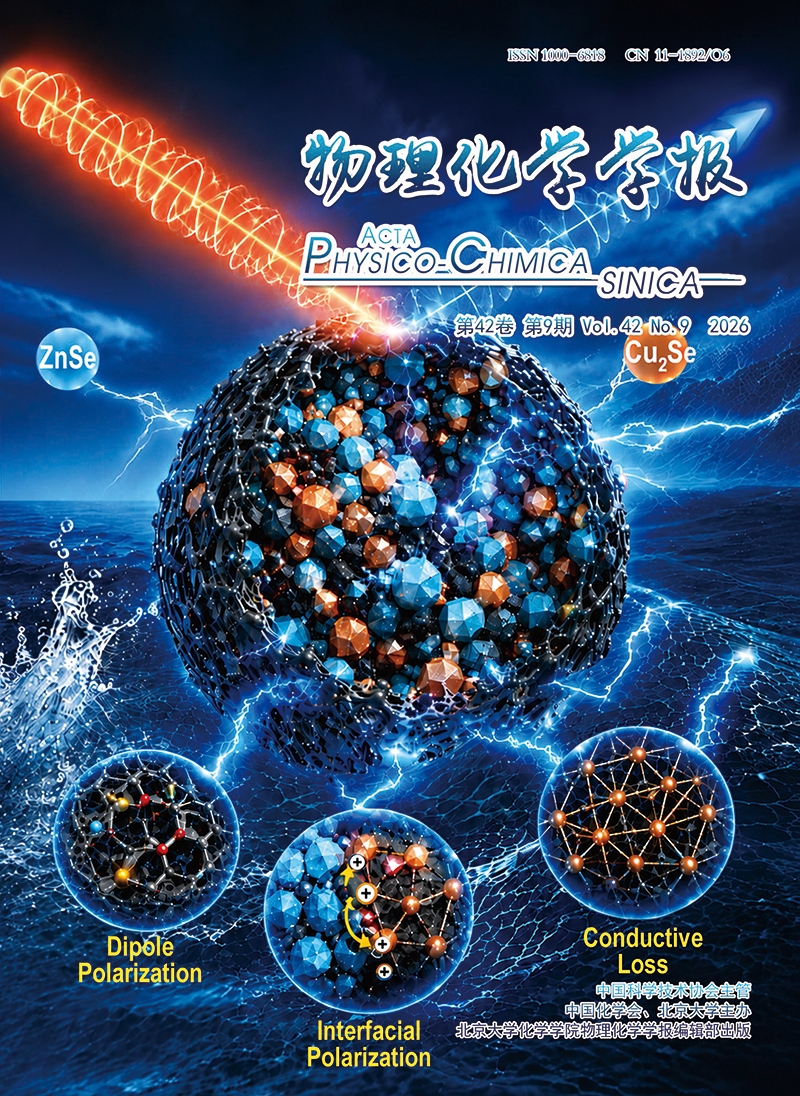
Multicomponent interface engineering based on metal-organic framework (MOF) derivatives holds great potential for achieving high-performance electromagnetic wave (EMW) absorption. However, precisely controlling heterointerface configurations and their associated polarization mechanisms remains a significant scientific and technical hurdle. In this study, a controlled pyrolysis-selenization strategy based on bimetallic MOF precursors was developed to prepare ZnSe/Cu2Se multiphase composites. The rational engineering of precursor architecture and selenization degree achieves precise dual-control over morphology and heterointerfaces. Multiscale characterization, finite element simulations, and density functional theory (DFT) calculations collectively demonstrate that Cu2Se forms an efficient conductive network within the carbon framework, leading to significant conductive loss. Simultaneously, the coexistence of the two metallic selenides creates numerous heterointerfaces which greatly enhance interfacial polarization losses. Additionally, defect-induced and dipole polarizations generate active sites that dissipate EMW through multiscale polarization synergy. Ultimately, the optimized composite exhibits outstanding EMW absorption performance, with a minimum reflection loss (RLmin) of −52.63 dB and a maximum effective absorption bandwidth (EABmax) of 8.64 GHz. This study introduces a precise strategy for engineering heterointerfaces in MOF-derived bimetallic selenides, offering fundamental insights into the multiscale polarization synergy crucial for efficient EMW attenuation.
Multicomponent interface engineering based on metal-organic framework (MOF) derivatives holds great potential for achieving high-performance electromagnetic wave (EMW) absorption. However, precisely controlling heterointerface configurations and their associated polarization mechanisms remains a significant scientific and technical hurdle. In this study, a controlled pyrolysis-selenization strategy based on bimetallic MOF precursors was developed to prepare ZnSe/Cu2Se multiphase composites. The rational engineering of precursor architecture and selenization degree achieves precise dual-control over morphology and heterointerfaces. Multiscale characterization, finite element simulations, and density functional theory (DFT) calculations collectively demonstrate that Cu2Se forms an efficient conductive network within the carbon framework, leading to significant conductive loss. Simultaneously, the coexistence of the two metallic selenides creates numerous heterointerfaces which greatly enhance interfacial polarization losses. Additionally, defect-induced and dipole polarizations generate active sites that dissipate EMW through multiscale polarization synergy. Ultimately, the optimized composite exhibits outstanding EMW absorption performance, with a minimum reflection loss (RLmin) of −52.63 dB and a maximum effective absorption bandwidth (EABmax) of 8.64 GHz. This study introduces a precise strategy for engineering heterointerfaces in MOF-derived bimetallic selenides, offering fundamental insights into the multiscale polarization synergy crucial for efficient EMW attenuation.