

 Figure1.
Synthetic procedures for nanosheets of Ni/Clay catalyst
Figure1.
Synthetic procedures for nanosheets of Ni/Clay catalyst
Citation:
REN Shi-biao, ZHANG Sheng, ZHAO Rong, WANG Zhi-cai, LEI Zhi-ping, PAN Chun-xiu, KANG Shi-gang, SHUI Heng-fu. Nanosheets of Ni/Clay as high efficient catalysts for hydrogenation of aromatics[J]. Journal of Fuel Chemistry and Technology,
2018, 46(2): 171-178.

黏土负载镍的纳米片高效芳烃加氢催化剂
English
Nanosheets of Ni/Clay as high efficient catalysts for hydrogenation of aromatics
Abstract:
Using montmorillonite (MMT), a natural layered clay, as the layered precursor, nanosheets of Ni/MMT are obtained via a facile method, in which the nickel components are introduced on to the surface of the exfoliated MMT nanosheets dispersed in water via deposition-precipitation with nickel nitrate and urea. Due to their unique properties originated from the two-dimensional (2D) structure, which favors mass transfer and diffusion of the aromatics and their hydrogenation products over the catalyst during reaction, the obtained nanosheets of Ni/Clay show higher efficient for hydrogenation of aromatics than Ni/SBA-15 and Ni/γ-Al2O3 catalysts. And the highest TOF for hydrogenation of tetralin over the nanosheets of Ni/Clay is obtained as nickel loading being high to 18.5%.
-
Key words:
- nanaosheets
- / Ni/Clay
- / montmorillonite
- / hydrogenation
- / aromatics
-
The two-dimensional (2D) catalytic materials of nanosheets such as 2D zeolites exhibit excellent catalytic properties in many reactions due to their superior properties on mass transfer and diffusion[1, 2]. Several approaches and techniques have been developed to obtain the different 2D catalytic materials[2], in which the so called "Top-down" routes focus on the post-synthetic treatment of the layered precursors (such as layered zeolites and layered double hydroxides (LDHs)) by delamination[3, 4] or exfoliation of the layered precursors[5]. However, using the layered zeolites as the precursors, it is difficult to control the extent of the delaminaion[3, 4]. For the LDHs precursors, the exfoliated LDHs nanosheets generally exist in the form of colloids[6]. In fact, as the cation layered clay, montmorillonite (MMT) is easier to be exfoliated to MMT nanosheets than the LDHs. As MMT is dissolved in water, the highly dispersed MMT is available due to the existence of the hydrated cations in the interlayers of MMT and the interlamellar spacing is enlarged greatly. As the content of MMT is low to 0.5%, the layered MMT is even exfoliated completely to MMT nanosheets[7, 8]. And ultrasonic treatment has a promotion on the exfoliation of MMT nanosheets[9]. Thus, MMT is the appropriate layered precursor to obtain the new size 2D catalytic materials based on the exfoliated MMT nanosheets in water.
As natural clay, MMT itself is seldom used as catalyst directly but has been wide applied in catalytic fields after introducing the active components such as metal or metal oxide (inorganic-pillared clays)[10]. To obtain 2D catalytic materials based on the exfoliated MMT nanosheets, the first key is to introduce the active components on to the surface of the exfoliated MMT nanosheets. It has been found that the stable exfoliated Pt-Clay nanocatalyst is successful available by using a chemical vapor deposition (CVD) method employing organoclay as the initial support[11]. In contrast to the CVD method, the deposition-precipitation method is generally used to prepare highly dispersed catalyst in the aqueous solution[12-17]. Thus, the active components may be introduced on to the surfaces of the exfoliated MMT nanosheets dispersed in water by the deposition-precipitation method. It is noteworthiness that water plays an important role to preserve the exfoliated MMT nanosheets and the exfoliated MMT nanosheets will be resumed to the layered MMT after removing water. Exfoliated nanosheets still preserved after removing water is the second key to obtain the 2D catalytic materials of MMT nanosheets via the deposition-precipitation method.
Hydrogenation of aromatic hydrocarbon is normally used for catalytic test because it is not only a useful model reaction for the activity evaluation of metal catalysts, but also of commercial importance in the upgrading of coal liquids and diesel fuels[18, 19]. Considering the large molecular size of aromatics such as naphthalene or tetralin, the superior properties on mass transfer and diffusion of the nanosheets of Ni/MMT should have a profound promotion on their performances for hydrogenation of aromatics. Herein, a high efficient catalyst of nanosheets of Ni/MMT obtained via a facile method of deposition-precipitation for hydrogenation of naphthalene and tetralin is reported.
1 Experimental
1.1 Catalyst preparation
Nanosheets of Ni/Clay catalyst were prepared by a deposition-precipitation method with nickel nitrate, urea and montmorillonite (MMT). Na-MMT (Zhejiang Sanding Group Co., Ltd.) was used directly without further purification. 0.5 g Na-MMT was dissolved in 100 mL H2O and dispersed with assistance of ultrasonic for 4 h. 7 g Ni(NO3)2·6H2O and 4 g urea were added into the suspension and dispersed with assistance of ultrasonic for another hour. Then the suspension reacted at 90 ℃ for several hours (such as 4 h) in a 100 mL hydrothermal autoclave reactor with teflon chamber by stirring. The suspension was separated by centrifugation, washed with water and dried at 100 ℃ overnight. Finally, the dried samples were reduced at 550 ℃ in H2 flow of 30 mL/min for 4 h and passivated in a nitrogen-diluted oxygen (1.0% O2) gas stream at room temperature for 3 h to obtain the nanosheets of Ni/MMT catalyst (denoted as Ni/MMT-nanosheets). Nickel loading of Ni/MMT-nanosheets was depended on the reaction time of the deposition-precipitation. For comparison, two nickel supported on MMT catalysts with 10.0% nickel loading were prepared with the custom impregnation method, in which one was obtained from the suspension of the layered MMT (dispersed in water by stirring) and denoted as Ni/MMT, and another was obtained from the suspension of the MMT-nanosheets (dispersed in water with assistance of ultrasonic) and denoted as Ni/MMT-Ultrasonic. The actual nickel loading on each catalyst was determined by flame atomic absorption spectroscopy (TAS-990F, Beijing Purkinje General Instrument Co., Ltd.).
1.2 Catalyst characterization
SEM images were acquired with a S-4800 scanning electron microscope at an acceleration voltage of 5 kV. TEM images were acquired with a JEM-1200EX transmission electron microscope at an acceleration voltage of 120 kV. XRD data were collected from a Shimadzu XD-3A diffractometer with Cu Kα radiation (λ=0.15418 nm) at 40 kV and 40 mA. The BET surface areas and pore structures were measured by nitrogen physisorption at 78 K in a Micromeritics model ASAP 2420 analyzer.
1.3 Catalytic hydrogenation of aromatics
Hydrogenation of naphthalene and tetralin was performed in a stainless steel autoclave (Ordino CS340, Premex) equipped with a heating system and a magnetic-coupled paddle stirrer. For hydrogenation of naphthalene, 10.0 g the solution of naphthalene in n-dodecane (10.0%) and 0.12 g catalyst were loaded into the reactor. For hydrogenation of tetralin, 3.0 g tetralin and 0.05 g catalyst were loaded into the reactor. The reaction conditions were 300 ℃ and 5.0 MPa H2. Each catalytic test was performed for 2.0 h. The reaction products were analyzed by gas chromatograph (GC-7890II, TechCom) equipped with an OV-1 column (30 m×0.25 mm×0.33 μm) and a flame ionization detector. The activity of the catalyst for hydrogenation of aromatics was determined based on the Turnover Frequency (TOF). TOF was defined as number of moles of consumed H2 per mole of Ni per hour. TOF of the catalyst for hydrogenation of naphthalene was calculated using the formula (1):
where mnaphthalene: mass of naphthalene, g; Mnaphthalene: molecular weight of naphthalene, 128.2; x: conversion of naphthalene, %; stetralin: selectivity of tetralin, %; sdecalin: selectivity of decalin, %; mcatalyst : mass of catalyst, g; LNi: loading of nickel, %; Mnickel: atomic weight of nickel, 58.7; t: reaction time, h.
TOF of the catalyst for hydrogenation of tetralin was calculated using the formula (2):
where mtetralin: mass of tetralin, g; Mtetralin: molecular weight of tetralin, 132.2; xt: conversion of tetralin, %; mcatalyst: mass of catalyst, g; LNi: loading of nickel, %; Mnickel: atomic weight of nickel, 58.7; t: reaction time, h.
2 Results and discussion
2.1 SEM and TEM results
The procedure for the synthesis of nanosheets of Ni/MMT is illustrated in Figure 1. After the aqueous suspension of the exfoliated MMT nanosheets (denoted as MMT-nanosheets) were obtained by dispersing the pristine MMT in water with assistance of ultrasonic, nickel nitrate and urea were added into the suspension, followed by ultrasonic for another hour. Nickel hydroxides deposited on the exfoliated MMT nanosheets (denoted as Ni(OH)2/MMT-nanosheets) were obtained by the deposition-precipitation method as the suspension reacted at 90 ℃ for several hours (such as 4 h) in a hydrothermal autoclave reactor with stirring. The suspension of Ni(OH)2/MMT-nanosheets was separated by centrifugation, washed with water and dried. Finally, the nanosheets of Ni/MMT catalyst (denoted as Ni/MMT-nanosheets) were obtained by simple reduction of Ni(OH)2/MMT-nanosheets at 550 ℃ in H2. Nickel loading of Ni/MMT-nanosheets was depended on the reaction time of the deposition-precipitation. For comparison, two nickel supported on MMT catalysts were prepared with the custom impregnation method, in which one was obtained from the suspension of the layered MMT (dispersed in water by stirring) and denoted as Ni/MMT, and the another was obtained from the suspension of the MMT-nanosheets (dispersed in water with assistance of ultrasonic) and denoted as Ni/MMT-ultrasonic.
Figure1.
Synthetic procedures for nanosheets of Ni/Clay catalyst
Figure 2(a) shows the typical SEM image of Ni/MMT-nanosheets with 12.3% Ni loading, which was prepared by deposition-precipitation for 4 h. Compared with the pristine MMT (Figure 2(b)), the layered sheets of MMT have been exfoliated to MMT nanosheets, suggesting the exfoliated MMT nanosheets obtained by dispersing the layered MMT in water with assistance of ultrasonic have been preserved in Ni/MMT-nanosheets. Figure 2(c) shows the typical TEM images of the Ni/MMT-nanosheets. The nickel particles are quite scattered throughout the sheets of MMT, especially the nickel supported on the exfoliated MMT nanosheets are obviously observed in the partial enlarged detail (Figure 2(c1)), confirming further the exfoliated MMT nanosheets dispersed in water are preserved during preparation of Ni/MMT-nanosheets catalysts. Furthermore, it can be found that the size distribution of nickel particles is uniform and average particle size is about 7.2 nm (Figure 2(c2)). In comparison with Ni/MMT-nanosheets, the MMT sheets show serious aggregation and the nickel particles are uneven scattered onto the sheets of MMT in Ni/MMT catalyst (Figure 2(d1)). As a result, the size distribution of the size distribution of nickel particles is not uniform and average particle size is about 19.9 nm (Figure 2(d2)), which is almost 3 times of Ni/MMT-nanosheets. It indicates that the nickel species are successfully introduced onto the surfaces of the exfoliated MMT nanosheets dispersed in water via the deposition-precipitation method, especially the exfoliated MMT nanosheets are still preserved after removing water and reduced in H2. Thus, the nanosheets of Ni/MMT catalyst is obtained and its dispersion of nickel metal is enhanced greatly. In addition, the average nickel particle size is about 7.3 nm according to the TEM images (not shown in the text) of Ni/MMT-nanosheets (12.3%) after hydrogenation of naphthalene, which is almost the same value with the fresh catalyst (7.23 nm, as shown in Figure 2(c2)). It indicates that the morphologies such as the dispersion of Ni/MMT-nanosheets are preserved after hydrogenation.
 Figure2.
SEM images of Ni/MMT-nanosheets (a) and MMT (b), TEM images of Ni/MMT-nanosheets (c) and Ni/MMT (d), partide size of Ni/MMT-nanosheets(e) and Ni/MMT(f)
Figure2.
SEM images of Ni/MMT-nanosheets (a) and MMT (b), TEM images of Ni/MMT-nanosheets (c) and Ni/MMT (d), partide size of Ni/MMT-nanosheets(e) and Ni/MMT(f)
2.2 XRD and textural properties results
Figure 3 (a) shows the small-angle XRD patterns of Ni/MMT-nanosheets catalyst with 12.3% Ni loading.
 Figure3.
Small angle (a) and wide angel (b) XRD patterns of Ni/MMT-nanosheets
Figure3.
Small angle (a) and wide angel (b) XRD patterns of Ni/MMT-nanosheets
The characteristic peak of the layered MMT at 2θ = 7.1° disappears for Ni/MMT-nanosheets catalyst. It demonstrates that the layered sheets of MMT have been exfoliated to MMT nanosheets, which is accordance to above results of SEM and TEM measurements. In addition, from Figure 3(b), it is found that the characteristic peaks of MMT (2θ = 18.4°, 19.8°, 27.8°, 35.1°, 62.0°, 68.0° and 73.3°) and nickel metal (2θ = 44.4°, 52.0° and 76.5°) are observed in all catalysts. It means the crystal structure of MMT has not been destroyed and the nickel species have been reduced to nickel metal in all the catalysts during preparation of the catalysts. In comparison with Ni/MMT catalyst, the peak intensities of nickel metal decrease and the widths of the peaks at half height increase obviously for Ni/MMT-nanosheets catalyst. This indicates that nickel metal particle size of Ni/MMT-nanosheets catalyst is smaller than that of Ni/MMT, suggesting that the dispersion of the catalyst is improved. Therefore, the results of XRD confirm further that Ni/MMT-nanosheets is composed of the exfoliated MMT nanosheets and its dispersion of nickel metal is enhanced greatly.
Figure 4 is the N2 adsorption-desorption isotherms of pristine MMT, Ni/MMT, Ni/MMT-ultrasonic and Ni/MMT-nanosheets.
 Figure4.
N2 adsorption-desorption isotherms and pore size distribution (insert) of Ni/MMT-nanosheets
Figure4.
N2 adsorption-desorption isotherms and pore size distribution (insert) of Ni/MMT-nanosheets
The data on the specific surface area, pore volume and pore size determined by N2 adsorption are shown in Table 1. From Figure 4 and Table 1, it can be seen that the nitrogen adsorption, pore volume and specific surface area of MMT and Ni/MMT are very low. However, Ni/MMT-nanosheets catalyst indicates a pronounced increase in N2 adsorption, specific surface area and pore volume. The specific surface area increases from 9 m2/g for Ni/MMT to 144 m2/g for Ni/MMT-nanosheets and pore volume enhances from 0.04 cm3/g for Ni/MMT to 0.23 cm3/g for Ni/MMT-nanosheets. In contrast, the specific surface area of Ni/MMT-ultrasonic is 44 m2/g, which is still much lower than that of Ni/MMT-nanosheets although it is improved greatly than Ni/MMT. The pore volume of Ni/MMT-ultrasonic is 0.10 cm3/g, which is even less than half of Ni/MMT-nanosheets. Moreover, from the pore size distributions of all catalysts (Figure 4 insert), Ni/MMT-nanosheets shows a narrow pore size distribution, suggesting the pore size distribution of the catalyst is also promoted. It indicates both the specific surface area and the pore structure of the catalyst are enhanced greatly by supporting nickel metal on the exfoliated MMT nanosheets via the deposition-precipitation method.
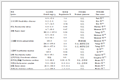 Table 1.
Textural properties of the catalysts determined by N2 adsorption
Table 1.
Textural properties of the catalysts determined by N2 adsorption
Catalyst Ni Loading
w/%BET surface
area A/(m2·g-1)Pore volume
v/(cm3·g-1)Pore diameter
d/nmMMT - 9 0.05 20.9 Ni/MMT 9.9 9 0.04 15.5 Ni/MMT-ultrasonic 10.1 44 0.10 8.9 Ni/MMT-nanosheets 12.3 144 0.23 6.5 Ni/SBA-15[20] 10.2 334 0.69 7.5 2.3 Catalytic performance of Ni/MMT-nanosheets in aromatics hydrogenation reaction
Ni/MMT-nanosheets shows high activity for hydrogenation of naphthalene (shown in Table 2). Its TOF reaches 37.8, which is not only enhanced about 6.4 times than that of Ni/MMT but about 4 times than that of Ni/MMT-ultrasonic. Moreover, Ni/MMT-nanosheets also shows higher activity than the Ni/SBA-15 (~35% improved) and Ni/γ-Al2O3 (~252% improved) catalysts we have reported[20]. However, it is noteworthiness that the high activity of Ni/MMT-nanosheets cannot be correlated with its dispersion of nickel metal. The dispersion of Ni/MMT-nanosheets (7.2 nm Ni0 particles) is improved about 175% than that of Ni/MMT (19.8 nm Ni0 particles), but the enhancement of the activity over Ni/MMT-nanosheets is 640%, which is much higher than the case of the dispersion. And Ni/MMT-nanosheets even still indicates higher activity than Ni/SBA-15 (3.7 nm Ni0 particles), especially Ni/γ-Al2O3 (2.2 nm Ni0 particles) although its dispersion is lower than these two catalysts. Similarly, the high activity of Ni/MMT-nanosheets also cannot be correlated with its textural properties such as specific surface area and pore volume. Although Ni/MMT-nanosheets catalyst shows higher specific surface area and pore volume than Ni/MMT, but less than that of Ni/SBA-15 (Table 1). As the nanosheets of Ni/MMT, Ni/MMT-nanosheets can be considered as the 2D catalytic materials such as 2D zeolites[1, 2]. And the 2D catalytic materials have shown excellent catalytic properties in many reactions due to their superior properties on mass transfer and diffusion[1, 2]. Therefore, the high activity of Ni/MMT-nanosheets can be attributed to its 2D structure, which favors mass transfer and diffusion of naphthalene and its hydrogenation products.
Table 2.
Activity of Ni/MMT-nanosheet for hydrogenation of naphthalene a
Catalyst Ni loading
w/%Conversion
x/%Selectivity s/% TOFb/
h-1Ni0 size
d/nmtetralin decalin Ni/MMT 9.9 13.1 99.3 0.7 5.1 19.8 Ni/MMT-ultrasonic 10.1 19.8 99.1 0.9 7.6 - Ni/MMT-nanosheet 12.3 100.0 85.4 14.6 37.8 7.2 Ni/SBA-15 [20] 10.2 68.2 93.6 6.4 28.0 3.7 Ni/γ-Al2O3 [20], c 9.8 42.5 99.2 0.8 8.4 2.2 a: reaction conditions: the solution of naphthalene in n-dodecane (10.0%) 10 g, catalyst 0.12 g, 300 ℃, p(H2) = 5.0 MPa, 2.0 h; b: turnover frequency (TOF) was defined as number of moles of consumed H2 per mole of Ni per hour; c: solution of naphthalene in n-dodecane is 5.0% for reaction For hydrogenation of naphthalene, hydrogenation products are composed of tetralin and decalin. Since decalin is produced through deep hydrogenating of tetralin and tetralin is more difficult to be hydrogenated than naphthalene[19], to evaluate the total activity of the catalyst based on the consumed H2 is not precise, especially in the case of high selectivity of decalin. In order to evaluate accurately the activity of Ni/MMT-nanosheets catalysts with different nickel loading, the activity of Ni/MMT-nanosheets for hydrogenation of tetralin is tested (shown in Table 3).
Table 3.
Activities of Ni/MMT-nanosheet with different nickel loading for hydrogenation of tetralina
Catalyst Ni loading
w/%Conversion
x/%TOFb/
h-1Ni/MMT 9.9 2.1 8.5 Ni/MMT-ultrasonic 10.1 3.7 14.6 5.7 11.7 82.0 Ni/MMT-nanosheets 12.3 35.0 113.7 18.5 78.6 169.8 27.7 55.2 79.6 a: reaction conditions: tetralin 3.0 g, catalyst 0.05 g, 300 ℃, p(H2) = 5.0 MPa, 2.0 h; b: turnover frequency (TOF) was defined as number of moles of consumed H2 per mole of Ni per hour Similar with the case of hydrogenation of naphthalene, Ni/MMT-nanosheets with 12.3% Ni loading also shows high activity for hydrogenation of tetralin and its TOF is enhanced about 12.4 times than that of Ni/MMT, which is much greater than 6.4 times in the case of hydrogenation of naphthalene. It is interesting of the effects of nickel loading on the properties of Ni/MMT-nanosheets. Generally, the increase of loading has negative effects on the textural properties (such as the specific surface area and pore volume) and dispersion of the metal supported on the porous materials (such as zeolite, mesoporous molecular sieve and so on) catalysts, and thus the activity of the catalyst decreases with increasing metal loading. However, the specific surface area and pore volume of Ni/MMT-nanosheets catalysts are increased with nickel loading and reach the max value as Ni loading being 18.5%, and then decreased as Ni loading increases to 27.7% (Figure 5 and Table 4).
 Figure5.
N2 adsorption-desorption isotherms and pore size distribution (insert) of Ni/MMT-nanosheets catalysts with different nickel loading
Table 4.
Physical properties of Ni/MMT-nanosheet catalysts with different nickel loadings
Figure5.
N2 adsorption-desorption isotherms and pore size distribution (insert) of Ni/MMT-nanosheets catalysts with different nickel loading
Table 4.
Physical properties of Ni/MMT-nanosheet catalysts with different nickel loadings
Catalyst Ni w/% BET surface area A/(m2·g-1) Pore volume v/(cm3·g-1) Pore diameter d/nm Ni/MMT-nanosheet 5.7 128 0.22 6.6 12.3 144 0.23 6.5 18.5 168 0.38 9.1 27.7 125 0.37 11.9 The XRD patterns of Ni/MMT-nanosheets with different nickel loading show that the widths of the characteristic peaks of nickel metal at half are almost the same (Figure 6), indicating the dispersion of the catalyst is little influenced with increasing Ni loading, which can be attributed to the promotion of the deposition-precipitation method itself on the dispersion of the catalyst[15]. As a result, TOF of Ni/MMT-nanosheets is increased with nickel loading and reaches the max value (169.8) as Ni loading being 18.5%, which is improved about 19 times than that of Ni/MMT. Then, TOF decreases greatly as Ni loading increases to 27.7%. Therefore, due to its special 2D structure with the nanosheets of Ni/MMT, Ni/MMT-nanosheets exhibits the excellent hydrogenation activity even Ni loading being high to 18.5%.
 Figure6.
XRD patterns of Ni/MMT-nanosheets catalysts with different nickel loadings
Figure6.
XRD patterns of Ni/MMT-nanosheets catalysts with different nickel loadings
3 Conclusions
The nanosheets of Ni/MMT are facile obtained via the deposition-precipitation method based on exfoliating the layered sheets of MMT to MMT nanosheets by dispersing the layered MMT in water with assistance of ultrasonic. The obtained nickel metal catalyst with 2D structure exhibits higher catalytic efficiency than other nickel catalysts (Ni/SBA-15 and Ni/γ-Al2O3) in aromatics hydrogenation, and shows excellent hydrogenation efficiency with high Ni loading of 18.5%. These results provide a new perspective on the preparation of the nanosheets of other metals or metal oxides supported on the clays.
-
-
[1]
CHOI M, NA K, KIM J, SAKAMOTOY , TERASAKI O, RAYOO R. Stable single-unit-cell nanosheets of zeolite MFI as active and long-lived catalysts[J]. Nature, 2009, 461: 246-249. doi: 10.1038/nature08288
-
[2]
ROTH W J, NACHTIGALL P, MORRIS R E, ČEJKA J. Two-Dimensional zeolites:Current status and perspectives[J]. Chem Rev, 2014, 114(9): 4807-4837. doi: 10.1021/cr400600f
-
[3]
OGINO I, NIGRA M M, HWANG S J, HA J M, REA T, STACEY I, ZONES S I, KATZ A. Delamination of layered zeolite precursors under mild conditions:Synthesis of UCB-1 via fluoride/chloride anion-promoted exfoliation[J]. J Am Chem Soc, 2011, 1339(10): 3288-3291.
-
[4]
EILERTSEN E A, OGINO I, HWANG S J, REA T, YEH S, ZONES S I, KATZ A. Nonaqueous fluoride/chloride anion-promoted delamination of layered zeolite precursors:Synthesis and characterization of UCB-2[J]. Chem Mater, 2011, 23(24): 5404-5408. doi: 10.1021/cm202364q
-
[5]
AN Z, HE J, DUAN X. Catalysts with catalytic sites highly dispersed from layered double hydroxide as precursors[J]. Chin J Catal, 2013, 34: 225-234.
-
[6]
WANG J, ZHAO L, SHI H, HE J. Highly enantioselective and efficient asymmetric epoxidation catalysts:Inorganic nanosheets modified withα-amino acids as ligands[J]. Angew Chem Int Ed, 2011, 50: 9171-9176. doi: 10.1002/anie.201103713
-
[7]
YAO H B, MAO L B, YAN Y X, CONG H P, LEI X, YU S H. Gold nanoparticle functionalized artificial nacre:Facile in situ growth of nanoparticles on montmorillonite nanosheets, self-assembly, and their multiple properties[J]. ACS Nano, 2012, 6(9): 8250-8260. doi: 10.1021/nn3029315
-
[8]
YAO H B, TAN Z H, FANG H Y, YU S H. Artificial nacre-like bionano-composite films from the self-assembly of chitosan-montmor-illonite hybrid building blocks[J]. Angew Chem Int Ed, 2010, 49: 10127-10131. doi: 10.1002/anie.201004748
-
[9]
INTROZZI L, BLOMFEID O J T, TRABATTONI S, TAVAZZI S, SANTO N, SCHIRALDI A, PIERGIOVANNI L, FARRIS S. Ultrasound-assisted pullulan/montmorillonite bionanocomposite coating with high oxygen barrier properties[J]. Langmuir, 2012, 28(30): 11206-11214. doi: 10.1021/la301781n
-
[10]
GIL A, KORILI S A, VICENTE M A. Recent advances in the synthesis and catalytic application of pillared clay catalysts[J]. Catal Rev Sci Eng, 2008, 50: 153-221. doi: 10.1080/01614940802019383
-
[11]
ZHANG W J, LI K S M, WANG R J, YUE P L, Gao P. Preparation of stable exfoliated Pt-Clay nanocatalyst[J]. Langmuir, 2009, 25(14): 8226-8234.
-
[12]
ONG W J, PUTRI L K, TAN L L, CHAI S P, YONG S T. Heterostructured AgX/g-C3N4 (X=Cl and Br) nanocomposites via a sonication-assisted deposition-precipitation approach:Emerging role of halide ions in the synergistic photocatalytic reduction of carbon dioxide[J]. Appl Catal B:Environ, 2016, 180: 530-543. doi: 10.1016/j.apcatb.2015.06.053
-
[13]
SKAF M, AOUAD S, HANY S, COUSIN R, ABI-AAD E, ABOUKAIS A. Physicochemical characterization and catalytic performance of 10% Ag/CeO2 catalysts prepared by impregnation and deposition-precipitation[J]. J Catal, 2014, 320: 137-146. doi: 10.1016/j.jcat.2014.10.006
-
[14]
KITTISAKMONTREE P, PONGTHAWORNSAKUN B, YOUSHIDA H, FUJITA S, ARAI M, PANPRANOT J. The liquid-phase hydrogenation of 1-heptyne over Pd-Au/TiO2 catalysts prepared by the combination of incipient wetness impregnation and deposition-precipitation[J]. J Catal, 2003, 297: 155-164.
-
[15]
BURATTIN B, CHE M, LOUIS C. Ni/SiO2 materials prepared by deposition-precipitation:Influence of the reduction conditions and mechanism of formation of metal particles[J]. J Phys Chem B, 2000, 104(45): 10482-10489. doi: 10.1021/jp0003151
-
[16]
LIU H C, WANG H, SHEN J H, SUN Y, LIU Z M. Preparation, characterization and activities of the nano-sized Ni/SBA-15 catalyst for producing COx -free hydrogen from ammonia[J]. Appl Catal A:Gen, 2008, 337(2): 138-147. doi: 10.1016/j.apcata.2007.12.006
-
[17]
GOMEZ-REYNOSO R, RAMLREZ J, NARES R, LUNA R, MURRIETA F. Characterization and catalytic activity of Ni/SBA-15, synthesized by deposition-precipitation[J]. Catal Today, 2005, 107/108: 926-932. doi: 10.1016/j.cattod.2005.07.152
-
[18]
KIM H J, SONG C S. Enhancing sulfur tolerance of Pd catalysts by hydrogen spillover with two different zeolite supports for low-temperature hydrogenation of aromatics[J]. Energy Fuels, 2014, 28(11): 6788-6792. doi: 10.1021/ef501541j
-
[19]
KIRUMAKKI S R, SHPEIZER B G, SAGAR G V, CHARY K V R, CLEARFIELD A. Hydrogenation of naphthalene over NiO/SiO2-Al2O3 catalysts:Structure-activity correlation[J]. J Catal, 2006, 242(2): 319-331. doi: 10.1016/j.jcat.2006.06.014
-
[20]
REN S B, ZHAO R, ZHANG P, LEI Z P, WANG Z C, KANG S G, PAN C X, SHUI H F. Effect of activation atmosphere on the reduction behaviors, dispersion and activities of nickel catalysts for the hydrogenation of naphthalene[J]. Reac Kinet Mech Cat, 2014, 111(1): 247-257. doi: 10.1007/s11144-013-0629-3
-
[1]
-

Figure 2 SEM images of Ni/MMT-nanosheets (a) and MMT (b), TEM images of Ni/MMT-nanosheets (c) and Ni/MMT (d), partide size of Ni/MMT-nanosheets(e) and Ni/MMT(f)

Figure 4 N2 adsorption-desorption isotherms and pore size distribution (insert) of Ni/MMT-nanosheets

Figure 5 N2 adsorption-desorption isotherms and pore size distribution (insert) of Ni/MMT-nanosheets catalysts with different nickel loading
Table 1. Textural properties of the catalysts determined by N2 adsorption
Catalyst Ni Loading
w/%BET surface
area A/(m2·g-1)Pore volume
v/(cm3·g-1)Pore diameter
d/nmMMT - 9 0.05 20.9 Ni/MMT 9.9 9 0.04 15.5 Ni/MMT-ultrasonic 10.1 44 0.10 8.9 Ni/MMT-nanosheets 12.3 144 0.23 6.5 Ni/SBA-15[20] 10.2 334 0.69 7.5  下载: 导出CSV
Table 2. Activity of Ni/MMT-nanosheet for hydrogenation of naphthalene a
Catalyst Ni loading
w/%Conversion
x/%Selectivity s/% TOFb/
h-1Ni0 size
d/nmtetralin decalin Ni/MMT 9.9 13.1 99.3 0.7 5.1 19.8 Ni/MMT-ultrasonic 10.1 19.8 99.1 0.9 7.6 - Ni/MMT-nanosheet 12.3 100.0 85.4 14.6 37.8 7.2 Ni/SBA-15 [20] 10.2 68.2 93.6 6.4 28.0 3.7 Ni/γ-Al2O3 [20], c 9.8 42.5 99.2 0.8 8.4 2.2 a: reaction conditions: the solution of naphthalene in n-dodecane (10.0%) 10 g, catalyst 0.12 g, 300 ℃, p(H2) = 5.0 MPa, 2.0 h; b: turnover frequency (TOF) was defined as number of moles of consumed H2 per mole of Ni per hour; c: solution of naphthalene in n-dodecane is 5.0% for reaction
下载: 导出CSV
Table 3. Activities of Ni/MMT-nanosheet with different nickel loading for hydrogenation of tetralina
Catalyst Ni loading
w/%Conversion
x/%TOFb/
h-1Ni/MMT 9.9 2.1 8.5 Ni/MMT-ultrasonic 10.1 3.7 14.6 5.7 11.7 82.0 Ni/MMT-nanosheets 12.3 35.0 113.7 18.5 78.6 169.8 27.7 55.2 79.6 a: reaction conditions: tetralin 3.0 g, catalyst 0.05 g, 300 ℃, p(H2) = 5.0 MPa, 2.0 h; b: turnover frequency (TOF) was defined as number of moles of consumed H2 per mole of Ni per hour
下载: 导出CSV
Table 4. Physical properties of Ni/MMT-nanosheet catalysts with different nickel loadings
Catalyst Ni w/% BET surface area A/(m2·g-1) Pore volume v/(cm3·g-1) Pore diameter d/nm Ni/MMT-nanosheet 5.7 128 0.22 6.6 12.3 144 0.23 6.5 18.5 168 0.38 9.1 27.7 125 0.37 11.9
下载: 导出CSV
-


 扫一扫看文章
计量
- PDF下载量: 6
- 文章访问数: 921
- HTML全文浏览量: 110
 下载:
下载:

